
STOCHASTIC DEFECT DETECTION FOR MONTECARLO FEATURE PROFILE MODEL

![HK PSEUDOCODE Find(x): while L(x)!=x x=L(x) return(x) [1] J. Hoshen and R. Kopelman, Phys.](https://slidetodoc.com/presentation_image/d7e21f666b08178a6ca254f88c098712/image-8.jpg "HK PSEUDOCODE Find(x): while L(x)!=x x=L(x) return(x) [1] J. Hoshen and R. Kopelman, Phys.")
- Slides: 14
STOCHASTIC DEFECT DETECTION FOR MONTE-CARLO FEATURE PROFILE MODEL * MIPSE Graduate Symposium 2015 Chad Huard and Mark Kushner University of Michigan, Dept. of Electrical Engineering * Work supported by Lam Research Corporation MIPSE_2015
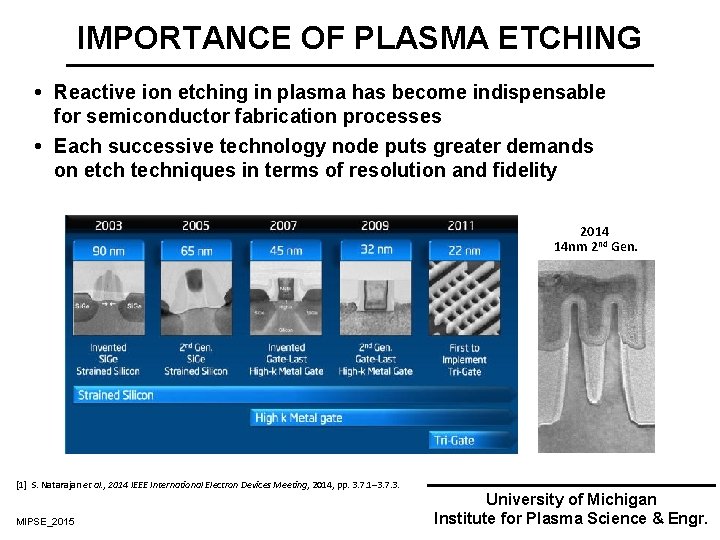
IMPORTANCE OF PLASMA ETCHING Reactive ion etching in plasma has become indispensable for semiconductor fabrication processes Each successive technology node puts greater demands on etch techniques in terms of resolution and fidelity 2014 14 nm 2 nd Gen. [1] S. Natarajan et al. , 2014 IEEE International Electron Devices Meeting, 2014, pp. 3. 7. 1– 3. 7. 3. MIPSE_2015 University of Michigan Institute for Plasma Science & Engr.
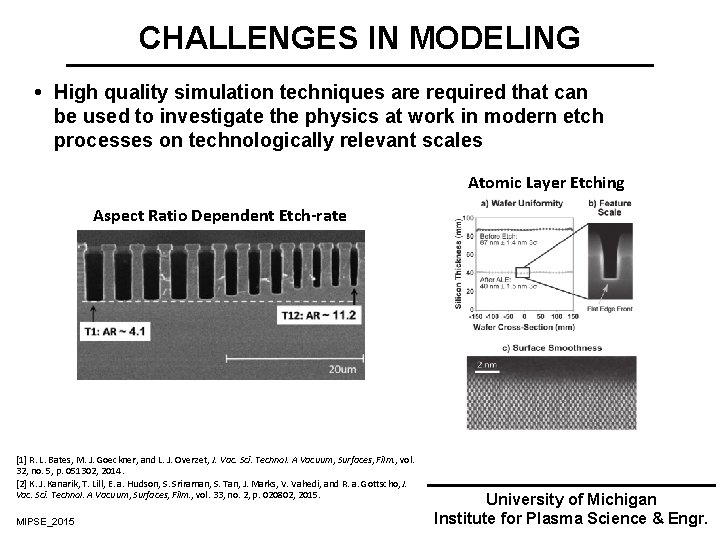
CHALLENGES IN MODELING High quality simulation techniques are required that can be used to investigate the physics at work in modern etch processes on technologically relevant scales Atomic Layer Etching Aspect Ratio Dependent Etch-rate [1] R. L. Bates, M. J. Goeckner, and L. J. Overzet, J. Vac. Sci. Technol. A Vacuum, Surfaces, Film. , vol. 32, no. 5, p. 051302, 2014. [2] K. J. Kanarik, T. Lill, E. a. Hudson, S. Sriraman, S. Tan, J. Marks, V. Vahedi, and R. a. Gottscho, J. Vac. Sci. Technol. A Vacuum, Surfaces, Film. , vol. 33, no. 2, p. 020802, 2015. MIPSE_2015 University of Michigan Institute for Plasma Science & Engr.
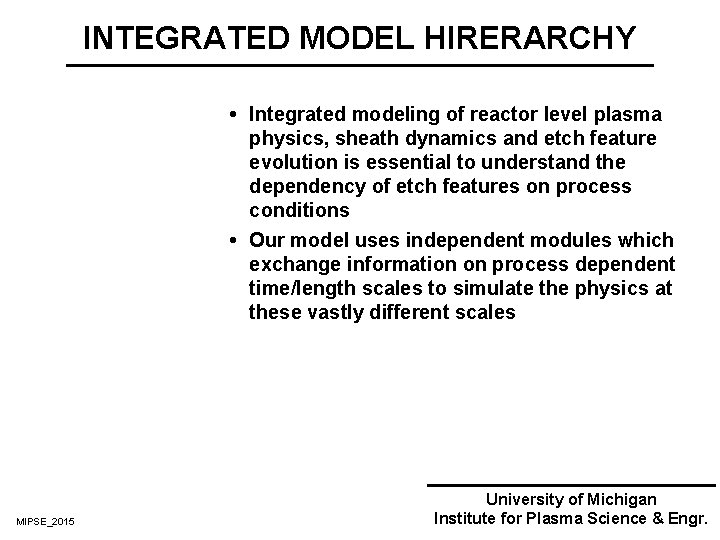
INTEGRATED MODEL HIRERARCHY Integrated modeling of reactor level plasma physics, sheath dynamics and etch feature evolution is essential to understand the dependency of etch features on process conditions Our model uses independent modules which exchange information on process dependent time/length scales to simulate the physics at these vastly different scales MIPSE_2015 University of Michigan Institute for Plasma Science & Engr.
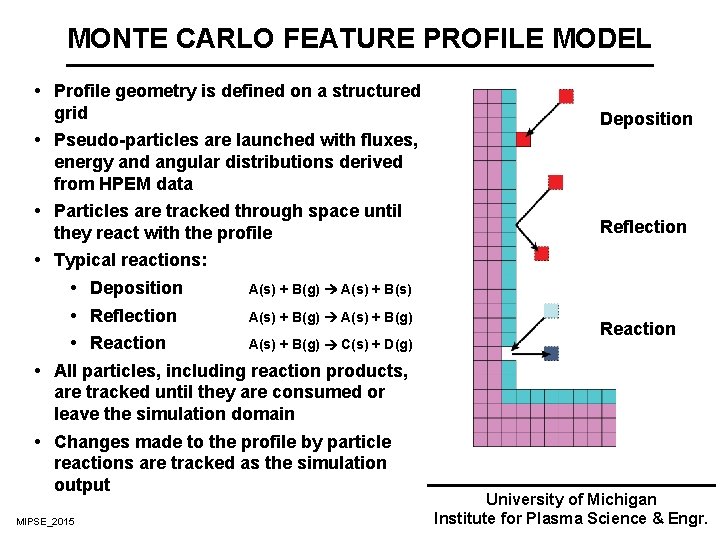
MONTE CARLO FEATURE PROFILE MODEL Profile geometry is defined on a structured grid Pseudo-particles are launched with fluxes, energy and angular distributions derived from HPEM data Particles are tracked through space until they react with the profile Typical reactions: Deposition A(s) + B(g) A(s) + B(s) Reflection A(s) + B(g) Reaction A(s) + B(g) C(s) + D(g) All particles, including reaction products, are tracked until they are consumed or leave the simulation domain Changes made to the profile by particle reactions are tracked as the simulation output MIPSE_2015 Deposition Reflection Reaction University of Michigan Institute for Plasma Science & Engr.
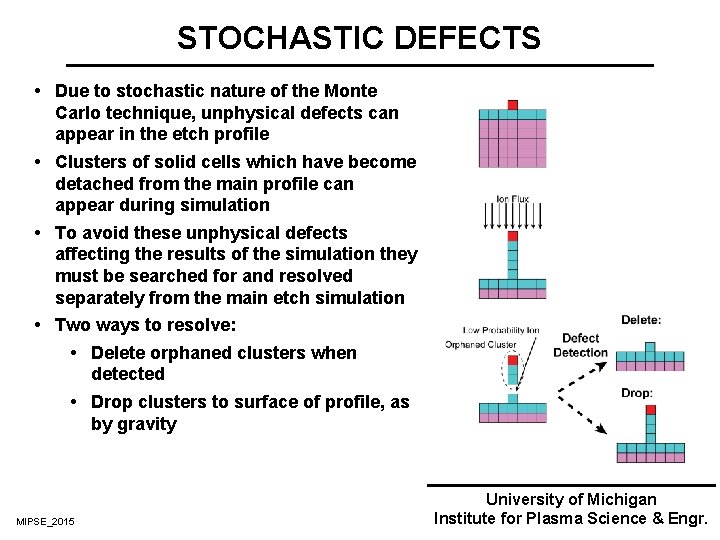
STOCHASTIC DEFECTS Due to stochastic nature of the Monte Carlo technique, unphysical defects can appear in the etch profile Clusters of solid cells which have become detached from the main profile can appear during simulation To avoid these unphysical defects affecting the results of the simulation they must be searched for and resolved separately from the main etch simulation Two ways to resolve: Delete orphaned clusters when detected Drop clusters to surface of profile, as by gravity MIPSE_2015 University of Michigan Institute for Plasma Science & Engr.
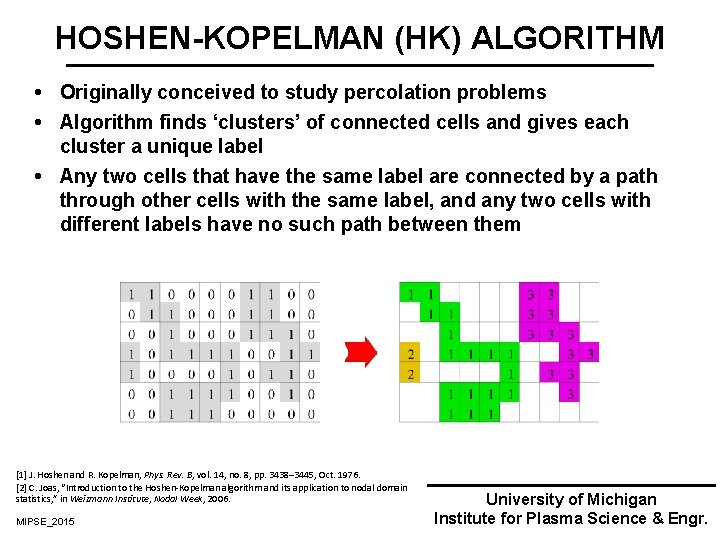
HOSHEN-KOPELMAN (HK) ALGORITHM Originally conceived to study percolation problems Algorithm finds ‘clusters’ of connected cells and gives each cluster a unique label Any two cells that have the same label are connected by a path through other cells with the same label, and any two cells with different labels have no such path between them [1] J. Hoshen and R. Kopelman, Phys. Rev. B, vol. 14, no. 8, pp. 3438– 3445, Oct. 1976. [2] C. Joas, “Introduction to the Hoshen-Kopelman algorithm and its application to nodal domain statistics, ” in Weizmann Institute, Nodal Week, 2006. MIPSE_2015 University of Michigan Institute for Plasma Science & Engr.
HK PSEUDOCODE Find(x): while L(x)!=x x=L(x) return(x) [1] J. Hoshen and R. Kopelman, Phys. Rev. B, vol. 14, no. 8, pp. 3438– 3445, Oct. 1976. [2] C. Joas, “Introduction to the Hoshen-Kopelman algorithm and its application to nodal domain statistics, ” in Weizmann Institute, Nodal Week, 2006. MIPSE_2015 Union(x, y): L(x)=Find(y) University of Michigan Institute for Plasma Science & Engr.
HK ALGORITHM FLOW HK algorithm requires two passes through system to accurately label all clusters [1] J. Hoshen and R. Kopelman, Phys. Rev. B, vol. 14, no. 8, pp. 3438– 3445, Oct. 1976. [2] C. Joas, “Introduction to the Hoshen-Kopelman algorithm and its application to nodal domain statistics, ” in Weizmann Institute, Nodal Week, 2006. MIPSE_2015 University of Michigan Institute for Plasma Science & Engr.
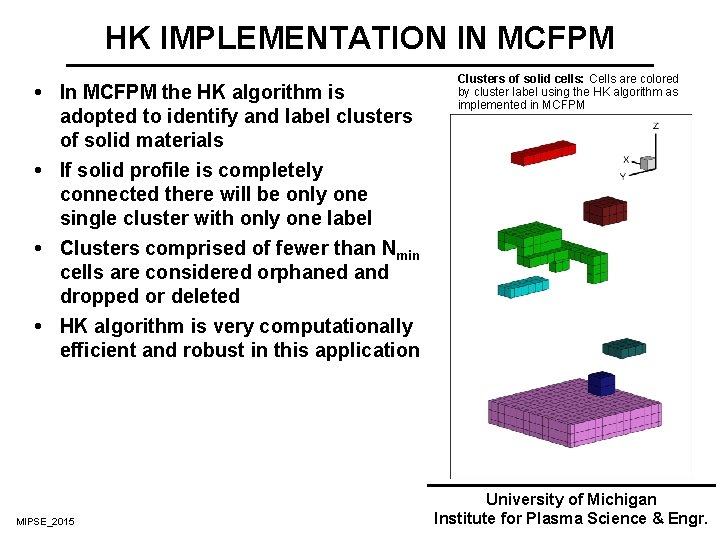
HK IMPLEMENTATION IN MCFPM In MCFPM the HK algorithm is adopted to identify and label clusters of solid materials If solid profile is completely connected there will be only one single cluster with only one label Clusters comprised of fewer than Nmin cells are considered orphaned and dropped or deleted HK algorithm is very computationally efficient and robust in this application MIPSE_2015 Clusters of solid cells: Cells are colored by cluster label using the HK algorithm as implemented in MCFPM University of Michigan Institute for Plasma Science & Engr.
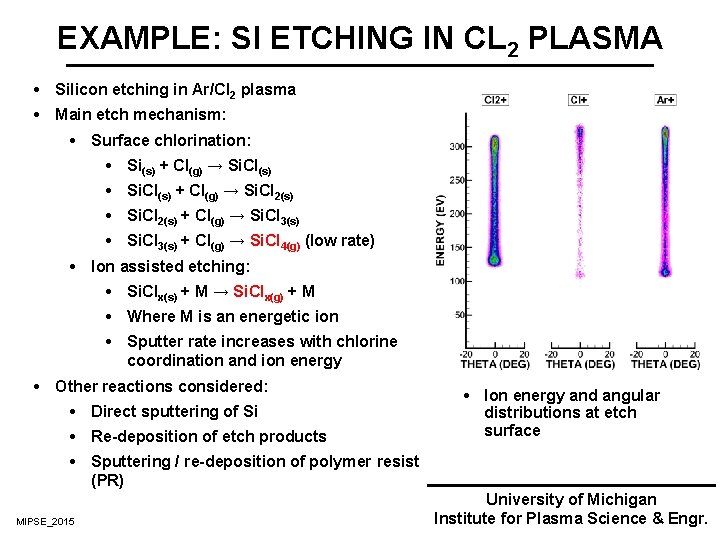
EXAMPLE: SI ETCHING IN CL 2 PLASMA Silicon etching in Ar/Cl 2 plasma Main etch mechanism: Surface chlorination: Si(s) + Cl(g) → Si. Cl(s) + Cl(g) → Si. Cl 2(s) + Cl(g) → Si. Cl 3(s) + Cl(g) → Si. Cl 4(g) (low rate) Ion assisted etching: Si. Clx(s) + M → Si. Clx(g) + M Where M is an energetic ion Sputter rate increases with chlorine coordination and ion energy Other reactions considered: Direct sputtering of Si Re-deposition of etch products Ion energy and angular distributions at etch surface Sputtering / re-deposition of polymer resist (PR) MIPSE_2015 University of Michigan Institute for Plasma Science & Engr.
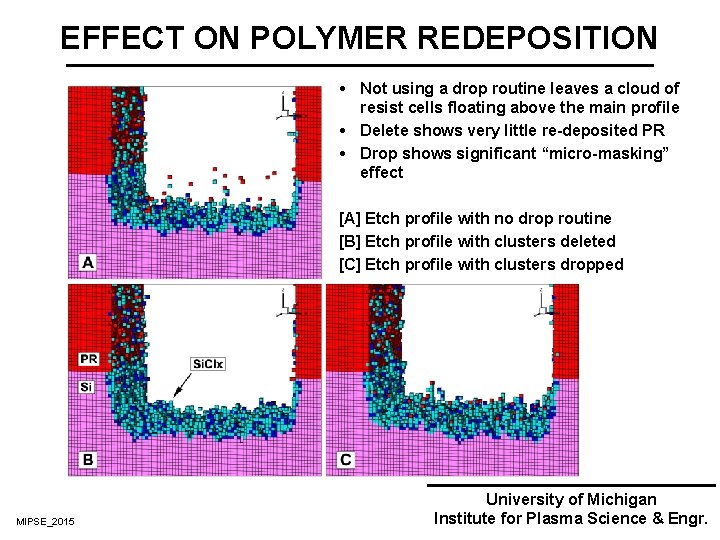
EFFECT ON POLYMER REDEPOSITION Not using a drop routine leaves a cloud of resist cells floating above the main profile Delete shows very little re-deposited PR Drop shows significant “micro-masking” effect [A] Etch profile with no drop routine [B] Etch profile with clusters deleted [C] Etch profile with clusters dropped MIPSE_2015 University of Michigan Institute for Plasma Science & Engr.
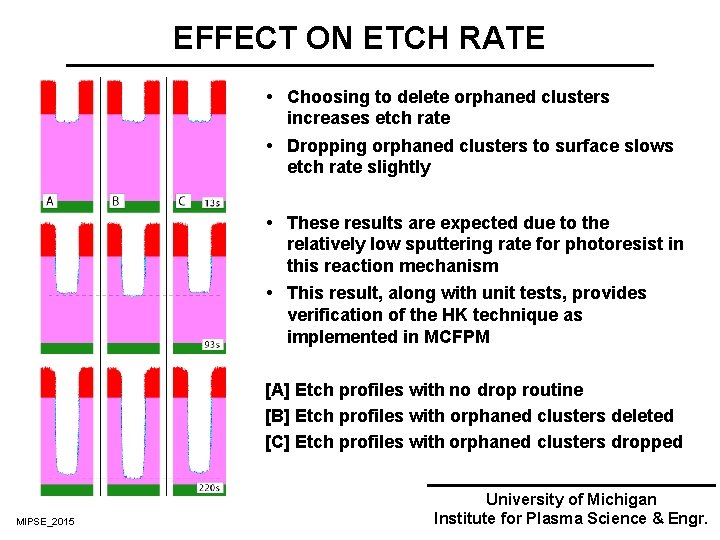
EFFECT ON ETCH RATE Choosing to delete orphaned clusters increases etch rate Dropping orphaned clusters to surface slows etch rate slightly These results are expected due to the relatively low sputtering rate for photoresist in this reaction mechanism This result, along with unit tests, provides verification of the HK technique as implemented in MCFPM [A] Etch profiles with no drop routine [B] Etch profiles with orphaned clusters deleted [C] Etch profiles with orphaned clusters dropped MIPSE_2015 University of Michigan Institute for Plasma Science & Engr.
CONCLUDING REMARKS Accurate etch profile simulation is essential to modern semiconductor technology MCFPM provides 2 d and 3 d etch simulation integrated with reactor simulation through HPEM Stochastic appearance of orphaned clusters of solid cells can effect etch simulation Hoshen-Kopelman algorithm provides an efficient method to search for orphaned clusters Choice of how to handle orphaned clusters can effect simulated profile In case of etching of Si in Ar/Cl 2 plasma: Deleting orphans increases etch rate Dropping orphans results in increased micro-masking Other systems may have different dependencies, and require flexible solution MIPSE_2015 University of Michigan Institute for Plasma Science & Engr.