
Stochastic Context Free Grammars for RNA Structure Modeling
- Slides: 39
Stochastic Context Free Grammars for RNA Structure Modeling BMI/CS 776 www. biostat. wisc. edu/bmi 776/ Spring 2019 Colin Dewey colin. dewey@wisc. edu These slides, excluding third-party material, are licensed under CC BY-NC 4. 0 by Mark Craven, Colin Dewey, and Anthony Gitter
Goals for Lecture Key concepts • transformational grammars • the Chomsky hierarchy • context free grammars • stochastic context free grammars • parsing ambiguity • the Inside and Outside algorithms • parameter learning via the Inside-Outside algorithm 2
Modeling RNA with Stochastic Context Free Grammars • Consider t. RNA genes – 274 in yeast genome, ~1500 in human genome – get transcribed, like protein-coding genes – don’t get translated, therefore base statistics much different than protein-coding genes – but secondary structure is conserved • To recognize new t. RNA genes, model known ones using stochastic context free grammars [Eddy & Durbin, 1994; Sakakibara et al. 1994] • But what is a grammar? 3
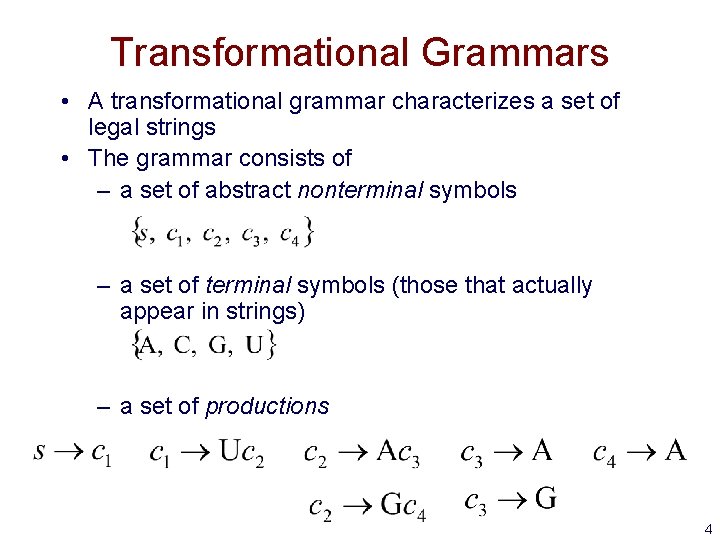
Transformational Grammars • A transformational grammar characterizes a set of legal strings • The grammar consists of – a set of abstract nonterminal symbols – a set of terminal symbols (those that actually appear in strings) – a set of productions 4
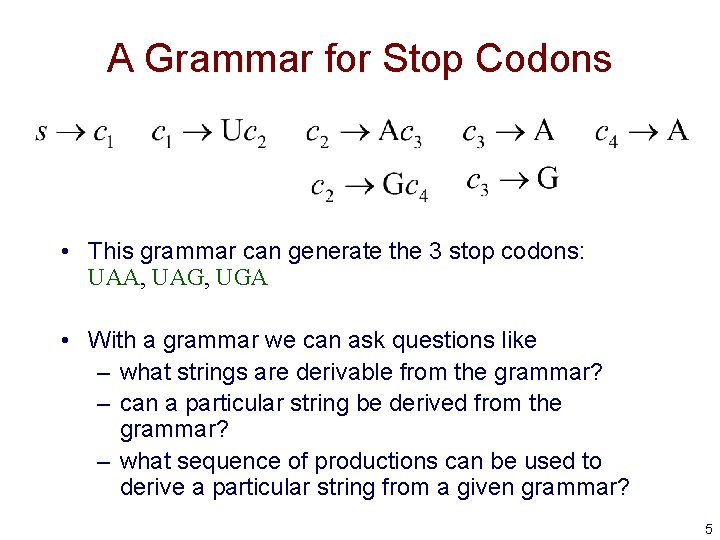
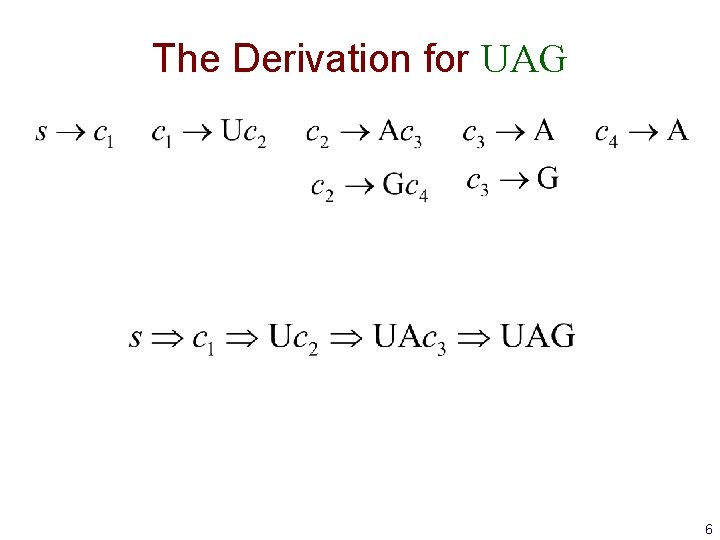
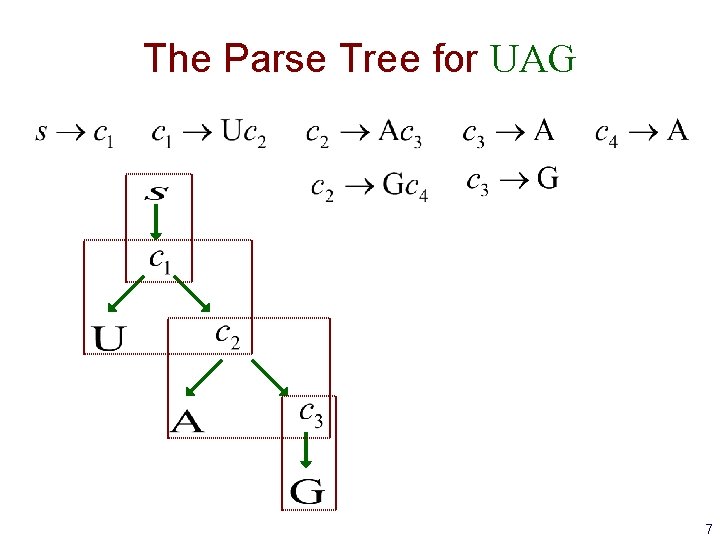
A Grammar for Stop Codons • This grammar can generate the 3 stop codons: UAA, UAG, UGA • With a grammar we can ask questions like – what strings are derivable from the grammar? – can a particular string be derived from the grammar? – what sequence of productions can be used to derive a particular string from a given grammar? 5
The Derivation for UAG 6
The Parse Tree for UAG 7
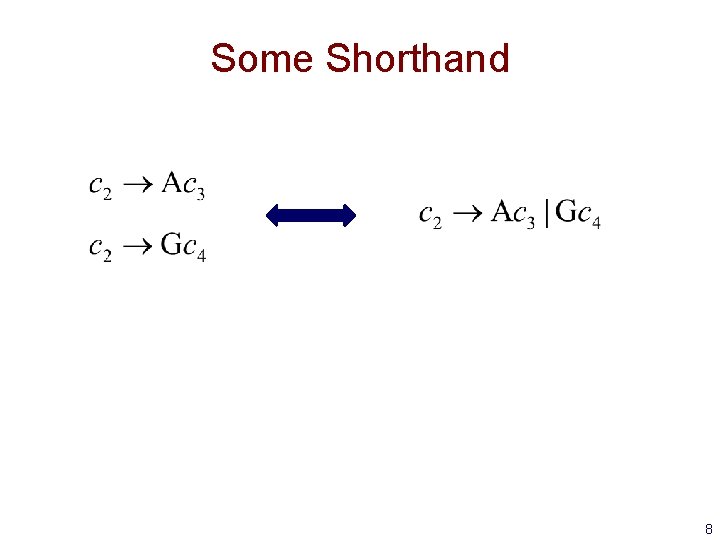
Some Shorthand 8
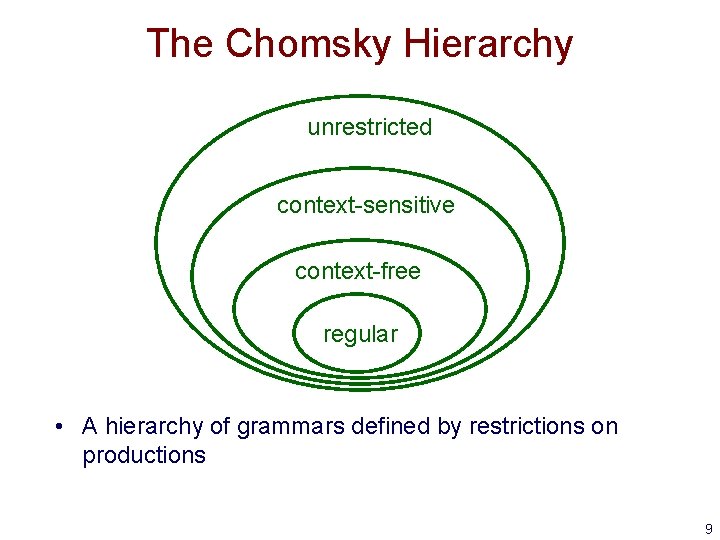
The Chomsky Hierarchy unrestricted context-sensitive context-free regular • A hierarchy of grammars defined by restrictions on productions 9
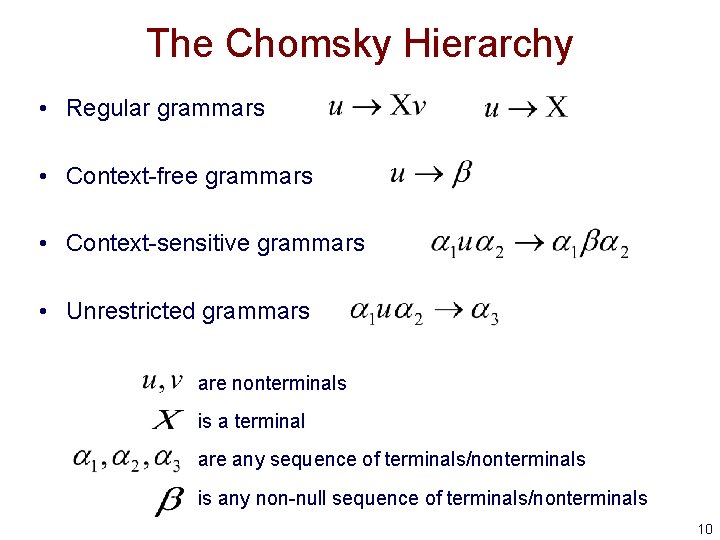
The Chomsky Hierarchy • Regular grammars • Context-free grammars • Context-sensitive grammars • Unrestricted grammars are nonterminals is a terminal are any sequence of terminals/nonterminals is any non-null sequence of terminals/nonterminals 10
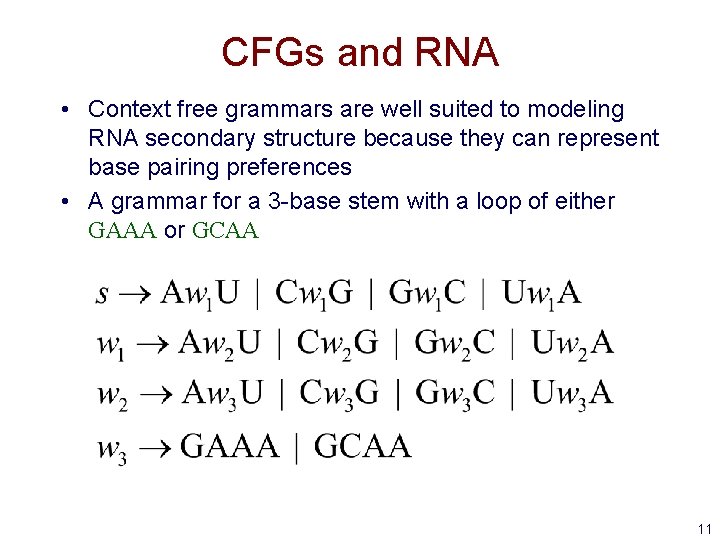
CFGs and RNA • Context free grammars are well suited to modeling RNA secondary structure because they can represent base pairing preferences • A grammar for a 3 -base stem with a loop of either GAAA or GCAA 11
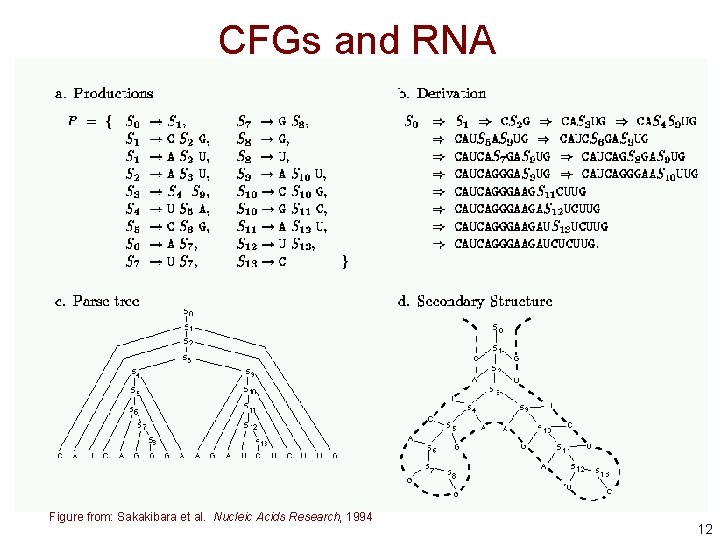
CFGs and RNA Figure from: Sakakibara et al. Nucleic Acids Research, 1994 12
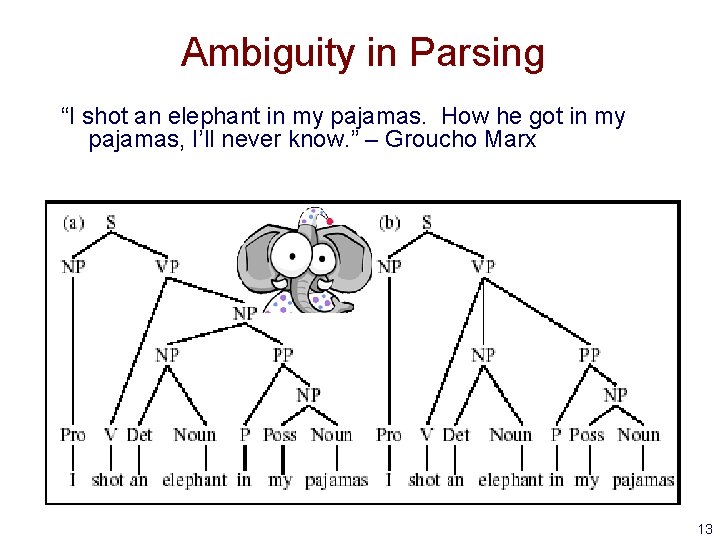
Ambiguity in Parsing “I shot an elephant in my pajamas. How he got in my pajamas, I’ll never know. ” – Groucho Marx 13
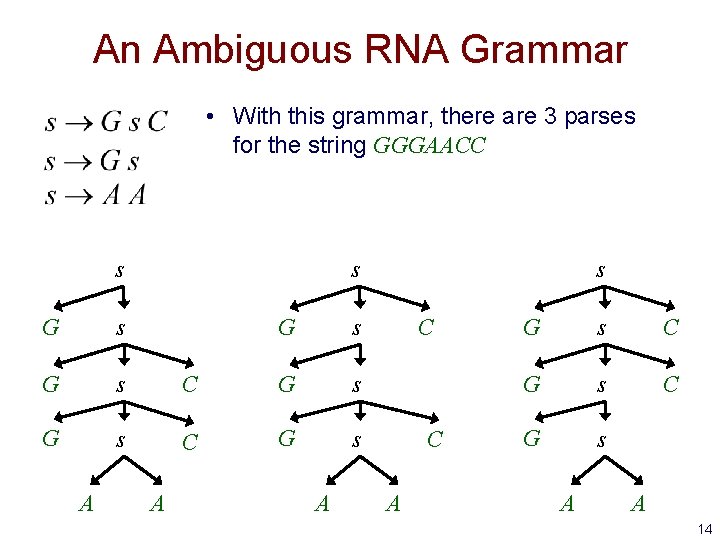
An Ambiguous RNA Grammar • With this grammar, there are 3 parses for the string GGGAACC s G s G s A G s C G s A s C C A G s C G s A A 14
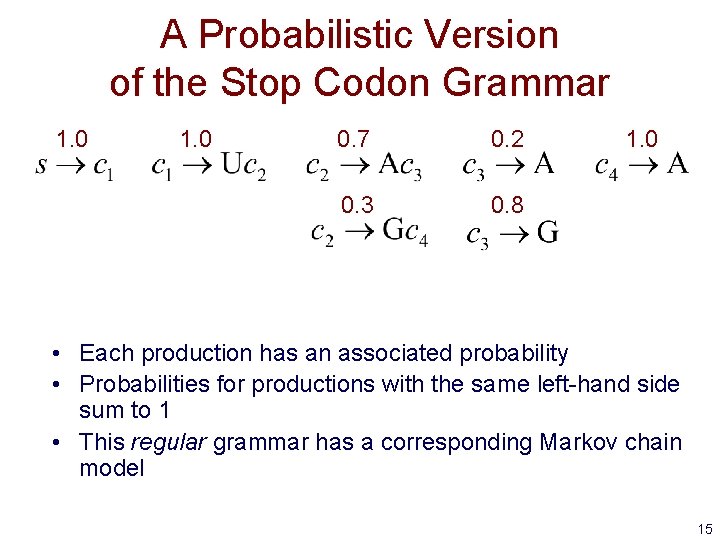
A Probabilistic Version of the Stop Codon Grammar 1. 0 0. 7 0. 2 0. 3 0. 8 1. 0 • Each production has an associated probability • Probabilities for productions with the same left-hand side sum to 1 • This regular grammar has a corresponding Markov chain model 15
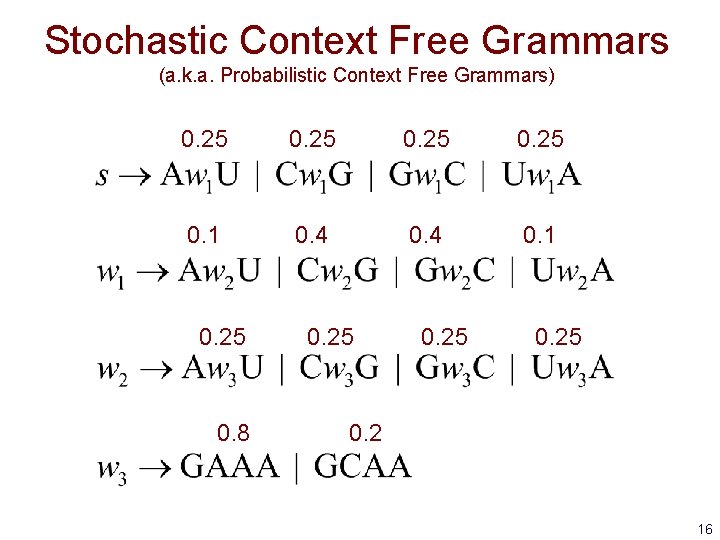
Stochastic Context Free Grammars (a. k. a. Probabilistic Context Free Grammars) 0. 25 0. 1 0. 4 0. 1 0. 25 0. 8 0. 25 0. 2 16
Stochastic Grammars? …the notion “probability of a sentence” is an entirely useless one, under any known interpretation of this term. — Noam Chomsky (famed linguist) Every time I fire a linguist, the performance of the recognizer improves. — Fred Jelinek (former head of IBM speech recognition group) Credit for pairing these quotes goes to Dan Jurafsky and James Martin, Speech and Language Processing 17
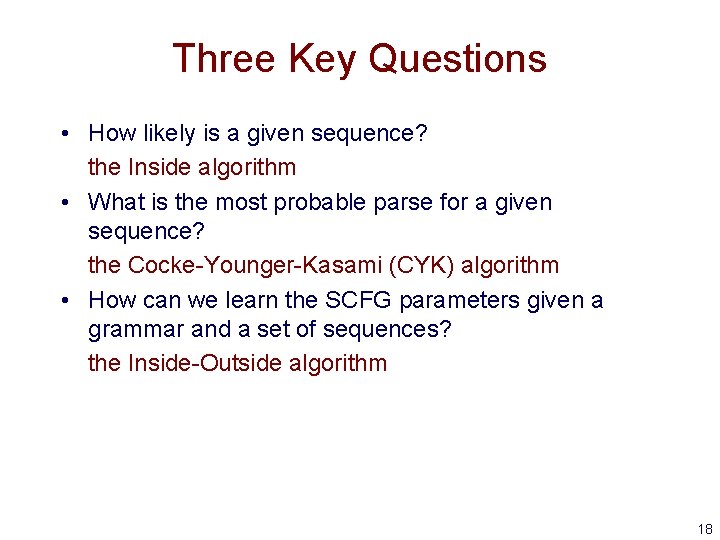
Three Key Questions • How likely is a given sequence? the Inside algorithm • What is the most probable parse for a given sequence? the Cocke-Younger-Kasami (CYK) algorithm • How can we learn the SCFG parameters given a grammar and a set of sequences? the Inside-Outside algorithm 18
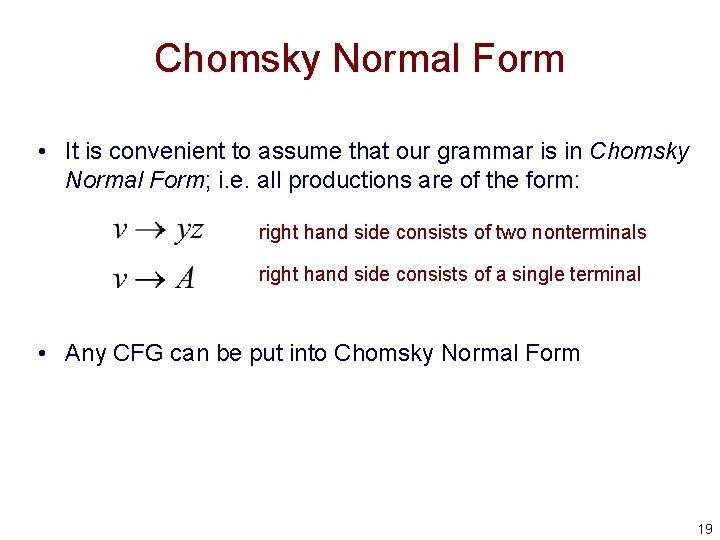
Chomsky Normal Form • It is convenient to assume that our grammar is in Chomsky Normal Form; i. e. all productions are of the form: right hand side consists of two nonterminals right hand side consists of a single terminal • Any CFG can be put into Chomsky Normal Form 19
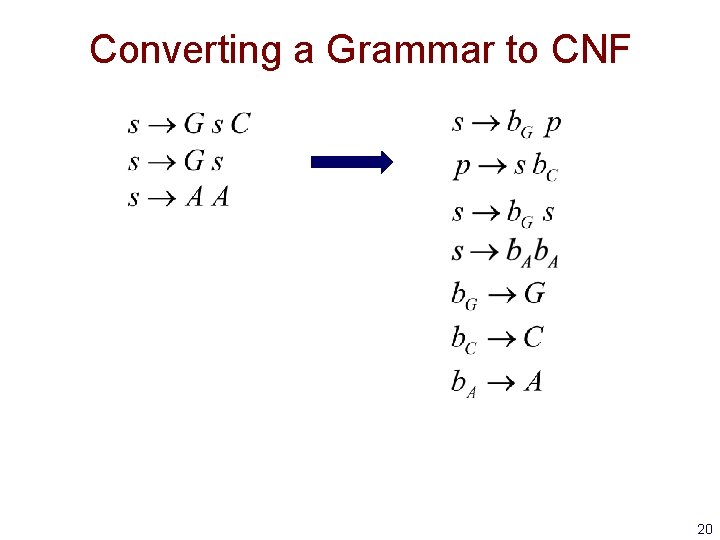
Converting a Grammar to CNF 20
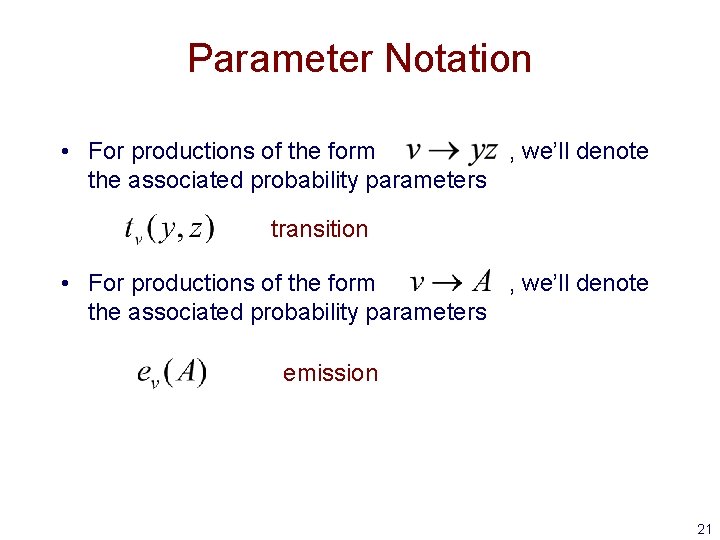
Parameter Notation • For productions of the form , we’ll denote the associated probability parameters transition • For productions of the form , we’ll denote the associated probability parameters emission 21
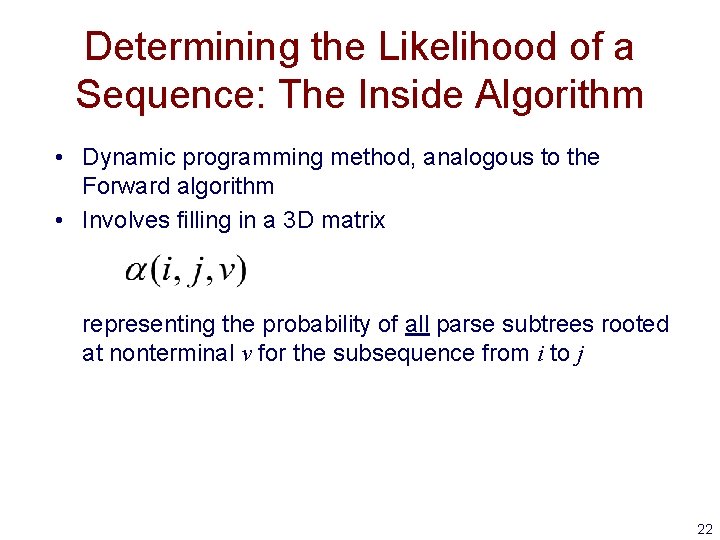
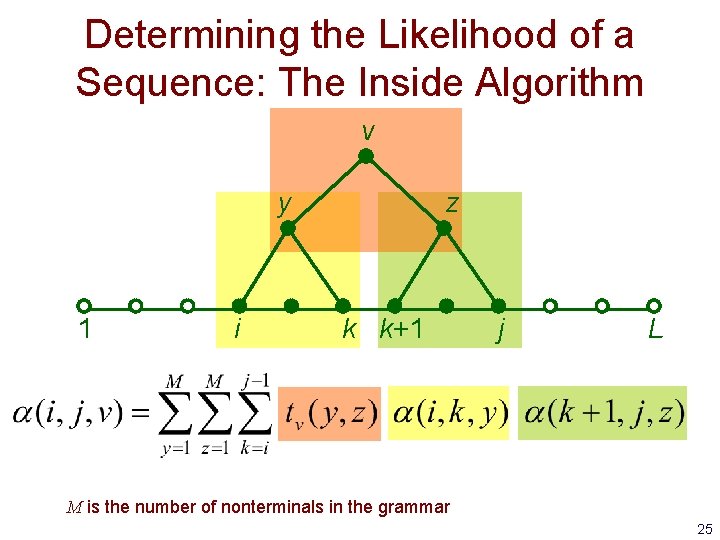
Determining the Likelihood of a Sequence: The Inside Algorithm • Dynamic programming method, analogous to the Forward algorithm • Involves filling in a 3 D matrix representing the probability of all parse subtrees rooted at nonterminal v for the subsequence from i to j 22
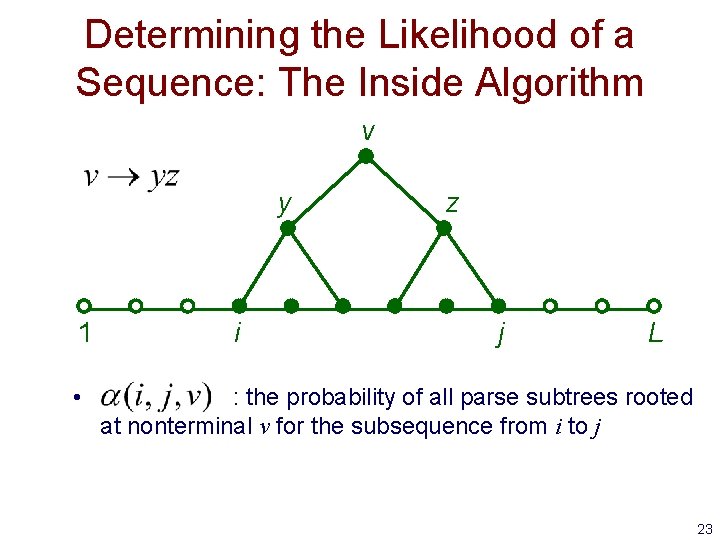
Determining the Likelihood of a Sequence: The Inside Algorithm v y 1 • i z j L : the probability of all parse subtrees rooted at nonterminal v for the subsequence from i to j 23
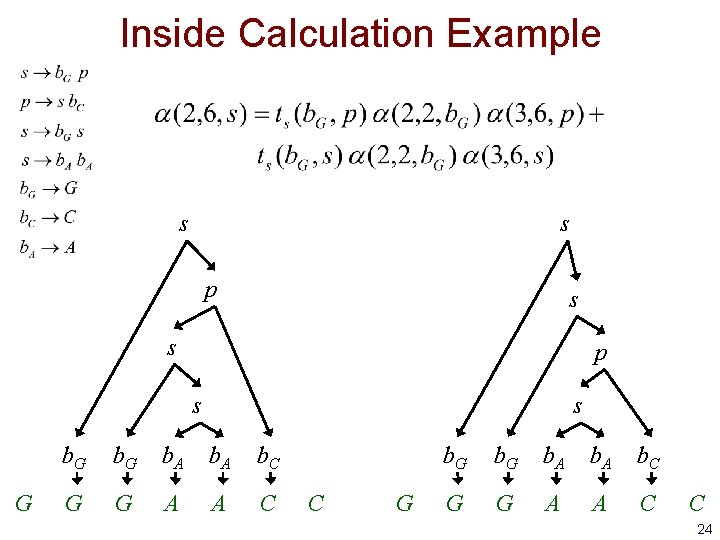
Inside Calculation Example s s p s G s b. G b. A b. C G G A A C C G b. A b. C G G A A C C 24
Determining the Likelihood of a Sequence: The Inside Algorithm v y 1 i z k k+1 j L M is the number of nonterminals in the grammar 25
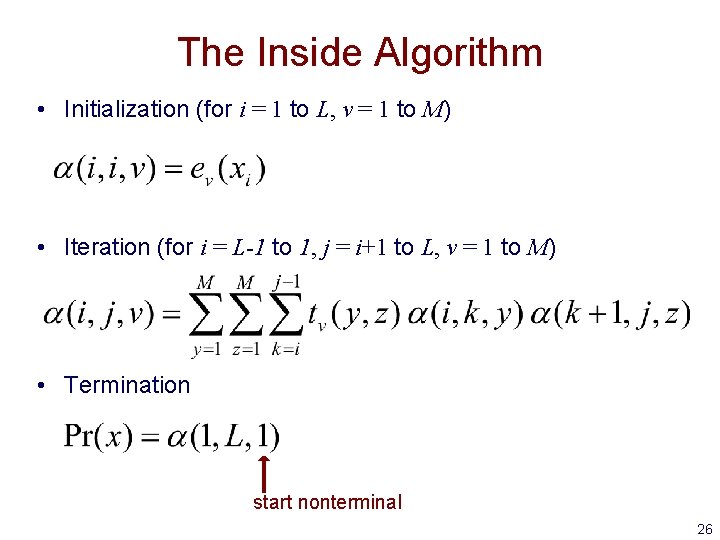
The Inside Algorithm • Initialization (for i = 1 to L, v = 1 to M) • Iteration (for i = L-1 to 1, j = i+1 to L, v = 1 to M) • Termination start nonterminal 26
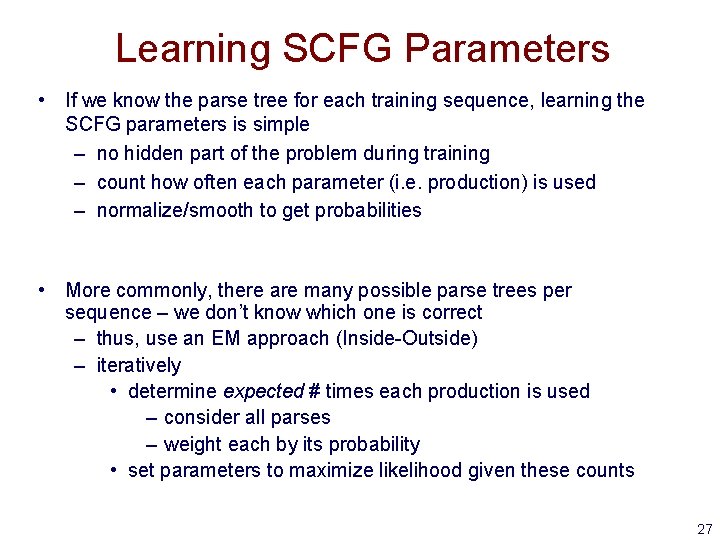
Learning SCFG Parameters • If we know the parse tree for each training sequence, learning the SCFG parameters is simple – no hidden part of the problem during training – count how often each parameter (i. e. production) is used – normalize/smooth to get probabilities • More commonly, there are many possible parse trees per sequence – we don’t know which one is correct – thus, use an EM approach (Inside-Outside) – iteratively • determine expected # times each production is used – consider all parses – weight each by its probability • set parameters to maximize likelihood given these counts 27
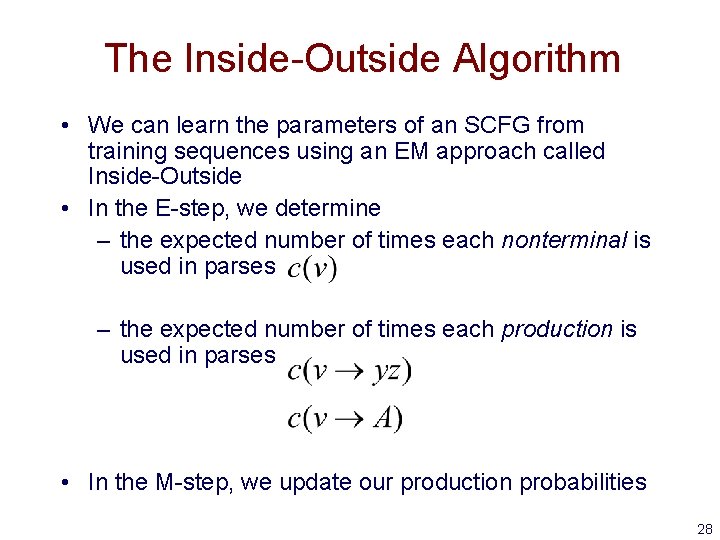
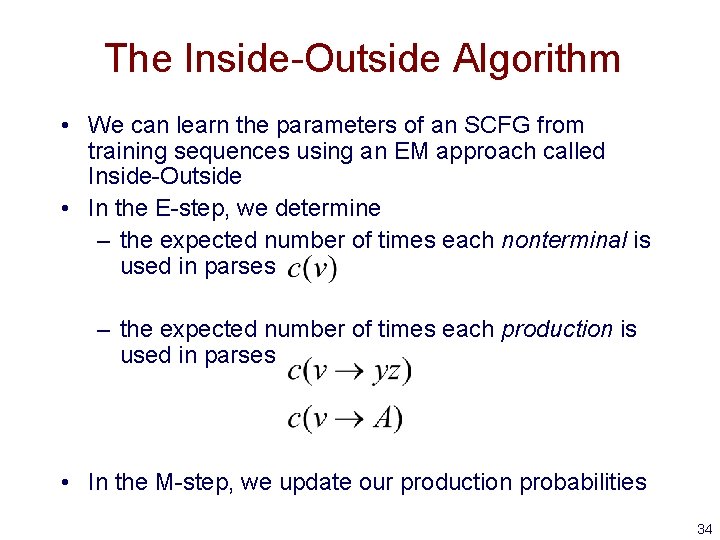
The Inside-Outside Algorithm • We can learn the parameters of an SCFG from training sequences using an EM approach called Inside-Outside • In the E-step, we determine – the expected number of times each nonterminal is used in parses – the expected number of times each production is used in parses • In the M-step, we update our production probabilities 28
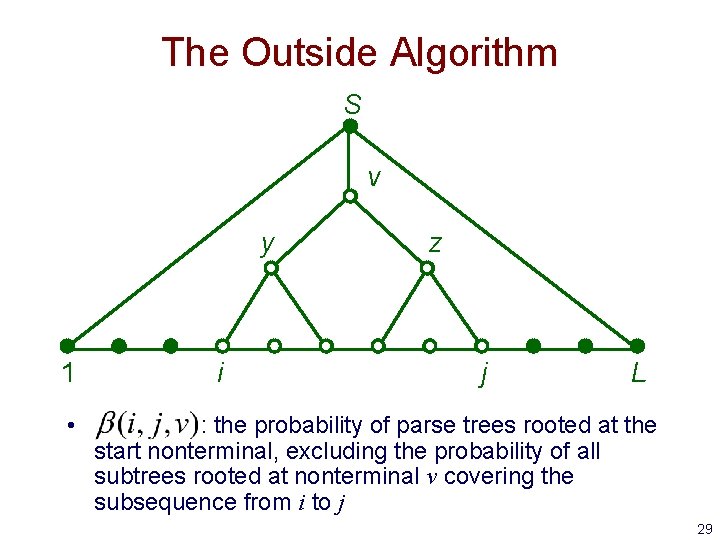
The Outside Algorithm S v y 1 • i z j L : the probability of parse trees rooted at the start nonterminal, excluding the probability of all subtrees rooted at nonterminal v covering the subsequence from i to j 29
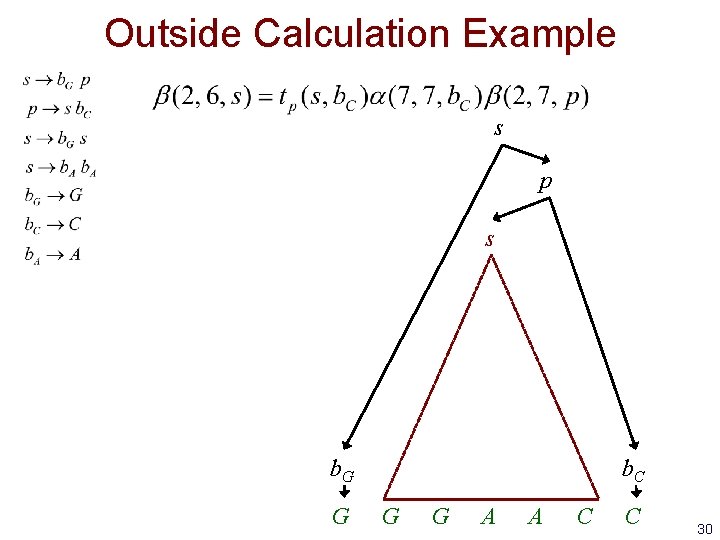
Outside Calculation Example s p s b. G G b. C G G A A C C 30
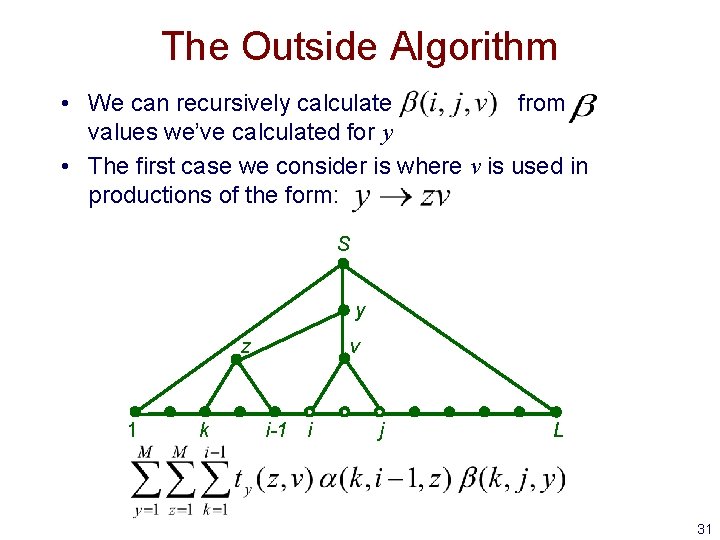
The Outside Algorithm • We can recursively calculate from values we’ve calculated for y • The first case we consider is where v is used in productions of the form: S y z 1 k v i-1 i j L 31
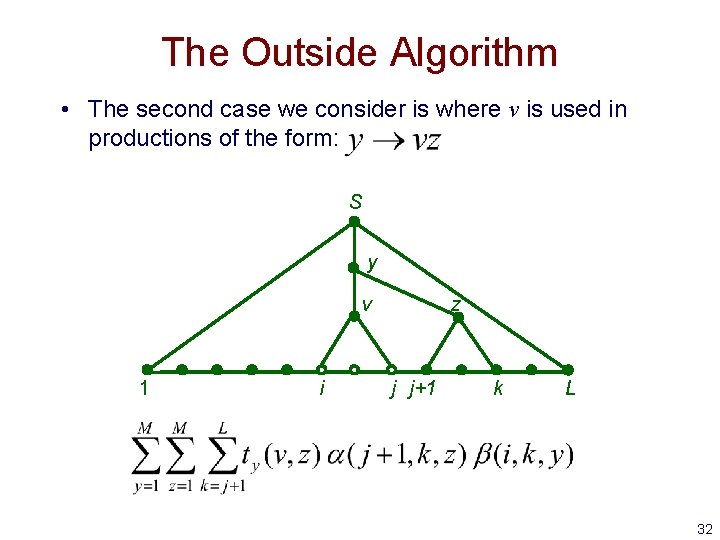
The Outside Algorithm • The second case we consider is where v is used in productions of the form: S y v 1 i z j j+1 k L 32
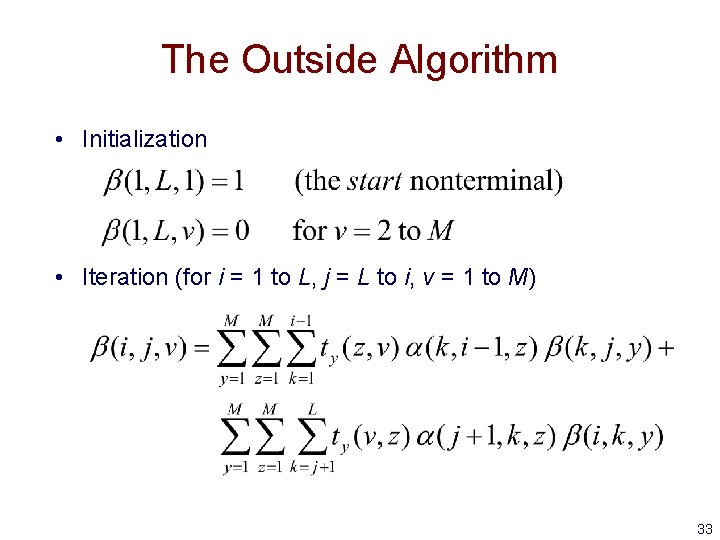
The Outside Algorithm • Initialization • Iteration (for i = 1 to L, j = L to i, v = 1 to M) 33
The Inside-Outside Algorithm • We can learn the parameters of an SCFG from training sequences using an EM approach called Inside-Outside • In the E-step, we determine – the expected number of times each nonterminal is used in parses – the expected number of times each production is used in parses • In the M-step, we update our production probabilities 34
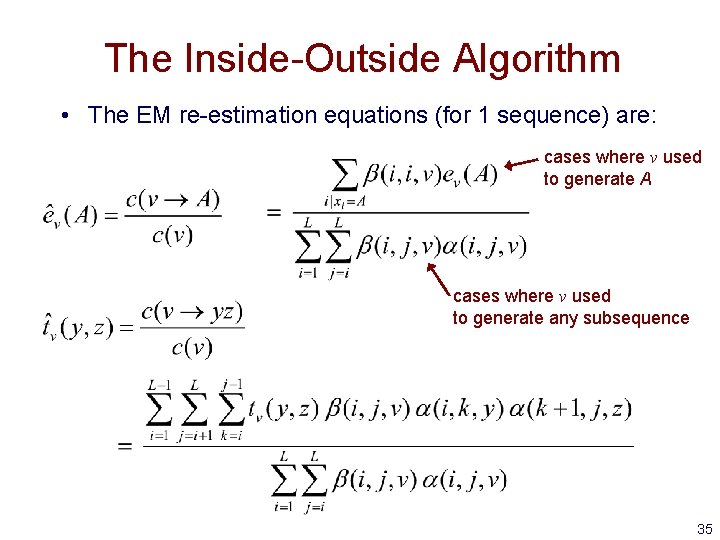
The Inside-Outside Algorithm • The EM re-estimation equations (for 1 sequence) are: cases where v used to generate A cases where v used to generate any subsequence 35
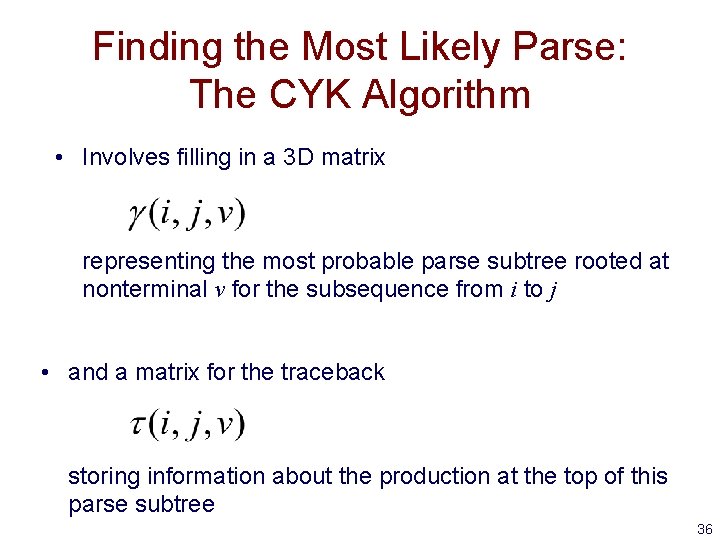
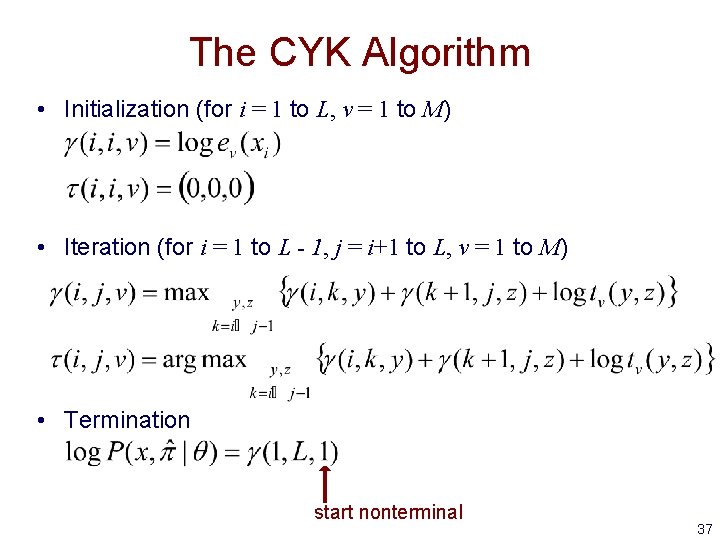
Finding the Most Likely Parse: The CYK Algorithm • Involves filling in a 3 D matrix representing the most probable parse subtree rooted at nonterminal v for the subsequence from i to j • and a matrix for the traceback storing information about the production at the top of this parse subtree 36
The CYK Algorithm • Initialization (for i = 1 to L, v = 1 to M) • Iteration (for i = 1 to L - 1, j = i+1 to L, v = 1 to M) • Termination start nonterminal 37
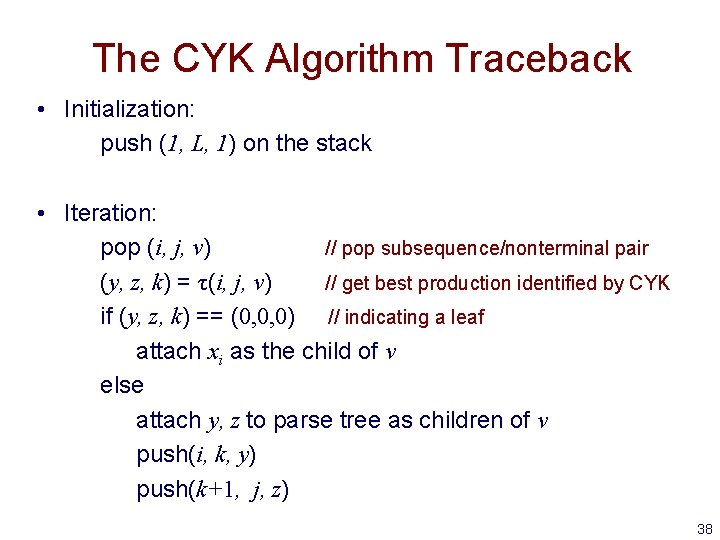
The CYK Algorithm Traceback • Initialization: push (1, L, 1) on the stack • Iteration: pop (i, j, v) // pop subsequence/nonterminal pair (y, z, k) = τ(i, j, v) // get best production identified by CYK if (y, z, k) == (0, 0, 0) // indicating a leaf attach xi as the child of v else attach y, z to parse tree as children of v push(i, k, y) push(k+1, j, z) 38
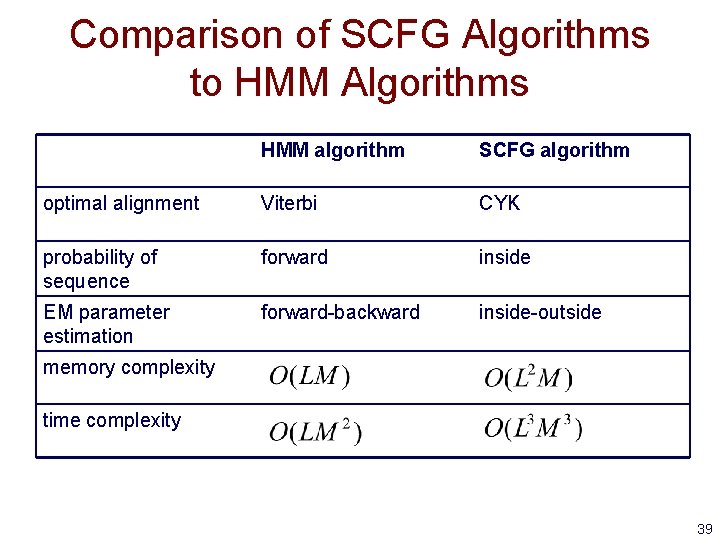
Comparison of SCFG Algorithms to HMM Algorithms HMM algorithm SCFG algorithm optimal alignment Viterbi CYK probability of sequence forward inside EM parameter estimation forward-backward inside-outside memory complexity time complexity 39