
Stochastic Context Free Grammars for RNA Modeling CS

- Slides: 38
Stochastic Context Free Grammars for RNA Modeling CS 838 www. cs. wisc. edu/~craven/cs 838. html Mark Craven craven@biostat. wisc. edu May 2001
Why RNA Is Interesting • in addition to messenger RNA (m. RNA), there are other RNA molecules that play key roles in biology – ribosomal RNA (r. RNA) • ribosomes are complexes that incorporate several RNA subunits in addition to numerous protein units – transfer RNA (t. RNA) • transport amino acids to the ribosome during translation – the spliceosome, which performs intron splicing, is a complex with several RNA units – the genomes for many viruses (e. g. HIV) are encoded in RNA – etc.
RNA Secondary Structure • RNA is typically single stranded • folding, in large part is determined by base-pairing A-U and C-G are the canonical base pairs other bases will sometimes pair, especially G-U • the base-paired structure is referred to as the secondary structure of RNA • related RNAs often have homologous secondary structure without significant sequence similarity
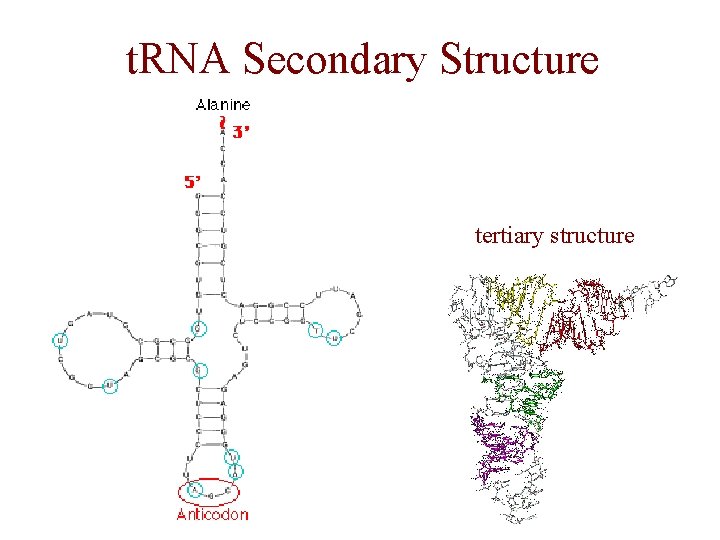
t. RNA Secondary Structure tertiary structure
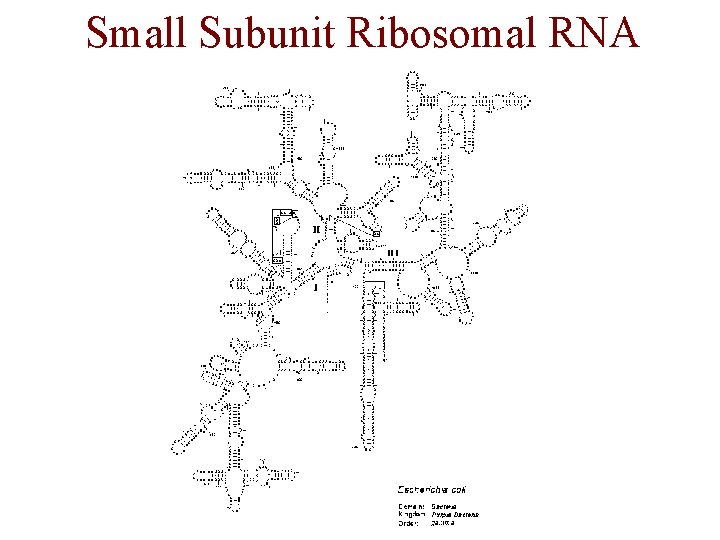
Small Subunit Ribosomal RNA Secondary Structure
Modeling RNA with Stochastic Context Free Grammars • consider t. RNA genes – 274 in yeast genome, ~1500 in human genome – get transcribed, like protein-coding genes – don’t get translated, therefore base statistics much different than protein-coding genes – but secondary structure is conserved • to recognize new t. RNA genes, model known ones using stochastic context free grammars [Eddy & Durbin, 1994; Sakakibara et al. 1994] • but what is a grammar?
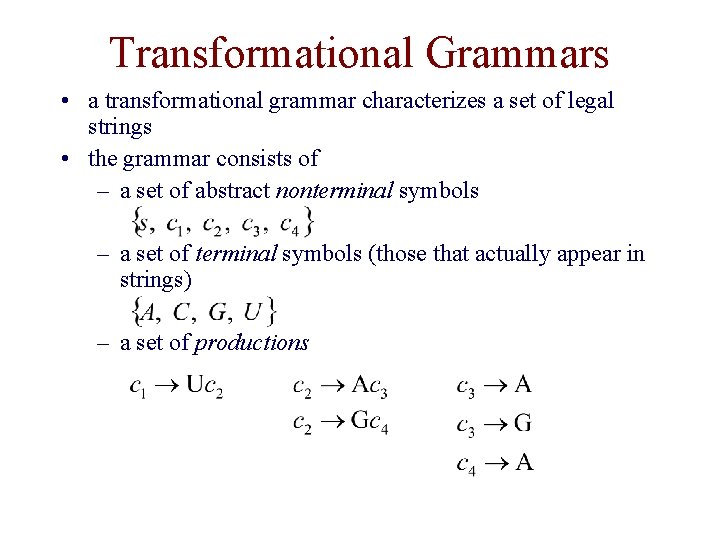
Transformational Grammars • a transformational grammar characterizes a set of legal strings • the grammar consists of – a set of abstract nonterminal symbols – a set of terminal symbols (those that actually appear in strings) – a set of productions
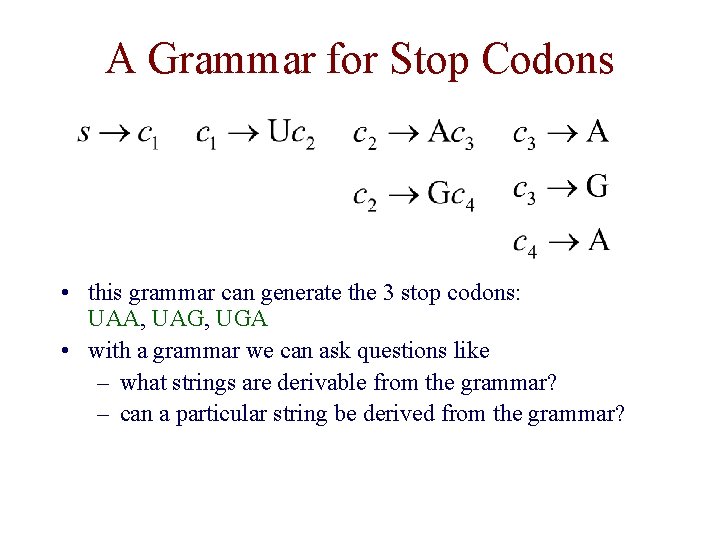
A Grammar for Stop Codons • this grammar can generate the 3 stop codons: UAA, UAG, UGA • with a grammar we can ask questions like – what strings are derivable from the grammar? – can a particular string be derived from the grammar?
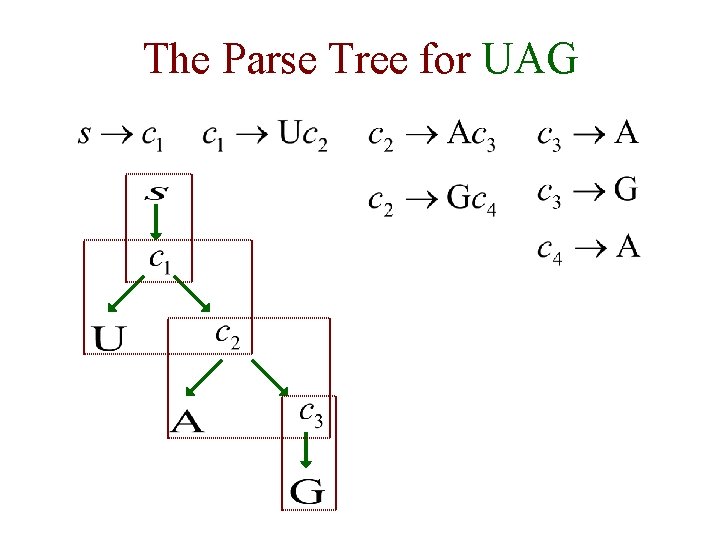
The Parse Tree for UAG
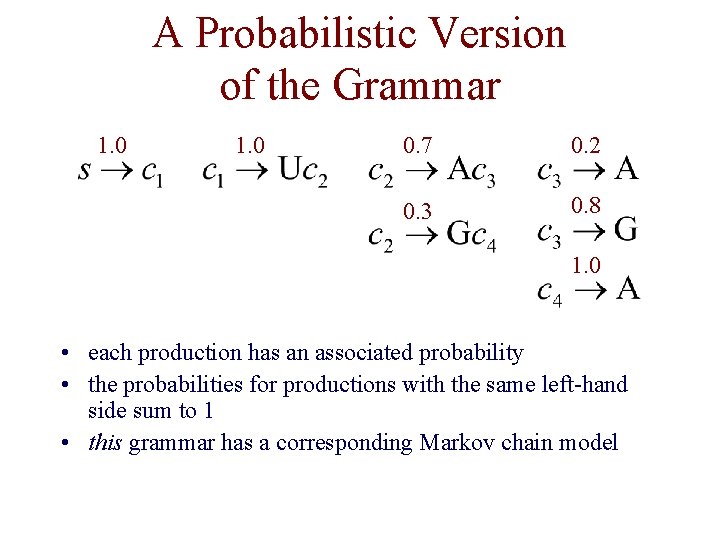
A Probabilistic Version of the Grammar 1. 0 0. 7 0. 2 0. 3 0. 8 1. 0 • each production has an associated probability • the probabilities for productions with the same left-hand side sum to 1 • this grammar has a corresponding Markov chain model
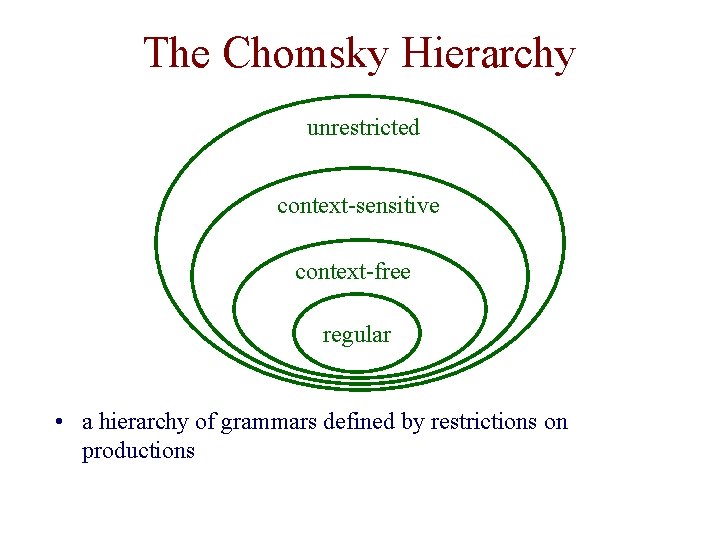
The Chomsky Hierarchy unrestricted context-sensitive context-free regular • a hierarchy of grammars defined by restrictions on productions
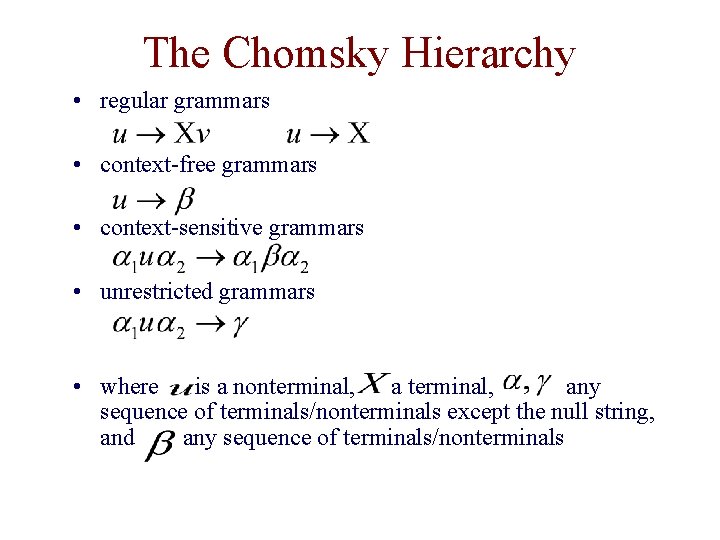
The Chomsky Hierarchy • regular grammars • context-free grammars • context-sensitive grammars • unrestricted grammars • where is a nonterminal, any sequence of terminals/nonterminals except the null string, and any sequence of terminals/nonterminals
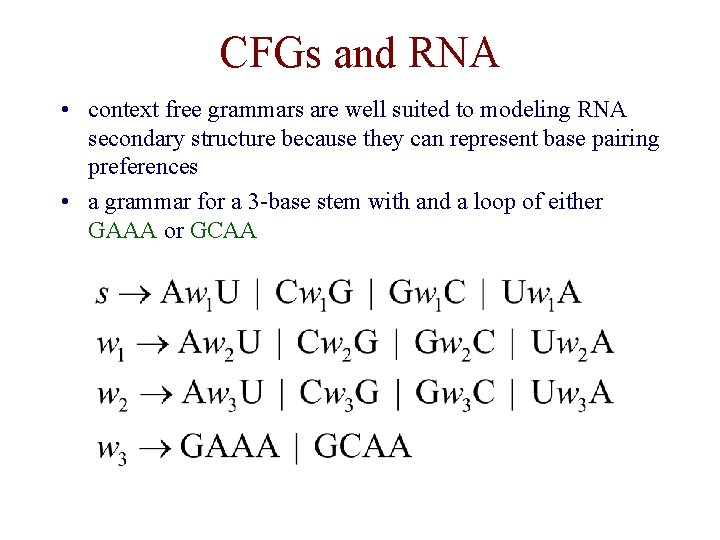
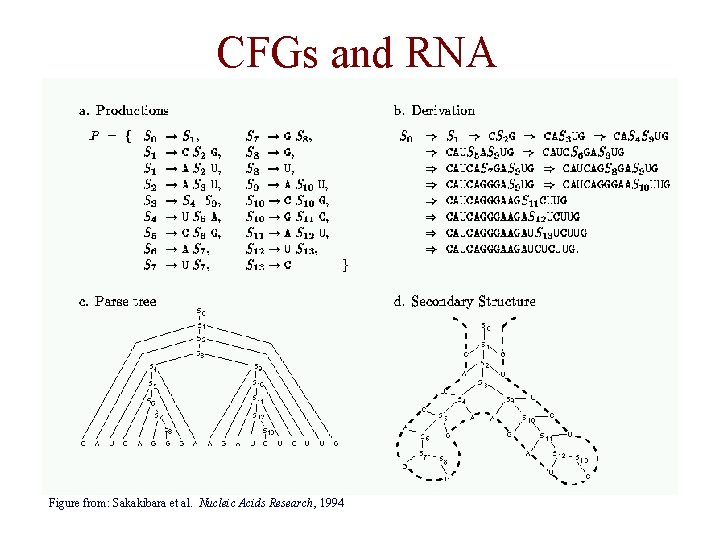
CFGs and RNA • context free grammars are well suited to modeling RNA secondary structure because they can represent base pairing preferences • a grammar for a 3 -base stem with and a loop of either GAAA or GCAA
CFGs and RNA Figure from: Sakakibara et al. Nucleic Acids Research, 1994
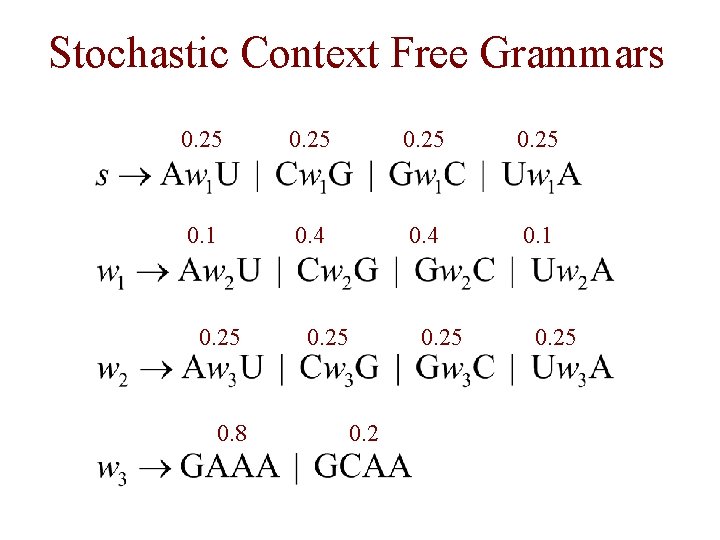
Stochastic Context Free Grammars 0. 25 0. 1 0. 4 0. 1 0. 25 0. 8 0. 25
Stochastic Grammars? …the notion “probability of a sentence” is an entirely useless one, under any known interpretation of this term. — Noam Chomsky (famed linguist) Every time I fire a linguist, the performance of the recognizer improves. — Fred Jelinek (former head of IBM speech recognition group) Credit for pairing these quotes goes to Dan Jurafsky and James Martin, Speech and Language Processing
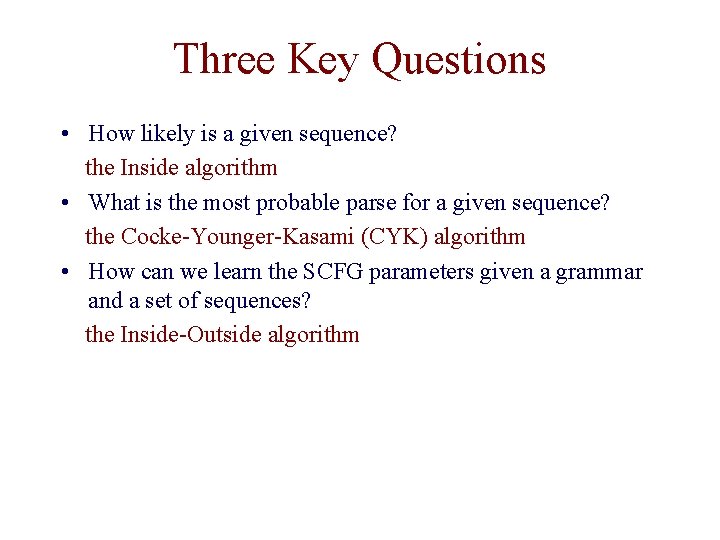
Three Key Questions • How likely is a given sequence? the Inside algorithm • What is the most probable parse for a given sequence? the Cocke-Younger-Kasami (CYK) algorithm • How can we learn the SCFG parameters given a grammar and a set of sequences? the Inside-Outside algorithm
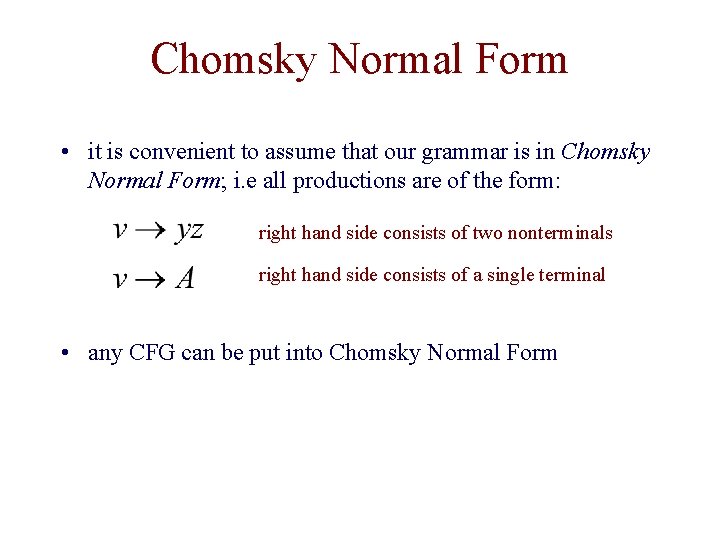
Chomsky Normal Form • it is convenient to assume that our grammar is in Chomsky Normal Form; i. e all productions are of the form: right hand side consists of two nonterminals right hand side consists of a single terminal • any CFG can be put into Chomsky Normal Form
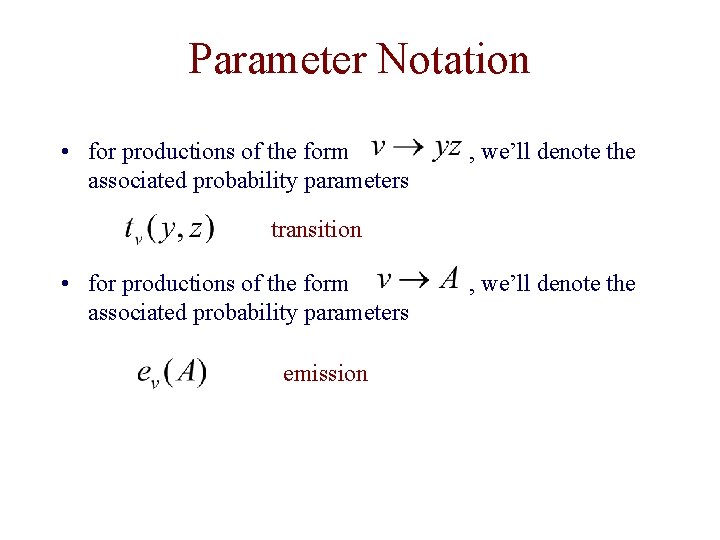
Parameter Notation • for productions of the form associated probability parameters , we’ll denote the transition • for productions of the form associated probability parameters emission , we’ll denote the
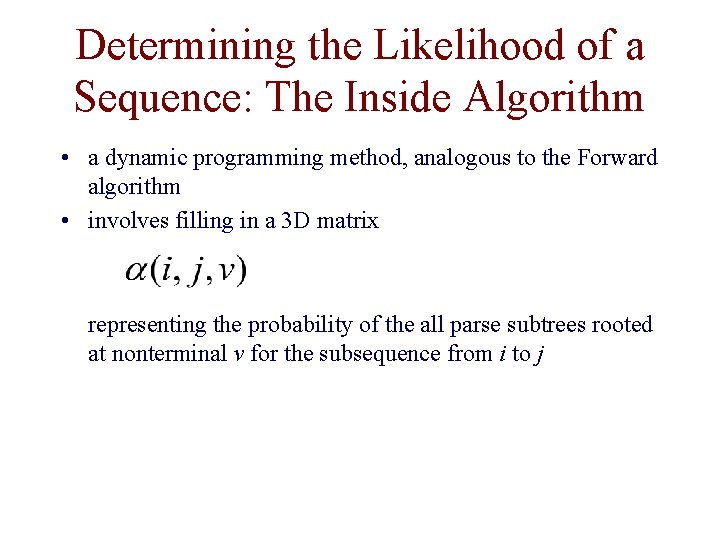
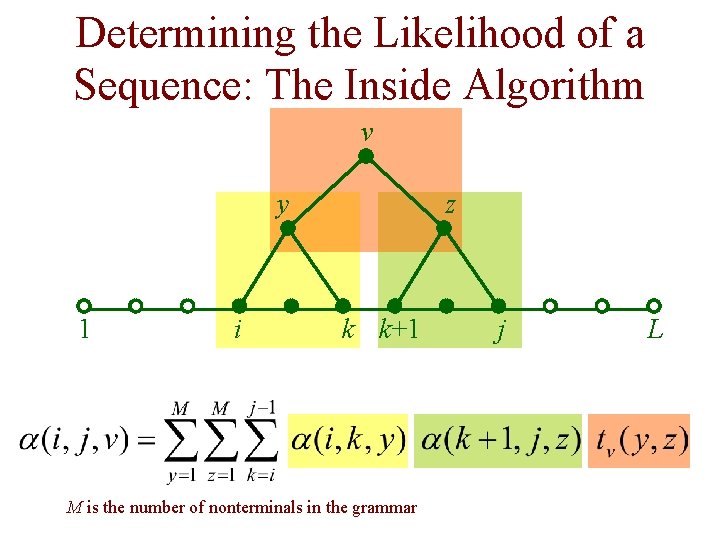
Determining the Likelihood of a Sequence: The Inside Algorithm • a dynamic programming method, analogous to the Forward algorithm • involves filling in a 3 D matrix representing the probability of the all parse subtrees rooted at nonterminal v for the subsequence from i to j
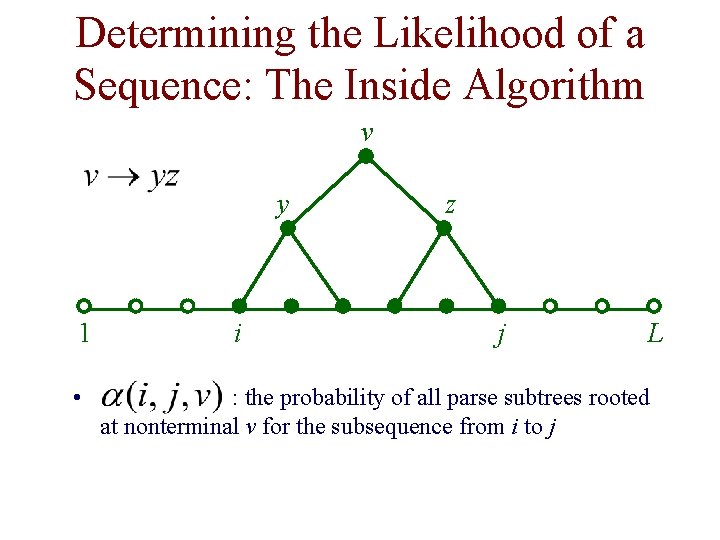
Determining the Likelihood of a Sequence: The Inside Algorithm v y 1 • i z j L : the probability of all parse subtrees rooted at nonterminal v for the subsequence from i to j
Determining the Likelihood of a Sequence: The Inside Algorithm v y 1 i z k k+1 M is the number of nonterminals in the grammar j L
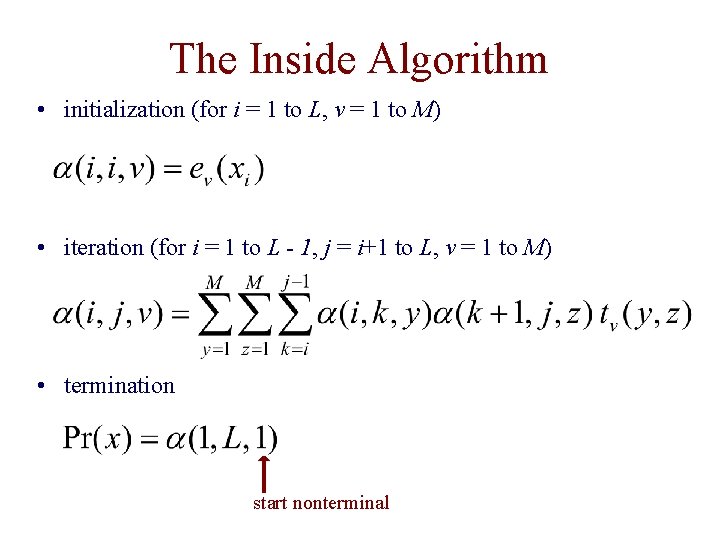
The Inside Algorithm • initialization (for i = 1 to L, v = 1 to M) • iteration (for i = 1 to L - 1, j = i+1 to L, v = 1 to M) • termination start nonterminal
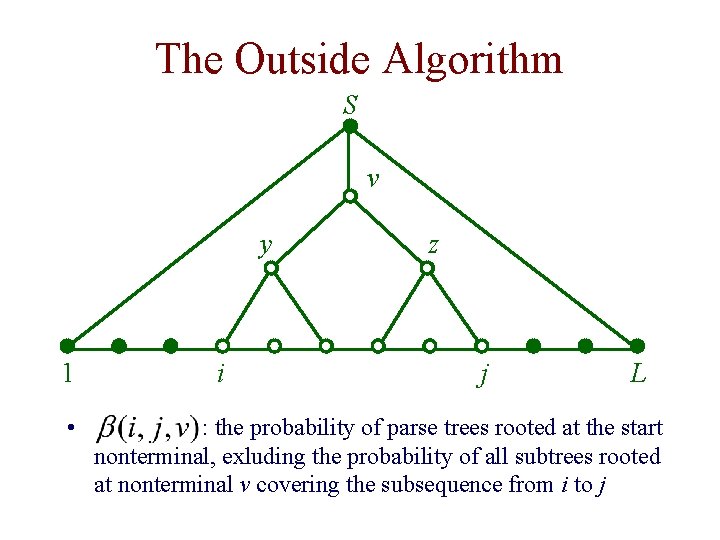
The Outside Algorithm S v y 1 • i z j L : the probability of parse trees rooted at the start nonterminal, exluding the probability of all subtrees rooted at nonterminal v covering the subsequence from i to j
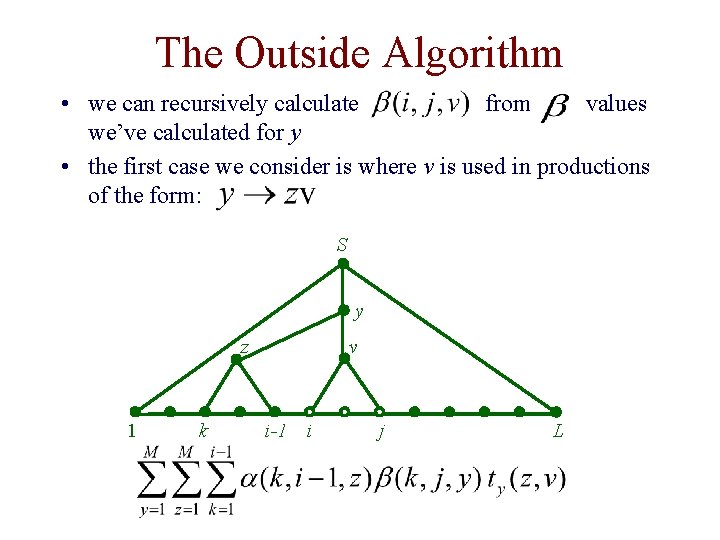
The Outside Algorithm • we can recursively calculate from values we’ve calculated for y • the first case we consider is where v is used in productions of the form: S y z 1 k v i-1 i j L
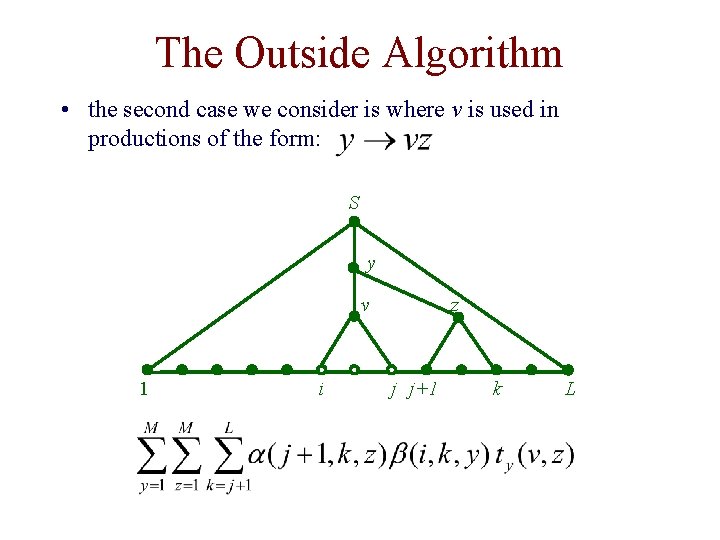
The Outside Algorithm • the second case we consider is where v is used in productions of the form: S y v 1 i z j j+1 k L
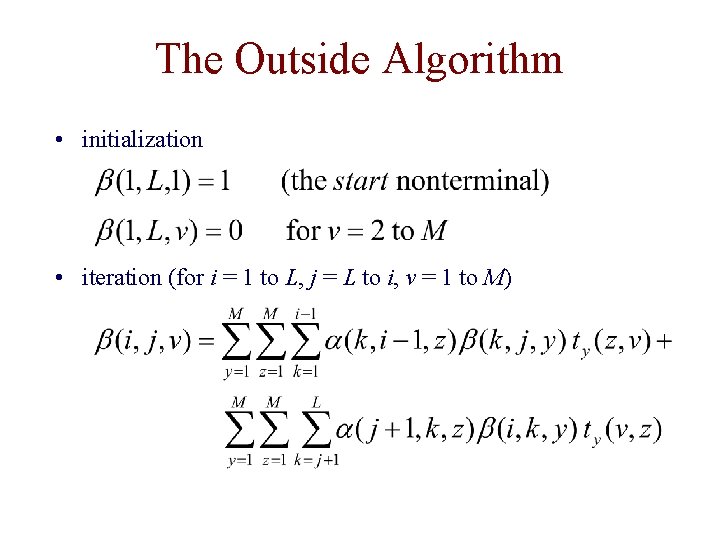
The Outside Algorithm • initialization • iteration (for i = 1 to L, j = L to i, v = 1 to M)
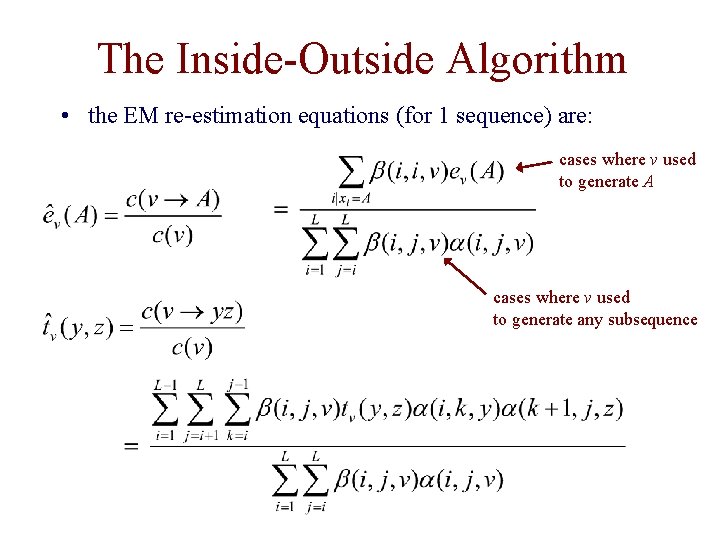
Learning SCFG Parameters • if we know the parse tree for each training sequence, learning the SCFG parameters is simple – no hidden state during training – count how often each parameter (i. e. production) is used – normalize/smooth to get probabilities • more commonly, there are many possible parse trees per sequence – we don’t know which one is correct – thus, use an EM approach (Inside-Outside) – iteratively • determine expected # times each production is used – consider all parses – weight each by it’s probability • set parameters to maximize these counts
The Inside-Outside Algorithm • we can learn the parameters of an SCFG from training sequences using an EM approach called Inside-Outside • in the E-step, we determine – the expected number of times each nonterminal is used in parses – the expected number of times each production is used in parses • in the M-step, we update our production probabilities
The Inside-Outside Algorithm • the EM re-estimation equations (for 1 sequence) are: cases where v used to generate A cases where v used to generate any subsequence
The CYK Algorithm • analogous to Viterbi algorithm • like Inside algorithm but – max operations instead of sums – retain traceback pointers • traceback is a little more involved than Viterbi – need to reconstruct parse tree instead of recovering simple path
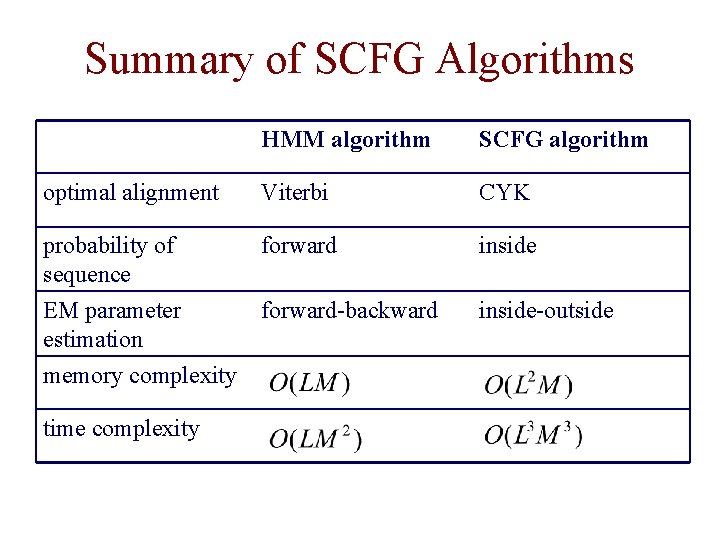
Summary of SCFG Algorithms HMM algorithm SCFG algorithm optimal alignment Viterbi CYK probability of sequence forward inside EM parameter estimation memory complexity forward-backward inside-outside time complexity
Applications of SCFGs • SCFGs have been applied to constructing multiple alignments and recognizing new instances of: – t. RNA genes [Eddy & Durbin, 1994; Sakakibara et al. , 1994] – r. RNA subunits [Brown, 2000] – terminators [Bockhorst & Craven, 2001] • trained SCFG models can be used to – recognize new instances (Inside algorithm) – predict secondary structure (CYK algorithm) – construct multiple alignments (CYK algorithm)
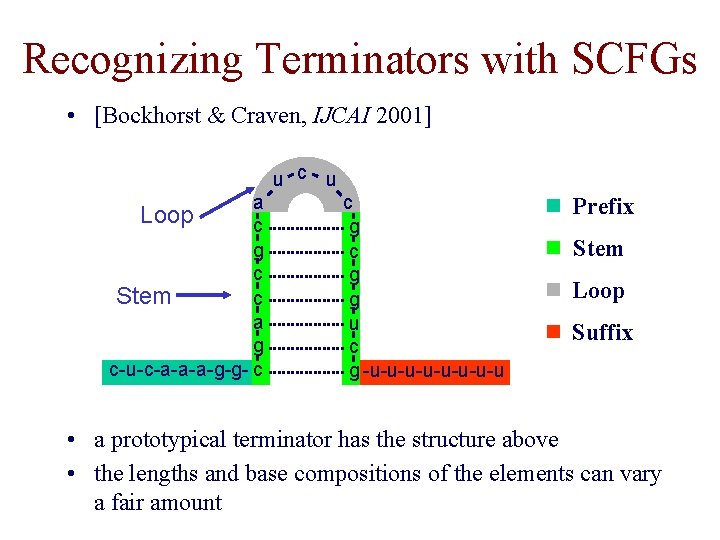
Recognizing Terminators with SCFGs • [Bockhorst & Craven, IJCAI 2001] u c u a c g c Stem c a g c-u-c-a-a-a-g-g- c Loop c g g u c g -u-u-u-u Prefix Stem Loop Suffix • a prototypical terminator has the structure above • the lengths and base compositions of the elements can vary a fair amount
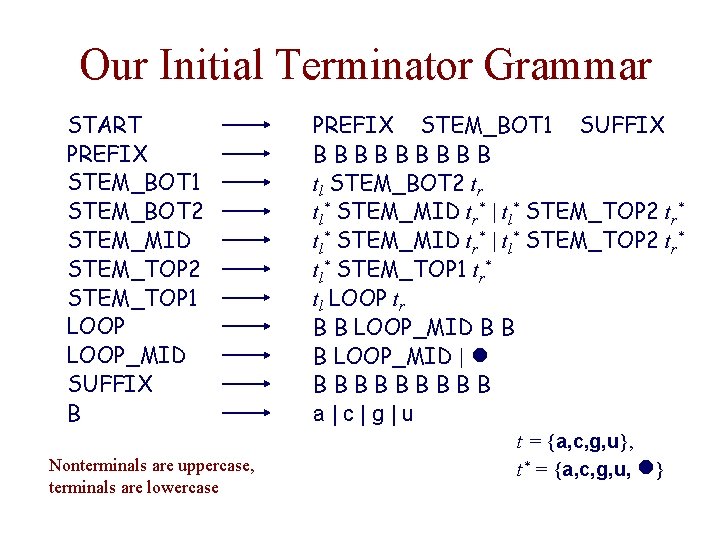
Our Initial Terminator Grammar START PREFIX STEM_BOT 1 STEM_BOT 2 STEM_MID STEM_TOP 2 STEM_TOP 1 LOOP_MID SUFFIX B Nonterminals are uppercase, terminals are lowercase PREFIX STEM_BOT 1 SUFFIX BBBBB tl STEM_BOT 2 tr tl* STEM_MID tr* | tl* STEM_TOP 2 tr* tl* STEM_TOP 1 tr* tl LOOP tr B B LOOP_MID B B B LOOP_MID | BBBBB a|c|g|u t = {a, c, g, u}, t* = {a, c, g, u, }
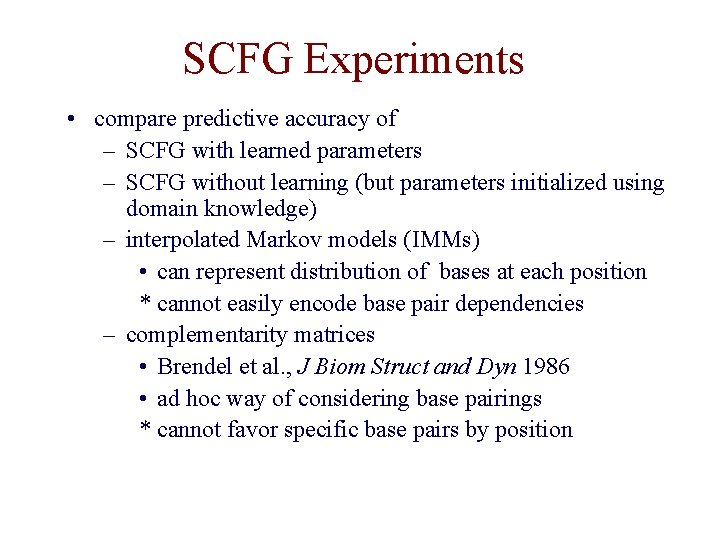
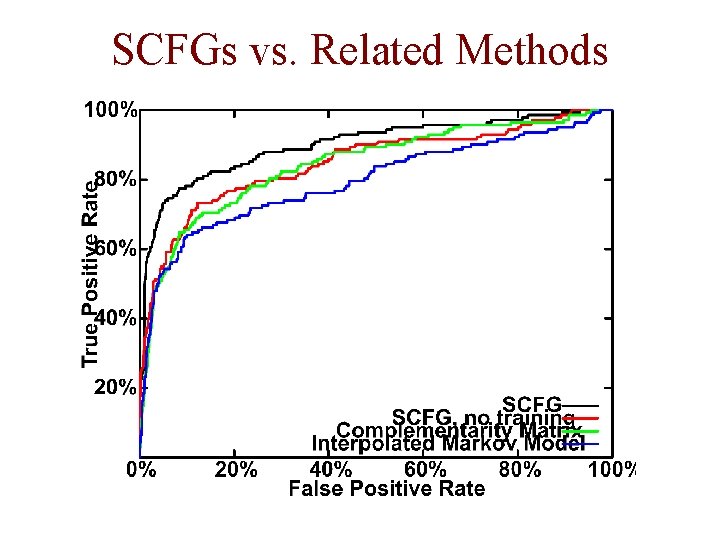
SCFG Experiments • compare predictive accuracy of – SCFG with learned parameters – SCFG without learning (but parameters initialized using domain knowledge) – interpolated Markov models (IMMs) • can represent distribution of bases at each position * cannot easily encode base pair dependencies – complementarity matrices • Brendel et al. , J Biom Struct and Dyn 1986 • ad hoc way of considering base pairings * cannot favor specific base pairs by position
SCFGs vs. Related Methods
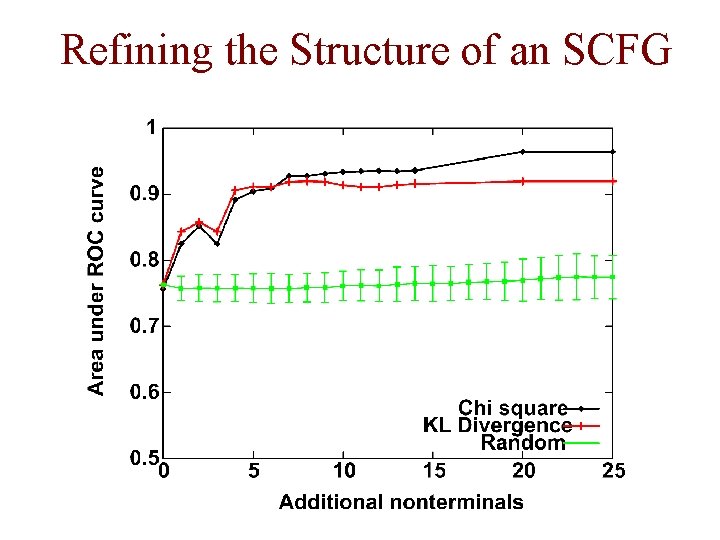
Refining the Structure of an SCFG