
Stochastic Approaches for Reserve Determination and Operational Planning

- Slides: 21
Stochastic Approaches for Reserve Determination and Operational Planning Erik Ela, Eamonn Lannoye, Bob Entriken, Aidan Tuohy eela@epri. com IEEE Power and Energy Society General Meeting July 19, 2016 © 2015 Electric Power Research Institute, Inc. All rights reserved.
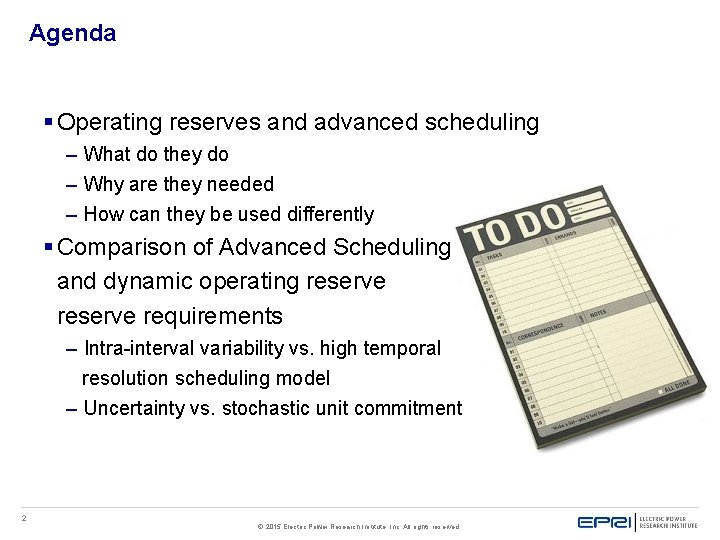
Agenda § Operating reserves and advanced scheduling – What do they do – Why are they needed – How can they be used differently § Comparison of Advanced Scheduling and dynamic operating reserve requirements – Intra-interval variability vs. high temporal resolution scheduling model – Uncertainty vs. stochastic unit commitment 2 © 2015 Electric Power Research Institute, Inc. All rights reserved.
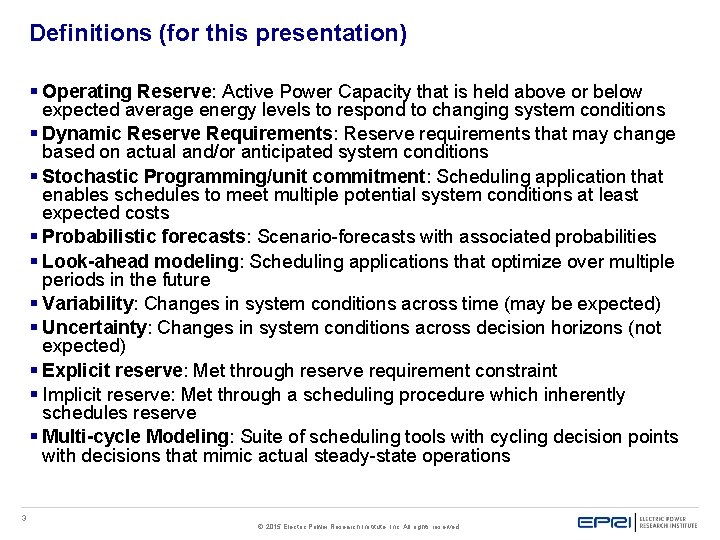
Definitions (for this presentation) § Operating Reserve: Active Power Capacity that is held above or below expected average energy levels to respond to changing system conditions § Dynamic Reserve Requirements: Reserve requirements that may change based on actual and/or anticipated system conditions § Stochastic Programming/unit commitment: Scheduling application that enables schedules to meet multiple potential system conditions at least expected costs § Probabilistic forecasts: Scenario-forecasts with associated probabilities § Look-ahead modeling: Scheduling applications that optimize over multiple periods in the future § Variability: Changes in system conditions across time (may be expected) § Uncertainty: Changes in system conditions across decision horizons (not expected) § Explicit reserve: Met through reserve requirement constraint § Implicit reserve: Met through a scheduling procedure which inherently schedules reserve § Multi-cycle Modeling: Suite of scheduling tools with cycling decision points with decisions that mimic actual steady-state operations 3 © 2015 Electric Power Research Institute, Inc. All rights reserved.
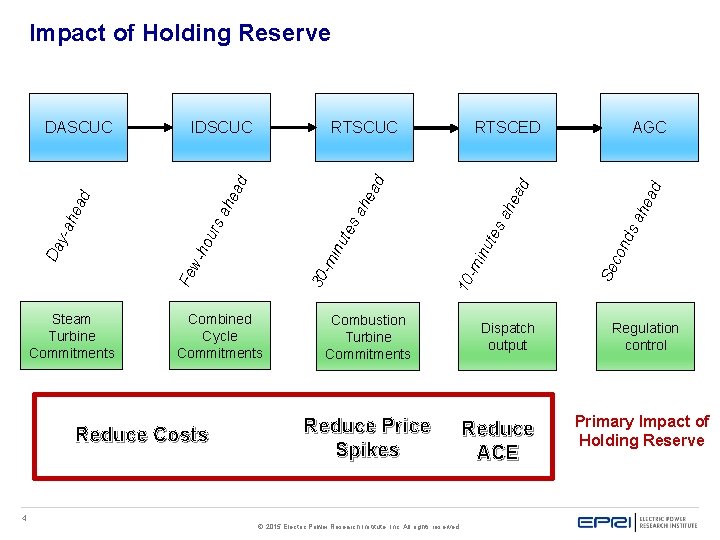
Impact of Holding Reserve ah tes inu 10 -m Combustion Turbine Commitments Reduce Price Spikes © 2015 Electric Power Research Institute, Inc. All rights reserved. Dispatch output Reduce ACE d AGC Se con ds ah ea ea d d ea ah tes -m Combined Cycle Commitments Reduce Costs 4 30 Fe Steam Turbine Commitments RTSCED inu urs w- Da ho y-a RTSCUC ah ea d IDSCUC he ad DASCUC Regulation control Primary Impact of Holding Reserve
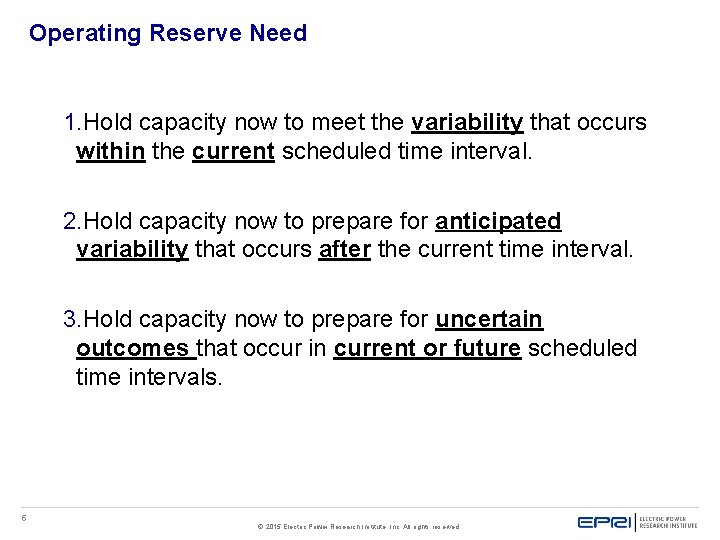
Operating Reserve Need 1. Hold capacity now to meet the variability that occurs within the current scheduled time interval. 2. Hold capacity now to prepare for anticipated variability that occurs after the current time interval. 3. Hold capacity now to prepare for uncertain outcomes that occur in current or future scheduled time intervals. 5 © 2015 Electric Power Research Institute, Inc. All rights reserved.
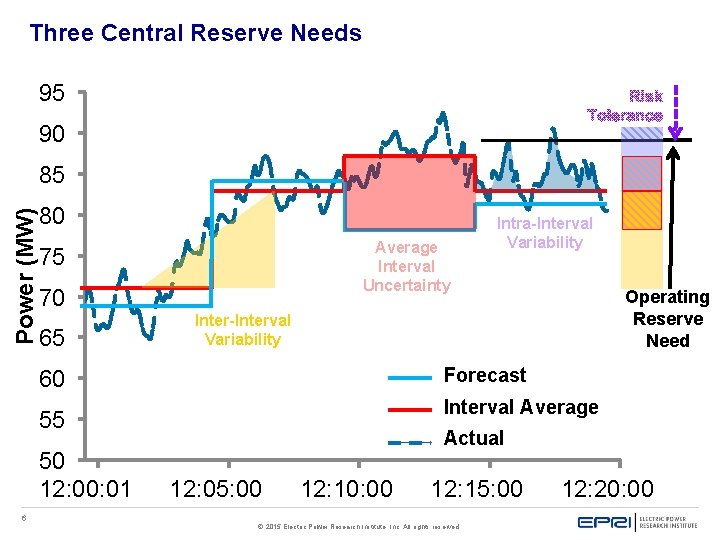
Three Central Reserve Needs 95 90 Power (MW) 85 80 Average Interval Uncertainty 75 70 65 Forecast Interval Average 55 6 Operating Reserve Need Inter-Interval Variability 60 50 12: 00: 01 Intra-Interval Variability Actual 12: 05: 00 12: 10: 00 12: 15: 00 © 2015 Electric Power Research Institute, Inc. All rights reserved. 12: 20: 00
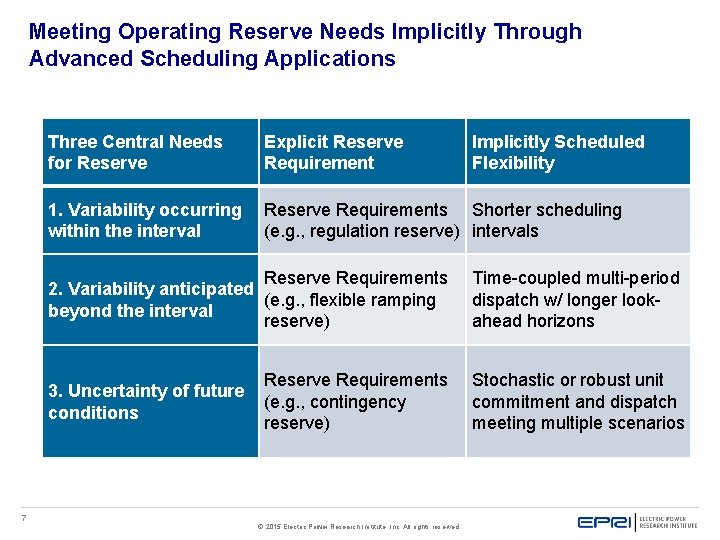
Meeting Operating Reserve Needs Implicitly Through Advanced Scheduling Applications Three Central Needs for Reserve Explicit Reserve Requirement 1. Variability occurring within the interval Reserve Requirements Shorter scheduling (e. g. , regulation reserve) intervals Reserve Requirements 2. Variability anticipated (e. g. , flexible ramping beyond the interval reserve) Time-coupled multi-period dispatch w/ longer lookahead horizons Reserve Requirements (e. g. , contingency reserve) Stochastic or robust unit commitment and dispatch meeting multiple scenarios 3. Uncertainty of future conditions 7 Implicitly Scheduled Flexibility © 2015 Electric Power Research Institute, Inc. All rights reserved.
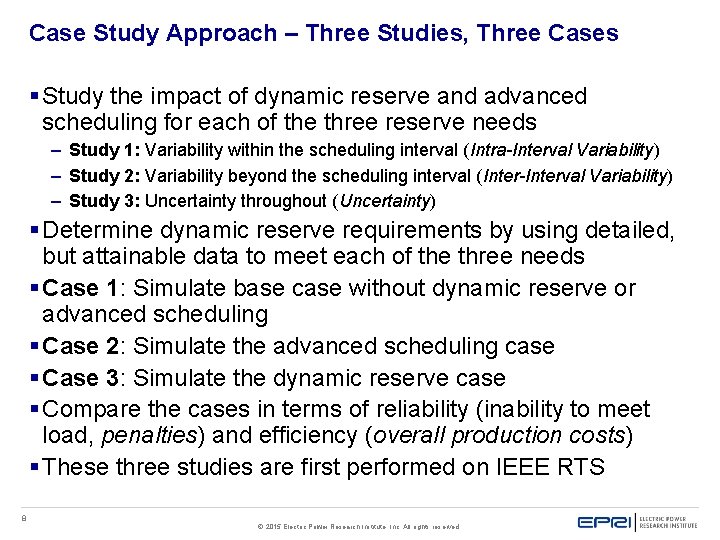
Case Study Approach – Three Studies, Three Cases § Study the impact of dynamic reserve and advanced scheduling for each of the three reserve needs – Study 1: Variability within the scheduling interval (Intra-Interval Variability) – Study 2: Variability beyond the scheduling interval (Inter-Interval Variability) – Study 3: Uncertainty throughout (Uncertainty) § Determine dynamic reserve requirements by using detailed, but attainable data to meet each of the three needs § Case 1: Simulate base case without dynamic reserve or advanced scheduling § Case 2: Simulate the advanced scheduling case § Case 3: Simulate the dynamic reserve case § Compare the cases in terms of reliability (inability to meet load, penalties) and efficiency (overall production costs) § These three studies are first performed on IEEE RTS 8 © 2015 Electric Power Research Institute, Inc. All rights reserved.
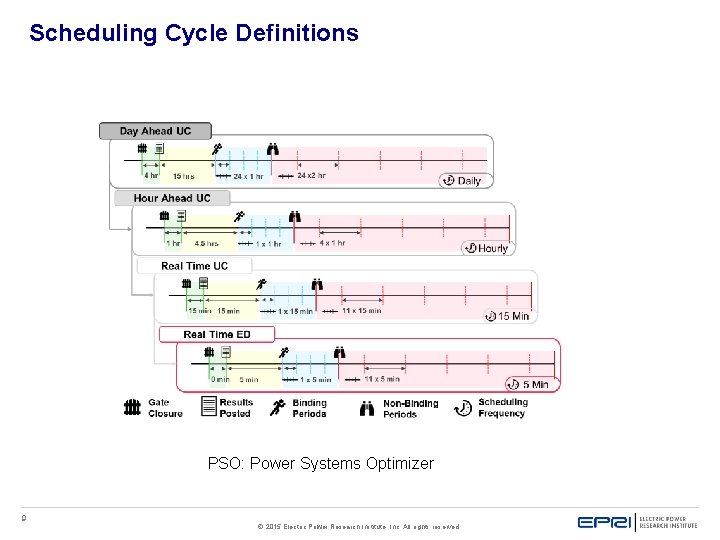
Scheduling Cycle Definitions PSO: Power Systems Optimizer 9 © 2015 Electric Power Research Institute, Inc. All rights reserved.
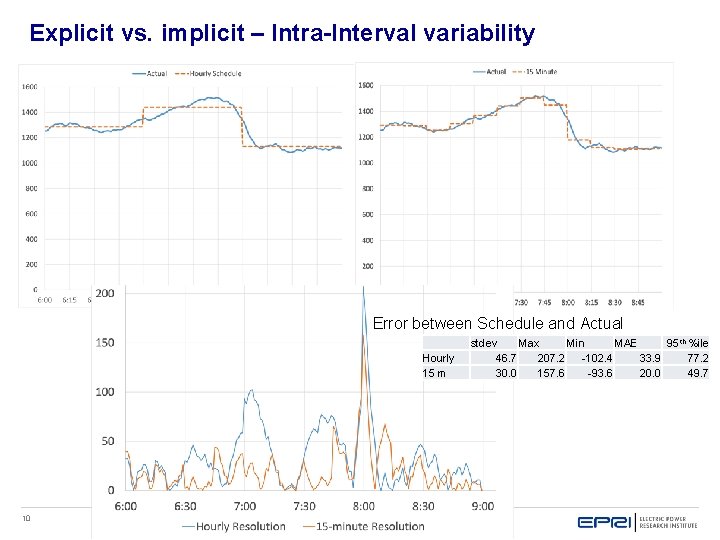
Explicit vs. implicit – Intra-Interval variability Error between Schedule and Actual Hourly 15 m 10 © 2015 Electric Power Research Institute, Inc. All rights reserved. stdev Max Min MAE 95 th %ile 46. 7 207. 2 -102. 4 33. 9 77. 2 30. 0 157. 6 -93. 6 20. 0 49. 7
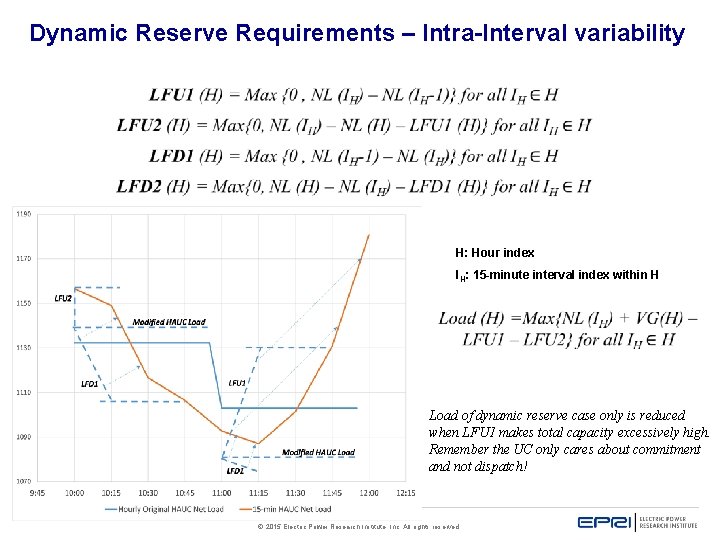
Dynamic Reserve Requirements – Intra-Interval variability H: Hour index IH: 15 -minute interval index within H Load of dynamic reserve case only is reduced when LFU 1 makes total capacity excessively high. Remember the UC only cares about commitment and not dispatch! 11 © 2015 Electric Power Research Institute, Inc. All rights reserved.
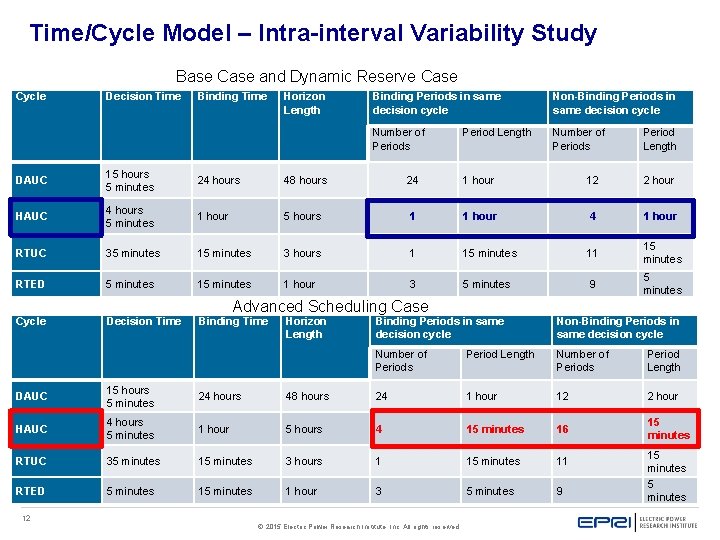
Time/Cycle Model – Intra-interval Variability Study Base Case and Dynamic Reserve Case Cycle Decision Time Binding Time Horizon Length Binding Periods in same decision cycle Non-Binding Periods in same decision cycle Number of Periods Period Length DAUC 15 hours 5 minutes 24 hours 48 hours 24 1 hour 12 2 hour HAUC 4 hours 5 minutes 1 hour 5 hours 1 1 hour 4 1 hour RTUC 35 minutes 15 minutes 3 hours 1 15 minutes 11 15 minutes RTED 5 minutes 1 hour 3 5 minutes 9 5 minutes Advanced Scheduling Case Cycle Decision Time Binding Time Horizon Length Binding Periods in same decision cycle Non-Binding Periods in same decision cycle Number of Periods Period Length DAUC 15 hours 5 minutes 24 hours 48 hours 24 1 hour 12 2 hour HAUC 4 hours 5 minutes 1 hour 5 hours 4 15 minutes 16 15 minutes RTUC 35 minutes 15 minutes 3 hours 1 15 minutes 11 RTED 5 minutes 1 hour 3 5 minutes 9 12 © 2015 Electric Power Research Institute, Inc. All rights reserved. 15 minutes
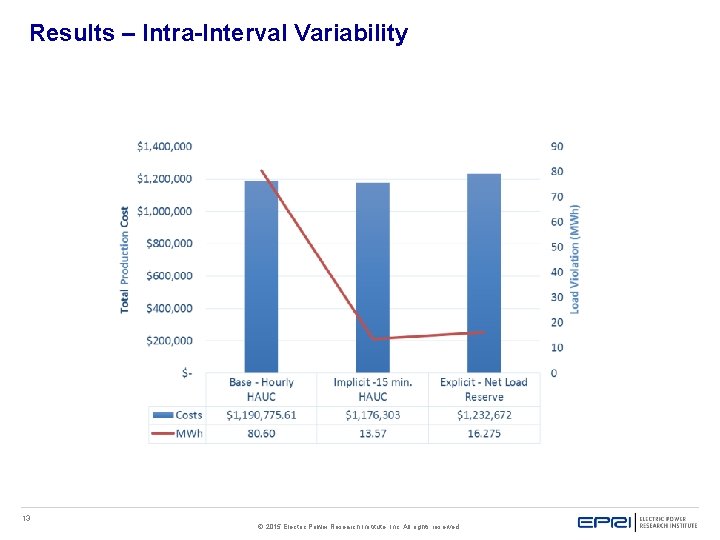
Results – Intra-Interval Variability 13 © 2015 Electric Power Research Institute, Inc. All rights reserved.
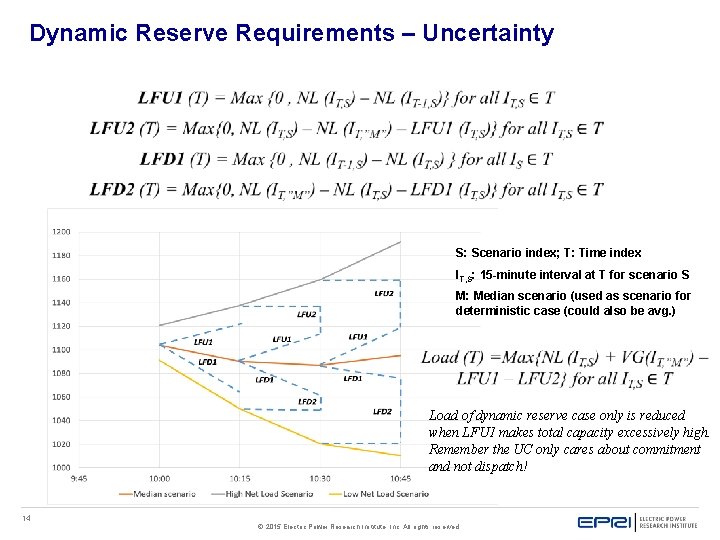
Dynamic Reserve Requirements – Uncertainty S: Scenario index; T: Time index IT, S: 15 -minute interval at T for scenario S M: Median scenario (used as scenario for deterministic case (could also be avg. ) Load of dynamic reserve case only is reduced when LFU 1 makes total capacity excessively high. Remember the UC only cares about commitment and not dispatch! 14 © 2015 Electric Power Research Institute, Inc. All rights reserved.
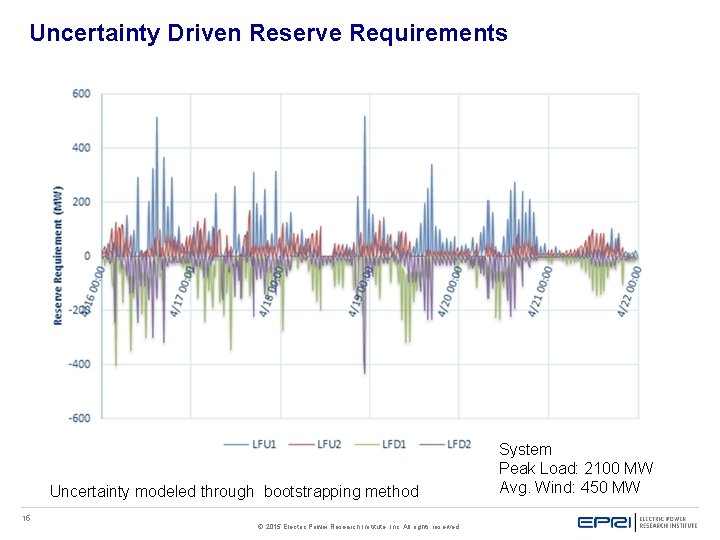
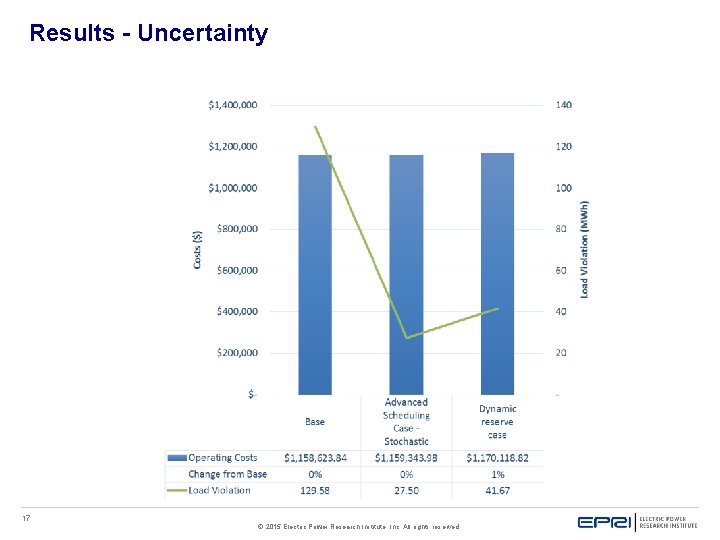
Uncertainty Driven Reserve Requirements Uncertainty modeled through bootstrapping method 15 © 2015 Electric Power Research Institute, Inc. All rights reserved. System Peak Load: 2100 MW Avg. Wind: 450 MW
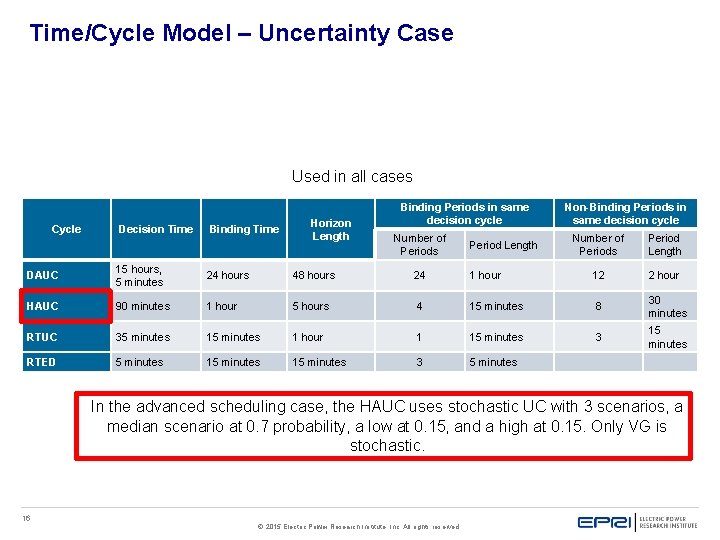
Time/Cycle Model – Uncertainty Case Used in all cases Cycle Decision Time Binding Time Horizon Length Binding Periods in same decision cycle Number of Periods Period Length Non-Binding Periods in same decision cycle Number of Periods Period Length DAUC 15 hours, 5 minutes 24 hours 48 hours 24 1 hour 12 2 hour HAUC 90 minutes 1 hour 5 hours 4 15 minutes 8 30 minutes RTUC 35 minutes 1 hour 1 15 minutes 3 15 minutes RTED 5 minutes 15 minutes 3 5 minutes In the advanced scheduling case, the HAUC uses stochastic UC with 3 scenarios, a median scenario at 0. 7 probability, a low at 0. 15, and a high at 0. 15. Only VG is stochastic. 16 © 2015 Electric Power Research Institute, Inc. All rights reserved.
Results - Uncertainty 17 © 2015 Electric Power Research Institute, Inc. All rights reserved.
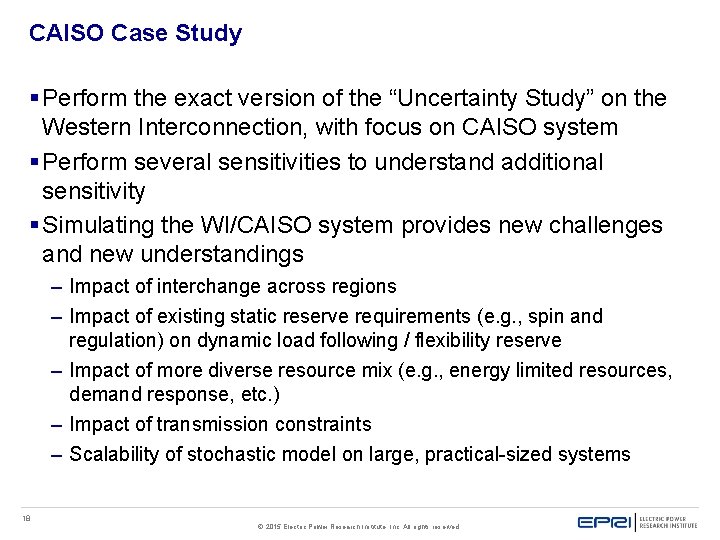
CAISO Case Study § Perform the exact version of the “Uncertainty Study” on the Western Interconnection, with focus on CAISO system § Perform several sensitivities to understand additional sensitivity § Simulating the WI/CAISO system provides new challenges and new understandings – Impact of interchange across regions – Impact of existing static reserve requirements (e. g. , spin and regulation) on dynamic load following / flexibility reserve – Impact of more diverse resource mix (e. g. , energy limited resources, demand response, etc. ) – Impact of transmission constraints – Scalability of stochastic model on large, practical-sized systems 18 © 2015 Electric Power Research Institute, Inc. All rights reserved.
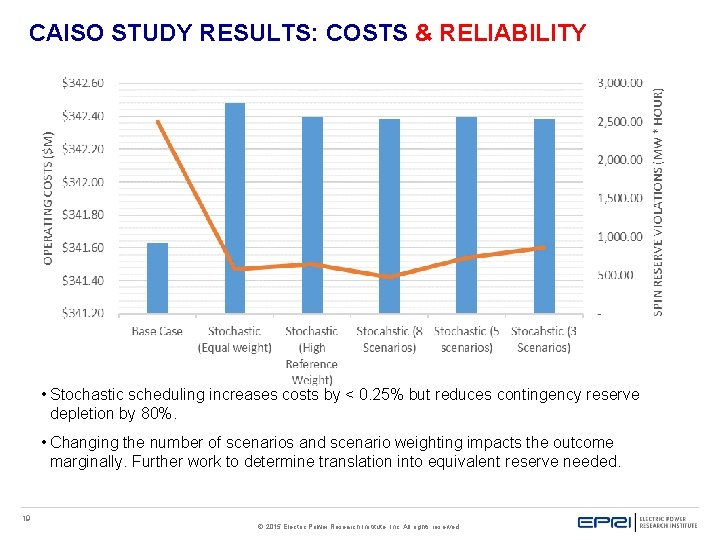
CAISO STUDY RESULTS: COSTS & RELIABILITY • Stochastic scheduling increases costs by < 0. 25% but reduces contingency reserve depletion by 80%. • Changing the number of scenarios and scenario weighting impacts the outcome marginally. Further work to determine translation into equivalent reserve needed. 19 © 2015 Electric Power Research Institute, Inc. All rights reserved.
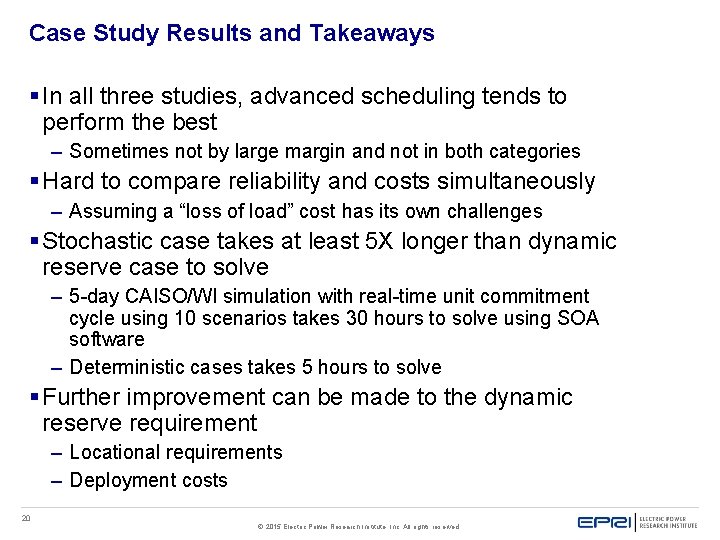
Case Study Results and Takeaways § In all three studies, advanced scheduling tends to perform the best – Sometimes not by large margin and not in both categories § Hard to compare reliability and costs simultaneously – Assuming a “loss of load” cost has its own challenges § Stochastic case takes at least 5 X longer than dynamic reserve case to solve – 5 -day CAISO/WI simulation with real-time unit commitment cycle using 10 scenarios takes 30 hours to solve using SOA software – Deterministic cases takes 5 hours to solve § Further improvement can be made to the dynamic reserve requirement – Locational requirements – Deployment costs 20 © 2015 Electric Power Research Institute, Inc. All rights reserved.
Together…Shaping the Future of Electricity 21 © 2015 Electric Power Research Institute, Inc. All rights reserved.