
Stnd 3 a Objective CNotes Meiosis Cell Division
Stnd: 3 a Objective: C-Notes: Meiosis (Cell Division of Sex Cells) 2/3/2013 SWBAT identify meiosis in the cell cycle as the results in 4 daughter cells with unidentical sets of chromosomes.
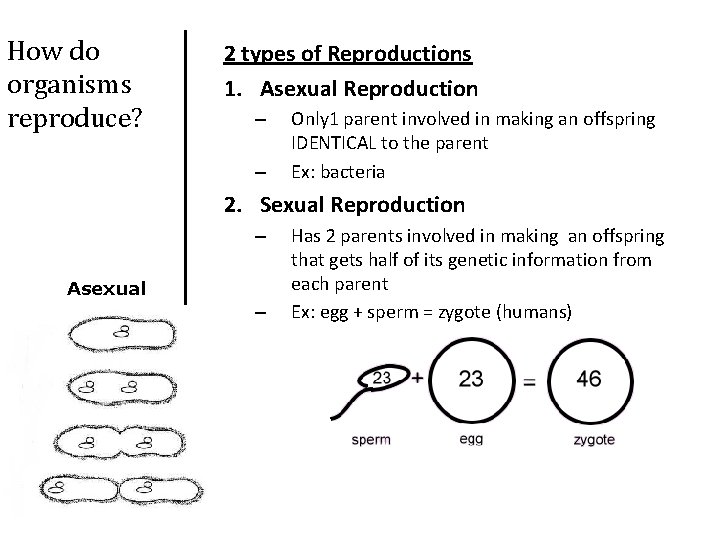
How do organisms reproduce? 2 types of Reproductions 1. Asexual Reproduction – – Only 1 parent involved in making an offspring IDENTICAL to the parent Ex: bacteria 2. Sexual Reproduction – Asexual – Has 2 parents involved in making an offspring that gets half of its genetic information from each parent Ex: egg + sperm = zygote (humans)
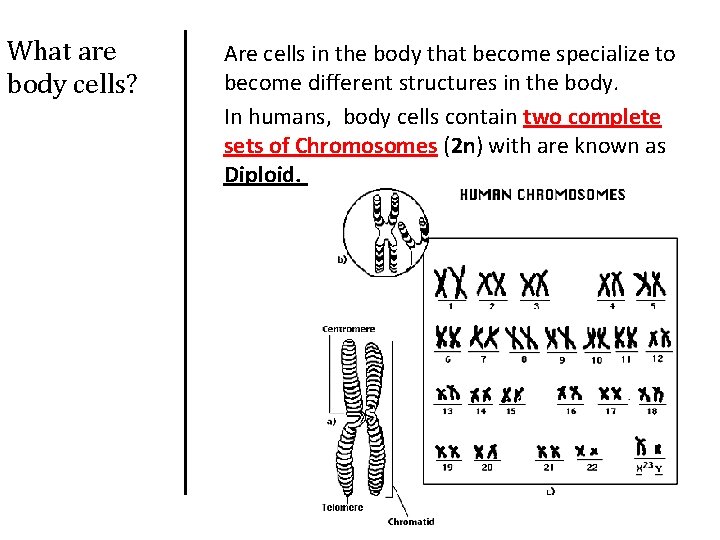
What are body cells? Are cells in the body that become specialize to become different structures in the body. In humans, body cells contain two complete sets of Chromosomes (2 n) with are known as Diploid.
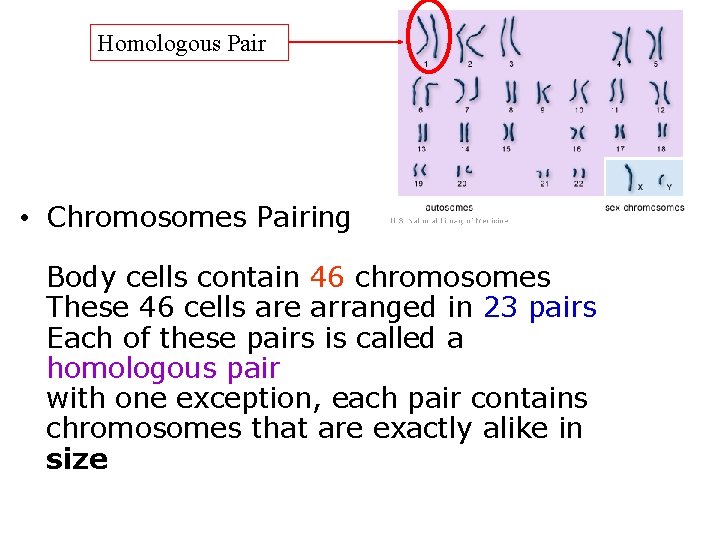
Homologous Pair • Chromosomes Pairing Body cells contain 46 chromosomes These 46 cells are arranged in 23 pairs Each of these pairs is called a homologous pair with one exception, each pair contains chromosomes that are exactly alike in size
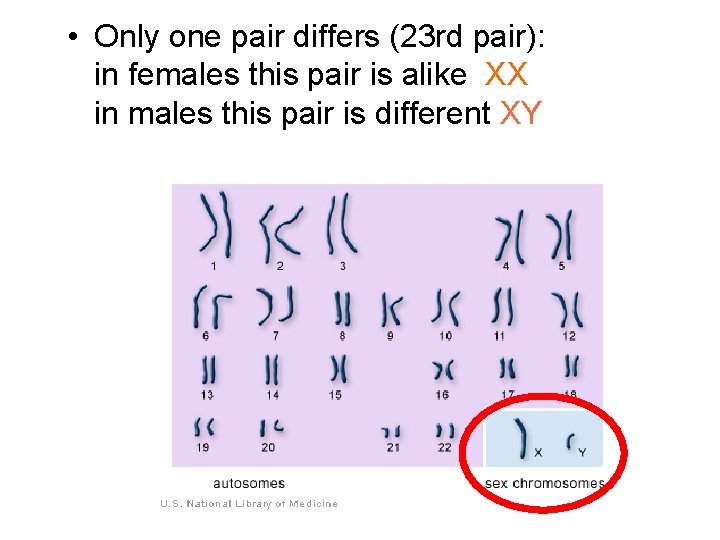
• Only one pair differs (23 rd pair): in females this pair is alike XX in males this pair is different XY
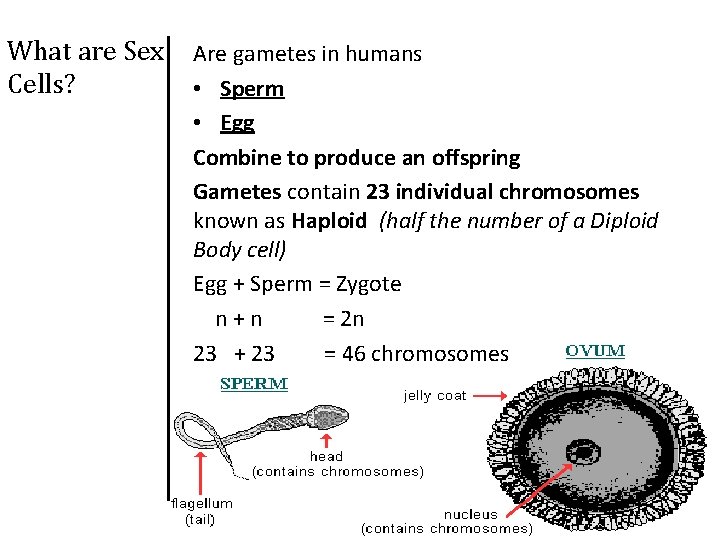
What are Sex Cells? Are gametes in humans • Sperm • Egg Combine to produce an offspring Gametes contain 23 individual chromosomes known as Haploid (half the number of a Diploid Body cell) Egg + Sperm = Zygote n+n = 2 n 23 + 23 = 46 chromosomes
Why is it important that gametes be Haploid? • to keep the number of chromosomes stable from generation to generation. • The fusion of haploid gametes creates offspring with diploid cells (n+n=2 n)
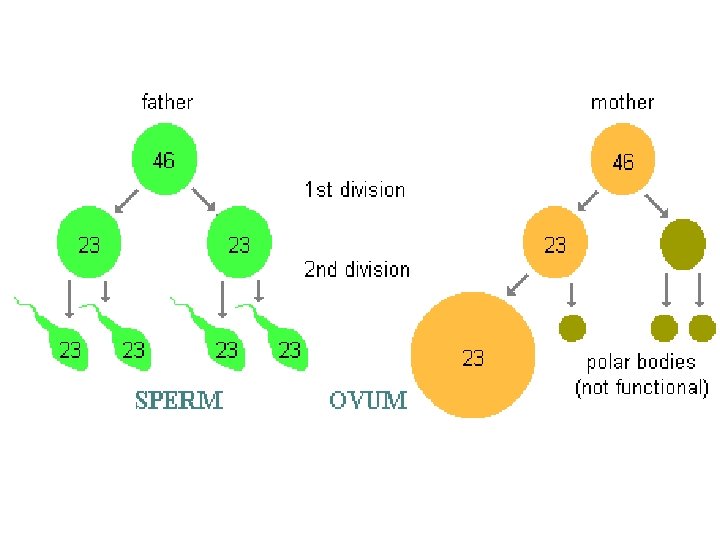
What is Meiosis? • a complex series of changes that divides the “nucleus” of sex cells • Creates eggs and sperm cells with 23 chromosomes, which combines during fertilization to make a zygote (fertilized egg) with 46 chromosomes. • The zygote can divide by mitosis to make a baby with body cells containing 46 chromosomes each.
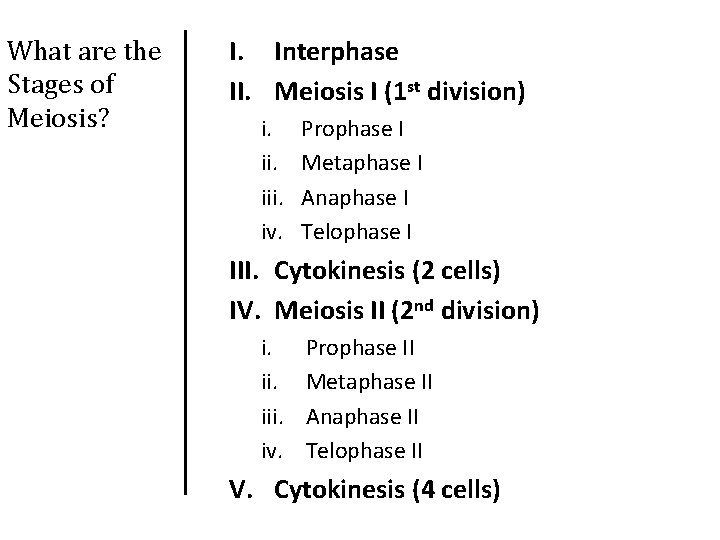
What are the Stages of Meiosis? I. Interphase II. Meiosis I (1 st division) i. iii. iv. Prophase I Metaphase I Anaphase I Telophase I III. Cytokinesis (2 cells) IV. Meiosis II (2 nd division) i. iii. iv. Prophase II Metaphase II Anaphase II Telophase II V. Cytokinesis (4 cells)
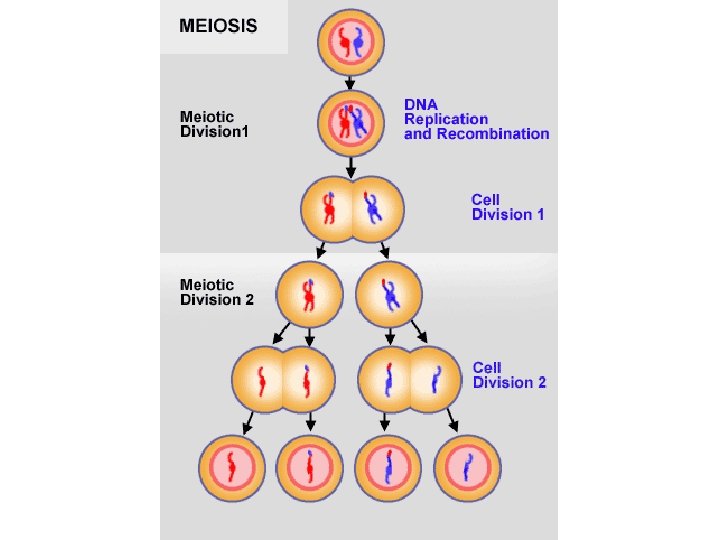

Stages • Before meiosis begins: Interphase -G 1: Cell grows and matures -S: Cell makes a copy of its DNA -G 2: Cell prepares for division • During Meiosis: – Meiosis II
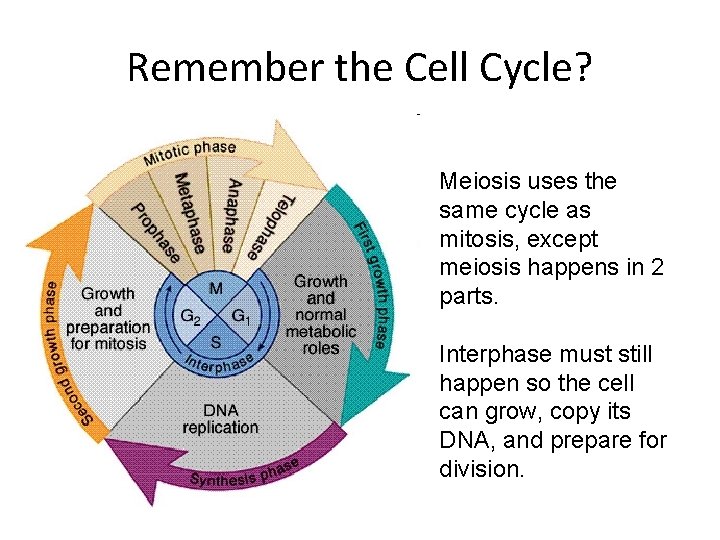
Remember the Cell Cycle? Meiosis uses the same cycle as mitosis, except meiosis happens in 2 parts. Interphase must still happen so the cell can grow, copy its DNA, and prepare for division.
What happens during Meiosis I? I. Chromosome number gets cut in half (1 diploid cell 2 haploid cells) II. 4 parts I. III. IV. Prophase I Metaphase I Anaphase I Telophase I
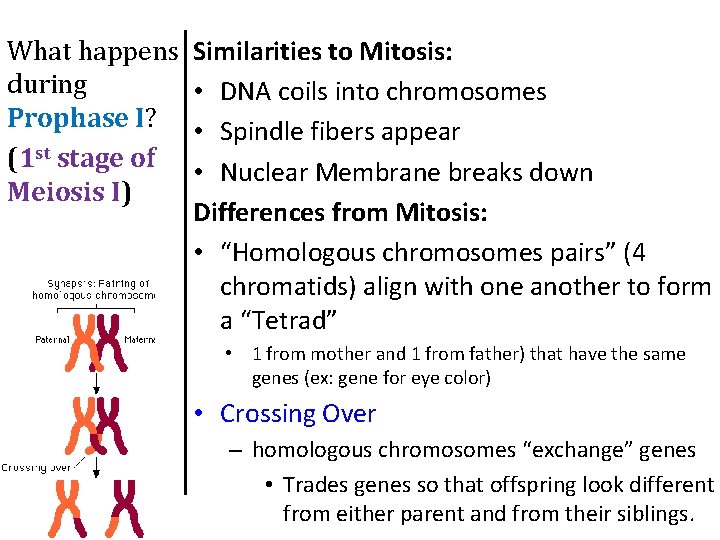
What happens during Prophase I? (1 st stage of Meiosis I) Similarities to Mitosis: • DNA coils into chromosomes • Spindle fibers appear • Nuclear Membrane breaks down Differences from Mitosis: • “Homologous chromosomes pairs” (4 chromatids) align with one another to form a “Tetrad” • 1 from mother and 1 from father) that have the same genes (ex: gene for eye color) • Crossing Over – homologous chromosomes “exchange” genes • Trades genes so that offspring look different from either parent and from their siblings.
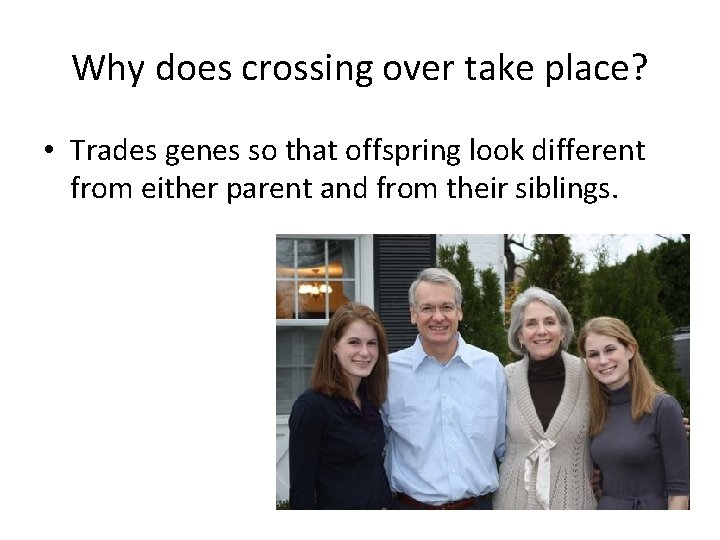
Why does crossing over take place? • Trades genes so that offspring look different from either parent and from their siblings.
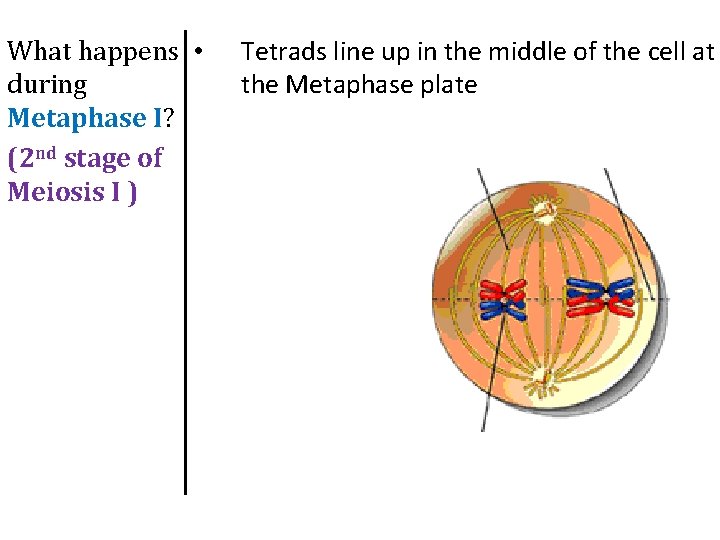
What happens • during Metaphase I? (2 nd stage of Meiosis I ) Tetrads line up in the middle of the cell at the Metaphase plate
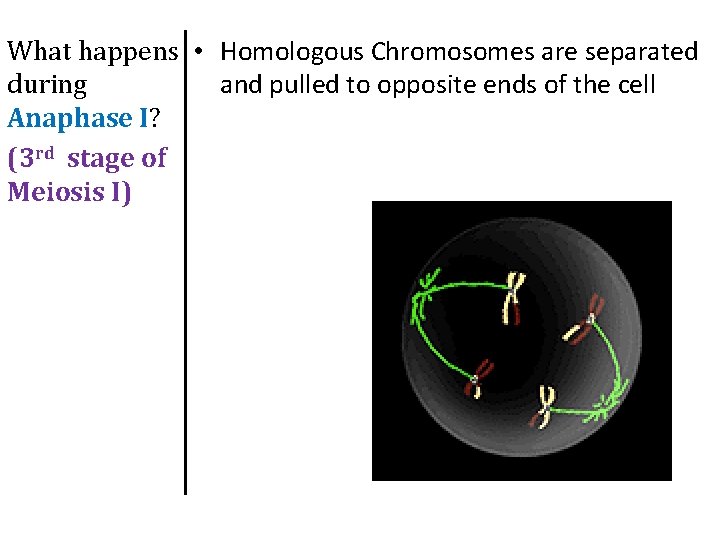
What happens • Homologous Chromosomes are separated and pulled to opposite ends of the cell during Anaphase I? (3 rd stage of Meiosis I)
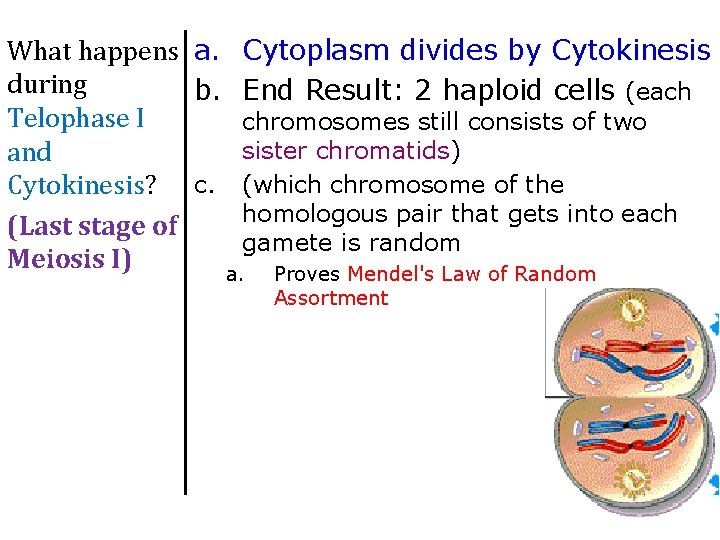
What happens a. Cytoplasm divides by Cytokinesis during b. End Result: 2 haploid cells (each Telophase I chromosomes still consists of two sister chromatids) and Cytokinesis? c. (which chromosome of the homologous pair that gets into each (Last stage of gamete is random Meiosis I) a. Proves Mendel's Law of Random Assortment
What happens during Meiosis II? • DNA is NOT copied again • Chromatids (identical copies of DNA) separate like they do during mitosis 4 Stages: (Everything occurs like Mitosis) 1) Prophase II 2) Metaphase II 3) Anaphase II 4) Telophase II and Cytokinesis
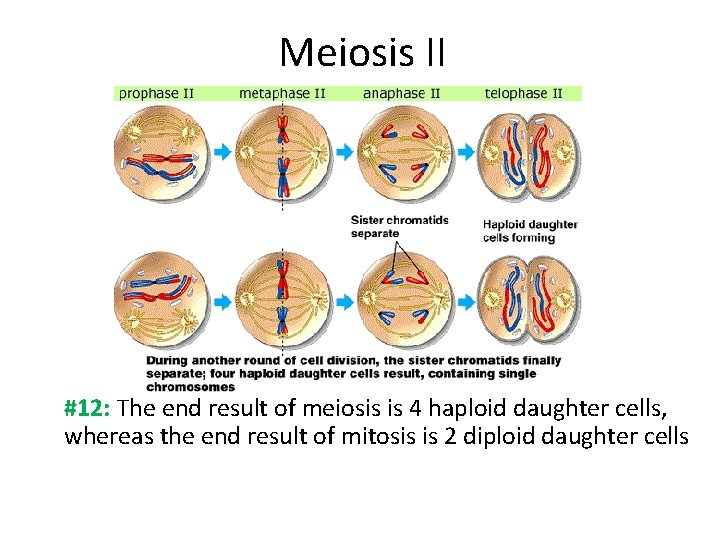
Meiosis II #12: The end result of meiosis is 4 haploid daughter cells, whereas the end result of mitosis is 2 diploid daughter cells
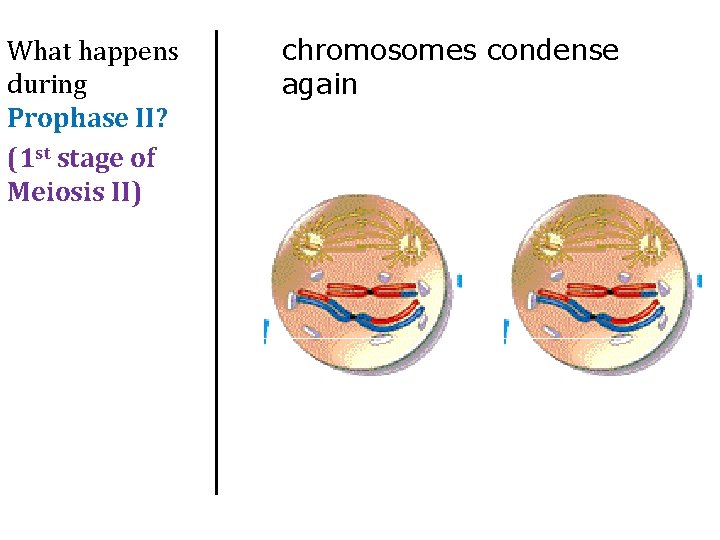
What happens during Prophase II? (1 st stage of Meiosis II) chromosomes condense again

What happens during Metaphase II? (2 nd stage of Meiosis II) • chromosomes line up along the center of the cell (metaphase plate)
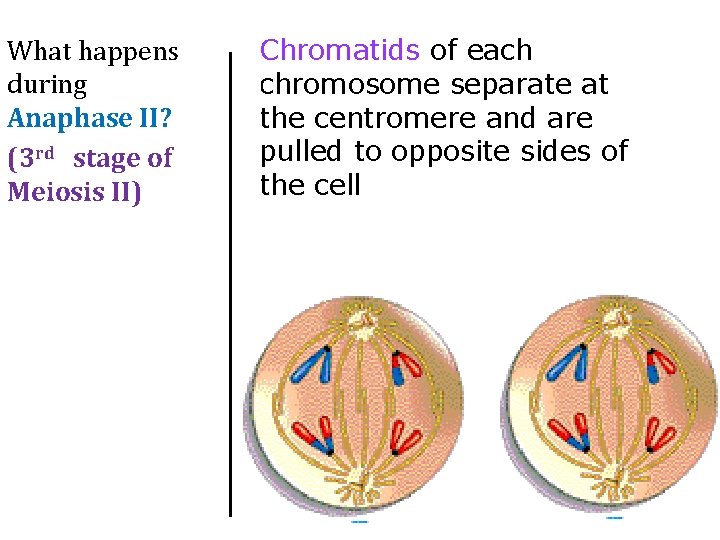
What happens during Anaphase II? (3 rd stage of Meiosis II) Chromatids of each chromosome separate at the centromere and are pulled to opposite sides of the cell

What happens during Telophase II and Cytokineses? (Last stage of Meiosis II) • Spindle breaks down • Chromosomes uncoil Nuclear envelopes form • Cytoplasm divides • Four haploid cells are produced
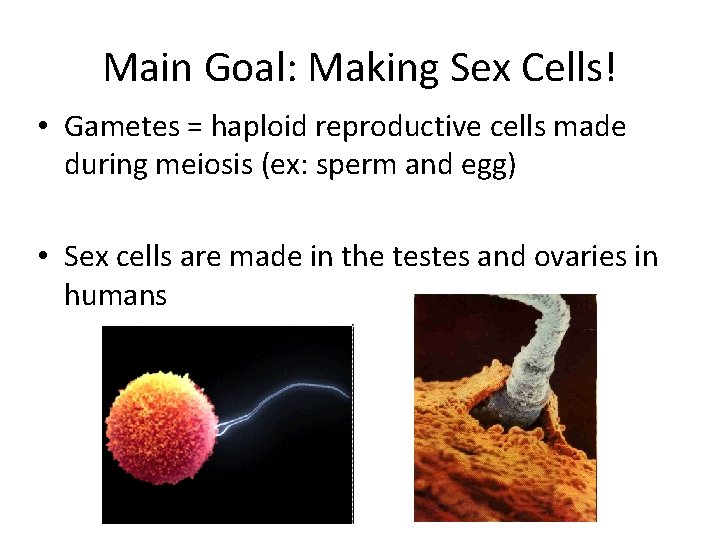
Main Goal: Making Sex Cells! • Gametes = haploid reproductive cells made during meiosis (ex: sperm and egg) • Sex cells are made in the testes and ovaries in humans
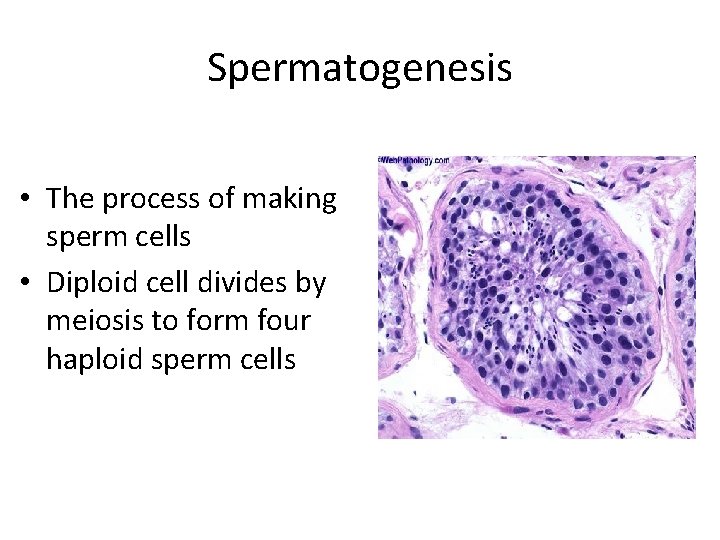
Spermatogenesis • The process of making sperm cells • Diploid cell divides by meiosis to form four haploid sperm cells
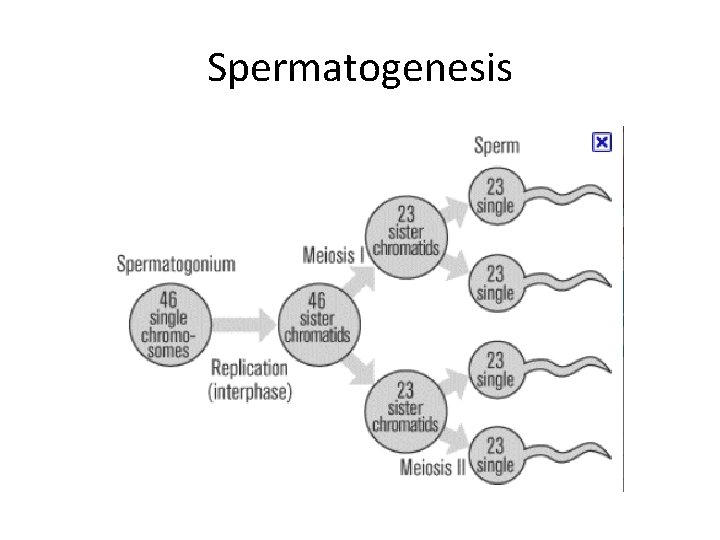
Spermatogenesis
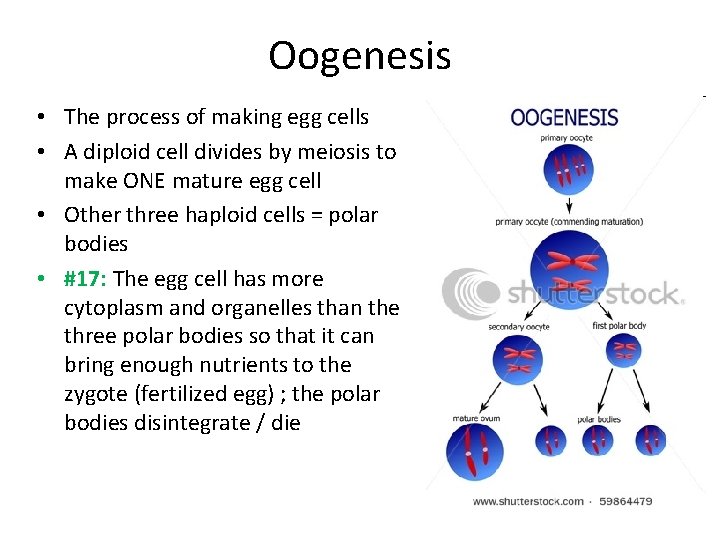
Oogenesis • The process of making egg cells • A diploid cell divides by meiosis to make ONE mature egg cell • Other three haploid cells = polar bodies • #17: The egg cell has more cytoplasm and organelles than the three polar bodies so that it can bring enough nutrients to the zygote (fertilized egg) ; the polar bodies disintegrate / die
Comparing Spermatogenesis and Oogenesis • #18: Spermatogenesis produces four functional sperm cell, and oogenesis only produces one functional egg cell.
Comparing Mitosis and Meiosis • #19: During metaphase I of meiosis, chromosomes line up in homologous pairs along the metaphase plate. During metaphase of mitosis, chromosomes line up single file along the metaphase plate.
Comparing Mitosis and Meiosis • #20: Meiosis II is most like mitosis because chromosomes line up single file along the metaphase plate, chromatids separate during anaphase, and daughter cells have the same number of chromosomes as the parent cell (just with one chromatid instead of two)

Meiosis Provides Genetic Variation Two Ways: 1. Random Assortment of chromosomes

Meiosis Provides Genetic Variation • 2. Crossing Over meiosis allows for the shuffling of chromosomes through crossing over
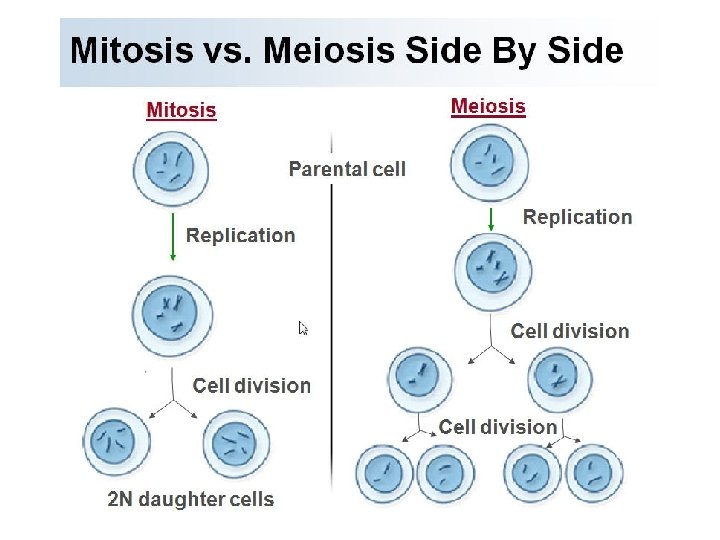
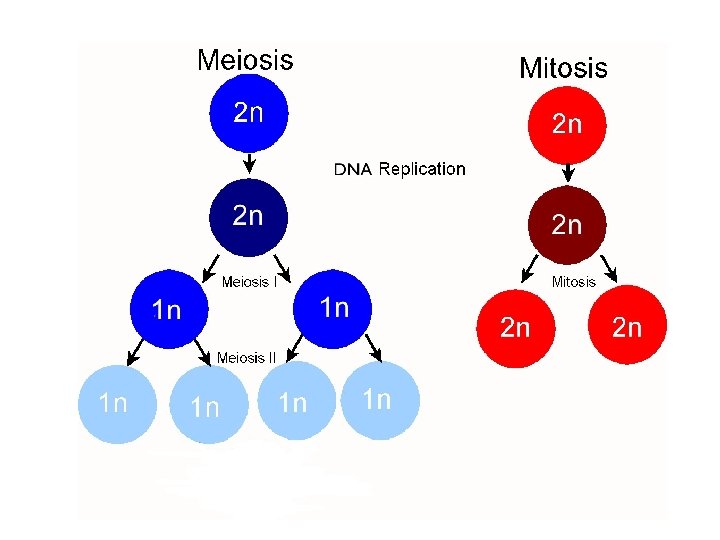
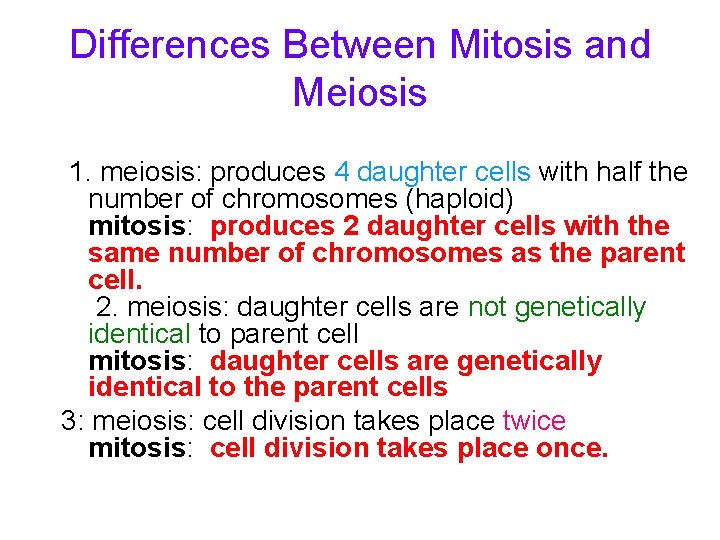
Differences Between Mitosis and Meiosis 1. meiosis: produces 4 daughter cells with half the number of chromosomes (haploid) mitosis: produces 2 daughter cells with the same number of chromosomes as the parent cell. 2. meiosis: daughter cells are not genetically identical to parent cell mitosis: daughter cells are genetically identical to the parent cells 3: meiosis: cell division takes place twice mitosis: cell division takes place once.
Comparison Animations http: //www. pbs. org/wgbh/nova/baby/divi_flash. html http: //www. usoe. k 12. ut. us/curr/science/sciber 00/7 th/ge netics/sciber/animatin. htm
- Slides: 38