
STLD K MAP PREPARED BY K ASHOK KUMAR

STLD K- MAP PREPARED BY K. ASHOK KUMAR ASSISTANT PROFESSOR DEPARTMENT OF ECE
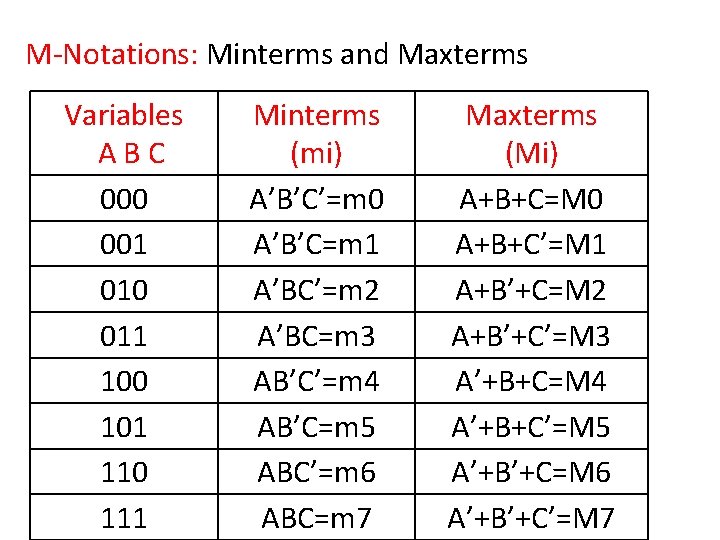
M-Notations: Minterms and Maxterms Variables A B C 000 001 010 011 100 101 110 111 Minterms (mi) A’B’C’=m 0 A’B’C=m 1 A’BC’=m 2 A’BC=m 3 AB’C’=m 4 AB’C=m 5 ABC’=m 6 ABC=m 7 Maxterms (Mi) A+B+C=M 0 A+B+C’=M 1 A+B’+C=M 2 A+B’+C’=M 3 A’+B+C=M 4 A’+B+C’=M 5 A’+B’+C=M 6 A’+B’+C’=M 7
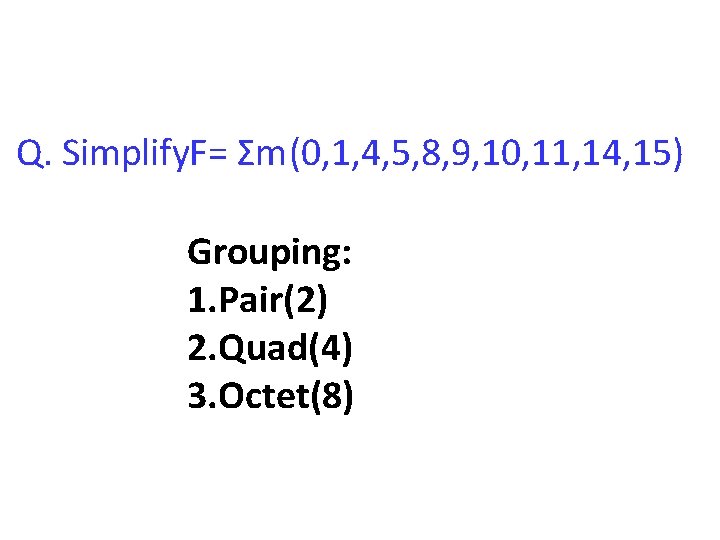
Q. Simplify. F= Σm(0, 1, 4, 5, 8, 9, 10, 11, 14, 15) Grouping: 1. Pair(2) 2. Quad(4) 3. Octet(8)
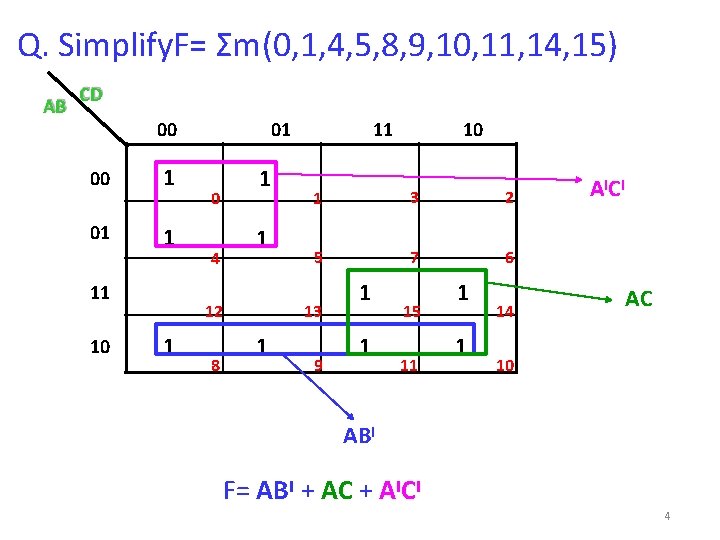
Q. Simplify. F= Σm(0, 1, 4, 5, 8, 9, 10, 11, 14, 15) AB CD 00 00 1 01 1 11 10 01 1 0 1 4 12 1 8 11 1 3 2 5 7 6 13 1 10 9 1 1 15 11 1 1 14 A I CI AC 10 ABI F= ABI + AC + AICI 4
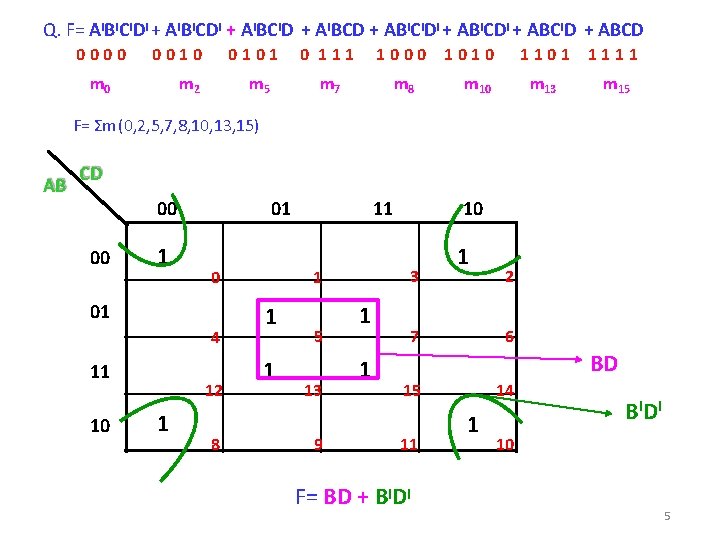
Q. F= AIBICIDI + AIBICDI + AIBCID + AIBCD + ABICIDI + ABICDI + ABCID + ABCD 0000 0010 m 0 0101 m 2 m 5 0 111 1000 1010 m 7 m 8 1101 1111 m 10 m 13 m 15 F= Σm(0, 2, 5, 7, 8, 10, 13, 15) AB CD 00 00 1 01 0 01 4 11 10 12 1 8 11 3 1 1 1 5 13 9 10 1 1 1 7 2 6 BD 15 11 F= BD + BIDI 14 1 BIDI 10 5
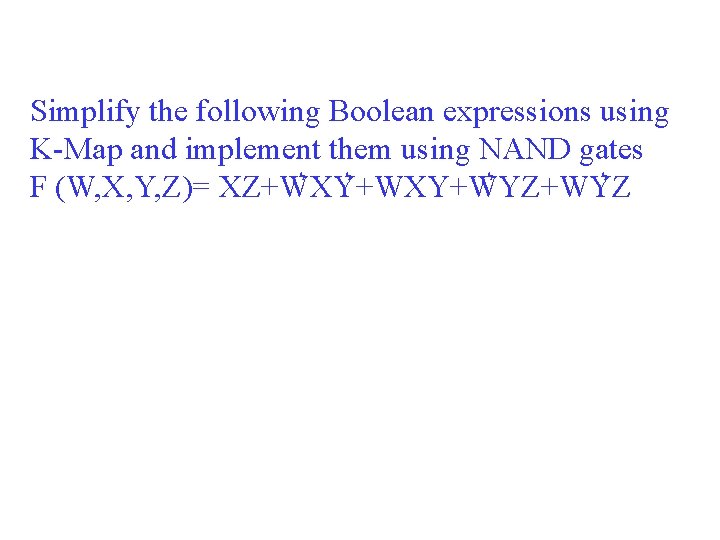
Simplify the following Boolean expressions using K-Map and implement them using NAND gates F (W, X, Y, Z)= XZ+W XY +WXY+W YZ+WY Z
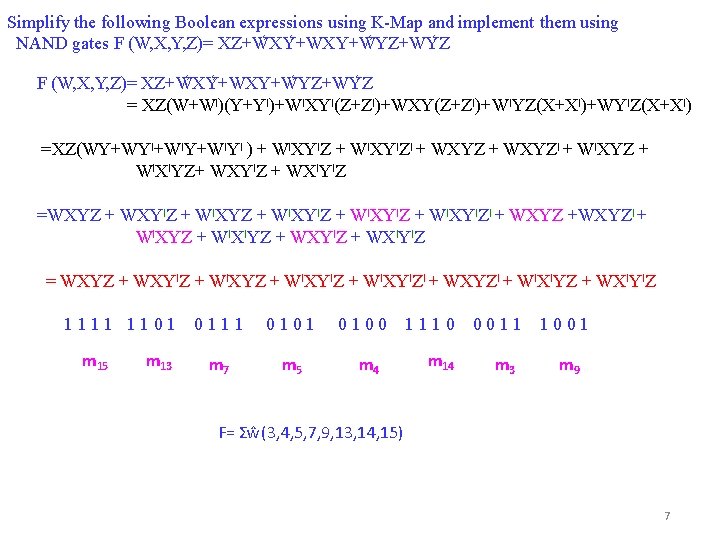
Simplify the following Boolean expressions using K-Map and implement them using NAND gates F (W, X, Y, Z)= XZ+W XY +WXY+W YZ+WY Z = XZ(W+WI)(Y+YI)+WIXYI(Z+ZI)+WXY(Z+ZI)+WIYZ(X+XI)+WYIZ(X+XI) =XZ(WY+WYI+WIYI ) + WIXYIZI + WXYZI + WIXYZ + WIXIYZ+ WXYIZ + WXIYIZ =WXYZ + WXYIZ + WIXYIZI + WXYZ +WXYZI + WIXYZ + WIXIYZ + WXYIZ + WXIYIZ = WXYZ + WXYIZ + WIXYIZI + WXYZI + WIXIYZ + WXIYIZ 1111 1101 0111 m 15 m 13 m 7 0101 m 5 0100 m 4 1110 m 14 0011 1001 m 3 m 9 F= Σŵ(3, 4, 5, 7, 9, 13, 14, 15) 7
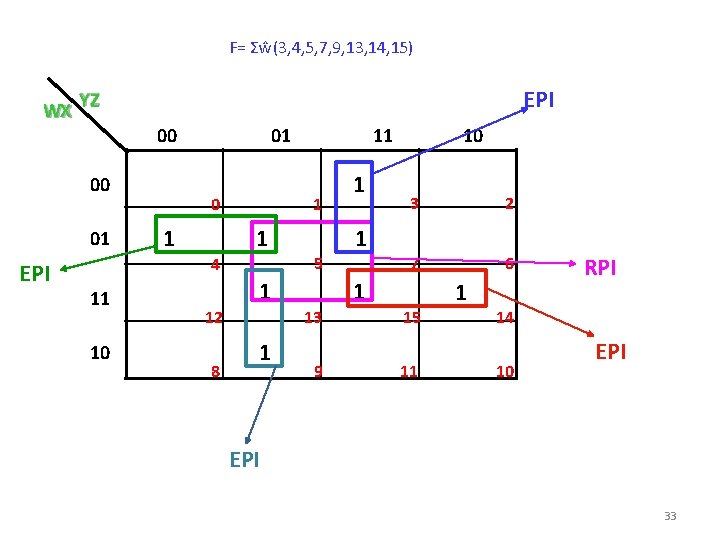
F= Σŵ(3, 4, 5, 7, 9, 13, 14, 15) EPI WX YZ 00 00 01 EPI 01 0 1 1 1 4 11 10 12 8 11 1 1 5 13 9 1 10 3 2 7 6 15 11 1 RPI 14 10 EPI 33
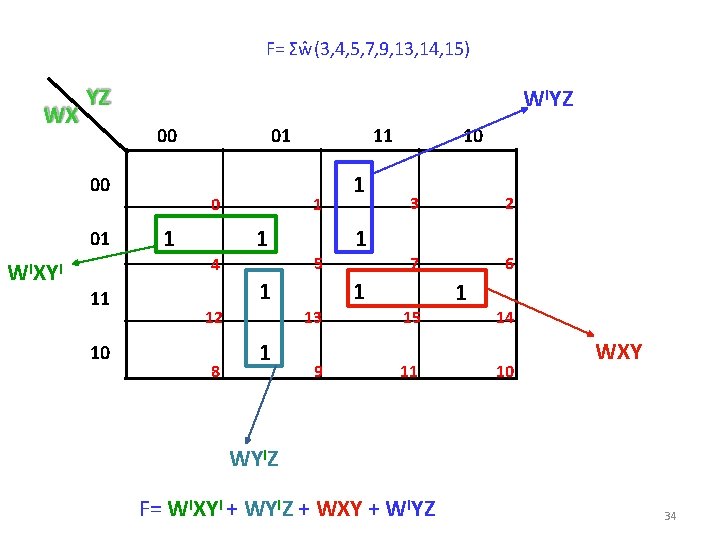
F= Σŵ(3, 4, 5, 7, 9, 13, 14, 15) WX YZ WIYZ 00 00 01 WIXYI 01 0 1 1 1 4 11 10 12 8 11 1 1 5 13 9 1 10 3 2 7 6 15 11 1 14 10 WXY WYIZ F= WIXYI + WYIZ + WXY + WIYZ 34
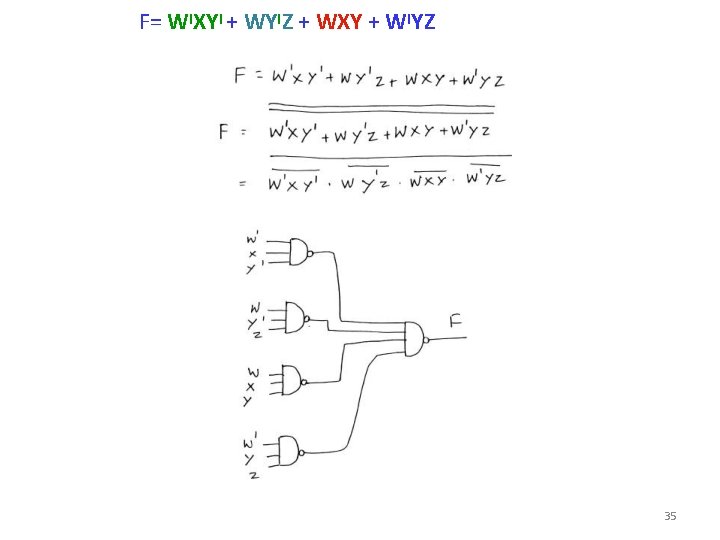
F= WIXYI + WYIZ + WXY + WIYZ 35
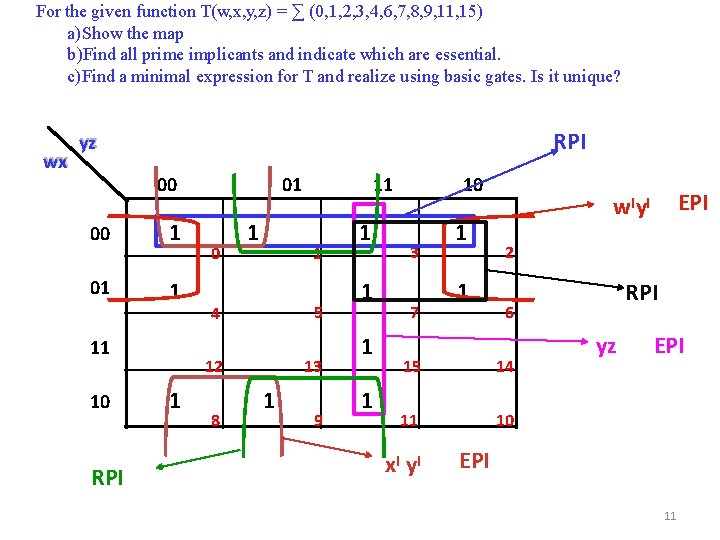
For the given function T(w, x, y, z) = ∑ (0, 1, 2, 3, 4, 6, 7, 8, 9, 11, 15) a)Show the map b)Find all prime implicants and indicate which are essential. c)Find a minimal expression for T and realize using basic gates. Is it unique? wx RPI yz 00 00 1 01 1 11 10 RPI 01 0 1 1 5 4 12 1 8 11 13 1 9 1 1 10 3 7 1 1 2 RPI 6 15 14 11 10 x. I y. I EPI w. Iy. I yz EPI 11
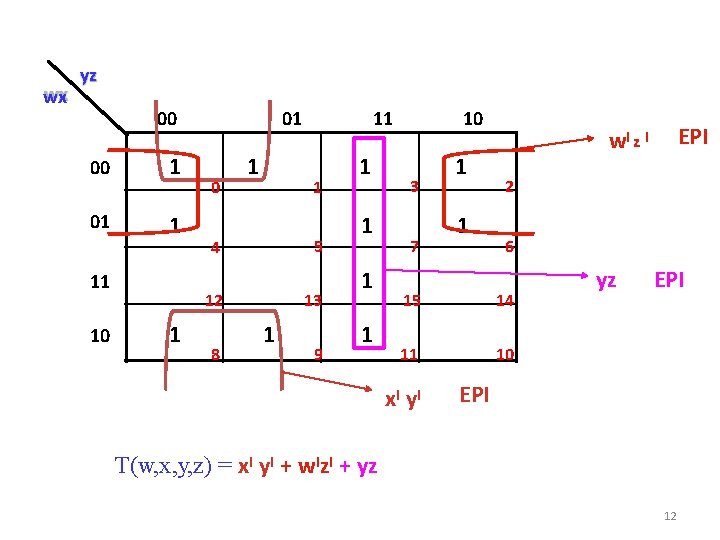
wx yz 00 00 1 01 1 11 10 01 0 1 1 5 4 12 1 8 11 13 1 9 1 1 10 3 7 1 1 2 6 15 14 11 10 x. I y. I EPI w. I z I yz EPI T(w, x, y, z) = x. I y. I + w. Iz. I + yz 12

Where Prime Implicants –PI Essential Prime Implicants –EPI Redundant Prime Implicants –RPI Grouping: 1. Pair(2) 2. Quad(4) 3. Octet(8)
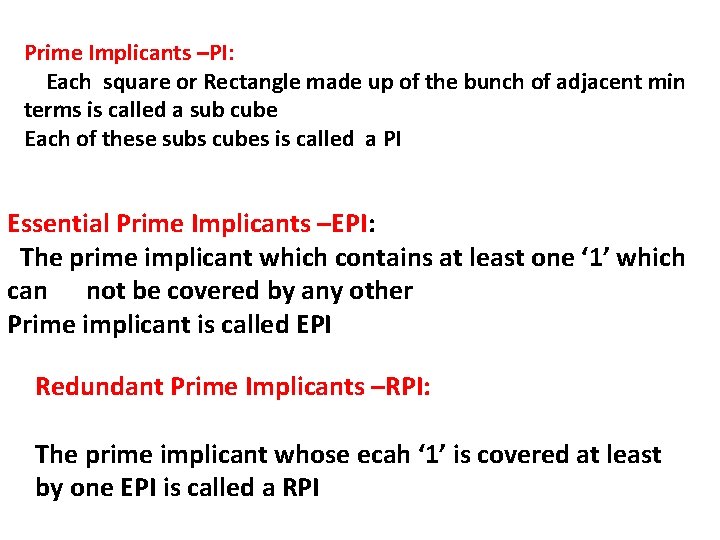
Prime Implicants –PI: Each square or Rectangle made up of the bunch of adjacent min terms is called a sub cube Each of these subs cubes is called a PI Essential Prime Implicants –EPI: The prime implicant which contains at least one ‘ 1’ which can not be covered by any other Prime implicant is called EPI Redundant Prime Implicants –RPI: The prime implicant whose ecah ‘ 1’ is covered at least by one EPI is called a RPI
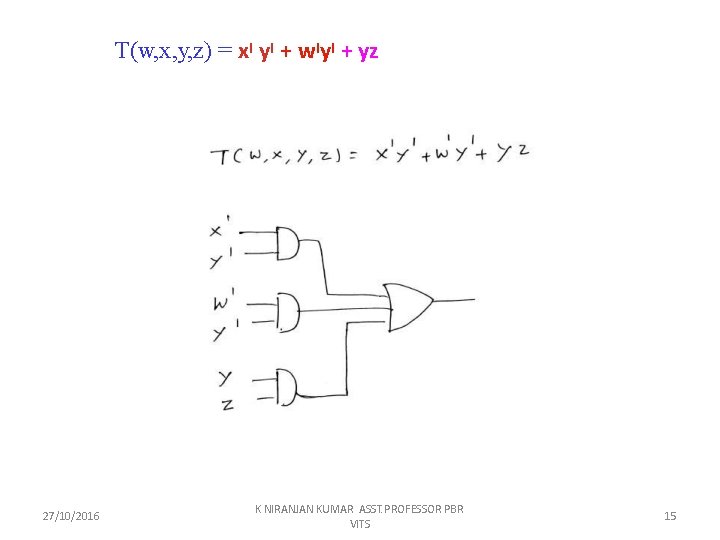
T(w, x, y, z) = x. I y. I + w. Iy. I + yz 27/10/2016 K NIRANJAN KUMAR ASST. PROFESSOR PBR VITS 15
Reduce using mapping the expression f=ΠM(2, 8, 9, 10, 11, 12, 14) and implement using NOR logic gates
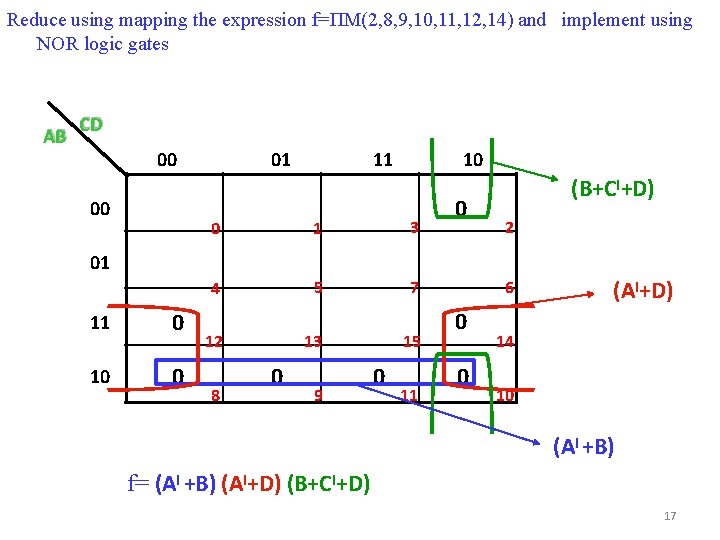
Reduce using mapping the expression f=ΠM(2, 8, 9, 10, 11, 12, 14) and implement using NOR logic gates AB CD 00 00 01 11 10 0 1 3 4 5 7 0 (B+CI+D) 2 01 11 0 10 0 12 8 13 0 9 15 0 11 6 0 0 (AI+D) 14 10 (AI +B) f= (AI +B) (AI+D) (B+CI+D) 17
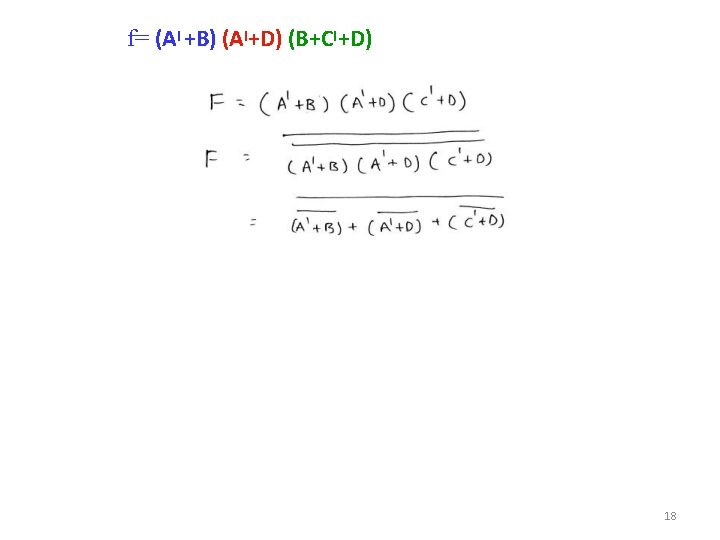
f= (AI +B) (AI+D) (B+CI+D) 18
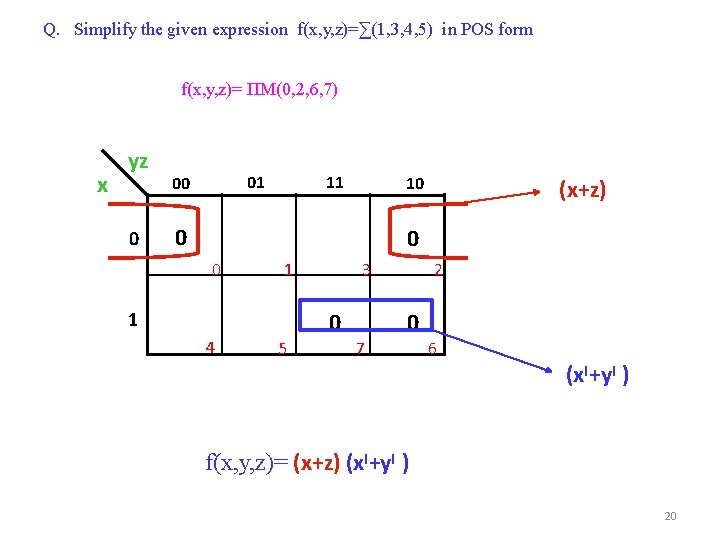
Q. Simplify the given expression f(x, y, z)=∑(1, 3, 4, 5) in POS form f(x, y, z)= ΠM(0, 2, 6, 7) x yz 0 01 00 11 10 0 (x+z) 0 0 1 4 3 5 2 0 7 6 (x. I+y. I ) f(x, y, z)= (x+z) (x. I+y. I ) 20
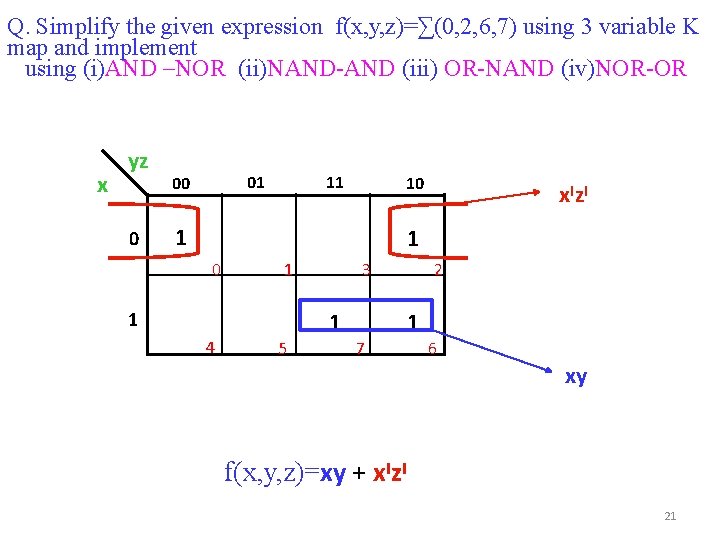
Q. Simplify the given expression f(x, y, z)=∑(0, 2, 6, 7) using 3 variable K map and implement using (i)AND –NOR (ii)NAND-AND (iii) OR-NAND (iv)NOR-OR x yz 0 01 00 11 10 1 x. Iz I 1 0 1 1 1 4 3 5 2 1 7 6 xy f(x, y, z)=xy + x. Iz. I 21
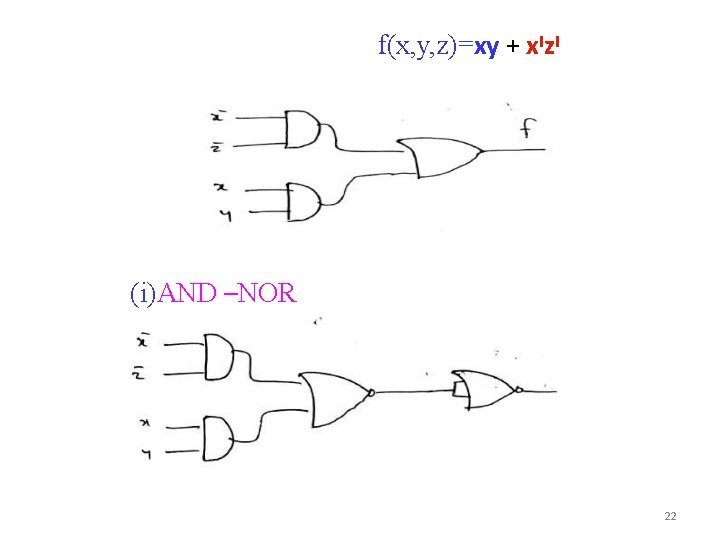
f(x, y, z)=xy + x. Iz. I (i)AND –NOR 22
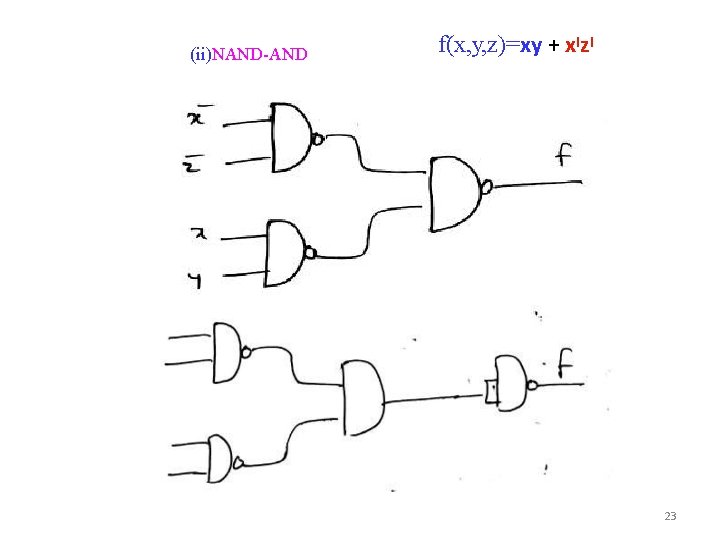
(ii)NAND-AND f(x, y, z)=xy + x. Iz. I 23
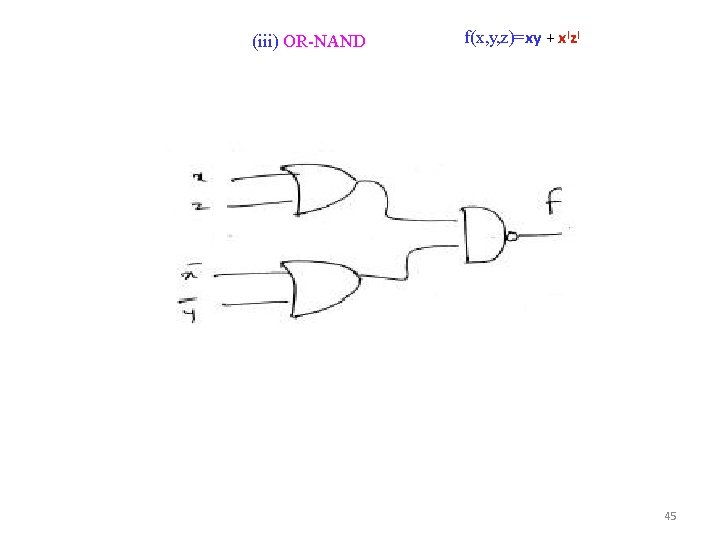
(iii) OR-NAND f(x, y, z)=xy + x. Iz. I 45
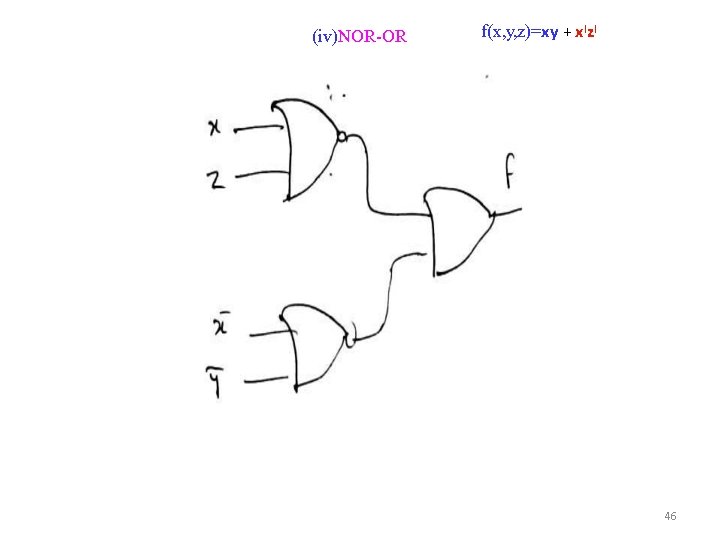
(iv)NOR-OR f(x, y, z)=xy + x. Iz. I 46
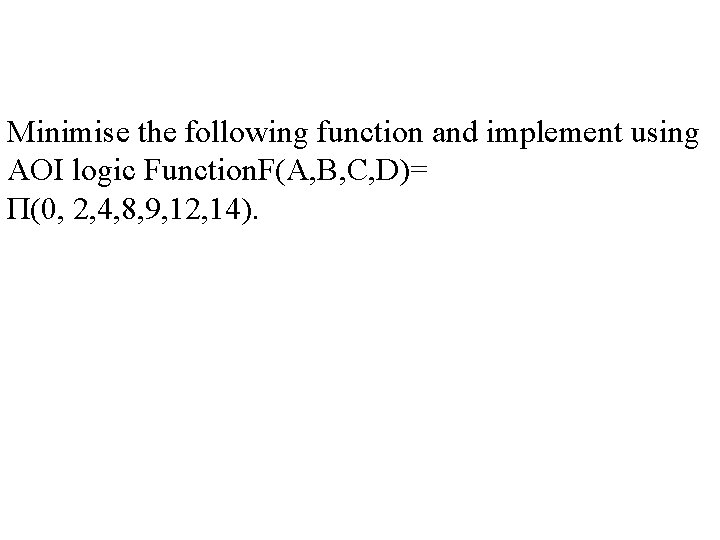
Minimise the following function and implement using AOI logic Function. F(A, B, C, D)= Π(0, 2, 4, 8, 9, 12, 14).

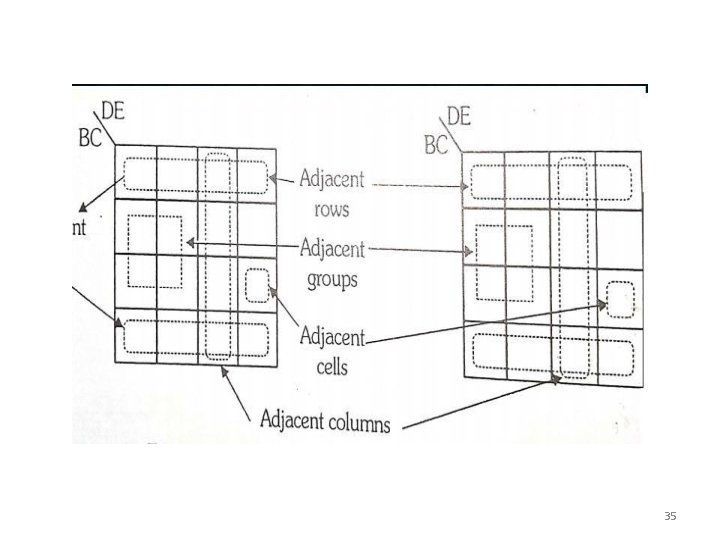
Don’t care Combinations: Some logic circuits can be designed so that there are certain input conditions for which there are no specified output levels. In such cases, the output level s not defined, it can be Either HIGH or LOW Don't cares in a Karnaugh map, or truth table, may be either 1 s or 0 s, as long as wedon't care what the output is for an input condition we never expect to see. . When forming groups of cells, treat the don't care cell as either a 1 or a 0, or ignore the don't cares. 27
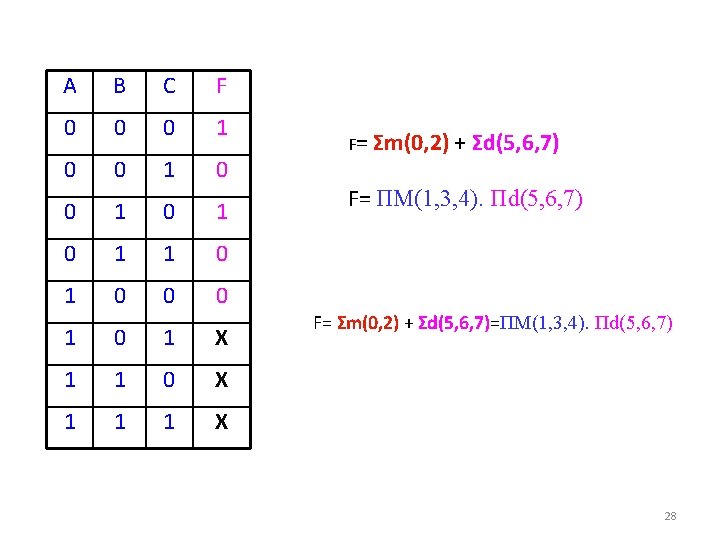
A B C F 0 0 0 1 0 1 1 0 0 0 1 X 1 1 0 X 1 1 1 X F= Σm(0, 2) + Σd(5, 6, 7) F= ΠM(1, 3, 4). Πd(5, 6, 7) F= Σm(0, 2) + Σd(5, 6, 7)=ΠM(1, 3, 4). Πd(5, 6, 7) 28

Q. Simplify F= Σm(0, 1, 4) + Σd(5, 6, 7) A BC 0 00 01 1 1 0 1 1 11 1 3 X 4 10 X 5 2 X 7 6 BI 29

Q. Simplify F= Σm(4, 6, 7, 13, 14) + Σd(5, 10, 12, 15) AB CD 00 00 01 01 0 4 11 10 X 12 8 1 5 13 9 10 3 1 X 1 11 1 X 7 15 11 2 1 1 X 6 14 B 10 50
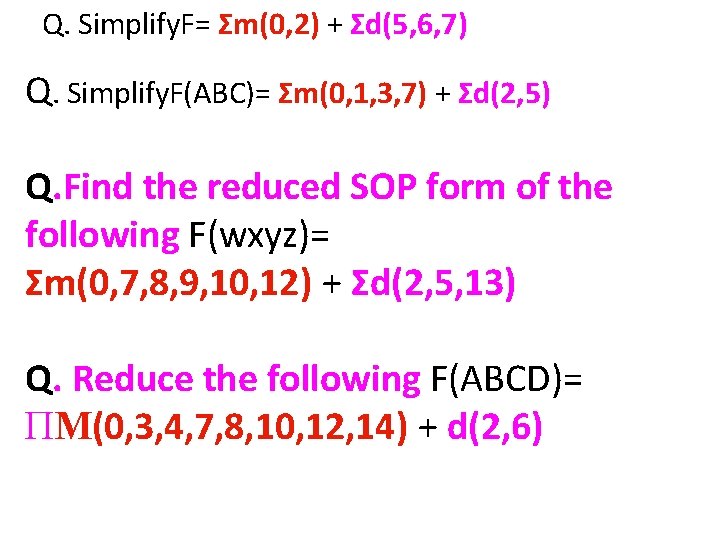
Q. Simplify. F= Σm(0, 2) + Σd(5, 6, 7) Q. Simplify. F(ABC)= Σm(0, 1, 3, 7) + Σd(2, 5) Q. Find the reduced SOP form of the following F(wxyz)= Σm(0, 7, 8, 9, 10, 12) + Σd(2, 5, 13) Q. Reduce the following F(ABCD)= ΠM(0, 3, 4, 7, 8, 10, 12, 14) + d(2, 6)
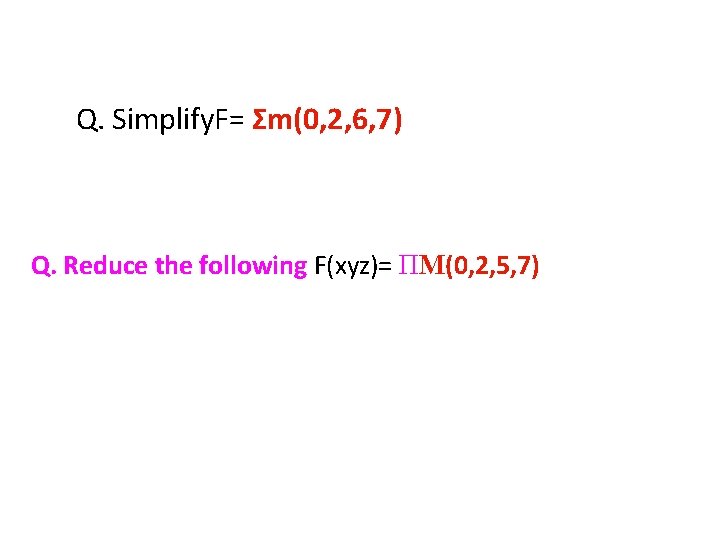
Q. Simplify. F= Σm(0, 2, 6, 7) Q. Reduce the following F(xyz)= ΠM(0, 2, 5, 7)
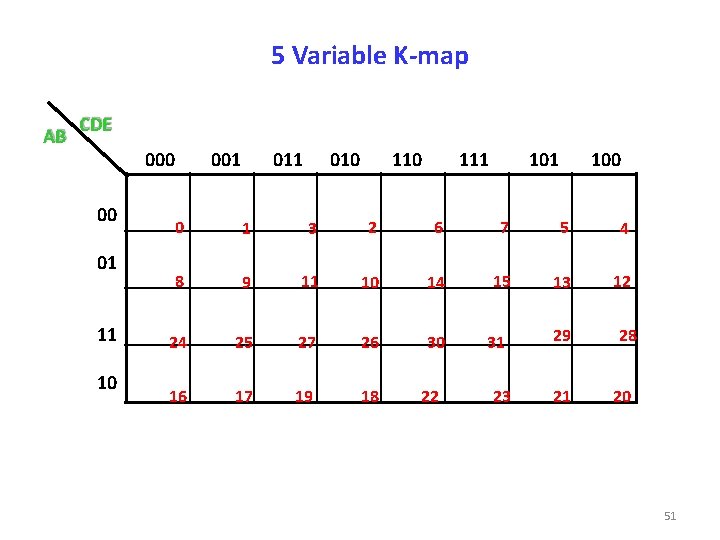
5 Variable K-map AB CDE 000 00 01 11 10 001 010 111 100 0 1 3 2 6 7 5 4 8 9 11 10 14 15 13 12 24 25 27 26 30 16 17 19 18 22 31 23 29 21 28 20 51

A=0 DE BC 00 0 01 1 00 4 5 11 3 7 10 DE 2 16 01 17 11 19 10 18 20 21 23 22 28 29 31 30 24 25 27 26 01 12 13 15 14 8 9 11 10 11 27/10/2016 00 00 6 01 10 BC A=1 11 10 52
35
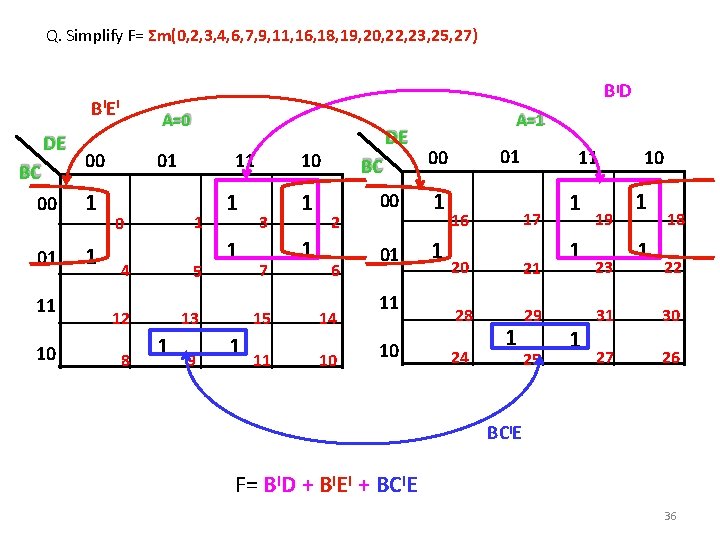
Q. Simplify F= Σm(0, 2, 3, 4, 6, 7, 9, 11, 16, 18, 19, 20, 22, 23, 25, 27) BID I I BE DE BC 00 00 1 01 1 11 10 A=0 01 11 1 0 4 5 12 13 8 1 9 1 1 10 3 7 15 1 DE 11 1 1 BC 2 6 14 10 A=1 00 1 01 1 11 10 01 00 11 17 16 20 21 28 29 24 1 25 1 19 23 10 1 1 18 22 31 30 27 26 BCIE F= BID + BIEI + BCIE 36
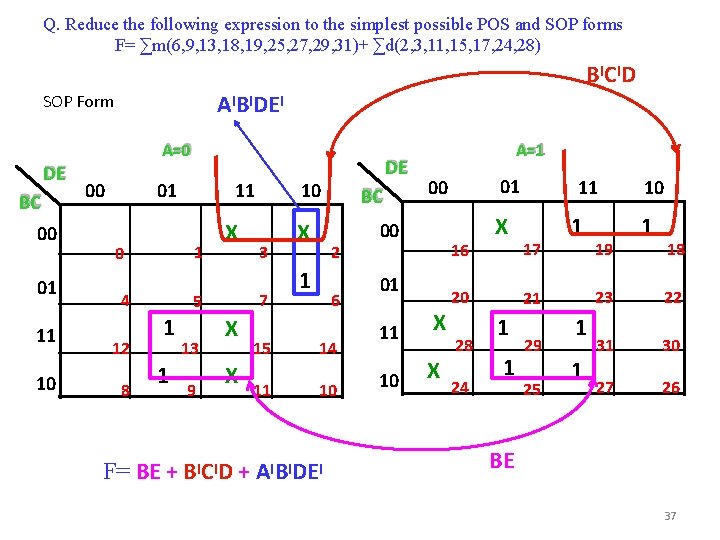
Q. Reduce the following expression to the simplest possible POS and SOP forms F= ∑m(6, 9, 13, 18, 19, 25, 27, 29, 31)+ ∑d(2, 3, 11, 15, 17, 24, 28) BICID AIBIDEI SOP Form A=0 DE BC 00 01 11 10 00 01 1 0 4 12 8 11 X 1 1 13 9 10 3 7 5 X X DE 15 11 X BC 2 1 6 14 10 F= BE + BICID + AIBIDEI A=1 01 00 00 16 01 11 X 10 X X 20 28 24 11 17 1 21 1 1 29 25 1 1 19 10 1 18 23 22 31 30 27 26 BE 37
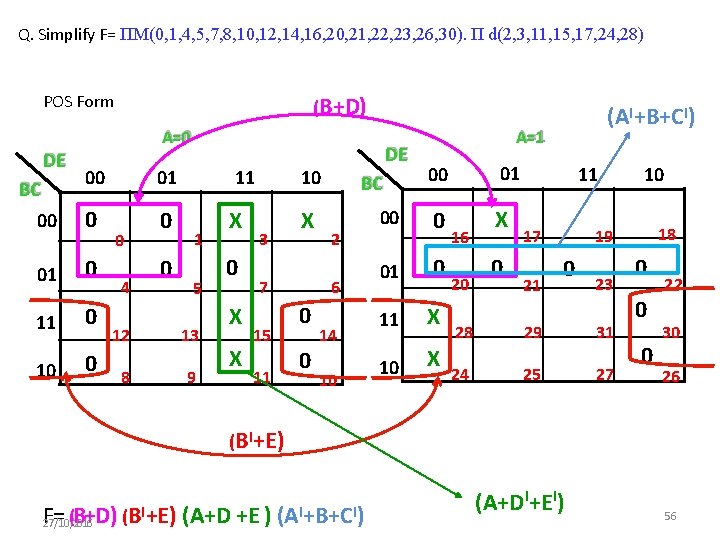
Q. Simplify F= ΠM(0, 1, 4, 5, 7, 8, 10, 12, 14, 16, 20, 21, 22, 23, 26, 30). Π d(2, 3, 11, 15, 17, 24, 28) POS Form (B+D) A=0 DE 00 01 00 0 0 01 0 10 0 BC 0 4 12 8 0 11 1 5 13 9 X 0 X X DE 10 3 X 7 15 11 2 6 0 0 14 10 A=1 00 0 X 01 0 11 X 10 X BC (AI+B+CI) 16 20 0 11 17 21 10 18 19 0 23 28 29 31 24 25 27 0 0 0 22 30 26 (BI+E) F= (B+D) (BI+E) (A+D +E ) (AI+B+CI) 27/10/2016 (A+DI+EI) 56
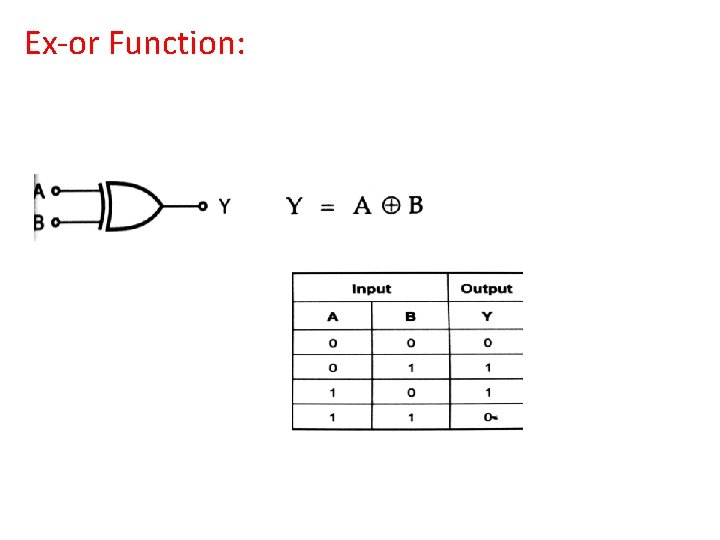
Ex-or Function:
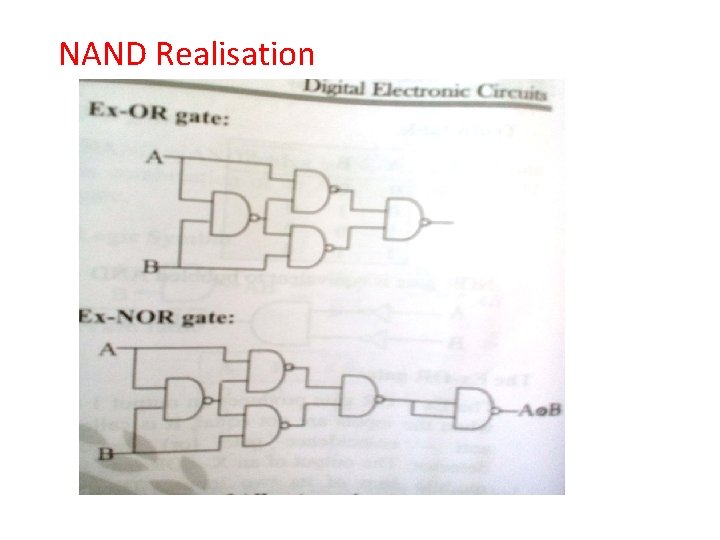
NAND Realisation
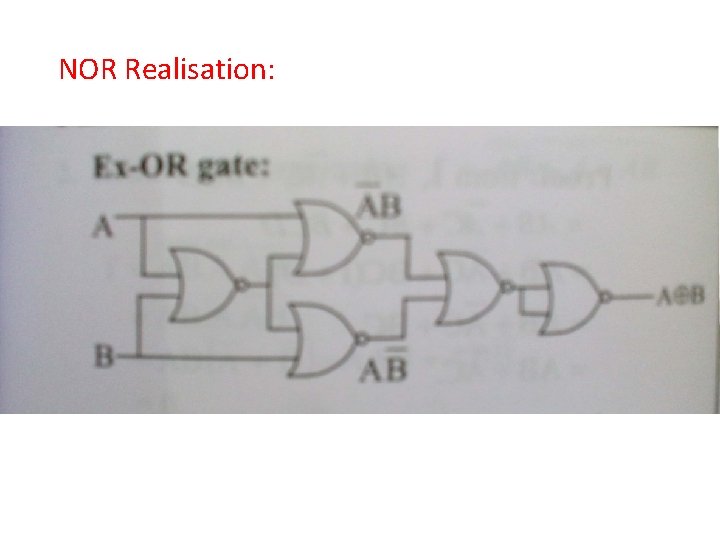
NOR Realisation:

Quine-Mc. Cluskey method (or) Tabular Minimization method (or) Prime implicants chart method
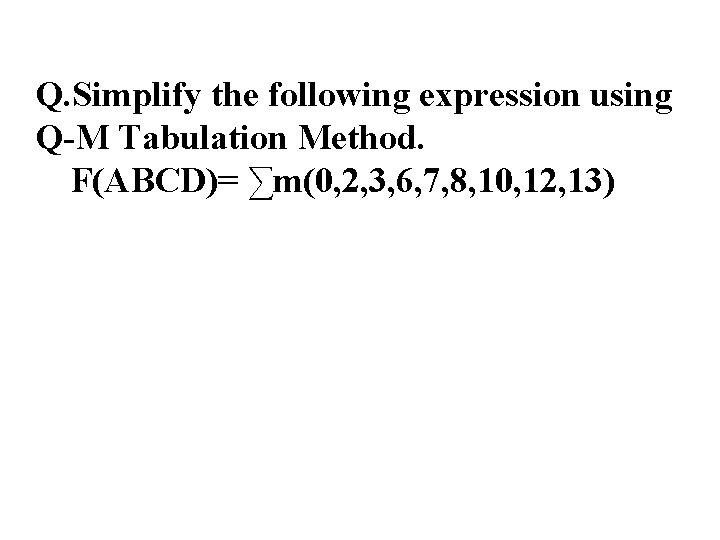
Q. Simplify the following expression using Q-M Tabulation Method. F(ABCD)= ∑m(0, 2, 3, 6, 7, 8, 10, 12, 13)

Q. Simplify the following expression using Q-M Tabulation Method. F= ∑m(0, 1, 2, 8, 9, 15, 17, 21, 24, 25, 27, 31)
- Slides: 44