
STL Generic Algorithm CS 247 Module 18 Scott

- Slides: 33
STL Generic Algorithm CS 247 Module 18 Scott Chen
Assigned Readings Ø Eckel. Vol. 2 • Chapter 6 – Generic Algorithms
Agenda for Module 18 Ø Non-modifying and Modifying STL Algorithms Ø Operation-Applying STL Algorithms • Function Object Adaptors Ø STL Example
Section 1 Non-Modifying and Modifying STL Algorithms
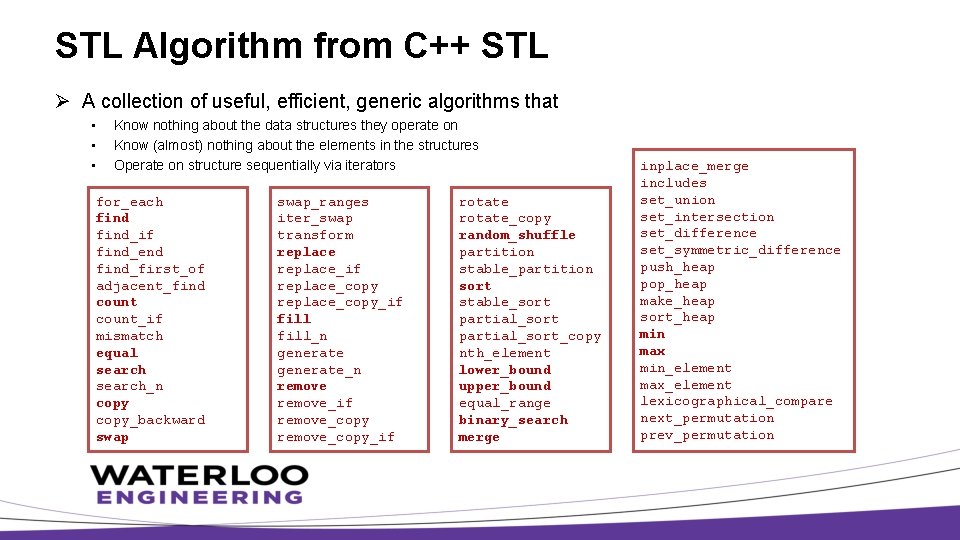
STL Algorithm from C++ STL Ø A collection of useful, efficient, generic algorithms that • • • Know nothing about the data structures they operate on Know (almost) nothing about the elements in the structures Operate on structure sequentially via iterators for_each find_if find_end find_first_of adjacent_find count_if mismatch equal search_n copy_backward swap_ranges iter_swap transform replace_if replace_copy_if fill_n generate_n remove_if remove_copy_if rotate_copy random_shuffle partition stable_partition sort stable_sort partial_sort_copy nth_element lower_bound upper_bound equal_range binary_search merge inplace_merge includes set_union set_intersection set_difference set_symmetric_difference push_heap pop_heap make_heap sort_heap min max min_element max_element lexicographical_compare next_permutation prev_permutation
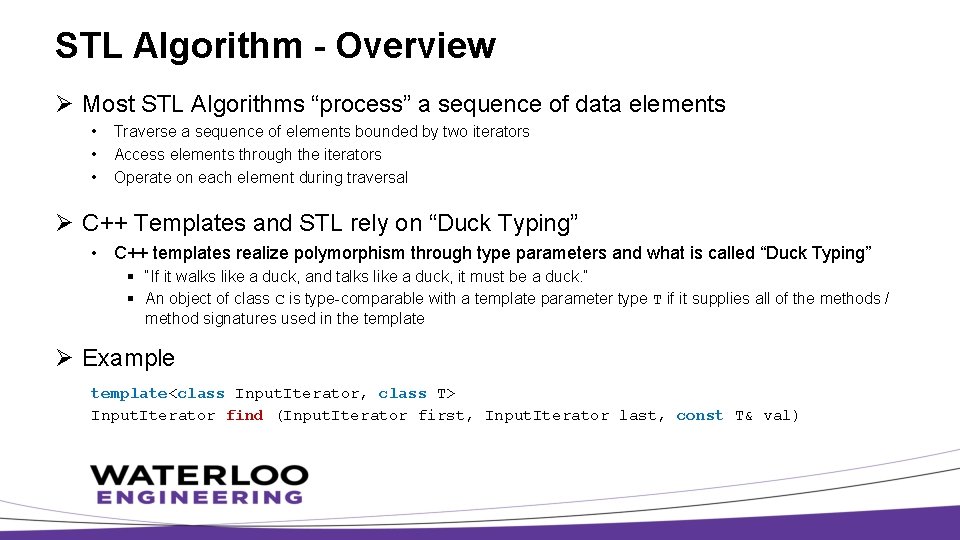
STL Algorithm - Overview Ø Most STL Algorithms “process” a sequence of data elements • • • Traverse a sequence of elements bounded by two iterators Access elements through the iterators Operate on each element during traversal Ø C++ Templates and STL rely on “Duck Typing” • C++ templates realize polymorphism through type parameters and what is called “Duck Typing” § “If it walks like a duck, and talks like a duck, it must be a duck. ” § An object of class C is type-comparable with a template parameter type T if it supplies all of the methods / method signatures used in the template Ø Example template<class Input. Iterator, class T> Input. Iterator find (Input. Iterator first, Input. Iterator last, const T& val)
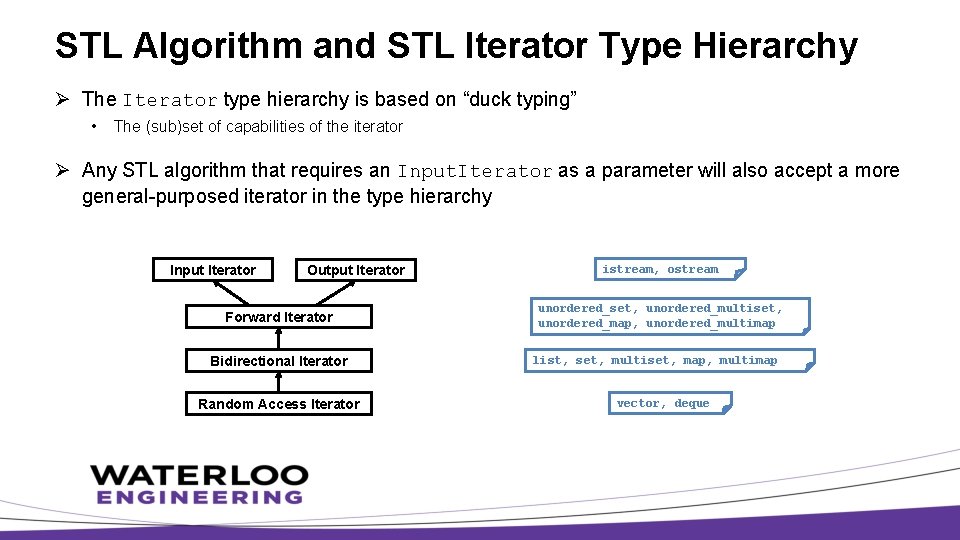
STL Algorithm and STL Iterator Type Hierarchy Ø The Iterator type hierarchy is based on “duck typing” • The (sub)set of capabilities of the iterator Ø Any STL algorithm that requires an Input. Iterator as a parameter will also accept a more general-purposed iterator in the type hierarchy Input Iterator Output Iterator Forward Iterator Bidirectional Iterator Random Access Iterator istream, ostream unordered_set, unordered_multiset, unordered_map, unordered_multimap list, set, multiset, map, multimap vector, deque
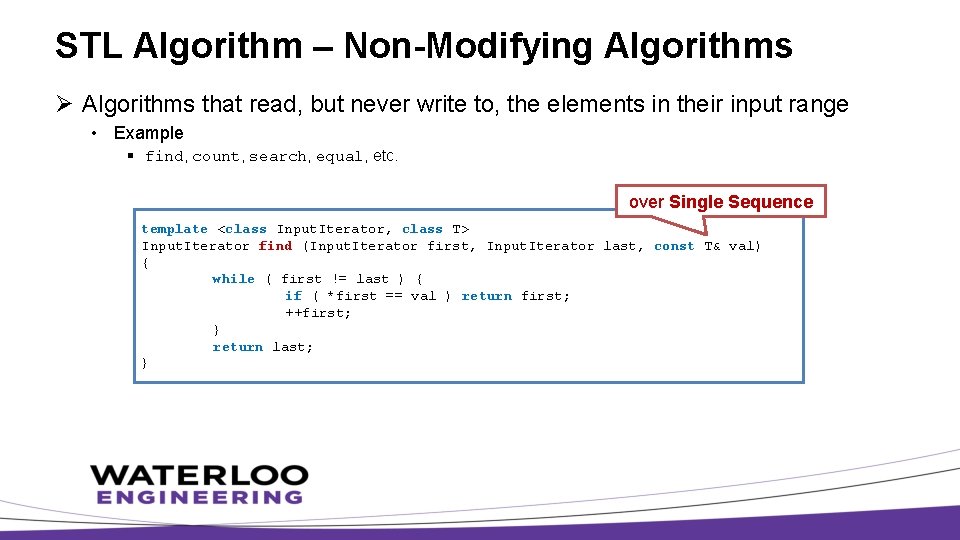
STL Algorithm – Non-Modifying Algorithms Ø Algorithms that read, but never write to, the elements in their input range • Example § find, count, search, equal, etc. over Single Sequence template <class Input. Iterator, class T> Input. Iterator find (Input. Iterator first, Input. Iterator last, const T& val) { while ( first != last ) { if ( *first == val ) return first; ++first; } return last; }
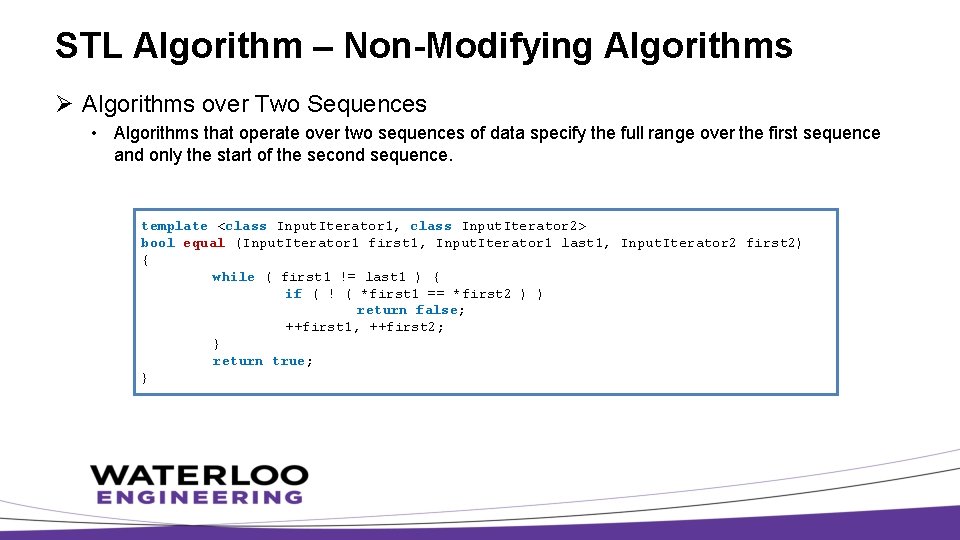
STL Algorithm – Non-Modifying Algorithms Ø Algorithms over Two Sequences • Algorithms that operate over two sequences of data specify the full range over the first sequence and only the start of the second sequence. template <class Input. Iterator 1, class Input. Iterator 2> bool equal (Input. Iterator 1 first 1, Input. Iterator 1 last 1, Input. Iterator 2 first 2) { while ( first 1 != last 1 ) { if ( ! ( *first 1 == *first 2 ) ) return false; ++first 1, ++first 2; } return true; }
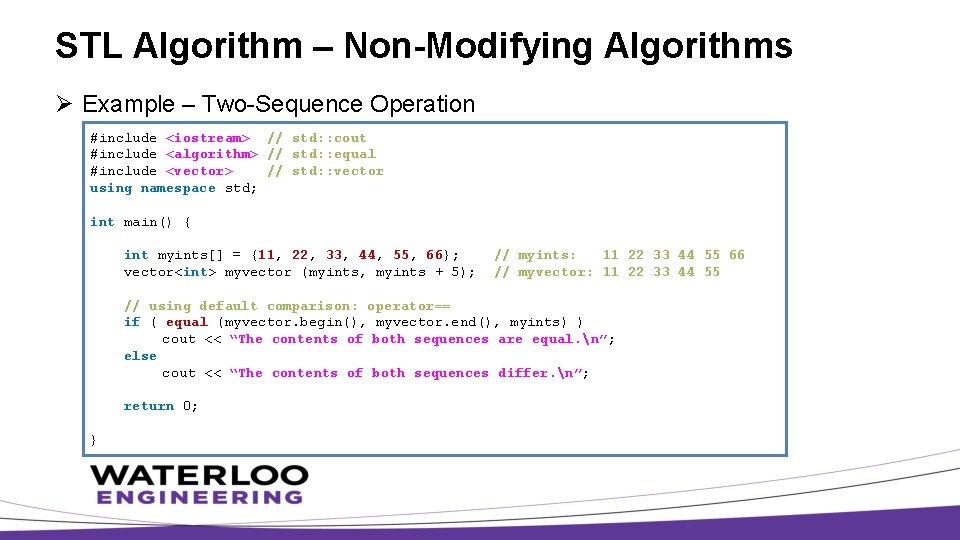
STL Algorithm – Non-Modifying Algorithms Ø Example – Two-Sequence Operation #include <iostream> // std: : cout #include <algorithm> // std: : equal #include <vector> // std: : vector using namespace std; int main() { int myints[] = {11, 22, 33, 44, 55, 66}; vector<int> myvector (myints, myints + 5); // myints: 11 22 33 44 55 66 // myvector: 11 22 33 44 55 // using default comparison: operator== if ( equal (myvector. begin(), myvector. end(), myints) ) cout << “The contents of both sequences are equal. n”; else cout << “The contents of both sequences differ. n”; return 0; }
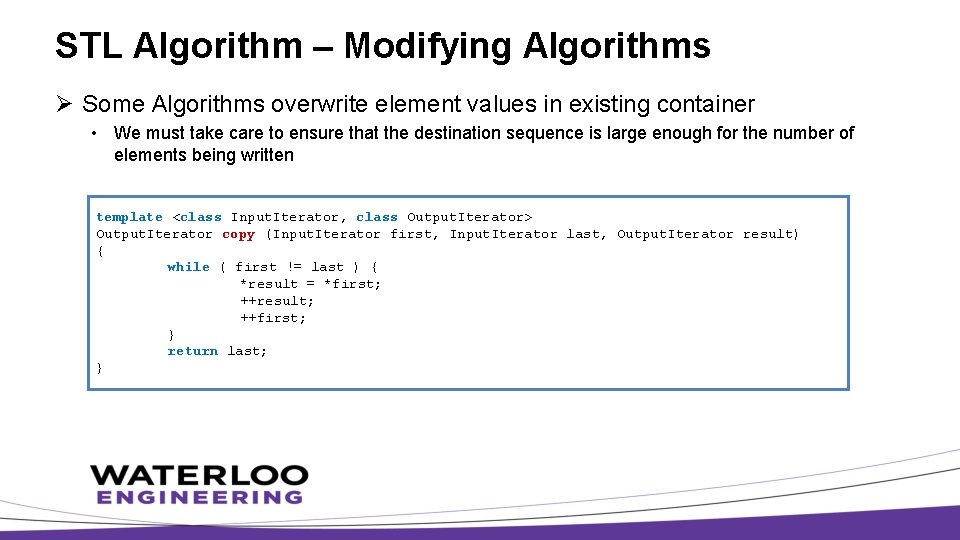
STL Algorithm – Modifying Algorithms Ø Some Algorithms overwrite element values in existing container • We must take care to ensure that the destination sequence is large enough for the number of elements being written template <class Input. Iterator, class Output. Iterator> Output. Iterator copy (Input. Iterator first, Input. Iterator last, Output. Iterator result) { while ( first != last ) { *result = *first; ++result; ++first; } return last; }
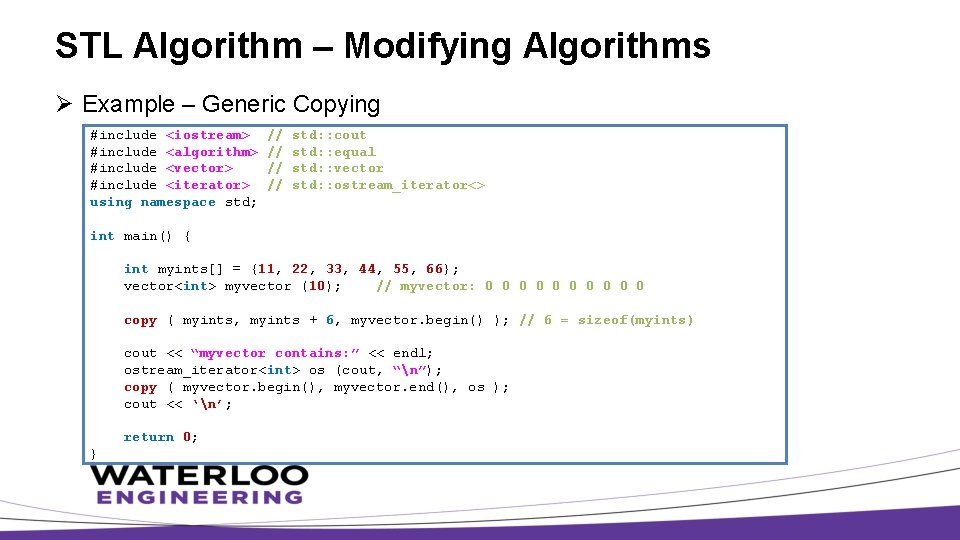
STL Algorithm – Modifying Algorithms Ø Example – Generic Copying #include <iostream> #include <algorithm> #include <vector> #include <iterator> using namespace std; // // std: : cout std: : equal std: : vector std: : ostream_iterator<> int main() { int myints[] = {11, 22, 33, 44, 55, 66}; vector<int> myvector (10); // myvector: 0 0 0 0 0 copy ( myints, myints + 6, myvector. begin() ); // 6 = sizeof(myints) cout << “myvector contains: ” << endl; ostream_iterator<int> os (cout, “n”); copy ( myvector. begin(), myvector. end(), os ); cout << ‘n’; return 0; }
STL Algorithm – Modifying Algorithms Ø Overwriting vs. Inserting • The default behaviour is to write to a destination sequence, overwriting existing elements. • Can impost insertion behaviour instead by providing an Inserter Iterator as the destination.
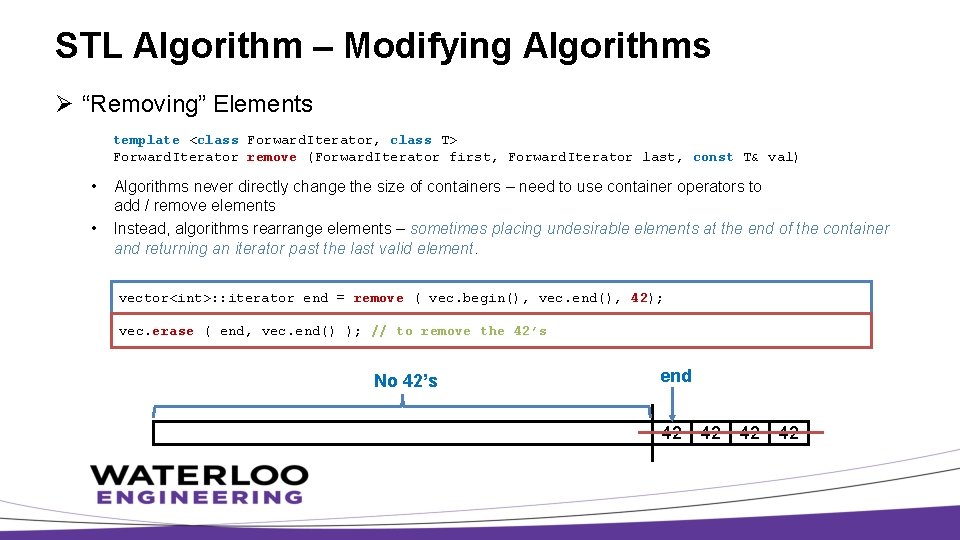
STL Algorithm – Modifying Algorithms Ø “Removing” Elements template <class Forward. Iterator, class T> Forward. Iterator remove (Forward. Iterator first, Forward. Iterator last, const T& val) • • Algorithms never directly change the size of containers – need to use container operators to add / remove elements Instead, algorithms rearrange elements – sometimes placing undesirable elements at the end of the container and returning an iterator past the last valid element. vector<int>: : iterator end = remove ( vec. begin(), vec. end(), 42); vec. erase ( end, vec. end() ); // to remove the 42’s No 42’s end 42 42
Section 2 Operation-Applying STL Algorithms (and Functors)
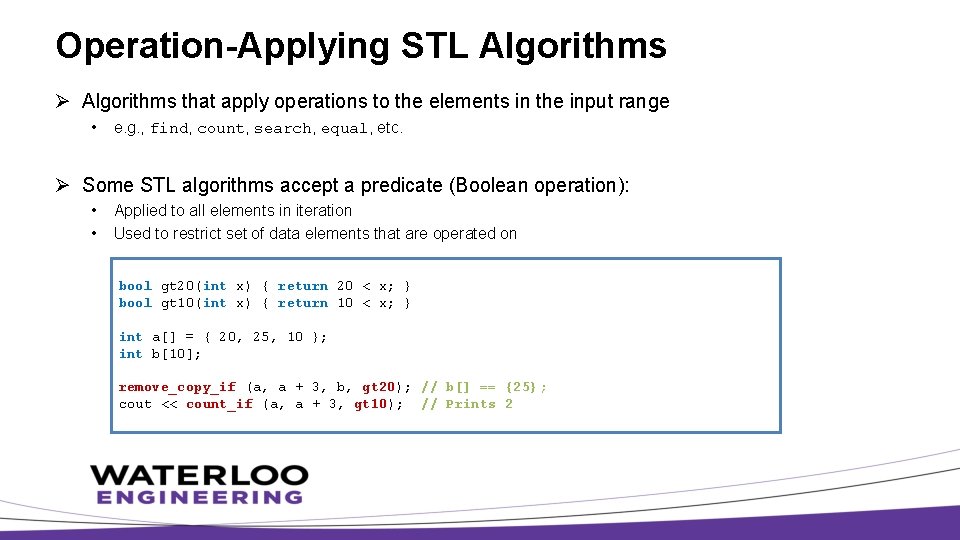
Operation-Applying STL Algorithms Ø Algorithms that apply operations to the elements in the input range • e. g. , find, count, search, equal, etc. Ø Some STL algorithms accept a predicate (Boolean operation): • • Applied to all elements in iteration Used to restrict set of data elements that are operated on bool gt 20(int x) { return 20 < x; } bool gt 10(int x) { return 10 < x; } int a[] = { 20, 25, 10 }; int b[10]; remove_copy_if (a, a + 3, b, gt 20); // b[] == {25}; cout << count_if (a, a + 3, gt 10); // Prints 2
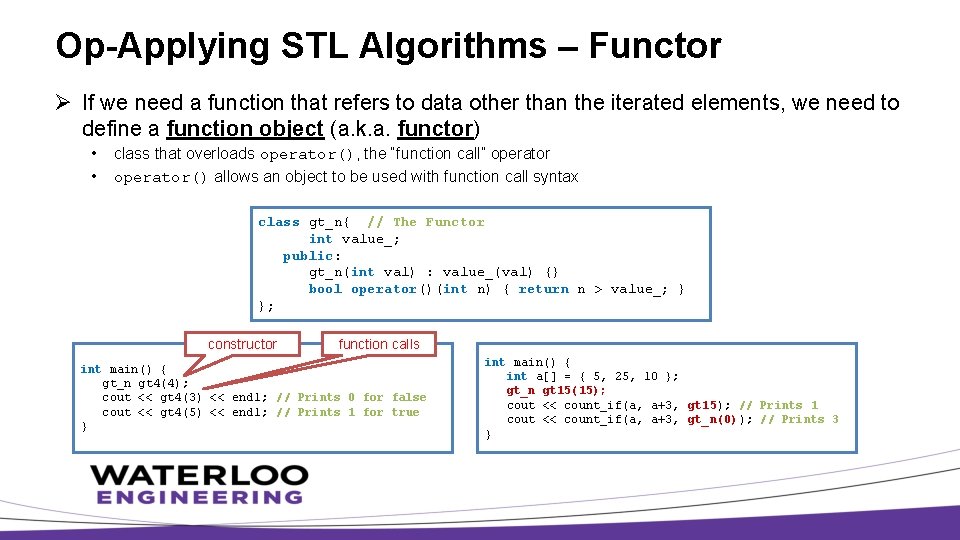
Op-Applying STL Algorithms – Functor Ø If we need a function that refers to data other than the iterated elements, we need to define a function object (a. k. a. functor) • • class that overloads operator(), the “function call” operator() allows an object to be used with function call syntax class gt_n{ // The Functor int value_; public: gt_n(int val) : value_(val) {} bool operator()(int n) { return n > value_; } }; constructor function calls int main() { gt_n gt 4(4); cout << gt 4(3) << endl; // Prints 0 for false cout << gt 4(5) << endl; // Prints 1 for true } int main() { int a[] = { 5, 25, 10 }; gt_n gt 15(15); cout << count_if(a, a+3, gt 15); // Prints 1 cout << count_if(a, a+3, gt_n(0)); // Prints 3 }
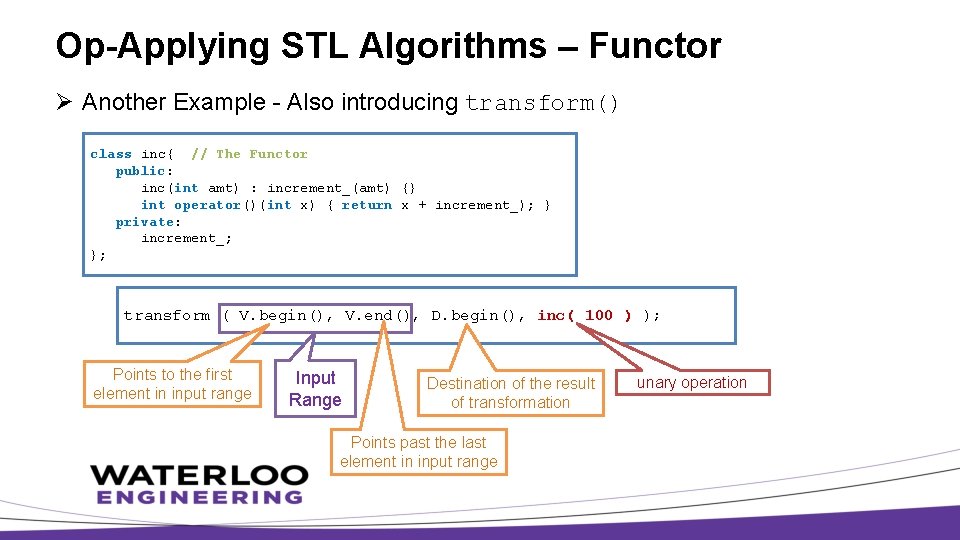
Op-Applying STL Algorithms – Functor Ø Another Example - Also introducing transform() class inc{ // The Functor public: inc(int amt) : increment_(amt) {} int operator()(int x) { return x + increment_); } private: increment_; }; transform ( V. begin(), V. end(), D. begin(), inc( 100 ) ); Points to the first element in input range Input Range Destination of the result of transformation Points past the last element in input range unary operation
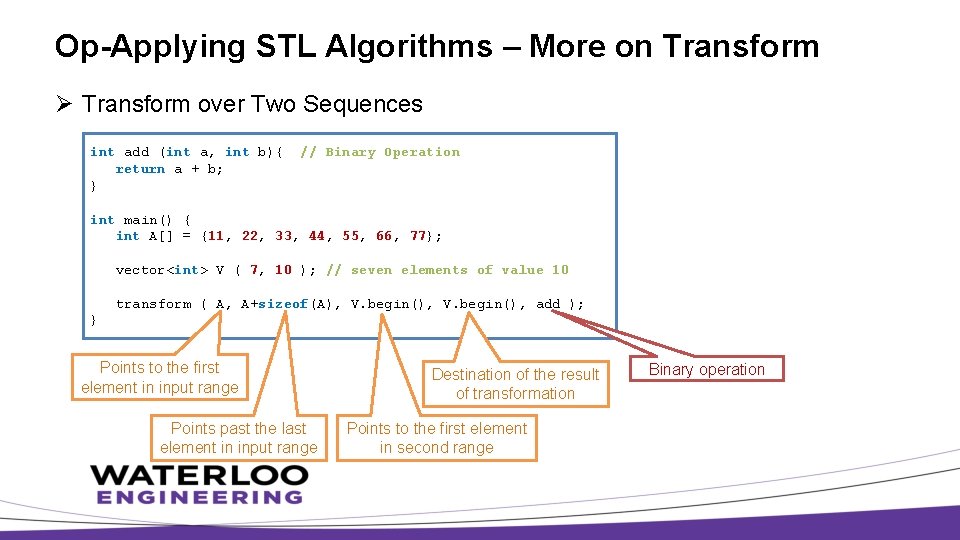
Op-Applying STL Algorithms – More on Transform Ø Transform over Two Sequences int add (int a, int b){ return a + b; } // Binary Operation int main() { int A[] = {11, 22, 33, 44, 55, 66, 77}; vector<int> V ( 7, 10 ); // seven elements of value 10 transform ( A, A+sizeof(A), V. begin(), add ); } Points to the first element in input range Points past the last element in input range Destination of the result of transformation Points to the first element in second range Binary operation
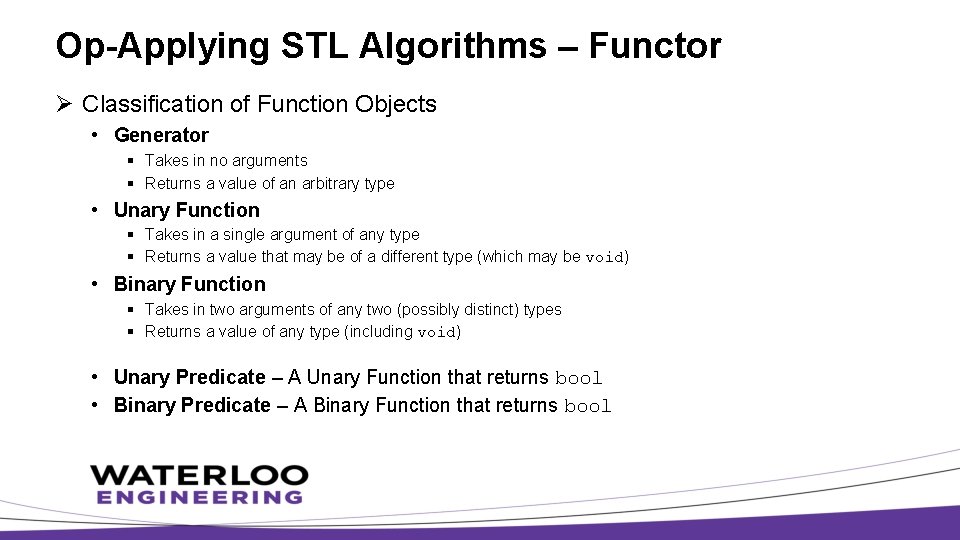
Op-Applying STL Algorithms – Functor Ø Classification of Function Objects • Generator § Takes in no arguments § Returns a value of an arbitrary type • Unary Function § Takes in a single argument of any type § Returns a value that may be of a different type (which may be void) • Binary Function § Takes in two arguments of any two (possibly distinct) types § Returns a value of any type (including void) • Unary Predicate – A Unary Function that returns bool • Binary Predicate – A Binary Function that returns bool
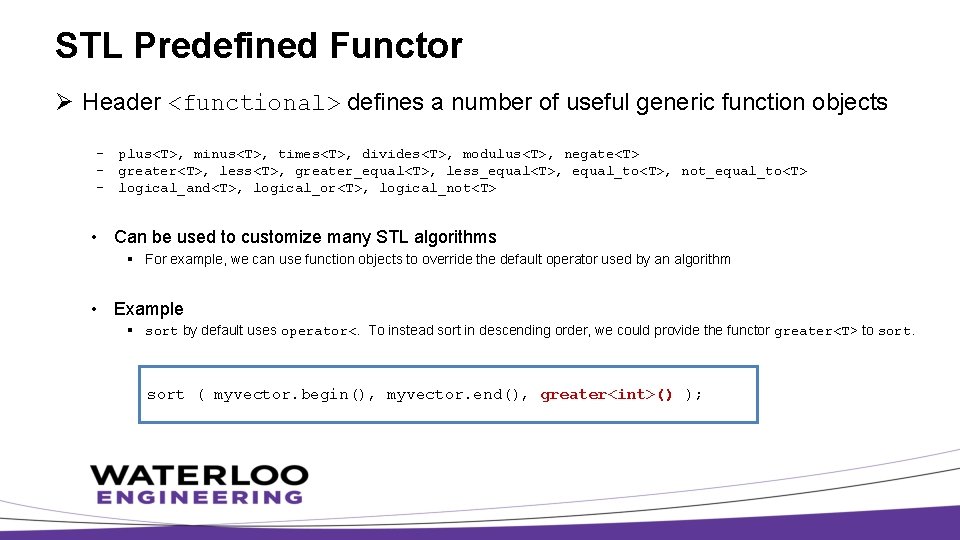
STL Predefined Functor Ø Header <functional> defines a number of useful generic function objects - plus<T>, minus<T>, times<T>, divides<T>, modulus<T>, negate<T> - greater<T>, less<T>, greater_equal<T>, less_equal<T>, equal_to<T>, not_equal_to<T> - logical_and<T>, logical_or<T>, logical_not<T> • Can be used to customize many STL algorithms § For example, we can use function objects to override the default operator used by an algorithm • Example § sort by default uses operator<. To instead sort in descending order, we could provide the functor greater<T> to sort ( myvector. begin(), myvector. end(), greater<int>() );
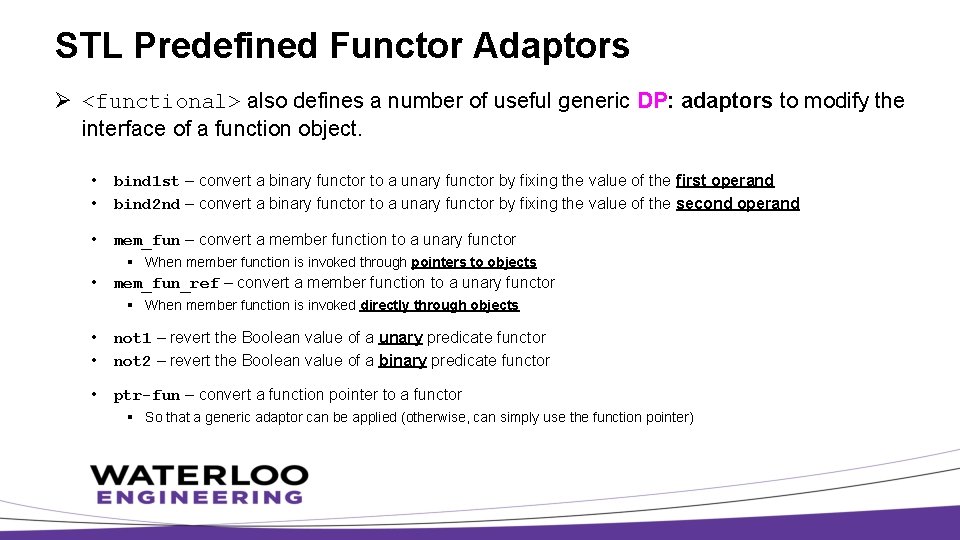
STL Predefined Functor Adaptors Ø <functional> also defines a number of useful generic DP: adaptors to modify the interface of a function object. • • bind 1 st – convert a binary functor to a unary functor by fixing the value of the first operand bind 2 nd – convert a binary functor to a unary functor by fixing the value of the second operand • mem_fun – convert a member function to a unary functor § When member function is invoked through pointers to objects • mem_fun_ref – convert a member function to a unary functor § When member function is invoked directly through objects • • not 1 – revert the Boolean value of a unary predicate functor not 2 – revert the Boolean value of a binary predicate functor • ptr-fun – convert a function pointer to a functor § So that a generic adaptor can be applied (otherwise, can simply use the function pointer)
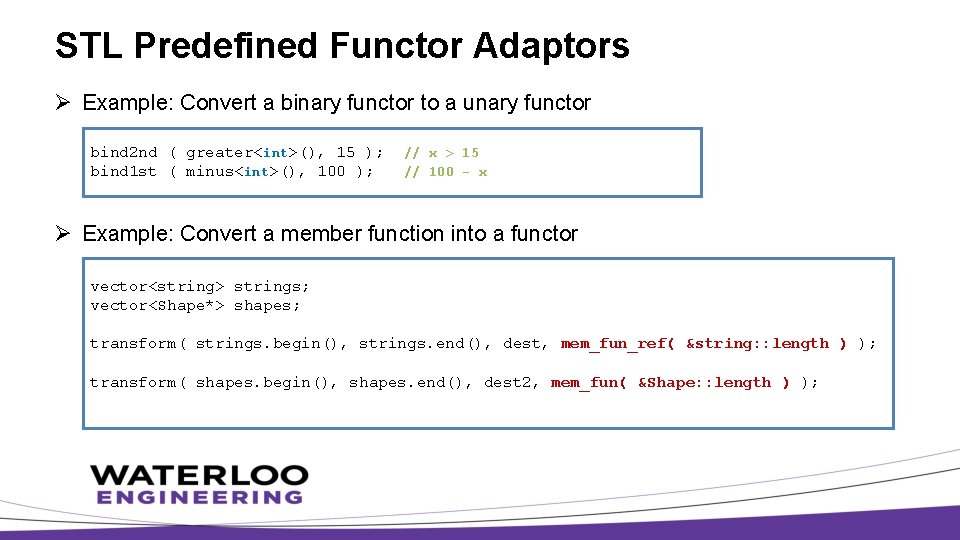
STL Predefined Functor Adaptors Ø Example: Convert a binary functor to a unary functor bind 2 nd ( greater<int>(), 15 ); bind 1 st ( minus<int>(), 100 ); // x > 15 // 100 - x Ø Example: Convert a member function into a functor vector<string> strings; vector<Shape*> shapes; transform( strings. begin(), strings. end(), dest, mem_fun_ref( &string: : length ) ); transform( shapes. begin(), shapes. end(), dest 2, mem_fun( &Shape: : length ) );
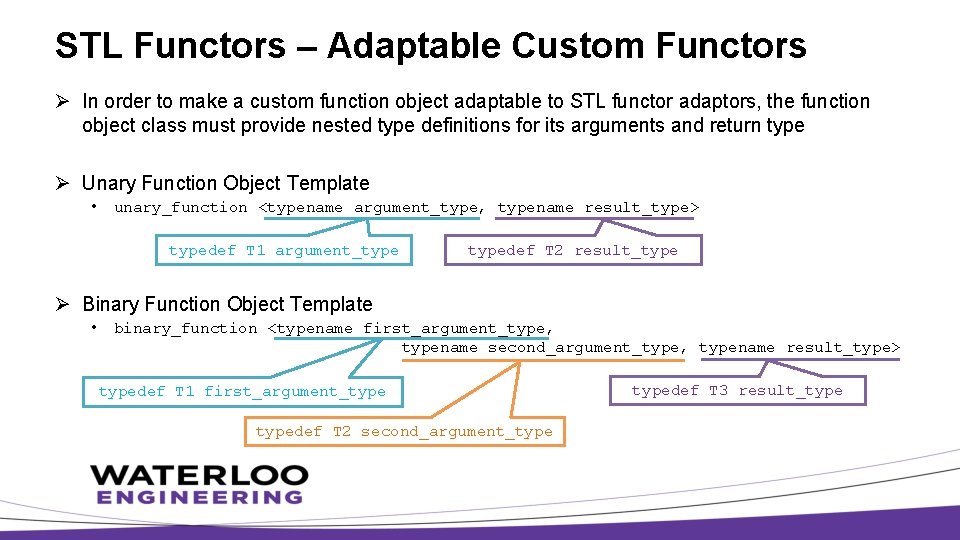
STL Functors – Adaptable Custom Functors Ø In order to make a custom function object adaptable to STL functor adaptors, the function object class must provide nested type definitions for its arguments and return type Ø Unary Function Object Template • unary_function <typename argument_type, typename result_type> typedef T 1 argument_typedef T 2 result_type Ø Binary Function Object Template • binary_function <typename first_argument_type, typename second_argument_type, typename result_type> typedef T 1 first_argument_typedef T 2 second_argument_typedef T 3 result_type
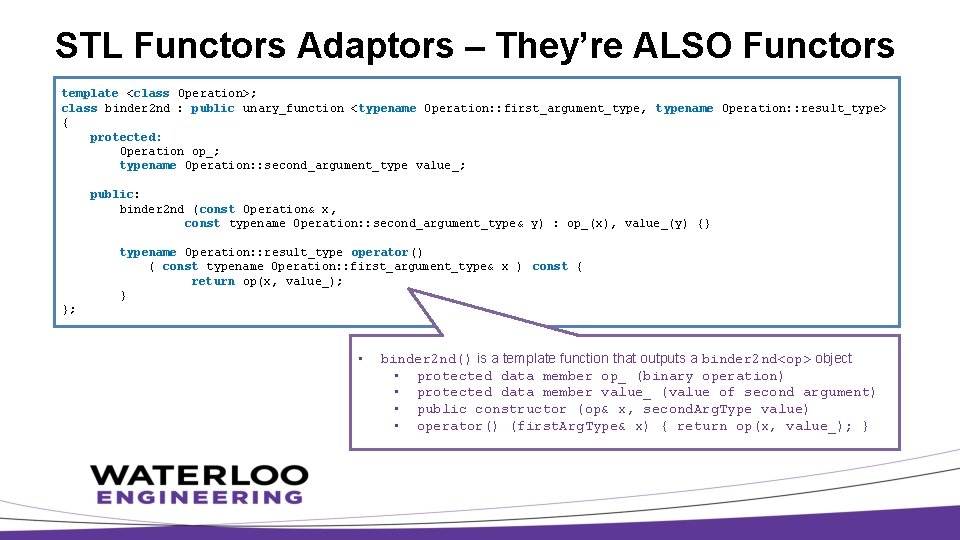
STL Functors Adaptors – They’re ALSO Functors template <class Operation>; class binder 2 nd : public unary_function <typename Operation: : first_argument_type, typename Operation: : result_type> { protected: Operation op_; typename Operation: : second_argument_type value_; public: binder 2 nd (const Operation& x, const typename Operation: : second_argument_type& y) : op_(x), value_(y) {} typename Operation: : result_type operator() ( const typename Operation: : first_argument_type& x ) const { return op(x, value_); } }; • binder 2 nd() is a template function that outputs a binder 2 nd<op> object • protected data member op_ (binary operation) • protected data member value_ (value of second argument) • public constructor (op& x, second. Arg. Type value) • operator() (first. Arg. Type& x) { return op(x, value_); }
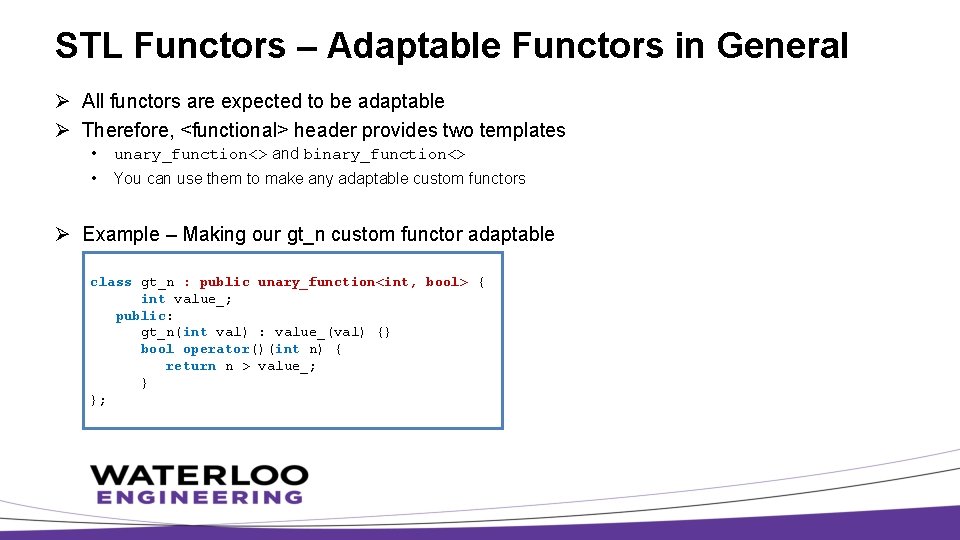
STL Functors – Adaptable Functors in General Ø All functors are expected to be adaptable Ø Therefore, <functional> header provides two templates • • unary_function<> and binary_function<> You can use them to make any adaptable custom functors Ø Example – Making our gt_n custom functor adaptable class gt_n : public unary_function<int, bool> { int value_; public: gt_n(int val) : value_(val) {} bool operator()(int n) { return n > value_; } };
Section 3 STL Algorithm Example
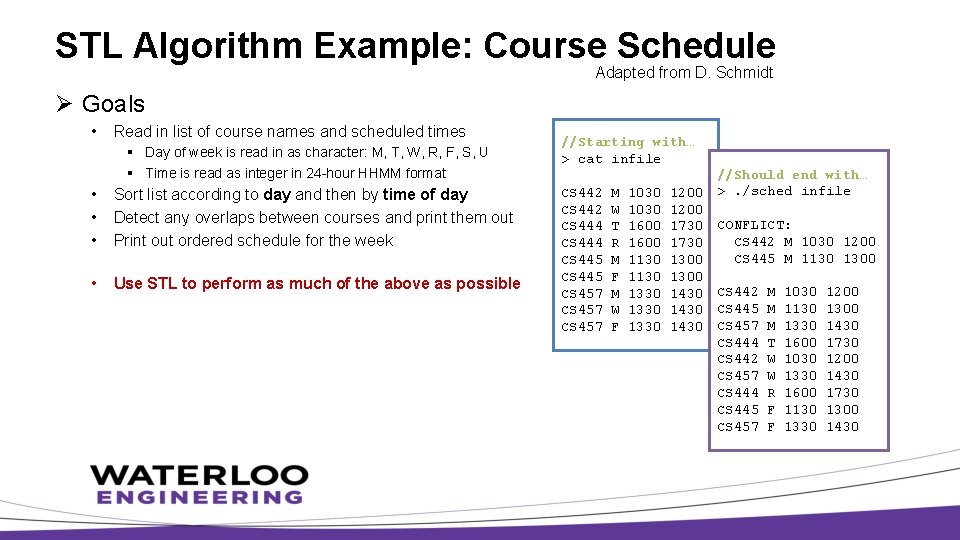
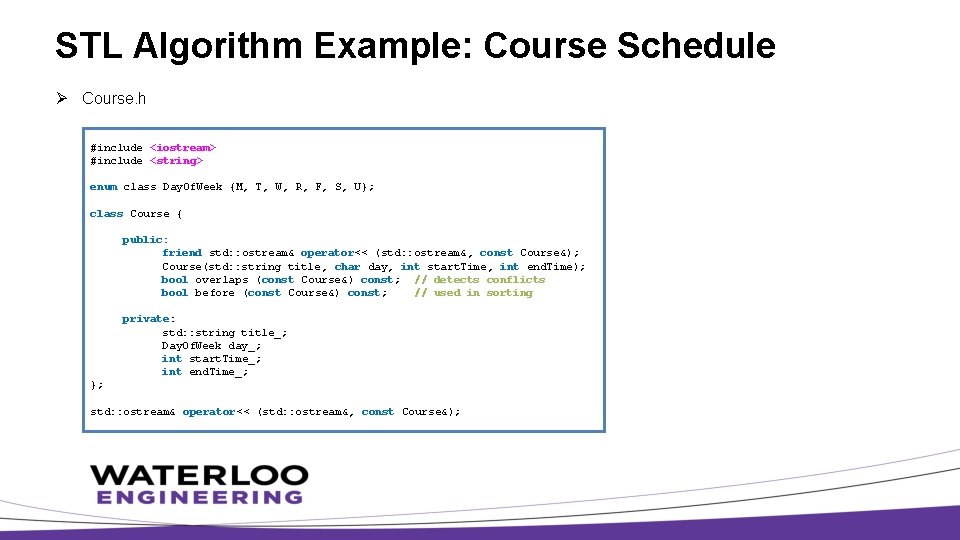
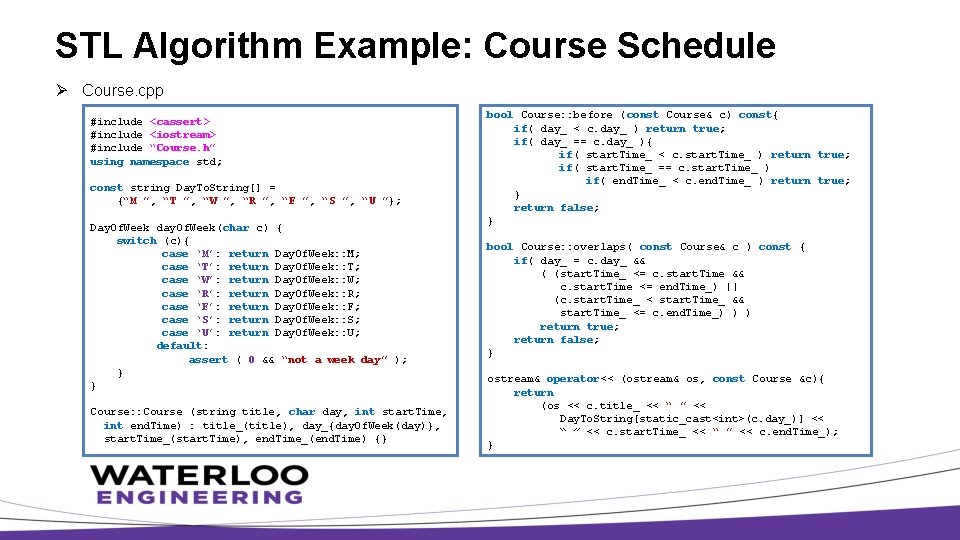
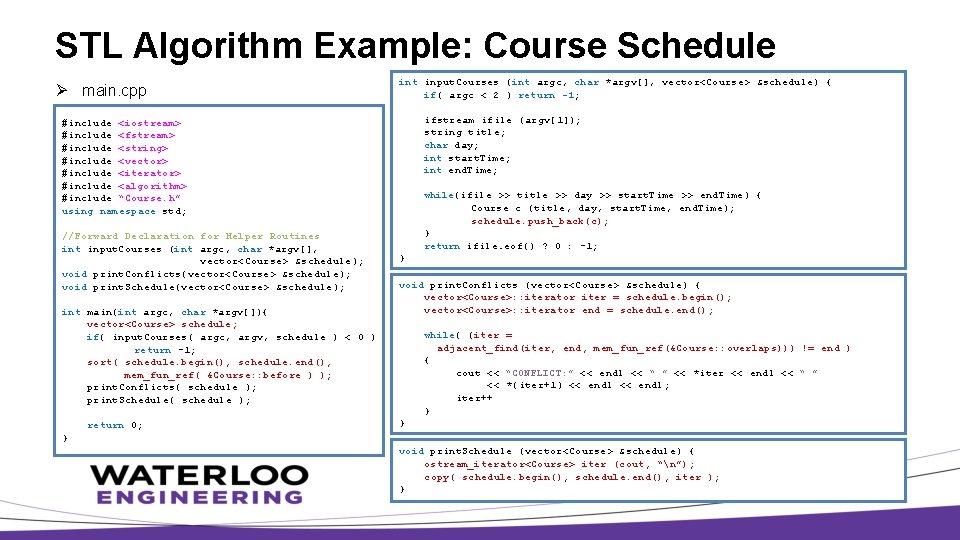
STL Algorithm Example: Course Schedule Adapted from D. Schmidt Ø Goals • Read in list of course names and scheduled times § Day of week is read in as character: M, T, W, R, F, S, U § Time is read as integer in 24 -hour HHMM format • • • Sort list according to day and then by time of day Detect any overlaps between courses and print them out Print out ordered schedule for the week • Use STL to perform as much of the above as possible //Starting with… > cat infile CS 442 CS 444 CS 445 CS 457 M W T R M F M W F 1030 1600 1130 1330 //Should end with… 1200 >. /sched infile 1200 1730 CONFLICT: CS 442 M 1030 1200 1730 CS 445 M 1130 1300 1430 CS 442 M 1030 1200 1430 CS 445 M 1130 1300 1430 CS 457 M 1330 1430 CS 444 T 1600 1730 CS 442 W 1030 1200 CS 457 W 1330 1430 CS 444 R 1600 1730 CS 445 F 1130 1300 CS 457 F 1330 1430
STL Algorithm Example: Course Schedule Ø Course. h #include <iostream> #include <string> enum class Day. Of. Week {M, T, W, R, F, S, U}; class Course { public: friend std: : ostream& operator<< (std: : ostream&, const Course&); Course(std: : string title, char day, int start. Time, int end. Time); bool overlaps (const Course&) const; // detects conflicts bool before (const Course&) const; // used in sorting private: std: : string title_; Day. Of. Week day_; int start. Time_; int end. Time_; }; std: : ostream& operator<< (std: : ostream&, const Course&);
STL Algorithm Example: Course Schedule Ø Course. cpp #include <cassert> #include <iostream> #include “Course. h” using namespace std; const string Day. To. String[] = {“M ”, “T ”, “W ”, “R ”, “F ”, “S ”, “U ”}; Day. Of. Week day. Of. Week(char c) { switch (c){ case ‘M’: return Day. Of. Week: : M; case ‘T’: return Day. Of. Week: : T; case ‘W’: return Day. Of. Week: : W; case ‘R’: return Day. Of. Week: : R; case ‘F’: return Day. Of. Week: : F; case ‘S’: return Day. Of. Week: : S; case ‘U’: return Day. Of. Week: : U; default: assert ( 0 && “not a week day” ); } } Course: : Course (string title, char day, int start. Time, int end. Time) : title_(title), day_{day. Of. Week(day)}, start. Time_(start. Time), end. Time_(end. Time) {} bool Course: : before (const Course& c) const{ if( day_ < c. day_ ) return true; if( day_ == c. day_ ){ if( start. Time_ < c. start. Time_ ) return true; if( start. Time_ == c. start. Time_ ) if( end. Time_ < c. end. Time_ ) return true; } return false; } bool Course: : overlaps( const Course& c ) const { if( day_ = c. day_ && ( (start. Time_ <= c. start. Time && c. start. Time <= end. Time_) || (c. start. Time_ < start. Time_ && start. Time_ <= c. end. Time_) ) ) return true; return false; } ostream& operator<< (ostream& os, const Course &c){ return (os << c. title_ << “ ” << Day. To. String[static_cast<int>(c. day_)] << “ ” << c. start. Time_ << “ ” << c. end. Time_); }
STL Algorithm Example: Course Schedule Ø main. cpp int input. Courses (int argc, char *argv[], vector<Course> &schedule) { if( argc < 2 ) return -1; ifstream ifile (argv[1]); string title; char day; int start. Time; int end. Time; #include <iostream> #include <fstream> #include <string> #include <vector> #include <iterator> #include <algorithm> #include “Course. h” using namespace std; //Forward Declaration for Helper Routines int input. Courses (int argc, char *argv[], vector<Course> &schedule); void print. Conflicts(vector<Course> &schedule); void print. Schedule(vector<Course> &schedule); int main(int argc, char *argv[]){ vector<Course> schedule; if( input. Courses( argc, argv, schedule ) < 0 ) return -1; sort( schedule. begin(), schedule. end(), mem_fun_ref( &Course: : before ) ); print. Conflicts( schedule ); print. Schedule( schedule ); return 0; while(ifile >> title >> day >> start. Time >> end. Time) { Course c (title, day, start. Time, end. Time); schedule. push_back(c); } return ifile. eof() ? 0 : -1; } void print. Conflicts (vector<Course> &schedule) { vector<Course>: : iterator iter = schedule. begin(); vector<Course>: : iterator end = schedule. end(); while( (iter = adjacent_find(iter, end, mem_fun_ref(&Course: : overlaps))) != end ) { cout << “CONFLICT: ” << endl << “ ” << *iter << endl << “ ” << *(iter+1) << endl; iter++ } } } void print. Schedule (vector<Course> &schedule) { ostream_iterator<Course> iter (cout, “n”); copy( schedule. begin(), schedule. end(), iter ); }
Summary
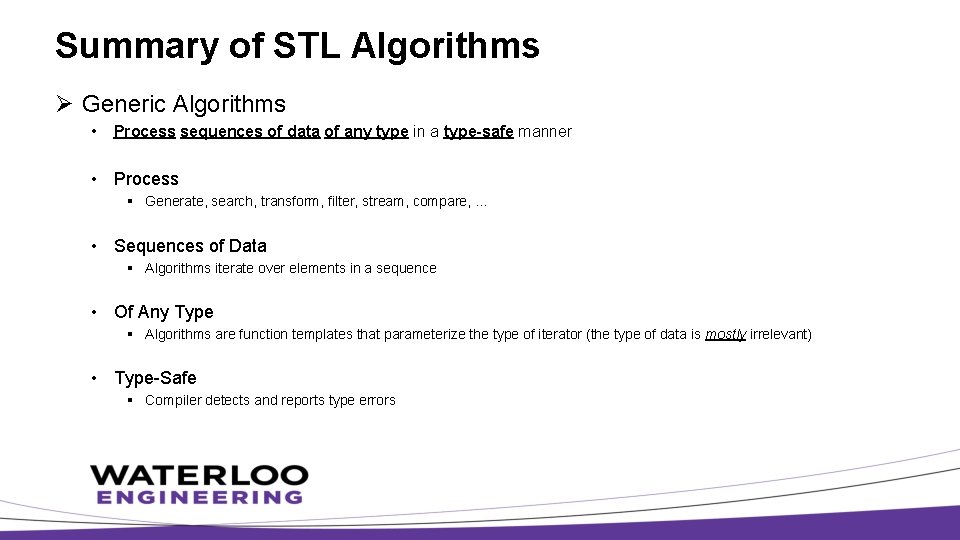
Summary of STL Algorithms Ø Generic Algorithms • Process sequences of data of any type in a type-safe manner • Process § Generate, search, transform, filter, stream, compare, … • Sequences of Data § Algorithms iterate over elements in a sequence • Of Any Type § Algorithms are function templates that parameterize the type of iterator (the type of data is mostly irrelevant) • Type-Safe § Compiler detects and reports type errors