
Stimulated Raman Scattering Coherent antiStokes Raman Scattering A
















- Slides: 50
Stimulated Raman Scattering Coherent anti-Stokes Raman Scattering
A. Surface Enhanced Raman Scattering (SERS) as nonlinear optical effect. B. New features of the Raman spectra of single-walled carbon nanotubes highly separated into semiconducting (99%) and metallic (98%) components. I. Baltog, M. Baibarac, L. Mihut,
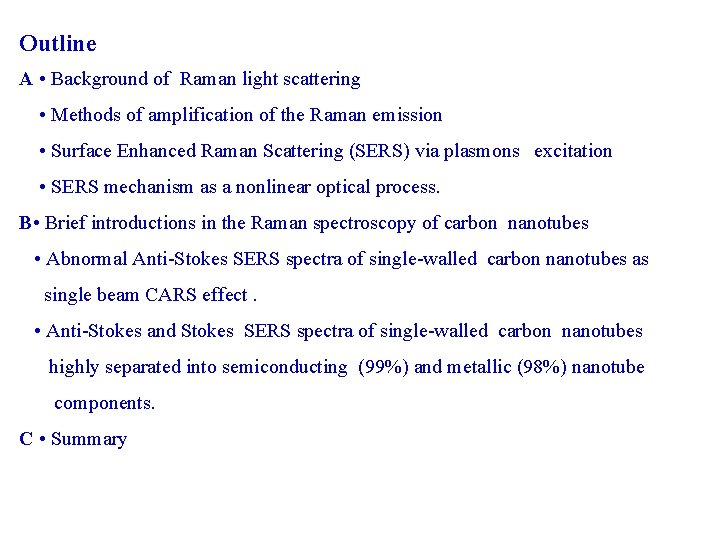
Outline A • Background of Raman light scattering • Methods of amplification of the Raman emission • Surface Enhanced Raman Scattering (SERS) via plasmons excitation • SERS mechanism as a nonlinear optical process. B • Brief introductions in the Raman spectroscopy of carbon nanotubes • Abnormal Anti-Stokes SERS spectra of single-walled carbon nanotubes as single beam CARS effect. • Anti-Stokes and Stokes SERS spectra of single-walled carbon nanotubes highly separated into semiconducting (99%) and metallic (98%) nanotube components. C • Summary
v 3 v 2 v 1 v 0 Excitation Raman anti-Stokes Raman Stokes Excitation Raman anti-Stokes Excitation Raman Stokes Virtual levels Electronic levels
Raman light scattering is an complex interaction of photons and intrinsic molecular bonds Rayleigh scattering Intensity Values at ~ 1500 cm-1 I( l) >> IS >> Ia. S 1 >> 10 -6 >> 10 -9 Anti-Stokes Raman scattering Both branches are amplified equally with the excitation light intensity
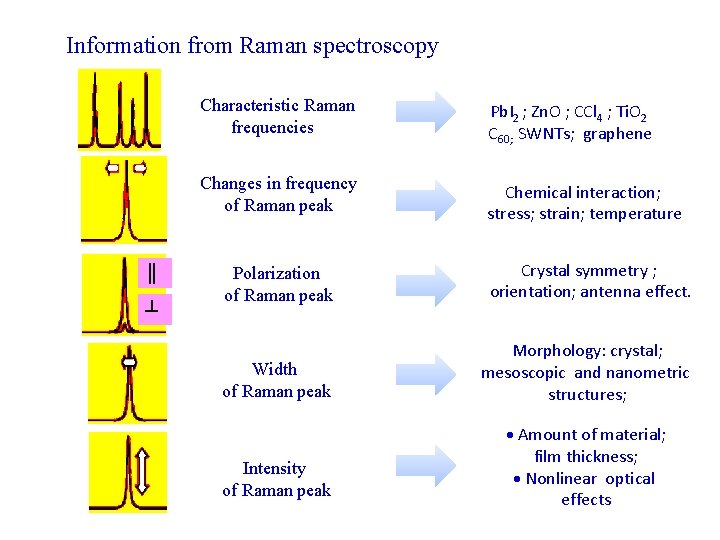
Information from Raman spectroscopy ║ ┴ Characteristic Raman frequencies Pb. I 2 ; Zn. O ; CCl 4 ; Ti. O 2 C 60; SWNTs; graphene Changes in frequency of Raman peak Chemical interaction; stress; strain; temperature Polarization of Raman peak Crystal symmetry ; orientation; antenna effect. Width of Raman peak Morphology: crystal; mesoscopic and nanometric structures; Intensity of Raman peak Amount of material; film thickness; Nonlinear optical effects
Methods of amplification of the Raman emission Resonant excitation SERS effect chemical + plasmons B. V 514. 5 nm 676. 4 nm B. C x 104 Stimulated Raman effect SERS chemical S R s SE mon s pla x 104 -106 SERS plasmons CARS effect ωS ħ(2ωP – ωS) ωa. S = 2ωP – ωS ka. S =2 k. P -k. S ħω1 ωp ωp-ωS=Ω x 104 -108 x 104 -1010 k(ω ) 1 k(ω0) k(2 ω0 ω 1) k(ω0)
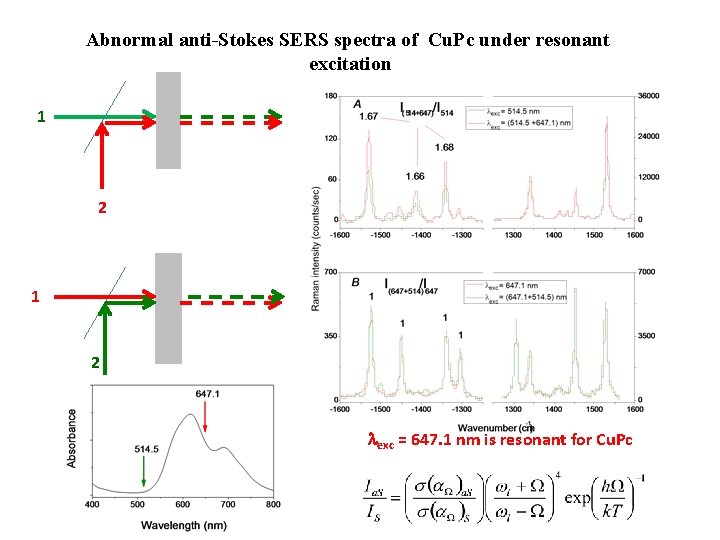
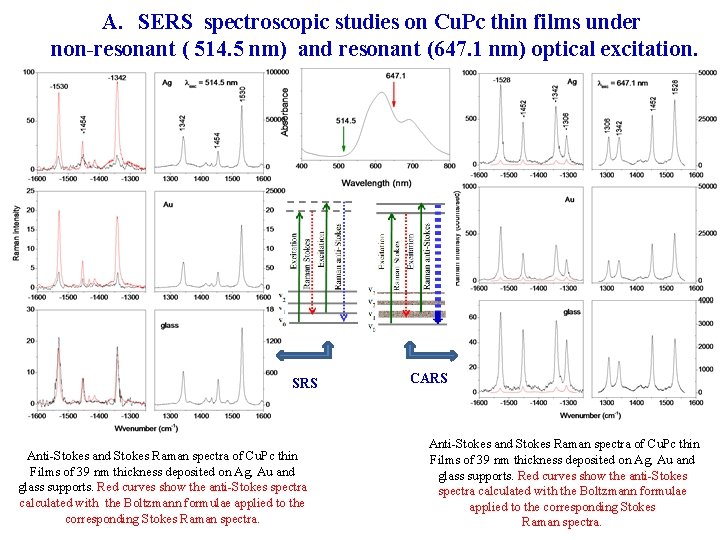
Abnormal anti-Stokes SERS spectra of Cu. Pc under resonant excitation 1 2 exc = 647. 1 nm is resonant for Cu. Pc
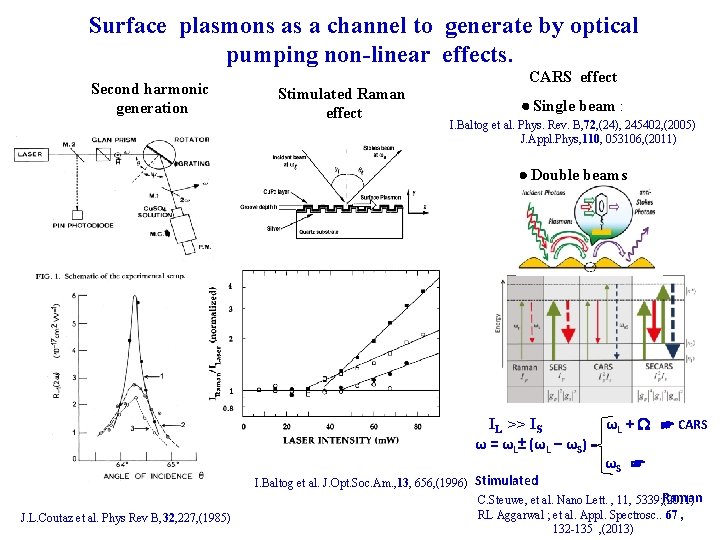
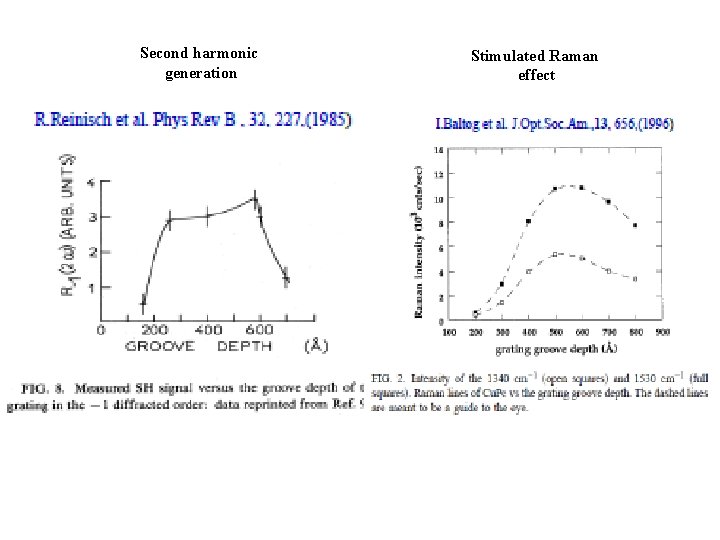
Surface plasmons as a channel to generate by optical pumping non-linear effects. Second harmonic generation Stimulated Raman effect CARS effect Single beam : I. Baltog et al. Phys. Rev. B, 72, (24), 245402, (2005) J. Appl. Phys, 110, 053106, (2011) Double beams IL >> IS ωL + ☛ CARS ω = ωL± (ωL – ωS) = ωS ☛ J. L. Coutaz et al. Phys Rev B, 32, 227, (1985) I. Baltog et al. J. Opt. Soc. Am. , 13, 656, (1996) Stimulated Raman C. Steuwe, et al. Nano Lett. , 11, 5339; (2011) RL Aggarwal ; et al. Appl. Spectrosc. . 67 , 132 -135 , (2013)
Second harmonic generation Stimulated Raman effect
s-polarization: E-field is perpendicular to the plane of incidence (German senkrecht = perpedicular) p-polarization: E-field is parallel to the plane of incidence Ez Hz E Hy z Ey Ex 1 z=0 y H x 1 2 Hx 1 z=0 y 2 x 1 2 2 z Any linearly polarized radiation can be represented as a superposition of p - and s - polarization.
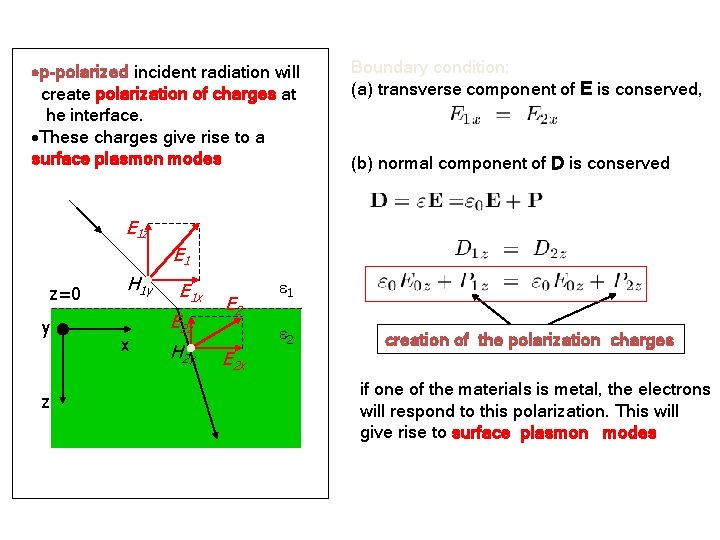
p-polarized incident radiation will create polarization of charges at he interface. These charges give rise to a surface plasmon modes Boundary condition: (a) transverse component of E is conserved, (b) normal component of D is conserved E 1 z E 1 z=0 y z H 1 y x E 1 x E 2 z H 2 y E 2 x 1 2 creation of the polarization charges if one of the materials is metal, the electrons will respond to this polarization. This will give rise to surface plasmon modes
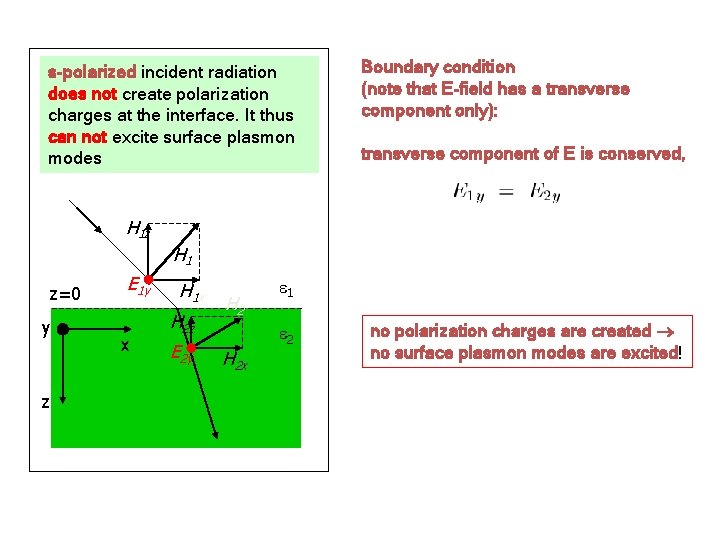
s-polarized incident radiation does not create polarization charges at the interface. It thus can not excite surface plasmon modes Boundary condition (note that E-field has a transverse component only): transverse component of E is conserved, H 1 z H 1 z=0 y z E 1 y x H 1 x H 2 z E 2 y H 2 x 1 2 no polarization charges are created no surface plasmon modes are excited!
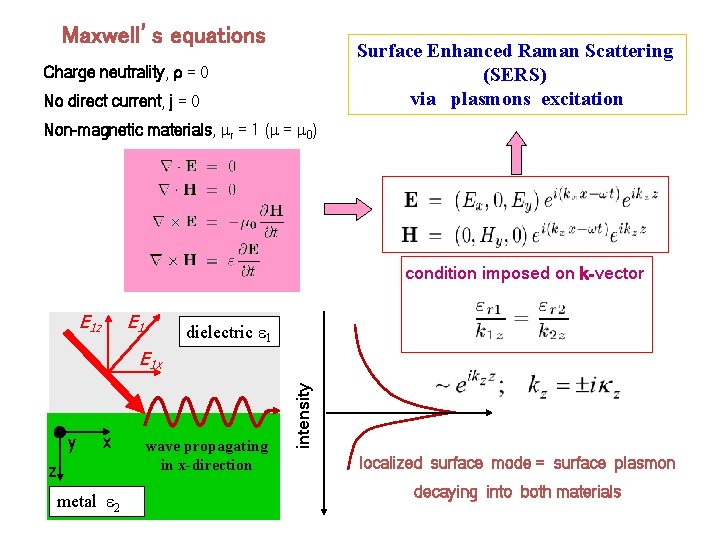
Maxwell’s equations Surface Enhanced Raman Scattering (SERS) via plasmons excitation Charge neutrality, = 0 No direct current, j = 0 Non-magnetic materials, r = 1 ( = 0) condition imposed on k-vector E 1 z E 1 dielectric 1 y x z metal 2 wave propagating in x-direction intensity E 1 x localized surface mode = surface plasmon decaying into both materials
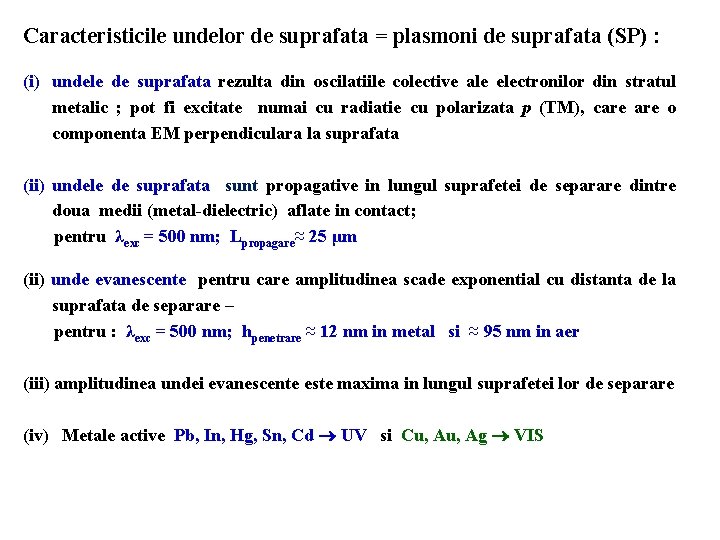
Caracteristicile undelor de suprafata = plasmoni de suprafata (SP) : (i) undele de suprafata rezulta din oscilatiile colective ale electronilor din stratul metalic ; pot fi excitate numai cu radiatie cu polarizata p (TM), care o componenta EM perpendiculara la suprafata (ii) undele de suprafata sunt propagative in lungul suprafetei de separare dintre doua medii (metal-dielectric) aflate in contact; pentru λexc = 500 nm; Lpropagare≈ 25 μm (ii) unde evanescente pentru care amplitudinea scade exponential cu distanta de la suprafata de separare – pentru : λexc = 500 nm; hpenetrare ≈ 12 nm in metal si ≈ 95 nm in aer (iii) amplitudinea undei evanescente este maxima in lungul suprafetei lor de separare (iv) Metale active Pb, In, Hg, Sn, Cd UV si Cu, Ag VIS
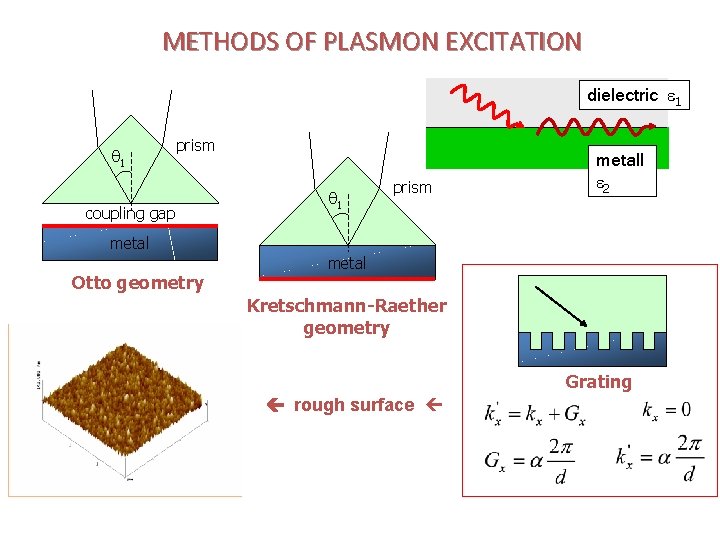
METHODS OF PLASMON EXCITATION dielectric 1 1 prism coupling gap metal Otto geometry 1 prism metall 2 metal Kretschmann-Raether geometry Grating rough surface
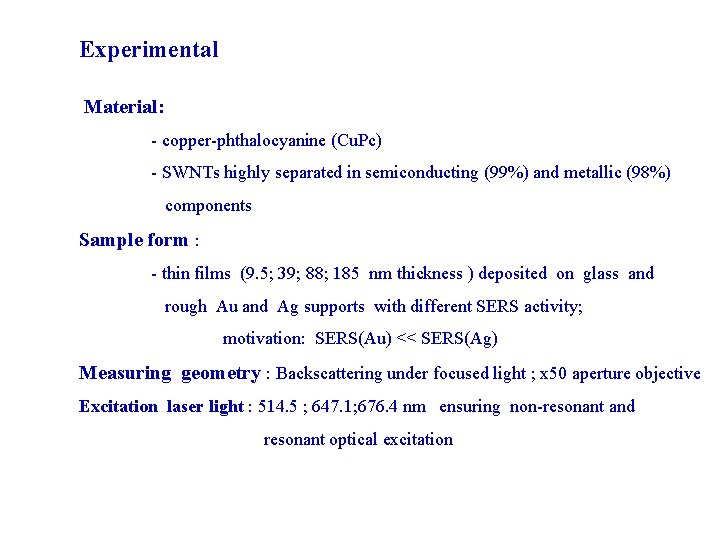
Experimental Material: - copper-phthalocyanine (Cu. Pc) - SWNTs highly separated in semiconducting (99%) and metallic (98%) components Sample form : - thin films (9. 5; 39; 88; 185 nm thickness ) deposited on glass and rough Au and Ag supports with different SERS activity; motivation: SERS(Au) << SERS(Ag) Measuring geometry : Backscattering under focused light ; x 50 aperture objective Excitation laser light : 514. 5 ; 647. 1; 676. 4 nm ensuring non-resonant and resonant optical excitation
Abnormal anti-Stokes SERS spectra of Cu. Pc under resonant excitation 1 2 exc = 647. 1 nm is resonant for Cu. Pc
A. SERS spectroscopic studies on Cu. Pc thin films under non-resonant ( 514. 5 nm) and resonant (647. 1 nm) optical excitation. SRS Anti-Stokes and Stokes Raman spectra of Cu. Pc thin Films of 39 nm thickness deposited on Ag, Au and glass supports. Red curves show the anti-Stokes spectra calculated with the Boltzmann formulae applied to the corresponding Stokes Raman spectra. CARS Anti-Stokes and Stokes Raman spectra of Cu. Pc thin Films of 39 nm thickness deposited on Ag, Au and glass supports. Red curves show the anti-Stokes spectra calculated with the Boltzmann formulae applied to the corresponding Stokes Raman spectra.
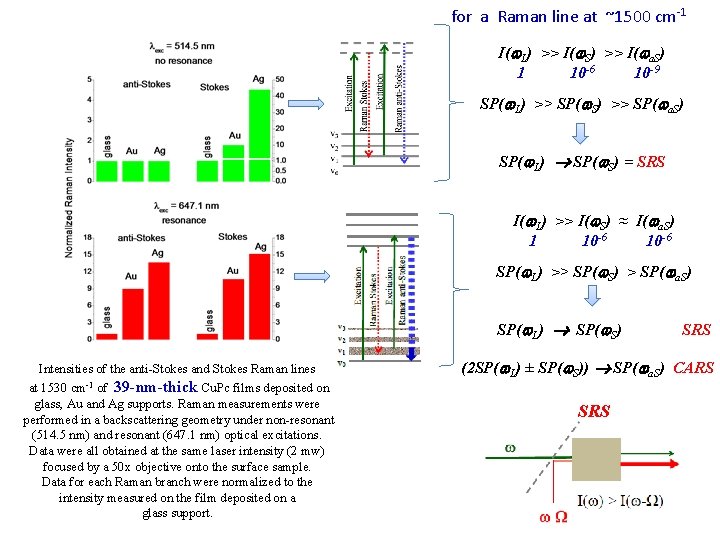
for a Raman line at ~1500 cm-1 I( L) >> I( S) >> I( a. S) 1 10 -6 10 -9 SP( L) >> SP( S) >> SP( a. S) SP( L) SP( S) = SRS I( L) >> I( S) ≈ I( a. S) 1 10 -6 SP( L) >> SP( S) > SP( a. S) SP( L) SP( S) Intensities of the anti-Stokes and Stokes Raman lines at 1530 cm-1 of 39 -nm-thick Cu. Pc films deposited on glass, Au and Ag supports. Raman measurements were performed in a backscattering geometry under non-resonant (514. 5 nm) and resonant (647. 1 nm) optical excitations. Data were all obtained at the same laser intensity (2 mw) focused by a 50 x objective onto the surface sample. Data for each Raman branch were normalized to the intensity measured on the film deposited on a glass support. SRS (2 SP( L) ± SP( S)) SP( a. S) CARS SRS
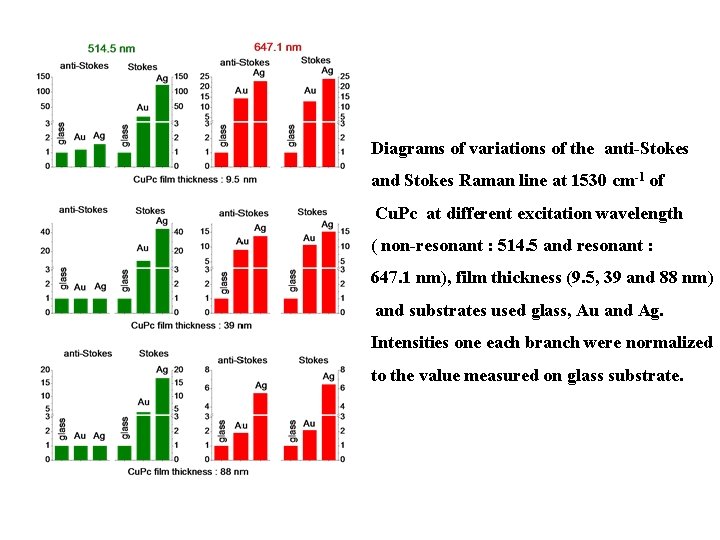
Diagrams of variations of the anti-Stokes and Stokes Raman line at 1530 cm-1 of Cu. Pc at different excitation wavelength ( non-resonant : 514. 5 and resonant : 647. 1 nm), film thickness (9. 5, 39 and 88 nm) and substrates used glass, Au and Ag. Intensities one each branch were normalized to the value measured on glass substrate.
A 2 Film thickness matched by plasmons wave penetration depth I( L) >> I( S) ≈ I( a. S) 1 10 -6 SP( L) >> SP( S) ≈ SP( a. S) Intensity of the anti-Stokes and Stokes Raman line at 1560 cm-1 of Cu. Pc thin films of 9. 5 nm thickness deposited on glass, Au and Ag supports under non-resonant (514. 5 nm) and resonant (647. 1 nm) laser excitation. Data were normalized to the intensity obtained on glass support. SRS SP( L) SP( S) CARS (2 SP( L) ± SP( S)) SP( a. S)
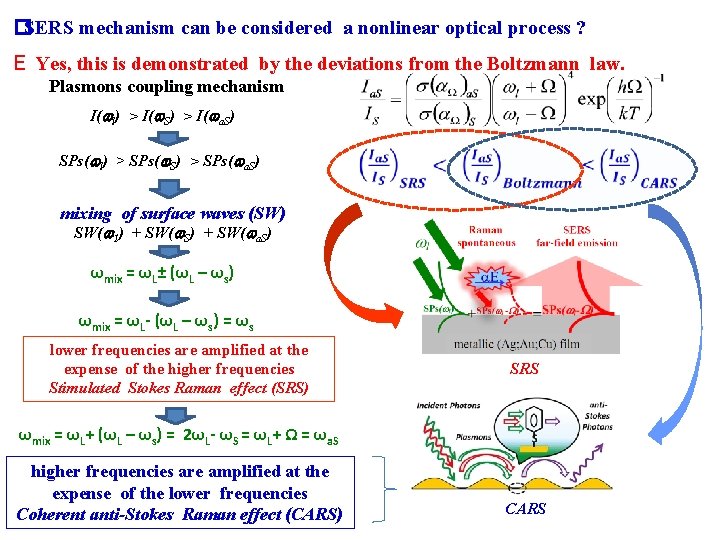
�SERS mechanism can be considered a nonlinear optical process ? E Yes, this is demonstrated by the deviations from the Boltzmann law. Plasmons coupling mechanism I( l) > I( S) > I( a. S) SPs( l) > SPs( S) > SPs( a. S) mixing of surface waves (SW) SW( 1) + SW( S) + SW( a. S) ωmix = ωL± (ωL – ωs) ωmix = ωL- (ωL – ωs) = ωs lower frequencies are amplified at the expense of the higher frequencies Stimulated Stokes Raman effect (SRS) SRS ωmix = ωL+ (ωL – ωs) = 2ωL- ωS = ωL+ Ω = ωa. S higher frequencies are amplified at the expense of the lower frequencies Coherent anti-Stokes Raman effect (CARS) CARS
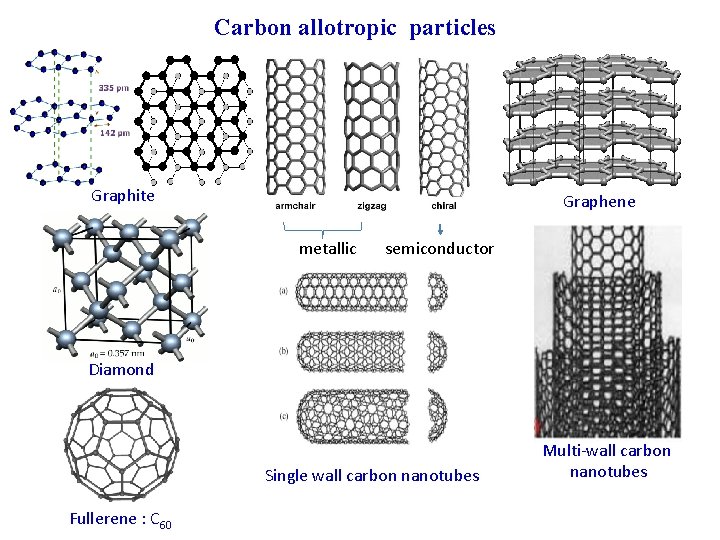
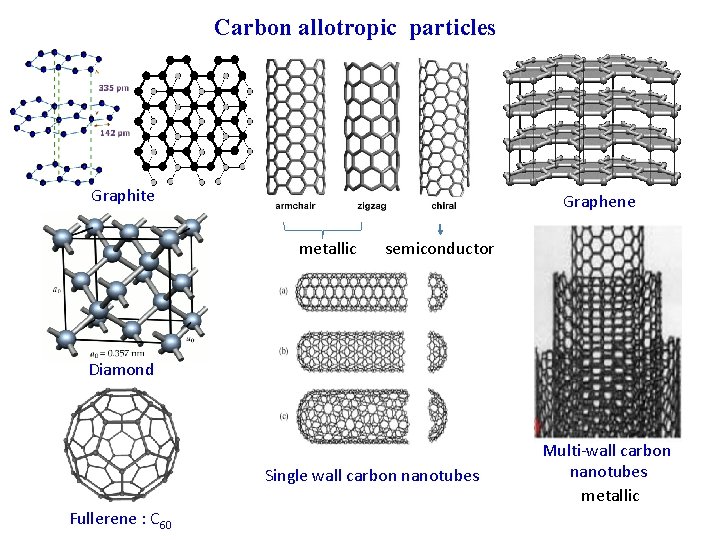
Carbon allotropic particles Graphite Graphene metallic semiconductor Diamond Single wall carbon nanotubes Fullerene : C 60 Multi-wall carbon nanotubes
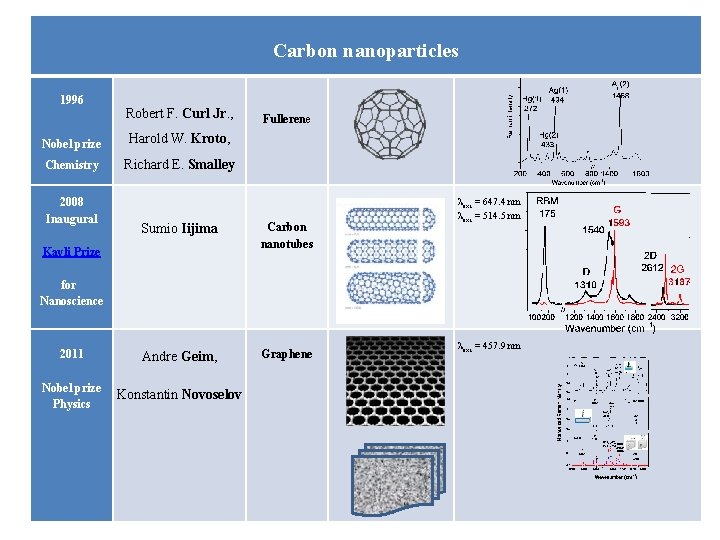
Carbon nanoparticles 1996 Robert F. Curl Jr. , Nobel prize Harold W. Kroto, Chemistry Richard E. Smalley 2008 Inaugural Fullerene Sumio Iijima Carbon nanotubes 2011 Andre Geim, Graphene Nobel prize Physics Konstantin Novoselov Kavli Prize exc = 647. 4 nm exc = 514. 5 nm for Nanoscience exc = 457. 9 nm
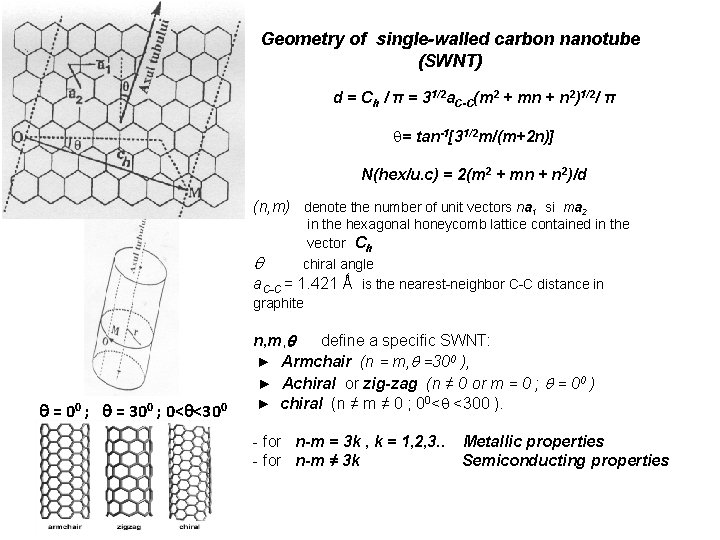
Geometry of single-walled carbon nanotube (SWNT) d = Ch / π = 31/2 a. C-C(m 2 + mn + n 2)1/2/ π = tan-1[31/2 m/(m+2 n)] N(hex/u. c) = 2(m 2 + mn + n 2)/d (n, m) denote the number of unit vectors na 1 si ma 2 in the hexagonal honeycomb lattice contained in the vector Ch chiral angle a. C-C = 1. 421 Ǻ is the nearest-neighbor C-C distance in graphite = 00 ; = 300 ; 0< <300 n, m, define a specific SWNT: ► Armchair (n = m, =300 ), ► Achiral or zig-zag (n ≠ 0 or m = 0 ; = 00 ) ► chiral (n ≠ m ≠ 0 ; 00< <300 ). - for n-m = 3 k , k = 1, 2, 3. . - for n-m ≠ 3 k Metallic properties Semiconducting properties
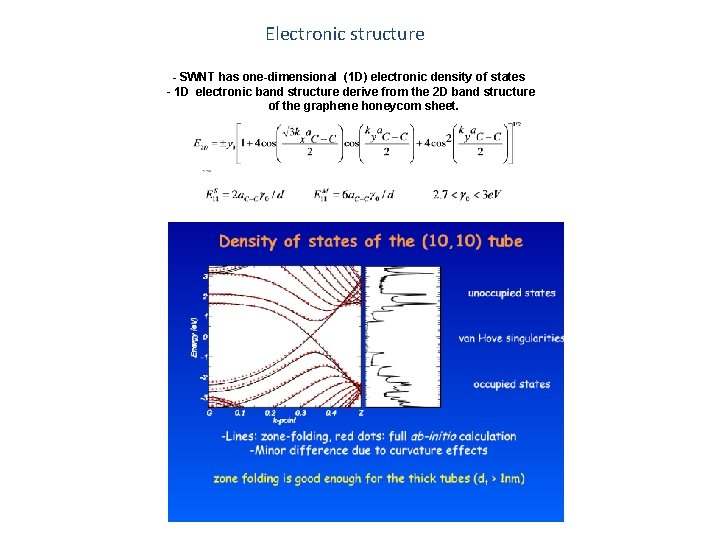
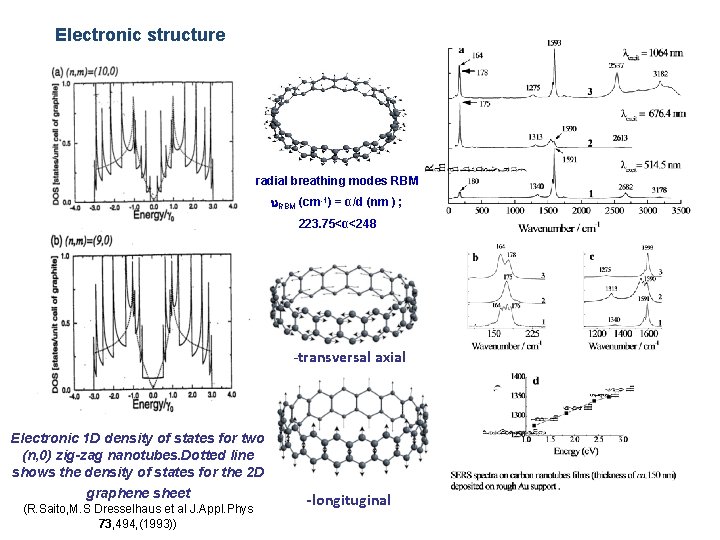
Electronic structure - SWNT has one-dimensional (1 D) electronic density of states - 1 D electronic band structure derive from the 2 D band structure of the graphene honeycom sheet.
► The structure of electronic bands density of an one dimensional system (1 D- carbon nanotube) derives from the bi dimensional structure (2 D) of graphite ► A set of 1 D energy dispersion relations is obtained by slicing up the 2 D energy band structure of graphite in the circumferential direction. where a = 1. 42 x Ǻ =2. 46 Ǻ is lattice constant of two dimensional graphite kx and ky are the corresponding basis vectors of the reciprocal lattice; γ 0 is nearest-neighbor transfer integral For an armchair SWNT tube the 1 D energy dispersion relation is: (-π < ka < π ); m = 1, . . . , 5 ; Similarly for a zig-zac SWNT tube: m = 1, . . . , 9 ; k is one dimensional vector along the tub axis ► The calculations for the electronic structure of SWNTs show that about 1/3 of the nanotubes are metallic and 2/3 are semiconducting , depending on the nanotube diameter dt and chiral angle θ. ►The metallic SWNT have a small non-vanishing 1 D density of states at the Fermi level while for the semiconducting 1 D SWNT the density of states is zero. ► The band gap for isolated semiconducting carbon nanotubes is proportional to the reciprocal nanotube diameter 1/dt
The tubes diameter and calculated band gap energies as function of n, m, parameters. 514. 5 nm 2. 4 e. V 676 nm 1. 83 e. V 1064 nm 1. 16 e. V Absorption spectrum of SWNT
Electronic structure radial breathing modes RBM (cm-1) = α/d (nm ) ; 223. 75<α<248 -transversal axial Electronic 1 D density of states for two (n, 0) zig-zag nanotubes. Dotted line shows the density of states for the 2 D graphene sheet (R. Saito, M. S Dresselhaus et al J. Appl. Phys 73, 494, (1993)) -longituginal
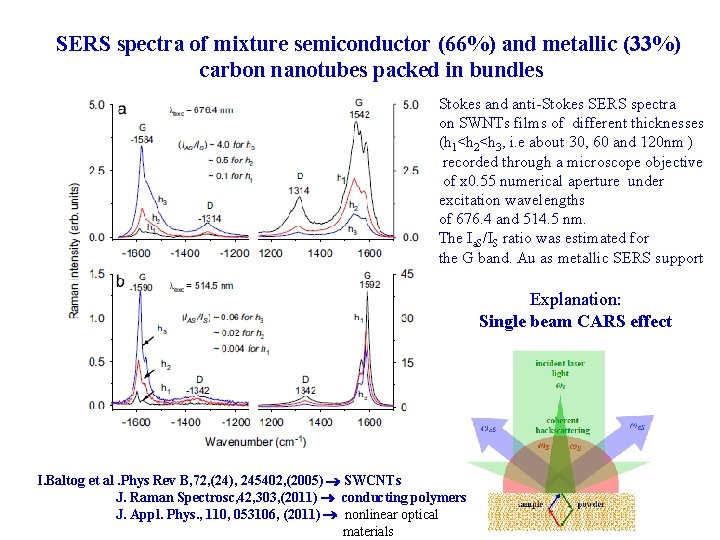
SERS spectra of mixture semiconductor (66%) and metallic (33%) carbon nanotubes packed in bundles Stokes and anti-Stokes SERS spectra on SWNTs films of different thicknesses (h 1<h 2<h 3, i. e about 30, 60 and 120 nm ) recorded through a microscope objective of x 0. 55 numerical aperture under excitation wavelengths of 676. 4 and 514. 5 nm. The Ia. S/IS ratio was estimated for the G band. Au as metallic SERS support Explanation: Single beam CARS effect I. Baltog et al. Phys Rev B, 72, (24), 245402, (2005) SWCNTs J. Raman Spectrosc, 42, 303, (2011) conducting polymers J. Appl. Phys. , 110, 053106, (2011) nonlinear optical materials
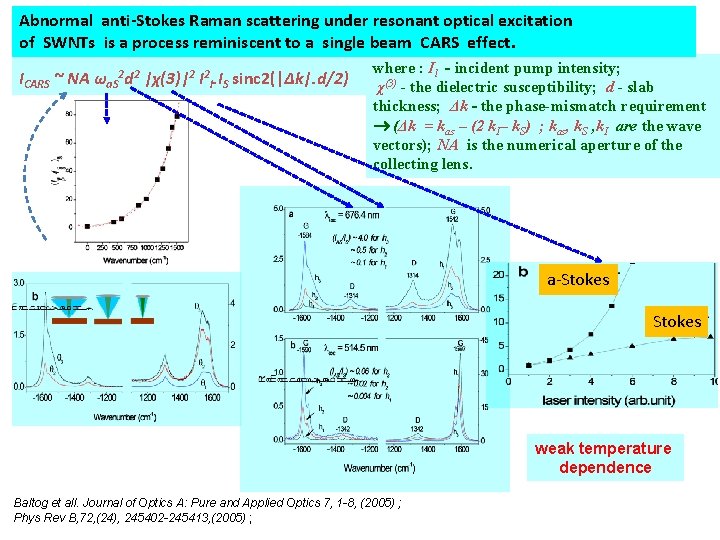
Abnormal anti-Stokes Raman scattering under resonant optical excitation of SWNTs is a process reminiscent to a single beam CARS effect. ICARS ~ NA ωa. S 2 d 2 |χ(3)|2 I 2 l. IS sinc 2(|Δk|. d/2) where : Il - incident pump intensity; χ(3) - the dielectric susceptibility; d - slab thickness; Δk - the phase-mismatch requirement (Δk = kas – (2 k. I– k. S) ; kas, k. S , k. I are the wave vectors); NA is the numerical aperture of the collecting lens. a-Stokes weak temperature dependence Baltog et all. Journal of Optics A: Pure and Applied Optics 7, 1 -8, (2005) ; Phys Rev B, 72, (24), 245402 -245413, (2005) ;
B. Anti-Stokes and Stokes SERS spectra of single-walled carbon nanotubes highly separated into semiconducting (99%) and metallic (98%) nanotube components. B 1. Absorption spectra of semiconducting (99%) and metallic (98%) SWNT 514 676 Calculated Kataura plots of van Hove singularities Energy vs. tub diameter
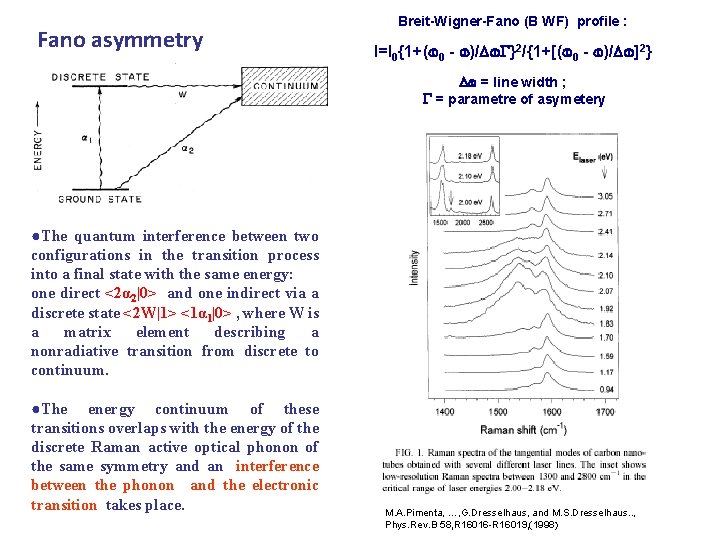
Fano asymmetry Breit-Wigner-Fano (B WF) profile : I=I 0{1+( 0 - )/ }2/{1+[( 0 - )/ ]2} = line width ; = parametre of asymetery ●The quantum interference between two configurations in the transition process into a final state with the same energy: one direct <2α 2|0> and one indirect via a discrete state <2 W|1> <1α 1|0> , where W is a matrix element describing a nonradiative transition from discrete to continuum. ●The energy continuum of these transitions overlaps with the energy of the discrete Raman active optical phonon of the same symmetry and an interference between the phonon and the electronic transition takes place. M. A. Pimenta, …, G. Dresselhaus, and M. S. Dresselhaus. . , Phys. Rev. B 58, R 16016 -R 16019, (1998)
TO Stokes and anti-Stokes Raman spectra for SWNT’s of d~1. 49 nm taken at four different values of E laser LO S. D. M. Brown et al. Phys. Rev. B 61, R 5137(2000) Raman G+ and G- peaks associated to LO and TO phonons for semiconducting and metallic SWNTs S. Piscanec et al. Phys. Rev. B 75, 035427(2007) ? LO TO
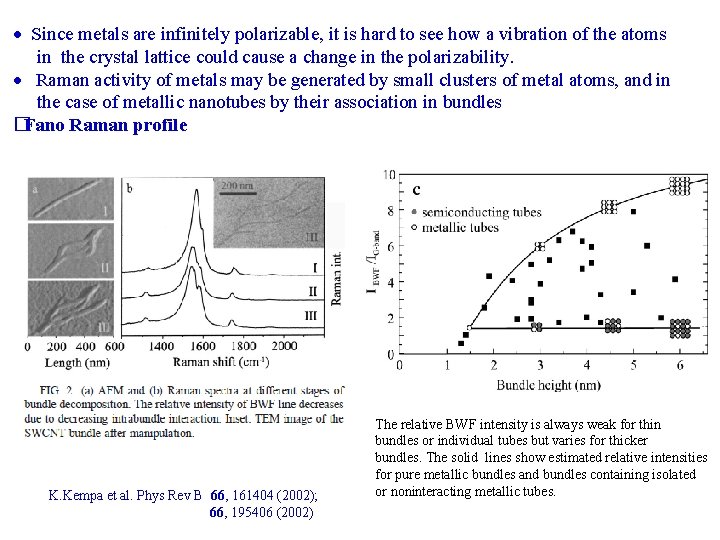
Since metals are infinitely polarizable, it is hard to see how a vibration of the atoms in the crystal lattice could cause a change in the polarizability. Raman activity of metals may be generated by small clusters of metal atoms, and in the case of metallic nanotubes by their association in bundles �Fano Raman profile K. Kempa et al. Phys Rev B 66, 161404 (2002); 66, 195406 (2002) The relative BWF intensity is always weak for thin bundles or individual tubes but varies for thicker bundles. The solid lines show estimated relative intensities for pure metallic bundles and bundles containing isolated or noninteracting metallic tubes.
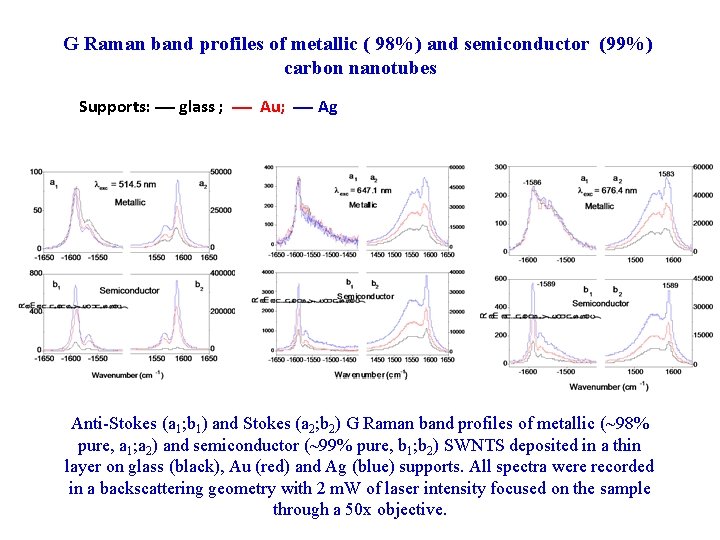
G Raman band profiles of metallic ( 98%) and semiconductor (99%) carbon nanotubes Supports: glass ; Au; Ag Anti-Stokes (a 1; b 1) and Stokes (a 2; b 2) G Raman band profiles of metallic (~98% pure, a 1; a 2) and semiconductor (~99% pure, b 1; b 2) SWNTS deposited in a thin layer on glass (black), Au (red) and Ag (blue) supports. All spectra were recorded in a backscattering geometry with 2 m. W of laser intensity focused on the sample through a 50 x objective.
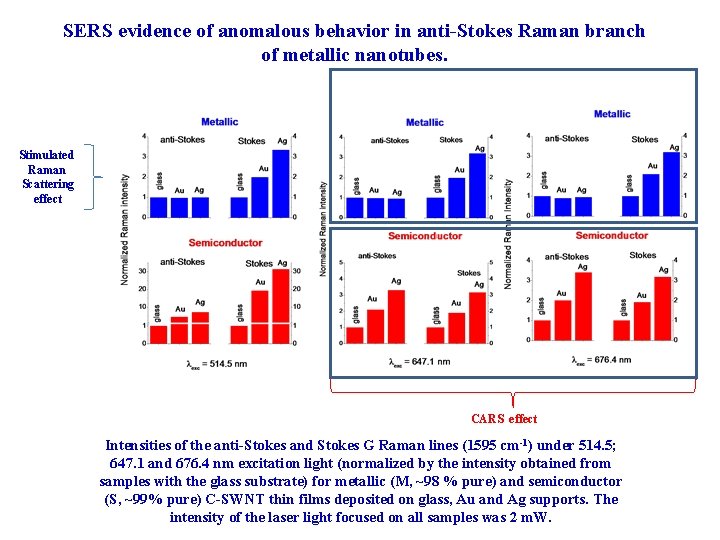
SERS evidence of anomalous behavior in anti-Stokes Raman branch of metallic nanotubes. Stimulated Raman Scattering effect CARS effect Intensities of the anti-Stokes and Stokes G Raman lines (1595 cm-1) under 514. 5; 647. 1 and 676. 4 nm excitation light (normalized by the intensity obtained from samples with the glass substrate) for metallic (M, ~98 % pure) and semiconductor (S, ~99% pure) C-SWNT thin films deposited on glass, Au and Ag supports. The intensity of the laser light focused on all samples was 2 m. W.
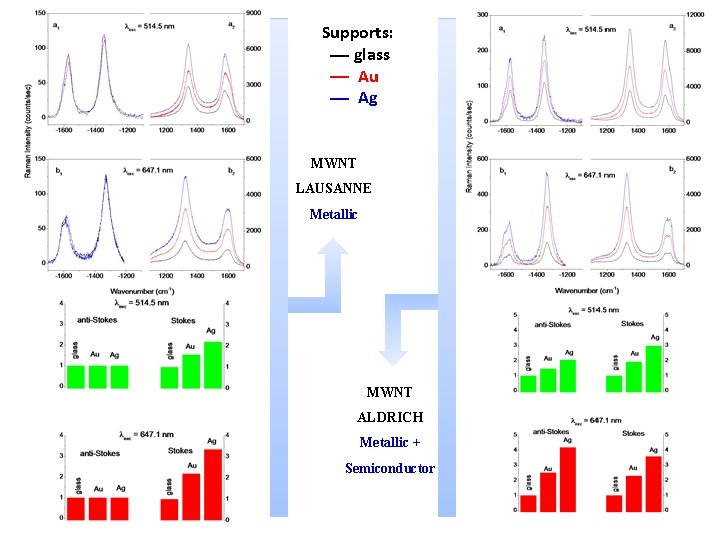
Supports: glass Au Ag MWNT LAUSANNE Metallic MWNT ALDRICH Metallic + Semiconductor
Insulator, semiconductor and metal Clasification based on bandstructure Conduction band EF Conduction band Eg Energy Vibration levels Valence band METAL INSULATOR or SEMICONDUCTOR
Absorption: Semiconductors • Absorption by electron transition occurs if h > Egap Energy of electron unfilled states incident photon energy h Egap typical resonance Io filled states
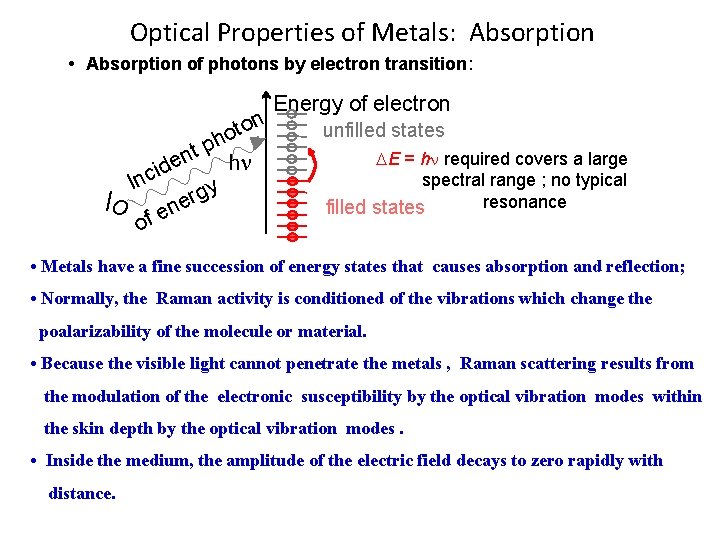
Optical Properties of Metals: Absorption • Absorption of photons by electron transition: n o t o ph nt h e id c n I y g r Io ene of Energy of electron unfilled states DE = h required covers a large spectral range ; no typical resonance filled states • Metals have a fine succession of energy states that causes absorption and reflection; • Normally, the Raman activity is conditioned of the vibrations which change the poalarizability of the molecule or material. • Because the visible light cannot penetrate the metals , Raman scattering results from the modulation of the electronic susceptibility by the optical vibration modes within the skin depth by the optical vibration modes. • Inside the medium, the amplitude of the electric field decays to zero rapidly with distance.
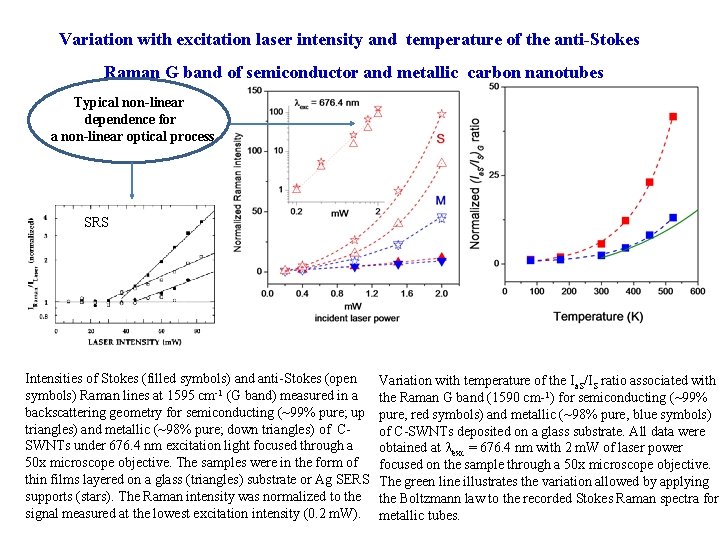
Variation with excitation laser intensity and temperature of the anti-Stokes Raman G band of semiconductor and metallic carbon nanotubes Typical non-linear dependence for a non-linear optical process SRS Intensities of Stokes (filled symbols) and anti-Stokes (open symbols) Raman lines at 1595 cm-1 (G band) measured in a backscattering geometry for semiconducting (~99% pure; up triangles) and metallic (~98% pure; down triangles) of CSWNTs under 676. 4 nm excitation light focused through a 50 x microscope objective. The samples were in the form of thin films layered on a glass (triangles) substrate or Ag SERS supports (stars). The Raman intensity was normalized to the signal measured at the lowest excitation intensity (0. 2 m. W). Variation with temperature of the Ia. S/IS ratio associated with the Raman G band (1590 cm-1) for semiconducting (~99% pure, red symbols) and metallic (~98% pure, blue symbols) of C-SWNTs deposited on a glass substrate. All data were obtained at exc = 676. 4 nm with 2 m. W of laser power focused on the sample through a 50 x microscope objective. The green line illustrates the variation allowed by applying the Boltzmann law to the recorded Stokes Raman spectra for metallic tubes.
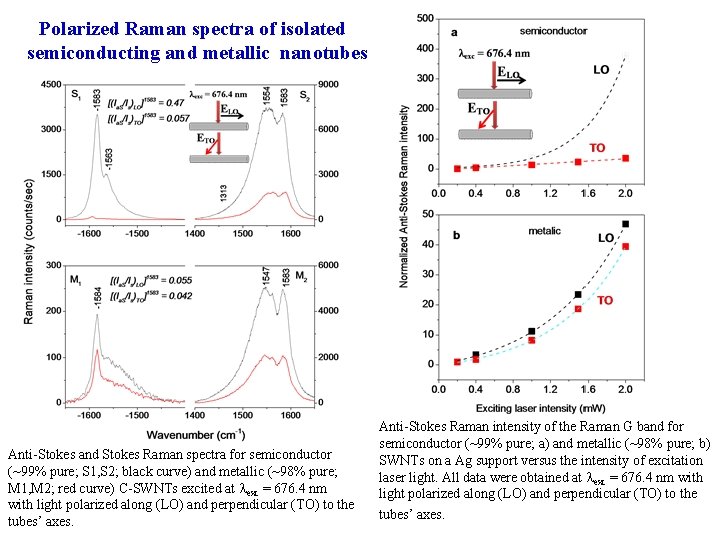
Polarized Raman spectra of isolated semiconducting and metallic nanotubes Anti-Stokes and Stokes Raman spectra for semiconductor (~99% pure; S 1, S 2; black curve) and metallic (~98% pure; M 1, M 2; red curve) C-SWNTs excited at exc = 676. 4 nm with light polarized along (LO) and perpendicular (TO) to the tubes’ axes. Anti-Stokes Raman intensity of the Raman G band for semiconductor (~99% pure; a) and metallic (~98% pure; b) SWNTs on a Ag support versus the intensity of excitation laser light. All data were obtained at exc = 676. 4 nm with light polarized along (LO) and perpendicular (TO) to the tubes’ axes.
Conclusion: i) SERS effect manifests differently under non-resonant and resonant optical excitations, it results from the coupling of plasmons associated with the incident light with the plasmons associated with the Stokes and anti-Stokes spontaneous Raman emissions. ii) Under non-resonant and resonant optical excitation SERS manifests as stimulated Raman process and CARS effect, respectively. iii) Contrary to the results reported so far , and regardless of whether the optical excitation was non-resonant or resonant and regardless of whether glass, Au or Ag was used as the substrate, the metallic single wall carbon nanotubes (SWNTs) do not show an anomalous anti-Stokes Raman emission. iv) Semiconducting SWNTs always show an anomalous anti-Stokes Raman emission that grows further under increases in the excitation light intensity or temperature. v) Semiconducting SWNTs behave differently than metallic SWNTs because of the splitting of electronic levels into a vibration structure, which under resonant optical excitation changes the polarizability of the material by overpopulating the states and contributes to an enhancement of the anti-Stokes Raman emission; vi) Metallic SWNTs (like any metal) are infinitely polarizable at very short distances, fact which determines the invariance of the Stokes Raman spectrum under changes of the polarization of the excitation light
Own contributions: Appl Phys Lett 66, 1187 -1190, (1995) J Opt Soc Am B 13, 656 -660, (1996) Pure Appl. Opt. 5 , 645– 653, (1996) J. Raman Spectrosc. 29, 825È832 (1998) Phys Rev B 65, 235401, (2002) Carbon, 40, 2201 -2211, (2002) J. Opt. A: Pure Appl. Opt. 7, 632– 639, (2005) Phys. Rev. B, 72, (24), 245402 -245413, (2005) Carbon, 43, 1 -9, (2005) J Raman Spectrosc 36, 676 -698, (2005) Physica E: 40(7), 2380, (2008) J. Phys: Condensed Matter. 20, (27), 275215, (2008) Physica Status Solidi (b) 245, (10), 2221, (2008) Carbon , 47, (5), 1389 -1398, (2009) Synthetic Metals 159 , 2173, (2009) J Raman Spectrosc , 42, (3), 303, (2011 ) J. Phys. B: At. Mol. Opt. Phys. 44, 095401, (2011) Optical Materials, 33, (9), 1410, (2011) J Appl Phy, 110, 053106, (2011) Proc. Romanian Acad. , Series A, 13, (2), 109– 117, (2012) J Phys Chem. C, 116, 25537− 25545, (2012) Optics Communication : submitted, (2013) J Raman Spectrosc, submitted, 2013 Journal of Optics : submitted, (2013)
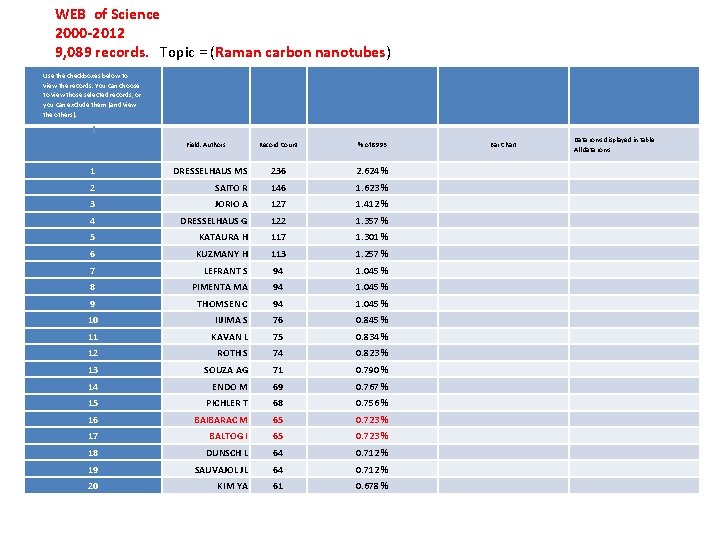
WEB of Science 2000 -2012 9, 089 records. Topic = (Raman carbon nanotubes) Use the checkboxes below to view the records. You can choose to view those selected records, or you can exclude them (and view the others). Field: Authors Record Count % of 8993 1 DRESSELHAUS MS 236 2. 624 % 2 SAITO R 146 1. 623 % 3 JORIO A 127 1. 412 % 4 DRESSELHAUS G 122 1. 357 % 5 KATAURA H 117 1. 301 % 6 KUZMANY H 113 1. 257 % 7 LEFRANT S 94 1. 045 % 8 PIMENTA MA 94 1. 045 % 9 THOMSEN C 94 1. 045 % 10 IIJIMA S 76 0. 845 % 11 KAVAN L 75 0. 834 % 12 ROTH S 74 0. 823 % 13 SOUZA AG 71 0. 790 % 14 ENDO M 69 0. 767 % 15 PICHLER T 68 0. 756 % 16 BAIBARAC M 65 0. 723 % 17 BALTOG I 65 0. 723 % 18 DUNSCH L 64 0. 712 % 19 SAUVAJOL JL 64 0. 712 % 20 KIM YA 61 0. 678 % Bar Chart Data rows displayed in table All data rows
Thanks for your attention
Carbon allotropic particles Graphite Graphene metallic semiconductor Diamond Single wall carbon nanotubes Fullerene : C 60 Multi-wall carbon nanotubes metallic
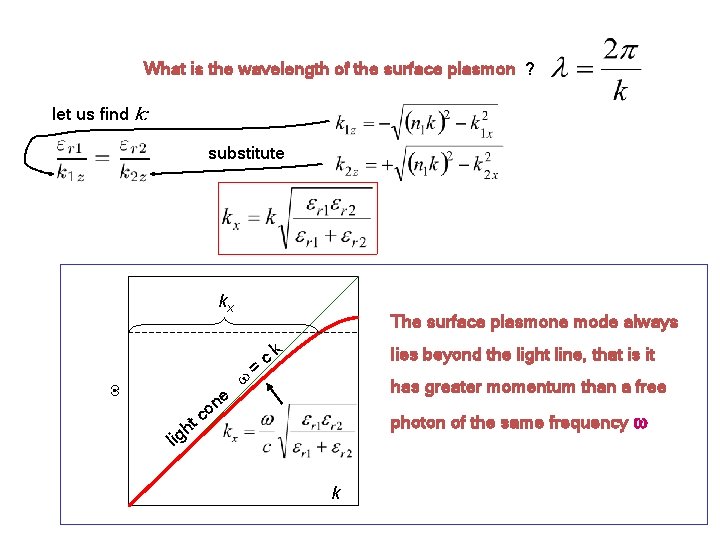
What is the wavelength of the surface plasmon ? let us find k: substitute kx ne The surface plasmone mode always = c k lies beyond the light line, that is it has greater momentum than a free o c t photon of the same frequency h lig k