
Still have a few registered iclickers 3 or

- Slides: 16
Still have a few registered iclickers (3 or 4 ? ) that need to be mapped to names Copyright © 2012 Pearson Education Inc.
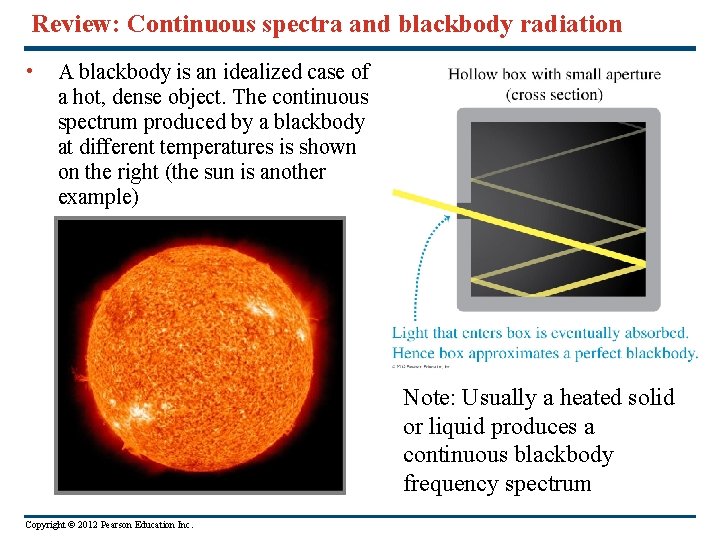
Review: Continuous spectra and blackbody radiation • A blackbody is an idealized case of a hot, dense object. The continuous spectrum produced by a blackbody at different temperatures is shown on the right (the sun is another example) Note: Usually a heated solid or liquid produces a continuous blackbody frequency spectrum Copyright © 2012 Pearson Education Inc.
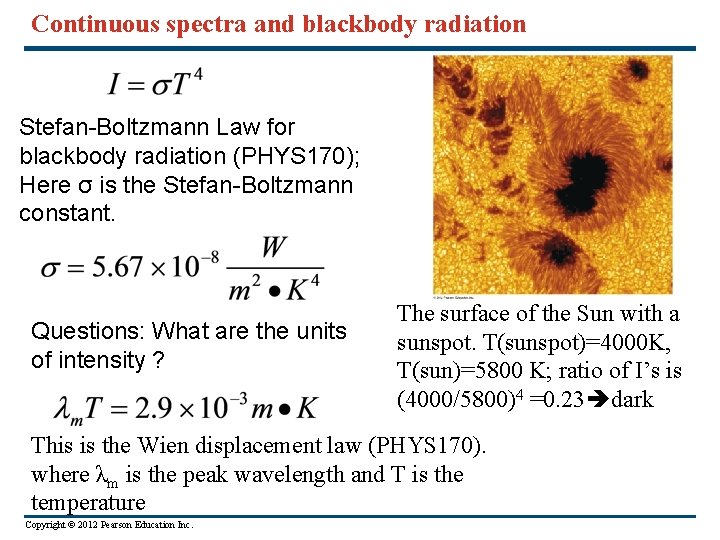
Continuous spectra and blackbody radiation Stefan-Boltzmann Law for blackbody radiation (PHYS 170); Here σ is the Stefan-Boltzmann constant. Questions: What are the units of intensity ? The surface of the Sun with a sunspot. T(sunspot)=4000 K, T(sun)=5800 K; ratio of I’s is (4000/5800)4 =0. 23 dark This is the Wien displacement law (PHYS 170). where λm is the peak wavelength and T is the temperature Copyright © 2012 Pearson Education Inc.
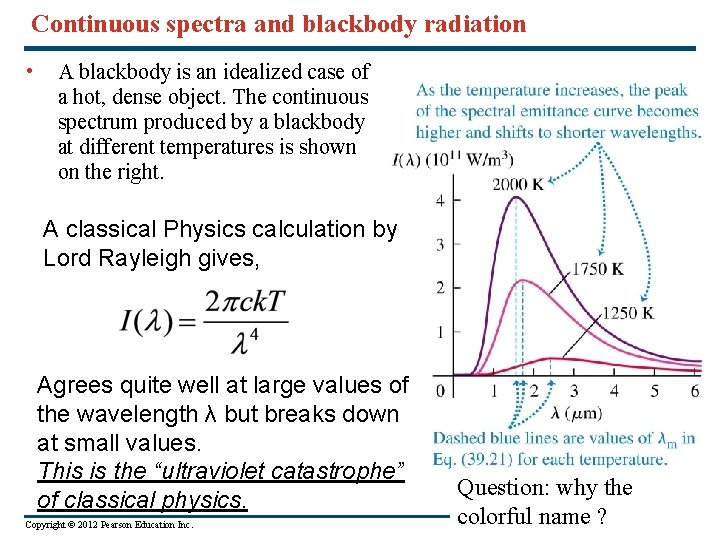
Continuous spectra and blackbody radiation • A blackbody is an idealized case of a hot, dense object. The continuous spectrum produced by a blackbody at different temperatures is shown on the right. A classical Physics calculation by Lord Rayleigh gives, Agrees quite well at large values of the wavelength λ but breaks down at small values. This is the “ultraviolet catastrophe” of classical physics. Copyright © 2012 Pearson Education Inc. Question: why the colorful name ?
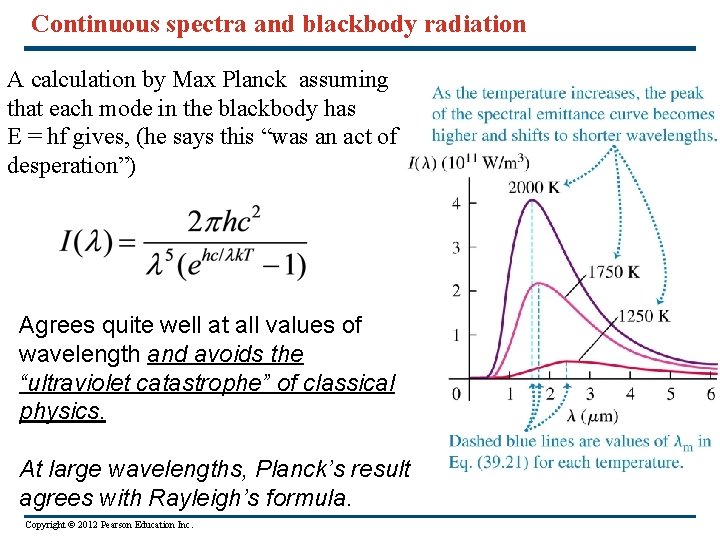
Continuous spectra and blackbody radiation A calculation by Max Planck assuming that each mode in the blackbody has E = hf gives, (he says this “was an act of desperation”) Agrees quite well at all values of wavelength and avoids the “ultraviolet catastrophe” of classical physics. At large wavelengths, Planck’s result agrees with Rayleigh’s formula. Copyright © 2012 Pearson Education Inc.
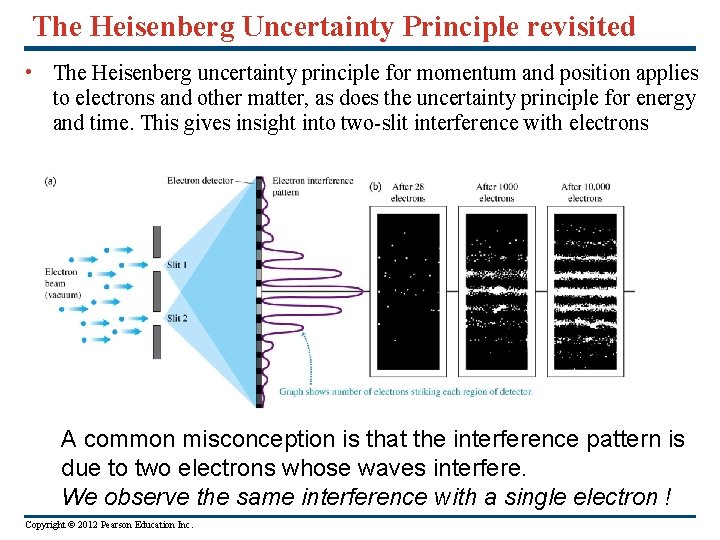
The Heisenberg Uncertainty Principle revisited • The Heisenberg uncertainty principle for momentum and position applies to electrons and other matter, as does the uncertainty principle for energy and time. This gives insight into two-slit interference with electrons A common misconception is that the interference pattern is due to two electrons whose waves interfere. We observe the same interference with a single electron ! Copyright © 2012 Pearson Education Inc.
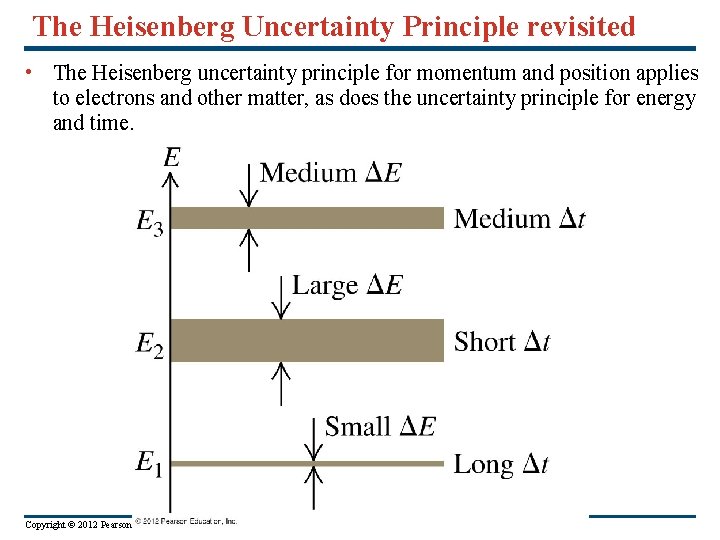
The Heisenberg Uncertainty Principle revisited • The Heisenberg uncertainty principle for momentum and position applies to electrons and other matter, as does the uncertainty principle for energy and time. Copyright © 2012 Pearson Education Inc.
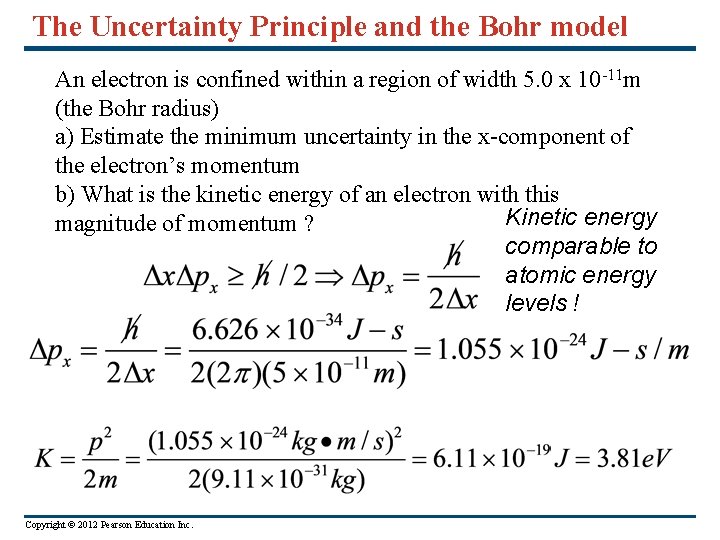
The Uncertainty Principle and the Bohr model An electron is confined within a region of width 5. 0 x 10 -11 m (the Bohr radius) a) Estimate the minimum uncertainty in the x-component of the electron’s momentum b) What is the kinetic energy of an electron with this Kinetic energy magnitude of momentum ? comparable to atomic energy levels ! Copyright © 2012 Pearson Education Inc.
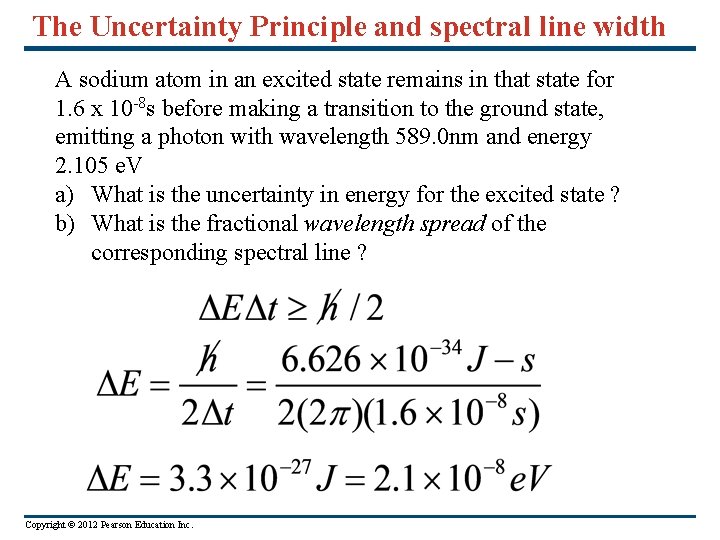
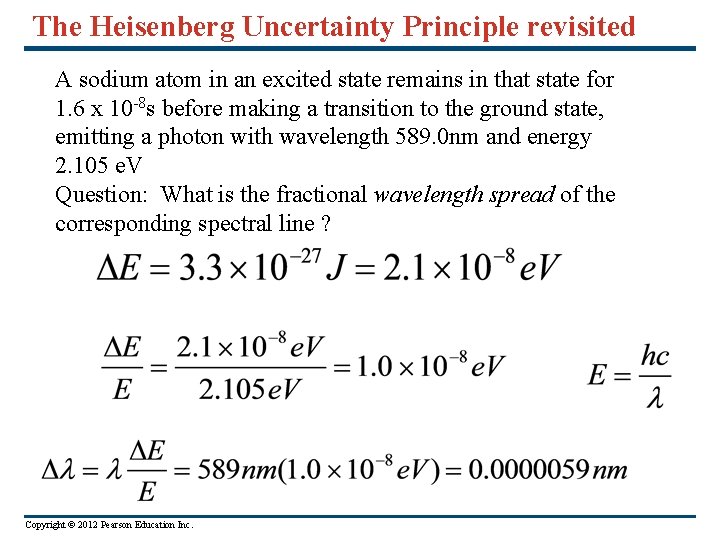
The Uncertainty Principle and spectral line width A sodium atom in an excited state remains in that state for 1. 6 x 10 -8 s before making a transition to the ground state, emitting a photon with wavelength 589. 0 nm and energy 2. 105 e. V a) What is the uncertainty in energy for the excited state ? b) What is the fractional wavelength spread of the corresponding spectral line ? Copyright © 2012 Pearson Education Inc.
The Heisenberg Uncertainty Principle revisited A sodium atom in an excited state remains in that state for 1. 6 x 10 -8 s before making a transition to the ground state, emitting a photon with wavelength 589. 0 nm and energy 2. 105 e. V Question: What is the fractional wavelength spread of the corresponding spectral line ? Copyright © 2012 Pearson Education Inc.
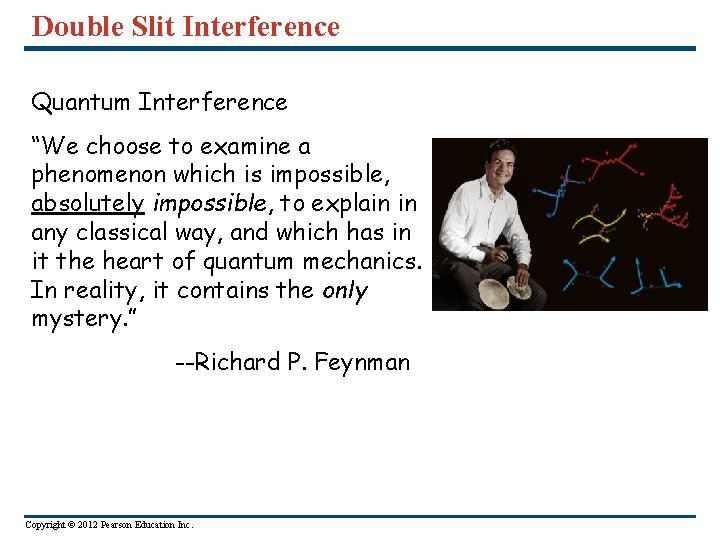
Double Slit Interference Quantum Interference “We choose to examine a phenomenon which is impossible, absolutely impossible, to explain in any classical way, and which has in it the heart of quantum mechanics. In reality, it contains the only mystery. ” --Richard P. Feynman Copyright © 2012 Pearson Education Inc.
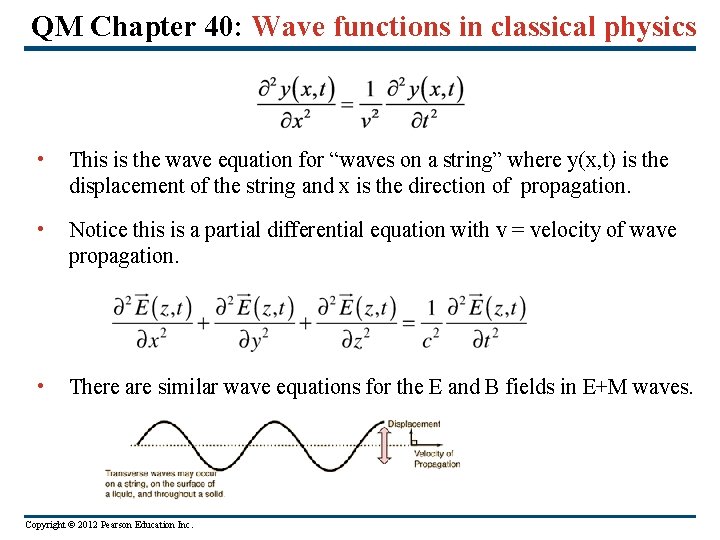
QM Chapter 40: Wave functions in classical physics • This is the wave equation for “waves on a string” where y(x, t) is the displacement of the string and x is the direction of propagation. • Notice this is a partial differential equation with v = velocity of wave propagation. • There are similar wave equations for the E and B fields in E+M waves. Copyright © 2012 Pearson Education Inc.
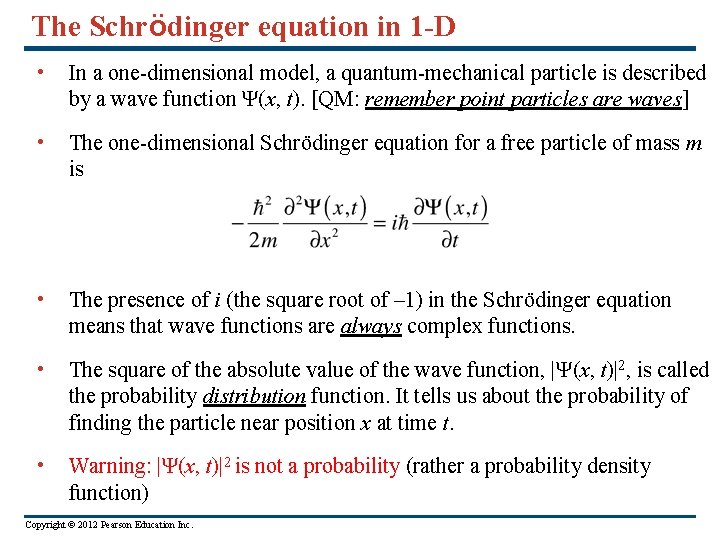
The Schrödinger equation in 1 -D • In a one-dimensional model, a quantum-mechanical particle is described by a wave function Ψ(x, t). [QM: remember point particles are waves] • The one-dimensional Schrödinger equation for a free particle of mass m is • The presence of i (the square root of – 1) in the Schrödinger equation means that wave functions are always complex functions. • The square of the absolute value of the wave function, |Ψ(x, t)|2, is called the probability distribution function. It tells us about the probability of finding the particle near position x at time t. • Warning: |Ψ(x, t)|2 is not a probability (rather a probability density function) Copyright © 2012 Pearson Education Inc.
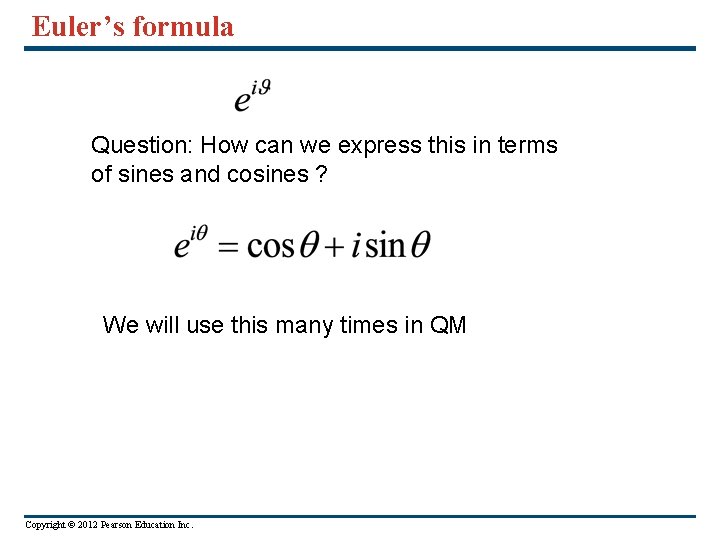
Euler’s formula Question: How can we express this in terms of sines and cosines ? We will use this many times in QM Copyright © 2012 Pearson Education Inc.
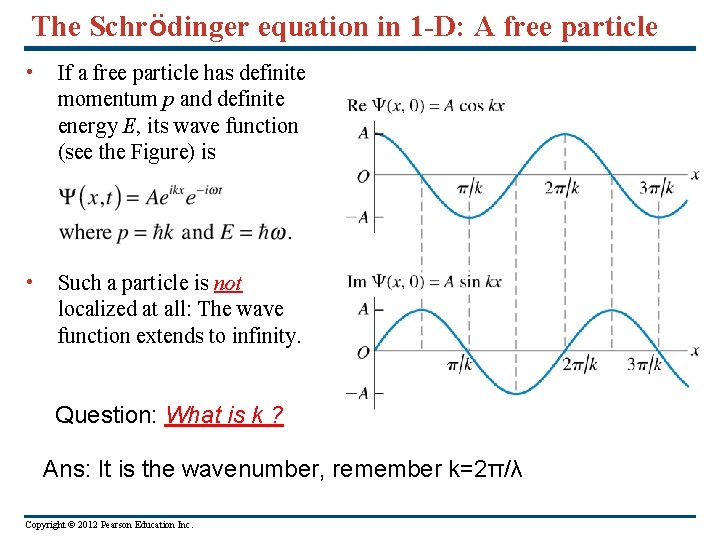
The Schrödinger equation in 1 -D: A free particle • If a free particle has definite momentum p and definite energy E, its wave function (see the Figure) is • Such a particle is not localized at all: The wave function extends to infinity. Question: What is k ? Ans: It is the wavenumber, remember k=2π/λ Copyright © 2012 Pearson Education Inc.
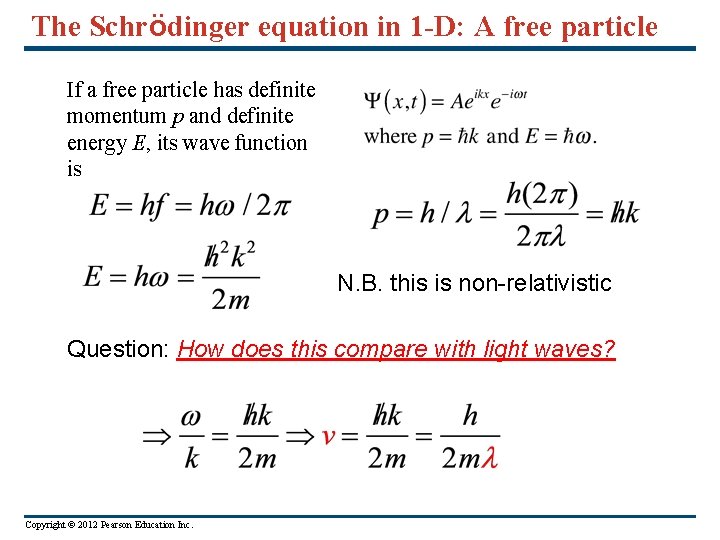
The Schrödinger equation in 1 -D: A free particle If a free particle has definite momentum p and definite energy E, its wave function is N. B. this is non-relativistic Question: How does this compare with light waves? Copyright © 2012 Pearson Education Inc.