
Stigma and Substance Use Disorders SUDs Presented by
Stigma and Substance Use Disorders (SUDs) Presented by: Mountain Plains ATTC Staff University of North Dakota Grand Forks, ND 58202 701 -777 -4520
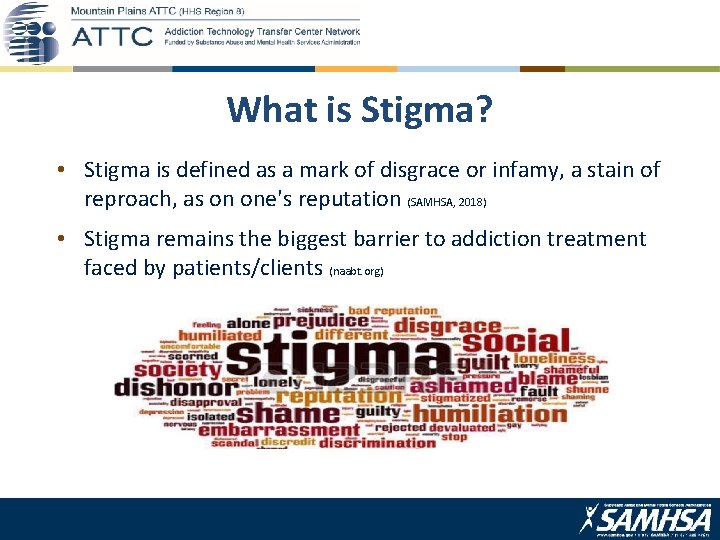
What is Stigma? • Stigma is defined as a mark of disgrace or infamy, a stain of reproach, as on one's reputation (SAMHSA, 2018) • Stigma remains the biggest barrier to addiction treatment faced by patients/clients (naabt. org)
FACTS • Substance Use Disorder (SUD) is among the most stigmatized conditions in the U. S. and around the world • Healthcare providers might treat patients/clients with substance use disorders differently due to stigma • People with a substance use disorder who expect or experience stigma have poorer healthcare outcomes (SAMHSA, 2018)
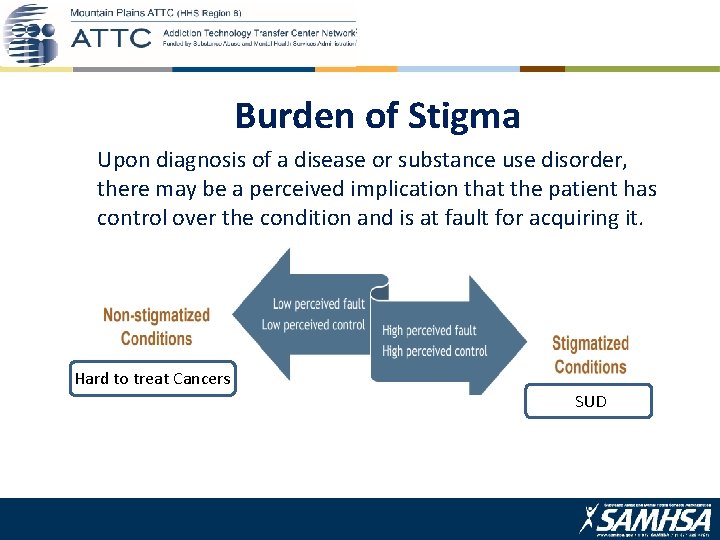
Burden of Stigma Upon diagnosis of a disease or substance use disorder, there may be a perceived implication that the patient has control over the condition and is at fault for acquiring it. condition. Hard to treat Cancers SUD
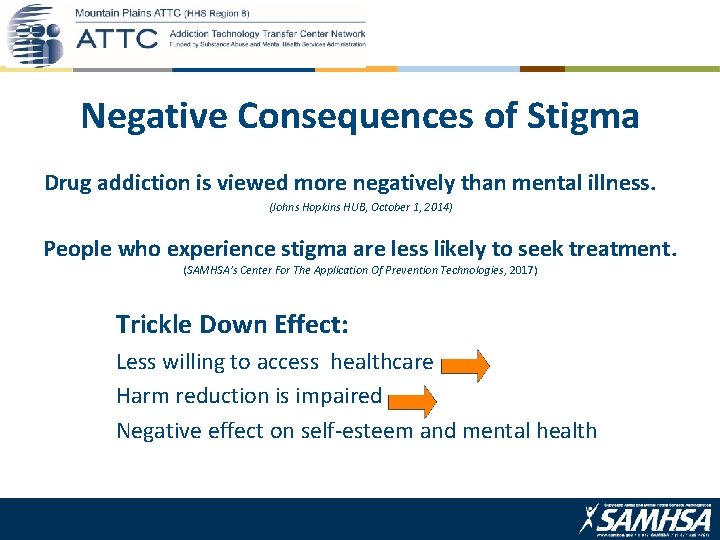
Negative Consequences of Stigma Drug addiction is viewed more negatively than mental illness. (Johns Hopkins HUB, October 1, 2014) People who experience stigma are less likely to seek treatment. (SAMHSA’s Center For The Application Of Prevention Technologies, 2017) Trickle Down Effect: Less willing to access healthcare Harm reduction is impaired Negative effect on self-esteem and mental health
Role of Prevention Providers • Reduce stigma surrounding substance misuse • Challenge providers and communities to be aware of unintentional bias • Use appropriate language in formal and informal conversations when discussing SUDs to decrease stigma by: • Removing labels • Using “person first” language Review the MPATTC “Language Matters” slide. Deck 4 U presentation at mtplainsattc. org
Role of Prevention Providers Substance misuse is often linked to trauma
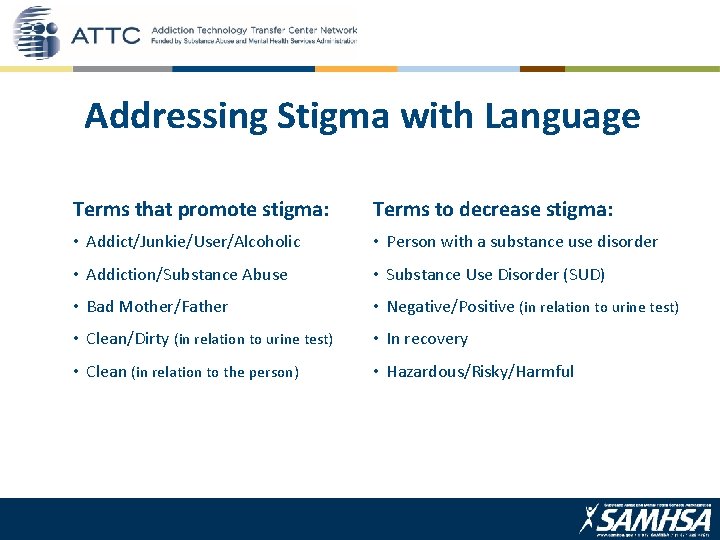
Addressing Stigma with Language Terms that promote stigma: Terms to decrease stigma: • Addict/Junkie/User/Alcoholic • Person with a substance use disorder • Addiction/Substance Abuse • Substance Use Disorder (SUD) • Bad Mother/Father • Negative/Positive (in relation to urine test) • Clean/Dirty (in relation to urine test) • In recovery • Clean (in relation to the person) • Hazardous/Risky/Harmful
Reminders • Substance Use Disorder (SUD) is a chronic disease. . . as are diabetes, depression and hypertension • Substance use falls along a continuum • Use ranges from abstinence/low-risk to chronic dependence and encompasses all stages in between • Relapse and lapse are a part of the disease process • As many other chronic diseases can be managed, SUD can also be managed through appropriate treatment -- even during pregnancy • Successful treatment for SUD means the person is in recovery; it does not mean they are “cured”
Reminders (continued) • Embrace positive change: Treatment for substance use disorders has historically been viewed as binary, with addiction and abstinence as a person’s only two options • Don’t create a dichotomy of “someone is using or not using. ” There are many positive changes a person can make to reduce negative consequences • Don’t convey the impression that abstinence is the only goal • Don’t assume there is only one “right” way to address substance misuse
References • • Addiction-stigma(2017). Retrieved from http: //www. drugabuse. com. Adlaf, E. M. , Hamilton, H. A. , Wu, F. , & Noh, S. (2009). Adolescent stigma towards drug addiction: Effects of age and drug use behavior. Addictive Behaviors, 34(), 360 -364. Brown, S. A. (2011). Standardized measures for substance use stigma. Drug and Alcohol Dependence, 116(), 137 -141. Browne, T. , Priester, M. , Clone, S. , & Iachini, A. , De. Hart, D. , & Hock, R. (2015). Barriers and facilitators to substance use treatment in the rural south: A qualitative study. The Journal of Rural Health, 32(), 92 -101. Buchman, D. Z. , Leece, P. , & Orkin, A. (2017, Winter). The epidemic as stigma: the bioethics of opioids. Journal of Law, Medicine, & Ethics, 45(4), 607 -611. Johns Hopkins HUB. (October 1, 2014). Drug addiction viewed more negatively than mental illness, Johns Hopkins study shows. Kelly, J. F. , Walkerman, S. E. & Saitz, R. (2015, January). Stop talking 'dirty': clinicians, language, and quality of care for the leading cause of preventable death in the United States. The American Journal of Medicine, 128(1), 8 -9. Kramlich, D. , Kronk, R. , Marcellus, L. , Colbert, A. , & Jakub, K. (2018). Rural Postpartum Women With Substance Use Disorders. Qualitative Health Research, (), 1 -13.
- Slides: 11