
Stigma and Person First Language SARAH RODEFER MSW
- Slides: 27
Stigma and Person First Language SARAH RODEFER, MSW
What do you first think of when you hear… Schizophrenia Disabled Bi-polar Mentally ill Alcoholic
Most often people think… Sick Disturbed Helpless Damaged Weak Scary Lazy Criminal And many other negative adjectives
What is the Definition of Stigma? Any mark of infamy or disgrace; sign of moral blemish; stain or reproach cause by dishonorable conduct; reproachful characterization. http: //www. webster-dictionary. net/definition/Stigma
What Are Stigma’s Roots There are 4 main components to stigma: Labeling someone with a condition Stereotyping people with that condition Creating a division such as a superior “healthy” group vs. a lesser “sick” group Discriminating against someone on the basis of their label
The Effects of Stigma �“Stigma” is an umbrella term that is used when talking about the negative effects that come with being in the minority of a larger group. �When talking specifically about mental illness, stigma may refer to or cause: Fear Shame Guilt Avoidance Embarrassment Low Self-esteem Isolation Stereotyping
What Stigma Can Cause An individual with mental illness to not get treatment because of fear To hide the mental illness out of guilt or fear they will be scorned by family members, friends or society in general. Social isolation because of embarrassment or shame
Hardships Caused by Stigma �A belief that recovery cannot happen because of a stereotype that persons with mental illness are less competent, cannot work or should be institutionalized �A decreased access to adequate services (as compared to a physical illness) �The current lack of mental health parity �Some people with mental illness have been subject to physical and verbal abuse �Even though it is against the law, employers may discriminate on hiring an employee and promotions based on mental illness �Sometimes it is difficult to find landlords who will accept a tenant with severe and persistent mental illness
So, What Are Some Causes of Stigma? �The term “mental illness” itself implies a distinction from “physical illness” �“Mental” suggests not a legitimate medical condition, but rather something that results from one’s own doing or choices. �Media Their accounts of crime. Statistics do not show a correlation between medicated mental illness and violence Inaccurate portrayals on TV and movies about characters with mental illnesses These negative portrayals fuel fear and mistrust and reinforce distorted perceptions, leading to even more stigma
How do we reduce stigma? Know the facts. Educate yourself. Be aware of your attitudes and behavior. Choose your words carefully. Educate others. Focus on the positive. Support people. Include everyone. https: //www. mendthemind. ca/stigma/seven-important-things-we-can-do-reduce-stigma-and-discrimination/
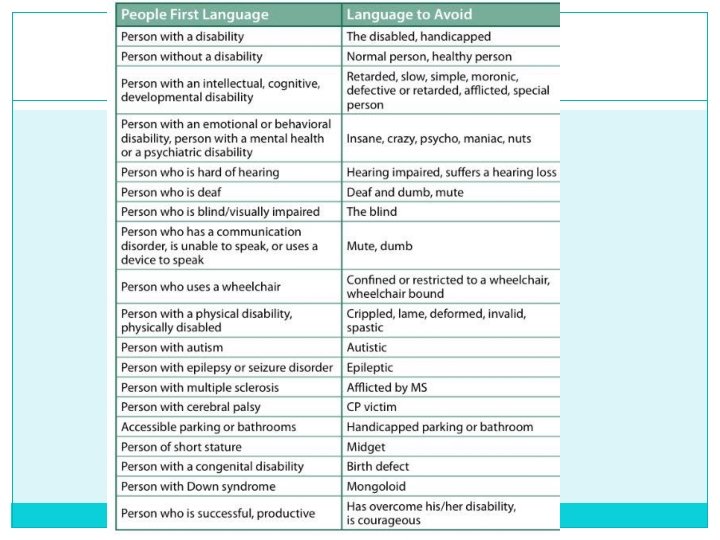
Person First Language What is person first language? Puts the person before the disability (or category), and describes what a person has, not who a person is. Language should be used to empower individuals, not place limitations on them See the person, not the illness
What do you call a person with a disability?
…a person
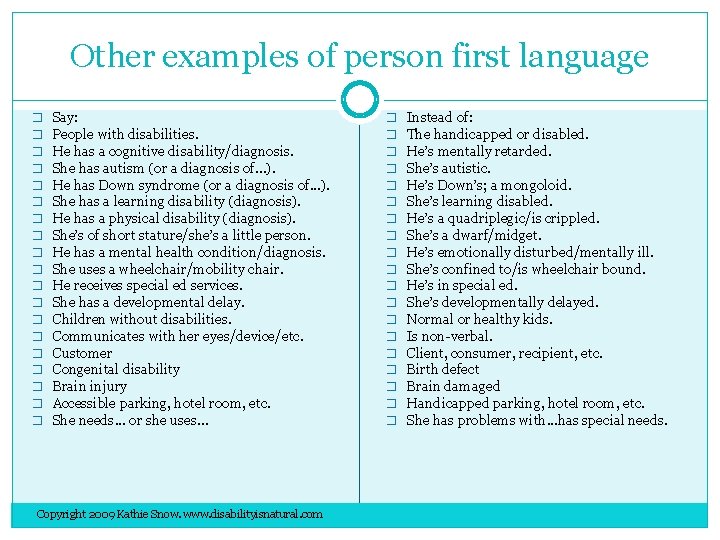
Other examples of person first language � � � � � Say: People with disabilities. He has a cognitive disability/diagnosis. She has autism (or a diagnosis of. . . ). He has Down syndrome (or a diagnosis of. . . ). She has a learning disability (diagnosis). He has a physical disability (diagnosis). She’s of short stature/she’s a little person. He has a mental health condition/diagnosis. She uses a wheelchair/mobility chair. He receives special ed services. She has a developmental delay. Children without disabilities. Communicates with her eyes/device/etc. Customer Congenital disability Brain injury Accessible parking, hotel room, etc. She needs. . . or she uses. . . Copyright 2009 Kathie Snow. www. disabilityisnatural. com � � � � � Instead of: The handicapped or disabled. He’s mentally retarded. She’s autistic. He’s Down’s; a mongoloid. She’s learning disabled. He’s a quadriplegic/is crippled. She’s a dwarf/midget. He’s emotionally disturbed/mentally ill. She’s confined to/is wheelchair bound. He’s in special ed. She’s developmentally delayed. Normal or healthy kids. Is non-verbal. Client, consumer, recipient, etc. Birth defect Brain damaged Handicapped parking, hotel room, etc. She has problems with. . . has special needs.
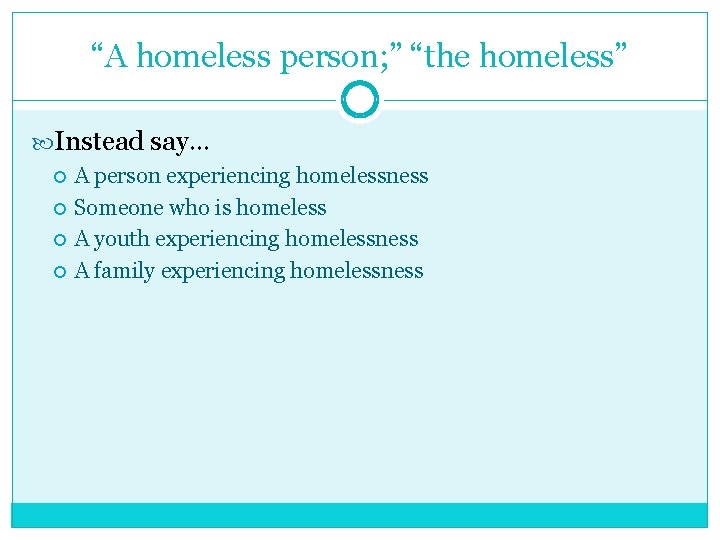
“A homeless person; ” “the homeless” Instead say… A person experiencing homelessness Someone who is homeless A youth experiencing homelessness A family experiencing homelessness
Imagine There Was No Stigma to Mental Illness | Dr. Jeffrey Lieberman | TEDx. Charlottesville https: //www. youtube. com/watch? v=Wrb. Tb. B 9 t. Tt. A Pay attention to how Dr. Lieberman describes his patients and how he advocates in his talk. Write down any instances of person first language or strengths based language
Activity on person first language
Recovery is Possible �In fact, it’s not only possible, but for many, probable. �Recovery is a holistic process that includes both physical health and aspects beyond medication. �Hope for recovery should be reflected in all treatments, services and supports. �This process is different for each individual. �Some individuals use medication and therapy. Others use community and successful living. Some use a combination of both. http: //www 2. nami. org/Content/Navigation. Menu/Find_Support/Consumer_Support/Recovery. htm
More on Recovery � The most important principle is that recovery is a process, not an event. � The course of the illness varies greatly from person to person � Medications and hospital time are important in symptom management, but not strongly related to long-term outcome � People DO have control over their own levels of happiness www 2. nami. org/Content/Navigation. Menu/Inform_Yourself/Upcoming_Events/Convention-2014/Recovery%26 EBP_for_state-T. Zipple. ppt&rct=j&frm=1&q=&esrc=s&sa=U&ved=0 CBQQFj. AAah. UKEwiqy. PG 3 mfz. GAh. XEc. T 4 KHewk. ADY&usg=AFQj. CNH 2 w. ZT 3 u. KRTBS 23 y_P 1 a. WS 44 C_TBg
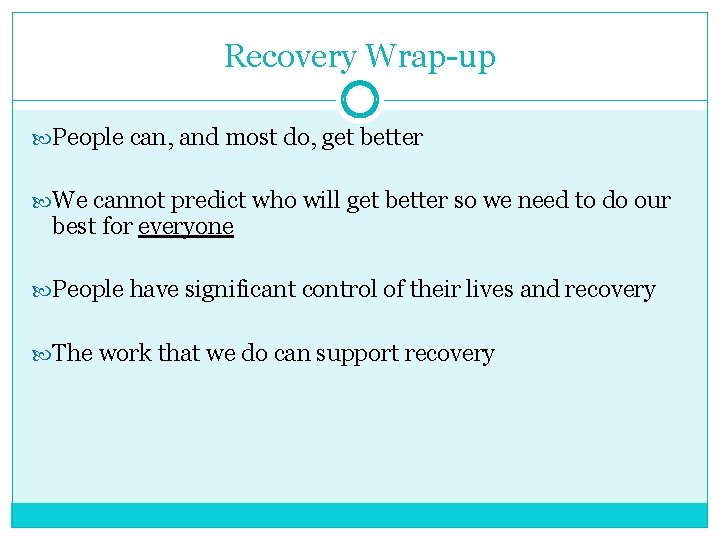
Recovery Wrap-up People can, and most do, get better We cannot predict who will get better so we need to do our best for everyone People have significant control of their lives and recovery The work that we do can support recovery
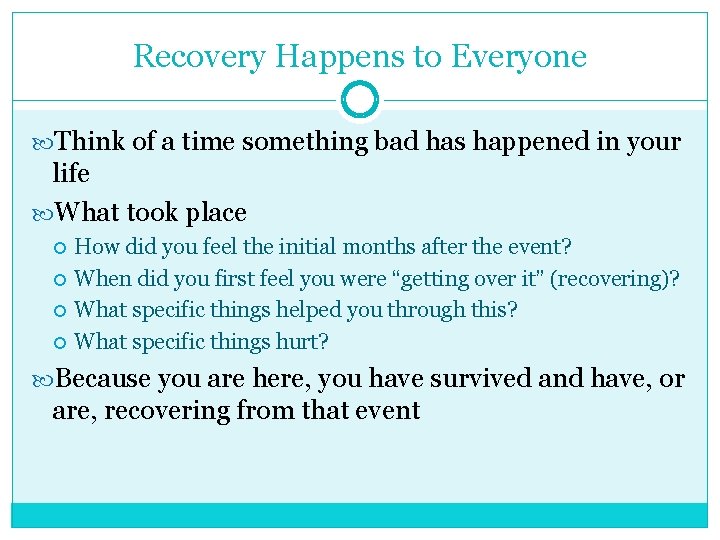
Recovery Happens to Everyone Think of a time something bad has happened in your life What took place How did you feel the initial months after the event? When did you first feel you were “getting over it” (recovering)? What specific things helped you through this? What specific things hurt? Because you are here, you have survived and have, or are, recovering from that event
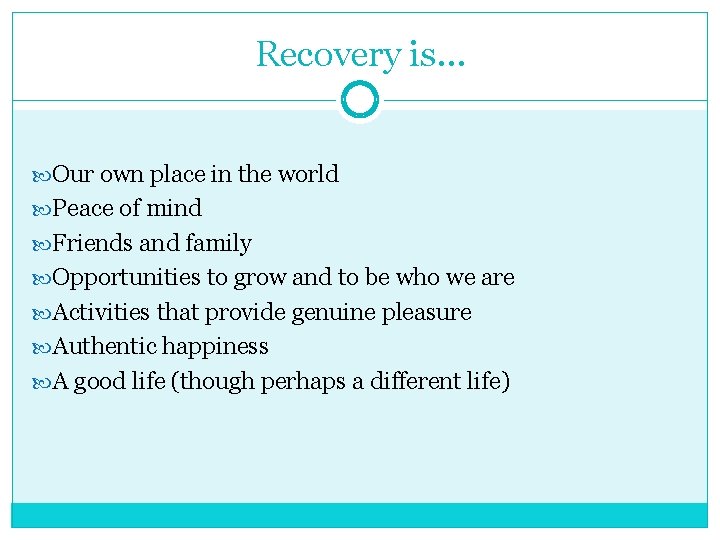
Recovery is… Our own place in the world Peace of mind Friends and family Opportunities to grow and to be who we are Activities that provide genuine pleasure Authentic happiness A good life (though perhaps a different life)
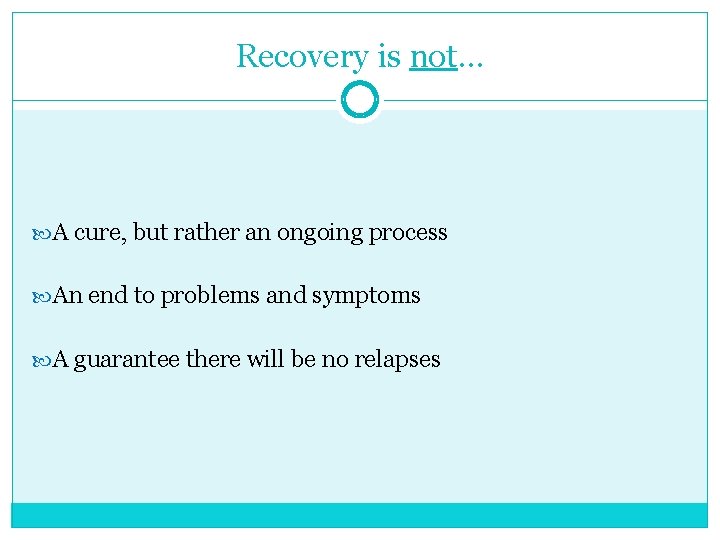
Recovery is not… A cure, but rather an ongoing process An end to problems and symptoms A guarantee there will be no relapses
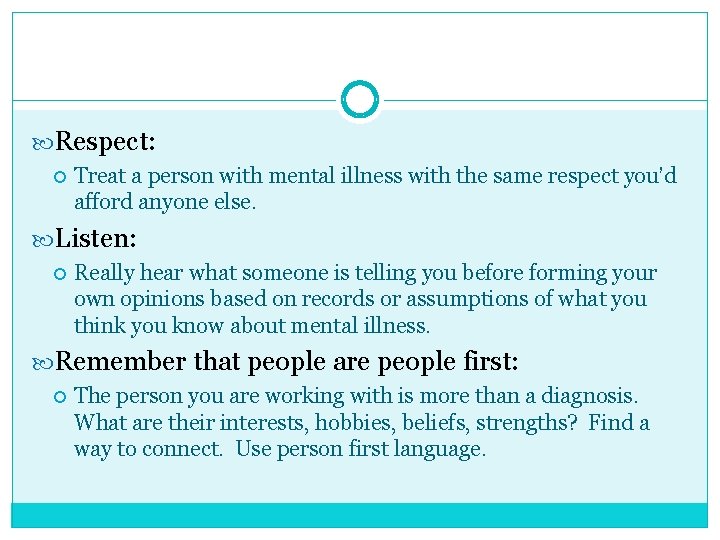
Respect: Treat a person with mental illness with the same respect you’d afford anyone else. Listen: Really hear what someone is telling you before forming your own opinions based on records or assumptions of what you think you know about mental illness. Remember that people are people first: The person you are working with is more than a diagnosis. What are their interests, hobbies, beliefs, strengths? Find a way to connect. Use person first language.
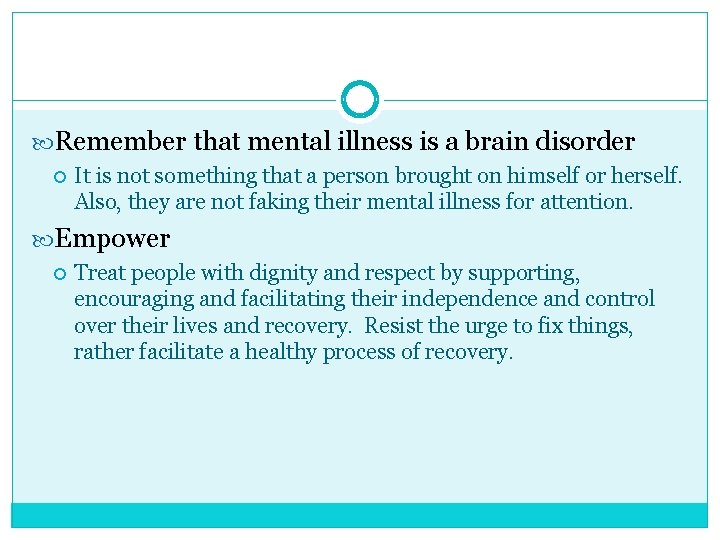
Remember that mental illness is a brain disorder It is not something that a person brought on himself or herself. Also, they are not faking their mental illness for attention. Empower Treat people with dignity and respect by supporting, encouraging and facilitating their independence and control over their lives and recovery. Resist the urge to fix things, rather facilitate a healthy process of recovery.
Sarah Rodefer, MSW Program Director sarah@namiwaukesha. org 262 -409 -2745