
STIGMA and Mental Illness Himalee Abeya Stigma they
STIGMA and Mental Illness Himalee Abeya
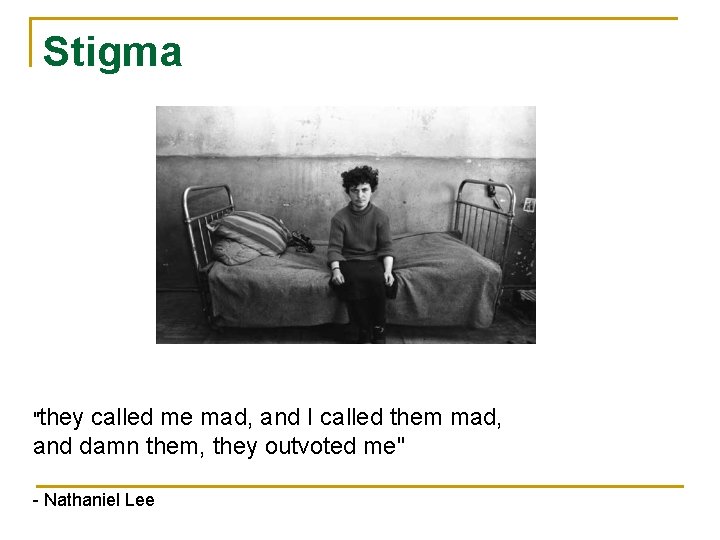
Stigma "they called me mad, and I called them mad, and damn them, they outvoted me" - Nathaniel Lee
Defining Stigma n A sign of disgrace or a discrediting attribute which sets a person apart from others and disqualifies from full social acceptance Goffman, E. (1963) Stigma: Notes on the management of spoiled identity. Penguin, Harmondsworth.
Origins of the term n Greek - ‘stizein’ a mark placed on slaves as a bodily sign designed to expose some defect in the ‘moral status’ of the signifier n Early Christian times - stigmata denoted signs of holy grace n Later medical metaphor in reference to physical signs of an illness
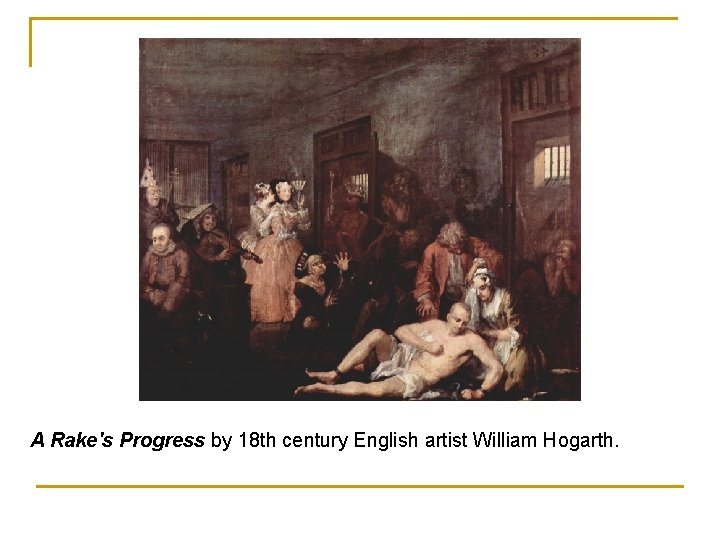
A Rake's Progress by 18 th century English artist William Hogarth.
The concept of Stigma n Stigmatization is an interactive social process n What causes the taint and consequent discredit? n In a psychiatric illness, the afflicted person may be perceived as identified with, and not separate from, the illness Is a person schizophrenic or do they have schizophrenia? Littlewood, R. , Jadhav, S. , Ryder, A. , (2007) A Cross National Study of the Stigmatization of Severe Psychiatric Illness: Historical Review, Methodological Considerations and Development of the Questionnaire. Transcultural Psychiatry, 44, 171 -202
“Why is it when we talk to God, we’re said to be praying, but when God talks to us, we’re said to be schizophrenic? ” n The difference between a normal and a stigmatised person is a question of perspective, not reality - Erving Goffman, E. (1963) Stigma: Notes on the management of spoiled identity. Penguin, Harmondsworth.
Theories of Stigmatisation Perception based models n The fundamental step in the generation of stigma is the perception of difference n Perceived differences may then be associated with undesirable traits Stereotypes q q q n dangerousness /unpredictability poor communication unsavoury or bizarre behaviour Leads to prejudice – therefore disqualified from full acceptance OR stigmatized Sayce, L. (1998). Stigma, discrimination and social exclusion: what's in a word? Journal of Mental Health, 7, 331– 43 Smith, M. (2002) Stigma. Advances in Psychiatric Treatment 8, 317 - 323
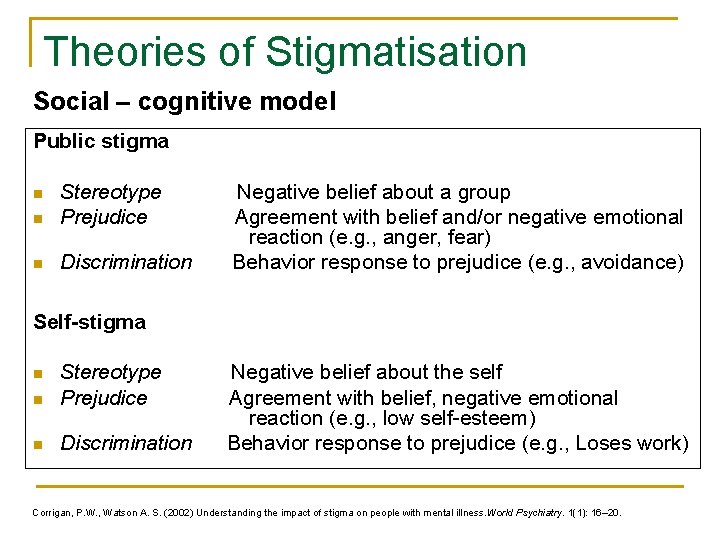
Theories of Stigmatisation Social – cognitive model Public stigma n Stereotype Prejudice n Discrimination n Negative belief about a group Agreement with belief and/or negative emotional reaction (e. g. , anger, fear) Behavior response to prejudice (e. g. , avoidance) Self-stigma n Stereotype Prejudice n Discrimination n Negative belief about the self Agreement with belief, negative emotional reaction (e. g. , low self-esteem) Behavior response to prejudice (e. g. , Loses work) Corrigan, P. W. , Watson A. S. (2002) Understanding the impact of stigma on people with mental illness. World Psychiatry. 1(1): 16– 20.
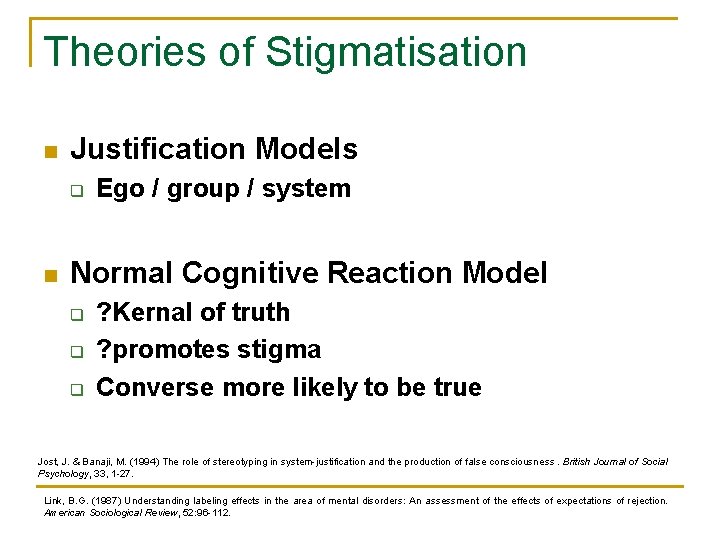
Theories of Stigmatisation n Justification Models q n Ego / group / system Normal Cognitive Reaction Model q q q ? Kernal of truth ? promotes stigma Converse more likely to be true Jost, J. & Banaji, M. (1994) The role of stereotyping in system-justification and the production of false consciousness. British Journal of Social Psychology, 33, 1 -27. Link, B. G. (1987) Understanding labeling effects in the area of mental disorders: An assessment of the effects of expectations of rejection. American Sociological Review, 52: 96 -112.
“Would you have your sister marry a person with mental illness ? ”
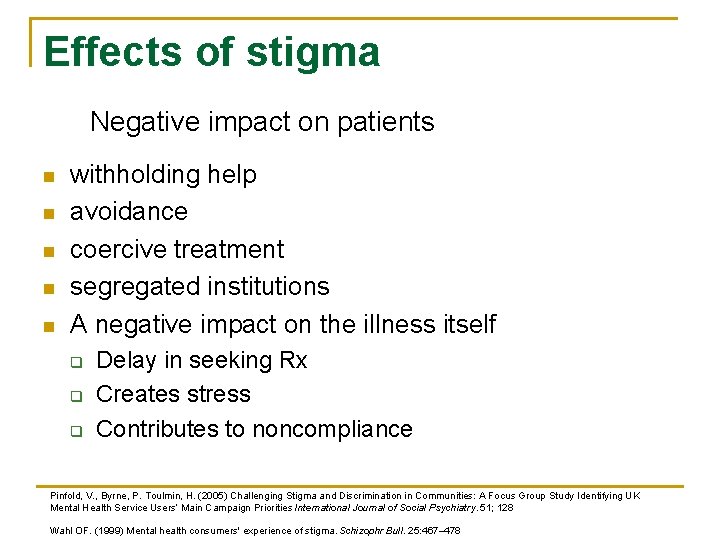
Effects of stigma Negative impact on patients n n n withholding help avoidance coercive treatment segregated institutions A negative impact on the illness itself q q q Delay in seeking Rx Creates stress Contributes to noncompliance Pinfold, V. , Byrne, P. Toulmin, H. (2005) Challenging Stigma and Discrimination in Communities: A Focus Group Study Identifying UK Mental Health Service Users’ Main Campaign Priorities International Journal of Social Psychiatry. 51; 128 Wahl OF. (1999) Mental health consumers' experience of stigma. Schizophr Bull. 25: 467– 478
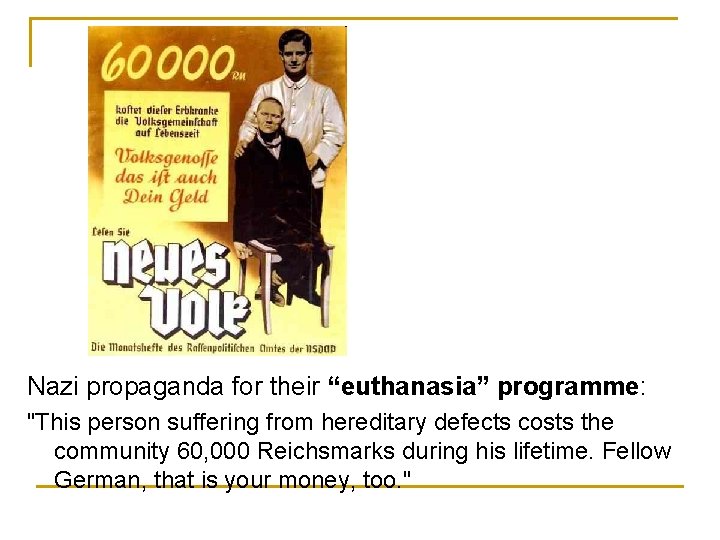
Nazi propaganda for their “euthanasia” programme: "This person suffering from hereditary defects costs the community 60, 000 Reichsmarks during his lifetime. Fellow German, that is your money, too. "
Effects of stigma Negative impact on the family n n Courtesy stigma ‘a particularly difficult and delicate position if they cannot remove themselves, for they are both marker and marked’ 43% to 92% of caregivers report feeling stigmatized can negatively affect their mental health by reducing their coping effectiveness Struening, E. L. , Perlick, D. A. , Link, B. G. , et al (2001) The extent to which caregivers believe most people devalue consumers and their families. Psychiatric Services, 52, 1633 -1638.
“Men will always be mad, and those who think they can cure them are the maddest of all. ” —Voltaire

Effects of stigma Negative impact of stigma on Psychiatric Services n Stigma has been identified as a serious barrier to effective psychiatric services n Lesser resources are allocated to mental health than other areas of medicine in developing countries n Discriminatory policies and practices are prevalent in developed and developing countries alike. e. g. Canada Norman, S. (1998). Stigma: what can psychiatrists do about it? Lancet, 352; 9133; 1058
Effects of stigma Positive effects of stigma Adopt protective strategies and develop resilience n q q Develop coping strategies Empowerment Oyserman, D. , and J. K. Swim. (2001). Stigma: An insider’s view. Journal of Social Issues 57 (1): 1 -14
Cultural variations of stigma n Difference in attitudes towards Mental illness n East - attribute an external causation to the illness. Madness is viewed as an affliction; when relieved the person may need care, but the negative labelling of madness disappeared q n societies are more cohesive – less extrusion West - value placed on the autonomous individual; need to assume personal responsibility for their illness. – less tolerance and support Littlewood, R. , Jadhav, S. , Ryder, A. , (2007) A Cross National Study of the Stigmatization of Severe Psychiatric Illness: Historical Review, Methodological Considerations and Development of the Questionnaire. Transcultural Psychiatry, 44, 171 -202
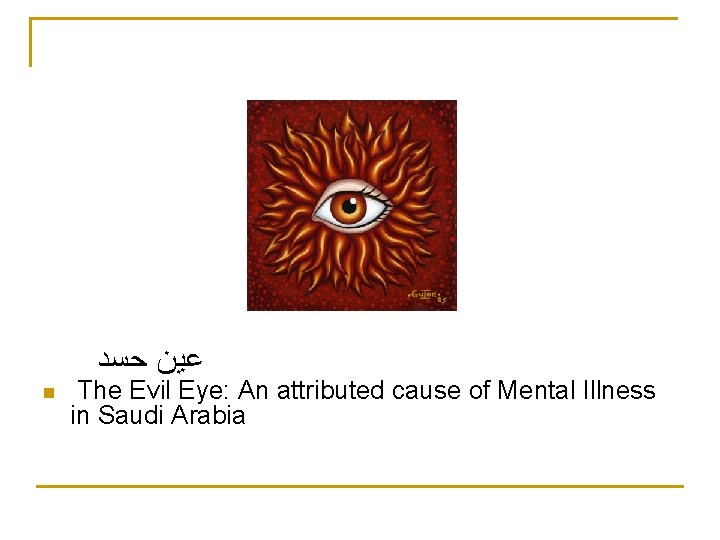
ﻋﻴﻦ ﺣﺴﺪ n The Evil Eye: An attributed cause of Mental Illness in Saudi Arabia
Stigma experienced by users of mental health care in a tertiary care hospital setting – a descriptive study Specific objectives n q q q To validate the Stigma Scale for a Sri Lankan setting To describe the nature of stigma experienced and quantify the intensity of stigma in terms of the Stigma Scale To describe the patterns of experience of stigma, if any, with relation to the psychiatric morbidity, sociodemographic characteristics and illness factors in participants
The stigma scale n n Developed by Prof Michael King and Sokratis Dinos et al (published in the BJPsych, Feb. 2007) was used in this study. Measures self stigma in mental health service users. self-report questionnaire, can be completed in 5– 10 minutes; It comprises 28 items The goal of validation was to generate a culturally appropriate translation with semantic and conceptual equivalence to the original King, M. , Dinos, S. , Shaw, J. et al (2007) The Stigma Scale: development of a standardised measure of the stigma of mental illness. British Journal of Psychiatry 190, 248 -254
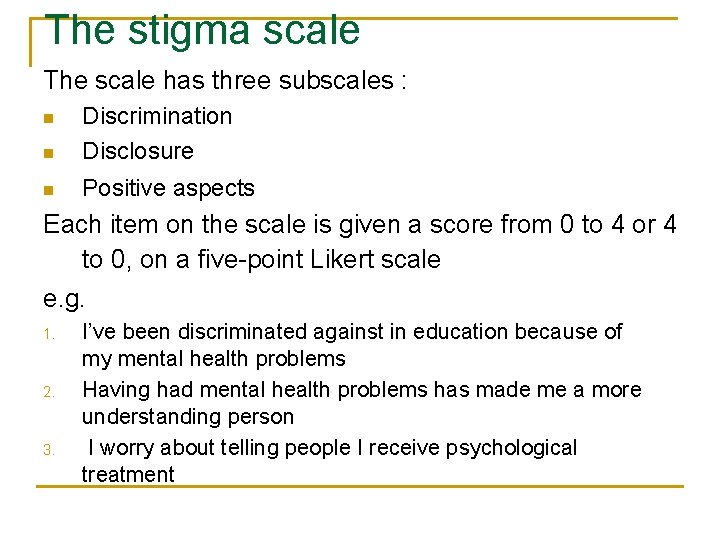
The stigma scale The scale has three subscales : n Discrimination Disclosure n Positive aspects n Each item on the scale is given a score from 0 to 4 or 4 to 0, on a five-point Likert scale e. g. 1. 2. 3. I’ve been discriminated against in education because of my mental health problems Having had mental health problems has made me a more understanding person I worry about telling people I receive psychological treatment
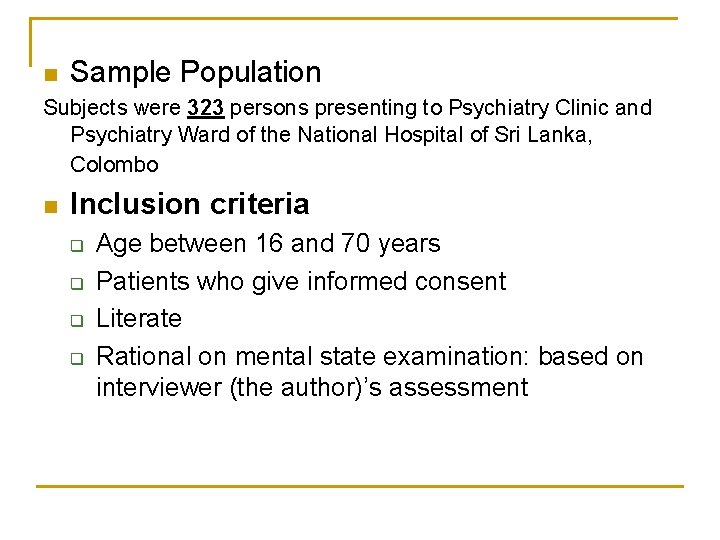
n Sample Population Subjects were 323 persons presenting to Psychiatry Clinic and Psychiatry Ward of the National Hospital of Sri Lanka, Colombo n Inclusion criteria q q Age between 16 and 70 years Patients who give informed consent Literate Rational on mental state examination: based on interviewer (the author)’s assessment
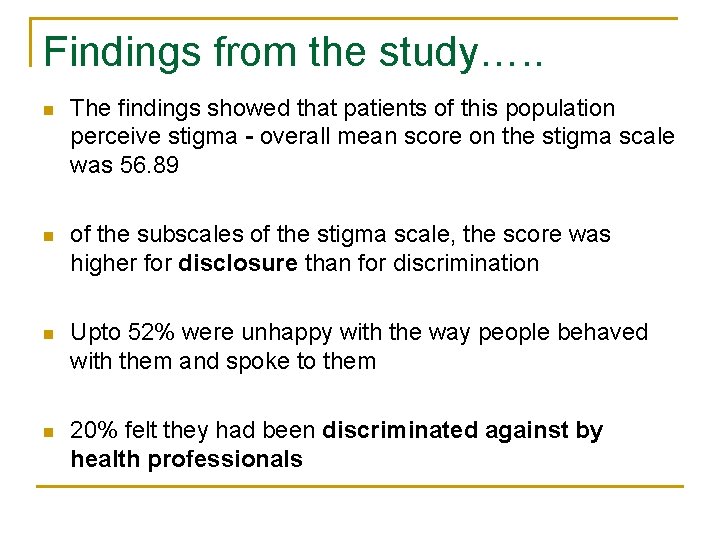
Findings from the study…. . n The findings showed that patients of this population perceive stigma - overall mean score on the stigma scale was 56. 89 n of the subscales of the stigma scale, the score was higher for disclosure than for discrimination n Upto 52% were unhappy with the way people behaved with them and spoke to them n 20% felt they had been discriminated against by health professionals
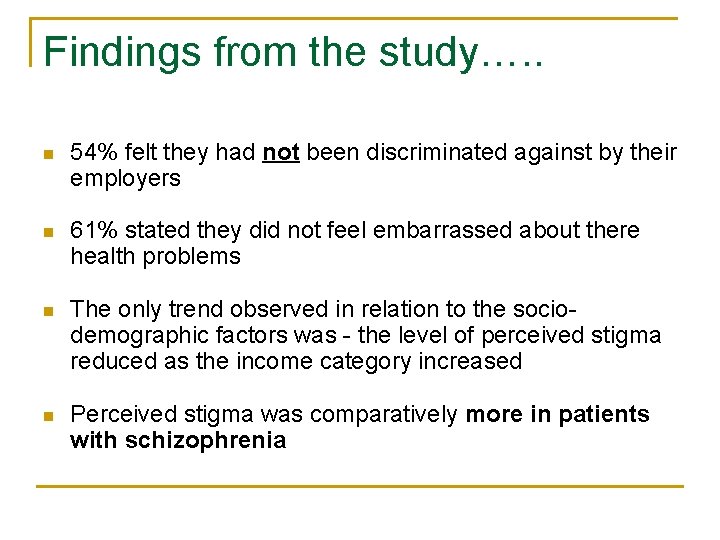
Findings from the study…. . n 54% felt they had not been discriminated against by their employers n 61% stated they did not feel embarrassed about there health problems n The only trend observed in relation to the sociodemographic factors was - the level of perceived stigma reduced as the income category increased n Perceived stigma was comparatively more in patients with schizophrenia
Themes in Stigma intervention n Rights-based protest: tackling discrimination q n Normalisation q q n Equal opportunities and rights “people with mental illness are just like us” Medicalisation ? Information, media and social attitudes q outcomes of media intervention are often disappointing.
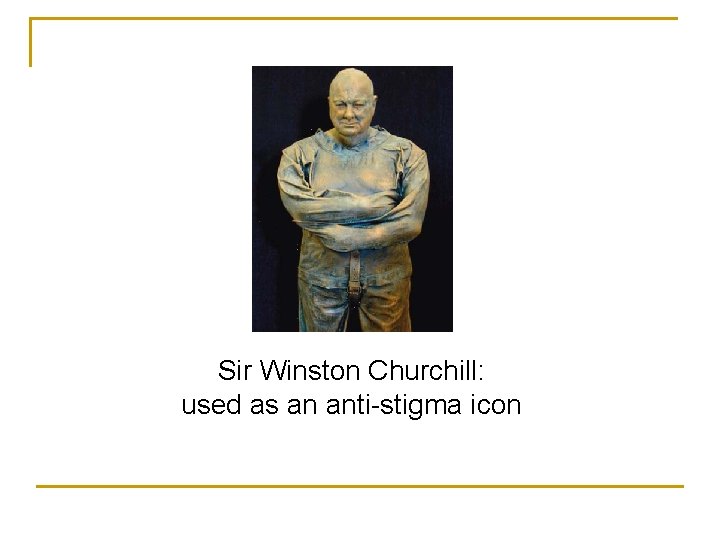
Sir Winston Churchill: used as an anti-stigma icon
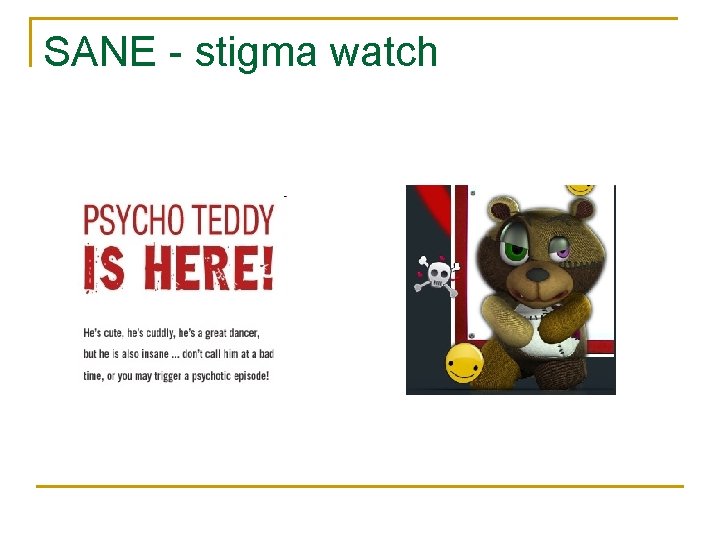
SANE - stigma watch
What can be done? n The goal is acceptance of difference, not normalisation or denial of difference. n We should seek to enable people to believe their own experience, rather than rely on stereotypes portrayed in the media n Risks should be acknowledged, but put in context. n The stigma against psychiatry and psychiatrists echoes most of the factors relating to stigma against those with mental illness: we should not be afraid to defend our profession.
“Why would I choose to have an manicdepression? Because I honestly believe that as a result of it I have felt more things more deeply; had more experiences, more intensely; loved more, and been more loved; laughed more often for having cried more often; appreciated more the springs for all the winters; worn death close, and appreciated it-and life-more…” Prof. Kay Redfield Jamison (Prof. of Psychiatry, John Hopkins University)
- Slides: 30