
STFM Process for Determining When to Act on
- Slides: 2
STFM Process for Determining When to Act on an Advocacy Issue Working with other family medicine organizations, the Society of Teachers of Family Medicine leadership has identified the most critical areas our organization must address in its federal advocacy efforts. We have a list of Academic Family Medicine Advocacy Committee priorities and focus on these (www. stfm. org/advocacy). The STFM strives to focus its finite resources on issues of primary importance to family medicine education where it can be in the best position to achieve its goals. As STFM considers where to focus its energies, it also remains attentive to our core value of inclusiveness and the need to respect diverse opinions of our members. STFM has members who would like the Society to get more involved in statements on social issues, and we also have members who have requested that we stay out of these conversations and focus our energy on developing resources of relevance to family medicine educators. Our leadership is sensitive to the diversity of our membership and recognizes that differences in opinion will occur. There will be times when STFM will decide that a statement or letter from STFM is necessary and other instances when the Society elects to do nothing. STFM also recognizes that there are situations that arise, often unpredictable, where the Society must address non-AFMAC issues. Our leadership has created a process for how we’ll examine those issues on a case-by-case and determine if an action, such as a statement, letter, or more robust advocacy effort, is warranted. Our process for making these decisions is represented visually on the decision tree. If individuals have an advocacy concern that STFM decides not to act on, staff will help identify other organizations that may be working on the issue.
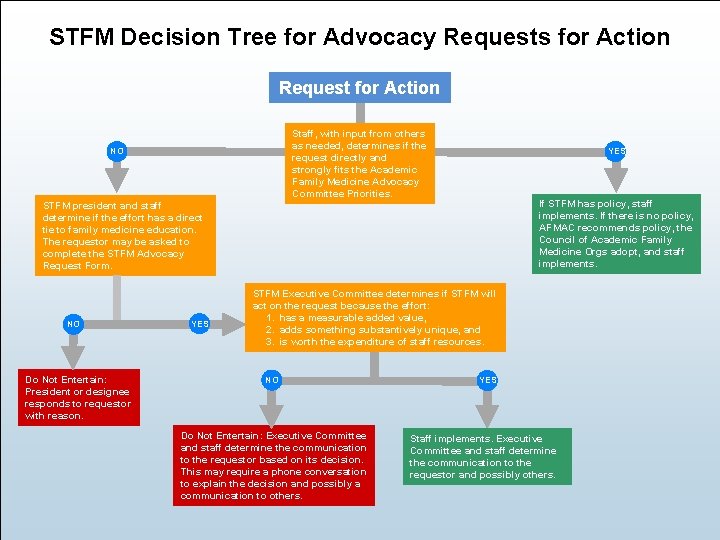
STFM Decision Tree for Advocacy Requests for Action Request for Action Staff, with input from others as needed, determines if the request directly and strongly fits the Academic Family Medicine Advocacy Committee Priorities. NO YES If STFM has policy, staff implements. If there is no policy, AFMAC recommends policy, the Council of Academic Family Medicine Orgs adopt, and staff implements. STFM president and staff determine if the effort has a direct tie to family medicine education. The requestor may be asked to complete the STFM Advocacy Request Form. NO Do Not Entertain: President or designee responds to requestor with reason. YES STFM Executive Committee determines if STFM will act on the request because the effort: 1. has a measurable added value, 2. adds something substantively unique, and 3. is worth the expenditure of staff resources. NO Do Not Entertain: Executive Committee and staff determine the communication to the requestor based on its decision. This may require a phone conversation to explain the decision and possibly a communication to others. YES Staff implements. Executive Committee and staff determine the communication to the requestor and possibly others.