
STFC Science Board highlights Jenny Thomas UCL Science
STFC Science Board highlights Jenny Thomas, UCL
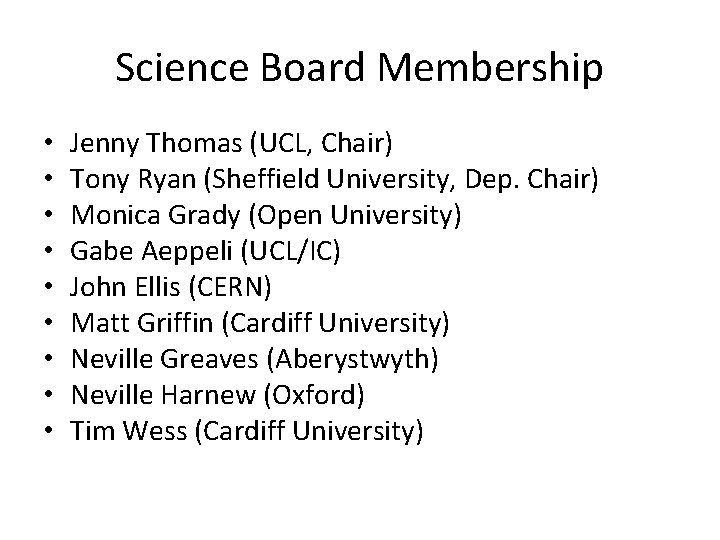
Science Board Membership • • • Jenny Thomas (UCL, Chair) Tony Ryan (Sheffield University, Dep. Chair) Monica Grady (Open University) Gabe Aeppeli (UCL/IC) John Ellis (CERN) Matt Griffin (Cardiff University) Neville Greaves (Aberystwyth) Neville Harnew (Oxford) Tim Wess (Cardiff University)
News and programme • Usually meet once every 2 months • Informing ourselves about the entire scientific programme but also the broad horizon of government objectives and where we fit with them • We have to wrestle with balance of funding between facilities and grant funding • Every area is being squeezed and there could be worse to come • This year, the exchange rate has drowned out any other issue: no-one could have foreseen it and DIUS is looking to all the RCs to balance the books • We are the big spenders of foreign money
Last year’s programme • We heard about challenges in Environment, Energy, Security and Health • We have discussed ways in which STFC can contribute to these grand challenges • With accelerator technology we stand to cut across all areas • With detector technology we can also contribute to all areas
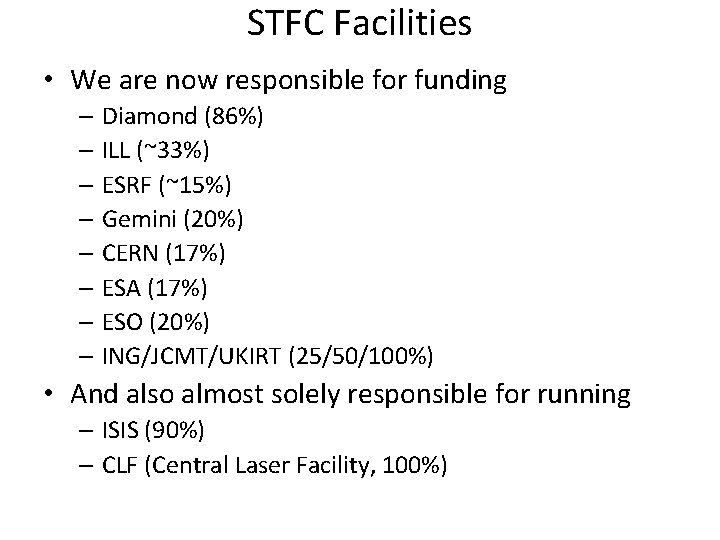
STFC Facilities • We are now responsible for funding – Diamond (86%) – ILL (~33%) – ESRF (~15%) – Gemini (20%) – CERN (17%) – ESA (17%) – ESO (20%) – ING/JCMT/UKIRT (25/50/100%) • And also almost solely responsible for running – ISIS (90%) – CLF (Central Laser Facility, 100%)

Routes towards solutions (STFC) • STFC facilities support Chemistry, Physics, Biology and Engineering – large scale and small scale – Making more complex materials – advanced methods for synthesis and fabrication – Detecting and treating/processing increasingly small amounts of material – Characterising materials – structure over many length scales, dynamics – Understanding materials – modelling and simulation of more complex systems, again over multiple length scales – Watching materials in action to understand function, over increasingly relevant (short? ) timescales
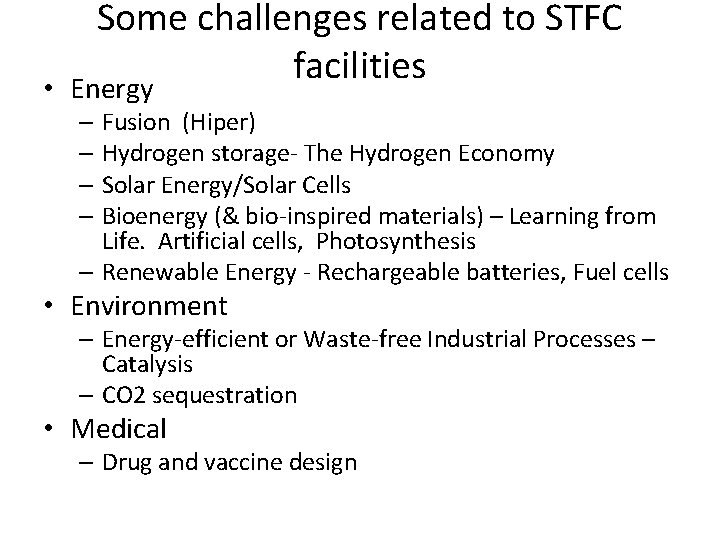
• Some challenges related to STFC facilities Energy – Fusion (Hiper) – Hydrogen storage- The Hydrogen Economy – Solar Energy/Solar Cells – Bioenergy (& bio-inspired materials) – Learning from Life. Artificial cells, Photosynthesis – Renewable Energy - Rechargeable batteries, Fuel cells • Environment – Energy-efficient or Waste-free Industrial Processes – Catalysis – CO 2 sequestration • Medical – Drug and vaccine design
SB Vision for Accelerator Science • SB has highlighted a number of areas where STFC could be more than the sum of its parts • The first one to gain momentum is the accelerator area – SB helping to put together a National Accelerator Strategy – Some initial ideas will be no surprise to many
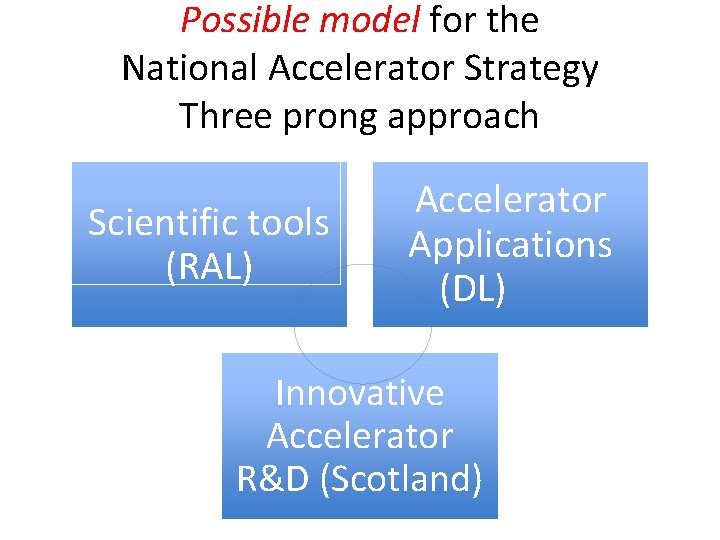
Possible model for the National Accelerator Strategy Three prong approach Scientific tools (RAL) Accelerator Applications (DL) Innovative Accelerator R&D (Scotland)
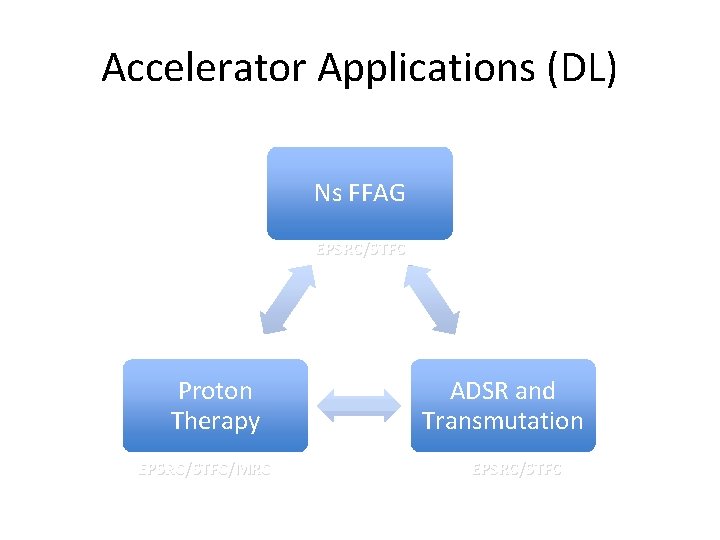
Accelerator Applications (DL) Ns FFAG EPSRC/STFC Proton Therapy EPSRC/STFC/MRC ADSR and Transmutation EPSRC/STFC
Global Picture • SB membership brings together many different disciplines and is getting a very new picture because of this • Clear that several different RCs are interested in this work • SB is talking to MRC and EPSRC about a shared big picture approach • Presently FFAGs sit at the center of this for the Accelerator Applications
FFAGs • These are interesting because they are small and cheap (on the accelerator scale at least) • ns. FFAGs are possibly the Next Big Thing and UK potentially could lead this • Could revolutionize the whole area of accelerator applications (low energy, low-high intensity) • UK industry in a good position to benefit from this development (made the magnets for EMMA) • success oriented blitz funded by combination of MRC/EPSRC/STFC could pull this off in 2 -3 years
Innovative Accelerator Technology • Scottish Universities (EPSRC/SUPA funded) have made big progress with Wakefield Acceleration (together with consortium from UK) • New investment here could lead to a step change in electron acceleration techniques – Synchrotron radiation, X-FEL, Gamma-FEL • Longer term could dream of high energy machine for PP
Where now? • Reasonably modest, targeted and collaborative investment in accelerator development could help PP weather the present political and economic storm and prepare for a possibly different future • Building on previous investment from PPARC and CCLRC, its time to join up the dots on this area of technology within the UK • Proposal is in the writing and Accelerator Vision meeting will be held on 2 nd June (Venue TBD)
STFC-KE • Just a word about KE developments – CLASP !!!! Challenge Led Applied Systems Program • Call should be announced in a month or so – – – Last pilot scheme (PNPAS) finally finished 37 very innovative proposals received 5 -8 funded this time around Issues with IP solved Idea is to • get identifiable income stream into STFC • Keep track of STFC’s contribution to UK PLC • Would like to see KE become a more serious integral part of science grants where appropriate – Works both ways: • serious about doing it, serious about funding it!
Conclusion • SB getting to grips with a very broad remit • Joining up not only inter-STFC but intra-RCUK • Government objectives cannot be ignored – Potential source of new money if Obama-style stimulus package occurs • Next Government’s objectives cannot be ignored !!! – The sooner we face up to the potential catastrophe, the sooner we can avert it • It is possible that science funding has changed for the forseeable future, not just the short term • We have Ph. Ds, lets be smart…
- Slides: 16