
Steve Teixeira Principal Product Unit Manager Parallel Developer
- Slides: 20
Steve Teixeira Principal Product Unit Manager Parallel Developer Tools Microsoft Corporation
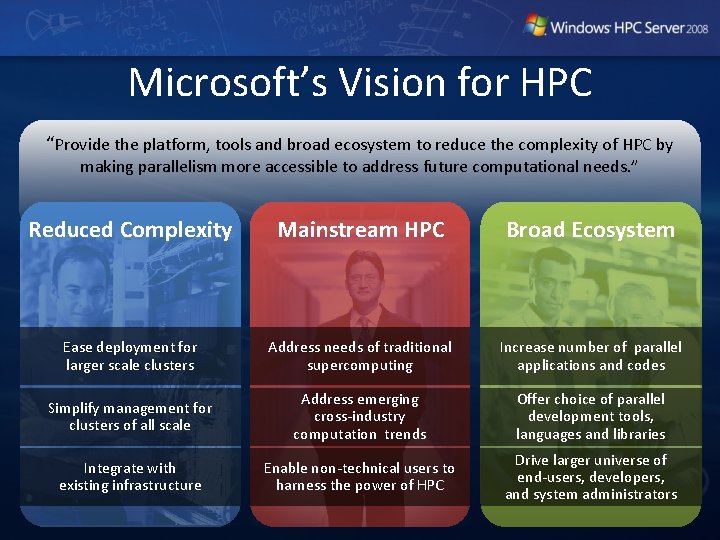
Microsoft’s Vision for HPC “Provide the platform, tools and broad ecosystem to reduce the complexity of HPC by making parallelism more accessible to address future computational needs. ” Reduced Complexity Mainstream HPC Broad Ecosystem Ease deployment for larger scale clusters Address needs of traditional supercomputing Increase number of parallel applications and codes Simplify management for clusters of all scale Address emerging cross-industry computation trends Offer choice of parallel development tools, languages and libraries Integrate with existing infrastructure Enable non-technical users to harness the power of HPC Drive larger universe of end-users, developers, and system administrators
Looking Forward: Hard Problems • Scaling distributed systems is hard • Data sets are increasing • Programming models are complex 3
We need simpler programming models 4 http: //www. flickr. com/photos/maisonbisson/201844037/
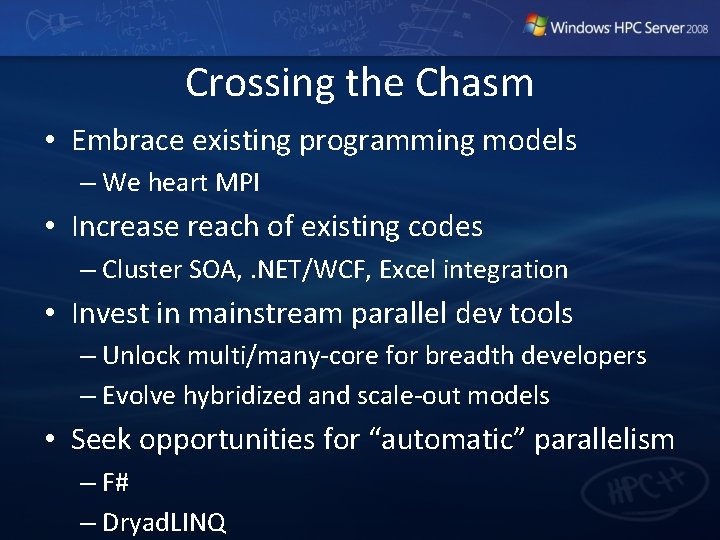
Crossing the Chasm • Embrace existing programming models – We heart MPI • Increase reach of existing codes – Cluster SOA, . NET/WCF, Excel integration • Invest in mainstream parallel dev tools – Unlock multi/many-core for breadth developers – Evolve hybridized and scale-out models • Seek opportunities for “automatic” parallelism – F# – Dryad. LINQ
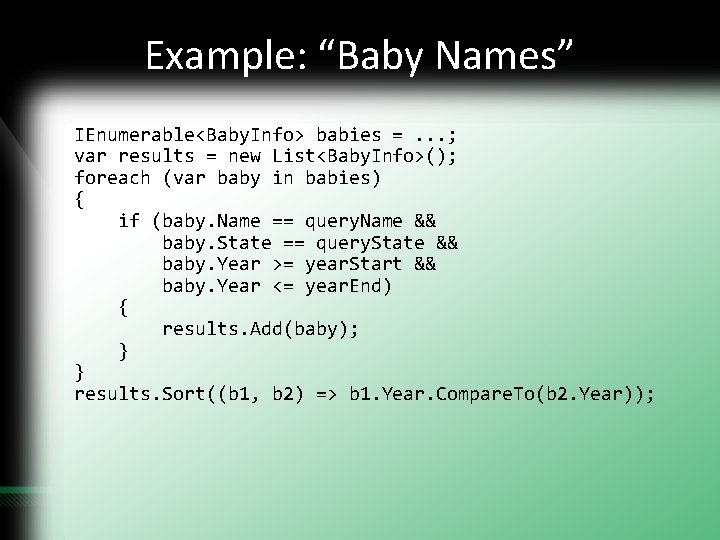
Example: “Baby Names” IEnumerable<Baby. Info> babies =. . . ; var results = new List<Baby. Info>(); foreach (var baby in babies) { if (baby. Name == query. Name && baby. State == query. State && baby. Year >= year. Start && baby. Year <= year. End) { results. Add(baby); } } results. Sort((b 1, b 2) => b 1. Year. Compare. To(b 2. Year));
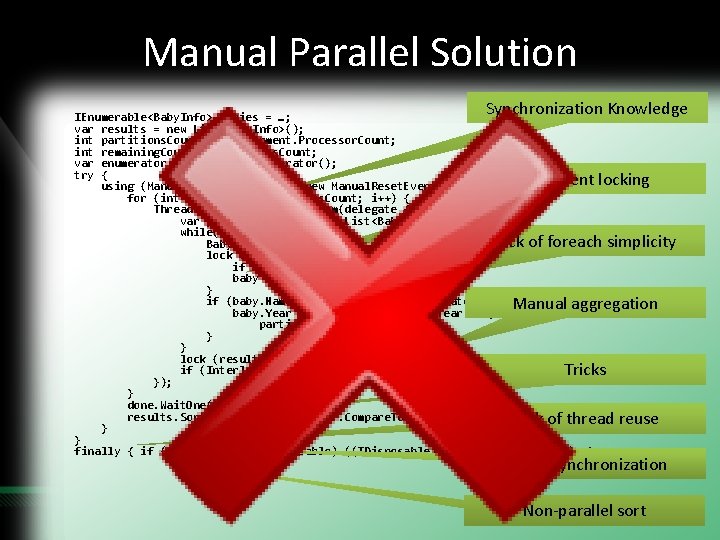
Manual Parallel Solution Synchronization Knowledge IEnumerable<Baby. Info> babies = …; var results = new List<Baby. Info>(); int partitions. Count = Environment. Processor. Count; int remaining. Count = partitions. Count; var enumerator = babies. Get. Enumerator(); try { using (Manual. Reset. Event done = new Manual. Reset. Event(false)) { Inefficient locking for (int i = 0; i < partitions. Count; i++) { Thread. Pool. Queue. User. Work. Item(delegate { var partial. Results = new List<Baby. Info>(); while(true) { Lack of foreach simplicity Baby. Info baby; lock (enumerator) { if (!enumerator. Move. Next()) break; baby = enumerator. Current; } if (baby. Name == query. Name && baby. State == query. State Manual && aggregation baby. Year >= year. Start && baby. Year <= year. End) { partial. Results. Add(baby); } } lock (results) results. Add. Range(partial. Results); if (Interlocked. Decrement(ref remaining. Count) == 0) done. Set(); Tricks }); } done. Wait. One(); results. Sort((b 1, b 2) => b 1. Year. Compare. To(b 2. Year)); Lack of thread reuse } } finally { if (enumerator is IDisposable) ((IDisposable)enumerator). Dispose(); } Heavy synchronization Non-parallel sort
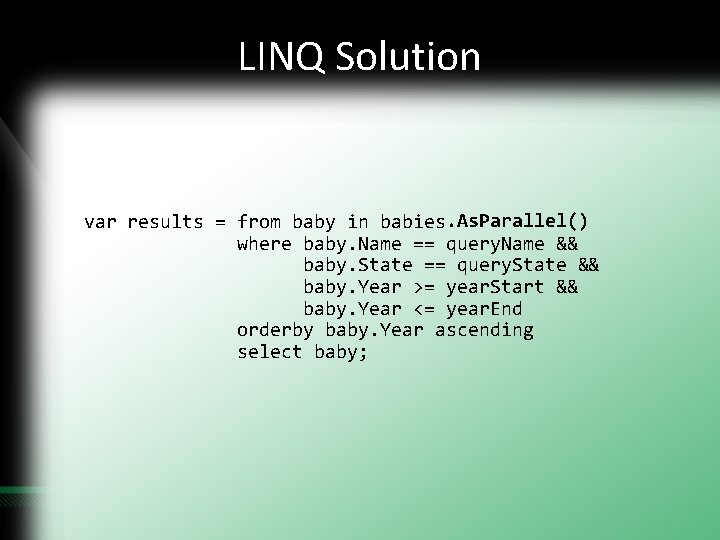
LINQ Solution var results = from baby in babies. As. Parallel() where baby. Name == query. Name && baby. State == query. State && baby. Year >= year. Start && baby. Year <= year. End orderby baby. Year ascending select baby;
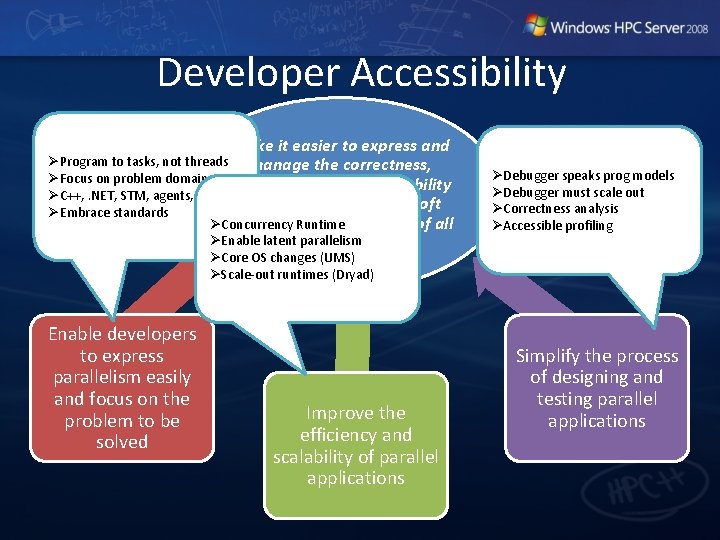
Developer Accessibility Make it easier to express and ØProgram to tasks, not threads manage the correctness, ØFocus on problem domain efficiency and maintainability ØC++, . NET, STM, agents, functional of parallelism on Microsoft ØEmbrace standards ØConcurrency platforms. Runtime for developers of all ØEnable latent parallelism skill levels ØDebugger speaks prog models ØDebugger must scale out ØCorrectness analysis ØAccessible profiling ØCore OS changes (UMS) ØScale-out runtimes (Dryad) Enable developers to express parallelism easily and focus on the problem to be solved Improve the efficiency and scalability of parallel applications Simplify the process of designing and testing parallel applications
Additional Information • Microsoft HPC Web site – http: //www. microsoft. com/hpc • Parallelism at Microsoft – http: //msdn. microsoft. com/concurrency • Visual Studio 2010 Beta – http: //msdn. microsoft. com/visualstudio • Windows HPC Tech. Center – http: //technet. microsoft. com/en-us/hpc/default. aspx • HPC on MSDN – http: //code. msdn. microsoft. com/hpc
© 2008 Microsoft Corporation. All rights reserved. Microsoft, Windows Vista and other product names are or may be registered trademarks and/or trademarks in the U. S. and/or other countries. The information herein is for informational purposes only and represents the current view of Microsoft Corporation as of the date of this presentation. Because Microsoft must respond to changing market conditions, it should not be interpreted to be a commitment on the part of Microsoft, and Microsoft cannot guarantee the accuracy of any information provided after the date of this presentation. MICROSOFT MAKES NO WARRANTIES, EXPRESS, IMPLIED OR STATUTORY, AS TO THE INFORMATION IN THIS PRESENTATION.
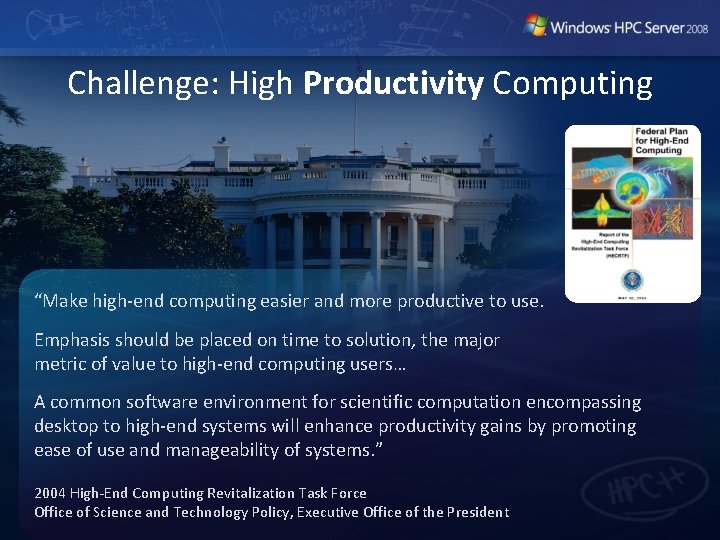
Challenge: High Productivity Computing “Make high-end computing easier and more productive to use. Emphasis should be placed on time to solution, the major metric of value to high-end computing users… A common software environment for scientific computation encompassing desktop to high-end systems will enhance productivity gains by promoting ease of use and manageability of systems. ” 2004 High-End Computing Revitalization Task Force Office of Science and Technology Policy, Executive Office of the President
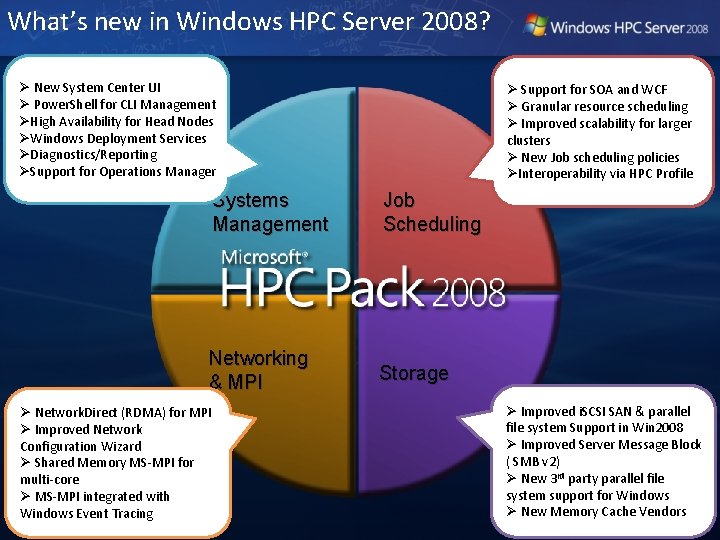
What’s new in Windows HPC Server 2008? Ø New System Center UI Ø Power. Shell for CLI Management ØHigh Availability for Head Nodes ØWindows Deployment Services ØDiagnostics/Reporting ØSupport for Operations Manager Ø Support for SOA and WCF Ø Granular resource scheduling Ø Improved scalability for larger clusters Ø New Job scheduling policies ØInteroperability via HPC Profile Systems Management Job Scheduling Networking & MPI Storage Ø Network. Direct (RDMA) for MPI Ø Improved Network Configuration Wizard Ø Shared Memory MS-MPI for multi-core Ø MS-MPI integrated with Windows Event Tracing Ø Improved i. SCSI SAN & parallel file system Support in Win 2008 Ø Improved Server Message Block ( SMB v 2) Ø New 3 rd party parallel file system support for Windows Ø New Memory Cache Vendors
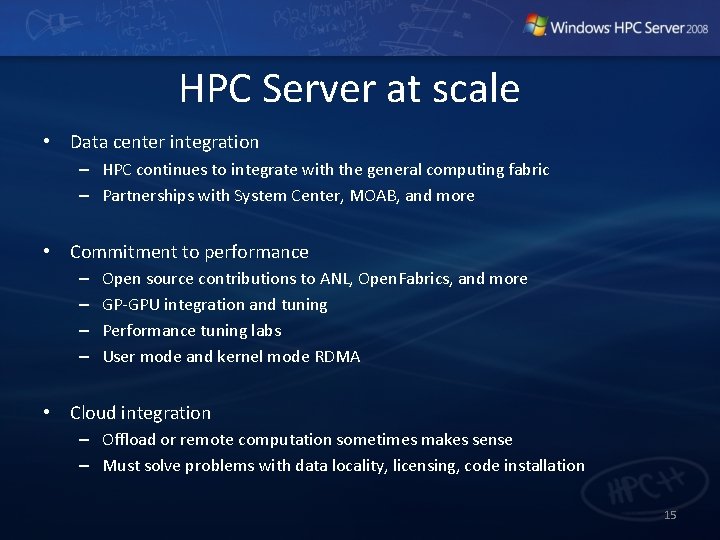
HPC Server at scale • Data center integration – HPC continues to integrate with the general computing fabric – Partnerships with System Center, MOAB, and more • Commitment to performance – – Open source contributions to ANL, Open. Fabrics, and more GP-GPU integration and tuning Performance tuning labs User mode and kernel mode RDMA • Cloud integration – Offload or remote computation sometimes makes sense – Must solve problems with data locality, licensing, code installation 15
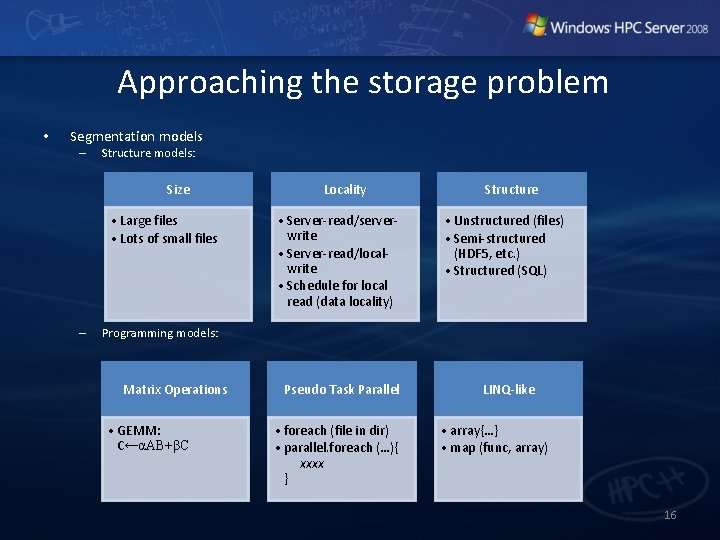
Approaching the storage problem • Segmentation models – Structure models: Size • Large files • Lots of small files – Locality • Server-read/serverwrite • Server-read/localwrite • Schedule for local read (data locality) Structure • Unstructured (files) • Semi-structured (HDF 5, etc. ) • Structured (SQL) Programming models: Matrix Operations • GEMM: C←αAB+βC Pseudo Task Parallel • foreach (file in dir) • parallel. foreach (…){ xxxx } LINQ-like • array{…} • map (func, array) 16
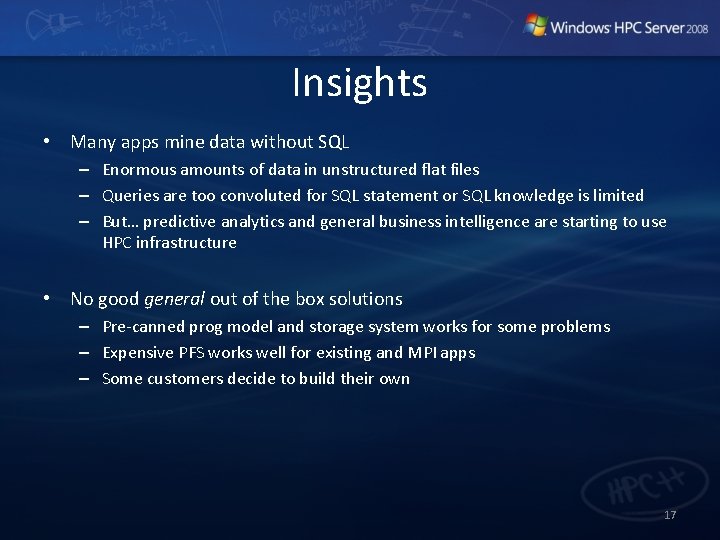
Insights • Many apps mine data without SQL – Enormous amounts of data in unstructured flat files – Queries are too convoluted for SQL statement or SQL knowledge is limited – But… predictive analytics and general business intelligence are starting to use HPC infrastructure • No good general out of the box solutions – Pre-canned prog model and storage system works for some problems – Expensive PFS works well for existing and MPI apps – Some customers decide to build their own 17
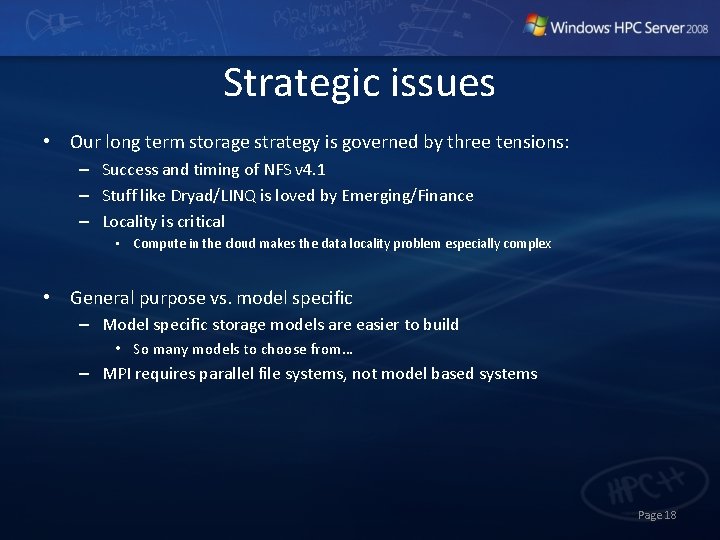
Strategic issues • Our long term storage strategy is governed by three tensions: – Success and timing of NFS v 4. 1 – Stuff like Dryad/LINQ is loved by Emerging/Finance – Locality is critical • Compute in the cloud makes the data locality problem especially complex • General purpose vs. model specific – Model specific storage models are easier to build • So many models to choose from… – MPI requires parallel file systems, not model based systems Page 18
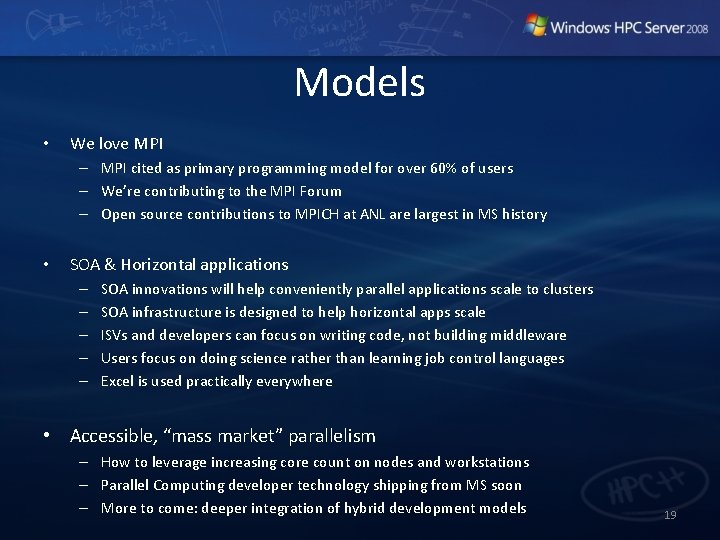
Models • We love MPI – MPI cited as primary programming model for over 60% of users – We’re contributing to the MPI Forum – Open source contributions to MPICH at ANL are largest in MS history • SOA & Horizontal applications – – – SOA innovations will help conveniently parallel applications scale to clusters SOA infrastructure is designed to help horizontal apps scale ISVs and developers can focus on writing code, not building middleware Users focus on doing science rather than learning job control languages Excel is used practically everywhere • Accessible, “mass market” parallelism – How to leverage increasing core count on nodes and workstations – Parallel Computing developer technology shipping from MS soon – More to come: deeper integration of hybrid development models 19
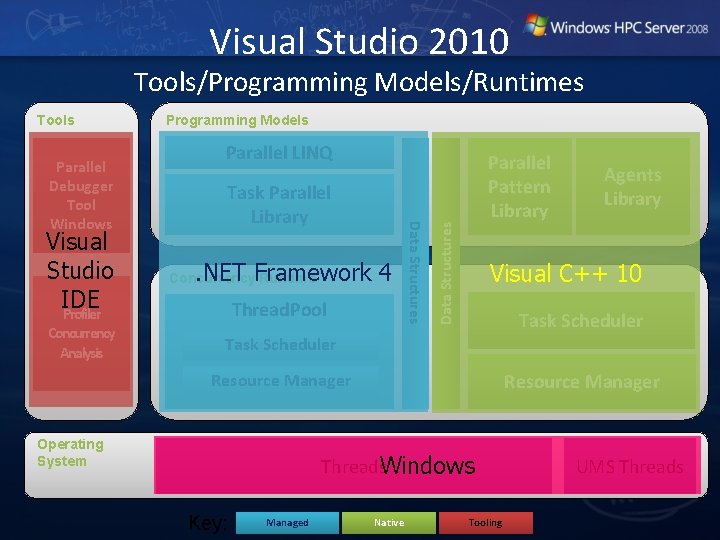
Visual Studio 2010 Tools/Programming Models/Runtimes Visual Studio IDE Profiler Concurrency Analysis Parallel LINQ Task Parallel Library . NET Framework 4 Concurrency Runtime Thread. Pool Data Structures Parallel Debugger Tool Windows Programming Models Parallel Pattern Library Data Structures Tools Agents Library Visual C++ 10 Task Scheduler Resource Manager Operating System Threads. Windows Key: Managed Native Tooling UMS Threads