
Steve Sisolak Governor Richard Whitley Director State of
- Slides: 26
Steve Sisolak Governor Richard Whitley Director State of Nevada Department of Health and Human Services Aging and Disability Services Division Desert Regional Center Intake Services Helping People. It’s who we are and what we do.
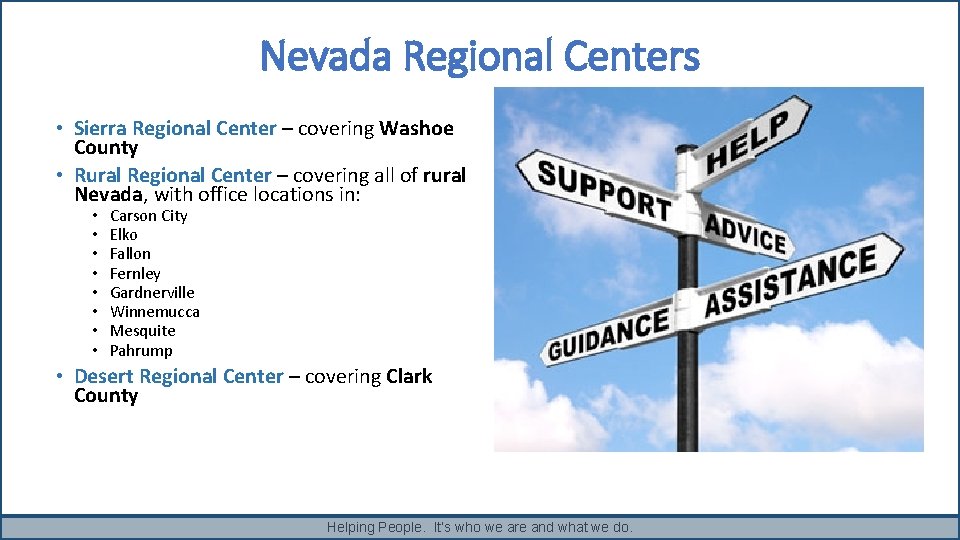
Nevada Regional Centers • Sierra Regional Center – covering Washoe County • Rural Regional Center – covering all of rural Nevada, with office locations in: • • Carson City Elko Fallon Fernley Gardnerville Winnemucca Mesquite Pahrump • Desert Regional Center – covering Clark County Helping People. It’s who we are and what we do.
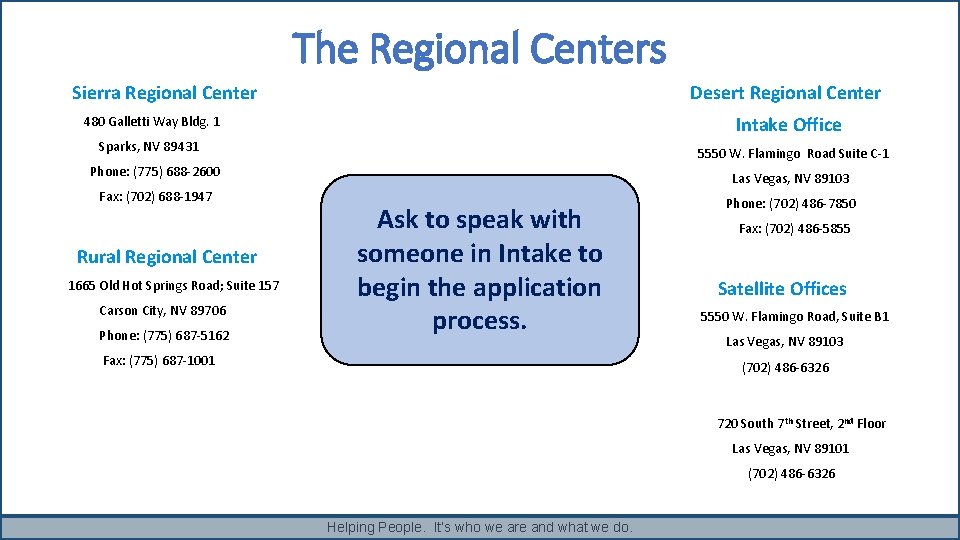
The Regional Centers Desert Regional Center Sierra Regional Center Intake Office 480 Galletti Way Bldg. 1 Sparks, NV 89431 5550 W. Flamingo Road Suite C-1 Phone: (775) 688 -2600 Las Vegas, NV 89103 Fax: (702) 688 -1947 Phone: (702) 486 -7850 Rural Regional Center 1665 Old Hot Springs Road; Suite 157 Carson City, NV 89706 Phone: (775) 687 -5162 Ask to speak with someone in Intake to begin the application process. Fax: (775) 687 -1001 Fax: (702) 486 -5855 Satellite Offices 5550 W. Flamingo Road, Suite B 1 Las Vegas, NV 89103 (702) 486 -6326 720 South 7 th Street, 2 nd Floor Las Vegas, NV 89101 (702) 486 -6326 Helping People. It’s who we are and what we do.
DRC Intake Department • Intake Coordination Supervisor • 8 Intake Specialist • Administrative Assistant III –Supervisor • Administrative Assistant II Helping People. It’s who we are and what we do. 4
Intake Inquiry Methods • Walk –In • Phone • Fax • PR/Application Events • Mail • Web Inquires Helping People. It’s who we are and what we do. 5
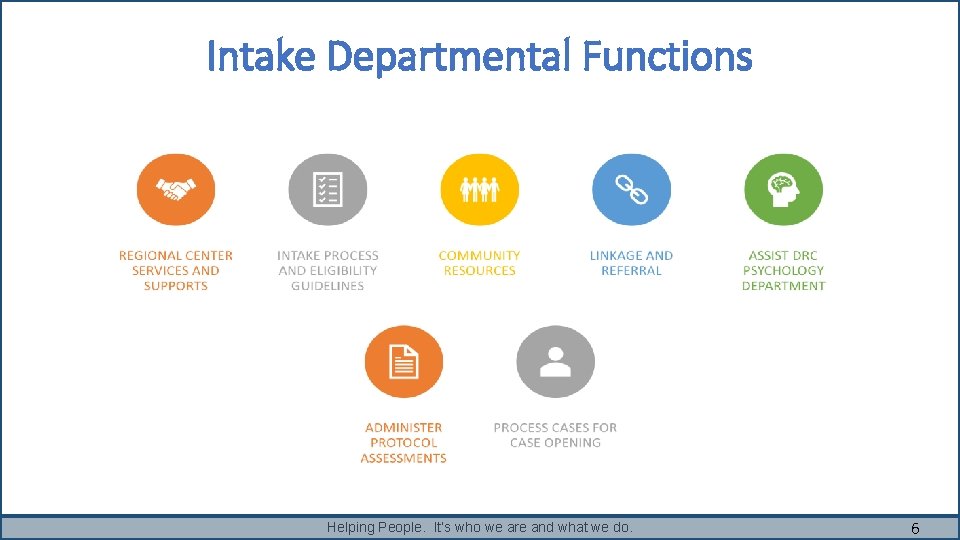
Intake Departmental Functions Helping People. It’s who we are and what we do. 6
Intake Process • The Intake specialist assists the applicant to gather information to determine if the individual meets eligibility requirements. Individuals apply at a regional center based on the area in which they live. • Once the information is gathered, it is reviewed by an Eligibility Committee. • If needed, psychological testing and assessment can be done by the Regional Center to inform eligibility. Helping People. It’s who we are and what we do.
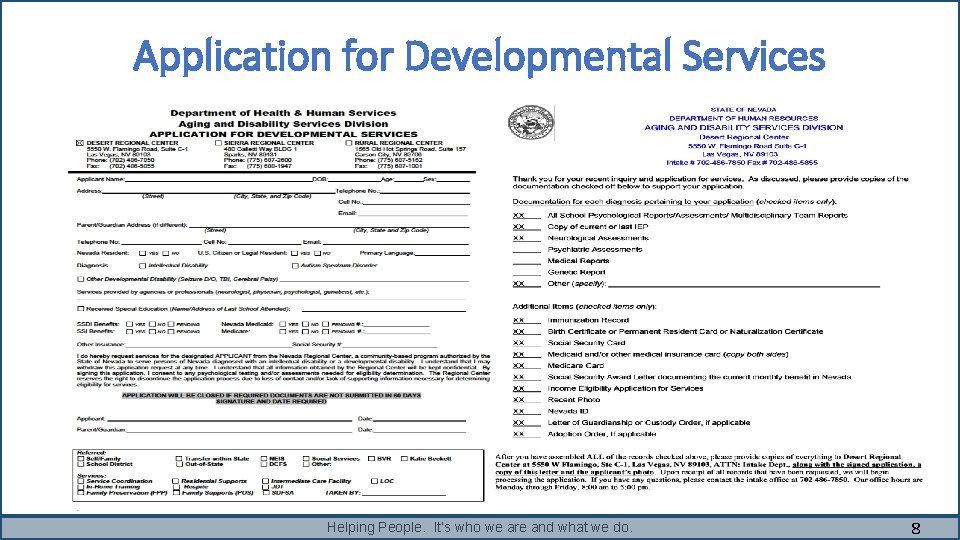
Application for Developmental Services Helping People. It’s who we are and what we do. 8
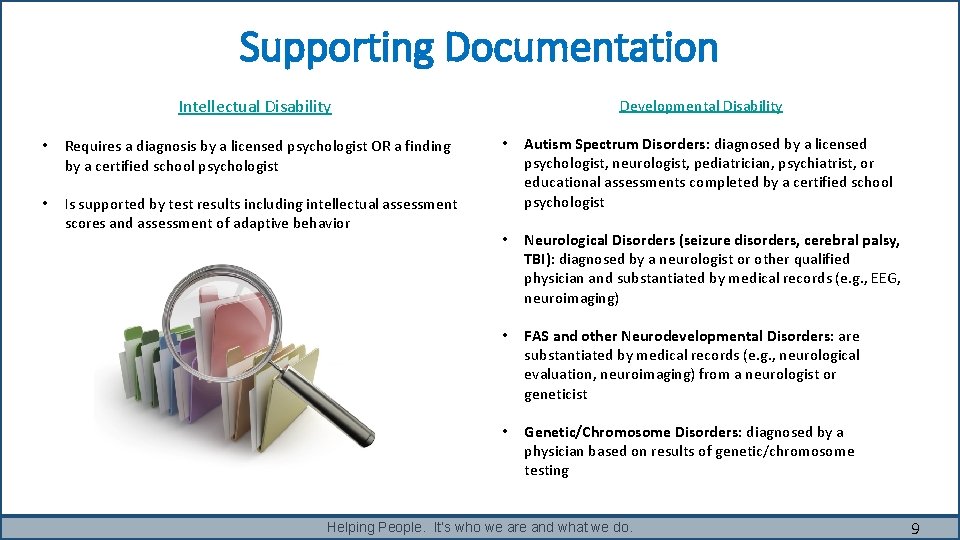
Supporting Documentation Intellectual Disability • Requires a diagnosis by a licensed psychologist OR a finding by a certified school psychologist • Is supported by test results including intellectual assessment scores and assessment of adaptive behavior Developmental Disability • Autism Spectrum Disorders: diagnosed by a licensed psychologist, neurologist, pediatrician, psychiatrist, or educational assessments completed by a certified school psychologist • Neurological Disorders (seizure disorders, cerebral palsy, TBI): diagnosed by a neurologist or other qualified physician and substantiated by medical records (e. g. , EEG, neuroimaging) • FAS and other Neurodevelopmental Disorders: are substantiated by medical records (e. g. , neurological evaluation, neuroimaging) from a neurologist or geneticist • Genetic/Chromosome Disorders: diagnosed by a physician based on results of genetic/chromosome testing Helping People. It’s who we are and what we do. 9
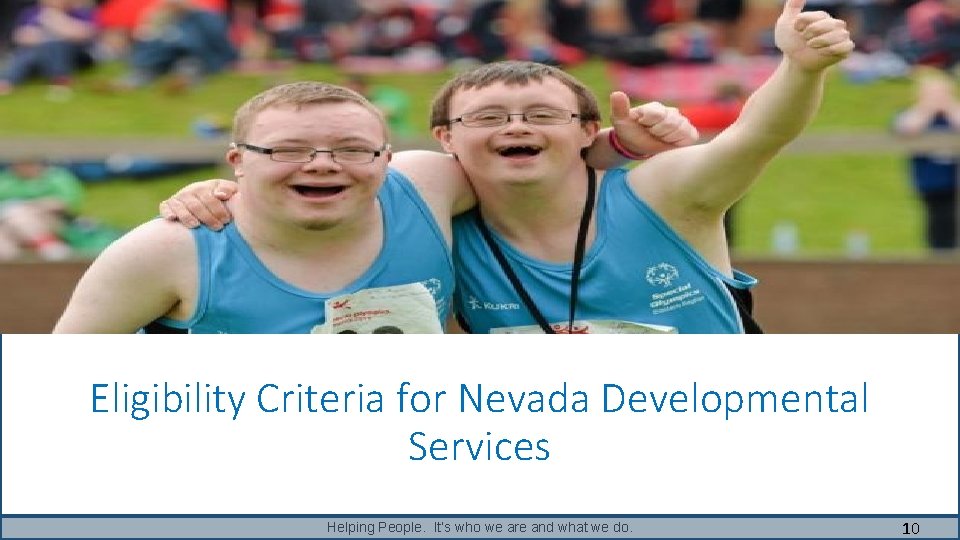
Eligibility Criteria for Nevada Developmental Services Helping People. It’s who we are and what we do. 10
Eligibility A person may qualify for Developmental Services from the state of Nevada if she or he is a legal resident of Nevada and has a confirmed diagnosis of: Ø Developmental Delay (under 6 years of age) Ø Developmental Disability § § § § Ø Autism Spectrum Disorder Seizure Disorder Cerebral Palsy Traumatic Brain Injury FAS/FDA Down Syndrome Fragile X Genetic/Neurological Conditions Intellectual Disability Helping People. It’s who we are and what we do.
Developmental Disability 12 • Developmental Disabilities are severe, chronic disabilities attributed to neurological or genetic disorders found to be closely related to intellectual disability because: • The condition results in impairment of general intellectual functioning AND/OR • Results in adaptive behavior similar to that of a person with intellectual disability • Developmental Disabilities are manifested before the person reaches age 22, and are likely to continue indefinitely, and result in substantial limitations in three or more areas of major life activity Developmental Disability Helping People. It’s who we are and what we do.
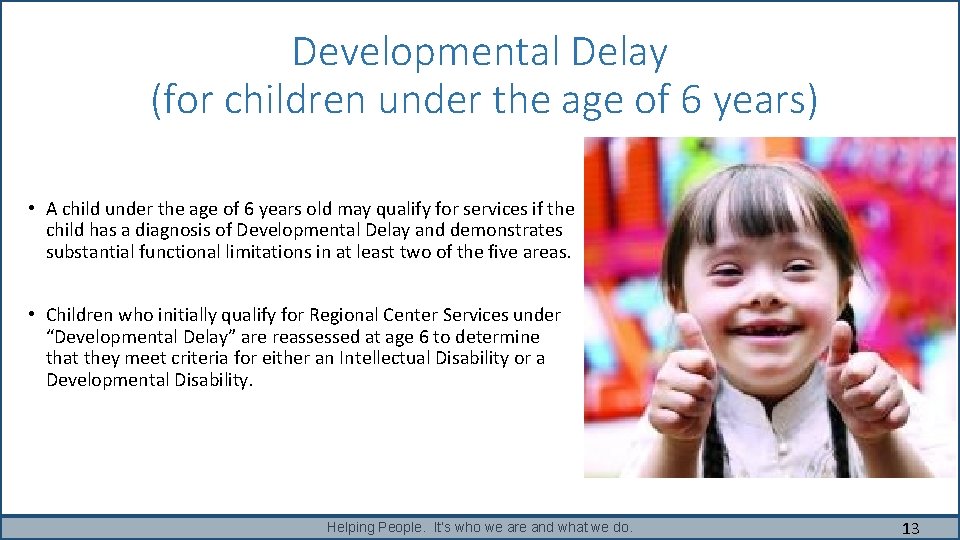
Developmental Delay (for children under the age of 6 years) • A child under the age of 6 years old may qualify for services if the child has a diagnosis of Developmental Delay and demonstrates substantial functional limitations in at least two of the five areas. • Children who initially qualify for Regional Center Services under “Developmental Delay” are reassessed at age 6 to determine that they meet criteria for either an Intellectual Disability or a Developmental Disability. Helping People. It’s who we are and what we do. 13
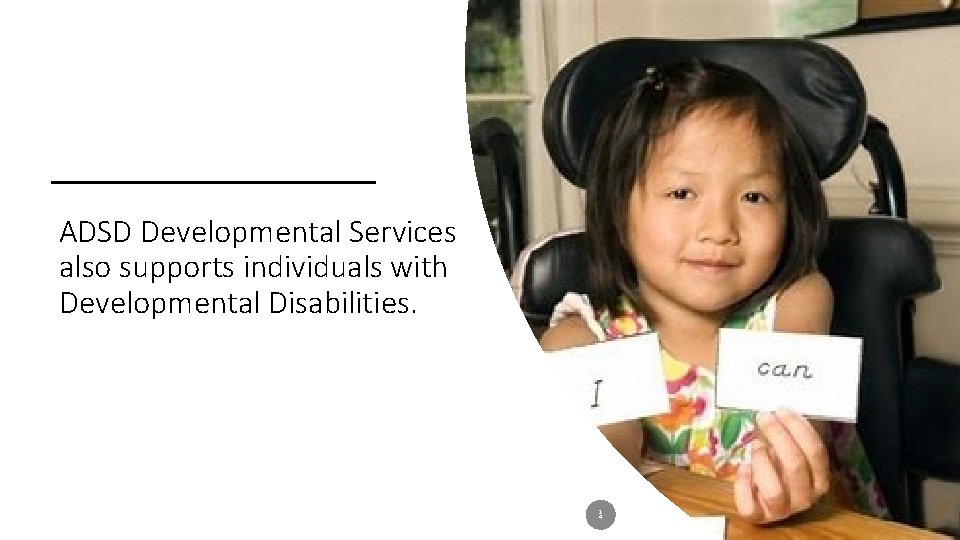
ADSD Developmental Services also supports individuals with Developmental Disabilities. 1 4 Helping People. It’s who we are and what we do.
Developmental Disability • Examples of types of Developmental Disabilities: • Autism • Fetal Alcohol Syndrome • Epilepsy • Down Syndrome • Prader-Willi Syndrome • Fragile X • Cerebral Palsy • Traumatic Brain Injury Helping People. It’s who we are and what we do. 15
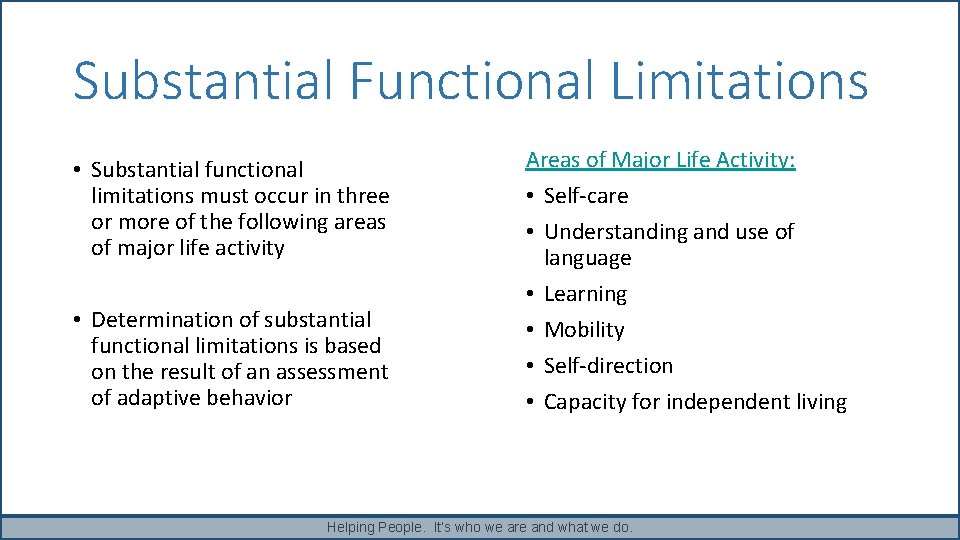
Substantial Functional Limitations • Substantial functional limitations must occur in three or more of the following areas of major life activity • Determination of substantial functional limitations is based on the result of an assessment of adaptive behavior Areas of Major Life Activity: • Self-care • Understanding and use of language • Learning • Mobility • Self-direction • Capacity for independent living Helping People. It’s who we are and what we do.
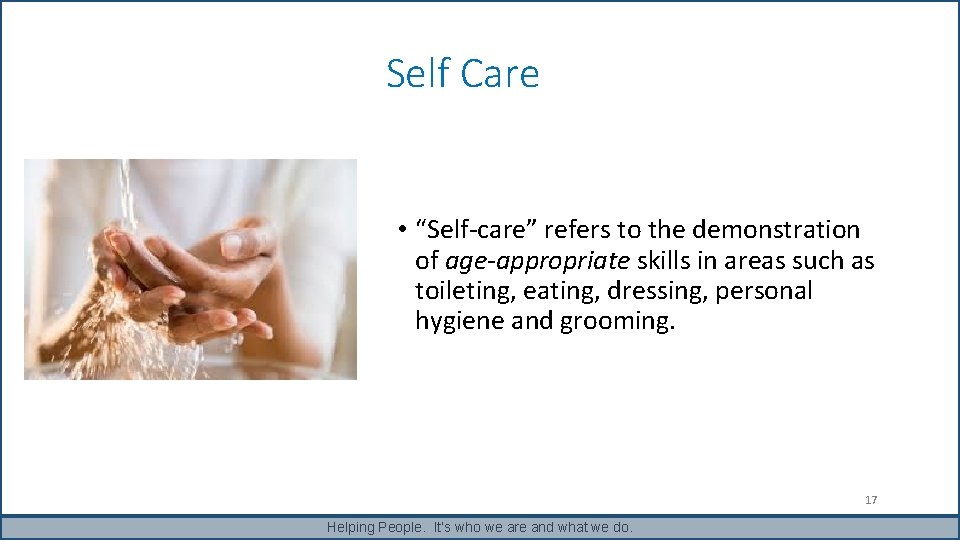
Self Care • “Self-care” refers to the demonstration of age-appropriate skills in areas such as toileting, eating, dressing, personal hygiene and grooming. 17 Helping People. It’s who we are and what we do.
Understanding and use of language • “Understanding and use of language” includes the demonstration of ageappropriate skills in comprehending and expressing information including - written communication - Speaking/sign language - facial expression, body movement, - touch or gestures. 18 Helping People. It’s who we are and what we do.
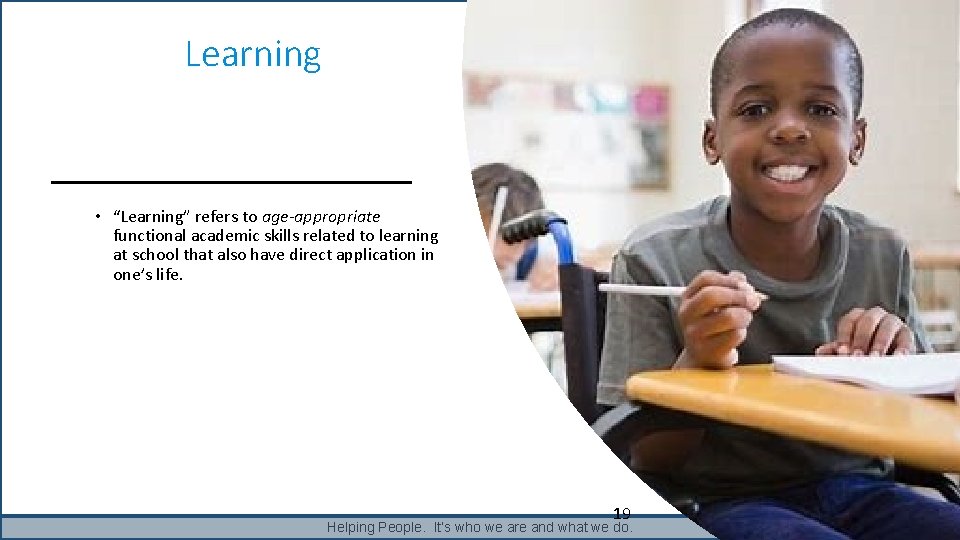
Learning • “Learning” refers to age-appropriate functional academic skills related to learning at school that also have direct application in one’s life. 19 Helping People. It’s who we are and what we do.
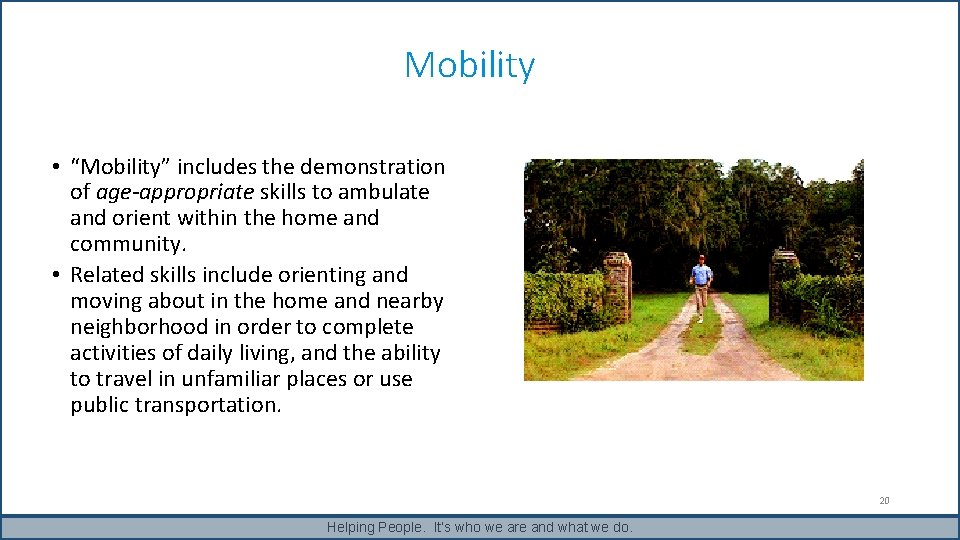
Mobility • “Mobility” includes the demonstration of age-appropriate skills to ambulate and orient within the home and community. • Related skills include orienting and moving about in the home and nearby neighborhood in order to complete activities of daily living, and the ability to travel in unfamiliar places or use public transportation. 20 Helping People. It’s who we are and what we do.
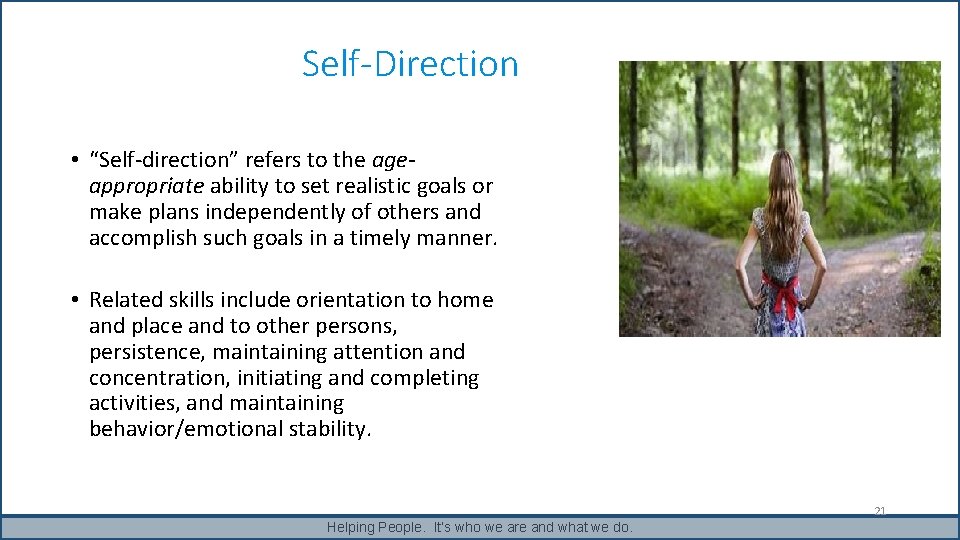
Self-Direction • “Self-direction” refers to the ageappropriate ability to set realistic goals or make plans independently of others and accomplish such goals in a timely manner. • Related skills include orientation to home and place and to other persons, persistence, maintaining attention and concentration, initiating and completing activities, and maintaining behavior/emotional stability. 21 Helping People. It’s who we are and what we do.
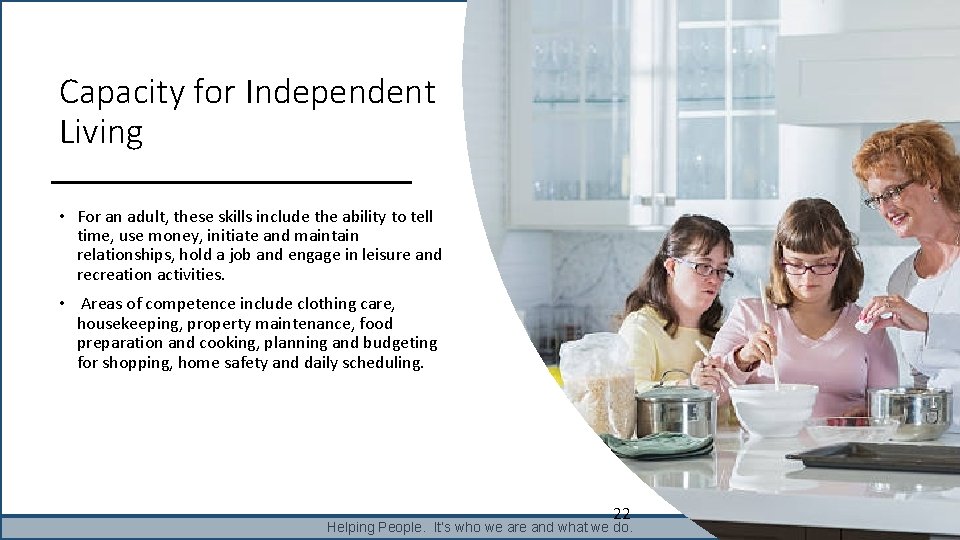
Capacity for Independent Living • For an adult, these skills include the ability to tell time, use money, initiate and maintain relationships, hold a job and engage in leisure and recreation activities. • Areas of competence include clothing care, housekeeping, property maintenance, food preparation and cooking, planning and budgeting for shopping, home safety and daily scheduling. 22 Helping People. It’s who we are and what we do.
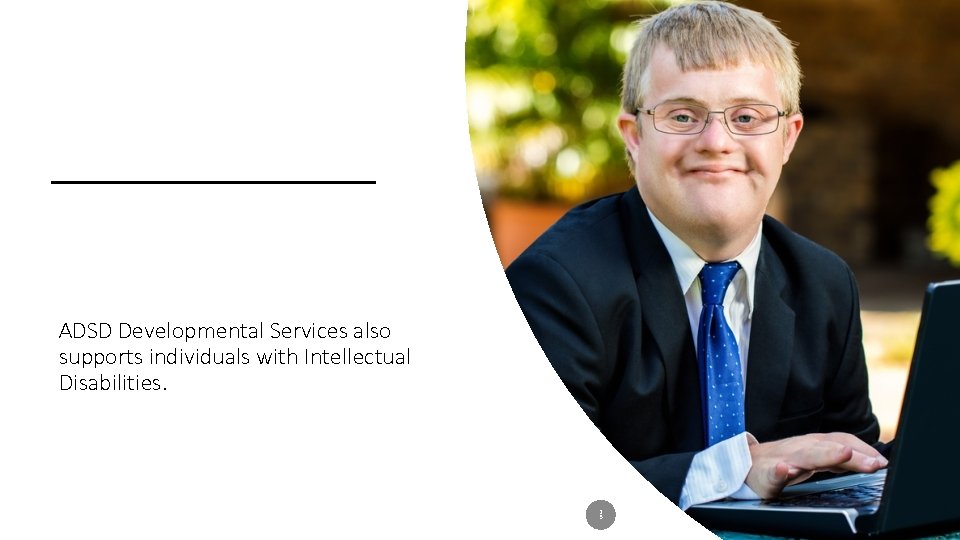
ADSD Developmental Services also supports individuals with Intellectual Disabilities. 2 3 Helping People. It’s who we are and what we do.
Intellectual Disability • Intellectual Disability is characterized by significant limitations in both: • Intellectual functioning • Adaptive skills • This is considered to be a lifelong condition originating before the age of 18 years. 24 Helping People. It’s who we are and what we do.
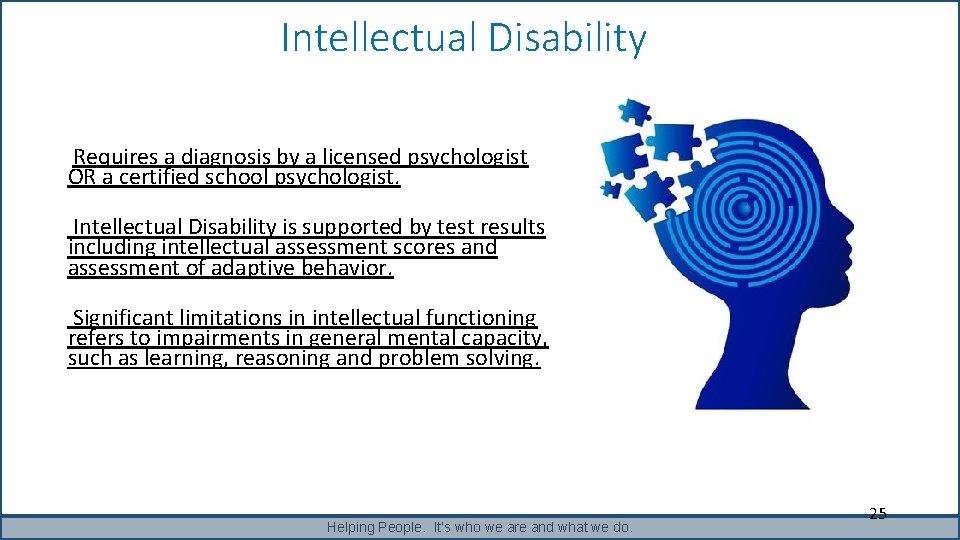
Intellectual Disability Requires a diagnosis by a licensed psychologist OR a certified school psychologist. Intellectual Disability is supported by test results including intellectual assessment scores and assessment of adaptive behavior. Significant limitations in intellectual functioning refers to impairments in general mental capacity, such as learning, reasoning and problem solving. Helping People. It’s who we are and what we do. 25
Notification and Processing of Ineligible Case Determinations Explanation of Appeals Process ADSD Appeals Appeal through NV Medicaid Appeals Request Receive Statewide Eligibility Review Committee Fair Hearing through NV Medicaid Linkage and Referral Helping People. It’s who we are and what we do. 26