
Steroids and Diabetes June James Associate Professor University

Steroids and Diabetes June James Associate Professor- University of Leicester Nurse Consultant- University Hospitals of Leicester NHS Trust July 2017
Leaning objectives At the end of this session you should be able to: • Discuss the implications of steroid use and diabetes • Review treatments for steroid induced hyperglycaemia • Identify use in different groups including: - People with known diabetes - People not known to have diabetes - Pregnancy - End of life care
Case study • 62 years man. Weight 102 kg, BMI 32 kg/m 2 • T 2 DM on Metformin. • Hb. A 1 c 55 mmol/mol • Background: - COPD, CVA, IHD - Respiratory clinic’…. progressive dyspnoea Plan: Prednisolone 30 mg for 10 days then reduced to 20 mg for one week and then to reduce to 10 mg maintenance for now. • Follow-up: 2/12
3 weeks later • Acute admission • Osmotic symptoms, BG 32 mmol/L • Hba 1 c 112 mmol/mol • 48 hrs in patient stay over weekend • Gliclazide (SU) , followed by insulin • 6 months OPD in diabetes clinic discharged OHA, Hb. A 1 c 44 mmol/mol
Background • 0. 75% use steroids • 40% for respiratory problems • Inpatient use >10% • Most use for <5 days, but 22% is for > 6 months and 4. 3% for > 5 years https: //www. nos. org. uk/Net. Community/Document. Doc? i d=422 Fardet L et al Rheumatology 2011; 50(11): 1982 -1990
Background • There are no reliable estimates for prevalence of glucocorticoid use in hospital/ community • We don’t know if more people in hospital are on steroids, and if so are the doses used usually higher than those used in community? • The prevalence of undiagnosed diabetes in hospitalised patients may be ~18% Wexler DJ et al JCEM 2008; 93(11): 4238 -4244
Steroid regimens • Once a day –short course (Prednisolone 30 mg OD for 5 days) • Multiple dose (Dexamethasone BD/TDS) • High dose short duration (methyl prednisolone 3 days/ 5 days) • High dose infrequent (Oncology) • Betamethasone x 2 doses ( Pregnancy )
People at risk of hyperglycaemia • Pre-existing type 1 or type 2 diabetes • People at increased risk of diabetes. • Impaired glucose regulation - Hb. A 1 c 42 -47 mmol/mol • People previously hyperglycaemic with steroid therapy
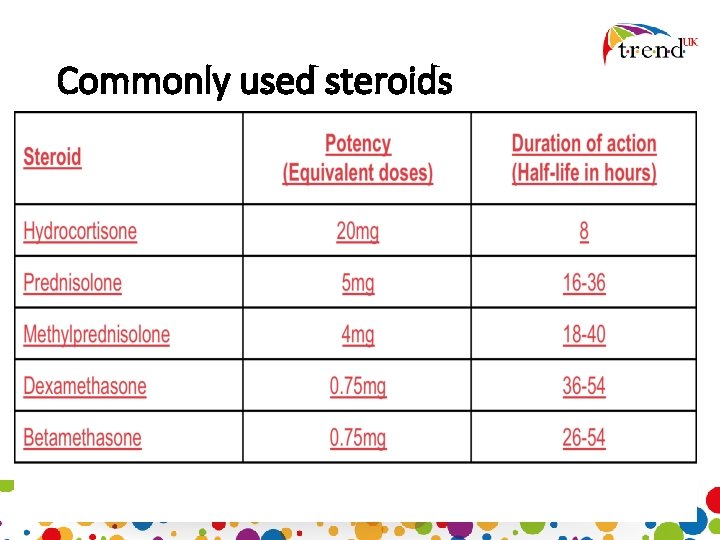
Commonly used steroids
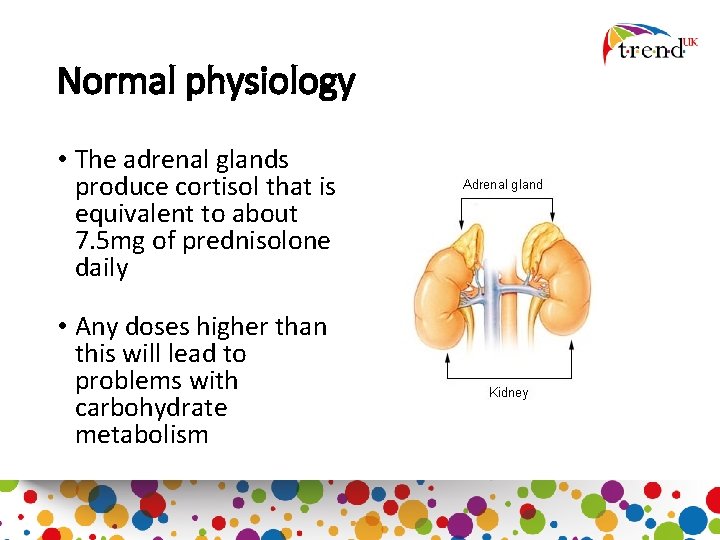
Normal physiology • The adrenal glands produce cortisol that is equivalent to about 7. 5 mg of prednisolone daily • Any doses higher than this will lead to problems with carbohydrate metabolism
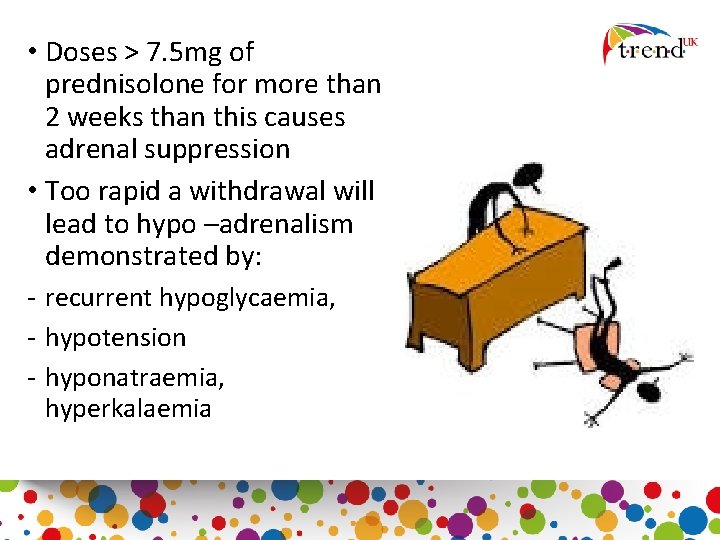
• Doses > 7. 5 mg of prednisolone for more than 2 weeks than this causes adrenal suppression • Too rapid a withdrawal will lead to hypo –adrenalism demonstrated by: - recurrent hypoglycaemia, - hypotension - hyponatraemia, hyperkalaemia
How do “steroids” work? • Acutely increases hepatic glucose production • Complex effects on β-cell function and may reduce insulin production • They promote visceral adipose tissue deposition and enhance lipolysis • Alter levels of adipose tissue derived hormones and cytokines Saltiel AR et al Nature 2001; 414: 799 -806 Hollingdal M et al Diabetologia 2002; 45: 49 -55 Boyle PJ Diabetes Reviews 1993; 1: 301 Lambillotte C et al J Clin Invest 1997; 99: 414 -423 Petersons CJ et al Diabetes Care 2013; 36: 2822 -2829
Glucose inhibition • Starts very early after steroid ingestion • In (previously well controlled) patients leads to postprandial hyperglycaemia • Hyperglycaemia may be a transient rise of blood glucose levels or may result in HHS • The best predictors of glucocorticoid-induced diabetes are family history of diabetes, increasing age, and glucocorticoid dose Schacke H et al Pharmacol Ther 2002; 96: 23 -43 Dimitriadis G et al Biochem J 1997; 321: 707– 712 Petersons CJ et al Diabetes Care 2013; 36: 2822 -2829
Now we know the cause, what’s the treatment? • Education and pre-empting the (almost) inevitable • Letting teams know that when someone starts corticosteroid treatment that blood glucose levels are very likely to rise and to watch for it • When it happens, treat early
What is the best treatment? • Glitazones • DPP-4 s • SGLT 2 Inhibitors • GLP- 1 RAs • Sulphonylureas • Insulin
Gltizones…. . • Work very slowly – so may have been useful in an outpatient setting • Several controversies abound regarding the use of glitazones, so their use is declining • Increased CV death rates • Increased fracture rates • Increased rates of macular oedema Nissen SE NEJM 2007; 356(24): 2457 -2471 Loke YK et al CMAJ 2009; 180(1): 32 -39 Ryan EH et al Retina 2006; 26(5): 562 -70 Ferwana M et al Diabetic Med 2013; 30(9): 1026 -1032
GLP-1’s/ DDP-4 s • SGLT 2 is - Little experience with steroid use - Do not have a fast response to reducing hyperglycaemia • GLP 1 s - reduce blood glucose but: - Little experience/ evidence with steroid use -It makes people who are already unwell feel nauseated -Not appropriate for people who are NBM -Do not have a fast response to reducing hyperglycaemia • DPP-IV antagonists - limited published data on the use with steroids, e. g. Umpierrez using Sitagliptin in 90 hospitalised patients Umpierrez GE et al Diabetes Care 2013
Sulphonylureas • • SU - Gliclazide Titrate from 40 mgs am to 240 mg am You may want to contact the specialist team if you are concerned re high Gliclazide doses Also add in up to 80 mgs pm ( max 320 mgs per day ) Insulin often required Various regimens VRII
Insulin • Insulin is recommended as the drug of choice for the treatment of glucocorticoid-induced hyperglycaemia • Prandial insulin should minimise the effects of the postprandial rise in glucose • For patients receiving high-dose intravenous glucocorticoids, an intravenous insulin infusion may be appropriate Hirsch IB et al Endocr Metab Clin North Am 1997; 26: 631– 645
However! • How much insulin should be given in the insulin naïve • What about dose increases in people already on insulin • Should you give it IV or SC
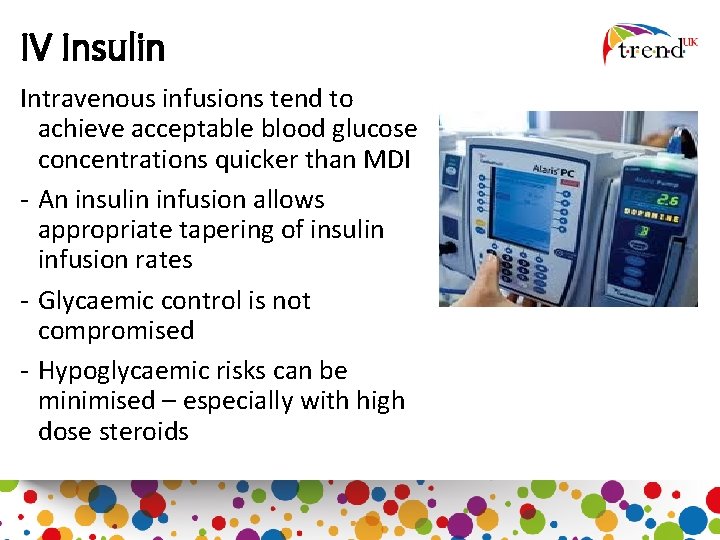
IV Insulin Intravenous infusions tend to achieve acceptable blood glucose concentrations quicker than MDI - An insulin infusion allows appropriate tapering of insulin infusion rates - Glycaemic control is not compromised - Hypoglycaemic risks can be minimised – especially with high dose steroids
What About Subcutaneous Insulin? • IV insulin is not the answer for all – but maybe if the blood glucose is consistently above ~15 mmol/L • May need a basal bolus regimen • No work has been done to compare human with analogue insulin in this field
Should “steroid induced” hyperglycaemia always be treated (pre-existing diabetes) • No clinical studies/ evidence to tell us • However - hyperglycaemia in a hospital setting (for any cause) is associated with poor mortality, morbidity, and health economic outcomes • Improving glycaemic control improves these outcomes Umpierrez GE et al J Clin Endocrinol Metab 2002; 87: 978– 982 Bruno A et al Diabetes Care 2008; 31(11): 2209 -2210
Which insulin? • Intermediate acting human basal insulin • Once a day • Gradually up titration • Analogue basal insulin if: – if hyperglycaemia throughout day – early morning hypos!
Factors to consider during treatment • Risk of hyperglycaemia and hypoglycaemia • Duration of steroid therapy • Pre-existing diabetes • Co-morbidities
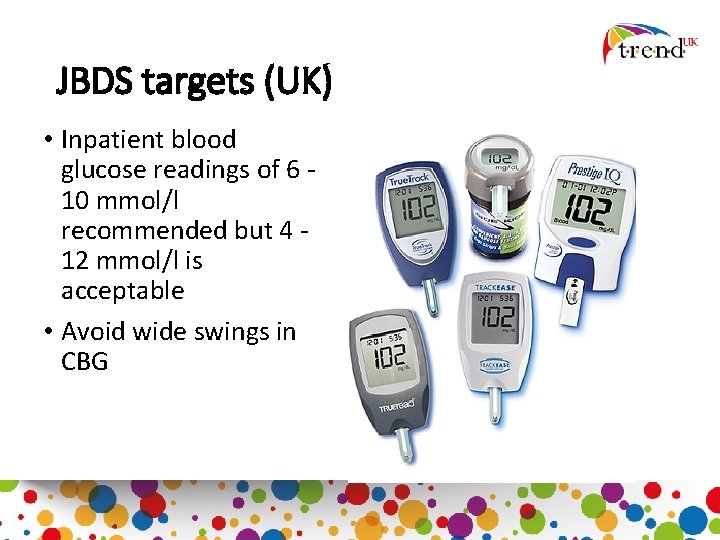
JBDS targets (UK) • Inpatient blood glucose readings of 6 10 mmol/l recommended but 4 12 mmol/l is acceptable • Avoid wide swings in CBG
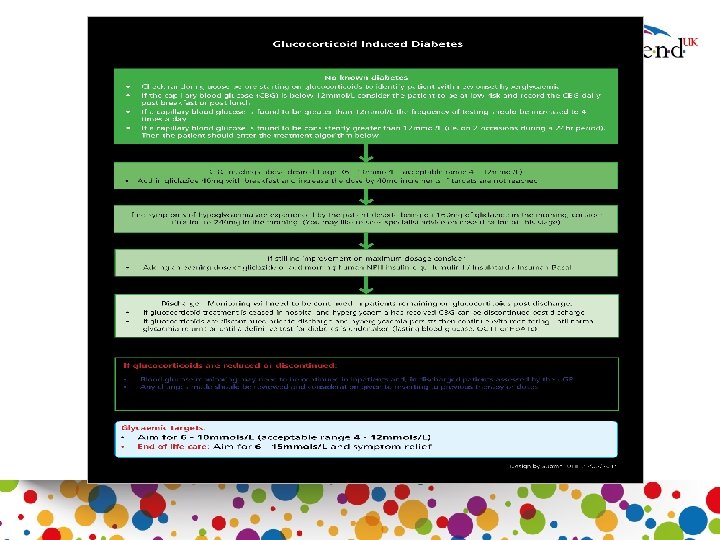
Pre existing diabetes Type 2 On non insulin therapies Titrate oral medications Add Gliclazide and titrate to 240 mgs am/ 80 mgs pm Type 1 and 2 Insulin treated patients - Increase morning dose of premixed insulin - Increase bolus at lunch/tea - Shift basal to morning • Test four times a day • If capillary >12 mmol/L on two occasions during 24 hours, then review treatment • -
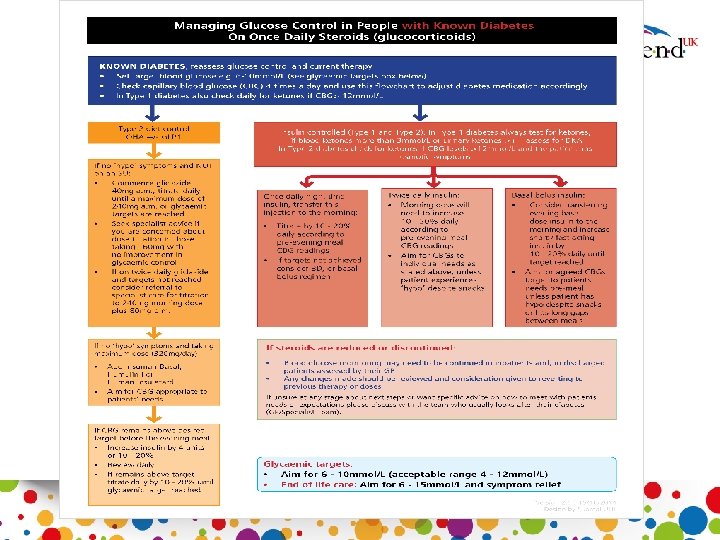
Steroid induced diabetes • Once a day BG monitoring • Pre lunch or evening meal • If BG >12 increase frequency to 4/day • If 2 or more BG >12 mmol/l -TREAT
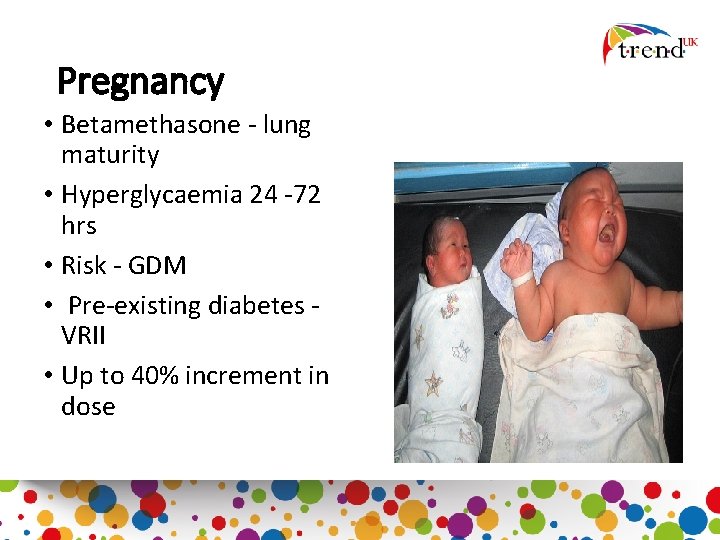
Pregnancy • Betamethasone - lung maturity • Hyperglycaemia 24 -72 hrs • Risk - GDM • Pre-existing diabetes VRII • Up to 40% increment in dose
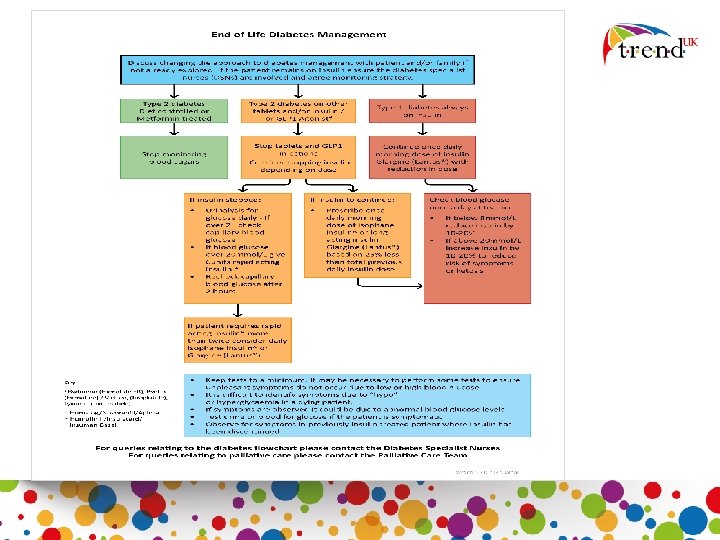
End of life • Consider stages of end of life • Hyperglycaemia may be complicated by use of food supplements • Keep BG 6 -15 mmols • No fasting BG readings • No Hb. A 1 c targets
Steroids commenced in hospital and patient discharged (No known diabetes) • Standard education for the individual and carer • Blood glucose testing once daily (pre or post lunch or evening meal) • If blood glucose readings greater than 12 mmol/L increase frequency of testing to four times daily • If two consecutive blood glucose readings greater than 12 mmol/L in a 24 hour period follow algorithm for management of steroid induced diabetes • If hyperglycaemia resolved stop CBG testing and arrange definitive test for diabetes
Hospital discharge (Known diabetes) • Standard education for patient and carer including advice on hypoglycaemia • Continue CBG monitoring until blood glucose normalises (4 -7 mmol/L) • Review by agreed individual (e. g. GP, Diabetologist, DSN/ PN) at an appropriate juncture to consider down-titration of antihyperglycaemic therapy if necessary
Education • Steroids are often started by health care professional who may not have experience of managing diabetes • Patients with or without pre-existing diabetes will need to be aware of the impact steroid therapy makes on glycaemia control. • Monitoring and treatment
Summary • Steroid use will result in hyperglycaemia in most cases • Treatment algorithms are available • There is consensus guidelines but no real evidence of appropriate treatment pathways • Those with no previous diagnosis of diabetes will need to undergo screening • Patient and staff education should be put in place in localities
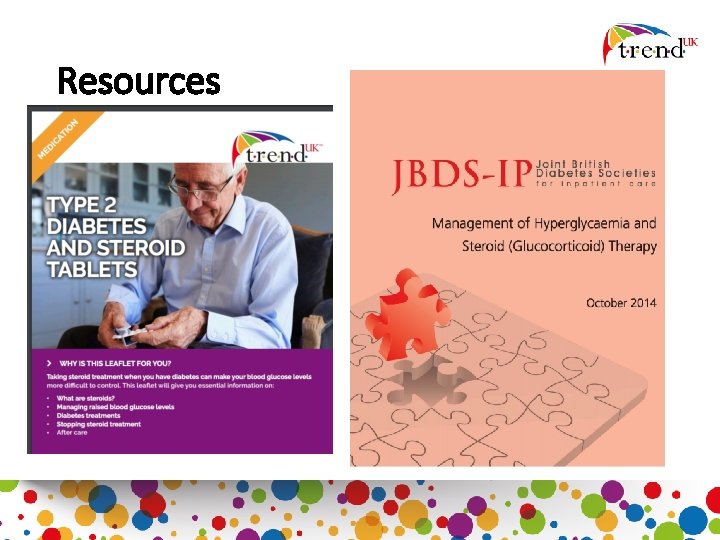
Resources
- Slides: 39