
Sterilization Dr Smita Kulkarni Assistant professor Sterilisation CONTENTS

- Slides: 48
Sterilization Dr. Smita Kulkarni Assistant professor
Sterilisation �CONTENTS: � 1) Introduction: Some Definitions � 2) Methods of Sterilisation�A)Physical �B)Chemical
Introduction : Definitions �Microorganisms are ubiquitous in nature �Cause contamination & Infection �AIM of Sterilisation �to remove or destroy microorganisms �Sterilisation: An article, surface or medium is made free of all microorganisms �either in the vegetative or spore form.
�Disinfection: destruction of all pathogens or organisms capable of producing infections , . � number is reduced to a level that is no longer harmful to health. �Antiseptics: Chemical disinfectants which can safely be applied to living tissues �used to prevent infection by inhibiting the growth of microorganisms.
�Asepsis: �The technique- occurence of infection into an uninfected tissue is prevented Use of Sterilisation/Disinfection: 1. For materials, instruments used in surgical and diagnostic procedures. 2. For media and reagents used in laboratory. 3. In food and drug manufacturing - safety from contaminating organisms.
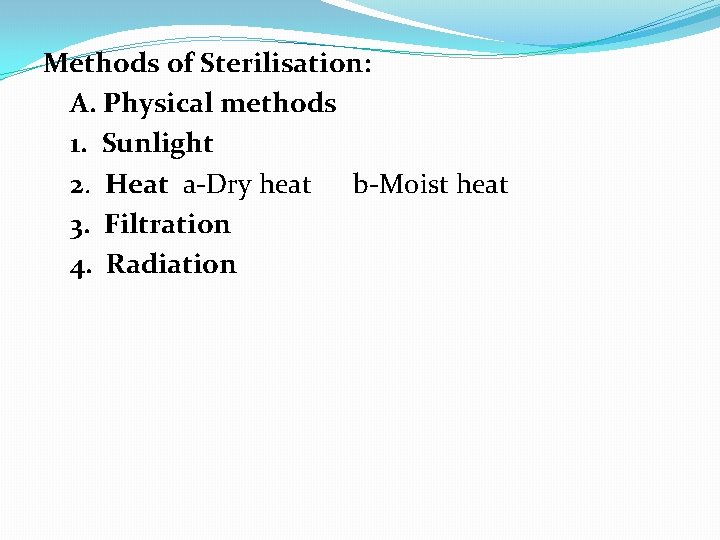
Methods of Sterilisation: A. Physical methods 1. Sunlight 2. Heat a-Dry heat b-Moist heat 3. Filtration 4. Radiation
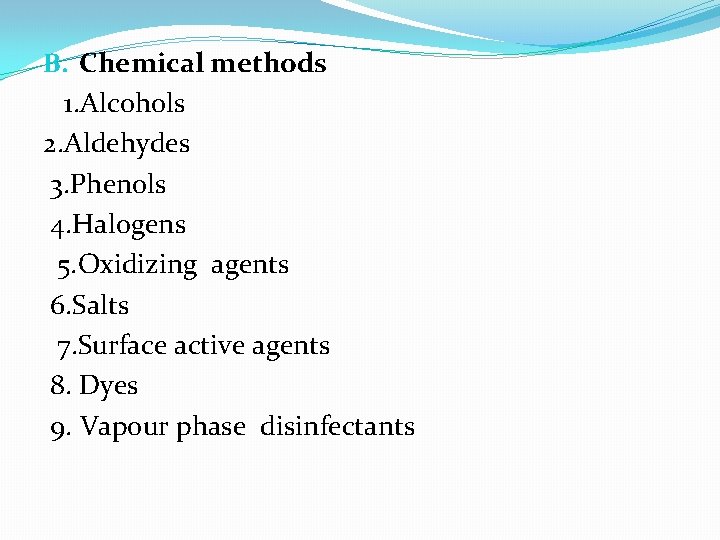
B. Chemical methods 1. Alcohols 2. Aldehydes 3. Phenols 4. Halogens 5. Oxidizing agents 6. Salts 7. Surface active agents 8. Dyes 9. Vapour phase disinfectants
A. Physical Methods 1. Sunlight: germicidal effect (ultraviolet rays). It is a natural method of sterilisation of water in tanks, rivers and lakes. 2. Heat: most reliable and commonly employed method. Two types of heat are used dry heat moist heat.
Principle (1) Dry heat kills (2) -by denaturation of bacterial protein (3) , oxidative damage , (4) by the toxic effect of elevated levels of electrolytes & DNA damage. (2) Moist heat kills – by denaturation and coagulation of proteins.
Factors influencing 1) Nature of heat: Dry heat or moist heat 2) Temperature and duration: the time is inversely proportional to temperature
(3) Characteristic of microorganisms and spores present: eg. spores and vegetative bacteria, fungi and viruses. (4) Type of material: A high content of organic substances like proteins, fats etc
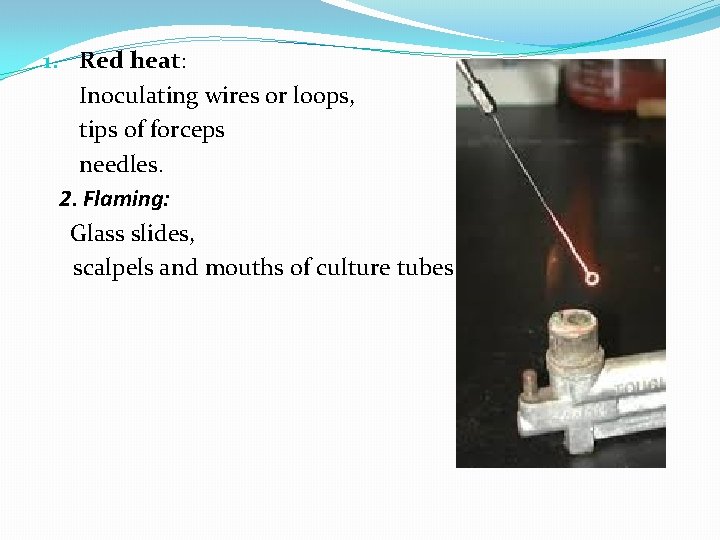
DRY HEAT STERILISATION methods 1. Red heat 2. flaming 3. Incineration 4. Hot air oven
1. Red heat: Inoculating wires or loops, tips of forceps needles. 2. Flaming: Glass slides, scalpels and mouths of culture tubes
3. Incineration: Incinerator (high temp) infective material is reduced to ashes by burning. Soiled dressings, animal carcasses, bedding pathological materials.
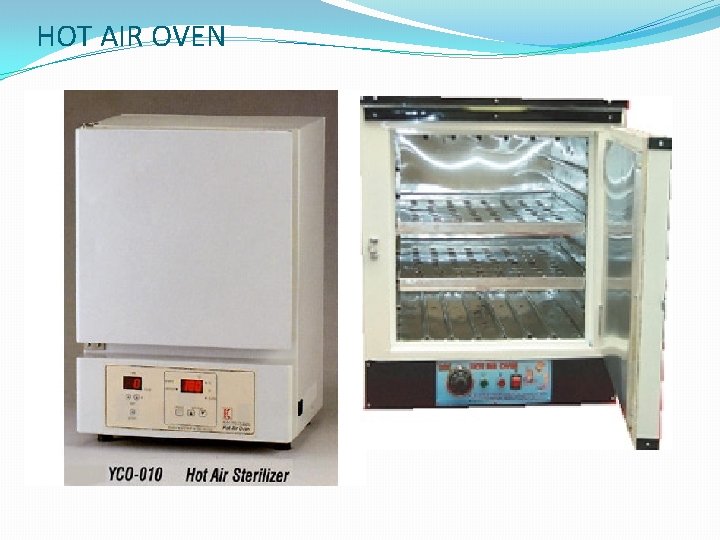
. Hot Air Oven: most widely used electrically heated fitted with a fan (figs. ) thermostat. Temperature and time : 160°C for two hour(holding time). alternative 170°C for one hour 180°C for 30 minutes
Uses: for sterilisation of i)Glasswares like glass syringes, petridishes, flasks, pipettes test tubes. ii)Surgical instruments scalpels, scissors, forceps etc. iii)Chemicals such as liquid paraffin, fats, sulphonamides powders etc.
Precautions: (i) should not be overloaded. (ii) allows free circulation of air. (iii)Material -perfectly dry. (iv)Test tubes, flasks -fitted with cotton plugs. (v) Petridishes and pipettes -wrapped in paper. (vi)Rubber materials) or any inflammable material should not be kept inside the oven. (vii)allowed to cool for two hours before opening the doors.
HOT AIR OVEN
Sterilisation control (i) The spores of Bacillus subtilis subsp. Niger (NCTC 10075 or ATCC 9372) (ii) Thermocouples may also be used. (iii) Browne’s tube -a green color is produced (after two hours at 160°C).
MOIST HEAT STERILISATION This method of sterilisation may be used at different temperatures as follows. (i) below 100°C (ii) At a 100°C (iii) above 100°C
At a Temperature below 100°C (a)Pasteurisation of milk– Two types of method, holder method (63°C for 30 minutes) and flash method (72°C for 20 seconds followed by cooling quickly to 13°C or lower) are used. egs.
b)Inspissation– serum or egg media, such as Lowenstein-Jensen’s and Loeffler’s serum, 80 -85°C temperature for 30 min daily on 3 consecutive days. . Instrument -inspissator. c)Vaccine bath– 60°C for one hour. Serum or body fluids at 56°C in a water bath on several successive days.
�e) Low temperature steam formaldehyde (LTSF)) sterilisation. � Steam at subatmospheric pressure at 75°C with formaldehyde vapour �. Bacillus stearothermophilus -biological control
At a temperature of 100°c a) Boiling—Time- 10 to 30 min (kills vegetative forms but not all spores) Uses- glass syringes & rubber stoppers. b)Tyndallisation –Or Intermittent sterilisation – Steam at 100° C for 20 min for 3 days.
Principle – 1 st exposure kills all vegetative forms & in the intervals between heatings remaining spores germinate into vegetative forms which are killed on further heating. Uses- egg , serum or sugar containing culture media (damaged at autoclave temp ) Instrument used- Koch’s or Arnold steam sterliser
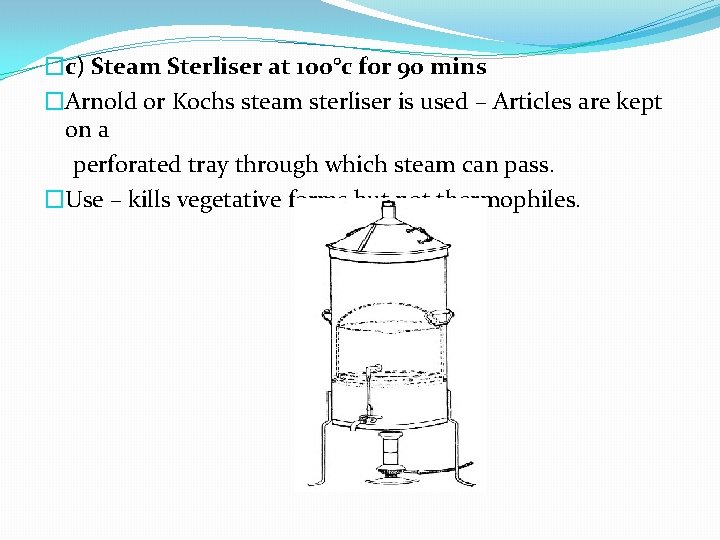
�c) Steam Sterliser at 100°c for 90 mins �Arnold or Kochs steam sterliser is used – Articles are kept on a perforated tray through which steam can pass. �Use – kills vegetative forms but not thermophiles.
�iii) At a temp above 100°C ( steam under pressure ) �Water boils when its vapour pressure equals that of the surrounding atmosphere. �When the atmospheric pressure is raised then the boiling temperature is also raised. �
�when pressure inside a closed vessel increases, the temperature at which water boils also increases. � The principle has been applied in autoclave and pressure cooker. �Types of Autoclave…. examples
�AUTOCLAVE �Principle– Steam above 100°C or saturated steam has a better killing power than dry heat. �susceptible to moist heat as bacterial protein coagulates rapidly. � Saturated steam can penetrate porous material easily
�steam -contact with a cooler surface it condenses to water � liberates its latent heat �, for example, 1600 ml of steam at 100°C , at atmospheric pressure condenses � into one ml of water �releases 518 calories of heat. � The large reduction in volume sucks in more steam to the same site and the process continues till the temperature of the article is raised to that of steam �. The condensed water produces moist conditions for killing the microbes present.
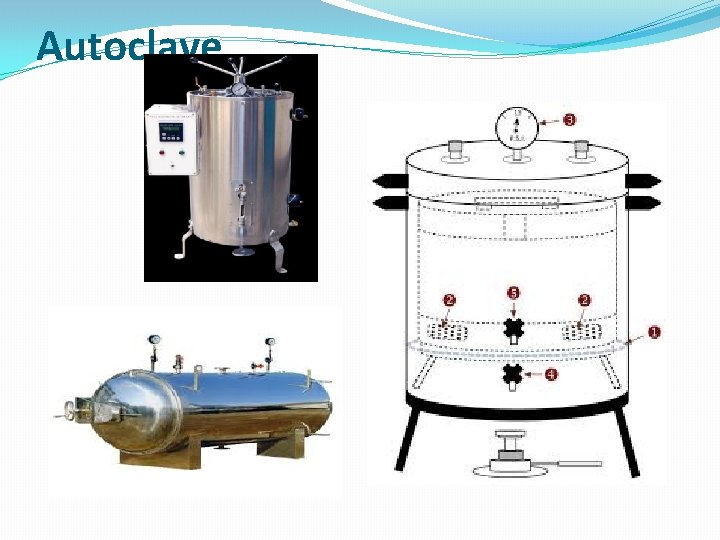
Component of autoclave �Autoclave is a modified pressure cooker or boiler. �vertical or horizontal cylinder of gunmetal or stainless steel in a supporting iron case. �The lid is fastened by screw clamps �rendered air tight by an asbestos washer. �The lid bears a discharge tap for air and steam � a pressure gauge and a safety valve
Procedure �The cylinder is filled with sufficient water �material -placed on the tray. �The lid is closed �discharge tap open. �The heater is put on. � Safety valve is adjusted to the required pressure. � the steam and air mixture is allowed to escape. �. The discharge tap is now closed.
�The steam pressure rises �reaches the desired set level (15 pounds (lbs) per square inch), � the safety valve opens and the excess steam escapes. � holding period (15 minutes) is counted �heating is stopped �autoclave allowed to cool
Sterilisation conditions Temperature -- 121°C Chamber pressure -- 15 lb per square inch Holding time -- 15 minutes Alternative, at 126°C (20 lbs/ square inch) for 10 minutes or at 133°C (30 lbs / square inch) for 3 minutes
Autoclave
�Uses (i) culture media, rubber material, gowns, dressing, gloves etc. (ii) For all glass syringes, hot air oven is a better sterilising method. � Precautions (i) The air must be allowed to escape from the chamber (ii) free circulation of steam inside the chamber.
� (ii) Sterilisation control i)Thermocouple– It is to record the temperature directly by a potentiometer. ii) Bacterial spores– Spores of Bacillus stearothermophilus. iii)Chemical indicators– Browne’s tube contains red solution which turns green, (iii) Autoclave tapes
Filtration � for substances which get damaged by heat process. Uses� sera, sugar, antibiotic solutions. � Separate toxins & bacteriophages � bacteria free filtrates of clinical specimens for virus isolation. � Purification of water. Limitation: Pore size of filter is about 0. 75 not safe for clinical use.
Types of filters 1. Candle filters eg Berkefeld, Chamerland 2. Asbestos disc. Eg Seitz filter 3. Sintered glass filter 4. Membrane filters 5. Air filters 6. Syringe filters
� 1). Candle filters- purification of water for industrial & drinking purposes. � Eg hollow candles � 02 types- a) Diatomaceous earth eg Berkefeld b) Unglazed porcelain eg Chamberland. � 2) Asbestos disc (Seitz filter) : Made up of asbestos (magnesium silicate). � 3)Sintered glass filters : Made by fusing powdered glass particles
� 4) Membrane filters – Made of cellulose esters. �Routinely used in water analysis �, sterility testing, �preparation of solutions for parenteral use. �Available in different pore sizes. � 5) Air filters: - clean bacteria free air to a cubicle or a room. �HEPA (high efficiency particulate air) filters – �in laminar air flow system in microbiology labs. � 6) Syringe filters – Fitted with membranes of different diameters are available.
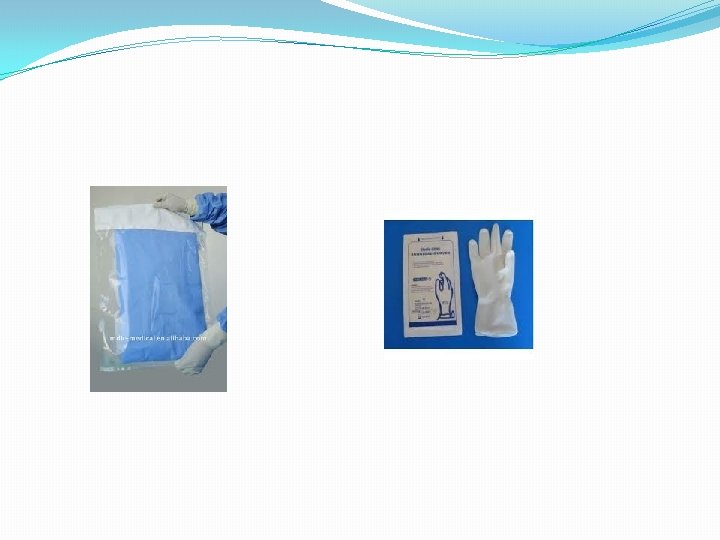
Radiation � 02 types of radiation are used. � 1) Ionising radiation �: gamma, x-rays, and cosmic rays. � High penetrating power, damage DNA of cells. �Uses: gamma radiation – �disposable items like plastic syringes, swabs, culture plates, cannulas, catheters etc. �(method cold sterlisation. ) �Advantage: speed, high penetrating power, absence of heat.
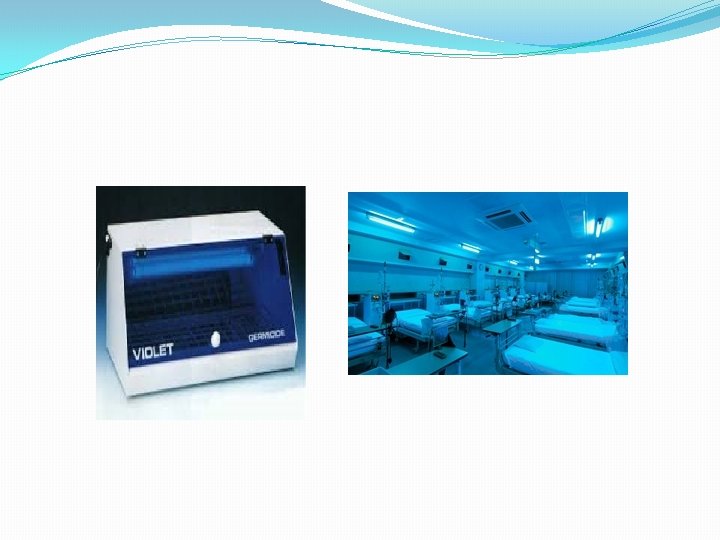
� 2) Non ionising radiation – � UV rays and infrared rays. �Infrared – rapid mass sterlisation of syringes & catheters. �UV�Uses-enclosed areas like bacteriological labs, �inoculation hoods �laminar flow �O. Ts
� 2) Non ionising radiation – � UV rays and infrared rays. �Infrared – rapid mass sterlisation of syringes & catheters. �UV�Uses-enclosed areas like bacteriological labs, �inoculation hoods �laminar flow �O. Ts
CSSD- Central sterile supply dept �It is integrated place in hospitals and other health care facilities that performs sterilization and other actions on medical devices equipments like surgical tools, syringes, linen, catheters, tubes, lab equipments, dental materials etc �To be delivered to Ots, wards, ICUs �Maintain detail records of cleaning, disinfection, sterilization �Follows Hosp. . control policies �To prevent Hospital infection
� THANK YOU