
Sterilization Disinfection Chemical Agents Hugh B Fackrell chemster
Sterilization & Disinfection Chemical Agents Hugh B. Fackrell chemster. ppt
2 Sterilization & Disinfection 4 Definitions 4 Bacterial Cell Death 4 General characteristics 4 Types of Chemical Agents 4 Comparisons 12/3/2020
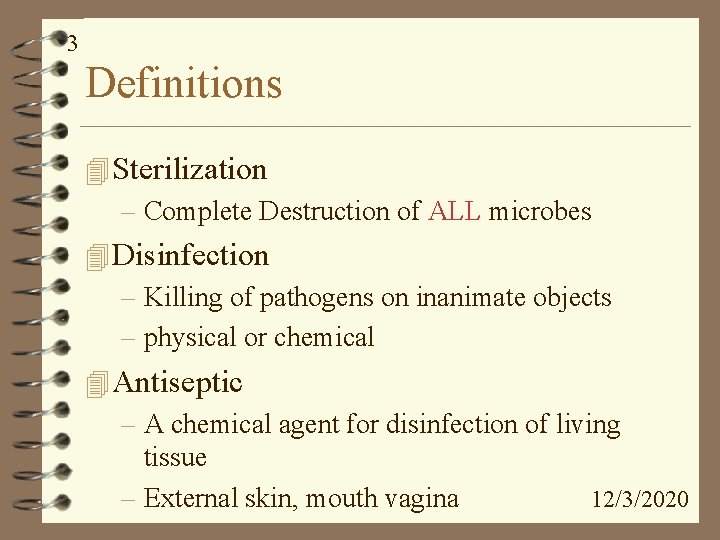
3 Definitions 4 Sterilization – Complete Destruction of ALL microbes 4 Disinfection – Killing of pathogens on inanimate objects – physical or chemical 4 Antiseptic – A chemical agent for disinfection of living tissue 12/3/2020 – External skin, mouth vagina
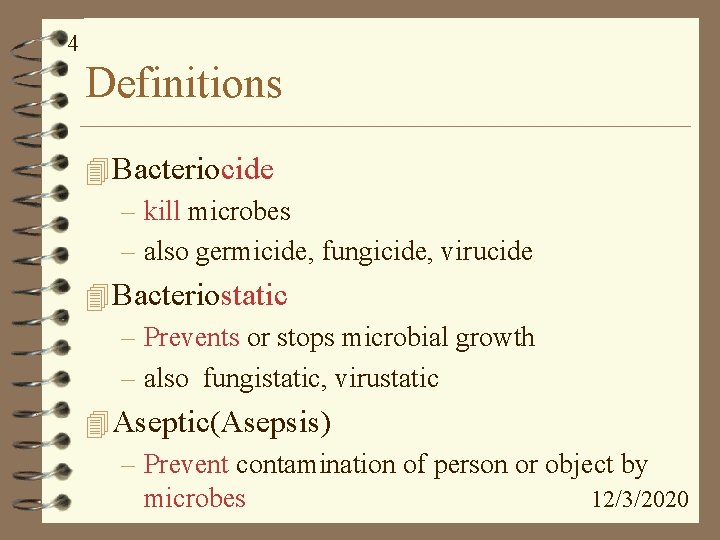
4 Definitions 4 Bacteriocide – kill microbes – also germicide, fungicide, virucide 4 Bacteriostatic – Prevents or stops microbial growth – also fungistatic, virustatic 4 Aseptic(Asepsis) – Prevent contamination of person or object by 12/3/2020 microbes
5 Definitions 4 Sanitize – Removal of pathogens from inanimate objects – Mechanical or chemical cleaning – need not sterilize of disinfect 4 Contamination – Presence of living microbes on object 12/3/2020
6 Definitions 4 Infection – Presence of living multiplying microbes in host tissues – often pathogenic 4 Preservation – Prevention of spoilage – Control of Contamination – Bacteriostatic 12/3/2020

7 Bacterial Cell Death Survivors (log) 5 4 1 log decrease = 90% kill 1 log Death rate (D) varies with bacteriocide 3 2 1 0 D Time (min) Time(min) to kill 90% 12/3/2020
8 Chemical agents 4 Wide variety in susceptibility 4 Growing cells more susceptible than resting cells or spores 4 Gram +ve more susceptible than Gram -ve 4 Mycobacterium (TB) more resistant 4 Hepatitis virus very resistant 12/3/2020
9 General Rule for Disinfection 4 Clean then disinfect – organic matter inactivates many chemicals 4 Use at recommended strength – Undiluted NOT always best – 70% alcohol better than 100% alcohol 4 Prevent contamination of disinfectant 4 Prepare fresh – deterioration after prolonged storage 12/3/2020
10 Types of Chemical Agents 4 Phenols 4 Halogens 4 Metal ions 4 Alcohols 4 Detergents 4 Alkylating agents 4 Ethylene Oxide 4 Hydrogen peroxide 12/3/2020
11 When in doubt about efficiency of a disinfectant Get a laboratory test 12/3/2020
12 Phenols 4 Mechanism of action – Rupture the cell membrane – Denature enzymes (protein) 4 Effective in presence of organic matter – blood, pus, feces, vomitus 4 Good environmental disinfectants 12/3/2020
13 Phenols (examples) 4 Phenol – corrosive to skin – smell – 1% effective disinfectant 12/3/2020
14 Cresols – Methyl phenol – Phenyl-phenol (“Lysol”) 12/3/2020
15 Chlorinated phenols 4 Hexachlorophene – Effective against Gm +ve – absorbed through skin – Toxic to infants if used often 4 Pentachlorophenol – more toxic than above 12/3/2020
16 Halogens 4 Cholorine 4 Iodine 12/3/2020
17 Iodine 4 Applications – Skin antiseptic – Environmental disinfectant 4 Mode of Action – Iodination of Tyrosine 12/3/2020
18 Iodine (cont) 4 Prepare fresh – Dark brown - active – Straw Yellow - inactive 4 Clean area first – organic matter reduces activity 12/3/2020
19 Iodine Formulations 4 Tincture iodine I 2 in ethanol 4 Aqueous iodine I 2 in Na. I/KI 4 Iodophors (organic) – I 2 in nonionic detergent • Wesocdyne – Generally 75 ppm – Mycobacterium 450 ppm – Iodoform • I 2 chemically combined 12/3/2020
20 Chlorine 4 Bacteriocide, fungicidal, virucidal – 2 -10 ppm 4 Applications – disinfection of water, sewage etc 4 Mode of Action – Oxidizes proteins 4 Features – corrosive – smells 12/3/2020
21 Chlorine /formulations 4 Chlorine gas – Poisonous – forms HOCl (hypochlorous acid) in water 4 Applications – water supplies – swimming pools – sewage effluent 4 Inorganic chlorine – Bleach Na. OCl – hypochlorite Ca(0 Cl)2 – chloramine 4 effective against – Hepatitis – HIV 12/3/2020
22 Metal Ions 4 Silver – 1% Ag. NO 3 eye drops – gonnorrheal neaonatal opthalmitis 4 Mercury – Hg Cl 2 Skin antiseptic – Mercurochrome 4 Copper, zinc – fungicide, algacide – pressure treated wood 12/3/2020
23 Alcohols 4 Ethanol – 70 -75% in water best – absolute less effective 4 Isopropanol – kills Mycobacterium “Tincture of … “ alcohol used as the solvent for other ingredient 12/3/2020
24 Detergents 4 Sanitize – soaps – neutral detergents 4 Disinfect – Anionic detergents – Cationic detergents DO NOT MIX 4 More effective with phenol 4 Surface active 12/3/2020
25 Anionic Detergents 4 -ve charge 4 salts of long chain alkyl or aryl sulphonates 12/3/2020
26 Cationic Detergents 4 + ve charge 4 non toxic Not effective for Pseudomonas 4 inactivated by proteins – eg cotton fibres 4 effective at low concentrations 4 Quaternary ammonium compounds – Benzalkonium chloride – eg “Zephiran” 12/3/2020
27 Chlorohexidine 4 “Hibitane” – 4% gluconate 4 Emulsion used as a scrub 4 Topical application for minor skin infections – inefficient at high concentrations 4 Mode of action – cell membrane – denatures protein – not affected by organic matter 12/3/2020
28 Alkylating Agents 4 Cross link proteins, nucleic acids – -NH 2, -OH, -SH, -COOH 4 Formaldehyde 4 Glutaraldehyde 4 Beta-priopiolactone 4 Ethylene oxide 12/3/2020
29 Formaldehyde 4 HCHO 4 Toxic 4 Irritant 4 Gas - fumigant 4 Solutions- protein vaccines – tetanus diptheria 12/3/2020
30 Glutaraldehyde 4 2% glutaraldehyde p. H 8 4 Exposure time – 5 min bactericidal – 10 min kills Mycobacterium, Heptatitis virus – 10 hr sterilizes 4 Applications – Lensed instruments, tubing, scalpels, inhalators 12/3/2020
31 Beta-propiolactone 4 Carcinogenic 4 Unstable – degrades but leaves no residue 4 Applications- sera, vaccines 12/3/2020
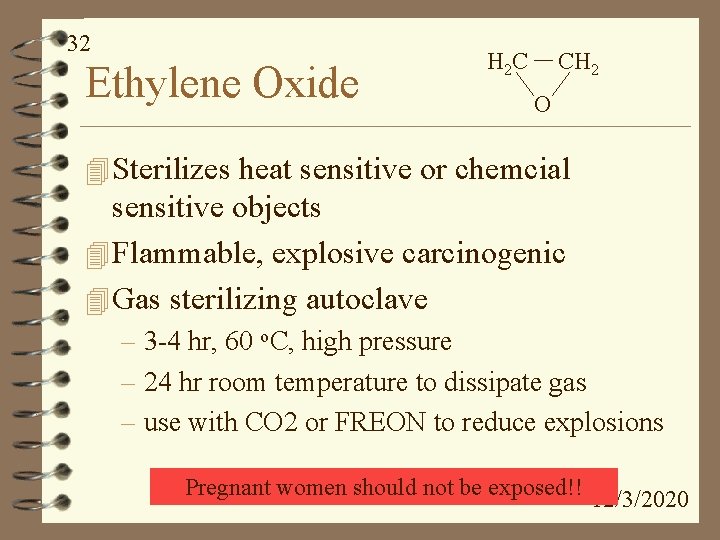
32 Ethylene Oxide H 2 C CH 2 O 4 Sterilizes heat sensitive or chemcial sensitive objects 4 Flammable, explosive carcinogenic 4 Gas sterilizing autoclave – 3 -4 hr, 60 o. C, high pressure – 24 hr room temperature to dissipate gas – use with CO 2 or FREON to reduce explosions Pregnant women should not be exposed!! 12/3/2020
33 Hydrogen Peroxide 4 Oxidizing agent 4 Disinfectant -6% – Bactericidal – Fungicidal – Virucidal 4 Prepare fresh 12/3/2020
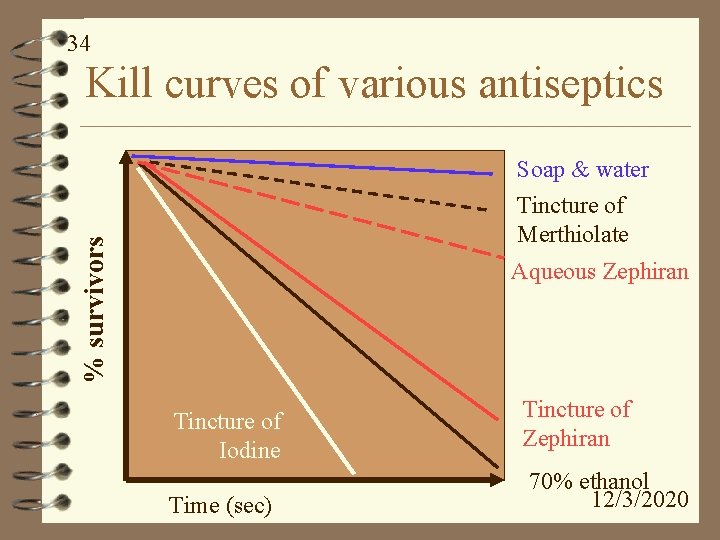
34 Kill curves of various antiseptics % survivors Soap & water Tincture of Merthiolate Aqueous Zephiran Tincture of Iodine Tincture of Zephiran Time (sec) 70% ethanol 12/3/2020
- Slides: 34