
STEREOSCOPE History Types Uses in Agriculture STEREOSCOPE A
- Slides: 23
STEREOSCOPE History, Types, Uses in Agriculture
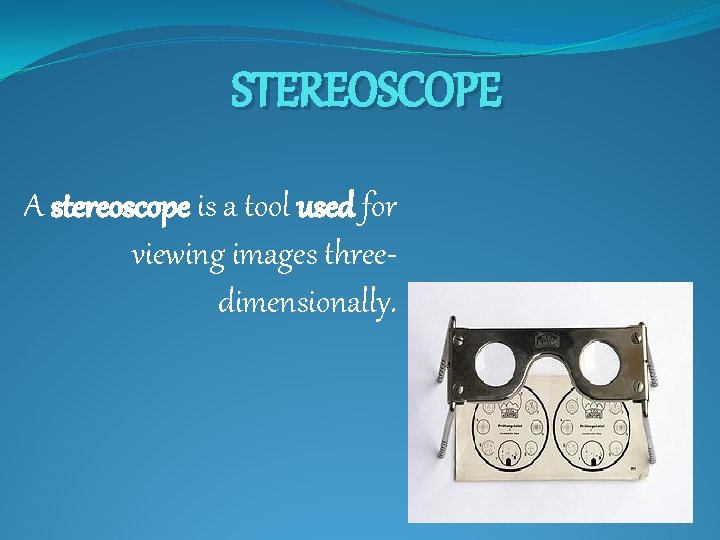
STEREOSCOPE A stereoscope is a tool used for viewing images threedimensionally.
history of stereoscope: �. The word stereoscopy derives from Greek word (stereos), meaning 'firm, solid', and (skopeō), meaning 'to look, to see � Any stereoscopic image is called a stereogram. Originally, stereogram referred to a pair of stereo images which could be viewed using a stereoscope
Stereoscopes, also known as stereopticons or stereo viewers, were one of America's most popular forms of entertainment in the late 1800 s and early 1900 s. The first patented stereoscope was invented by Sir Charles Wheatstone in 1838.
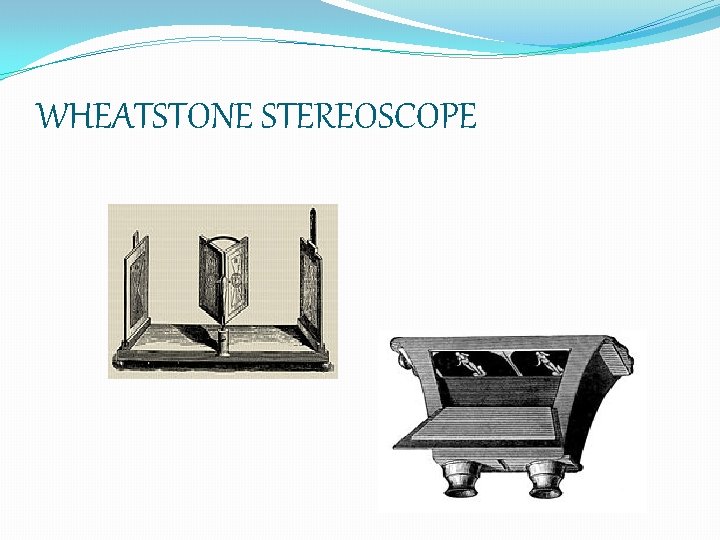
�Wheatstone had experimented with simple stereoscopic drawings in 1832, several years before photography was invented. Later, the two principles were combined to form the stereoscope. �However, Wheatstone's stereoscope was not as popular as a later version, made by Oliver Wendell Holmes Called the Holmes Stereo Viewer, it was the most common type of stereoscope from 1881 until 1939.
WHEATSTONE STEREOSCOPE
HOW IT WORKS? �A stereoscope is composed of two pictures mounted next to each other, and a set of lenses to view the pictures through. Each picture is taken from a slightly different viewpoint that corresponds closely to the spacing of the eyes.
�The left picture represents what the left eye would see, and likewise for the right picture. When observing the pictures through a special viewer, the pair of twodimensional pictures merge together into a single three-dimensional photograph
�We can see a 3 D picture through a stereoscope for the same reason a building appears threedimensional. The right and left eyes see a slightly different version of the same scene, and taken together, we get an illusion of depth. This phenomenon had been known for quite some time, ever since the ancient Greek mathematician Euclid discovered the principles of binocular vision.
�. It is believed that approximately 12% of people are unable to properly see 3 D images, due to a variety of medical conditions. According to another experiment up to 30% of people have very weak stereoscopic vision preventing them from depth perception based on stereo disparity. This nullifies or greatly decreases immersion effects of stereo to them.
�Early stereo photographs were taken with a camera mounted on a tripod with a sliding bar. Once the first picture was taken and a new photographic plate was inserted, the camera was moved about 7 cm along the bar (approximately adult eye spacing). Then, the second picture was taken.
�Stereoscopes continued to be widespread in America until the 1930 s. Then stereoscope production declined, likely due to the new interest in motion pictures. However, the stereoscope continues to offer viewers something that no ordinaryphotograph or movie can offer
�Visual requirements �Anatomically, there are 3 levels of binocular vision required to view stereo images: �Simultaneous perception �Fusion (binocular 'single' vision) �Stereopsis
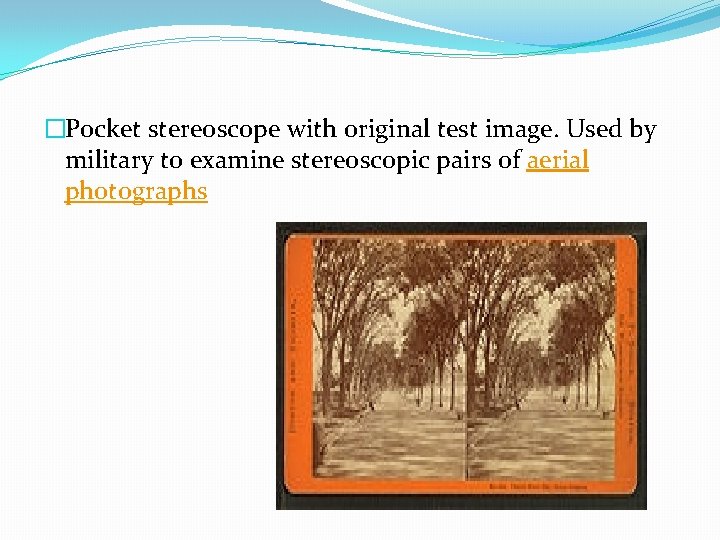
�Pocket stereoscope with original test image. Used by military to examine stereoscopic pairs of aerial photographs
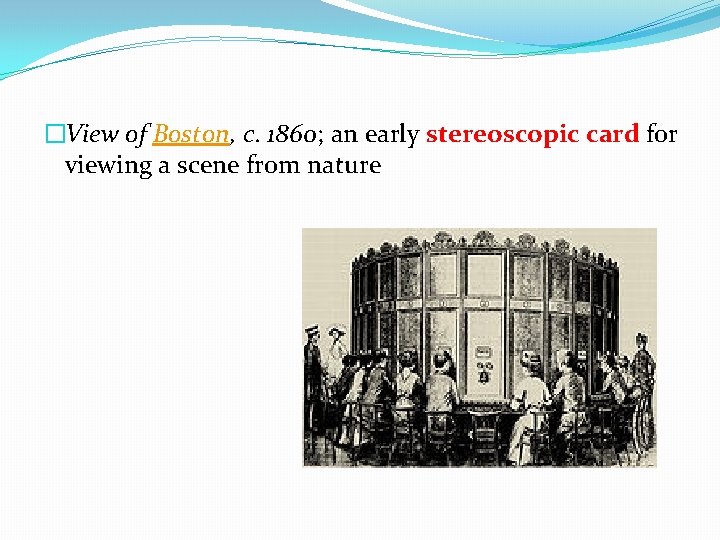
�View of Boston, c. 1860; an early stereoscopic card for viewing a scene from nature
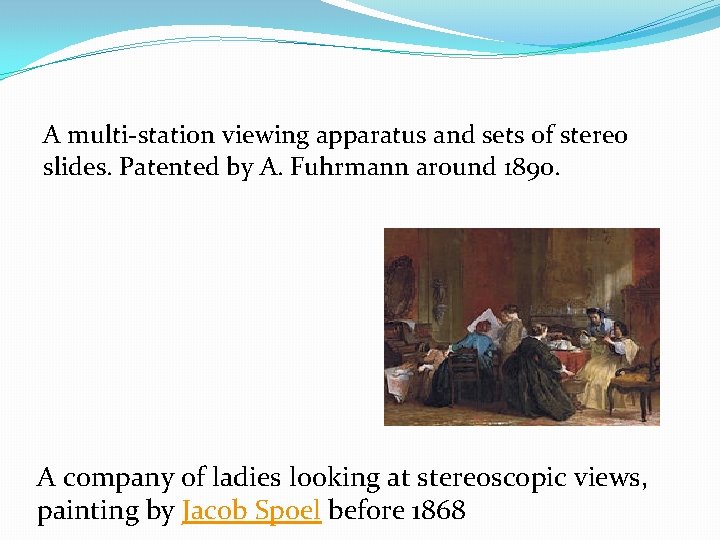
A multi-station viewing apparatus and sets of stereo slides. Patented by A. Fuhrmann around 1890. A company of ladies looking at stereoscopic views, painting by Jacob Spoel before 1868
Auto-stereogram �An auto-stereogram is a single-image stereogram (SIS), designed to create the visual illusion of a threedimensional (3 D) scene within the human brain from an external two-dimensional image. In order to perceive 3 D shapes in these auto-stereograms, one must overcome the normally automatic coordination between focusing and vergence
Integral imaging �Integral imaging is an autostereoscopic or multiscopic 3 D display, meaning that it displays a 3 D image without the use of special glasses on the part of the viewer. It achieves this by placing an array of microlenses (similar to a lenticular lens) in front of the image, where each lens looks different depending on viewing angle. Thus rather than displaying a 2 D image that looks the same from every direction, it reproduces a 4 D light field, creating stereo images that exhibit parallax when the viewer moves.
Wiggle stereoscopy is an image display technique achieved by quickly alternating display of left and right sides of a stereogram
Uses of stereoscope �A stereoscope is used in various fields, such as police work, education, archeology, biology, government services, health and medical research. �Clinical uses �Stereograms cards are frequently used by orthoptists and vision therapists in the treatment of many binocular vision and accommodative disorders. [33]
Mathematical, scientific and engineering uses �Cartographers generate today stereopairs using computer programs in order to visualise topography in three dimensions. Computerised stereo visualisation applies stereo matching programs. In biology and chemistry, complex molecular structures are often rendered in stereopairs.
�The same technique can also be applied to any mathematical (or scientific, or engineering) parameter that is a function of two variables, although in these cases it is more common for a three-dimensional effect to be created using a 'distorted' mesh or shading (as if from a distant light source).
USE IN SOIL SURVEY �Aerial photos serve as base maps , since they show the location of land features such as roads , rivers settelement , and even field boundaries. �Thus a surveyor can locate himself exactly on the ground when making observations.