
Stereochemistry 3 dimensional Aspects of Tetrahedral Atoms Chiral









- Slides: 59
Stereochemistry 3 -dimensional Aspects of Tetrahedral Atoms
Chiral • Entire molecules or simply atoms that do not possess a plane of symmetry are called “chiral”. • Conversely, the term “achiral” is applied to molecules or atoms that possess a plane of symmetry.
Chiral? • Is methane, CH 4, a chiral molecule? • What makes a molecule chiral? • The molecule cannot have a plane of symmetry
Answer: • No, methane has a plane of symmetry and therefore cannot be chiral.
Chiral? • Consider CH 3 X and ask yourself if this molecule is chiral…?
Answer: • No, CH 3 X has a plane of symmetry and therefore cannot be chiral
Chiral? • Consider CH 2 XY and ask yourself if this molecule is chiral…?
Answer: • No, CH 2 XY has a plane of symmetry and therefore cannot be chiral
Chiral? • Consider CHXYZ and ask yourself if this molecule contains a chiral center. • The carbon atom in this molecule has four different groups attached to it.
Answer: • CHXYZ does not have a plane of symmetry and therefore IS chiral
The Chiral Carbon Atom • Carbon atoms that are bonded to four different groups cannot contain a plane of symmetry. • These carbons are CHIRAL and may be called “chiral carbons”, “chiral centers”, “asymmetric centers”, “stereogenic centers” or simply “stereocenters”. • This leads to a “handedness” and we can consider both possible “hands”, or mirror images.
Check this one out… • How many chiral centers do you see? • None, this molecule has a plane of symmetry.
What about this one? • How many chiral centers do you see? • One chiral center – and this molecule is chiral overall because it does not have a plane of symmetry.
One more time… • How many chiral centers do you see? • Two chiral centers, but this molecule has a plane of symmetry so the molecule, overall, is not chiral.
Mirror Images of a Chiral Carbon These two molecules have the same number and kinds of atoms, and even the same order of connectivity, but their three-dimensional arrangement is that of mirror images.
Non-Superimposable? • Notice that when you attempt to lay one isomer on top of the other one, all four groups will not match up… • Non-superimposable!!
Stereoisomers • What is the definition of a stereoisomer? • Molecules that have the same number and kinds of atoms, and the same connectivity of these atoms, but have a different threedimensional arrangement.
Enantiomers • A specific type of stereoisomer • Enantiomers are stereoisomers that are mirror images that cannot be superimposed upon each other.
Assignment of Configurations • We use the convention “R” or “S” to differentiate between the two possible enantiomers.
To Assign R or S to the Configuration: Apply the Cahn-Ingold-Prelog Rules: Step 1: Determine what four atoms are attached to the chiral carbon in question. Step 2: Assign priorities to the four atoms based on their Atomic Numbers (the highest priority is #1, the lowest, #4).
An Example of Priority Assignment: • The highest atomic number corresponds to bromine (atomic number 35, #1), then oxygen (atomic number 8, #2), then carbon (atomic number 6, #3) and finally hydrogen (atomic number 1, #4).
Position the Molecule: Step 3: Rotate the molecule so the lowest priority faces away from you. Step 4: Determination of “R” or “S”…
The “R” Configuration: • If 1 2 3 is a clockwise rotation, you are viewing the R configuration.
The “S” Configuration: • If 1 2 3 is a counterclockwise rotation, you are viewing the S configuration.
What if two of the groups are very similar? • If a priority difference cannot be determined because two of the atoms on the chiral center are the same, then utilize the atoms connected to each of these, until a differentiation may be made.
An example with two similar groups: • Consider the chiral carbon atom shown. • Note how it has a methyl group (C with three H’s) and an ethyl group (C with two H’s and a C). The presence of the C atom determines the priority.
How does one assign priorities to functional groups that contain multiple bonds? • Consider the functional group with the multiple bond to be equivalent to the same number of single-bonded atoms. • An example would be the C=O bond. In this case, the carbon-oxygen double bond is equivalent to the carbon atom being bonded TWICE to the oxygen atom, and vice versa.
An example containing a multiple bond:
R or S? • Is the molecule shown the “R” or the “S” enantiomer? • Determine the priority assignments and assign the correct configuration
Answer: • After rotation of the molecule so the lowest priority is in the back, rotation of 1 2 3 shows that this chiral center is the “S” configuration.
The Relationship of Enantiomers • Enantiomers are non-superimposable mirror images. • For every “R” stereocenter in one isomer, the mirror image has an “S”, and vice versa. • A molecule with 5 stereocenters (ex. R, S, S, S, R) has an enantiomer whose stereocenters are the opposite (i. e. S, R, R, R, S).
Racemic Mixture: • A racemic mixture is a 50: 50 mixture of both enantiomers. • The process of physically separating the enantiomers of a racemic mixture is called “resolution”.
Characteristics of Enantiomers • Enantiomers have the same physical properties (ex. melting point, boiling point, density, solubility, refractive index, etc. ). • The only way to differentiate between two enantiomers is to measure the Optical Activity of each.
Optical Activity • Chiral molecules possess the ability to rotate “plane-polarized” light. • A solution of each enantiomer of a molecule will rotate the light the same magnitude but in opposite directions. This is the only way to physically differentiate between two enantiomers.
Determination of Specific Rotation: • Every solution concentration is different and so is every polarimeter, so we compare optical activity using the Specific Rotation. • The Specific Rotation, [ ]D, is the observed rotation, , caused by a solution of chiral molecules whose concentration (C) is 1 g/m. L with a cell path length (l) of 1 dm, which is the distance the light travels through the solution.
• The observed rotation, , has both a magnitude and a direction for rotation. • The magnitude is directly dependent upon the concentration and the cell path length. – Double the concentration, and you will double the magnitude. – Halve the cell path length and you will halve the magnitude.
• Direction of Rotation: – Rotation of light in a clockwise fashion is a dextrorotatory rotation, or rotation to the right, symbolized by “d” or (+). – Rotation of light in a counterclockwise fashion is a levorotatory rotation, or rotation to the left, symbolized by “l” or (-).
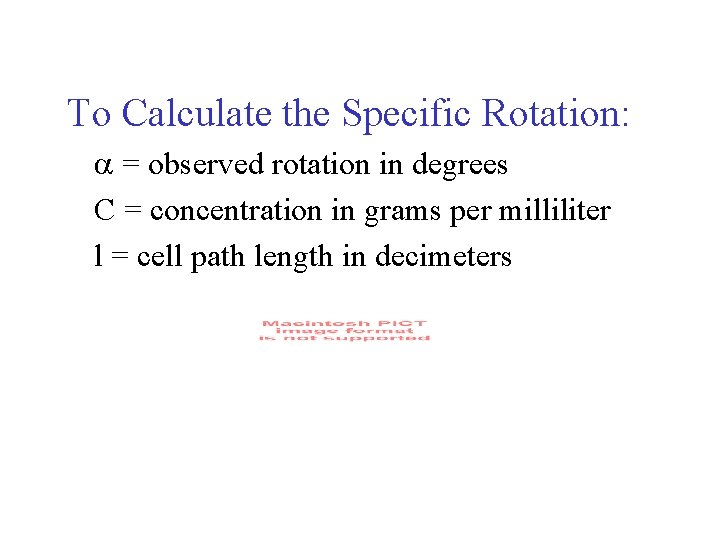
To Calculate the Specific Rotation: = observed rotation in degrees C = concentration in grams per milliliter l = cell path length in decimeters
Problem: • Calculate the specific rotation for a solution of Compound X, whose concentration (C) is 500 mg/m. L, in a polarimeter whose cell path length (l) is 10 cm, if the observed rotation ( ) is (+) 6. 50 º. • Answer: (+) 13. 0 º. Be sure to convert all units (g/m. L and dm) before calculating. You must include the direction of rotation.
Fischer Projections • A Fischer Projection is a two-dimensional representation of a three-dimensional carbon atom.
Conversion of 3 -D to 2 -D: • By convention, a Fischer Projection is always drawn in the same manner: the horizontal lines represent bonds coming towards you and the vertical lines are bonds going away from you. • Everyone views structures in 3 -dimensions slightly differently and very often from a different perspective. There are several correct Fischer Projections for any single chiral center.
“Flatten” the Chiral Center: • Try “flattening” your chiral centers the same way each time, to prevent careless errors. The example shown here positions the view point between A and B. Note where C and D wind up as a result.
Consider this Molecule: • Draw the 3 -dimension chiral center as a Fischer Projection.
• Remember that everyone sees objects in 3 dimensions differently. If your answer looks different, it may just be a different perspective.
Compare two Fischer Projections: • Fischer Projections can be manipulated to to determine if the molecules you are viewing are the same or enantiomers.
“Legal” Movements? • Fischer Projections must maintain the convention that horizontal lines are bonds coming AT you and the vertical lines are bonds going AWAY from you. – Fischer Projections may be rotated 180 degrees in either direction, but never 90 nor 270 degrees. – Fischer Projections may also be turned by holding one group constant and rotating the remaining three groups, in either direction.
Examples:
Same or Enantiomers? • When comparing Fischer Projections, the goal is to match two of the groups and see what happens with the remaining two. • If the remaining two match, they are the same molecule. • If the remaining two do not match, they are mirror images (enantiomers).
Manipulate and Match? • Always leave one molecule untouched and manipulate the other. • You can see, after rotation, these are the same molecule.
Determination of R or S using a Fischer Projection: • Assign Priorities as before. • Rotate so the lowest priority is at top or bottom. • Determine direction of rotation 1 2 3 (clockwise is R, counterclockwise is S).
Multiple-Centered Fischer Projections? • Fischer Projections were developed to deal with systems with multiple chiral centers. • Remember the same molecules will always match completely and enantiomers will always be mirror images.
Molecules with more than one chiral center: • For a molecule with “n” chiral centers, there a total of 2 n possible stereoisomers that one can draw. • Consider a molecule with 4 chiral centers. How many possible stereoisomers are there? • 24 = 16 possible stereoisomers
Consider a Molecule with Two Stereocenters: • Shown below are the four possible stereoisomers for 2 -bromo-3 -chlorobutane.
What’s the Relationship? • The stereoisomers shown here a set of enantiomers, the S, R and the R, S isomers. • The other set of stereoisomers, the S, S and the R, R isomers, are also enantiomers.
But, What About…? ? • What’s the relationship between the S, R isomer and the R, R isomer? • Part of the molecule is a mirror image and the other part is the same. • These stereoisomers are called “diastereomers”
Diastereomers • Another specific type of stereoisomer • Diastereomers are stereoisomers with two or more chiral centeres that are not entirely mirror images nor entirely the same. • The physical properties vary widely from one diastereomer to another. There is no predictable physical relationship between diastereomers, not even optical activity.
Meso Compound • A specific type of diastereomer • Meso compounds are stereoisomers with two or more chiral centers that also contain a plane of symmetry.
An Example of a Meso Compound • 2, 3 -butanediol is an example of a meso compound. • These two are exactly the same!! • Because meso compounds have a plane of symmetry, they cannot be optically active.
• This ends your review of stereochemistry and the major subjects that you should understand: – This list includes the concepts of: chiral, stereocenter, enantiomer, racemic mixture, optical activity, specific rotation, diastereomers, and meso compounds. – Assignment for R or S can be made for either a chiral carbon atom or a Fischer Projection. – Fischer Projections can be manipulated to compare relationships of molecules (same, enantiomers or diastereomers). – Calculations for Specific Rotation