
Stepwise Approach to Building Sustainable Models of Interprofessional
Stepwise Approach to Building Sustainable Models of Interprofessional Education and Collaborative Care in Ambulatory Community Settings Gina Rowe, Ph. D, DNP, MPH, APRN, BC, PHCNS BC, CNE Assistant Professor and Family Nurse Practitioner Coordinator, DNP/FNP Program at Shady Grove University of Maryland School of Nursing Heather Brennan Congdon, Pharm. D, BCPS, CDE, FNAP Assistant Dean for Shady Grove, University of Maryland School of Pharmacy Co Director, University of Maryland, Baltimore Center for Interprofessional Education
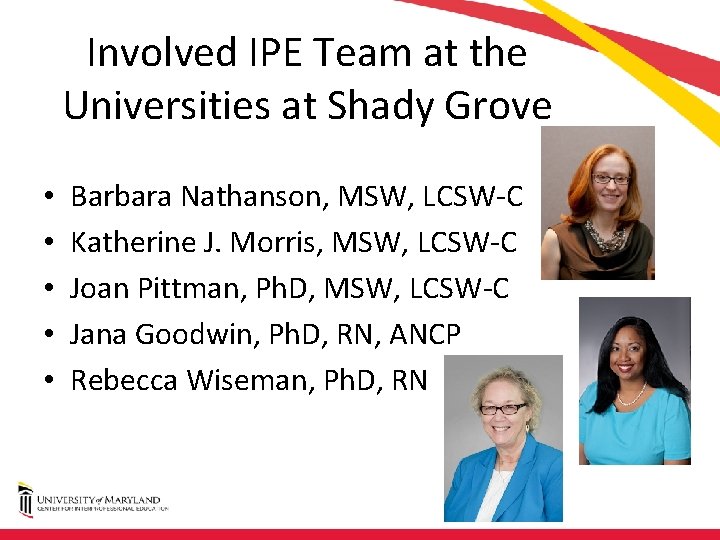
Involved IPE Team at the Universities at Shady Grove • • • Barbara Nathanson, MSW, LCSW C Katherine J. Morris, MSW, LCSW C Joan Pittman, Ph. D, MSW, LCSW C Jana Goodwin, Ph. D, RN, ANCP Rebecca Wiseman, Ph. D, RN
Objectives • Interprofessional Education (IPE) – Definitions – Rationale/drivers • Stepwise Progression in Montgomery County – Mercy Health Clinic – Holy Cross Hospital Outpatient Clinics – National Center Training and Future Progression
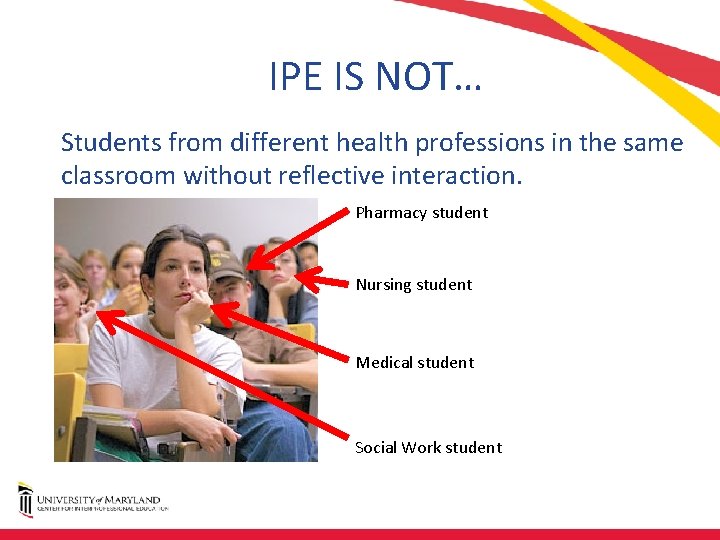
IPE IS NOT… Students from different health professions in the same classroom without reflective interaction. Pharmacy student Nursing student Medical student Social Work student
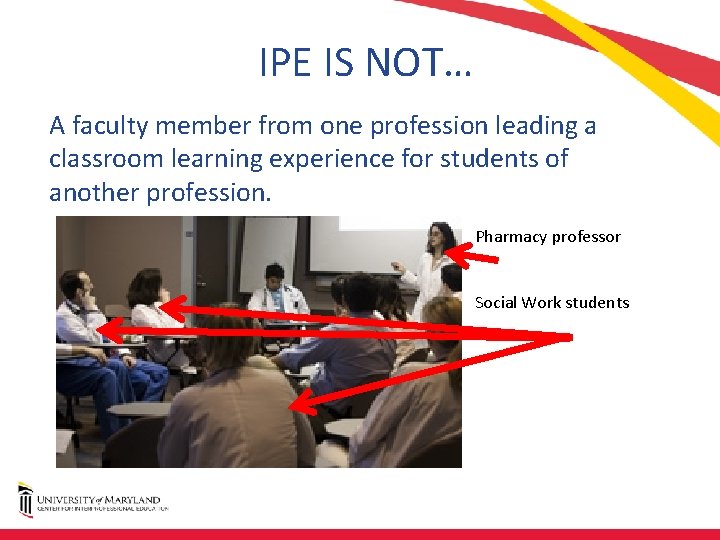
IPE IS NOT… A faculty member from one profession leading a classroom learning experience for students of another profession. Pharmacy professor Social Work students
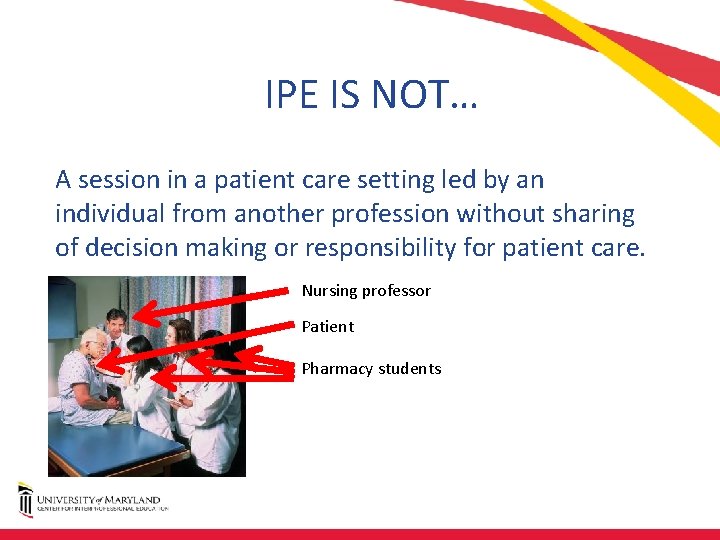
IPE IS NOT… A session in a patient care setting led by an individual from another profession without sharing of decision making or responsibility for patient care. Nursing professor Patient Pharmacy students
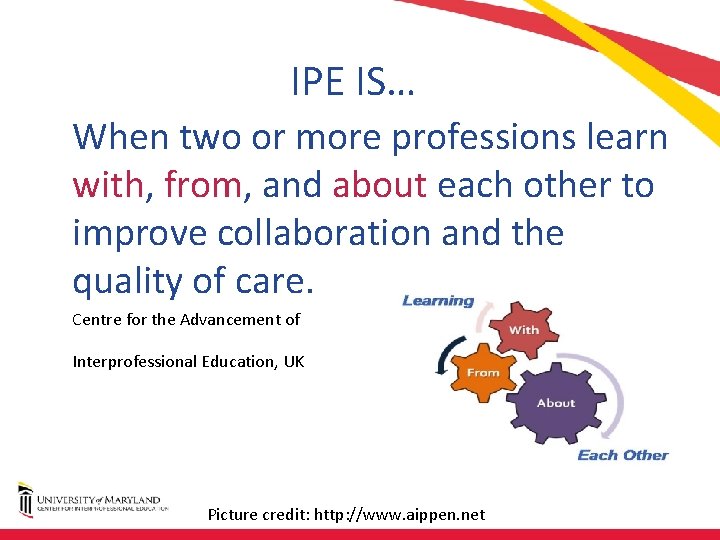
IPE IS… When two or more professions learn with, from, and about each other to improve collaboration and the quality of care. Centre for the Advancement of Interprofessional Education, UK Picture credit: http: //www. aippen. net
IPE IS… Educators and learners from two or more health professions and their foundational disciplines who jointly create and foster a collaborative learning environment. 2005 2006 AACP COF Interprofessional Education Task Force
What Drives Interest in IPE? • Health professionals expected to work in teams – But students rarely taught how to do so in school • Potential to influence healthcare quality, costs, and outcomes • Reeves, S. , et al. (2016). BEME systematic review of the effects of interprofessional education • Bradley, E. H. and Taylor, L. A. (2013). The American health care paradox: Why spending more Is getting us less. New York, NY: Public Affairs.
Organizational Interest in IPE Healthcare Environment • Institute of Medicine reports • To Err is Human, 1999 • Institute of Healthcare Improvement • Triple Aim Initiative, 2007 • National Legislation • Affordable Care Act, 2010 • Medicare Access and CHIP Reauthorization Act (MACRA), 2015 • Accreditation Standards • Competencies • IPEC Core Competencies • NACE Competencies Nursing • American Association of Colleges of Nursing – Essentials of Baccalaureate (2008), Masters (2011) and Doctoral (2006) Education • Quality and Safety Education for Nurses – Entry-level and Graduate Competencies, 2007, 2012 • Professional Competencies, e. g. , National Organization of Nurse Practitioner Faculty – NP Core Competencies, 2012, 2017 • Institute of Medicine – The Future of Nursing: Leading Change, Advancing Health, 2010

Nursing and Interprofessional Education Collaborative (IPEC) Essentials and Competencies Nursing Competencies • AACN Essentials – Quality improvement and safety – Inter professional communication/collaboration • QSEN – Teamwork and collaboration – Safety • NONPF Competencies – Collaboration and coordination – Ethics IPEC Competencies • • Values and Ethics Roles/Responsibilities Interprofessional Communication Teams and Teamwork
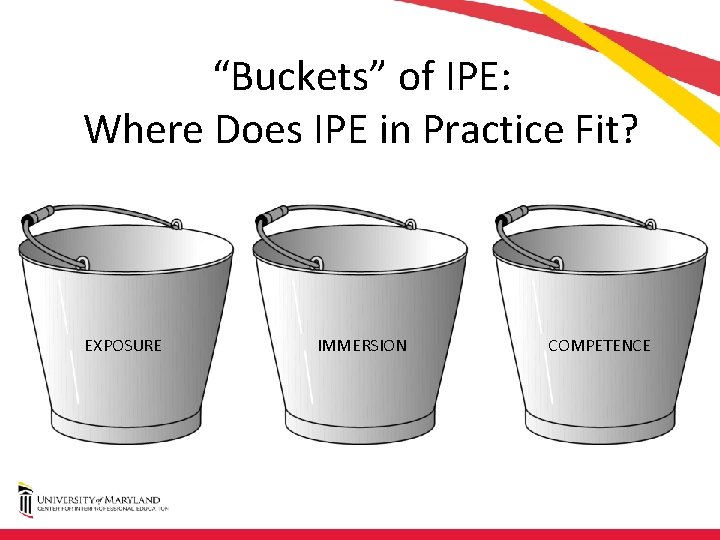
“Buckets” of IPE: Where Does IPE in Practice Fit? EXPOSURE IMMERSION COMPETENCE
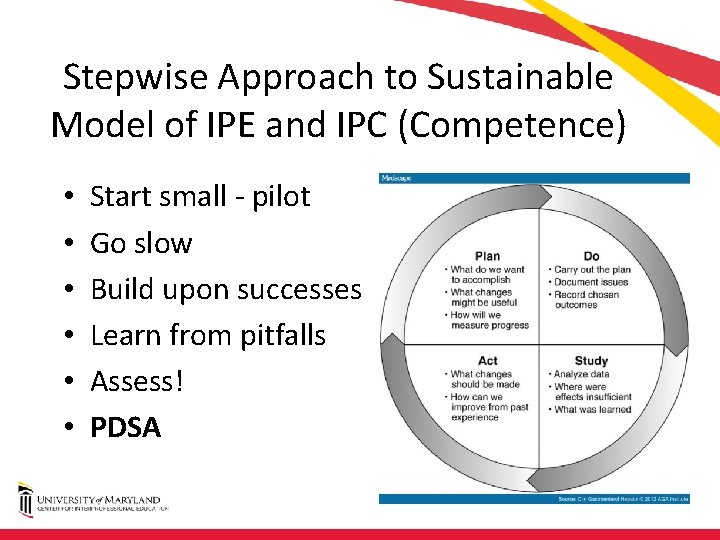
Stepwise Approach to Sustainable Model of IPE and IPC (Competence) • • • Start small pilot Go slow Build upon successes Learn from pitfalls Assess! PDSA
Mercy Health Clinic • One of 12 safety net clinics in the Montgomery Care program of the Primary Care Coalition of Montgomery County • Serves low income, uninsured patients • Provides a variety of services – Primary preventative care – Diagnosis and treatment of general acute and chronic medical problems – Management of chronic medication conditions – Referrals for consultation
Goals of IPE Clinic at MHC • To enhance and expand care for medically complex, uninsured, ethnically diverse patients through coordinated interprofessional care. • To educate and train healthcare professional students from pharmacy, nursing, and social work programs at the University of Maryland, Baltimore (UMB) and the University of Maryland, Baltimore County (UMBC) to efficiently and effectively provide coordinated care through mastery of the Interprofessional Education Collaborative (IPEC) Core Competencies for Interprofessional Practice.
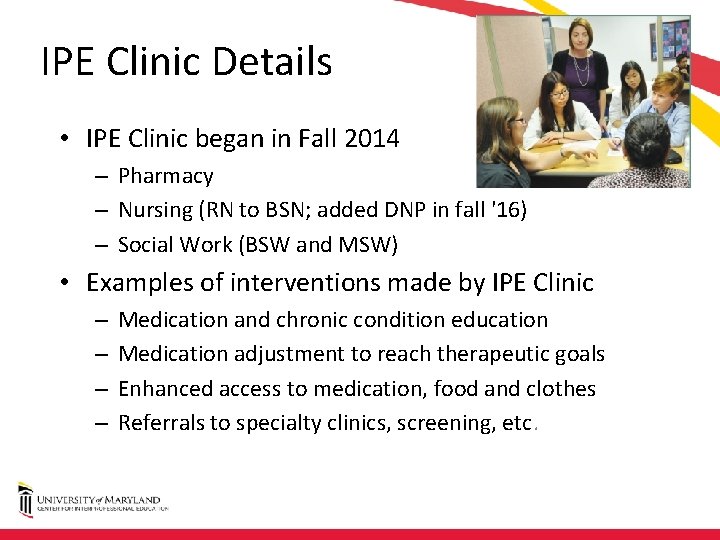
IPE Clinic Details • IPE Clinic began in Fall 2014 – Pharmacy – Nursing (RN to BSN; added DNP in fall '16) – Social Work (BSW and MSW) • Examples of interventions made by IPE Clinic – – Medication and chronic condition education Medication adjustment to reach therapeutic goals Enhanced access to medication, food and clothes Referrals to specialty clinics, screening, etc.
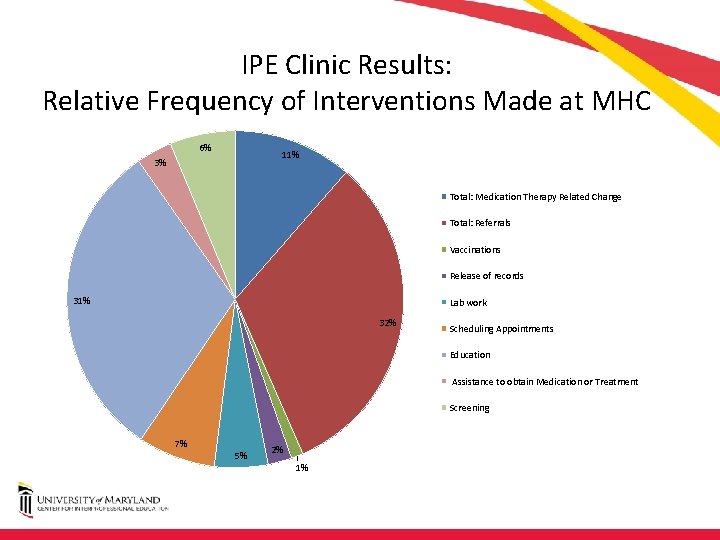
IPE Clinic Results: Relative Frequency of Interventions Made at MHC 6% 11% 3% Total: Medication Therapy Related Change Total: Referrals Vaccinations Release of records 31% Lab work 32% Scheduling Appointments Education Assistance to obtain Medication or Treatment Screening 7% 5% 2% 1%
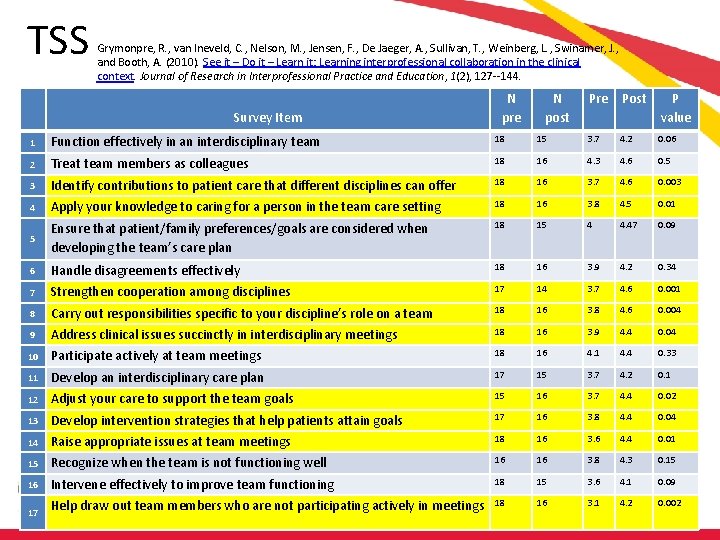
TSS Grymonpre, R. , van Ineveld, C. , Nelson, M. , Jensen, F. , De Jaeger, A. , Sullivan, T. , Weinberg, L. , Swinamer, J. , and Booth, A. (2010). See it – Do it – Learn it: Learning interprofessional collaboration in the clinical context. Journal of Research in Interprofessional Practice and Education, 1(2), 127 144. Survey Item N pre N post Pre Post P value 1 Function effectively in an interdisciplinary team 18 15 3. 7 4. 2 0. 06 2 Treat team members as colleagues 18 16 4. 3 4. 6 0. 5 3 Identify contributions to patient care that different disciplines can offer 18 16 3. 7 4. 6 0. 003 4 Apply your knowledge to caring for a person in the team care setting 18 16 3. 8 4. 5 0. 01 Ensure that patient/family preferences/goals are considered when developing the team’s care plan 18 15 4 4. 47 0. 09 5 6 Handle disagreements effectively 18 16 3. 9 4. 2 0. 34 7 Strengthen cooperation among disciplines 17 14 3. 7 4. 6 0. 001 8 Carry out responsibilities specific to your discipline’s role on a team 18 16 3. 8 4. 6 0. 004 9 Address clinical issues succinctly in interdisciplinary meetings 18 16 3. 9 4. 4 0. 04 10 Participate actively at team meetings 18 16 4. 1 4. 4 0. 33 11 Develop an interdisciplinary care plan 17 15 3. 7 4. 2 0. 1 12 Adjust your care to support the team goals 15 16 3. 7 4. 4 0. 02 13 Develop intervention strategies that help patients attain goals 17 16 3. 8 4. 4 0. 04 14 Raise appropriate issues at team meetings 18 16 3. 6 4. 4 0. 01 15 Recognize when the team is not functioning well 16 16 3. 8 4. 3 0. 15 16 Intervene effectively to improve team functioning 18 15 3. 6 4. 1 0. 09 17 Help draw out team members who are not participating actively in meetings 18 16 3. 1 4. 2 0. 002
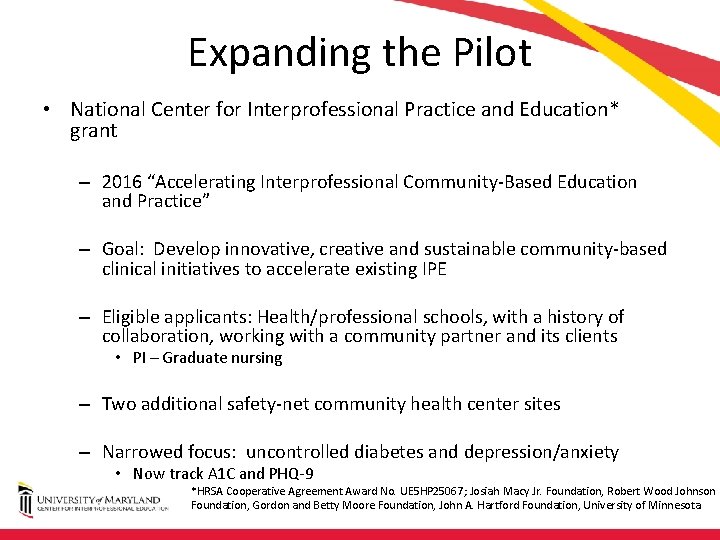
Expanding the Pilot • National Center for Interprofessional Practice and Education* grant – 2016 “Accelerating Interprofessional Community Based Education and Practice” – Goal: Develop innovative, creative and sustainable community based clinical initiatives to accelerate existing IPE – Eligible applicants: Health/professional schools, with a history of collaboration, working with a community partner and its clients • PI – Graduate nursing – Two additional safety net community health center sites – Narrowed focus: uncontrolled diabetes and depression/anxiety • Now track A 1 C and PHQ 9 *HRSA Cooperative Agreement Award No. UE 5 HP 25067; Josiah Macy Jr. Foundation, Robert Wood Johnson Foundation, Gordon and Betty Moore Foundation, John A. Hartford Foundation, University of Minnesota
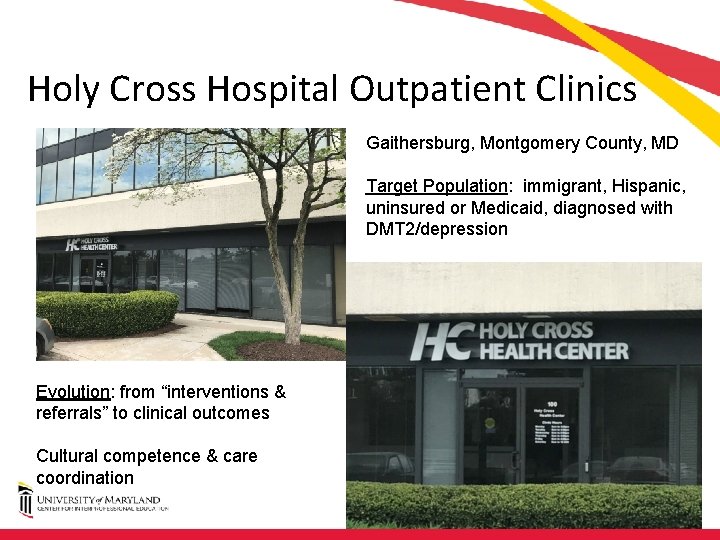
Holy Cross Hospital Outpatient Clinics Gaithersburg, Montgomery County, MD Target Population: immigrant, Hispanic, uninsured or Medicaid, diagnosed with DMT 2/depression Evolution: from “interventions & referrals” to clinical outcomes Cultural competence & care coordination
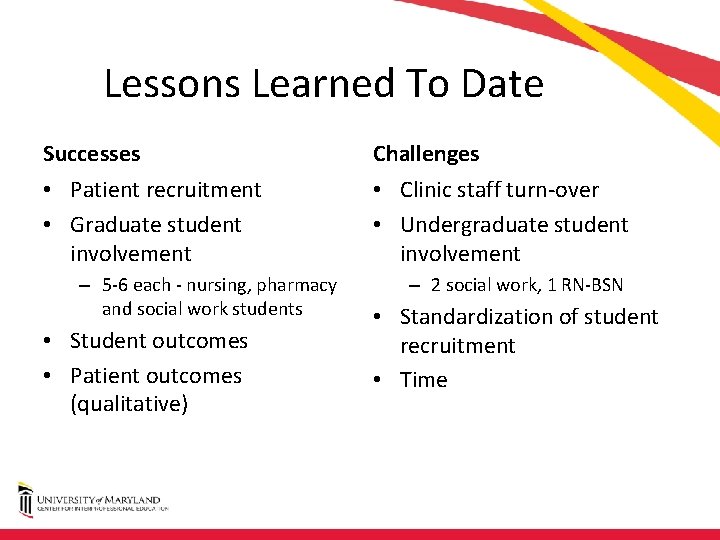
Lessons Learned To Date Successes Challenges • Patient recruitment • Graduate student involvement • Clinic staff turn over • Undergraduate student involvement – 5 6 each nursing, pharmacy and social work students • Student outcomes • Patient outcomes (qualitative) – 2 social work, 1 RN BSN • Standardization of student recruitment • Time
Looking to the Future • Expansion to 3 rd health center in Fall, 2017. • Larger external grants to support IPE and IPC. • Expand to additional safety net community health clinics in Montgomery County. • Train clinical preceptors to replicate IPE Clinics. – National Center for IPE: Interprofessional Learning IN Practice for Preceptors and Site Development
Select References • American Association of Colleges of Nursing. (2011). The essentials of baccalaureate education for professional nursing practice. From: http: //www. aacn. nche. edu/education resources/Bacc. Essentials 08. pdf • American Association of Colleges of Nursing. (2006). The essentials of doctoral education for advanced nursing practice. From: http: //www. aacn. nche. edu/publications/position/DNPEssentials. pdf • American Association of Colleges of Nursing. (2011). The essentials of masters education in nursing. From: http: //www. aacn. nche. edu/education resources/Masters. Essentials 11. pdf • Bradley, E. H. and Taylor, L. A. (2013). The American health care paradox: Why spending more Is getting us less. New York, NY: Public Affairs. • Commonwealth Fund. (2015). U. S. healthcare from a global perspective. (2015). From: http: //www. commonwealthfund. org/publications/issue briefs/2015/oct/us health care from a global perspective • Institute for Healthcare Improvement. (2017). The IHI Triple Aim Initiative. From: http: //www. ihi. org/engage/initiatives/Triple. Aim/Pages/default. aspx • Institute of Medicine. (2010). The Future of Nursing: Leading Change, Advancing Health. From: http: //nationalacademies. org/hmd/reports/2010/the future of nursing leading change advancing health. aspx • Interprofessional Education Collaborative. (2016). Core competencies for interprofessional collaborative practice: 2016 Update. From: http: //www. aacn. nche. edu/education resources/IPEC 2016 Updated Core Competencies Report. pdf • National Organization of Nurse Practitioner Faculties. (2012). Nurse practitioner core competencies. From: http: //www. nonpf. org/? page=14 • QSEN Institute. (2007, 2012). QSEN competencies. From: http: //qsen. org/ • Reeves, S. , et al. (2016). A BEME systematic review of the effects of interprofessional education: BEME guide no. 39. Medical Teacher, 38(7), 656 -668.

Questions? Heather Congdon –hcongdon@rx. umaryland. edu Gina Rowe – rowe@son. umaryland. edu
- Slides: 24