
StepUp Building Respectful Families Violence Risk Safety Assessment
Step-Up: Building Respectful Families
Violence Risk / Safety Assessment SAFETY PLANNING W/ PARENTS AND YOUTH
Assessment of Violence and Safety Concerns Separate parent / teen interviews Parents interviewed separately Behavior check-list Violence Risk and Safety Assessment

Adolescent Family Violence Risk and Safety Assessment Parent/Caretaker Name ___________ Youth Name _____________ Date _____ Please describe the incident that led to your family coming to us. Have you called the police before? How many times? What was the outcome? (Arrest, detention or no action taken by officer) Was this the most severe incident? If not, describe it to me.
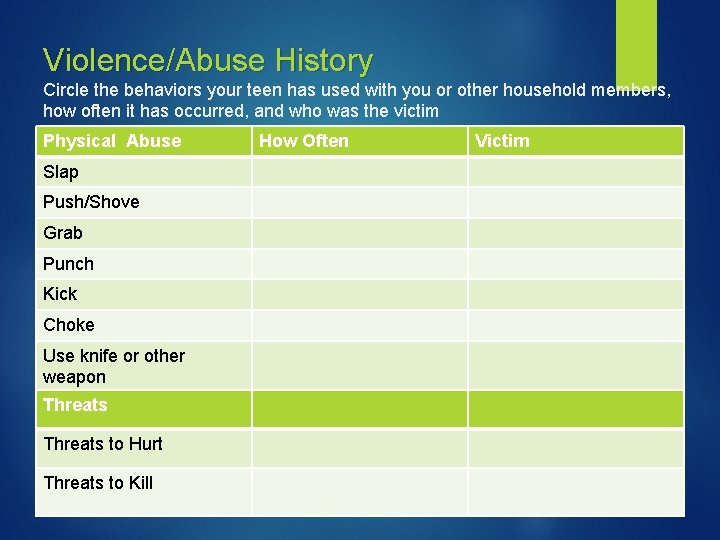
Violence/Abuse History Circle the behaviors your teen has used with you or other household members, how often it has occurred, and who was the victim Physical Abuse Slap Push/Shove Grab Punch Kick Choke Use knife or other weapon Threats Other Threats to Hurt Threats to Kill How Often Victim
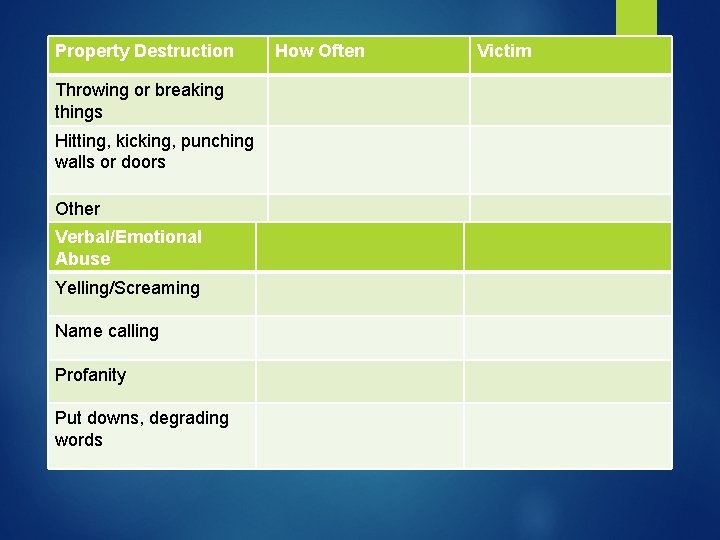
Property Destruction Throwing or breaking things Hitting, kicking, punching walls or doors Other Verbal/Emotional Abuse Yelling/Screaming Name calling Profanity Put downs, degrading words How Often Victim
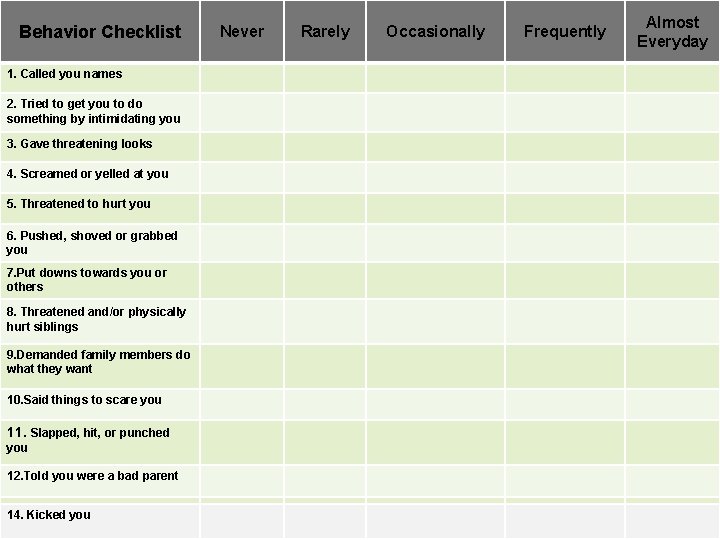
Behavior Checklist 1. Called you names 2. Tried to get you to do something by intimidating you 3. Gave threatening looks 4. Screamed or yelled at you 5. Threatened to hurt you 6. Pushed, shoved or grabbed you 7. Put downs towards you or others 8. Threatened and/or physically hurt siblings 9. Demanded family members do what they want 10. Said things to scare you 11. Slapped, hit, or punched you 12. Told you were a bad parent 13. Threw, hit, or smashed 14. Kicked you something Never Rarely Occasionally Frequently Almost Everyday
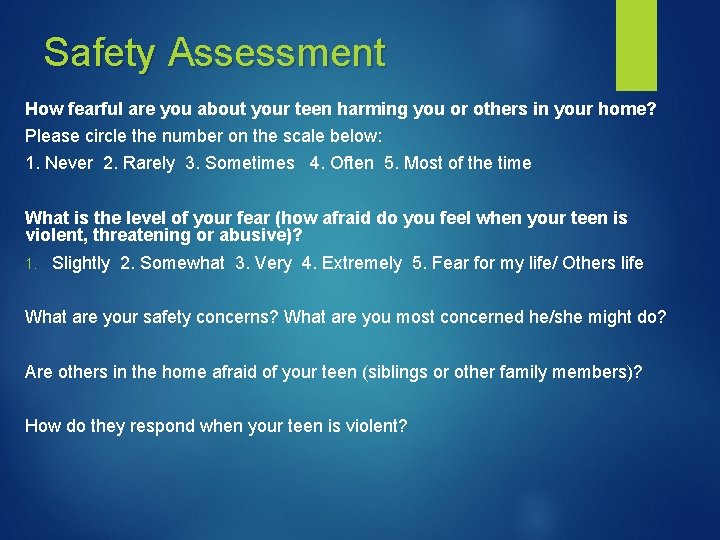
Safety Assessment How fearful are you about your teen harming you or others in your home? Please circle the number on the scale below: 1. Never 2. Rarely 3. Sometimes 4. Often 5. Most of the time What is the level of your fear (how afraid do you feel when your teen is violent, threatening or abusive)? 1. Slightly 2. Somewhat 3. Very 4. Extremely 5. Fear for my life/ Others life What are your safety concerns? What are you most concerned he/she might do? Are others in the home afraid of your teen (siblings or other family members)? How do they respond when your teen is violent?
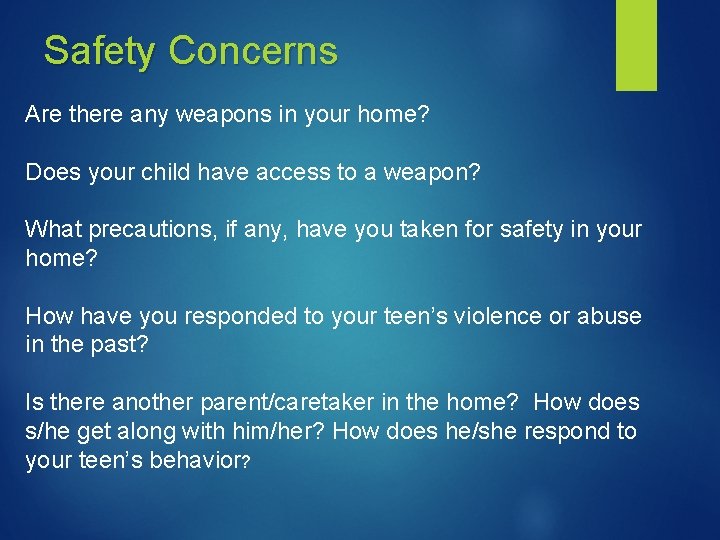
Safety Concerns Are there any weapons in your home? Does your child have access to a weapon? What precautions, if any, have you taken for safety in your home? How have you responded to your teen’s violence or abuse in the past? Is there another parent/caretaker in the home? How does s/he get along with him/her? How does he/she respond to your teen’s behavior?
Youth History Has s/he ever experienced or witnessed any violence or trauma? Has s/he ever been a victim of violence or abuse? Is s/he in counseling currently? In the past? Are there other services or helping agencies involved with your teen/family at this time? Does your teen have mental health issues? If so, please describe the diagnosis and treatment.
Youth History Do you have concerns that your teen has mental health issues that have not been addressed (such as, depression, anxiety, etc. )? Has your child ever talked about suicide or made attempts? If, so please describe, including date of last incident. Has your teen ever been to the hospital for mental health problems, or for being at risk for harm to self or others?
Who can you go to for support or help? (Friends, family, counselor, church, etc. )? What is your major concern about your child returning home? Is there anything else you would like to tell us?
Richard Gelles and Claire Pedrick Cornell, Intimate Violence in Families “Children abusing their parents is so counter normative that it is extremely difficult for parents to admit that they are being victimized by one of their children. ”
Safety on All Levels Safety in your practice model Safety in sessions (family or group) Safety in the home
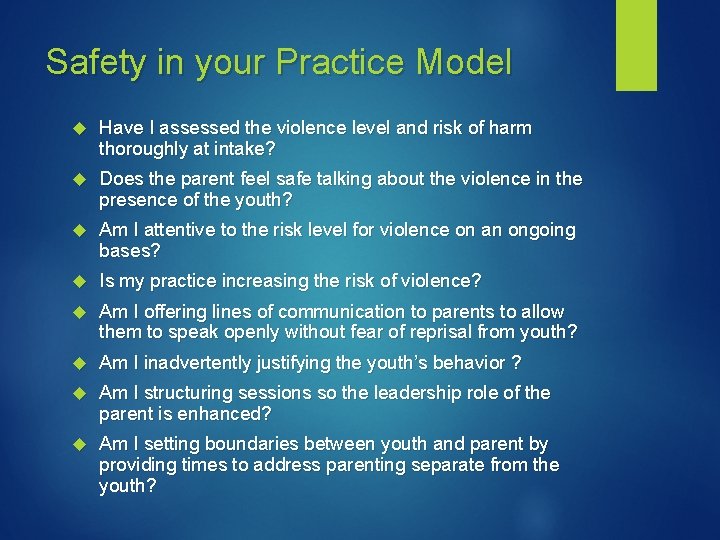
Safety in your Practice Model Have I assessed the violence level and risk of harm thoroughly at intake? Does the parent feel safe talking about the violence in the presence of the youth? Am I attentive to the risk level for violence on an ongoing bases? Is my practice increasing the risk of violence? Am I offering lines of communication to parents to allow them to speak openly without fear of reprisal from youth? Am I inadvertently justifying the youth’s behavior ? Am I structuring sessions so the leadership role of the parent is enhanced? Am I setting boundaries between youth and parent by providing times to address parenting separate from the youth?
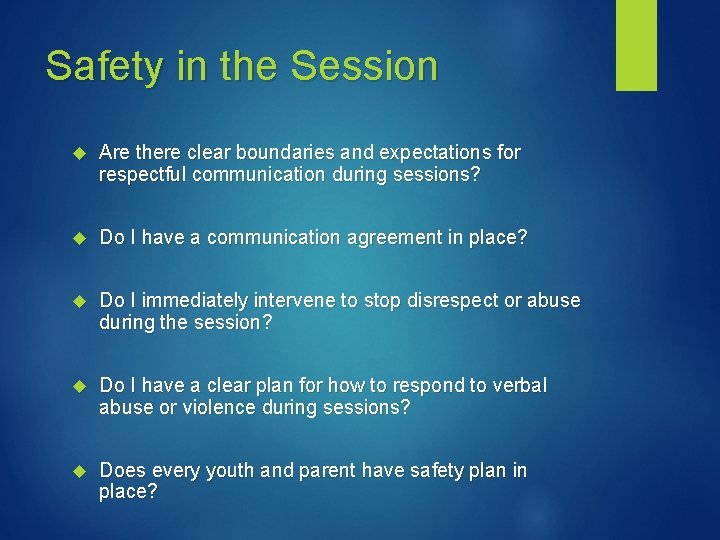
Safety in the Session Are there clear boundaries and expectations for respectful communication during sessions? Do I have a communication agreement in place? Do I immediately intervene to stop disrespect or abuse during the session? Do I have a clear plan for how to respond to verbal abuse or violence during sessions? Does every youth and parent have safety plan in place?
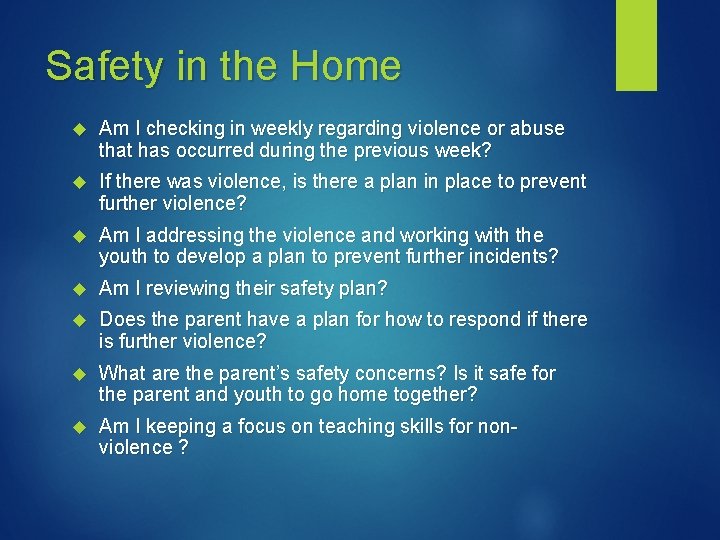
Safety in the Home Am I checking in weekly regarding violence or abuse that has occurred during the previous week? If there was violence, is there a plan in place to prevent further violence? Am I addressing the violence and working with the youth to develop a plan to prevent further incidents? Am I reviewing their safety plan? Does the parent have a plan for how to respond if there is further violence? What are the parent’s safety concerns? Is it safe for the parent and youth to go home together? Am I keeping a focus on teaching skills for nonviolence ?
Safety Precautions Checklist Before Group / Family Sessions q Conduct separate intake assessments q Assess violence level by youth q Assess parent’s safety concerns Ask: ü Are you afraid your teen will hurt you or other family members? ü Do you feel safe living with your teen
Safety Precautions Checklist After Group / Sessions Begin q Review and revise Safety Plan as needed q Encourage parents to communicate anytime about safety concerns (phone, email, individual session) q Routinely monitor violence / safety concerns q Communicate with other care providers
Safety Precautions Checklist q Do you feel safe talking about your youth’s behavior in group / session? Let parents know they do not have to talk about the youth’s behavior if they don’t feel safe doing so. They can speak with you separately until they feel safe discussing it in group. q Help parent make their own plan for safety in the home q Facilitate a Safety Plan with youth and parent
Safety Precautions Checklist q Are you afraid your teen will hurt you? q Do you feel safe living with your youth? q Do you feel safe driving home with your youth? q Assess need for immediate help to assure family safety.
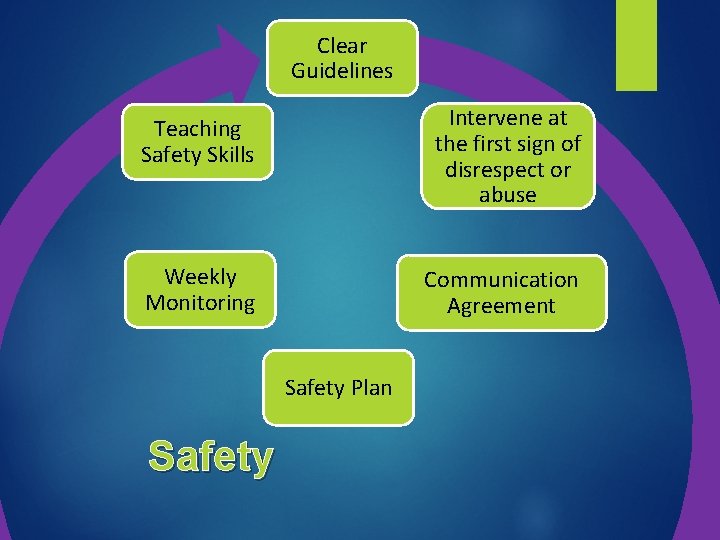
Clear Guidelines Teaching Safety Skills Intervene at the first sign of disrespect or abuse Weekly Monitoring Communication Agreement Safety Plan Safety
Safety Planning
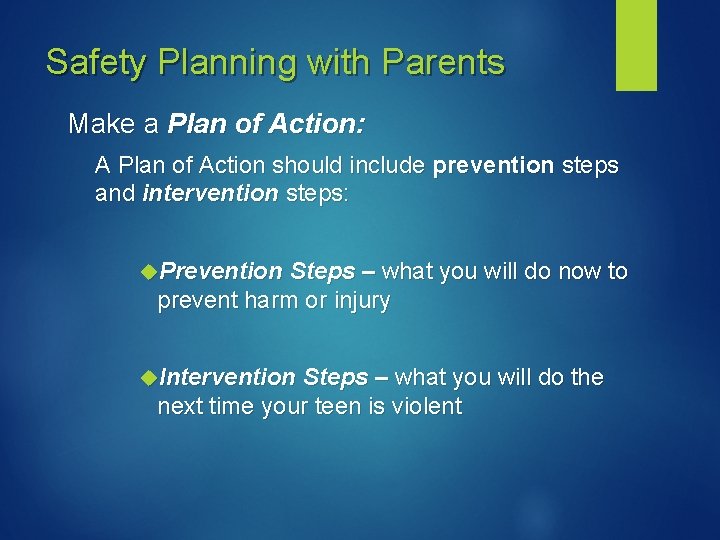
Safety Planning with Parents Make a Plan of Action: A Plan of Action should include prevention steps and intervention steps: Prevention Steps – what you will do now to prevent harm or injury Intervention Steps – what you will do the next time your teen is violent
Safety Planning with Parents What precautions have you taken for safety in your home? What dangerous behavior are you most concerned about that your teen might use? Is there anything you can do to prevent this behavior? What do you think is the safest response to this behavior?
Safety Planning with Parents How can you make your home more safe? Remove all weapons Put knives away Locks on doors Do not leave teen home alone with siblings Keep cell phone accessible Have planned escape routes out of home Inform a neighbor you trust
Safety Planning with Parents Make a list of support systems to call for help: 911 Friends, neighbors, family members, counselors, probation officer or court advocate 24 hour Crisis Line
How to Respond When Your Teen is Violent Do not continue the argument or discussion. Do not physically engage with your child. Separate yourself and your children from him/her. Go to another room or if necessary, bring your other children with you and leave the house. If your teen’s behavior is escalating and you are concerned about further violence, call for help (see ‘calling 911’).
What to Say to Your Teen When things are calm, tell your teen about your plan about how you will respond: Ø When you are abusive or violent, I will separate from you. Ø If you are physically violent, or I am concerned about our safety, I will call take the following steps…. (may be calling 911) Ø I cannot be around you when you are using hurtful behaviors. Ø We need to all feel safe in our home.
Addressing the Violent Behavior Afterwards I / we separated from you because your behavior was not safe. Our home needs to be a safe place for everyone. We will plan a time to talk about what happened, and how you could have responded differently. We will talk about how you can make amends, and make plan for how to prevent this from happening again. Use the Restorative Inquiry questions to guide this conversation.
Prevention: Disengaging from Power Struggles Learn to know when it is becoming a power struggle Don’t argue Be clear and specific about what needs to happen, and then stop talking Try not to take your child’s resistance or anger personally Stay calm, minimal words, step away You can hold your ground best by talking less
Disengaging from Power Struggles Ignore attempts to get you engaged Separate physically from your teen, if needed Talk about the problem later, when you are both calm Stop talking and disengage if yelling, put downs or verbal abuse starts again
Youth Safety Plan
Safety Plan for Youth I agree to the following plan to prevent abuse or violence: 1. I will separate from my family member/s when I start to feel angry or upset and might become hurtful, or I start to use any hurtful behaviors including the following:
Safety Plan for Youth (continued) Screaming/yelling Name calling/profanity Threats Intimidating behaviors Unwanted physical contact, such as, Hitting, punching, pushing, shoving, kicking, slapping, grabbing, or other unwanted touching of any kind. Property damage
Safety Plan for Youth (continued) 2. I will respectfully tell the person I am separating by saying: ___________________ 3. I will separate from the person and go to one of the following places: ___________________ 4. While I am separated I will do something to calm myself down, such as: ___________________
Safety Plan for Youth (continued) After my separation time I will return and talk to the person about what to do next (talk about it, plan a time later to talk about it, or let it go). If the other person separates from me I will respect their time alone and not bother them. I will stay away from the other person until they are ready to talk again.
Safety Plan for Youth (continued) I understand if I am violent the consequences will be: I agree to be non-violent at home. Signature: Date:
Safety Plan for Youth (cont. ) Parent Agreement: I also agree to be non-violent and to support my youth in following this plan. Parent Signature Date:
Safety Plan Tips Check in with them about how their safety plan is working every week Revise it as needed It takes time and mistakes to get it right It takes time to become an integrated habit If they are violent or abusive always ask: “What about your safety plan? ” Figure out the barriers and help them make a plan to remember to use it.
Safety Plans Work Most youth and parents tell us the safety plan was the most helpful skill that they learned in Step-Up Parents say the violence stopped once both of them remembered to use the plan Parent support is critical Give lots of encouragement for small successes

Collaboration with Other Providers
Lily Anderson, MSW Step-Up Program Co-Developer Lily. anderson@kingcounty. gov 206 -296 -7841 www. kingcounty. gov/courts/stepup
- Slides: 43