
Steps towards a Single Point of Access for



- Slides: 27
Steps towards a Single Point of Access for Survey Questions across Europe: The Euro Question Bank Project Wolfgang Zenk-Möltgen Azadeh Mahmoud. Hashemi TARKI UKDA NSD SND GESIS DDA FSD FORS DANS Consortium of European Social Science Data Archives License: CC BY 4. 0 (exceptions see last slide)
Agenda ² Introduction ² Purposes ² Features ² Use cases ² Architecture
Introduction of Euro Question Bank • EQB content is provided by CESSDA Service Providers • Contains survey questions of different datasets in different languages • Contains associated information about studies, datasets, variables, etc • Expand on existing QDB for social science survey research • Offer databases of well-documented surveys and variables
Purposes of Euro Question Bank • Develop and implement a central search facility across all CESSDA surveys • Covering questions of surveys as much as possible • Exploration of findings on particular topics to identify existing survey items • Retrieval will be used for looking up question text, building new questionnaires or compare questions
Question Data bank Partners TARKI UKDA NSD GESIS SND DDA FSD FORS DANS
Key Features of CESSDA EQB • Based on DDI-Lifecycle metadata standard • Provide conversion tool from DDI-Codebook metadata standard • Search and filter by keywords, survey or series title, data collection dates or countries, question types or languages, provider, data availability, etc
Key Features of CESSDA EQB • Assist in searching in different languages by integrating multilingual thesaurus (ELSST) • Discovered questions include study-level, citation, frequencies, multilingual documentation and links to full original questionnaires • Access to CESSDA resources without switching systems
Basic Functions I. A highly relevant tool for any kind of harmonization work • An important module in CESSDA Data portal • Present different versions of a question for immediate comparison II. EQB will support the development of new questionnaire by giving researchers access to a selection of questions
Use Cases 1. Import questions, variables, study from DDI-XML file Actor: Harvester Import through OSMH 2. Update questions, variables and study with import from DDI-XML file into DB, keep different version Actor: Provider Update automatic through harvester
Use Cases 3. Find questions, variables, study and concepts in EQB Actor: End user 4. Filter and search facets on questions, variables, study and concepts in DB Actor: End user
Use Cases 5. Compare documentation of questions, variables, study and concepts Actor: End user 6. Explore relations between questions and question groups in a study Actor: End user
Use Cases 7. Output for a new module, questionnaire or questions Actor: End user 8. See how special metadata has developed and repeated in a survey Actor: End user
Use Cases 9. Translation for a new survey or a question related to a specific concept as well as switch the language to view other translation of the same question Actor: End user 10. Display related studies, datasets, variable names and lables which are used for specific questions Actor: End user
Use Cases 11. Usage statistics Actor: Provider 12. Sort result list by preference Actor: End user
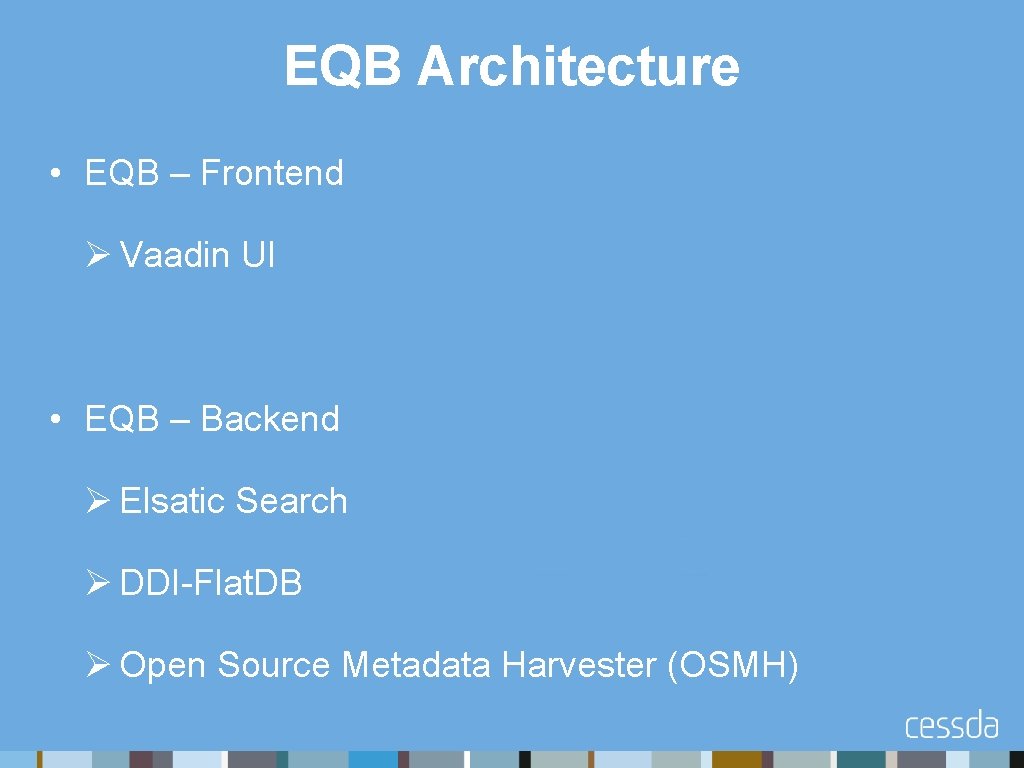
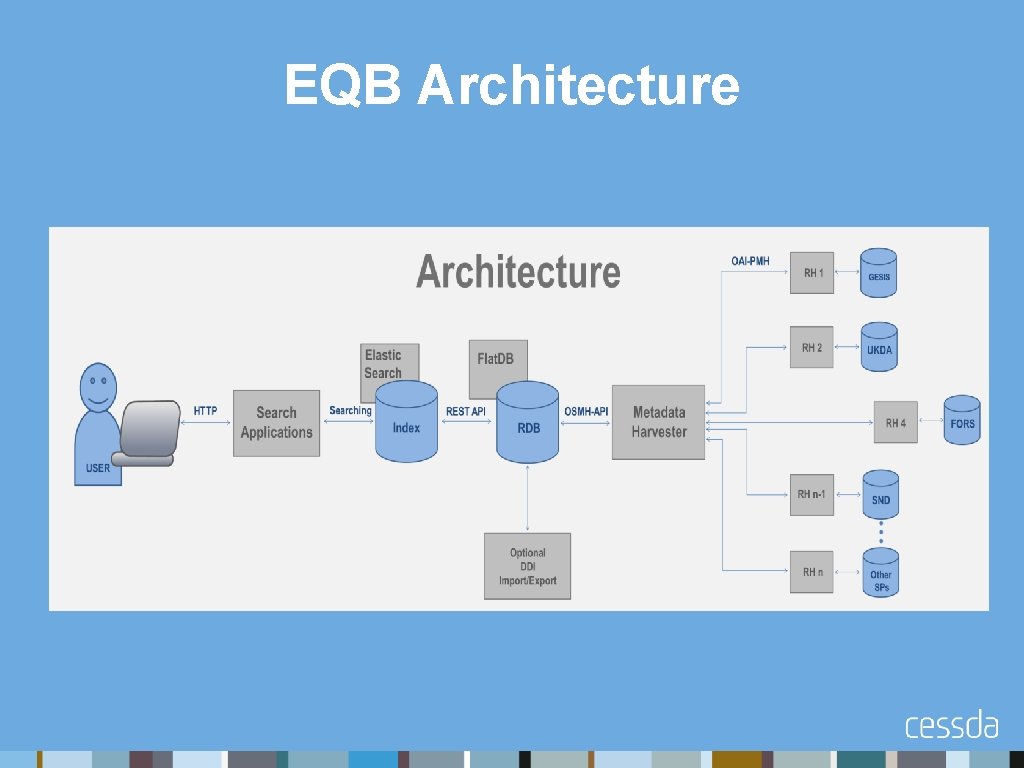
EQB Architecture • EQB – Frontend Ø Vaadin UI • EQB – Backend Ø Elsatic Search Ø DDI-Flat. DB Ø Open Source Metadata Harvester (OSMH)
EQB Architecture
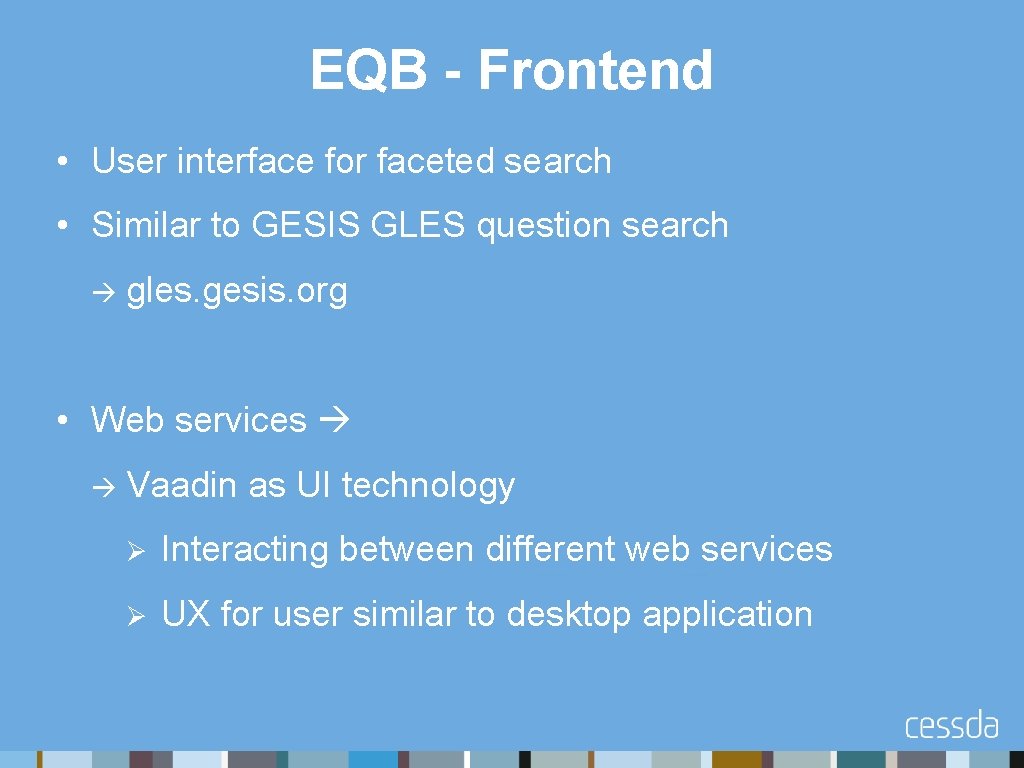
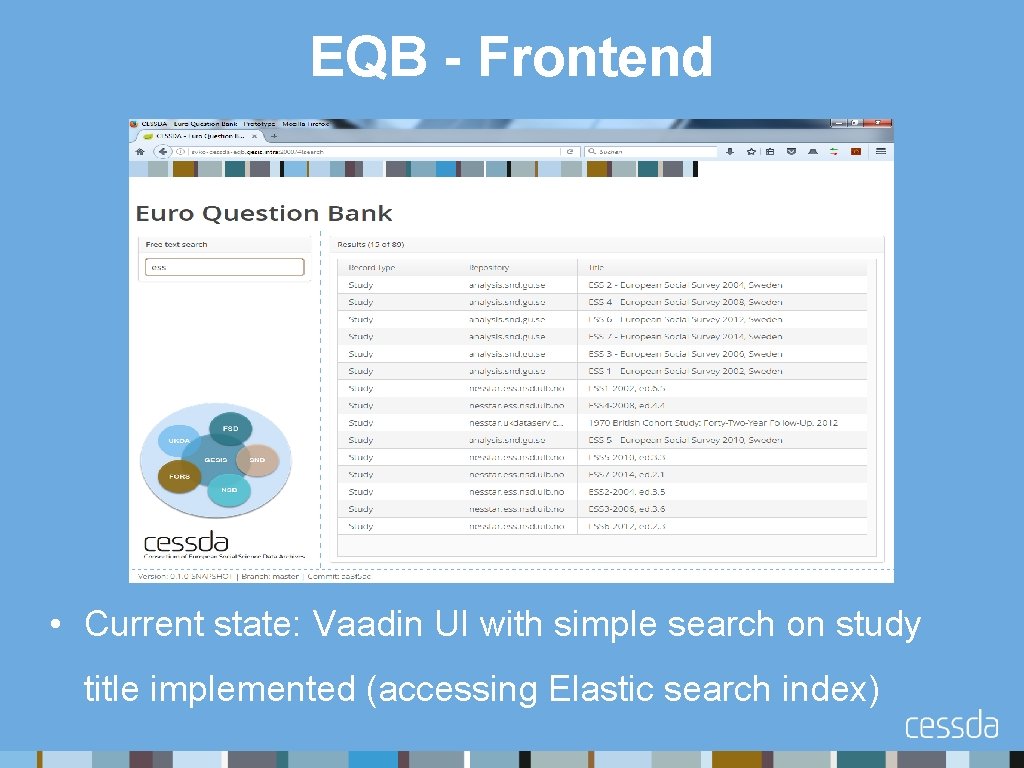
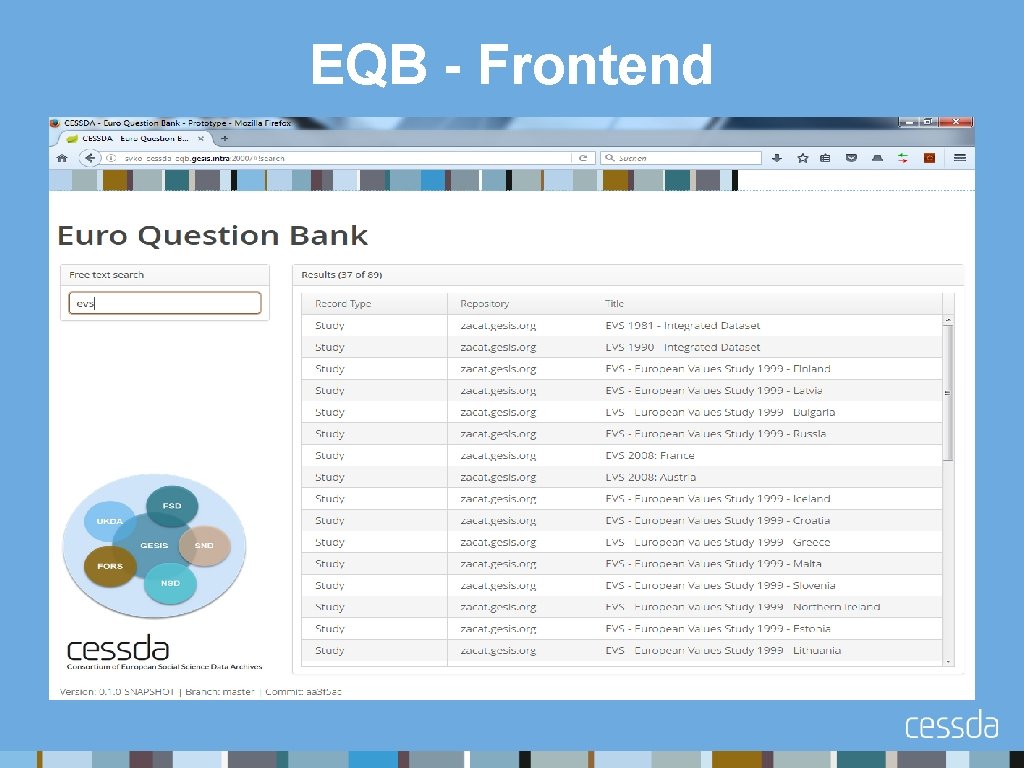
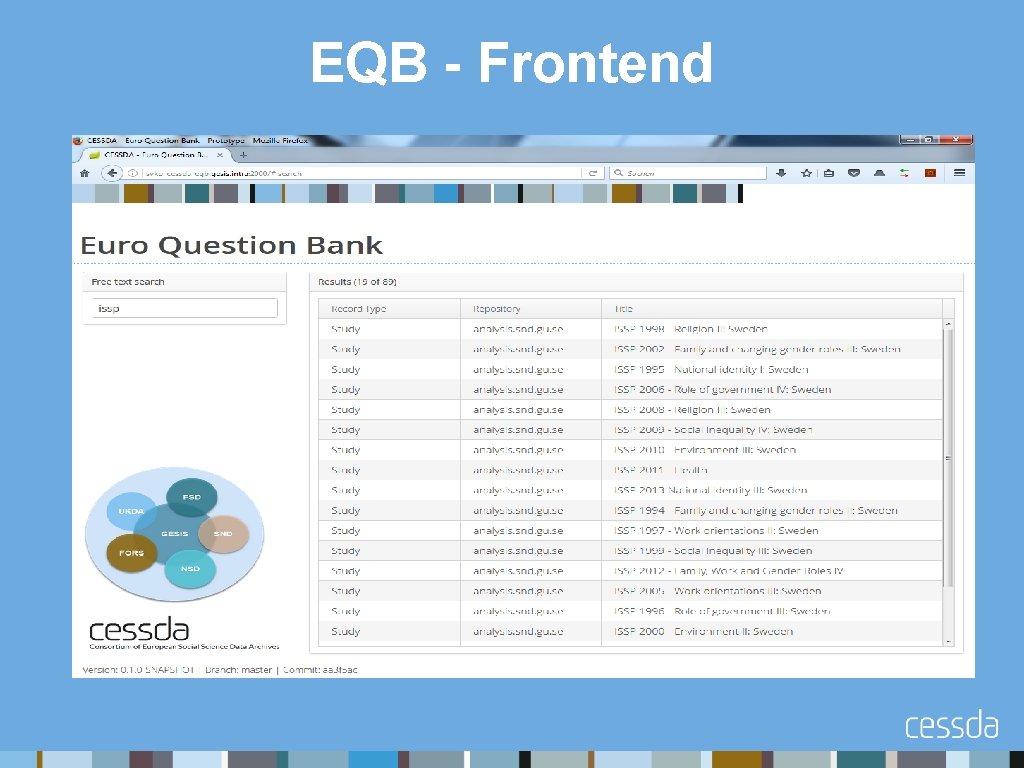
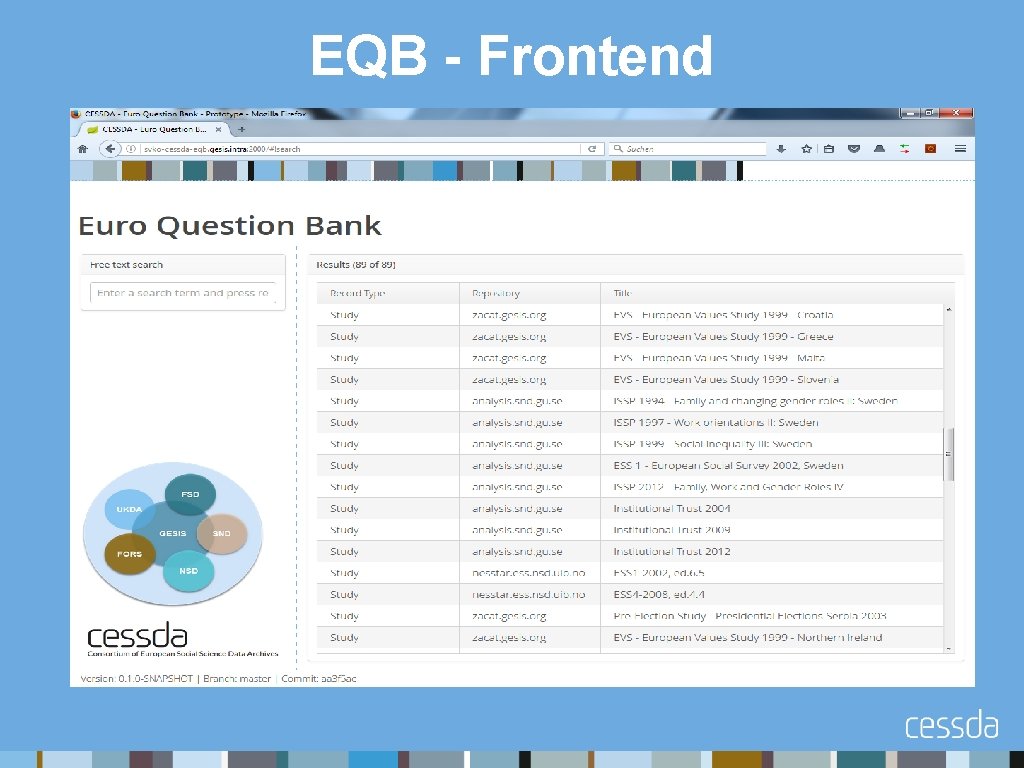
EQB - Frontend • User interface for faceted search • Similar to GESIS GLES question search gles. gesis. org • Web services Vaadin as UI technology Ø Interacting between different web services Ø UX for user similar to desktop application
EQB - Frontend • Current state: Vaadin UI with simple search on study title implemented (accessing Elastic search index)
EQB - Frontend
EQB - Frontend
EQB - Frontend
EQB - Backend • Elastic search Indexing an open-source full-text search library v Search engine with JSON over HTTP web interface v Fast search responses using inverted index • DDI-Flat. DB v Idea is to access the entities very fast without any problem with DDI version or My. SQL DB.
EQB - Backend • DDI-Flat. DB v The DDI-Flat DB architecture is abstract, efficient, functional driven and REST-Full access to studies in DDI format. v Store Question, variable and study entities v Accessing and loading faster and easily • Current state: Elastic search index implemented (accessing Harvester), Flat. DB implemented
Open Source Metadata Harvester (OSMH) • Harvest all information from heterogeneous and autonomous handlers (SPs) with different technologies • A CESSDA MH classify the entities and objects which gets harvested • Repository Handlers Enables repository owners to write RHs for repository technology they use • Current state: Repository Handlers for NESSTAR servers implemented
Questions?
Thank you for your attention
License This presentation is offered under license CC-BY 4. 0. The license does not apply to the following copyrighted material used in this presentation: The logo of GESIS The logo of CESSDA The slideshow layout of CESSDA