
Steps to Writing a Research Paper Step 1
- Slides: 26
Steps to Writing a Research Paper
Step 1: Understand the Available Resources. o Become familiar with primary and secondary sources, as well as the variety of print, non-print, and electronic resources that are available. o Understand how to locate these resources and how to use them responsibly and without plagiarism.
Step 2: Select a Topic o Locate a subject of personal interest, then find a specific angle or approach to that topic that is reasonable to handle within the prescribed page limit.
Step 3: Conduct Preliminary Research and Begin Writing Source Cards. o Search for sources of information and record publication information about available resources on source cards, following MLA format.
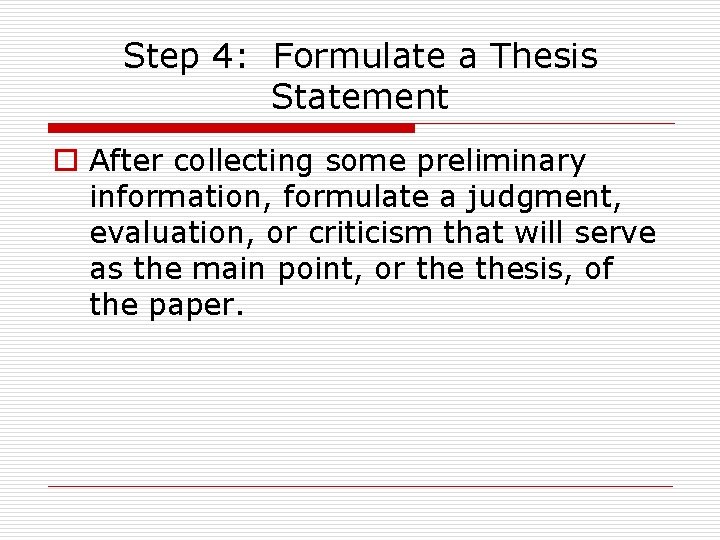
Step 4: Formulate a Thesis Statement o After collecting some preliminary information, formulate a judgment, evaluation, or criticism that will serve as the main point, or thesis, of the paper.
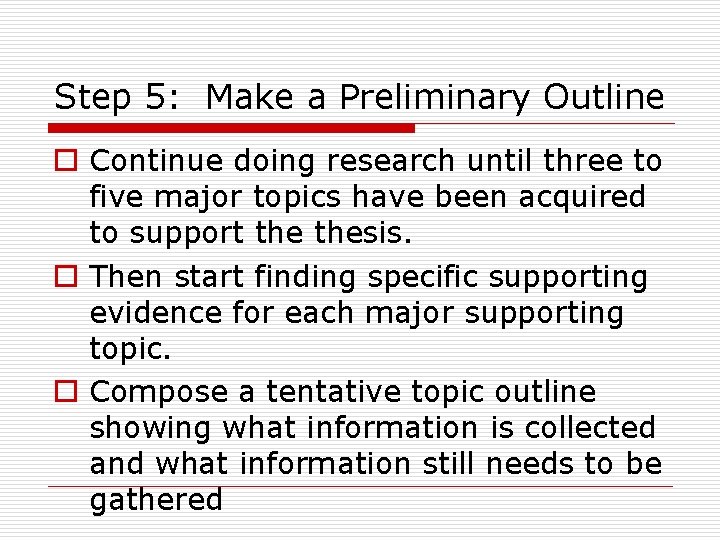
Step 5: Make a Preliminary Outline o Continue doing research until three to five major topics have been acquired to support thesis. o Then start finding specific supporting evidence for each major supporting topic. o Compose a tentative topic outline showing what information is collected and what information still needs to be gathered
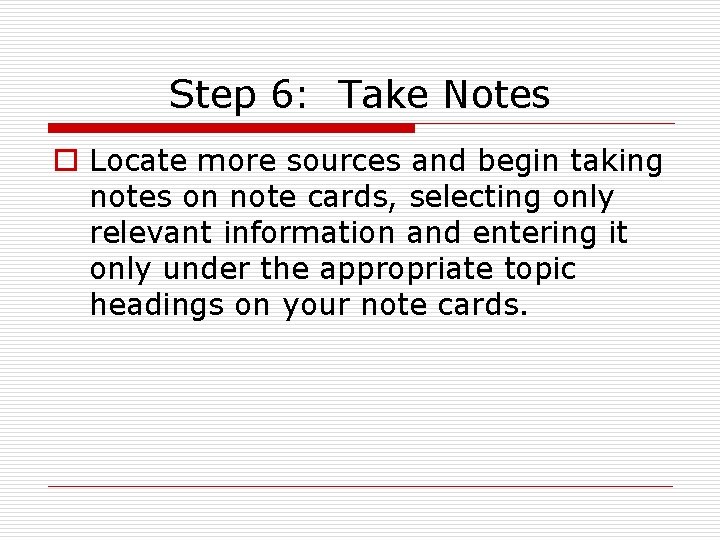
Step 6: Take Notes o Locate more sources and begin taking notes on note cards, selecting only relevant information and entering it only under the appropriate topic headings on your note cards.
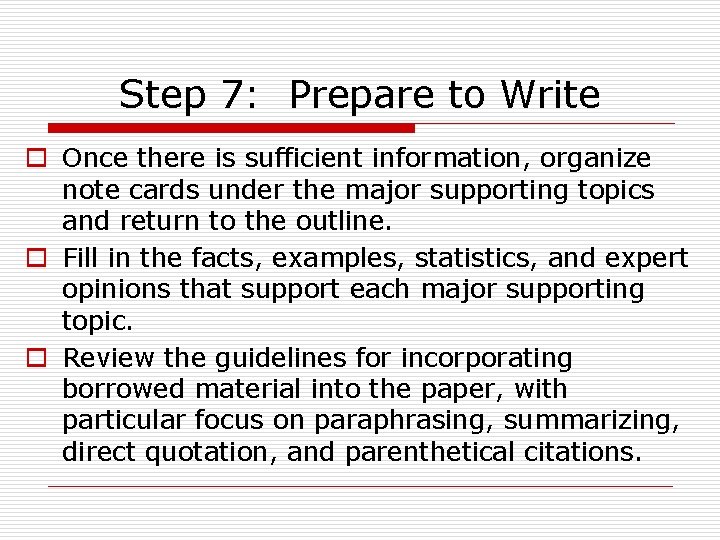
Step 7: Prepare to Write o Once there is sufficient information, organize note cards under the major supporting topics and return to the outline. o Fill in the facts, examples, statistics, and expert opinions that support each major supporting topic. o Review the guidelines for incorporating borrowed material into the paper, with particular focus on paraphrasing, summarizing, direct quotation, and parenthetical citations.
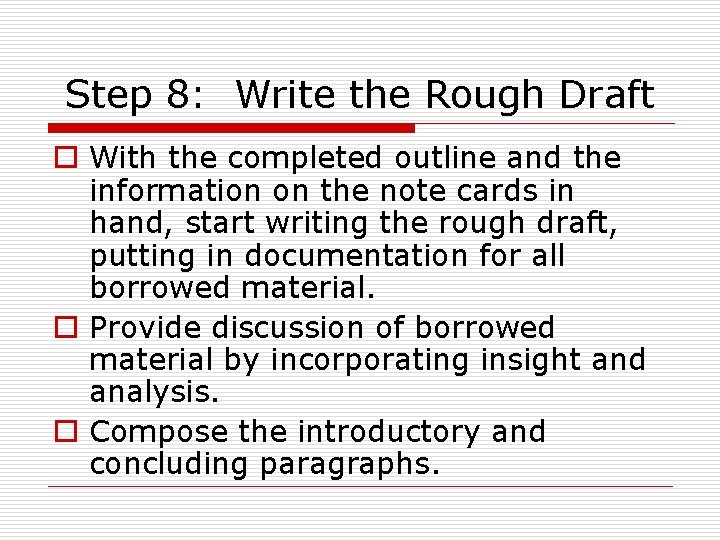
Step 8: Write the Rough Draft o With the completed outline and the information on the note cards in hand, start writing the rough draft, putting in documentation for all borrowed material. o Provide discussion of borrowed material by incorporating insight and analysis. o Compose the introductory and concluding paragraphs.
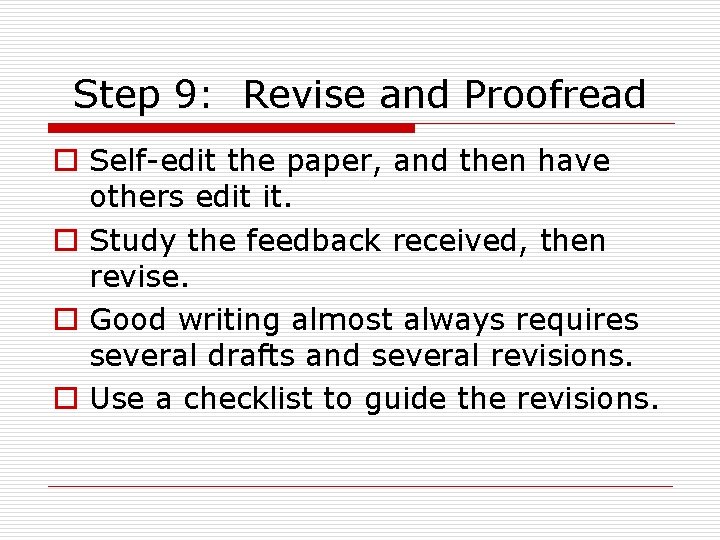
Step 9: Revise and Proofread o Self-edit the paper, and then have others edit it. o Study the feedback received, then revise. o Good writing almost always requires several drafts and several revisions. o Use a checklist to guide the revisions.
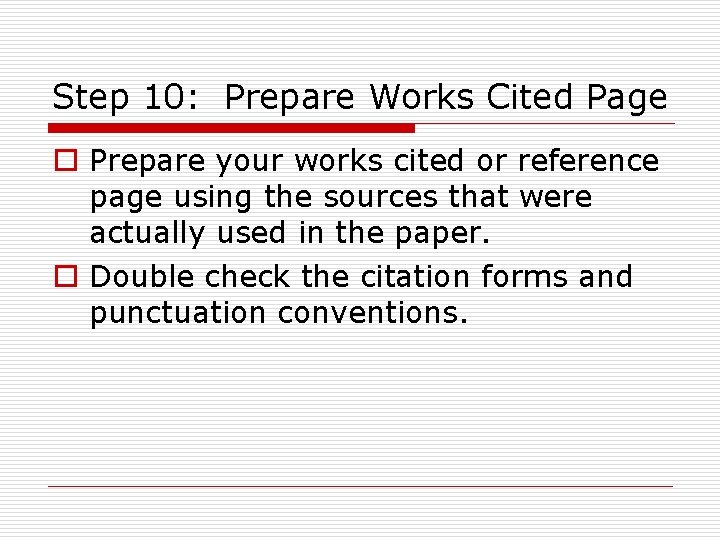
Step 10: Prepare Works Cited Page o Prepare your works cited or reference page using the sources that were actually used in the paper. o Double check the citation forms and punctuation conventions.
Understanding Available Resources
Why Not Google? o Google searching is certainly useful in many circumstances, but it is NOT an effective or efficient way to conduct scholarly research. o It promotes content based on the number of hits that a site generates, how the site’s html code is written, and the amount of advertising dollars spent.
How About Wikipedia? o Even Superman knows better!
o Wikipedia is NOT a definitive encyclopedia! o It should NEVER be considered as an authoritative source, nor should it be used as a resource for quoting, paraphrasing, or summarizing in a research paper. o Use Wikipedia ONLY as a starting point. It can provide a topic overview, key words to start research, and links that can be used as reliable resources.
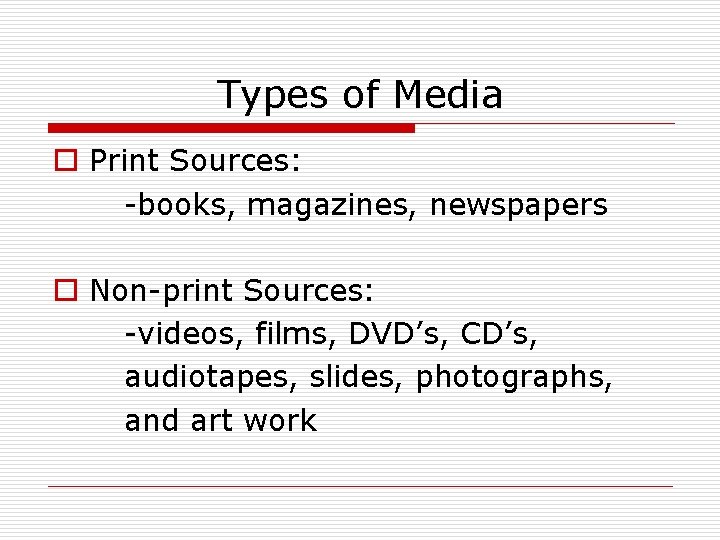
Types of Media o Print Sources: -books, magazines, newspapers o Non-print Sources: -videos, films, DVD’s, CD’s, audiotapes, slides, photographs, and art work
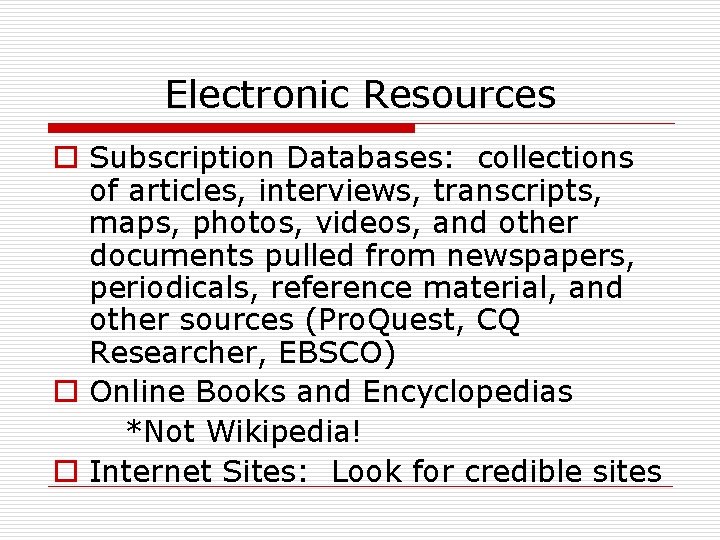
Electronic Resources o Subscription Databases: collections of articles, interviews, transcripts, maps, photos, videos, and other documents pulled from newspapers, periodicals, reference material, and other sources (Pro. Quest, CQ Researcher, EBSCO) o Online Books and Encyclopedias *Not Wikipedia! o Internet Sites: Look for credible sites
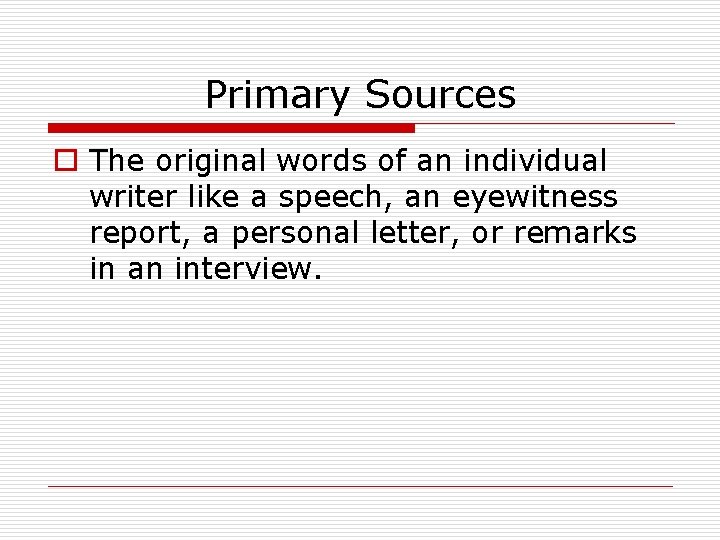
Primary Sources o The original words of an individual writer like a speech, an eyewitness report, a personal letter, or remarks in an interview.
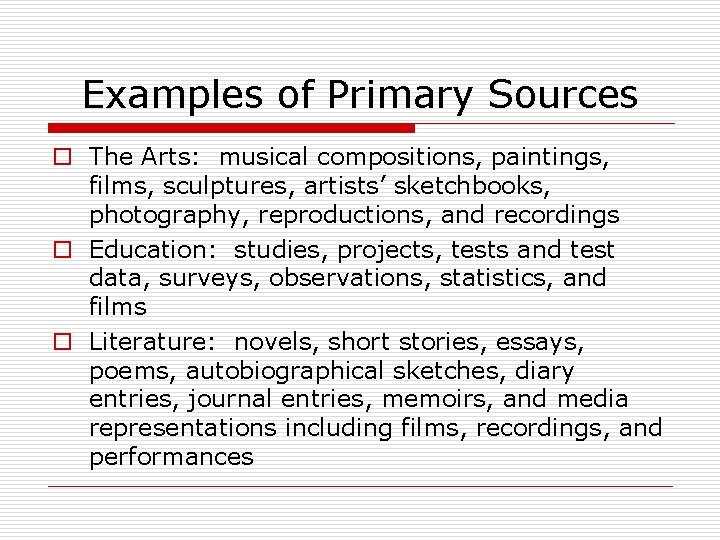
Examples of Primary Sources o The Arts: musical compositions, paintings, films, sculptures, artists’ sketchbooks, photography, reproductions, and recordings o Education: studies, projects, tests and test data, surveys, observations, statistics, and films o Literature: novels, short stories, essays, poems, autobiographical sketches, diary entries, journal entries, memoirs, and media representations including films, recordings, and performances
o Social Science: agency reports, government records, historical documents, case studies, survey results, the Census, presidential tapes, and market research o Science: results of experiments and tests; reports of observations and discoveries by those conducting the experiments
Secondary Sources o Works about an individual and his/her work, including biographies, histories, critical studies of novels, and discussion of scientific findings.
Examples of Secondary Sources o The Arts: reviews and biographies o Education: articles evaluating educational practices, reports, and books about educational issues and problems o Literature: articles, reviews, analyses, and books about literary works and writers
o Social Science: articles and reports from books, newspapers, and magazines about social issues and historical events o Science: review and interpretation of scientific experiments, observations, and controversies
Tertiary Sources o Consist of information which is a distillation and collection of primary and secondary sources. o o o o o Almanacs Bibliographies (also considered secondary); Chronologies Dictionaries and Encyclopedias (also considered secondary) Directories Fact books Guidebooks Indexes, abstracts, bibliographies used to locate primary and secondary sources Manuals Textbooks (also be secondary)
Finding the Right Sources o o School Library The Public Library University Library The World Wide Web