
STEPS OF THE SCIENTIFIC METHOD STEPS OF THE


- Slides: 13
STEPS OF THE SCIENTIFIC METHOD
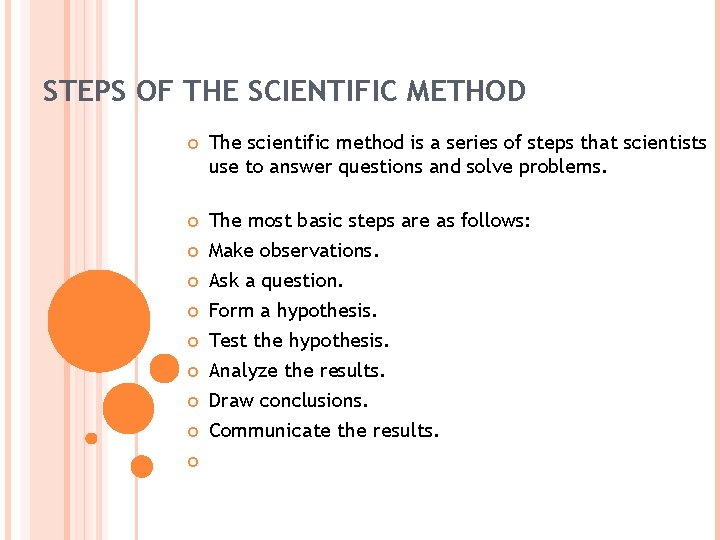
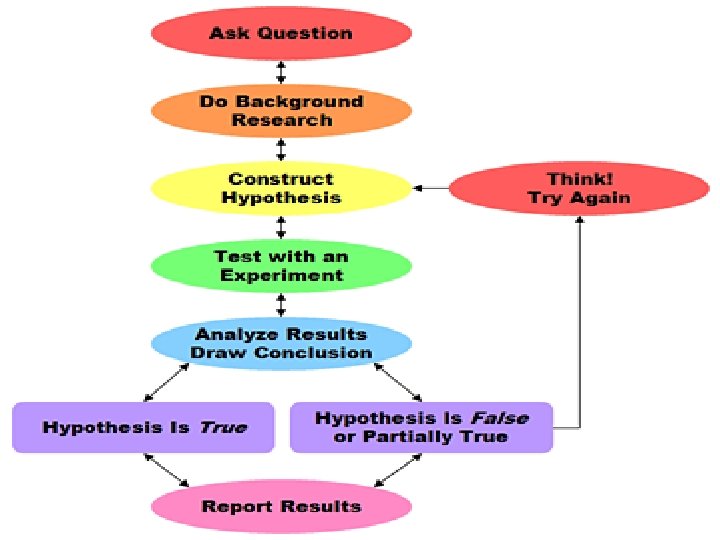
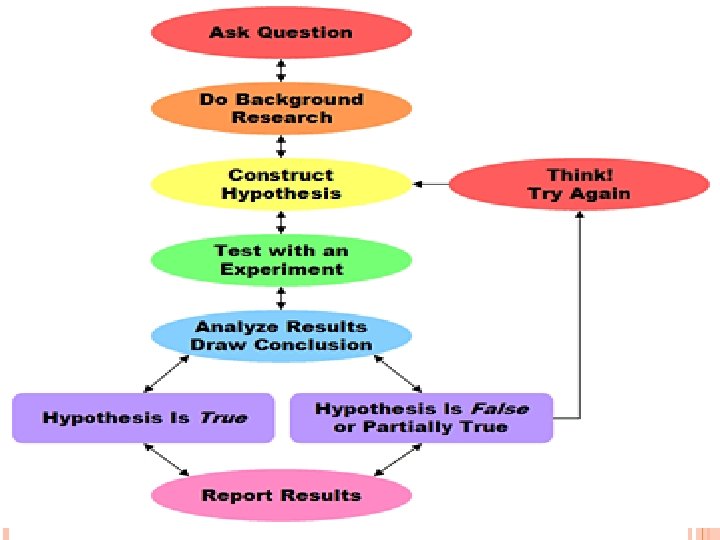
STEPS OF THE SCIENTIFIC METHOD The scientific method is a series of steps that scientists use to answer questions and solve problems. The most basic steps are as follows: Make observations. Ask a question. Form a hypothesis. Test the hypothesis. Analyze the results. Draw conclusions. Communicate the results.
ASK A QUESTION The scientific method starts when you ask a question about something that you observe: How, What, When, Who, Which, Why, or Where?
DO BACKGROUND RESEARCH Rather than starting from scratch in putting together a plan for answering your question, you want to be a savvy scientist using library and Internet research to help you find the best way to do things and insure that you don't repeat mistakes from the past.
CONSTRUCT A HYPOTHESIS: A hypothesis is an educated guess about how things work: "If _____[I do this] _____, then _____[this]_____ will happen. " You must state your hypothesis in a way that you can easily measure, and of course, your hypothesis should be constructed in a way to help you answer your original question.
TEST YOUR HYPOTHESIS BY DOING AN EXPERIMENT: Your experiment tests whether your hypothesis is true or false. It is important for your experiment to be a fair test. You conduct a fair test by making sure that you change only one factor at a time while keeping all other conditions the same. You should also repeat your experiments several times to make sure that the first results weren't just an accident.
ANALYZE YOUR DATA AND DRAW A CONCLUSION Once your experiment is complete, you collect your measurements and analyze them to see if your hypothesis is true or false.
COMMUNICATE YOUR RESULTS To complete your science fair project you will communicate your results to others in a final report and/or a display board. Professional scientists do almost exactly the same thing by publishing their final report in a scientific journal or by presenting their results on a poster at a scientific meeting.
EXAMPLES These are examples of good science fair project questions • When is the best time to plant soy beans? • Which material is the best insulator? • How does arch curvature affect load carrying strength? • How do different foundations stand up to earthquakes? • What sugars do yeast use?
WHAT MAKES A GOOD SCIENCE FAIR PROJECT QUESTION? Is the topic interesting enough to read about, then work on for the next couple months? Can you find at least 3 sources of written information on the subject? Can you measure changes to the important factors (variables) using a number that represents a quantity such as a count, percentage, length, width, weight, voltage, velocity, energy, time, etc. ?
WHAT MAKES A GOOD SCIENCE FAIR PROJECT QUESTION? Is your experiment safe to perform? Do you have all the materials and equipment you need for your science fair project, or will you be able to obtain them quickly and at a very low cost? Do you have enough time to do your experiment more than once before the science fair? Does your science fair project meet all the rules and requirements for your science fair? Have you checked to see if your science fair project will require SRC (Scientific Review Committee) approval?