
Steps of the Scientific Method Step 1 State



- Slides: 70
Steps of the Scientific Method
Step 1: State the Question Problem § All experiments begin with a testable research question § This question often stems from an experience you’ve had or observations you’ve made in the past § Your research question must be testable, this means that you can design an investigation, make observations, and gather evidence to answer the question.
Scientific questions CANNOT be based on opinions or personal judgments § Testable Research Question: Will M&M color dissolve faster in water, vinegar, or salt water? § Non-Testable Question: Which color M&M tastes better? § Remember that the key to a good question is that it can be tested. An experiment could be designed to find an answer to the question. If the question is based on OPINIONS or PERSONAL PREFERENCES, then it is NOT TESTABLE!
Number 1 -5. Read each research question below. If it is testable, write YES, if it cannot be tested write NO § 1. Does the amount of fertilizer affect how tall a flower grows? § 2. Are roses prettier flowers then tulips? § 3. How can we make cut flowers stay fresher for a longer period of time? § 4. Can daisies grow in different types of soil? § 5. Do daffodils smell better than carnations?
Read each situation. Then in your notebook write a TESTABLE Research Question § EXAMPLE: Aaron and Sam want to grow some tomato plants this summer. They’re trying to decide where to plant them so the plants receive the right amount of sunlight to produce the most tomatoes § RESEARCH QUESTION: What amount of sunlight makes tomato plants produce the most tomatoes?
Read each situation. Then in your notebook write a TESTABLE Research Question § Andre and Marie love popcorn, but they don’t have much money to spend. They want to decide if more expensive brands of popcorn really pop better than others. § RESEARCH QUESTION:
Read each situation. Then in your notebook write a TESTABLE Research Question § Sheri is tired of buying light bulbs. She wants to find out whether Brand A or Brand B light bulbs will last longer in her lamp. § RESEARCH QUESTION
Read each situation. Then in your notebook write a TESTABLE Research Question § Jerome’s brother told him to fill the ice cube trays with warm water instead of cold water because warm water freezes faster. Jerome wants to find out if this is true. § RESEARCH QUESTION:
CHALLENGE ACTIVITY § Write your own scientific situation on a separate piece of paper. Trade papers with a classmate (someone at your table) and have him or her write the research question that goes with your scientific situation
STEP 2: Collect Information § After choosing a topic to investigate and writing a testable research question, it’s time to find information about your topic. However, some topics are very broad. You must narrow your topic enough to focus on the most important parts relating to your experiment and research only those parts. § What are the most important parts?
Variables § Variables are all the factors that can change in an experiment, possibly affecting the results. § It’s important that you test only one variable at a time; this way you can be sure it’s the one thing that caused the results.
3 kinds of variables § 1. The Independent (or Manipulated) Variable: is the ONE factor or condition that is intentionally changed by the experimenter. § 2. The Dependent (or Responding) Variable is the factor or condition that may be affected as a result of changing the independent variable. The dependent variable is what you measure or observe to obtain your results § 3. The Constant Variable are all the factors or conditions that must be kept the same in the experiment
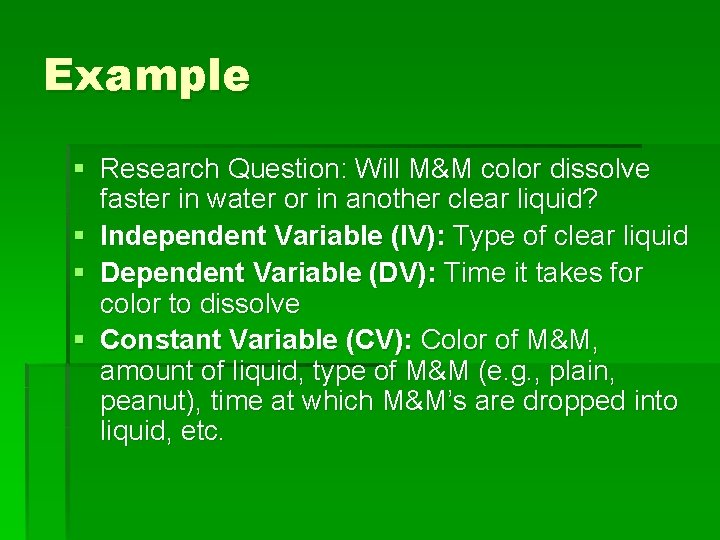
Example § Research Question: Will M&M color dissolve faster in water or in another clear liquid? § Independent Variable (IV): Type of clear liquid § Dependent Variable (DV): Time it takes for color to dissolve § Constant Variable (CV): Color of M&M, amount of liquid, type of M&M (e. g. , plain, peanut), time at which M&M’s are dropped into liquid, etc.
YOUR TURN, identify the IV, DV, and CV for each Research Question § 1. What amount of sunlight makes pea plants grow tallest? § IV: § DV: § CV:
Continue § 2. Which type of soda has more sugar: Brand X, Brand Y, or Brand Z? § IV: § DV: § CV:
Continue § Is the height of a ball’s bounce affected by the height from which the ball is dropped? § IV: § DV: § CV:
Continue § Which battery will last the longest: Superlast or Energy Star? § IV: § DV: § CV:
LAST ONE § Is the water temperature of Lake Michigan affected by the depth of the water? § IV: § DV: § CV:
QUIZ TIME § Number 1 -7 in your notebooks, after each description identify which type of variable is described § IV = Independent Variable § DV = Dependent Variable § CV = Constant Variable
READY… § 1. The factors that are kept the same in an experiment. _______ § 2. This is also known as the responding variable. _________ § 3. This is the one thing that is changed by the experimenter. _______ § 4. This is also called the manipulated variable. ________ § 5. This is the factor that is affected as a result of changing the manipulated variable. ___________
LAST 2 § 6. This variable must be measurable to obtain results. ___________ § 7. There may be many of this type of variable in an experiment. _________
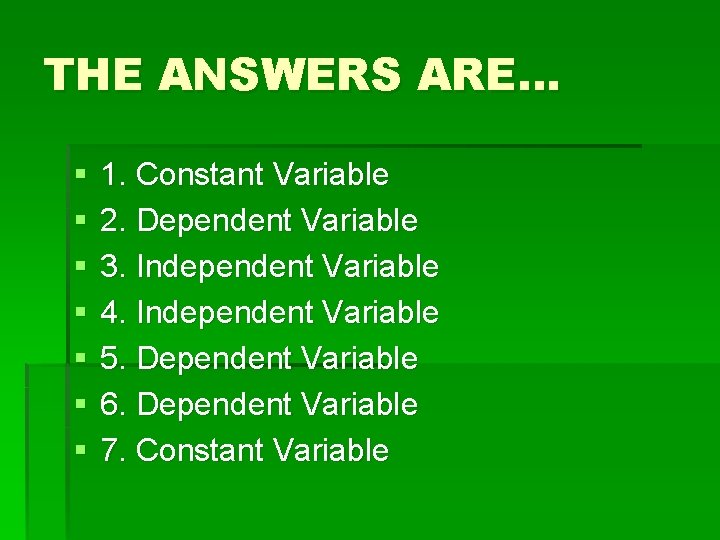
THE ANSWERS ARE… § § § § 1. Constant Variable 2. Dependent Variable 3. Independent Variable 4. Independent Variable 5. Dependent Variable 6. Dependent Variable 7. Constant Variable
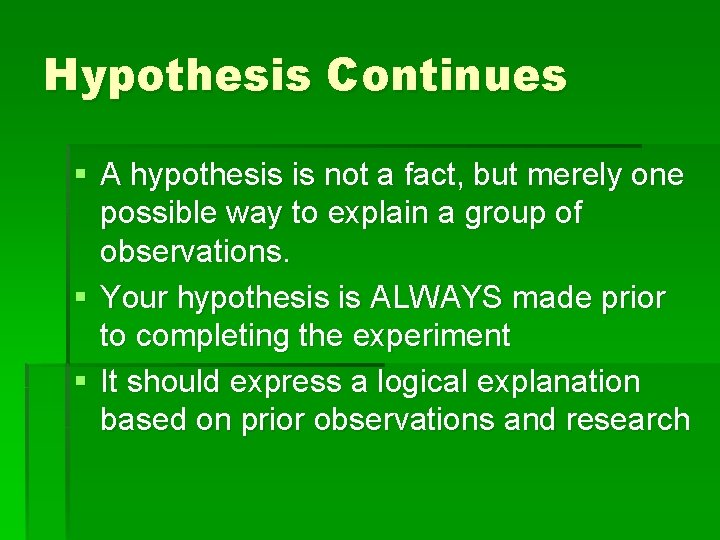
Hypothesis Continues § A hypothesis is not a fact, but merely one possible way to explain a group of observations. § Your hypothesis is ALWAYS made prior to completing the experiment § It should express a logical explanation based on prior observations and research
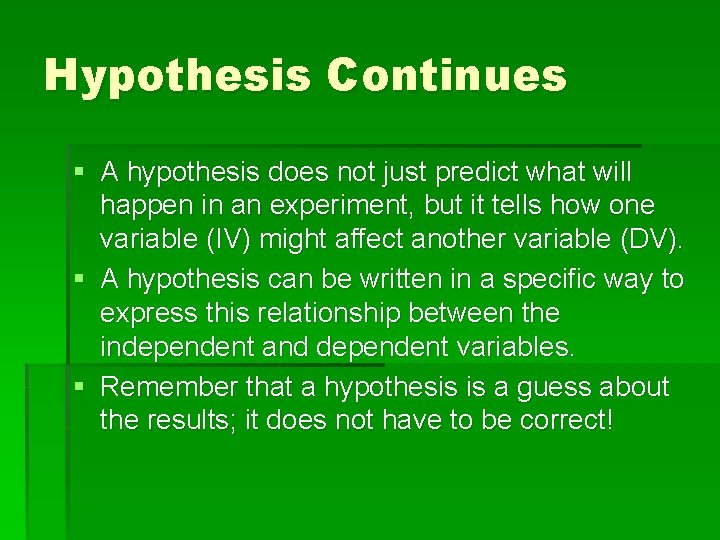
Hypothesis Continues § A hypothesis does not just predict what will happen in an experiment, but it tells how one variable (IV) might affect another variable (DV). § A hypothesis can be written in a specific way to express this relationship between the independent and dependent variables. § Remember that a hypothesis is a guess about the results; it does not have to be correct!
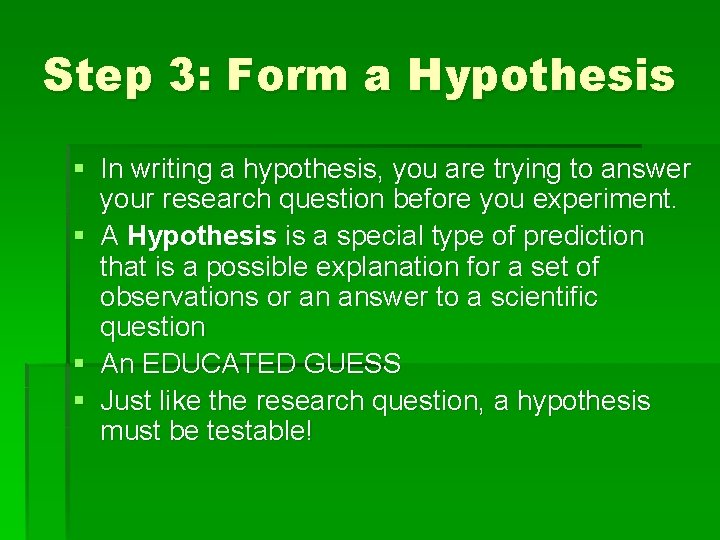
Step 3: Form a Hypothesis § In writing a hypothesis, you are trying to answer your research question before you experiment. § A Hypothesis is a special type of prediction that is a possible explanation for a set of observations or an answer to a scientific question § An EDUCATED GUESS § Just like the research question, a hypothesis must be testable!
Hypothesis Continues § A hypothesis can be written as an “If…then…” statement. When the variables are added into the hypothesis, the format becomes “If IV, then DV. ” or “If I change the IV, then I think (or my hypothesis is that) the result (DV) will be_____. ” § Don’t forget that the hypothesis is your prediction about what will happen, so you will have to add your own words and toughts into this format!
Practice Example § Research Question: Does salt water freeze faster than fresh water? IV: Type of water DV: Time water takes to freeze Possible Hypothesis: If I test salt water and fresh water, then fresh water will freeze faster. A good way to make sure that your hypothesis is written correctly is to circle the words “If” and “then” in the hypothesis and underline the IV and DV. 6 practice problems!
Number 1 -6 in your notebooks § 1. Which type of music quiets a crying baby faster: jazz, classical, or rock? § IV: _________ DV: _______ § Hypothesis: ______________ § 2. Does the color of the recycling bins, red or blue, affect the number of cans recycled at school? § IV: _________ DV: ________ § Hypothesis: _______________
Hypothesis Continues § 3. Does the temperature of water affect how quickly food coloring spreads through it? § IV: ________ DV: ______ § Hypothesis: ___________ § 4. Is the number of eggs a chicken lays affected by the hours of daylight? § IV: ________ DV: ______ § Hypothesis: ______________
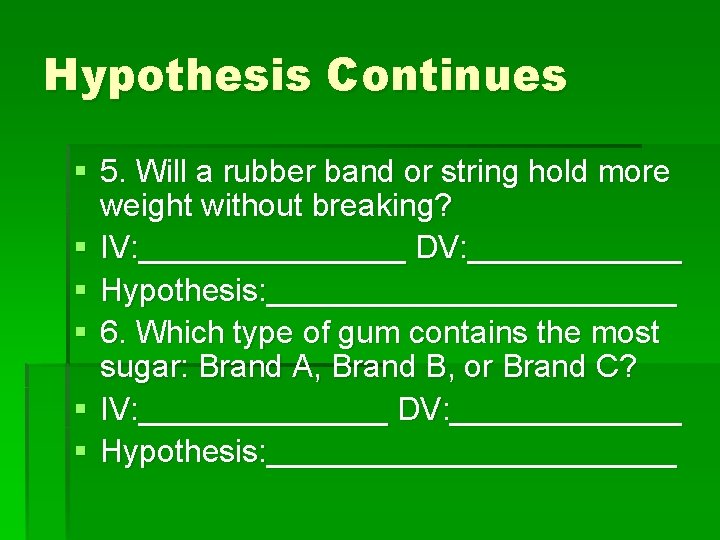
Hypothesis Continues § 5. Will a rubber band or string hold more weight without breaking? § IV: ________ DV: ______ § Hypothesis: ____________ § 6. Which type of gum contains the most sugar: Brand A, Brand B, or Brand C? § IV: _______ DV: _______ § Hypothesis: ____________
Procedure § When you are planning a way to test your hypothesis, you should write a step-by-step procedure describing the materials needed, the set-up of the experiment, and the observations and measurements that will be made. § The goal of a well-designed experiment is to allow anyone who reads it to understand the process you are using and to allow someone to complete the experiment just by following your directions
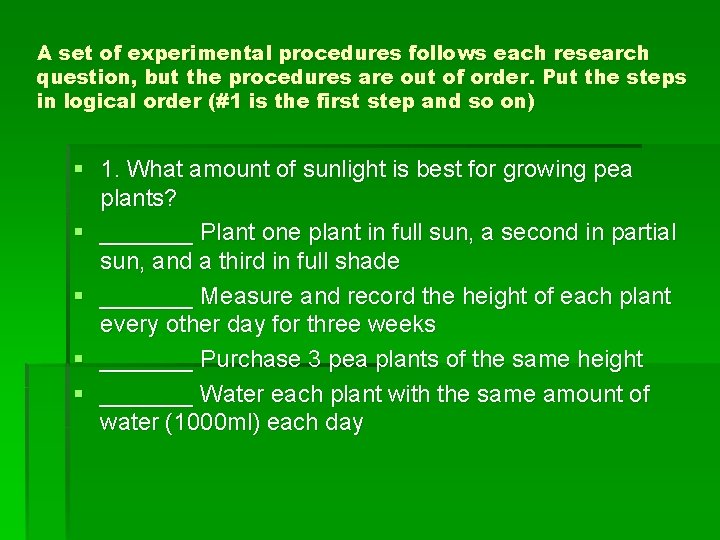
A set of experimental procedures follows each research question, but the procedures are out of order. Put the steps in logical order (#1 is the first step and so on) § 1. What amount of sunlight is best for growing pea plants? § _______ Plant one plant in full sun, a second in partial sun, and a third in full shade § _______ Measure and record the height of each plant every other day for three weeks § _______ Purchase 3 pea plants of the same height § _______ Water each plant with the same amount of water (1000 ml) each day
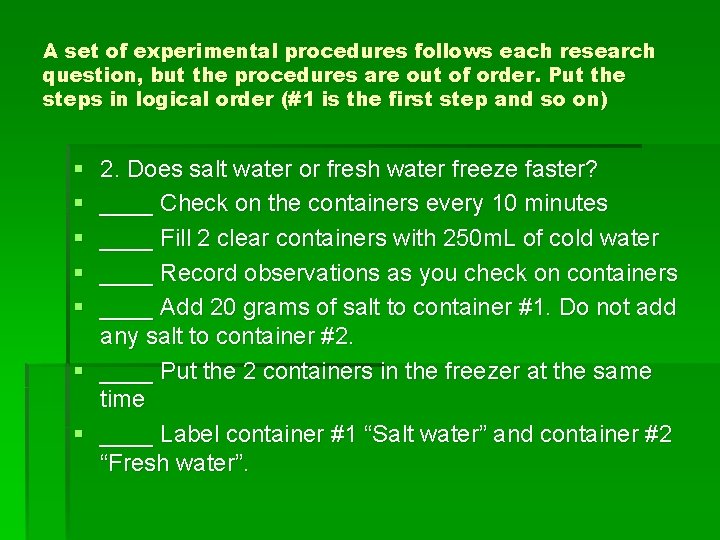
A set of experimental procedures follows each research question, but the procedures are out of order. Put the steps in logical order (#1 is the first step and so on) § § § 2. Does salt water or fresh water freeze faster? ____ Check on the containers every 10 minutes ____ Fill 2 clear containers with 250 m. L of cold water ____ Record observations as you check on containers ____ Add 20 grams of salt to container #1. Do not add any salt to container #2. § ____ Put the 2 containers in the freezer at the same time § ____ Label container #1 “Salt water” and container #2 “Fresh water”.
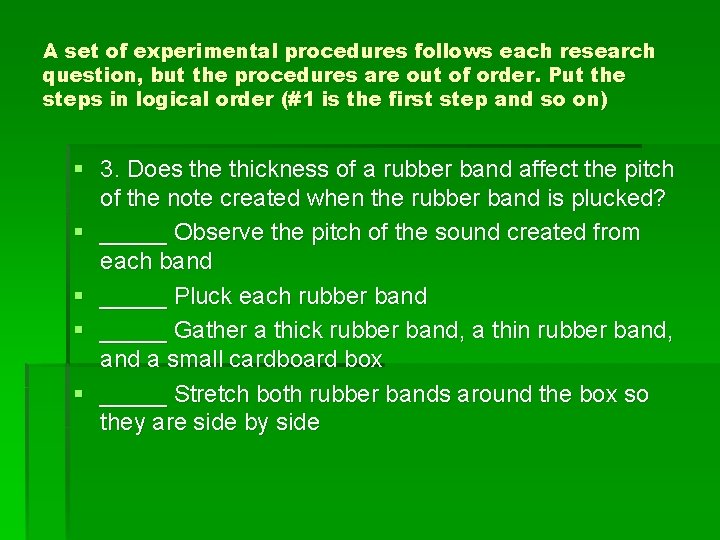
A set of experimental procedures follows each research question, but the procedures are out of order. Put the steps in logical order (#1 is the first step and so on) § 3. Does the thickness of a rubber band affect the pitch of the note created when the rubber band is plucked? § _____ Observe the pitch of the sound created from each band § _____ Pluck each rubber band § _____ Gather a thick rubber band, a thin rubber band, and a small cardboard box § _____ Stretch both rubber bands around the box so they are side by side
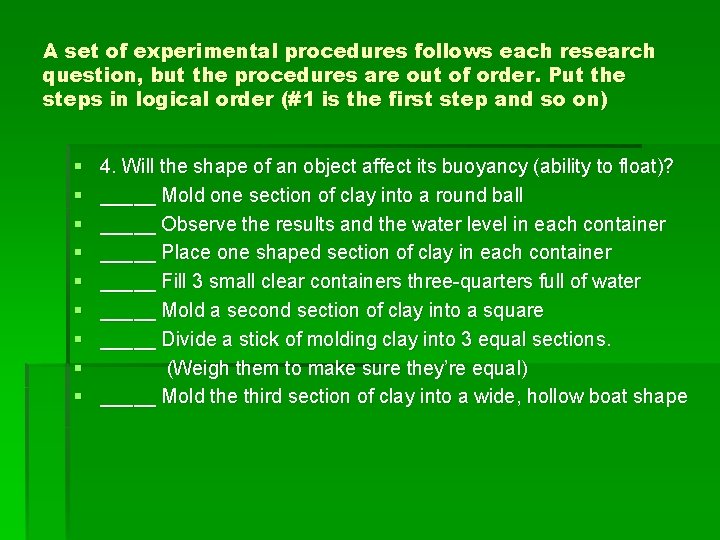
A set of experimental procedures follows each research question, but the procedures are out of order. Put the steps in logical order (#1 is the first step and so on) § § § § § 4. Will the shape of an object affect its buoyancy (ability to float)? _____ Mold one section of clay into a round ball _____ Observe the results and the water level in each container _____ Place one shaped section of clay in each container _____ Fill 3 small clear containers three-quarters full of water _____ Mold a second section of clay into a square _____ Divide a stick of molding clay into 3 equal sections. (Weigh them to make sure they’re equal) _____ Mold the third section of clay into a wide, hollow boat shape
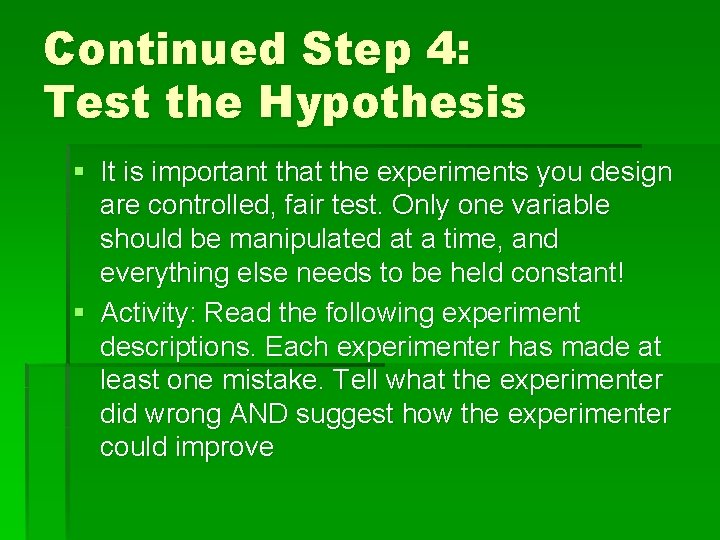
Continued Step 4: Test the Hypothesis § It is important that the experiments you design are controlled, fair test. Only one variable should be manipulated at a time, and everything else needs to be held constant! § Activity: Read the following experiment descriptions. Each experimenter has made at least one mistake. Tell what the experimenter did wrong AND suggest how the experimenter could improve
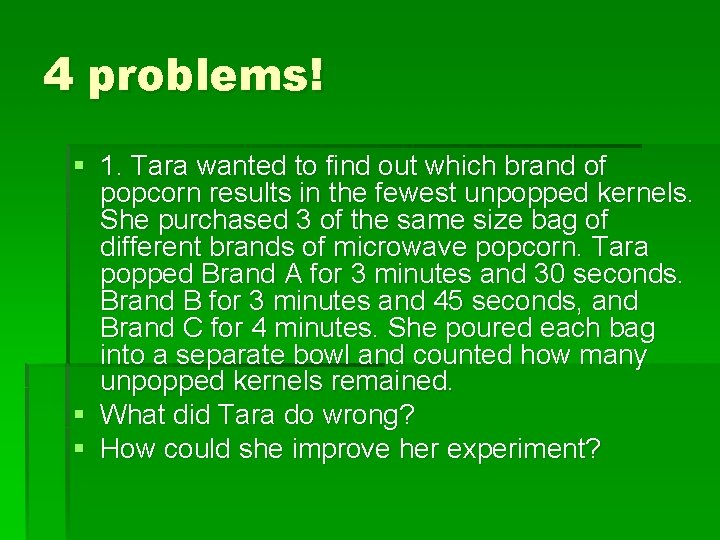
4 problems! § 1. Tara wanted to find out which brand of popcorn results in the fewest unpopped kernels. She purchased 3 of the same size bag of different brands of microwave popcorn. Tara popped Brand A for 3 minutes and 30 seconds. Brand B for 3 minutes and 45 seconds, and Brand C for 4 minutes. She poured each bag into a separate bowl and counted how many unpopped kernels remained. § What did Tara do wrong? § How could she improve her experiment?
Answer § Tara’s mistake was popping the different popcorns for different amounts of time. She could improve her experiment by popping each bag for the same amount of time
§ 2. Jeremiah is testing which paper towel is most absorbent. He takes 4 different brands of paper towels and cuts them to the same size. He holds each paper towel under running water and observes the results. § What did Jeremiah do wrong? § How could he improve his experiment?
Answer § Jeremiah did not control the amount of water put on each paper towel. He could improve his experiment by measuring a specific amount of water before pouring it on each paper towel to determine how much water each paper towel absorbed
Answer § The girls are testing two candies at once. Testing only one candy at a time and having the same girl test each candy would improve their experiment.
Last one! § 4. Demetrius wants to find out if the size of the ball will affect how high it bounces. He chooses a ping-pong ball, a softball, and a bowling ball. He drops each from a height of 2 meters. His friend holds a meter stick and records the bounce of each ball. § What did Demetrius do wrong? § How could he improve his experiment/
§ 3. Tina and Jazmine want to know which flavor of hard candy lasts the longest. They choose 4 flavors of candy. Tina puts 2 in her mouth and, at the same time, Jazmine puts 2 in her mouth. They time to see which candy lasts longest. § What did Tina and Jazmine do wrong? § How could their experiment be improved?
Answer § Demetrius did not control the weight of each ball. The balls he is testing are different weights, which can influence his results. He could improve his experiment by finding balls of different sizes but the same weight
Conducting Research § You are encouraged to investigate as many different sources as possible to ensure a thorough understanding of your chosen topic
Materials to Investigate § § § § § Encyclopedias Dictionaries Biographical dictionaries Atlases Pamphlets Records Newspaper files Maps Bibliographies graphs § § § § § Library card catalogs Professional indexes Audio and video recordings Almanacs Textbooks Brochures Magazines and professional journals Historical stories Magazine indexes Public documents
Places To Go § § § College library Museums Scientific societies Local library Historical society Parks TV/ Radio station Medical laboratory Hardware store Botanical garden Gardening center farm § § § § Newspaper office Supermarkets Restaurants Pet store Florist or plant nursery Science periodicals TV specials Computer databases
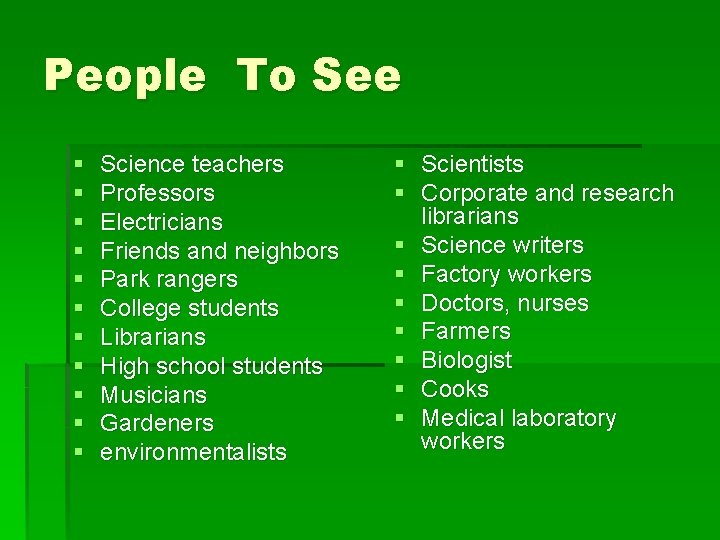
People To See § § § Science teachers Professors Electricians Friends and neighbors Park rangers College students Librarians High school students Musicians Gardeners environmentalists § Scientists § Corporate and research librarians § Science writers § Factory workers § Doctors, nurses § Farmers § Biologist § Cooks § Medical laboratory workers
Step 5: Observe, Record, & Analyze Data § While conducting your experiment, it is very important to make clear and accurate observations. § An observation involves using all five senses to make sense of the world around you. § Scientists use observations to gather the data that will support or disprove their hypothesis
Step 5: Observe, Record, & Analyze Data § There are two basic types of observations: Quantitative and Qualitative § Quantitative observations are observations that involve a number in the form of an amount or measurement. § Noticing that there are 12 students working in the library is a quantitative observation. Scientists try to use quantitative observations as much as possible because they are more accurate and precise.
Step 5: Observe, Record, & Analyze Data § Qualitative observation are observations that use non-numerical descriptions. § Noticing that your friend’s sweater is blue and green is a qualitative observation § Practice problems… in your notebooks, write whether the observation is quantitative or qualitative
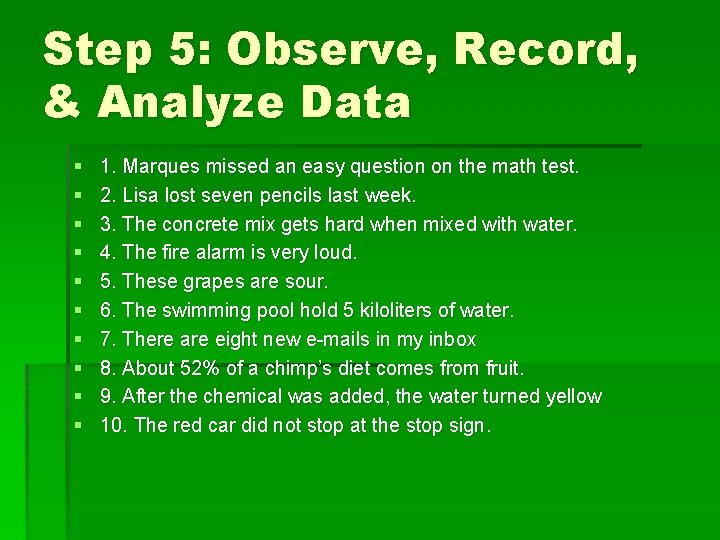
Step 5: Observe, Record, & Analyze Data § § § § § 1. Marques missed an easy question on the math test. 2. Lisa lost seven pencils last week. 3. The concrete mix gets hard when mixed with water. 4. The fire alarm is very loud. 5. These grapes are sour. 6. The swimming pool hold 5 kiloliters of water. 7. There are eight new e-mails in my inbox 8. About 52% of a chimp’s diet comes from fruit. 9. After the chemical was added, the water turned yellow 10. The red car did not stop at the stop sign.
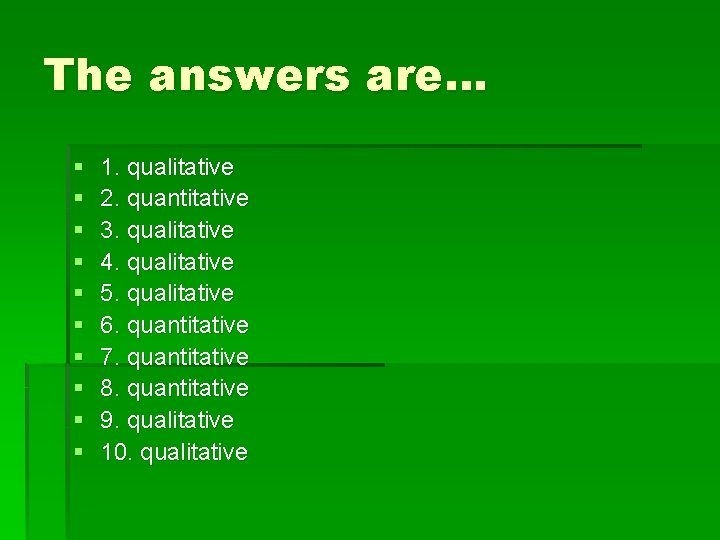
The answers are… § § § § § 1. qualitative 2. quantitative 3. qualitative 4. qualitative 5. qualitative 6. quantitative 7. quantitative 8. quantitative 9. qualitative 10. qualitative
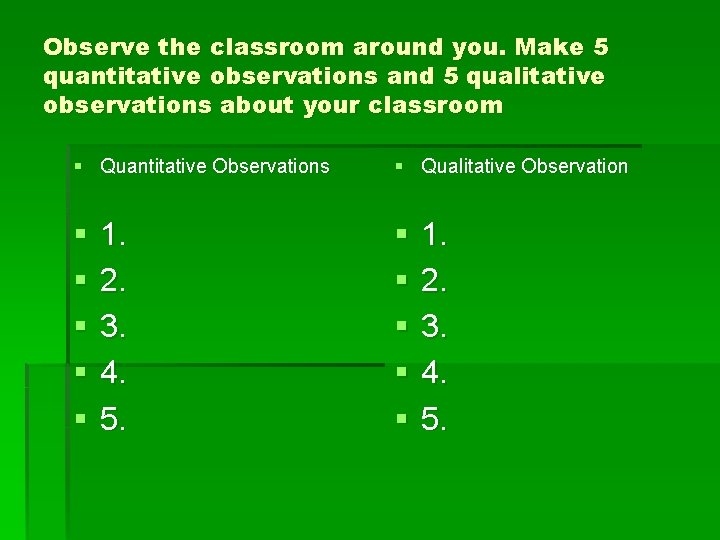
Observe the classroom around you. Make 5 quantitative observations and 5 qualitative observations about your classroom § Quantitative Observations § Qualitative Observation § § § § § 1. 2. 3. 4. 5.
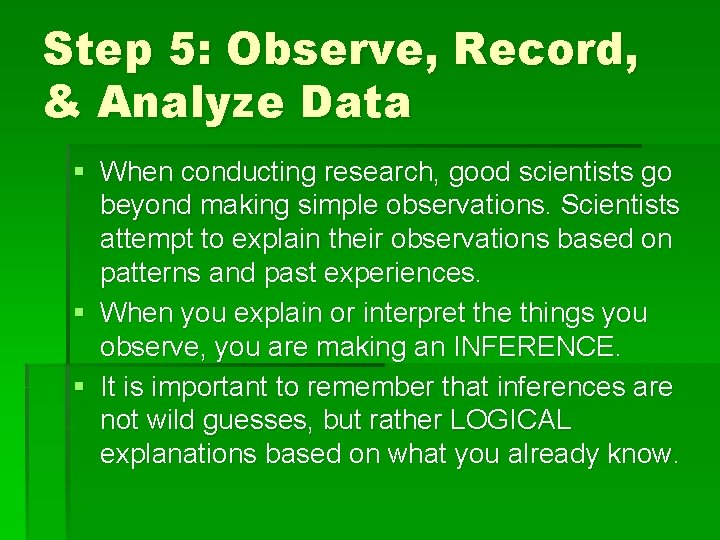
Step 5: Observe, Record, & Analyze Data § When conducting research, good scientists go beyond making simple observations. Scientists attempt to explain their observations based on patterns and past experiences. § When you explain or interpret the things you observe, you are making an INFERENCE. § It is important to remember that inferences are not wild guesses, but rather LOGICAL explanations based on what you already know.
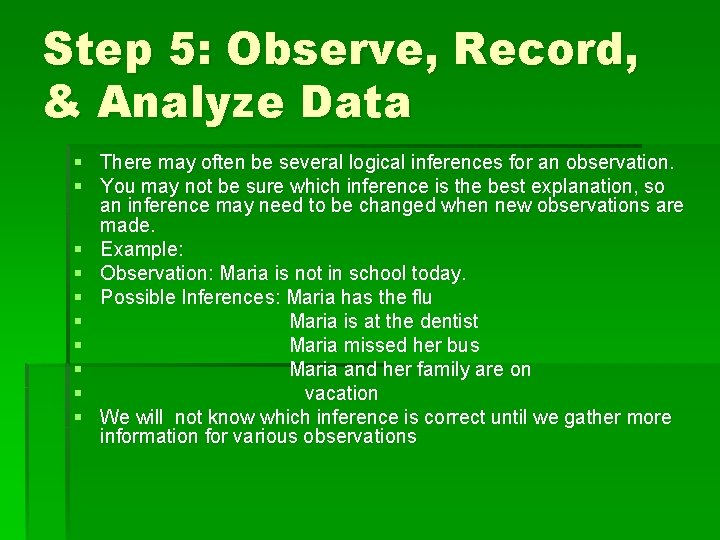
Step 5: Observe, Record, & Analyze Data § There may often be several logical inferences for an observation. § You may not be sure which inference is the best explanation, so an inference may need to be changed when new observations are made. § Example: § Observation: Maria is not in school today. § Possible Inferences: Maria has the flu § Maria is at the dentist § Maria missed her bus § Maria and her family are on § vacation § We will not know which inference is correct until we gather more information for various observations
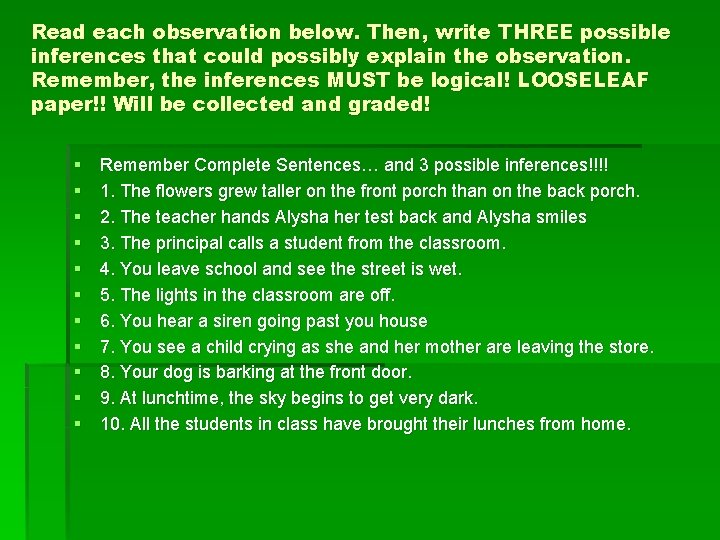
Read each observation below. Then, write THREE possible inferences that could possibly explain the observation. Remember, the inferences MUST be logical! LOOSELEAF paper!! Will be collected and graded! § § § Remember Complete Sentences… and 3 possible inferences!!!! 1. The flowers grew taller on the front porch than on the back porch. 2. The teacher hands Alysha her test back and Alysha smiles 3. The principal calls a student from the classroom. 4. You leave school and see the street is wet. 5. The lights in the classroom are off. 6. You hear a siren going past you house 7. You see a child crying as she and her mother are leaving the store. 8. Your dog is barking at the front door. 9. At lunchtime, the sky begins to get very dark. 10. All the students in class have brought their lunches from home.
Step 5: Observe, Record, & Analyze Data § Scientific observations need to be recorded in an organized way so the experimenter can analyze the information. § All experiments produce data, which are the facts, figures, and other evidence gathered through observations. § Making sense of the data is called data interpretation
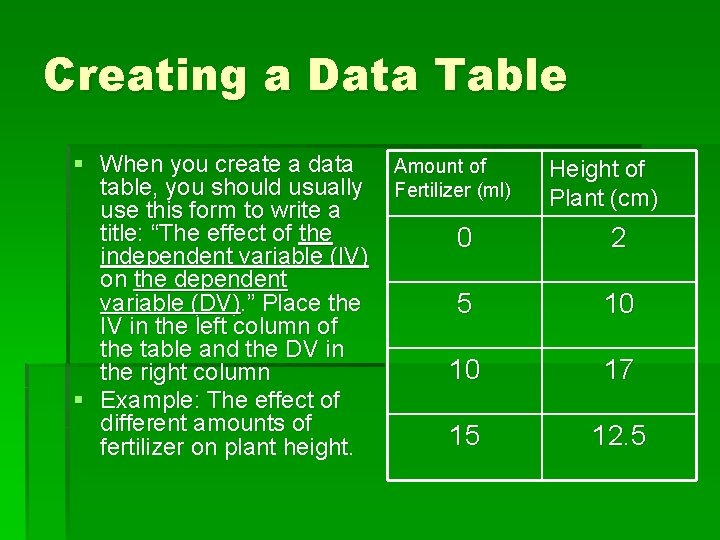
Creating a Data Table § When you create a data table, you should usually use this form to write a title: “The effect of the independent variable (IV) on the dependent variable (DV). ” Place the IV in the left column of the table and the DV in the right column § Example: The effect of different amounts of fertilizer on plant height. Amount of Fertilizer (ml) Height of Plant (cm) 0 2 5 10 10 17 15 12. 5
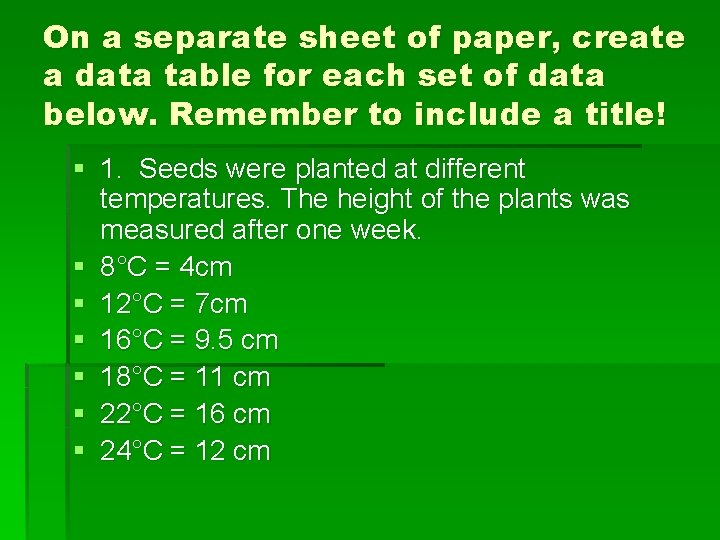
On a separate sheet of paper, create a data table for each set of data below. Remember to include a title! § 1. Seeds were planted at different temperatures. The height of the plants was measured after one week. § 8°C = 4 cm § 12°C = 7 cm § 16°C = 9. 5 cm § 18°C = 11 cm § 22°C = 16 cm § 24°C = 12 cm
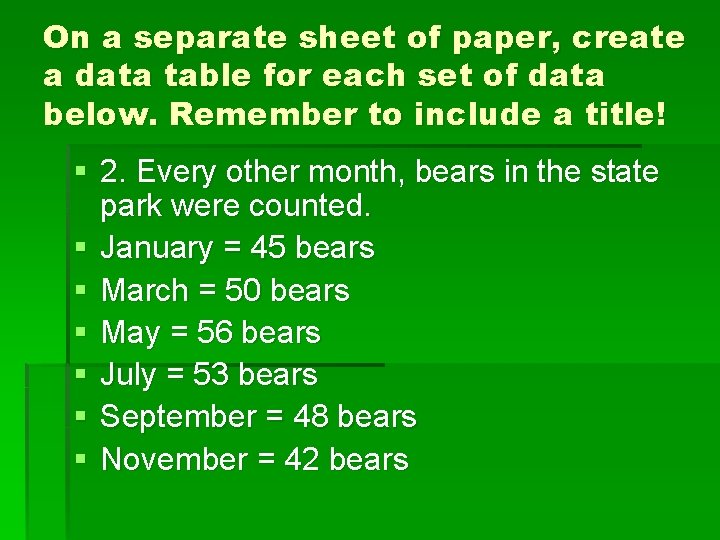
On a separate sheet of paper, create a data table for each set of data below. Remember to include a title! § 2. Every other month, bears in the state park were counted. § January = 45 bears § March = 50 bears § May = 56 bears § July = 53 bears § September = 48 bears § November = 42 bears
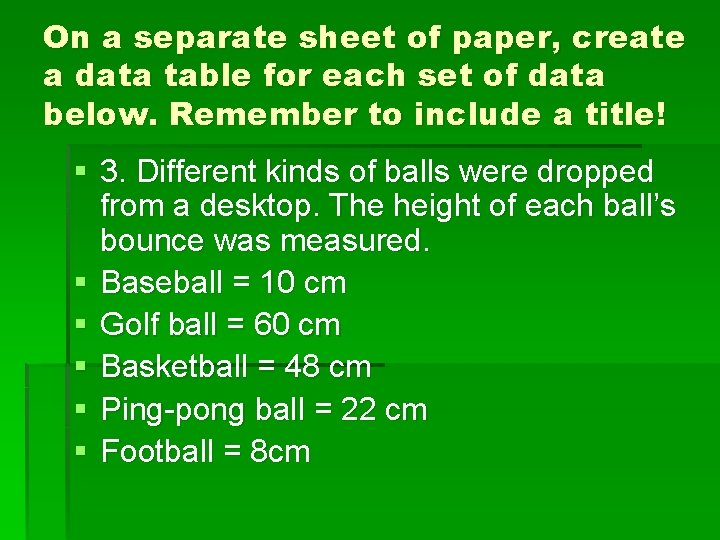
On a separate sheet of paper, create a data table for each set of data below. Remember to include a title! § 3. Different kinds of balls were dropped from a desktop. The height of each ball’s bounce was measured. § Baseball = 10 cm § Golf ball = 60 cm § Basketball = 48 cm § Ping-pong ball = 22 cm § Football = 8 cm
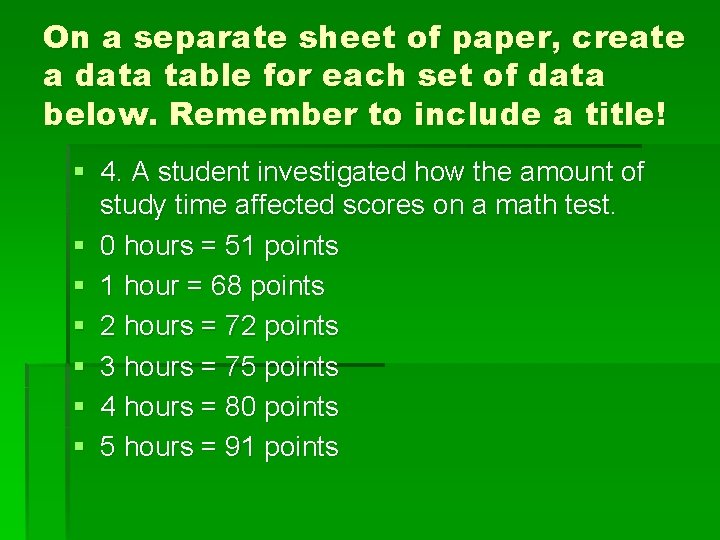
On a separate sheet of paper, create a data table for each set of data below. Remember to include a title! § 4. A student investigated how the amount of study time affected scores on a math test. § 0 hours = 51 points § 1 hour = 68 points § 2 hours = 72 points § 3 hours = 75 points § 4 hours = 80 points § 5 hours = 91 points
Step 5: Observe, Record, & Analyze Data § After making a data table, scientists look for patterns in their data. Often it is easiest to detect patterns once the data is put into graph form. § You must decide whether a line graph or a bar graph is appropriate for your data. § To decide which type of graph to use, look at you IV. If the IV represents the passage of time or change over time, make a line graph.
Step 5: Observe, Record, & Analyze Data § A graph should have a title, usually written in the form “The effect on the IV on the DV. ” § The IV is always written on the graph’s xaxis (horizontal axis), while the DV is placed on the y-axis (vertical axis). You must label each axis with its variables.
Setting up your graph Title: The effect of (IV) on (DV) See back board!
Homework Assignment! § Use the four data tables you created for items 1 -4, and on the piece of graph paper, make a graph for each data table. § Remember to give each graph a title and label each axis, including the unit of measure!
Step 6: Draw Conclusions § The final step in the scientific process is to draw conclusions. § A conclusion is a summary of what you have learned from the experiment. § When reaching conclusions, you should decide whether the data you collected supports your hypothesis or not. § It is also important to consider if you have collected enough data or if more testing needs to occur before a conclusion can be reached
Step 6: Draw Conclusions § An effective conclusion should summarize the findings of the experiment, state whether the hypothesis was supported by the data or not, and address any problems that happened during the experiment.
Step 6: Draw Conclusions § Examining the process you used and deciding if there were any unidentified or unexpected variables that could have affected the results is also necessary when drawing conclusions. § Remember, it is not a problem if the experiment does not turn out how you expected or does not support your hypothesis. § Conclusions often lead to new scientific questions and experiments!