
STEPS IN WRITING A WOD WHAT IS A





- Slides: 71
STEPS IN WRITING A WOD
WHAT IS A WOD? WRITING ON DEMAND GUIDELINES AND INTRODUCTION
WHAT IS A WRITING ON-DEMAND? • A 3 -5 paragraph essay that argues or explains a point and provides evidence to support that argument. • The essay can be timed OR untimed. • You must annotate 1 or more articles before your begin writing. • You will use the information from the articles in your paper to support your argument or opinion. • The essay will be in MLA format. It may be hand written or typed.
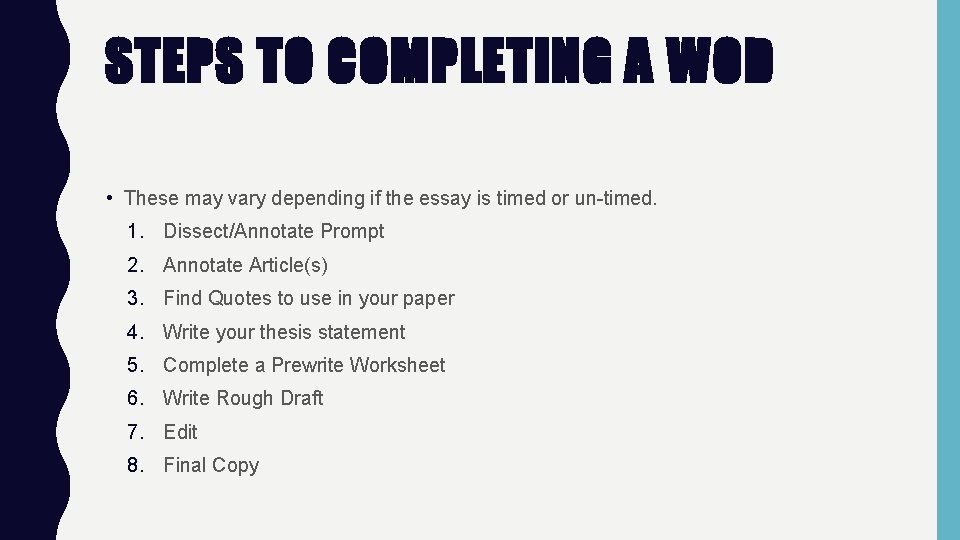
STEPS TO COMPLETING A WOD • These may vary depending if the essay is timed or un-timed. 1. Dissect/Annotate Prompt 2. Annotate Article(s) 3. Find Quotes to use in your paper 4. Write your thesis statement 5. Complete a Prewrite Worksheet 6. Write Rough Draft 7. Edit 8. Final Copy
COVER PAGE & PRE-WRITE SHEET
COVER PAGE • Background: – Information about the subject – Can contain directions • Prompt: – The question you will be responding to • Sources – Check to find the most reliable • New date? • Legit publication? – Which one is the visual
3 D PRINTING WOD
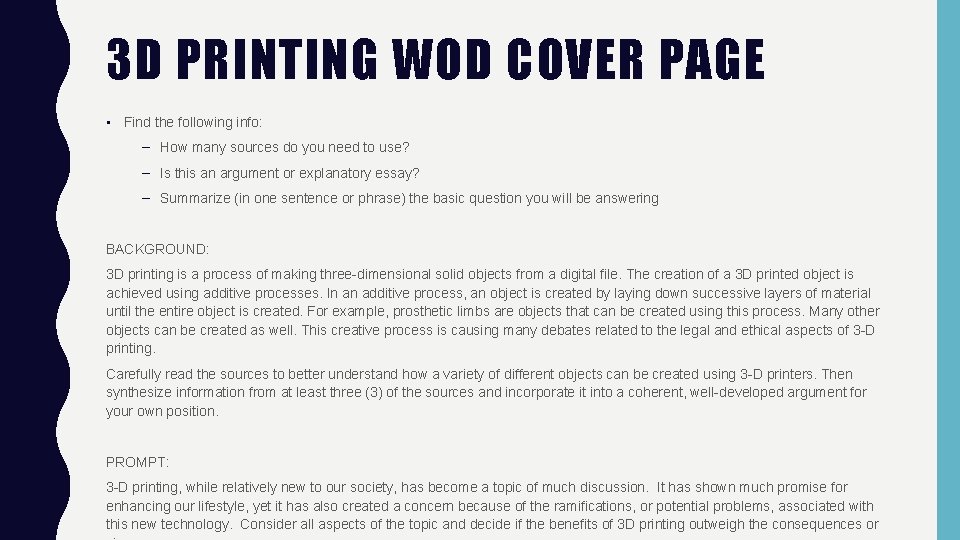
3 D PRINTING WOD COVER PAGE • Find the following info: – How many sources do you need to use? – Is this an argument or explanatory essay? – Summarize (in one sentence or phrase) the basic question you will be answering BACKGROUND: 3 D printing is a process of making three-dimensional solid objects from a digital file. The creation of a 3 D printed object is achieved using additive processes. In an additive process, an object is created by laying down successive layers of material until the entire object is created. For example, prosthetic limbs are objects that can be created using this process. Many other objects can be created as well. This creative process is causing many debates related to the legal and ethical aspects of 3 -D printing. Carefully read the sources to better understand how a variety of different objects can be created using 3 -D printers. Then synthesize information from at least three (3) of the sources and incorporate it into a coherent, well-developed argument for your own position. PROMPT: 3 -D printing, while relatively new to our society, has become a topic of much discussion. It has shown much promise for enhancing our lifestyle, yet it has also created a concern because of the ramifications, or potential problems, associated with this new technology. Consider all aspects of the topic and decide if the benefits of 3 D printing outweigh the consequences or
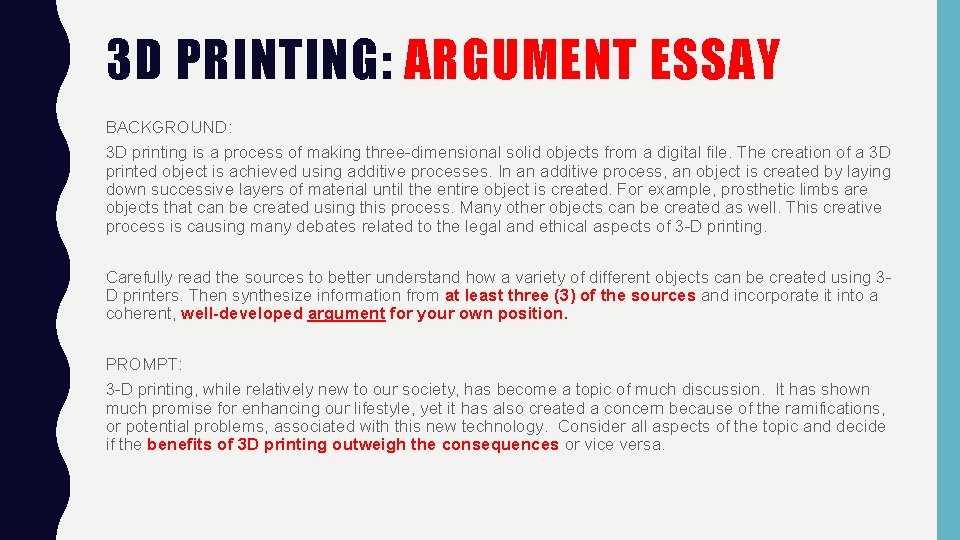
3 D PRINTING: ARGUMENT ESSAY BACKGROUND: 3 D printing is a process of making three-dimensional solid objects from a digital file. The creation of a 3 D printed object is achieved using additive processes. In an additive process, an object is created by laying down successive layers of material until the entire object is created. For example, prosthetic limbs are objects that can be created using this process. Many other objects can be created as well. This creative process is causing many debates related to the legal and ethical aspects of 3 -D printing. Carefully read the sources to better understand how a variety of different objects can be created using 3 D printers. Then synthesize information from at least three (3) of the sources and incorporate it into a coherent, well-developed argument for your own position. PROMPT: 3 -D printing, while relatively new to our society, has become a topic of much discussion. It has shown much promise for enhancing our lifestyle, yet it has also created a concern because of the ramifications, or potential problems, associated with this new technology. Consider all aspects of the topic and decide if the benefits of 3 D printing outweigh the consequences or vice versa.
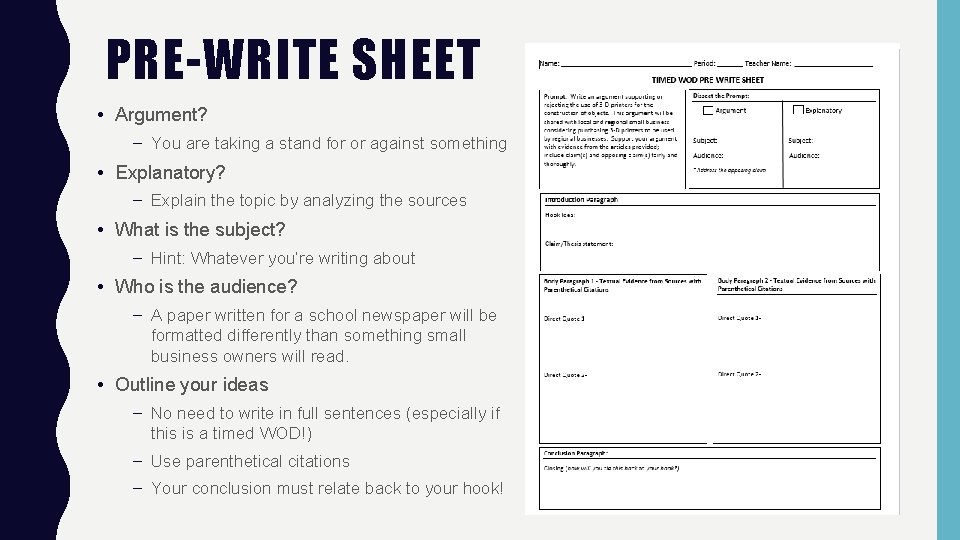
PRE-WRITE SHEET • Argument? – You are taking a stand for or against something • Explanatory? – Explain the topic by analyzing the sources • What is the subject? – Hint: Whatever you’re writing about • Who is the audience? – A paper written for a school newspaper will be formatted differently than something small business owners will read. • Outline your ideas – No need to write in full sentences (especially if this is a timed WOD!) – Use parenthetical citations – Your conclusion must relate back to your hook!
3 D PRINTING: • Argument – You are taking a stand for or against something – Do the benefits of 3 D printing outweigh the consequences or vice versa? • What is the subject? – Hint: Whatever you’re writing about – 3 D Printers • Who is the audience? – A paper written for a school newspaper will be formatted differently than something small business owners will read. – Teacher • Outline your ideas – No need to write in full sentences (especially if this is a timed WOD!) – Use parenthetical citations – Your conclusion must relate back to your hook! – Fill out the pre-write sheet
ANNOTATING
WHAT IS ANNOTATING? an·no·tate /ˈanəˌtāt/ verb • 1. add notes to (a text or diagram) giving explanation or comment "documentation should be annotated with explanatory notes" synonyms: comment on, add notes/footnotes to – AKA: Mark up the page with MEANINGFUL comments • The following are NOT annotations: – This is sad – – I think so too! – Random highlights without explanation
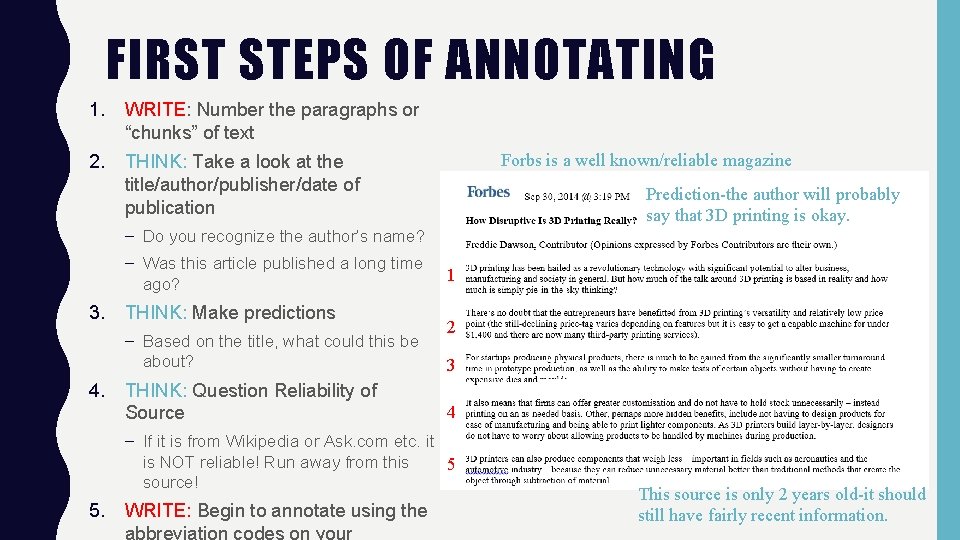
FIRST STEPS OF ANNOTATING 1. WRITE: Number the paragraphs or “chunks” of text 2. THINK: Take a look at the title/author/publisher/date of publication Forbs is a well known/reliable magazine Prediction-the author will probably say that 3 D printing is okay. – Do you recognize the author’s name? – Was this article published a long time ago? 3. THINK: Make predictions – Based on the title, what could this be about? 4. THINK: Question Reliability of Source 1 2 3 4 – If it is from Wikipedia or Ask. com etc. it is NOT reliable! Run away from this 5 source! 5. WRITE: Begin to annotate using the This source is only 2 years old-it should still have fairly recent information.
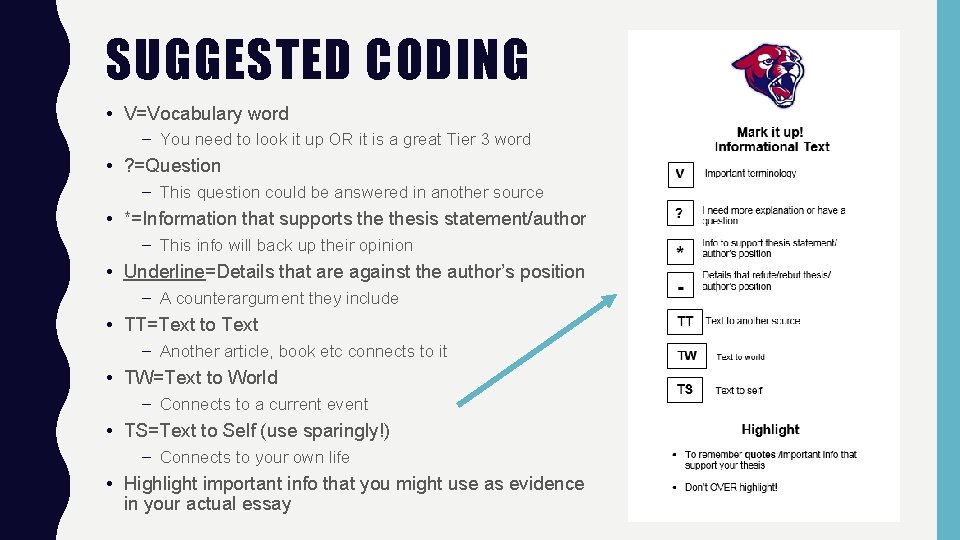
SUGGESTED CODING • V=Vocabulary word – You need to look it up OR it is a great Tier 3 word • ? =Question – This question could be answered in another source • *=Information that supports thesis statement/author – This info will back up their opinion • Underline=Details that are against the author’s position – A counterargument they include • TT=Text to Text – Another article, book etc connects to it • TW=Text to World – Connects to a current event • TS=Text to Self (use sparingly!) – Connects to your own life • Highlight important info that you might use as evidence in your actual essay
3 D PRINTING PRACTICE FOR ANNOTATING: • Look at the article “What 3 -D Printing Could Mean for Small Businesses” • Number every paragraph 1. THINK: Take a look at the title/author/publisher/date of publication – Do you recognize the author’s name? – Was this article published a long time ago? 2. THINK: Make predictions – Based on the title, what could this be about? 3. THINK: Question Reliability of Source • Each table is in charge of a different part of the bookmark • Decide as a class what you need to write • We will combine info as a class **Write in a different color than you originally did!**
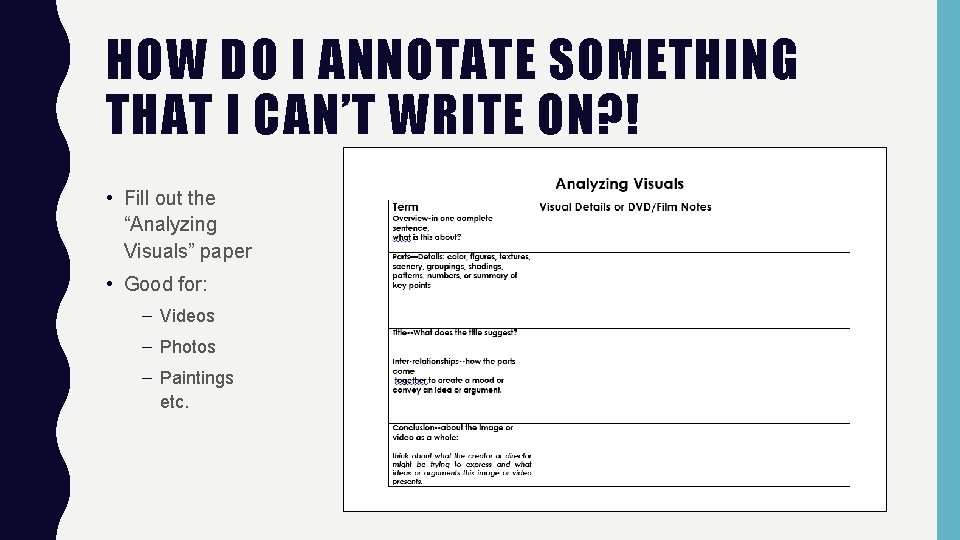
HOW DO I ANNOTATE SOMETHING THAT I CAN’T WRITE ON? ! • Fill out the “Analyzing Visuals” paper • Good for: – Videos – Photos – Paintings etc.
ORGANIZING THE OVERALL ESSAY
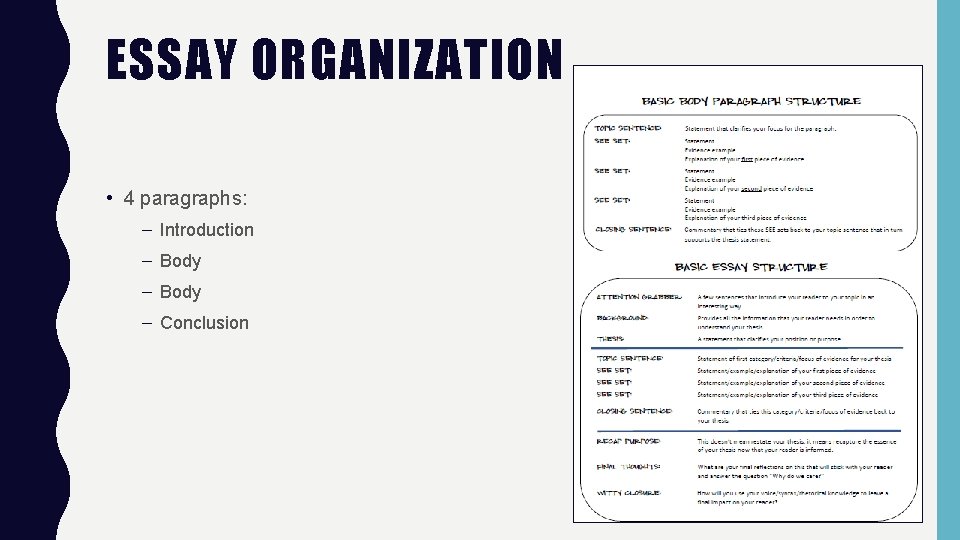
ESSAY ORGANIZATION • 4 paragraphs: – Introduction – Body – Conclusion
INTRODUCTION
INTRODUCTION SENTENCES • This paragraph introduces the topic and provides a roadmap for the rest of the paper. Introduction is 2 -4 sentences in length. • What do you need to include? – Attention Grabber- The first sentence to “hook” your audience – Thesis Statement – 1 sentence that explains… • Your stance • 2 reasons you are right (make sure you can back up your opinion with the information from the articles!)
HOOK/ATTENTION GRABBER IDEAS • Shocking statements – a startling statement can attract people easily to join the conversation. • Scene hook – the scene hook instantly instructs the mind of the reader to picture the scene. • Literary quote hooks –Certain quotes from popular works such as Romeo and Juliet could become really nice hooks especially when theme of the essay is a utopian one. • Humorous hook –You can use some humor in your essay by simply providing a statement that is ridiculously funny or absurd. Adding humor into your work makes the article more exciting and develops the reader’s interest into the topic.
AVOID THESE ATTENTION GRABBERS • Have you ever wondered…? • The definition of ____ is… • In this essay I will tell you about…
THESIS STATEMENT • A THESIS STATEMENT… It is one complete sentence that answers the prompt and contains two main ideas to support the response. It proves that your opinion is right! • How to Generate a Thesis Statement: – Almost all assignments, no matter how complicated, can be reduced to a single question. • For example, if your assignment is, “Write a report to the local school board explaining the potential benefits of using computers in a fourth-grade class. ” • Filter it to: “What are the potential benefits of using computers in a fourth-grade class? ”
ANSWER THE QUESTION Turn your answer to the question into a complete sentence…then you have your thesis! • Q: “What are the potential benefits of using computers in a fourth-grade class? ” • A: “The potential benefits of using computers in a fourth-grade class are. . . ” OR • A: “Using computers in a fourth-grade class promises to improve. . . ” (better option) • The answer to the question is thesis
BODY PARAGRAPHS
BODY PARAGRAPHS • 2 body paragraphs • Use SEE sets
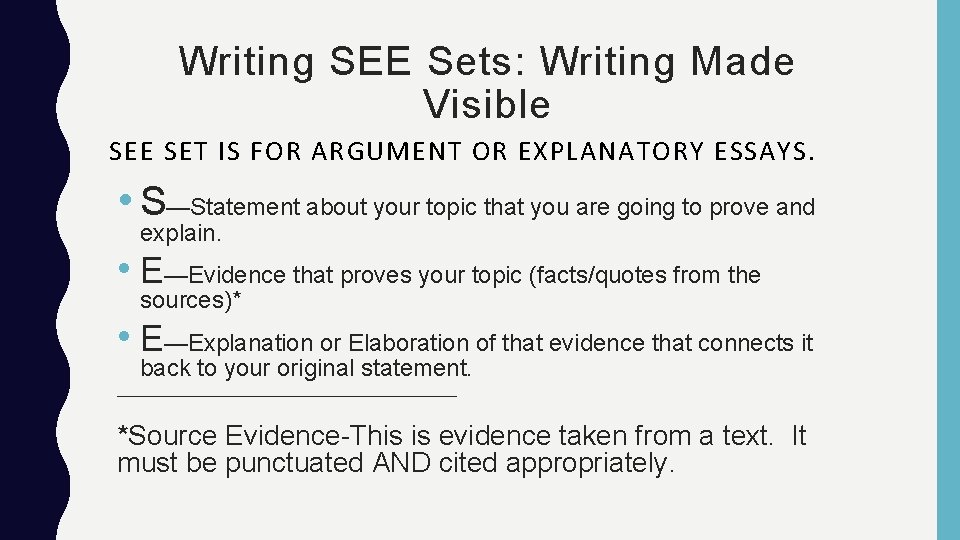
Writing SEE Sets: Writing Made Visible SEE SET IS FOR ARGUMENT OR EXPLANATORY ESSAYS. • S—Statement about your topic that you are going to prove and explain. • E—Evidence that proves your topic (facts/quotes from the sources)* • E—Explanation or Elaboration of that evidence that connects it back to your original statement. _______________________________ *Source Evidence-This is evidence taken from a text. It must be punctuated AND cited appropriately.
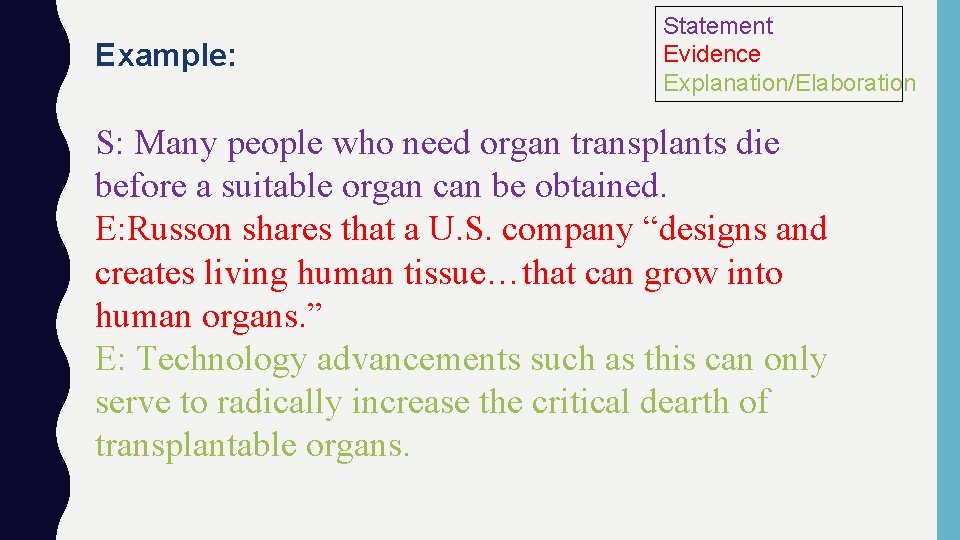
Example: Statement Evidence Explanation/Elaboration S: Many people who need organ transplants die before a suitable organ can be obtained. E: Russon shares that a U. S. company “designs and creates living human tissue…that can grow into human organs. ” E: Technology advancements such as this can only serve to radically increase the critical dearth of transplantable organs.
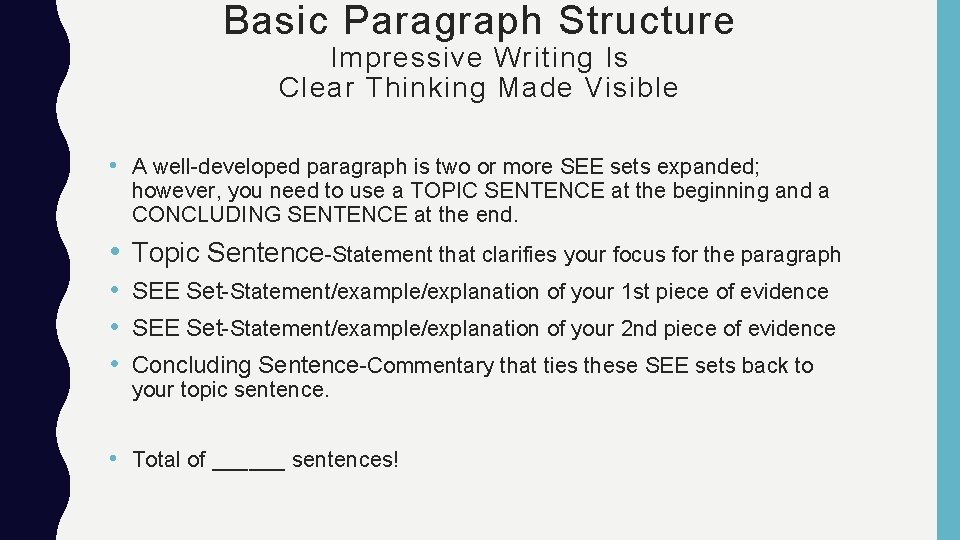
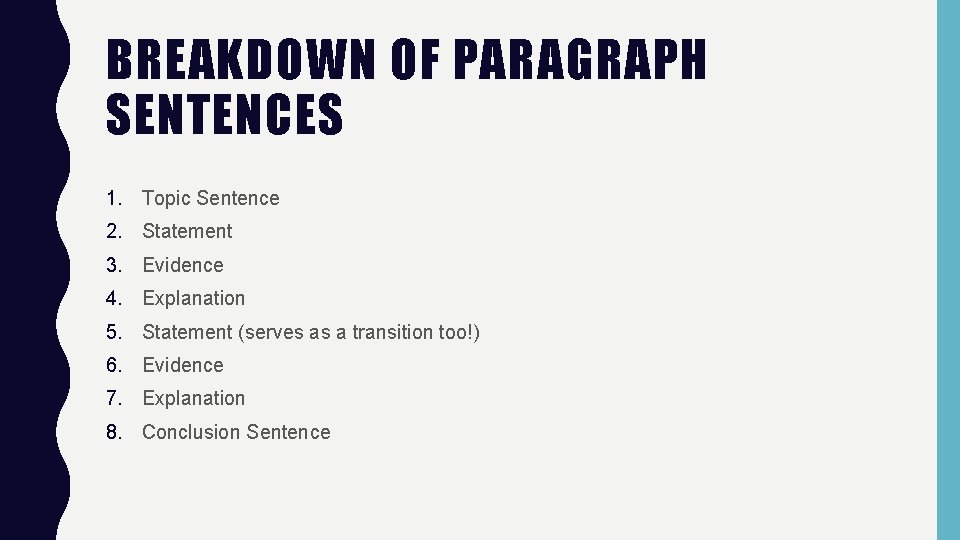
Basic Paragraph Structure Impressive Writing Is Clear Thinking Made Visible • A well-developed paragraph is two or more SEE sets expanded; however, you need to use a TOPIC SENTENCE at the beginning and a CONCLUDING SENTENCE at the end. • Topic Sentence-Statement that clarifies your focus for the paragraph • SEE Set-Statement/example/explanation of your 1 st piece of evidence • SEE Set-Statement/example/explanation of your 2 nd piece of evidence • Concluding Sentence-Commentary that ties these SEE sets back to your topic sentence. • Total of ______ sentences!
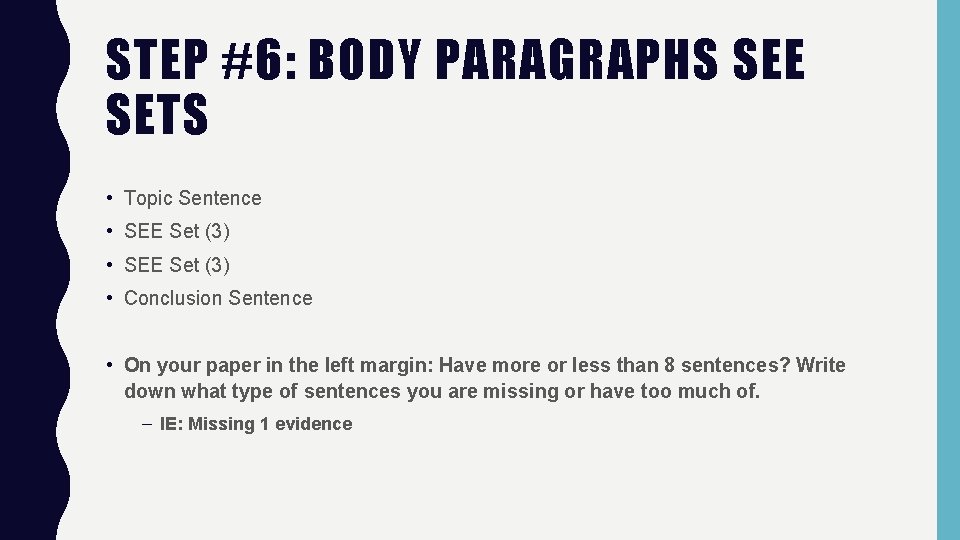
BREAKDOWN OF PARAGRAPH SENTENCES 1. Topic Sentence 2. Statement 3. Evidence 4. Explanation 5. Statement (serves as a transition too!) 6. Evidence 7. Explanation 8. Conclusion Sentence
THE COUNTERARGUMENT
COUNTER ARGUMENT • A paragraph on its own OR a single SEE set within your second body paragraph – Varies by essay • There is a reason your argument could be wrong…what is it? • Example: If you think 4 th grade classrooms should get computers…why would someone think they shouldn’t? – Too expensive – Should focus on handwriting – They can do everything out of a book
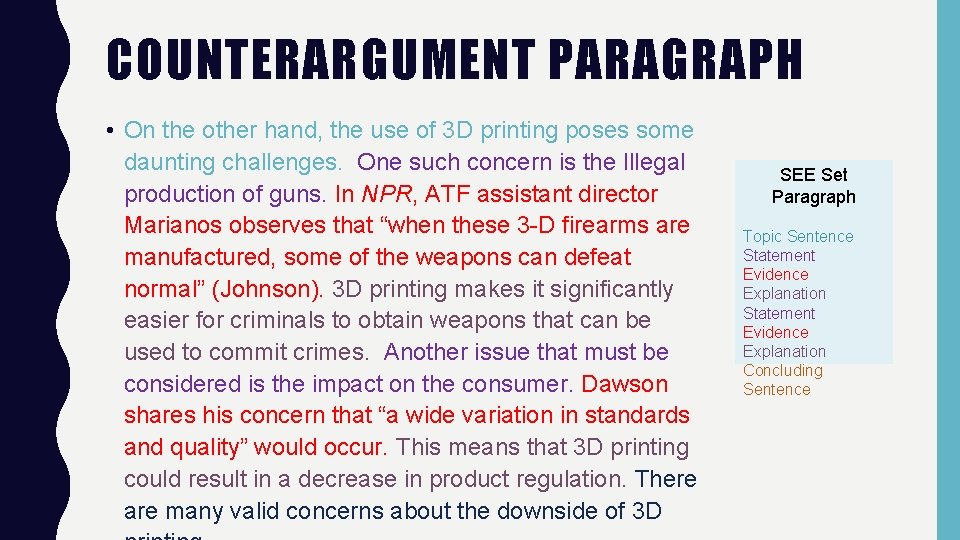
COUNTERARGUMENT PARAGRAPH • On the other hand, the use of 3 D printing poses some daunting challenges. One such concern is the Illegal production of guns. In NPR, ATF assistant director Marianos observes that “when these 3 -D firearms are manufactured, some of the weapons can defeat normal” (Johnson). 3 D printing makes it significantly easier for criminals to obtain weapons that can be used to commit crimes. Another issue that must be considered is the impact on the consumer. Dawson shares his concern that “a wide variation in standards and quality” would occur. This means that 3 D printing could result in a decrease in product regulation. There are many valid concerns about the downside of 3 D SEE Set Paragraph Topic Sentence Statement Evidence Explanation Concluding Sentence
THE CONCLUSION
CONCLUSION • This paragraph does not merely repeat what has already been said. Instead it offers new insight and leaves the reader with something to think about. This paragraph is 2 -3 sentences in length. • What do I need to include? – Restate your thesis using different words – Tie it back to your hook
TIER 2 VS. TIER 3 WORDS
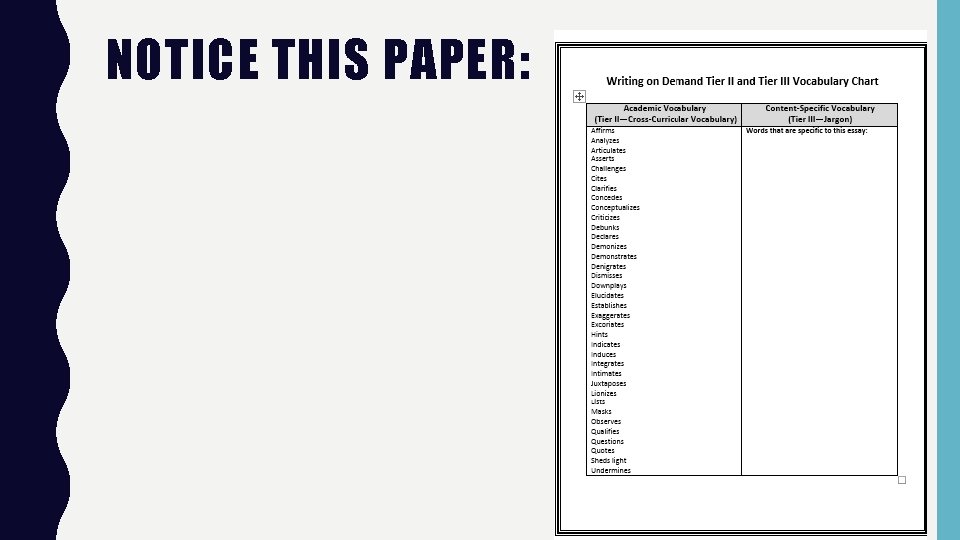
NOTICE THIS PAPER:
TIER 2 AND TIER 3 WORDS • Highlight in the essay you write • Be sure to provide the grader with a key! They need to know if a yellow highlight means Tier 2 or Tier 3
TIER 2 WORDS • AKA “Power Verbs” AKA Jargon or check the Word Wall! • Serve as a way to introduce a quote • You can use these in ALL of your writing on demands • Examples: – Acknowledges – Justifies – Qualifies – Questions – Clarifies
BAD TIER 2 WORDS • Says • Writes
TIER 3 WORDS • Specific to whatever the topic is • You will only use these Tier 3 words on this WOD • Examples for the 3 D printer WOD: – 3 D – Technology – Printing – Manufactures – Technical
HOW TO CITE
CITATIONS • You have to give the author credit for his/her ideas • Requirements: – Put their words in “quotation marks” in order to show that they are the one who came up with it – Include their name… • 2 types of citations – Parenthetical citations: last name of the author is in parentheses at the end of the sentence OR – Embedded citations: In the lead in of a sentence include the author’s
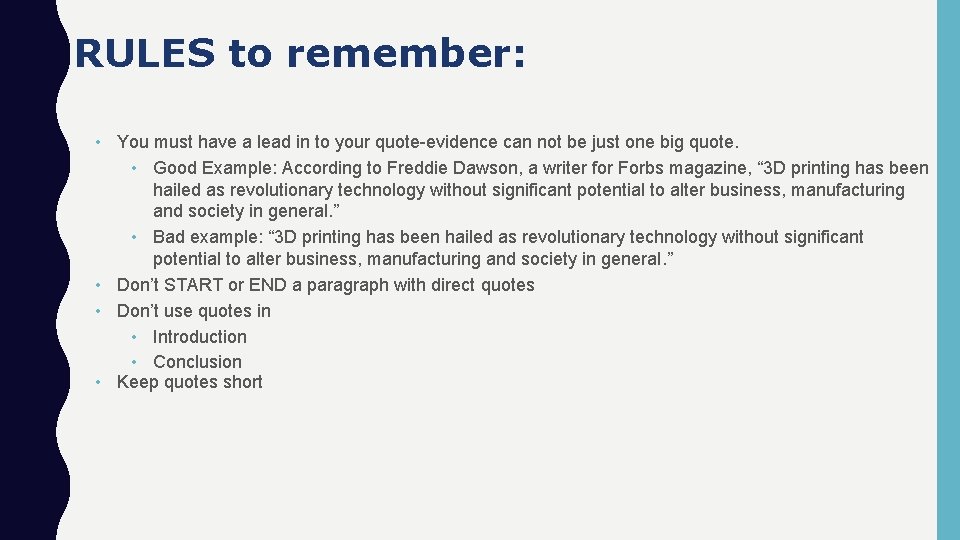
RULES to remember: • You must have a lead in to your quote-evidence can not be just one big quote. • Good Example: According to Freddie Dawson, a writer for Forbs magazine, “ 3 D printing has been hailed as revolutionary technology without significant potential to alter business, manufacturing and society in general. ” • Bad example: “ 3 D printing has been hailed as revolutionary technology without significant potential to alter business, manufacturing and society in general. ” • Don’t START or END a paragraph with direct quotes • Don’t use quotes in • Introduction • Conclusion • Keep quotes short
RULES CONTINUED: • Your quote must make sense in your sentence. – Bad: John Patrick Pullen, writer for Entrepreneur likes 3 -D printers “ 3 -D printers can't print money, but they can produce prototypes for almost anything else. ” – Good: John Patrick Pullen, writer for Entrepreneur, knows there’s limitations to 3 -D printing, but also recognizes the merits of it when he clarifies that, “ 3 -D printers can't print money, but they can produce prototypes for almost anything else. ”
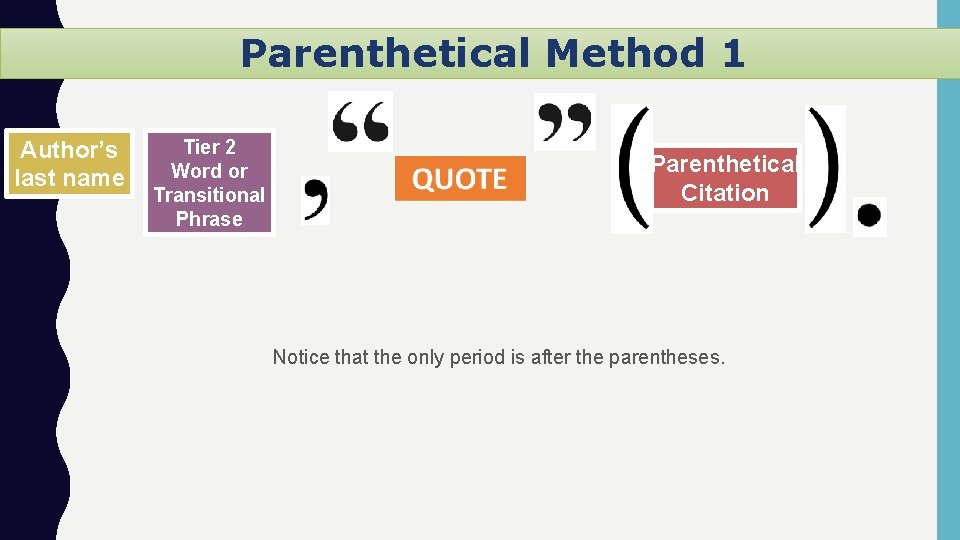
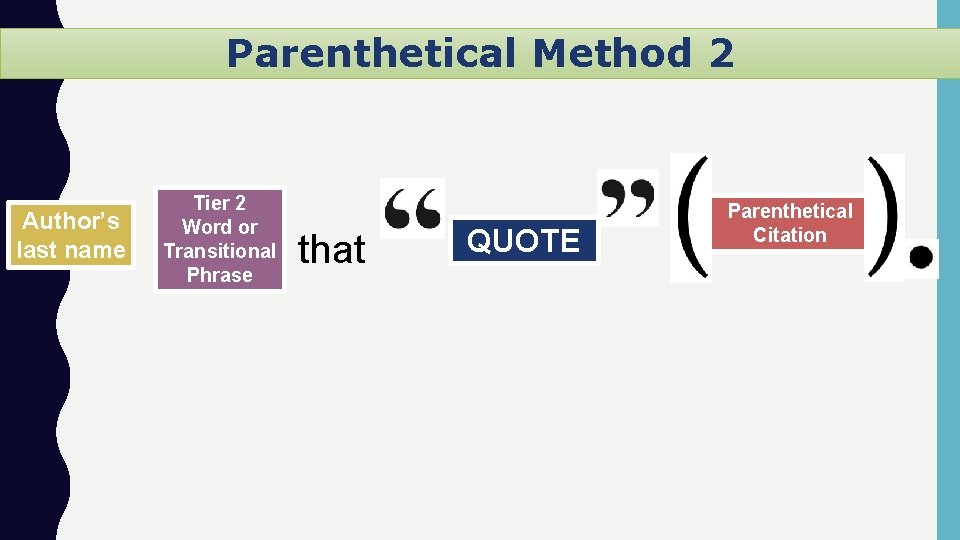
PARENTHETICAL CITATIONS Citations that give the “quote and credit the author in parentheses” (Author Last Name).
Parenthetical Method 1 Author’s last name Tier 2 Word or Transitional Phrase Parenthetical Citation Notice that the only period is after the parentheses.
Parenthetical Method 2 Author’s last name Tier 2 Word or Transitional Phrase that QUOTE Parenthetical Citation
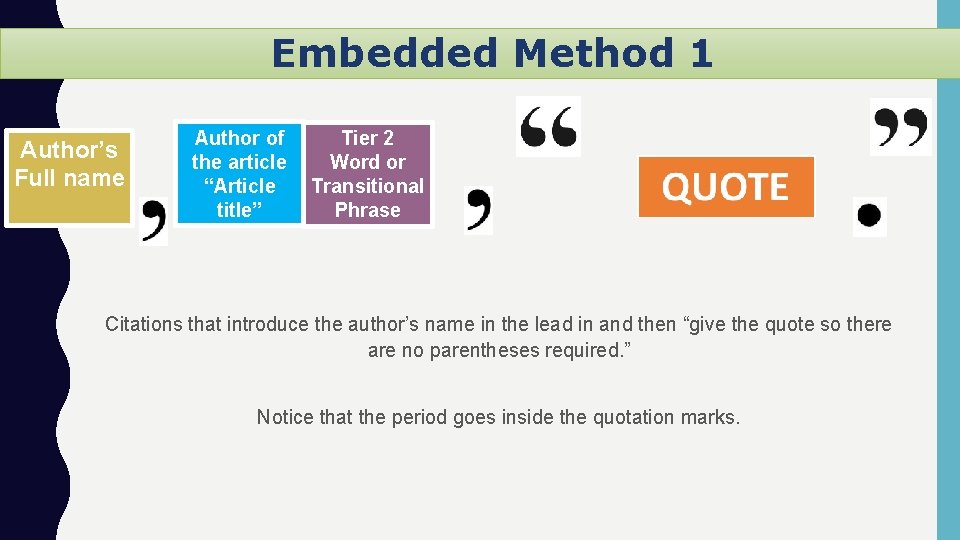
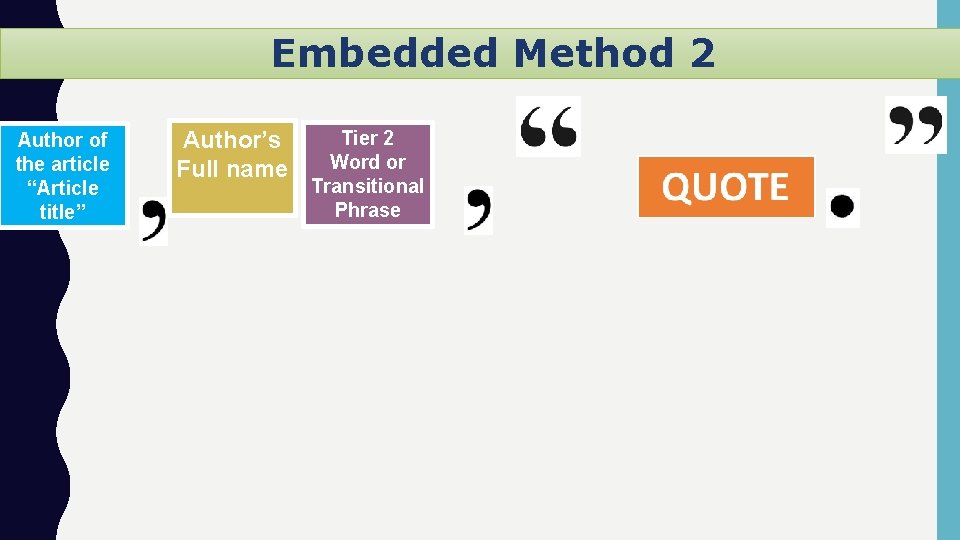
EMBEDDED CITATIONS Citations that introduce the author’s name in the lead in and then “give the quote so there are no parentheses required. ” Notice that the period goes inside the quotation marks.
Embedded Method 1 Author’s Full name Author of the article “Article title” Tier 2 Word or Transitional Phrase Citations that introduce the author’s name in the lead in and then “give the quote so there are no parentheses required. ” Notice that the period goes inside the quotation marks.
Embedded Method 2 Author of the article “Article title” Author’s Full name Tier 2 Word or Transitional Phrase
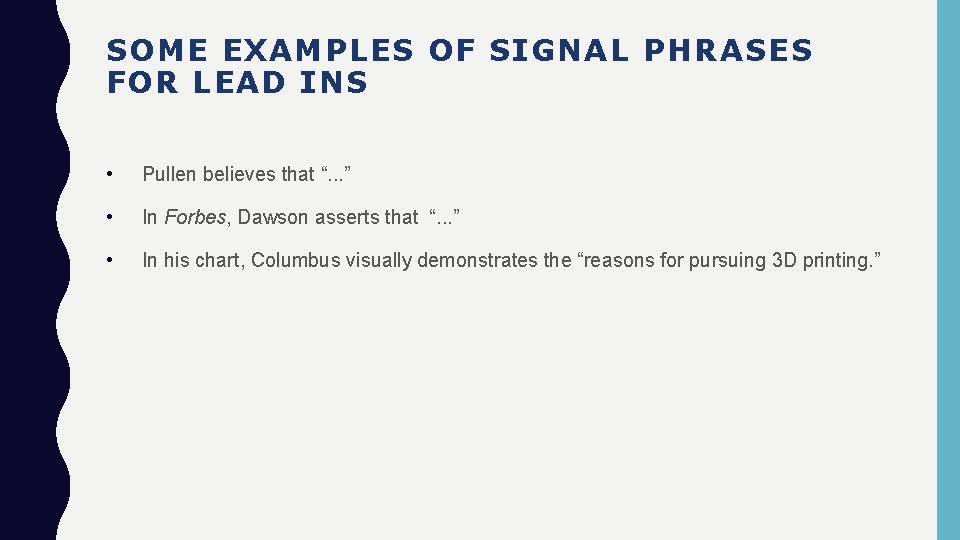
SOME EXAMPLES OF SIGNAL PHRASES FOR LEAD INS • Pullen believes that “. . . ” • In Forbes, Dawson asserts that “. . . ” • In his chart, Columbus visually demonstrates the “reasons for pursuing 3 D printing. ”
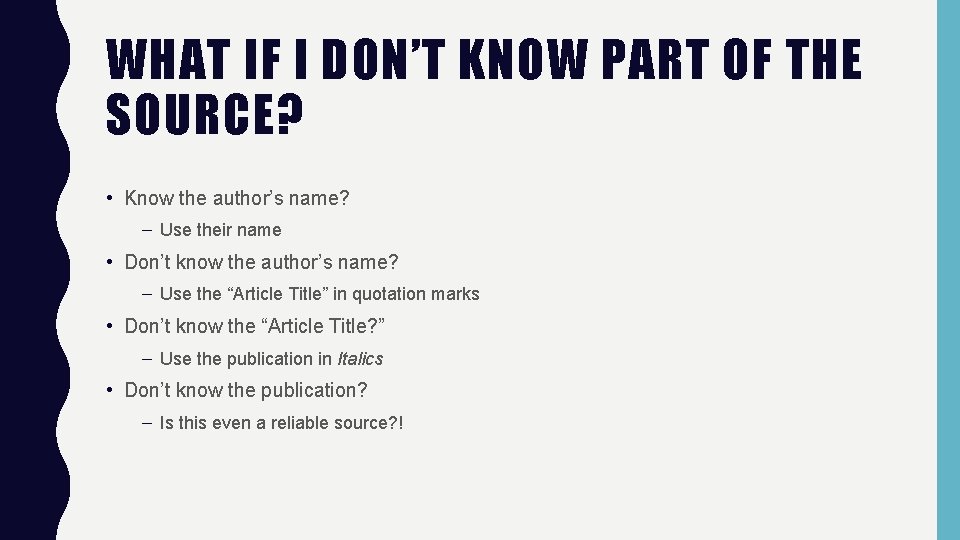
WHAT IF I DON’T KNOW PART OF THE SOURCE? • Know the author’s name? – Use their name • Don’t know the author’s name? – Use the “Article Title” in quotation marks • Don’t know the “Article Title? ” – Use the publication in Italics • Don’t know the publication? – Is this even a reliable source? !
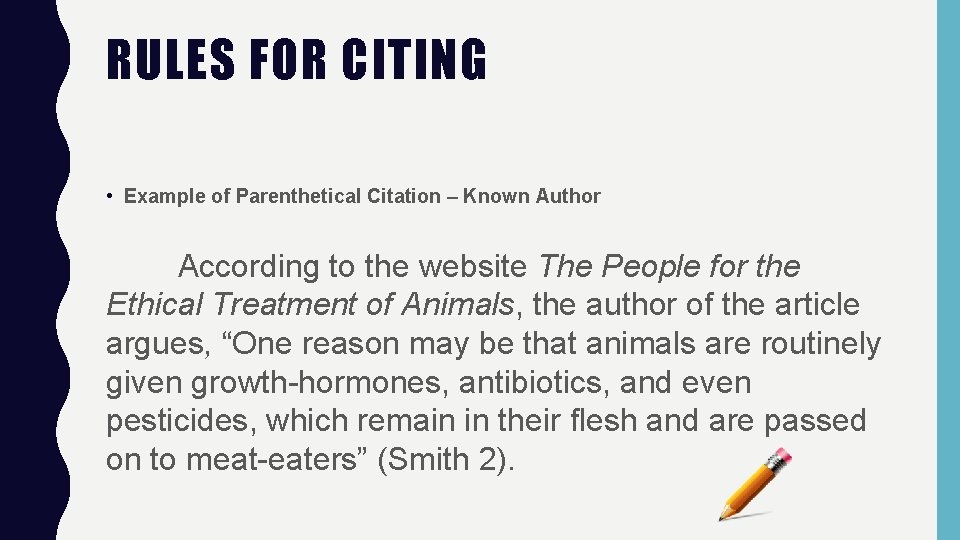
RULES FOR CITING • Example of Parenthetical Citation – Known Author According to the website The People for the Ethical Treatment of Animals, the author of the article argues, “One reason may be that animals are routinely given growth-hormones, antibiotics, and even pesticides, which remain in their flesh and are passed on to meat-eaters” (Smith 2).
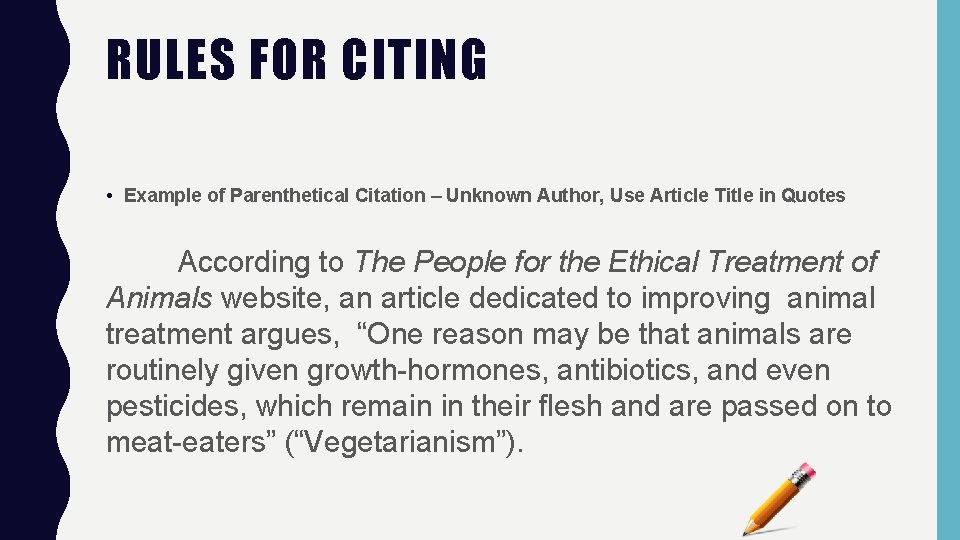
RULES FOR CITING • Example of Parenthetical Citation – Unknown Author, Use Article Title in Quotes According to The People for the Ethical Treatment of Animals website, an article dedicated to improving animal treatment argues, “One reason may be that animals are routinely given growth-hormones, antibiotics, and even pesticides, which remain in their flesh and are passed on to meat-eaters” (“Vegetarianism”).
Let’s practice 1. Use your WOD essay 2. Examine each quote/evidence in your essay 3. Reformat each quote/evidence to be sure that each has: a. author / source b. Tier 2 word c. parenthetical citation (if needed)
HOW I GRADE YOUR WOD PRETEND YOU ARE GRADING WITH ME, AND FIX YOUR OWN ERRORS.
STEP #1: BASIC CONVENTIONS ETC. • Needs correct grammar, word choice, sentence fluency • On your paper: Fix any convention errors
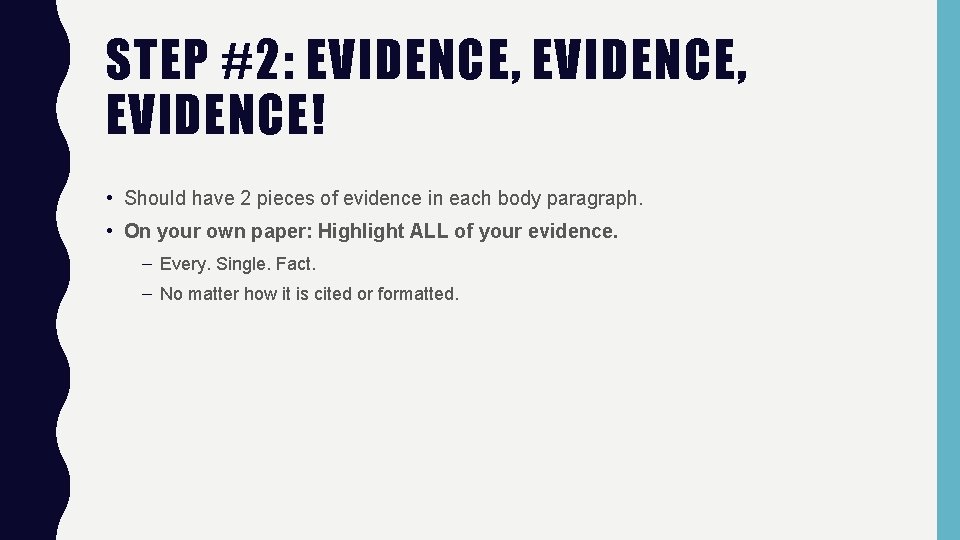
STEP #2: EVIDENCE, EVIDENCE! • Should have 2 pieces of evidence in each body paragraph. • On your own paper: Highlight ALL of your evidence. – Every. Single. Fact. – No matter how it is cited or formatted.
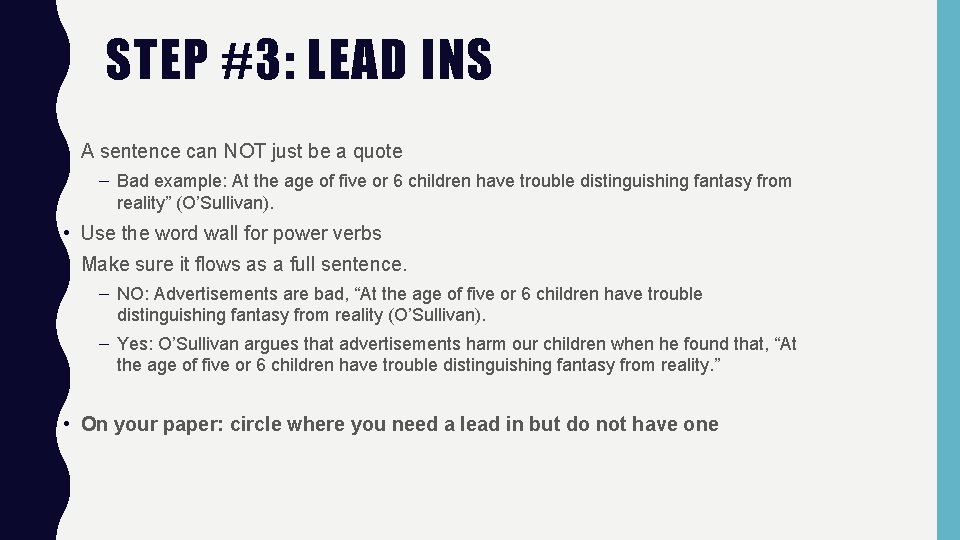
STEP #3: LEAD INS • A sentence can NOT just be a quote – Bad example: At the age of five or 6 children have trouble distinguishing fantasy from reality” (O’Sullivan). • Use the word wall for power verbs • Make sure it flows as a full sentence. – NO: Advertisements are bad, “At the age of five or 6 children have trouble distinguishing fantasy from reality (O’Sullivan). – Yes: O’Sullivan argues that advertisements harm our children when he found that, “At the age of five or 6 children have trouble distinguishing fantasy from reality. ” • On your paper: circle where you need a lead in but do not have one
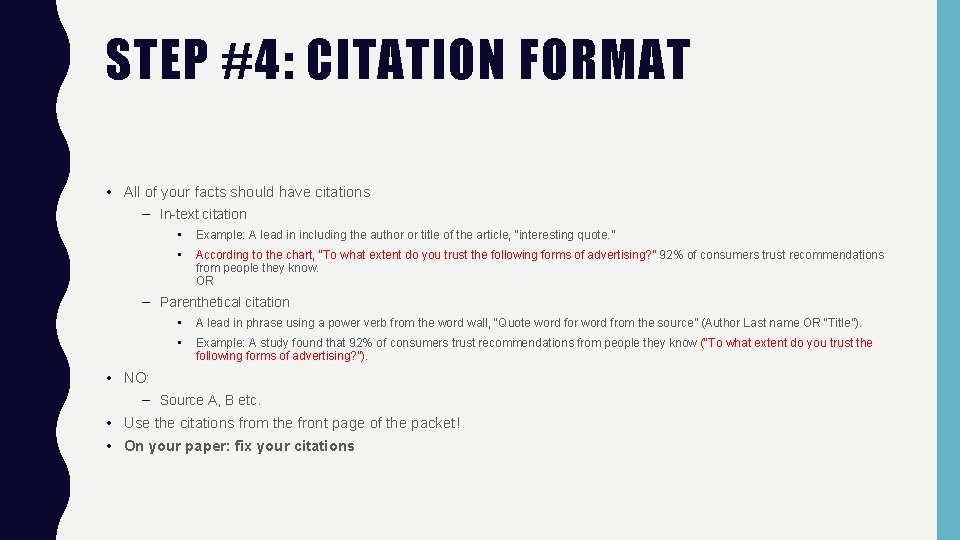
STEP #4: CITATION FORMAT • All of your facts should have citations – In-text citation • Example: A lead in including the author or title of the article, “interesting quote. ” • According to the chart, “To what extent do you trust the following forms of advertising? ” 92% of consumers trust recommendations from people they know. OR – Parenthetical citation • A lead in phrase using a power verb from the word wall, “Quote word for word from the source” (Author Last name OR “Title”). • Example: A study found that 92% of consumers trust recommendations from people they know (“To what extent do you trust the following forms of advertising? ”). • NO: – Source A, B etc. • Use the citations from the front page of the packet! • On your paper: fix your citations
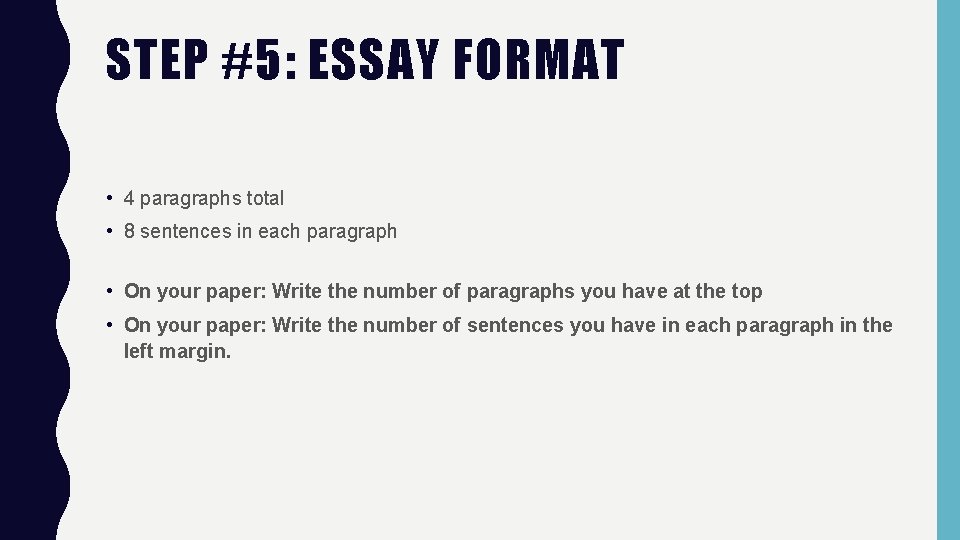
STEP #5: ESSAY FORMAT • 4 paragraphs total • 8 sentences in each paragraph • On your paper: Write the number of paragraphs you have at the top • On your paper: Write the number of sentences you have in each paragraph in the left margin.
STEP #6: BODY PARAGRAPHS SEE SETS • Topic Sentence • SEE Set (3) • Conclusion Sentence • On your paper in the left margin: Have more or less than 8 sentences? Write down what type of sentences you are missing or have too much of. – IE: Missing 1 evidence
STEP #7: INTRODUCTION • Attention grabber – NO! • Have you ever wondered…? • Did you know…? • Advertisements are everywhere • Lots of people see advertisements • Background – Lead up to if your thesis is going to support advertisements or not • Thesis – Effect – Two reasons • On your paper: Re-write your attention grabber and thesis (if necessary)
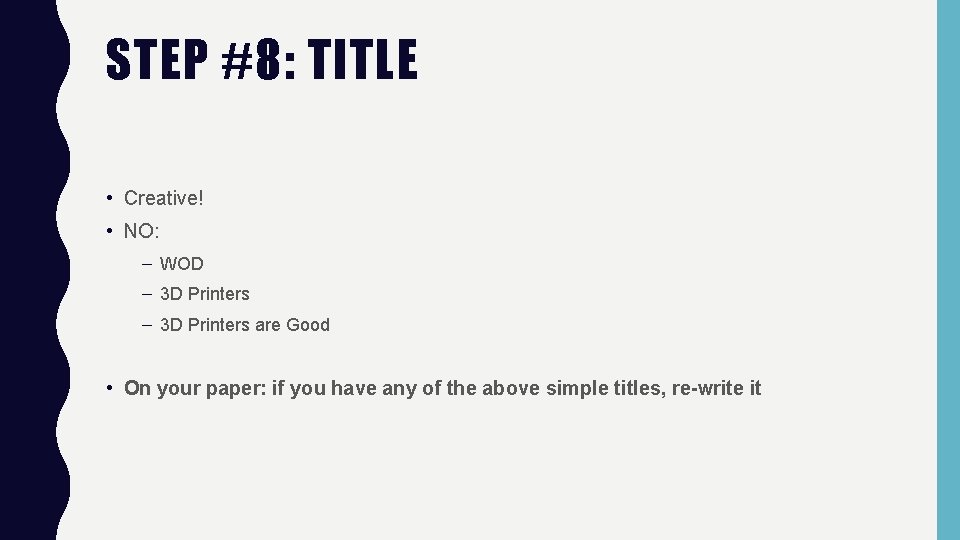
STEP #8: TITLE • Creative! • NO: – WOD – 3 D Printers are Good • On your paper: if you have any of the above simple titles, re-write it
STEP #9: FIRST PERSON • No I, me, us, our, we • On your paper: Cross out any first person words
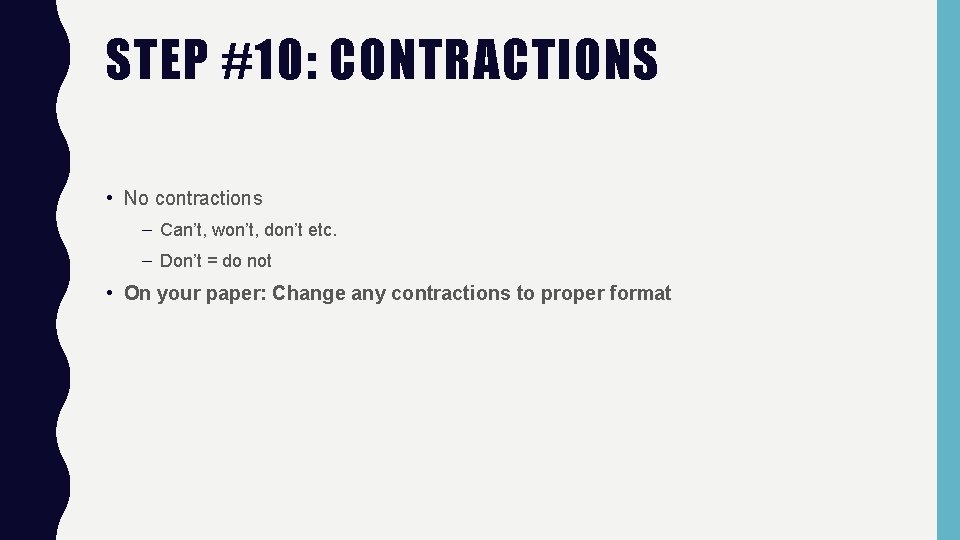
STEP #10: CONTRACTIONS • No contractions – Can’t, won’t, don’t etc. – Don’t = do not • On your paper: Change any contractions to proper format
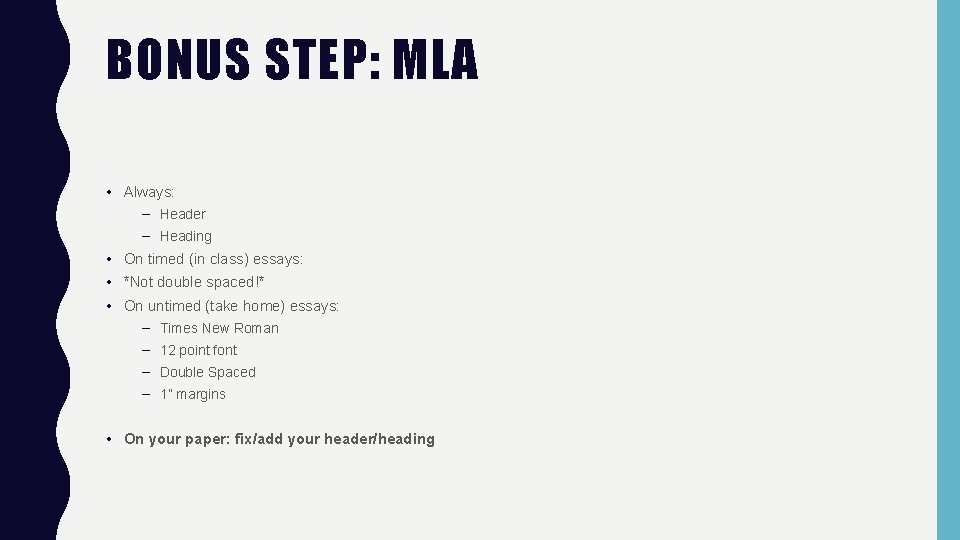
BONUS STEP: MLA • Always: – Header – Heading • On timed (in class) essays: • *Not double spaced!* • On untimed (take home) essays: – Times New Roman – 12 point font – Double Spaced – 1” margins • On your paper: fix/add your header/heading
ADDITIONAL PRACTICE
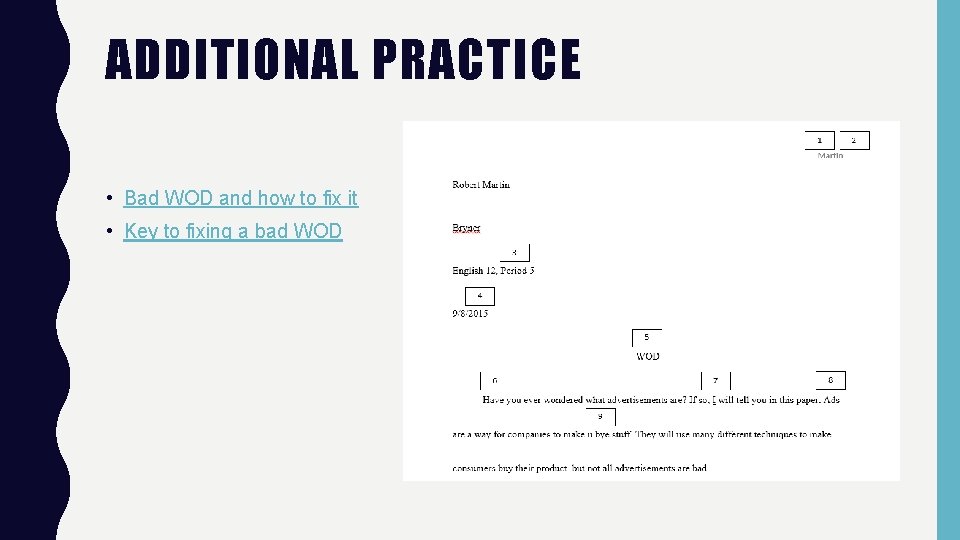
ADDITIONAL PRACTICE • Bad WOD and how to fix it • Key to fixing a bad WOD