
Steps in the writing process 1 Inventing Collecting


![Brackets [ ] Sometimes you may want to insert something into a quotation for](https://slidetodoc.com/presentation_image_h2/6d7c9dcd5c2dc0a69fdcc6db686775ad/image-29.jpg "Brackets [ ] Sometimes you may want to insert something into a quotation for")

- Slides: 35
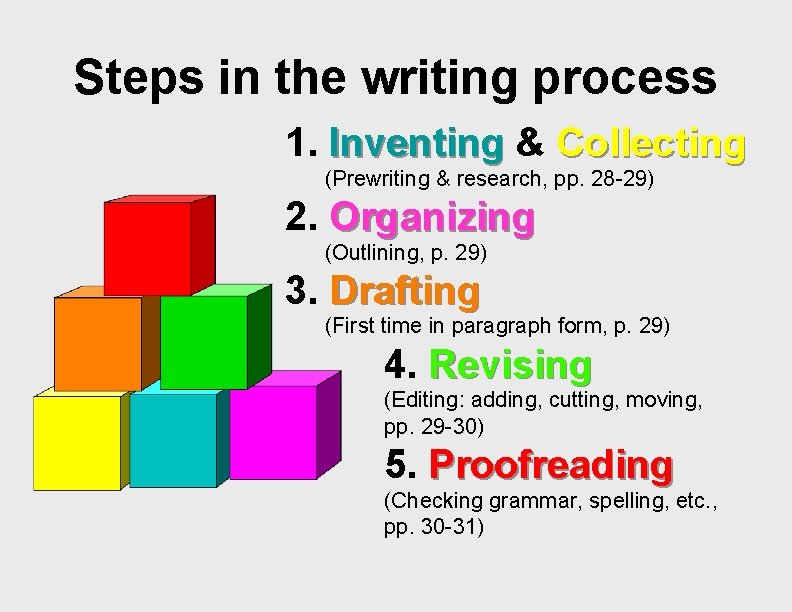
Steps in the writing process 1. Inventing & Collecting (Prewriting & research, pp. 28 -29) 2. Organizing (Outlining, p. 29) 3. Drafting (First time in paragraph form, p. 29) 4. Revising (Editing: adding, cutting, moving, pp. 29 -30) 5. Proofreading (Checking grammar, spelling, etc. , pp. 30 -31)
REVIEW: What is a thesis statement? The MOST IMPORTANT SENTENCE in your paper © Lets the reader know the main idea of the paper © Answers the question: “What am I trying to prove? ” © Not a factual statement, but a claim that has to be proven throughout the paper © Purdue University Writing Lab
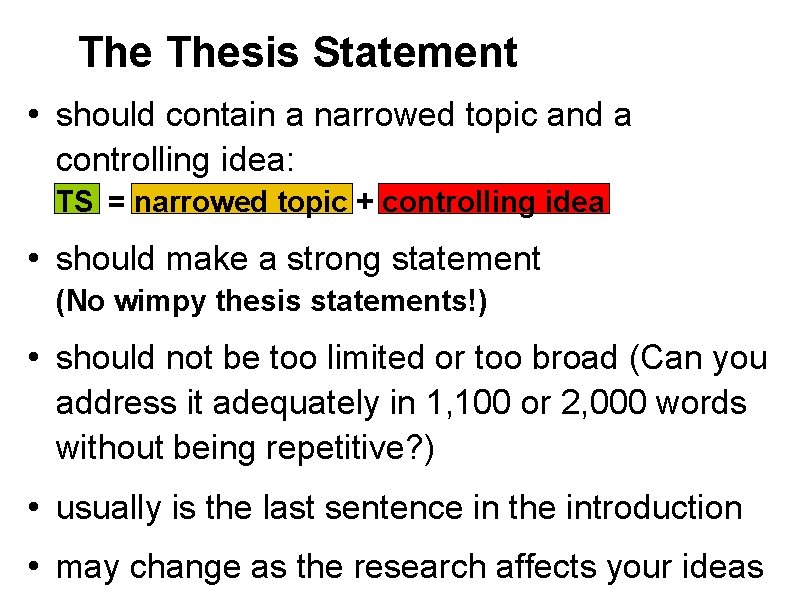
The Thesis Statement • should contain a narrowed topic and a controlling idea: TS = narrowed topic + controlling idea • should make a strong statement (No wimpy thesis statements!) • should not be too limited or too broad (Can you address it adequately in 1, 100 or 2, 000 words without being repetitive? ) • usually is the last sentence in the introduction • may change as the research affects your ideas
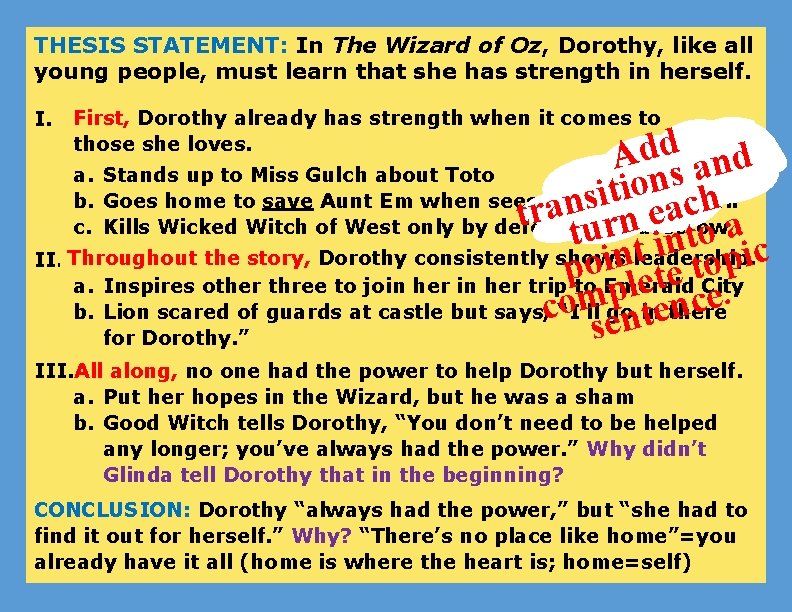
THESIS STATEMENT: In The Wizard of Oz, Dorothy, like all young people, must learn that she has strength in herself. I. First, Dorothy already has strength it comes to she Dorothy already has strength when it comes to those loves. she loves. a. Stands up to Miss Gulch about Toto b. Goes home to save Aunt Em when sees her in crystal ball c. Kills Wicked Witch of West only by defending Scarecrow Adds and n o i t i s n a tr urn eacoh a t t n i t c the story, shows Dorothy consistently shows leadership. II. Throughout Dorothy consistently leadership. i n i p o o p lete t. City a. Inspires other three to join her trip to Emerald p. e m c o b. Lion scared of guards at castle but says, c“I’ll go in there n e t n se for Dorothy. ” III. All along, no one had the power to help Dorothy but herself. a. Put her hopes in the Wizard, but he was a sham b. Good Witch tells Dorothy, “You don’t need to be helped any longer; you’ve always had the power. ” Why didn’t Glinda tell Dorothy that in the beginning? CONCLUSION: Dorothy “always had the power, ” but “she had to find it out for herself. ” Why? “There’s no place like home”=you already have it all (home is where the heart is; home=self)
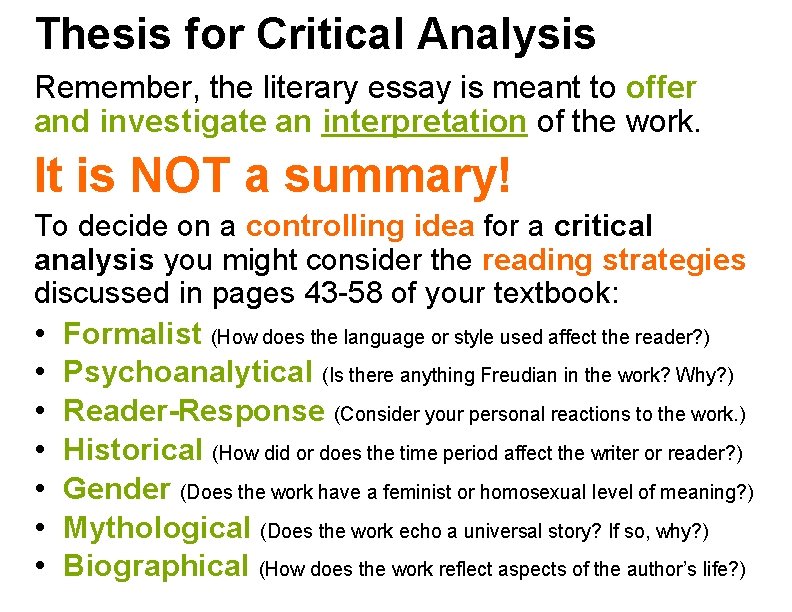
Thesis for Critical Analysis Remember, the literary essay is meant to offer and investigate an interpretation of the work. It is NOT a summary! To decide on a controlling idea for a critical analysis you might consider the reading strategies discussed in pages 43 -58 of your textbook: • Formalist (How does the language or style used affect the reader? ) • Psychoanalytical (Is there anything Freudian in the work? Why? ) • Reader-Response (Consider your personal reactions to the work. ) • Historical (How did or does the time period affect the writer or reader? ) • Gender (Does the work have a feminist or homosexual level of meaning? ) • Mythological (Does the work echo a universal story? If so, why? ) • Biographical (How does the work reflect aspects of the author’s life? )
SUPPORT The strongest evidence is usually EXPERT INFORMATION and DIRECT QUOTES. As a rule, include one of each in every body paragraph. These will need formal citations.
QUOTATIONS Quotations should be chosen carefully and used sparingly (about one per body paragraph). Choose ones that say something significant in a memorable way. Quotations must be copied EXACTLY (letter for letter) as they appear in the original! Then don’t forget to explain the evidence (such as quotes) that you provide. “Connect the dots” to be sure that the your readers understand.
Have no idea where to include quotations in your paragraphs? Try following this formula in a body paragraph: (1. ) PRIMARY SUPPORT POINT to support thesis in the topic sentence of this paragraph. (2. ) DETAIL in the second sentence to bring the primary point to life. (3. ) QUOTATION in the third sentence to prove the point. (4. ) EXPLANATION follows to make the significance of the quote and the point clear. The topic sentence is your own point, not a quote.
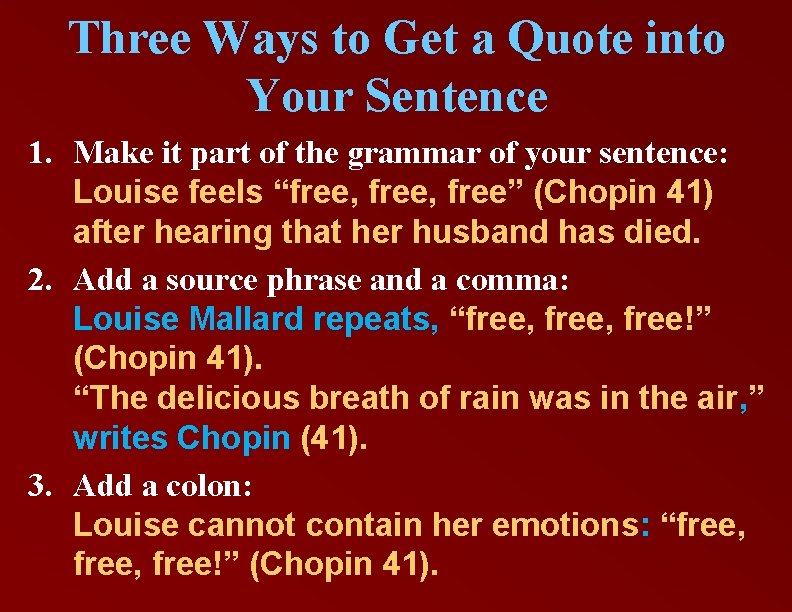
Three Ways to Get a Quote into Your Sentence 1. Make it part of the grammar of your sentence: Louise feels “free, free” (Chopin 41) after hearing that her husband has died. 2. Add a source phrase and a comma: Louise Mallard repeats, “free, free!” (Chopin 41). “The delicious breath of rain was in the air, ” writes Chopin (41). 3. Add a colon: Louise cannot contain her emotions: “free, free!” (Chopin 41).
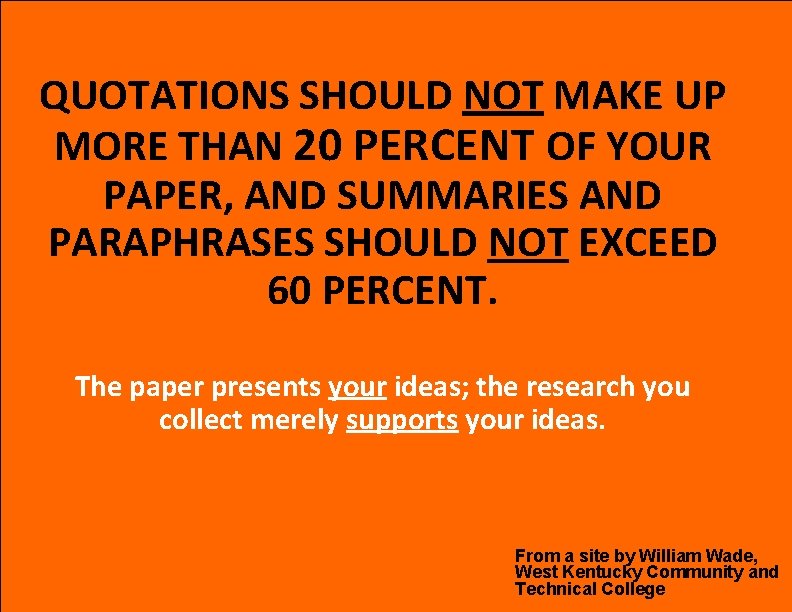
QUOTATIONS SHOULD NOT MAKE UP MORE THAN 20 PERCENT OF YOUR PAPER, AND SUMMARIES AND PARAPHRASES SHOULD NOT EXCEED 60 PERCENT. The paper presents your ideas; the research you collect merely supports your ideas. From a site by William Wade, West Kentucky Community and Technical College
OK, you understand now that you need quotes for support. How do you get the punctuation right? Steps in Punctuating Direct Quotations It is as easy as counting to six!
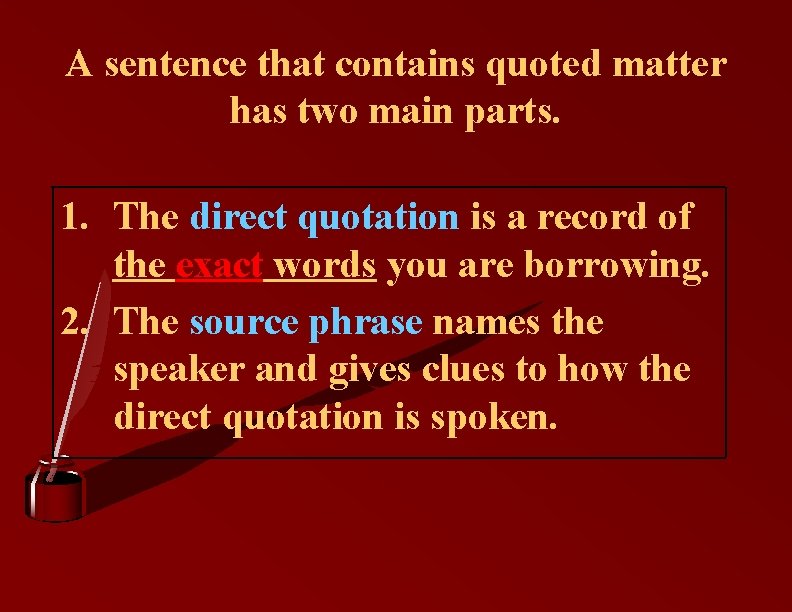
A sentence that contains quoted matter has two main parts. 1. The direct quotation is a record of the exact words you are borrowing. 2. The source phrase names the speaker and gives clues to how the direct quotation is spoken.
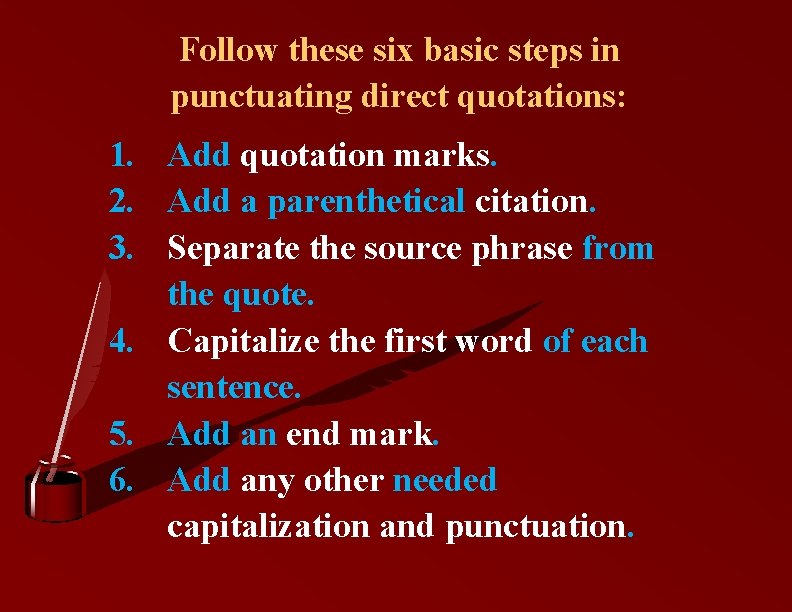
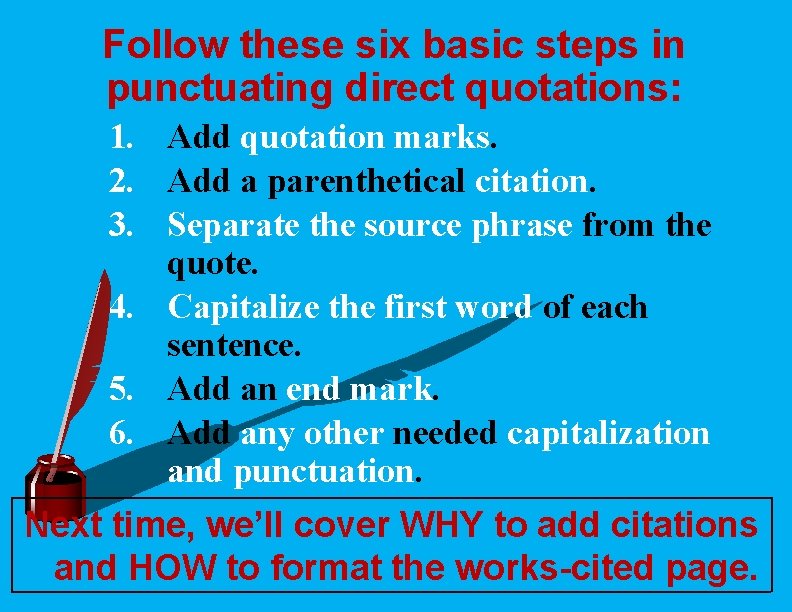
Follow these six basic steps in punctuating direct quotations: 1. Add quotation marks. 2. Add a parenthetical citation. 3. Separate the source phrase from the quote. 4. Capitalize the first word of each sentence. 5. Add an end mark. 6. Add any other needed capitalization and punctuation.
How do you punctuate a conversation if the “who said” part (source phrase) comes first?
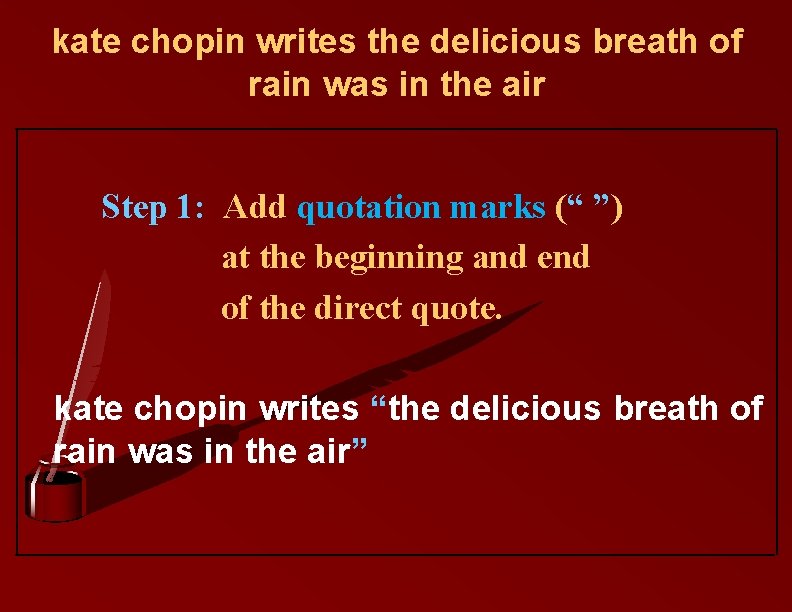
kate chopin writes the delicious breath of rain was in the air Step 1: Add quotation marks (“ ”) at the beginning and end of the direct quote. kate chopin writes “the delicious breath of rain was in the air”
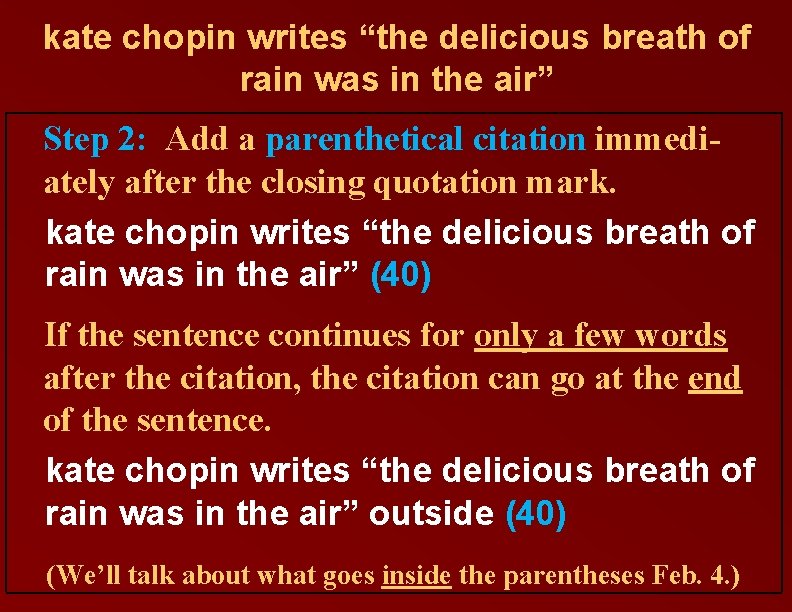
kate chopin writes “the delicious breath of rain was in the air” Step 2: Add a parenthetical citation immediately after the closing quotation mark. kate chopin writes “the delicious breath of rain was in the air” (40) If the sentence continues for only a few words after the citation, the citation can go at the end of the sentence. kate chopin writes “the delicious breath of rain was in the air” outside (40) (We’ll talk about what goes inside the parentheses Feb. 4. )
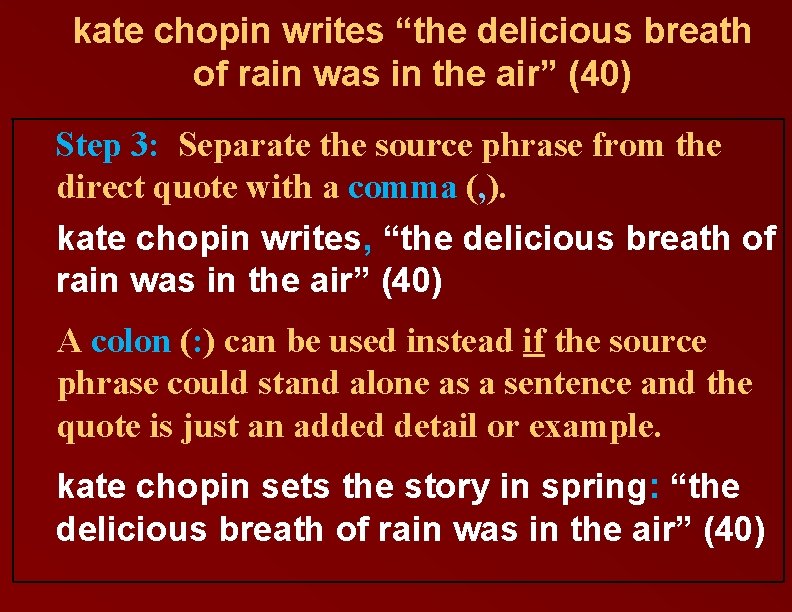
kate chopin writes “the delicious breath of rain was in the air” (40) Step 3: Separate the source phrase from the direct quote with a comma (, ). kate chopin writes, “the delicious breath of rain was in the air” (40) A colon (: ) can be used instead if the source phrase could stand alone as a sentence and the quote is just an added detail or example. kate chopin sets the story in spring: “the delicious breath of rain was in the air” (40)
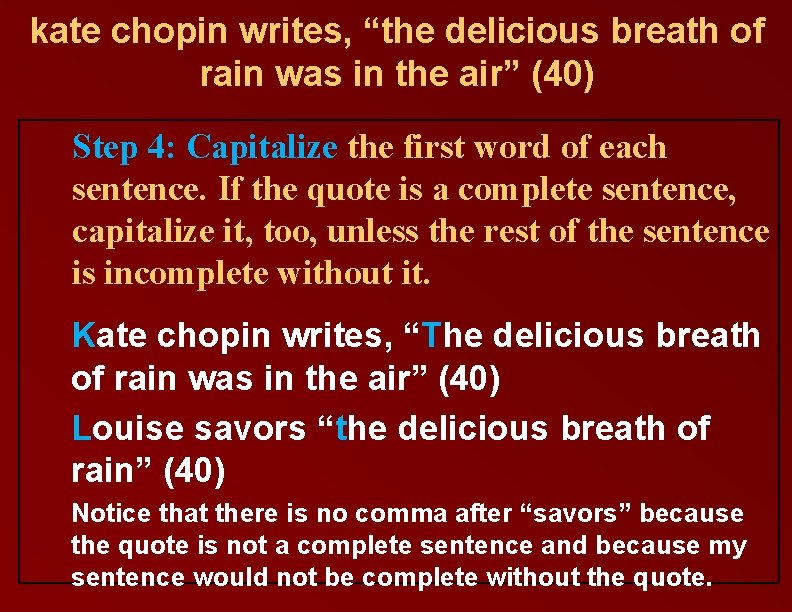
kate chopin writes, “the delicious breath of rain was in the air” (40) Step 4: Capitalize the first word of each sentence. If the quote is a complete sentence, capitalize it, too, unless the rest of the sentence is incomplete without it. Kate chopin writes, “The delicious breath of rain was in the air” (40) Louise savors “the delicious breath of rain” (40) Notice that there is no comma after “savors” because the quote is not a complete sentence and because my sentence would not be complete without the quote.
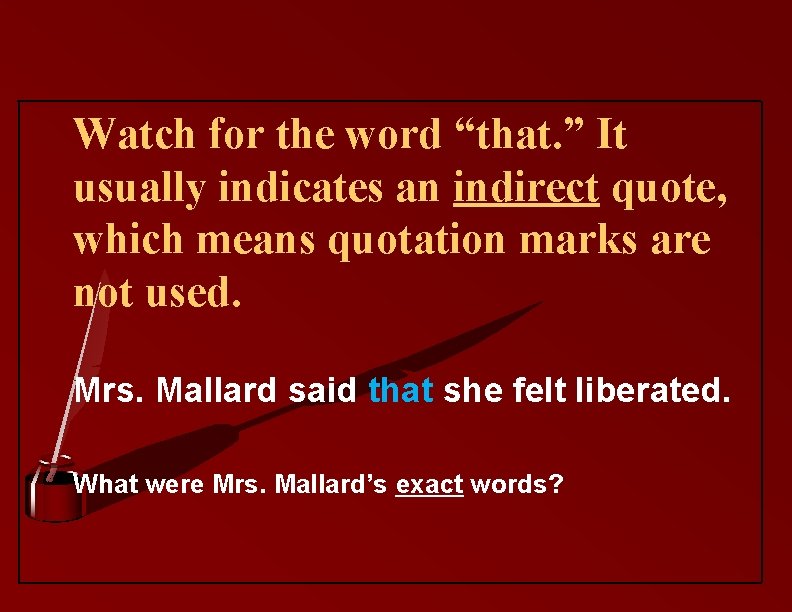
Watch for the word “that. ” It usually indicates an indirect quote, which means quotation marks are not used. Mrs. Mallard said that she felt liberated. What were Mrs. Mallard’s exact words?
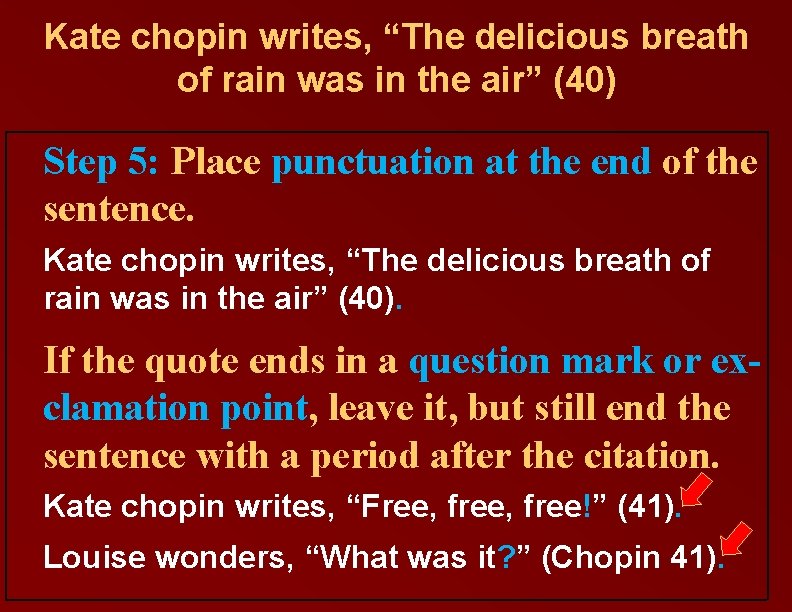
Kate chopin writes, “The delicious breath of rain was in the air” (40) Step 5: Place punctuation at the end of the sentence. Kate chopin writes, “The delicious breath of rain was in the air” (40). If the quote ends in a question mark or exclamation point, leave it, but still end the sentence with a period after the citation. Kate chopin writes, “Free, free!” (41). Louise wonders, “What was it? ” (Chopin 41).
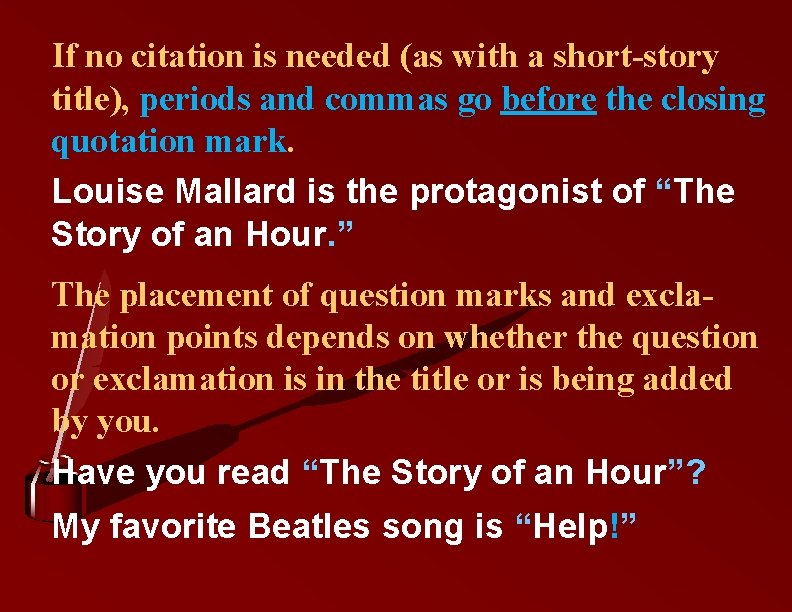
If no citation is needed (as with a short-story title), periods and commas go before the closing quotation mark. Louise Mallard is the protagonist of “The Story of an Hour. ” The placement of question marks and exclamation points depends on whether the question or exclamation is in the title or is being added by you. Have you read “The Story of an Hour”? My favorite Beatles song is “Help!”
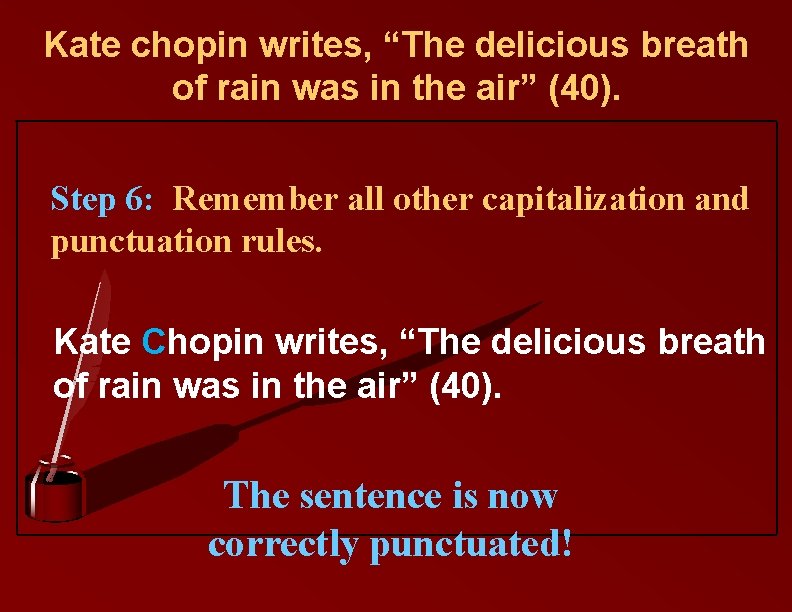
Kate chopin writes, “The delicious breath of rain was in the air” (40). Step 6: Remember all other capitalization and punctuation rules. Kate Chopin writes, “The delicious breath of rain was in the air” (40). The sentence is now correctly punctuated!
What if the direct quote is at the beginning of the sentence? she would have no one follow her writes chopin Step 1: “she would have no one follow her” writes chopin Step 2: “she would have no one follow her” (40) writes chopin OR “she would have no one follow her” writes chopin (40) Step 3: “she would have no one follow her, ” writes chopin (40) Step 4: “She would have no one follow her, ” writes chopin (40) Step 5: “She would have no one follow her, ” writes chopin (40). Step 6: “She would have no one follow her, ” writes Chopin (40).
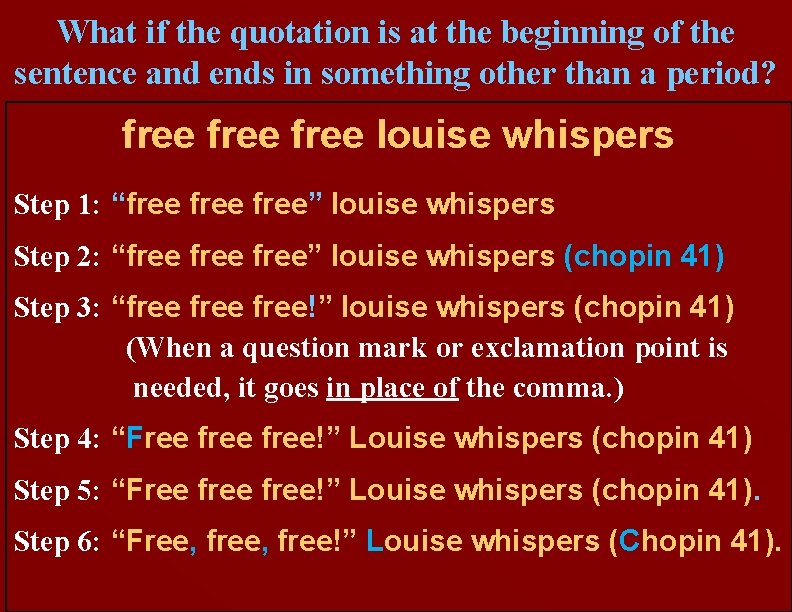
What if the quotation is at the beginning of the sentence and ends in something other than a period? free louise whispers Step 1: “free” louise whispers Step 2: “free” louise whispers (chopin 41) Step 3: “free!” louise whispers (chopin 41) (When a question mark or exclamation point is needed, it goes in place of the comma. ) Step 4: “Free free!” Louise whispers (chopin 41) Step 5: “Free free!” Louise whispers (chopin 41). Step 6: “Free, free!” Louise whispers (Chopin 41).
How would you punctuate a direct quote when the source phrase divides it in two? her pulses beat fast chopin writes and the coursing blood warmed every inch of her body Step 1: “her pulses beat fast” chopin writes “and the coursing blood warmed every inch of her body” (Remember, the quote is divided in two. Place quotation marks around both parts of the quote. ) Step 2: “her pulses beat fast” chopin writes “and the coursing blood warmed every inch of her body” (41) (Put the citation after the second half of the quote. )
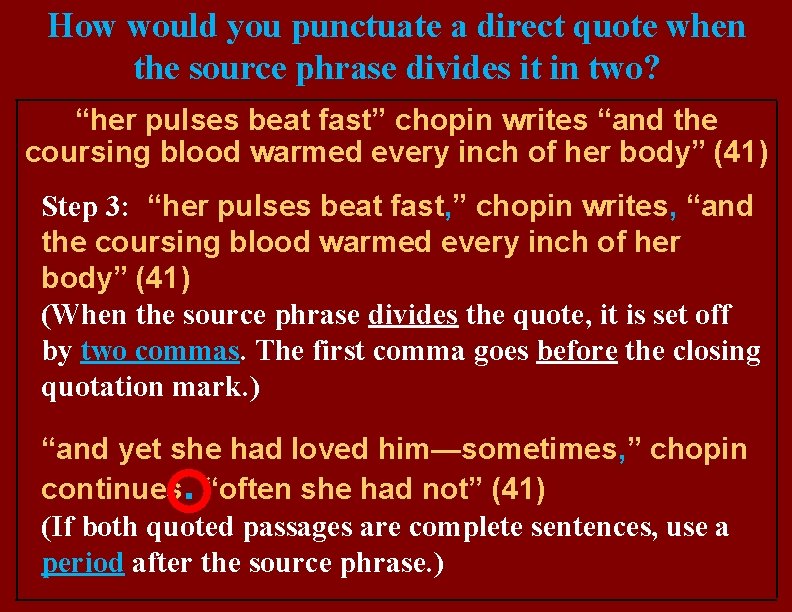
How would you punctuate a direct quote when the source phrase divides it in two? “her pulses beat fast” chopin writes “and the coursing blood warmed every inch of her body” (41) Step 3: “her pulses beat fast, ” chopin writes, “and the coursing blood warmed every inch of her body” (41) (When the source phrase divides the quote, it is set off by two commas. The first comma goes before the closing quotation mark. ) “and yet she had loved him—sometimes, ” chopin continues. “often she had not” (41) (If both quoted passages are complete sentences, use a period after the source phrase. )
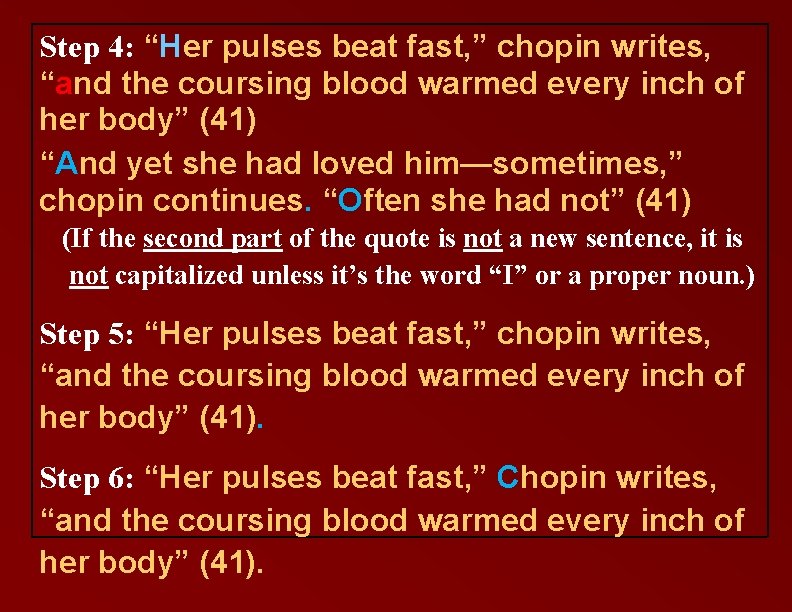
Step 4: “Her pulses beat fast, ” chopin writes, “and the coursing blood warmed every inch of her body” (41) “And yet she had loved him—sometimes, ” chopin continues. “Often she had not” (41) (If the second part of the quote is not a new sentence, it is not capitalized unless it’s the word “I” or a proper noun. ) Step 5: “Her pulses beat fast, ” chopin writes, “and the coursing blood warmed every inch of her body” (41). Step 6: “Her pulses beat fast, ” Chopin writes, “and the coursing blood warmed every inch of her body” (41).
Follow these six basic steps in punctuating direct quotations: 1. Add quotation marks. 2. Add a parenthetical citation. 3. Separate the source phrase from the quote. 4. Capitalize the first word of each sentence. 5. Add an end mark. 6. Add any other needed capitalization and punctuation. Next time, we’ll cover WHY to add citations and HOW to format the works-cited page.
Brackets [ ] Sometimes you may want to insert something into a quotation for clarification. Place any added information within square brackets [ ]. The way Chopin describes “Richards’ quick motion to screen him [Brently Mallard] from the view of his wife” (42) sounds almost as if Richards was worried more about Brently than about Louise. OR The way Chopin describes “Richards’ quick motion to screen [Brently Mallard] from the view of his wife” (42) sounds almost as if Richards was worried more about Brently than about Louise. This is on the homework!
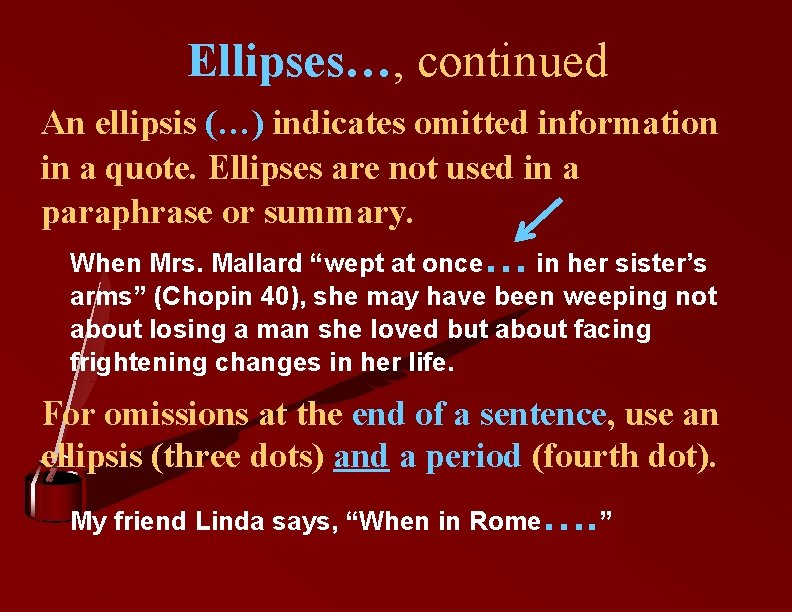
Ellipses…, continued An ellipsis (…) indicates omitted information in a quote. Ellipses are not used in a paraphrase or summary. … When Mrs. Mallard “wept at once in her sister’s arms” (Chopin 40), she may have been weeping not about losing a man she loved but about facing frightening changes in her life. For omissions at the end of a sentence, use an ellipsis (three dots) and a period (fourth dot). My friend Linda says, “When in Rome …. ”
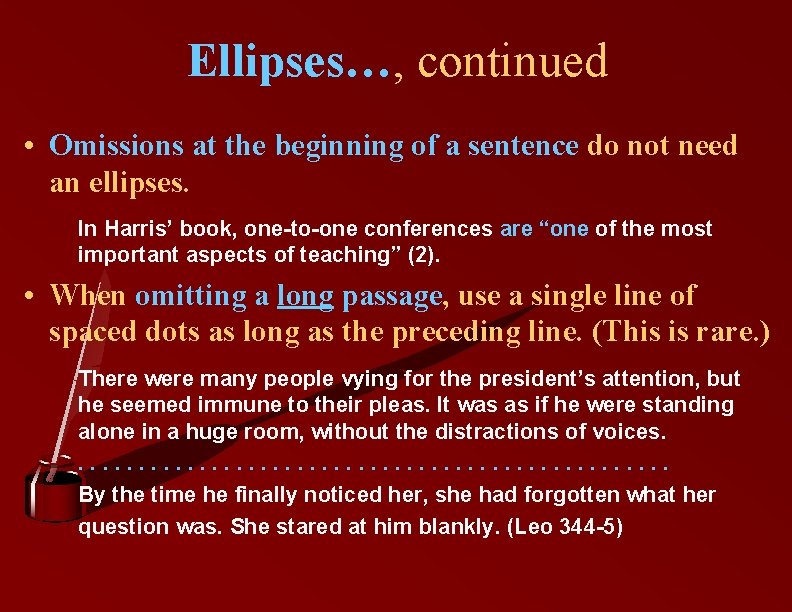
Ellipses…, continued • Omissions at the beginning of a sentence do not need an ellipses. In Harris’ book, one-to-one conferences are “one of the most important aspects of teaching” (2). • When omitting a long passage, use a single line of spaced dots as long as the preceding line. (This is rare. ) There were many people vying for the president’s attention, but he seemed immune to their pleas. It was as if he were standing alone in a huge room, without the distractions of voices. . . By the time he finally noticed her, she had forgotten what her question was. She stared at him blankly. (Leo 344 -5)
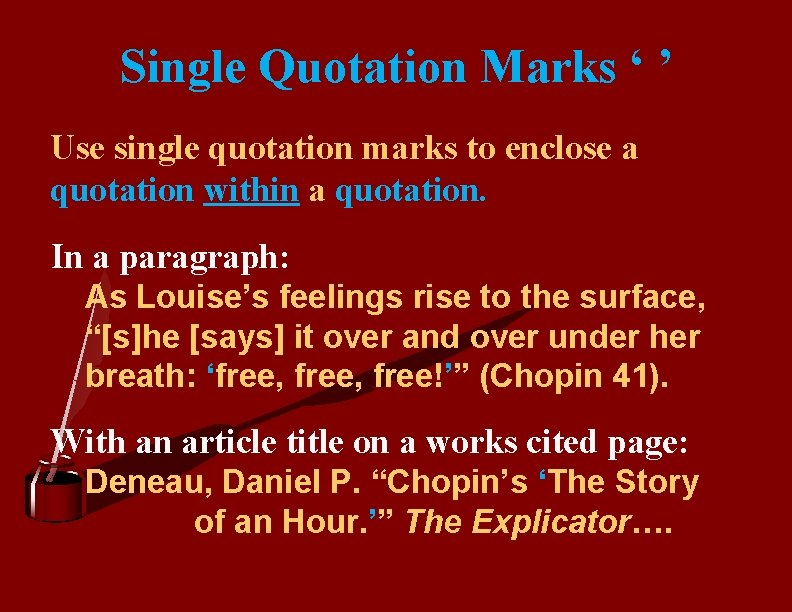
Single Quotation Marks ‘ ’ Use single quotation marks to enclose a quotation within a quotation. In a paragraph: As Louise’s feelings rise to the surface, “[s]he [says] it over and over under her breath: ‘free, free!’” (Chopin 41). With an article title on a works cited page: Deneau, Daniel P. “Chopin’s ‘The Story of an Hour. ’” The Explicator….
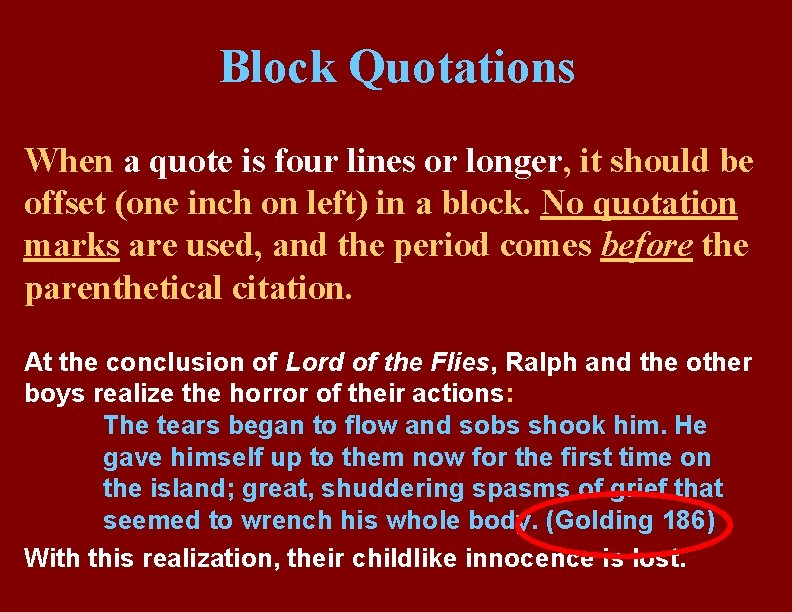
Block Quotations When a quote is four lines or longer, it should be offset (one inch on left) in a block. No quotation marks are used, and the period comes before the parenthetical citation. At the conclusion of Lord of the Flies, Ralph and the other boys realize the horror of their actions: The tears began to flow and sobs shook him. He gave himself up to them now for the first time on the island; great, shuddering spasms of grief that seemed to wrench his whole body. (Golding 186) With this realization, their childlike innocence is lost.
Complete the Grammar #2 handout and turn it in at the beginning of our next class. WE WILL MEET IN THE LIBRARY (YLRC 200)!
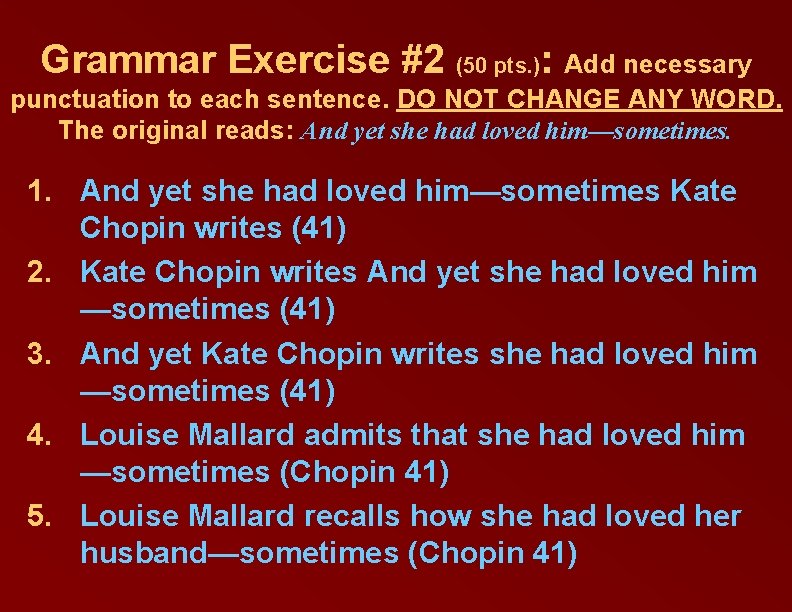
Grammar Exercise #2 (50 pts. ): Add necessary punctuation to each sentence. DO NOT CHANGE ANY WORD. The original reads: And yet she had loved him—sometimes. 1. And yet she had loved him—sometimes Kate Chopin writes (41) 2. Kate Chopin writes And yet she had loved him —sometimes (41) 3. And yet Kate Chopin writes she had loved him —sometimes (41) 4. Louise Mallard admits that she had loved him —sometimes (Chopin 41) 5. Louise Mallard recalls how she had loved her husband—sometimes (Chopin 41)