
STEPS IN THE RESEARCH PROCESS and FOCUS ON











- Slides: 17
STEPS IN THE RESEARCH PROCESS and FOCUS ON MAJOR PARADIGMS IN RESEARCH Wong-Wylie, G. adapted from: Mertens, D. M. (1998). Research methods in education and psychology. Thousand Oaks, CA: Sage.
STEP 1 • Identify your worldview and preferred research paradigm
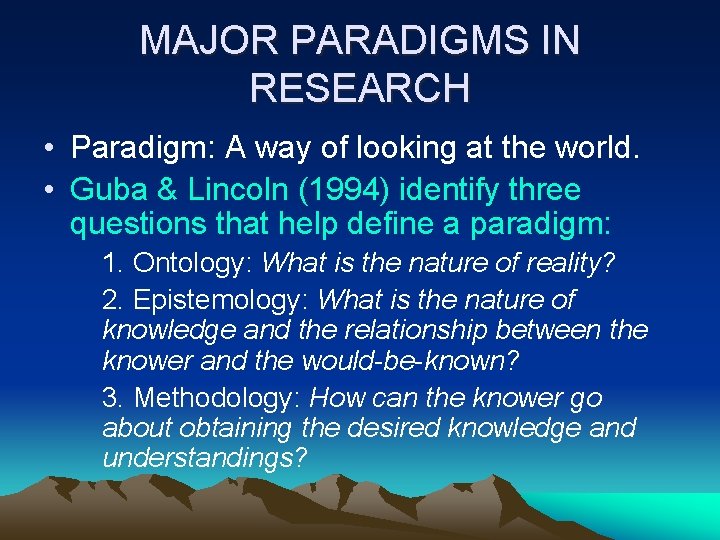
MAJOR PARADIGMS IN RESEARCH • Paradigm: A way of looking at the world. • Guba & Lincoln (1994) identify three questions that help define a paradigm: 1. Ontology: What is the nature of reality? 2. Epistemology: What is the nature of knowledge and the relationship between the knower and the would-be-known? 3. Methodology: How can the knower go about obtaining the desired knowledge and understandings?
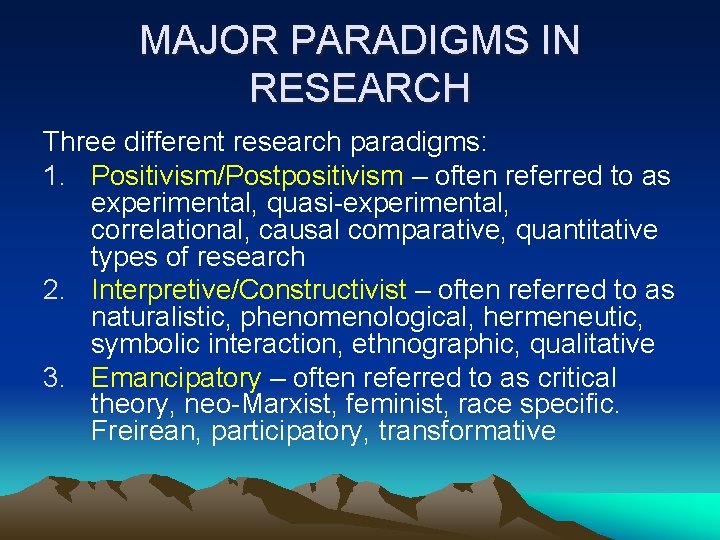
MAJOR PARADIGMS IN RESEARCH Three different research paradigms: 1. Positivism/Postpositivism – often referred to as experimental, quasi-experimental, correlational, causal comparative, quantitative types of research 2. Interpretive/Constructivist – often referred to as naturalistic, phenomenological, hermeneutic, symbolic interaction, ethnographic, qualitative 3. Emancipatory – often referred to as critical theory, neo-Marxist, feminist, race specific. Freirean, participatory, transformative
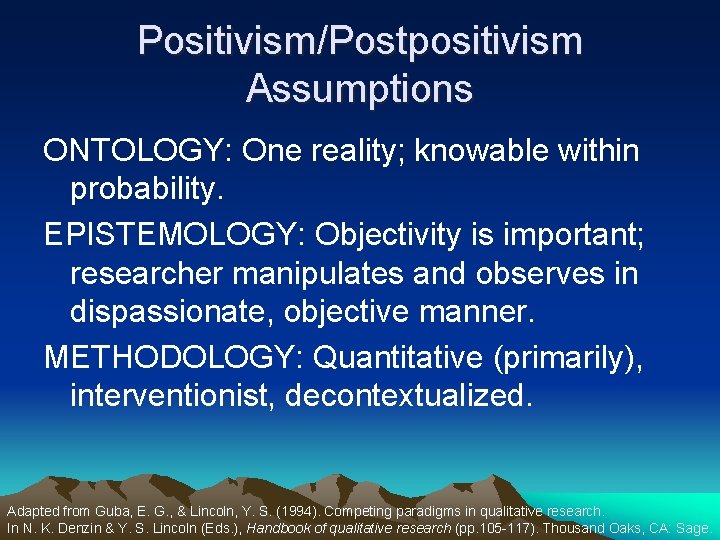
Positivism/Postpositivism Assumptions ONTOLOGY: One reality; knowable within probability. EPISTEMOLOGY: Objectivity is important; researcher manipulates and observes in dispassionate, objective manner. METHODOLOGY: Quantitative (primarily), interventionist, decontextualized. Adapted from Guba, E. G. , & Lincoln, Y. S. (1994). Competing paradigms in qualitative research. In N. K. Denzin & Y. S. Lincoln (Eds. ), Handbook of qualitative research (pp. 105 -117). Thousand Oaks, CA: Sage.
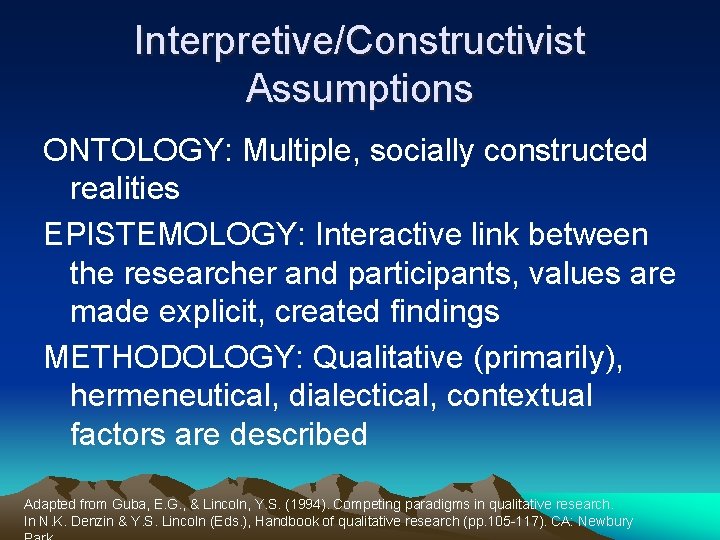
Interpretive/Constructivist Assumptions ONTOLOGY: Multiple, socially constructed realities EPISTEMOLOGY: Interactive link between the researcher and participants, values are made explicit, created findings METHODOLOGY: Qualitative (primarily), hermeneutical, dialectical, contextual factors are described Adapted from Guba, E. G. , & Lincoln, Y. S. (1994). Competing paradigms in qualitative research. In N. K. Denzin & Y. S. Lincoln (Eds. ), Handbook of qualitative research (pp. 105 -117). CA: Newbury
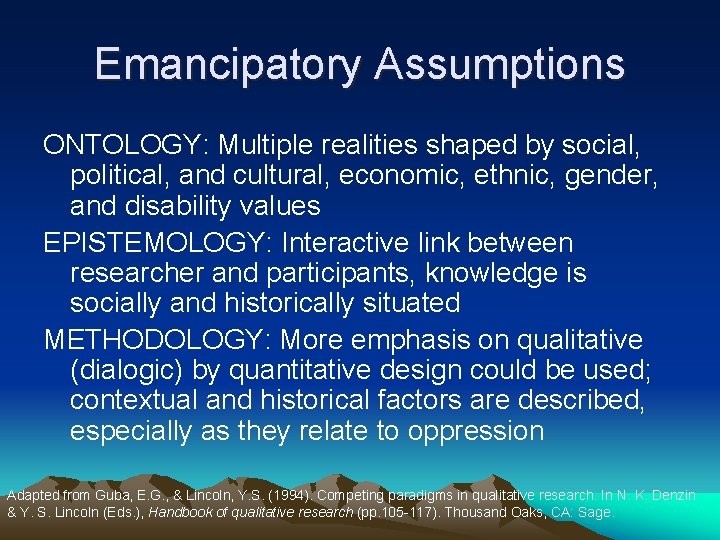
Emancipatory Assumptions ONTOLOGY: Multiple realities shaped by social, political, and cultural, economic, ethnic, gender, and disability values EPISTEMOLOGY: Interactive link between researcher and participants, knowledge is socially and historically situated METHODOLOGY: More emphasis on qualitative (dialogic) by quantitative design could be used; contextual and historical factors are described, especially as they relate to oppression Adapted from Guba, E. G. , & Lincoln, Y. S. (1994). Competing paradigms in qualitative research. In N. K. Denzin & Y. S. Lincoln (Eds. ), Handbook of qualitative research (pp. 105 -117). Thousand Oaks, CA: Sage.
STEP 2 Identify the problem
STEP 3 Develop a literature review and research question(s)
STEP 4 Identify research design (quantitative / qualitative / mixed method)
STEP 5 Identify and select sources of data (sampling)
STEP 6 Identify and select data collection methods and instruments
STEP 7 Ensure ethical issues of research are addressed
STEP 8 Consider credibility of research
STEP 9 Data analysis, reporting, dissemination, and utilization (consider relevance and practical significance)
STEP 10 Identify future directions
BEGIN AGAIN…