
Steps in the races strategy RRestate the question


- Slides: 5
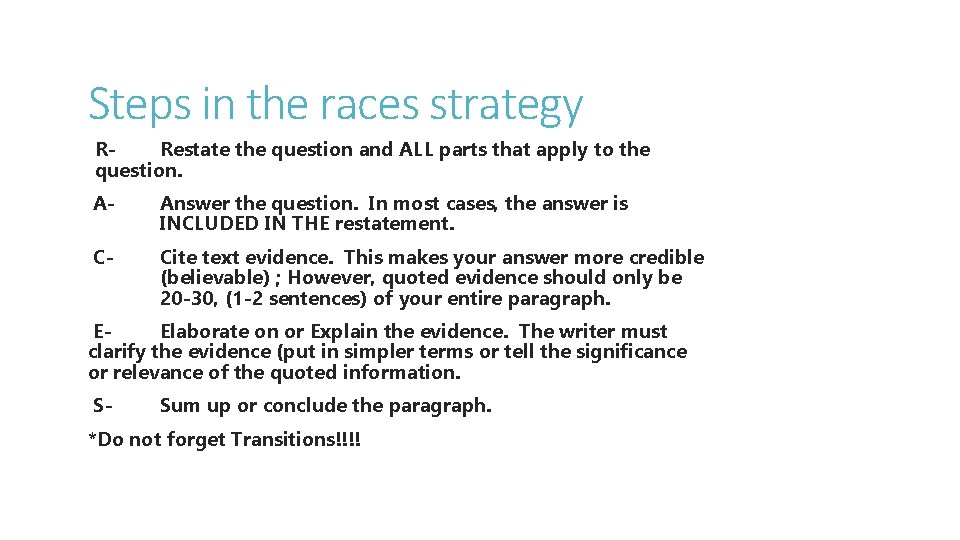
Steps in the races strategy RRestate the question and ALL parts that apply to the question. A- Answer the question. In most cases, the answer is INCLUDED IN THE restatement. C- Cite text evidence. This makes your answer more credible (believable) ; However, quoted evidence should only be 20 -30, (1 -2 sentences) of your entire paragraph. EElaborate on or Explain the evidence. The writer must clarify the evidence (put in simpler terms or tell the significance or relevance of the quoted information. S- Sum up or conclude the paragraph. *Do not forget Transitions!!!!
Guided practice prompt In the realistic fictional story, “The Treasure of Lemon Brown, ” by Walter Dean Myers, Greg Ridley’s attitude changes from the exposition to the resolution of the story. Discuss the sequential events that develop his attitude change. Use text evidence, examples and transitions in your answer.
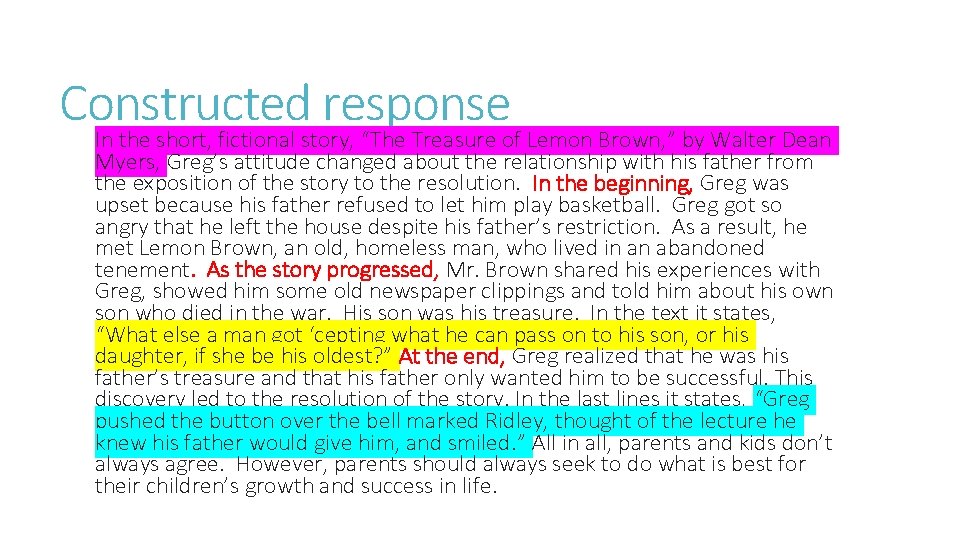
Constructed response In the short, fictional story, “The Treasure of Lemon Brown, ” by Walter Dean Myers, Greg’s attitude changed about the relationship with his father from the exposition of the story to the resolution. In the beginning, Greg was upset because his father refused to let him play basketball. Greg got so angry that he left the house despite his father’s restriction. As a result, he met Lemon Brown, an old, homeless man, who lived in an abandoned tenement. As the story progressed, Mr. Brown shared his experiences with Greg, showed him some old newspaper clippings and told him about his own son who died in the war. His son was his treasure. In the text it states, “What else a man got ‘cepting what he can pass on to his son, or his daughter, if she be his oldest? ” At the end, Greg realized that he was his father’s treasure and that his father only wanted him to be successful. This discovery led to the resolution of the story. In the last lines it states, “Greg pushed the button over the bell marked Ridley, thought of the lecture he knew his father would give him, and smiled. ” All in all, parents and kids don’t always agree. However, parents should always seek to do what is best for their children’s growth and success in life.
GUIDED PRACTICE PROMPT Prompt: In the fictional story “The Southpaw, ” by Judith Viorst, Richard’s attitude about girls and baseball changes from the exposition to the resolution. Discuss how the author develops Richard’s point of view using text evidence and relevant examples. Make sure you elaborate and use transitions.
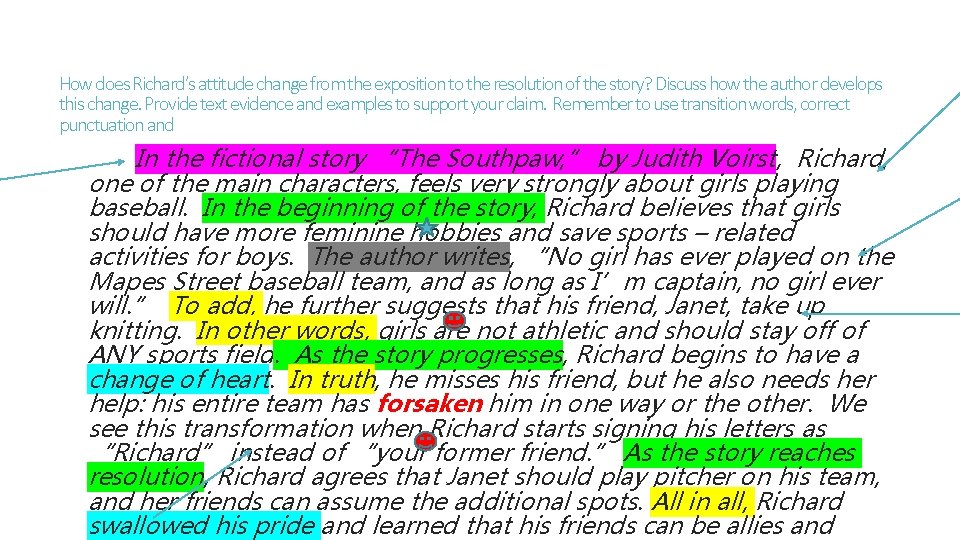
How does Richard’s attitude change from the exposition to the resolution of the story? Discuss how the author develops this change. Provide text evidence and examples to support your claim. Remember to use transition words, correct punctuation and In the fictional story “The Southpaw, ” by Judith Voirst, Richard, one of the main characters, feels very strongly about girls playing baseball. In the beginning of the story, Richard believes that girls should have more feminine hobbies and save sports – related activities for boys. The author writes, “No girl has ever played on the Mapes Street baseball team, and as long as I’m captain, no girl ever will. ” To add, he further suggests that his friend, Janet, take up knitting. In other words, girls are not athletic and should stay off of ANY sports field. As the story progresses, Richard begins to have a change of heart. In truth, he misses his friend, but he also needs her help: his entire team has forsaken him in one way or the other. We see this transformation when Richard starts signing his letters as “Richard” instead of “your former friend. ” As the story reaches resolution, Richard agrees that Janet should play pitcher on his team, and her friends can assume the additional spots. All in all, Richard swallowed his pride and learned that his friends can be allies and