
Steps in planning a test 1 Identifying test
- Slides: 11
� Steps in planning a test: 1. Identifying test objectives 2. Deciding on the type of objective test to be prepared. 3. Preparing a Table of Specifications 4. Constructing the draft test items 5. Try-out and validation
� Identifying � Test Objectives it must be comprehensive and must cover the various levels of Bloom’s taxonomy 1. Knowledge, 2. Comprehension, 3. Application, 4. Analysis, 5. Synthesis and 6. Evaluation.
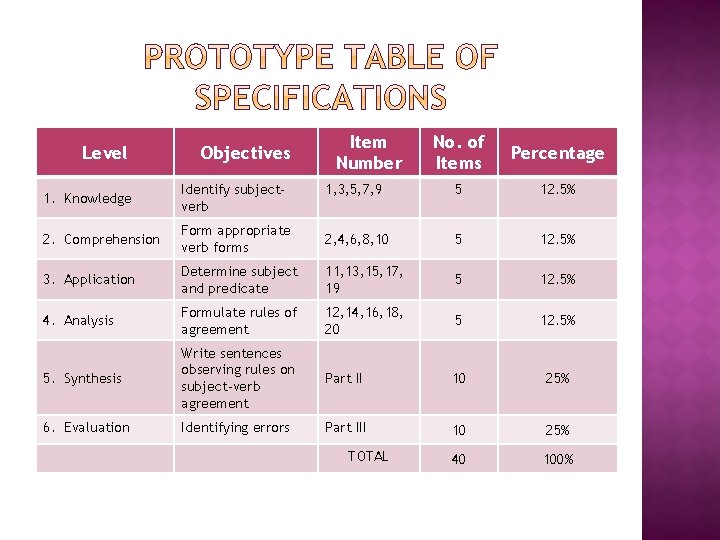
A Table of Specifications or TOS is a test map that guides the teacher in constructing a test. It ensures that there is balance between items that test lower level thinking skills and those which test higher order thinking skills. The simplest TOS consists of four (4) columns: (a) level of objective to be tested; (b) statement of objective; (c) item numbers where such an objective is tested; and (4) number of items and percentage out of the total for that particular objective.
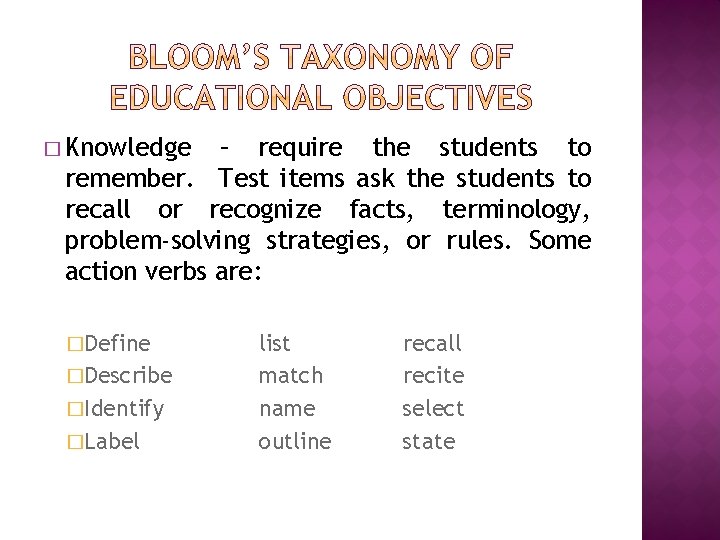
� Knowledge – require the students to remember. Test items ask the students to recall or recognize facts, terminology, problem-solving strategies, or rules. Some action verbs are: �Define �Describe �Identify �Label list match name outline recall recite select state
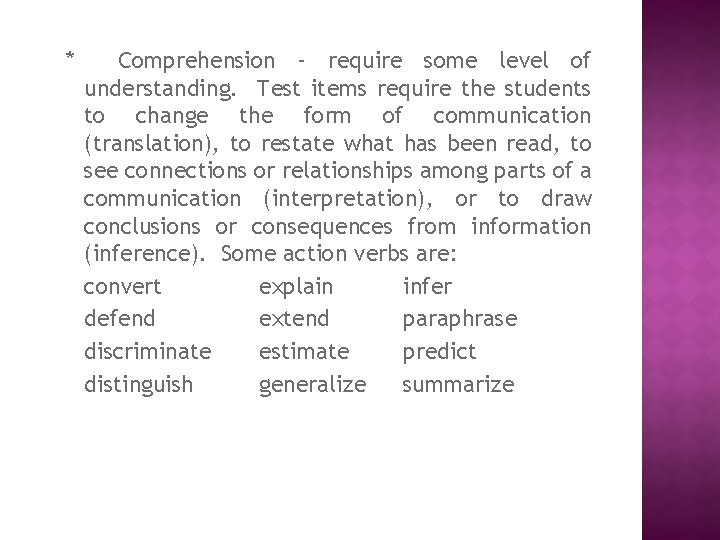
* Comprehension – require some level of understanding. Test items require the students to change the form of communication (translation), to restate what has been read, to see connections or relationships among parts of a communication (interpretation), or to draw conclusions or consequences from information (inference). Some action verbs are: convert explain infer defend extend paraphrase discriminate estimate predict distinguish generalize summarize
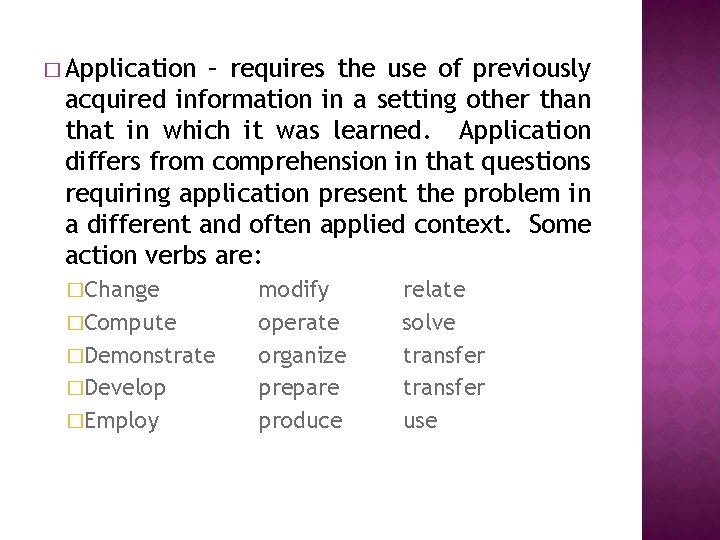
� Application – requires the use of previously acquired information in a setting other than that in which it was learned. Application differs from comprehension in that questions requiring application present the problem in a different and often applied context. Some action verbs are: �Change �Compute �Demonstrate �Develop �Employ modify operate organize prepare produce relate solve transfer use
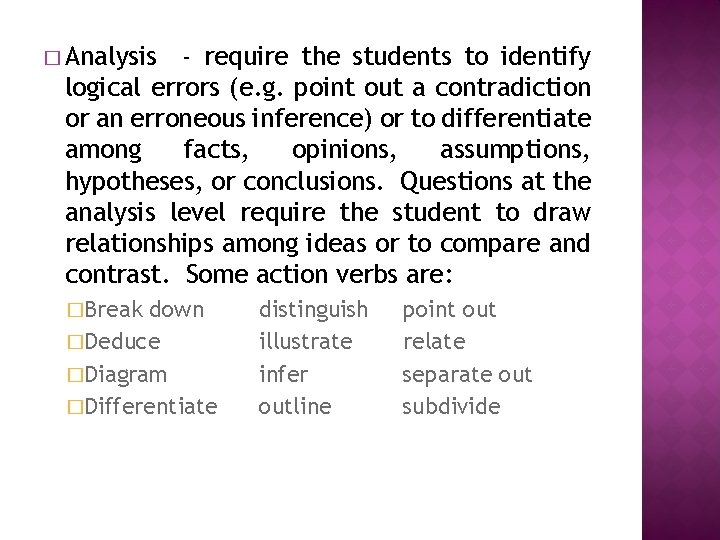
� Analysis - require the students to identify logical errors (e. g. point out a contradiction or an erroneous inference) or to differentiate among facts, opinions, assumptions, hypotheses, or conclusions. Questions at the analysis level require the student to draw relationships among ideas or to compare and contrast. Some action verbs are: �Break down �Deduce �Diagram �Differentiate distinguish illustrate infer outline point out relate separate out subdivide
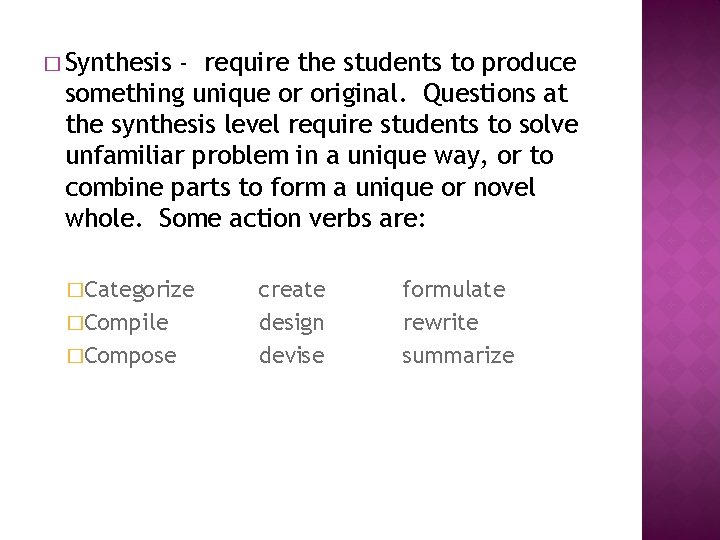
� Synthesis - require the students to produce something unique or original. Questions at the synthesis level require students to solve unfamiliar problem in a unique way, or to combine parts to form a unique or novel whole. Some action verbs are: �Categorize �Compile �Compose create design devise formulate rewrite summarize
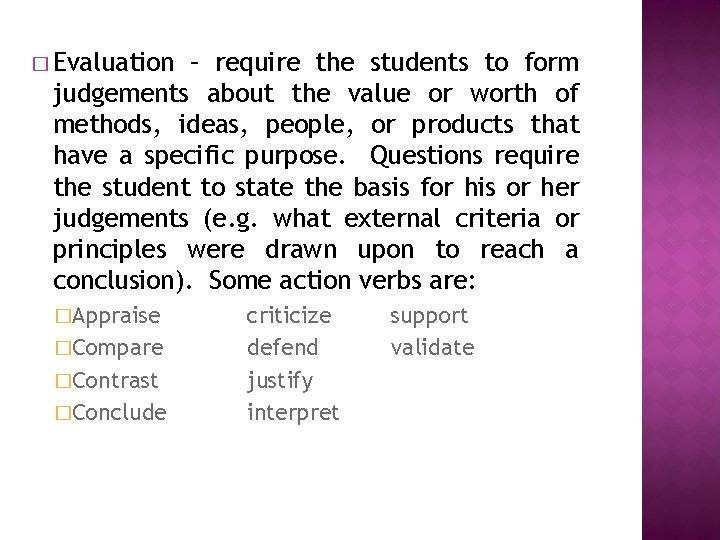
� Evaluation – require the students to form judgements about the value or worth of methods, ideas, people, or products that have a specific purpose. Questions require the student to state the basis for his or her judgements (e. g. what external criteria or principles were drawn upon to reach a conclusion). Some action verbs are: �Appraise �Compare �Contrast �Conclude criticize defend justify interpret support validate
Level Objectives Item Number No. of Items Percentage 1, 3, 5, 7, 9 5 12. 5% 1. Knowledge Identify subjectverb 2. Comprehension Form appropriate verb forms 2, 4, 6, 8, 10 5 12. 5% 3. Application Determine subject and predicate 11, 13, 15, 17, 19 5 12. 5% 4. Analysis Formulate rules of agreement 12, 14, 16, 18, 20 5 12. 5% 5. Synthesis Write sentences observing rules on subject-verb agreement Part II 10 25% 6. Evaluation Identifying errors Part III 10 25% 40 100% TOTAL