
Steps in Creating a Parallel Program At or
- Slides: 26
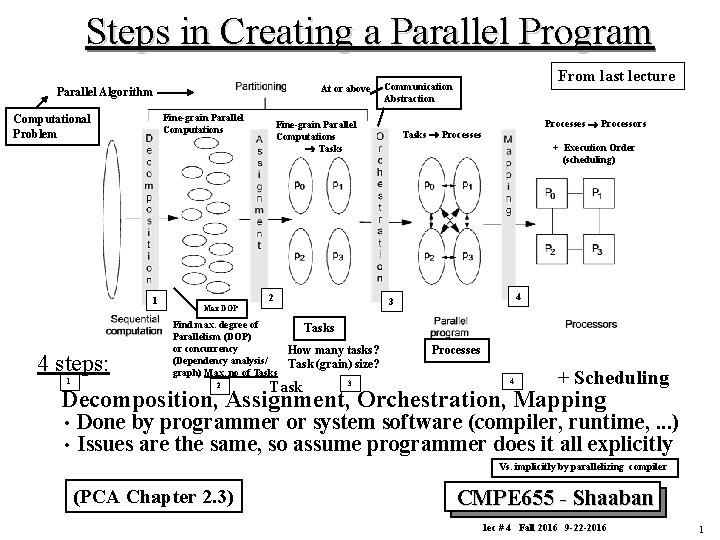
Steps in Creating a Parallel Program At or above Parallel Algorithm Fine-grain Parallel Computations Computational Problem 1 4 steps: 1 Fine-grain Parallel Computations ® Tasks 2 2 Processes ® Processors + Execution Order (scheduling) Tasks ® Processes 4 3 Max DOP Find max. degree of Parallelism (DOP) or concurrency (Dependency analysis/ graph) Max. no of Tasks From last lecture Communication Abstraction Tasks How many tasks? Task (grain) size? Task 3 Processes 4 + Scheduling Decomposition, Assignment, Orchestration, Mapping • • Done by programmer or system software (compiler, runtime, . . . ) Issues are the same, so assume programmer does it all explicitly Vs. implicitly by parallelizing compiler (PCA Chapter 2. 3) 1 CMPE 655 - Shaaban lec # 4 Fall 2016 9 -22 -2016 1
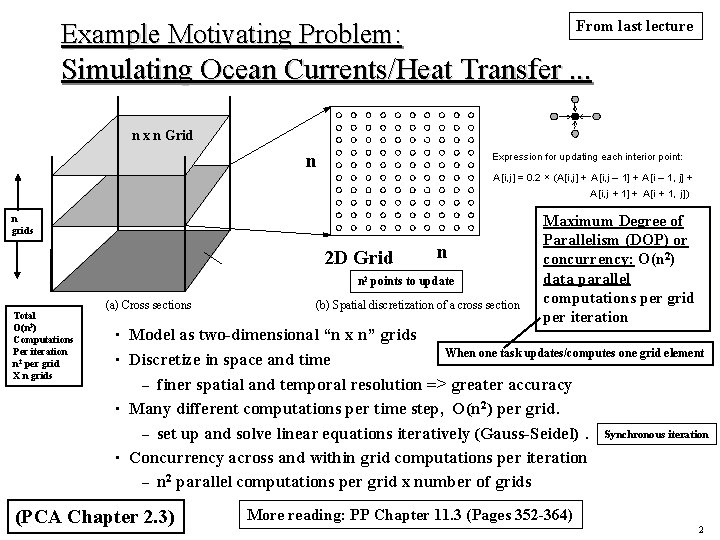
From last lecture Example Motivating Problem: Simulating Ocean Currents/Heat Transfer. . . n x n Grid n Expression for updating each interior point: A[i, j ] = 0. 2 ´ (A[i, j ] + A[i, j – 1] + A[i – 1, j] + A[i, j + 1] + A[i + 1, j ]) n grids 2 D Grid n n 2 points to update Total O(n 3) Computations Per iteration n 2 per grid X n grids (a) Cross sections (b) Spatial discretization of a cross section Maximum Degree of Parallelism (DOP) or concurrency: O(n 2) data parallel computations per grid per iteration Model as two-dimensional “n x n” grids When one task updates/computes one grid element • Discretize in space and time – finer spatial and temporal resolution => greater accuracy • Many different computations per time step, O(n 2) per grid. – set up and solve linear equations iteratively (Gauss-Seidel). Synchronous iteration • Concurrency across and within grid computations per iteration – n 2 parallel computations per grid x number of grids • (PCA Chapter 2. 3) More reading: PP Chapter 11. 3 (Pages 352 -364) 2
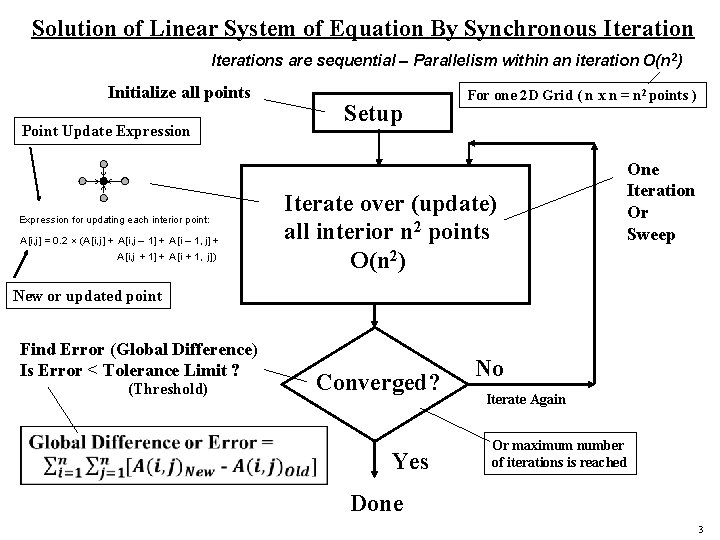
Solution of Linear System of Equation By Synchronous Iterations are sequential – Parallelism within an iteration O(n 2) Initialize all points Point Update Expression for updating each interior point: A[i, j ] = 0. 2 ´ (A[i, j ] + A[i, j – 1] + A[i – 1, j] + A[i, j + 1] + A[i + 1, j ]) Setup For one 2 D Grid ( n x n = n 2 points ) One Iteration Iterate over (update) Or all interior n 2 points Sweep O(n 2) New or updated point Find Error (Global Difference) Is Error < Tolerance Limit ? (Threshold) Converged? Yes No Iterate Again Or maximum number of iterations is reached Done 3
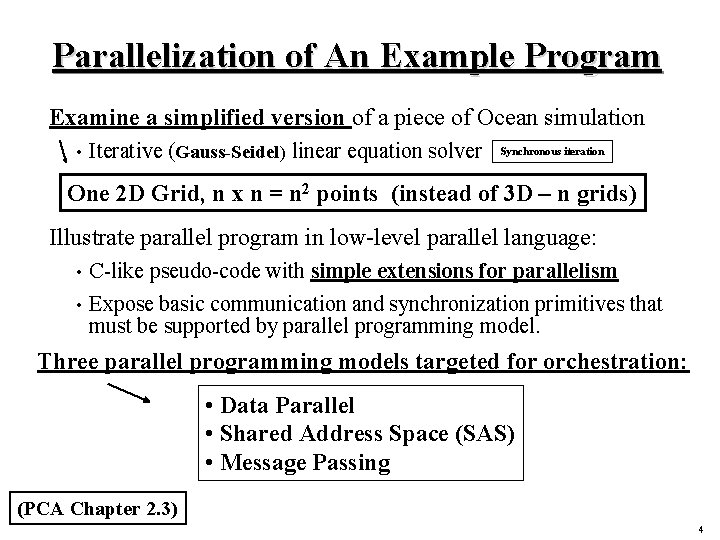
Parallelization of An Example Program Examine a simplified version of a piece of Ocean simulation • Iterative (Gauss-Seidel) linear equation solver Synchronous iteration One 2 D Grid, n x n = n 2 points (instead of 3 D – n grids) Illustrate parallel program in low-level parallel language: C-like pseudo-code with simple extensions for parallelism • Expose basic communication and synchronization primitives that must be supported by parallel programming model. • Three parallel programming models targeted for orchestration: • Data Parallel • Shared Address Space (SAS) • Message Passing (PCA Chapter 2. 3) 4
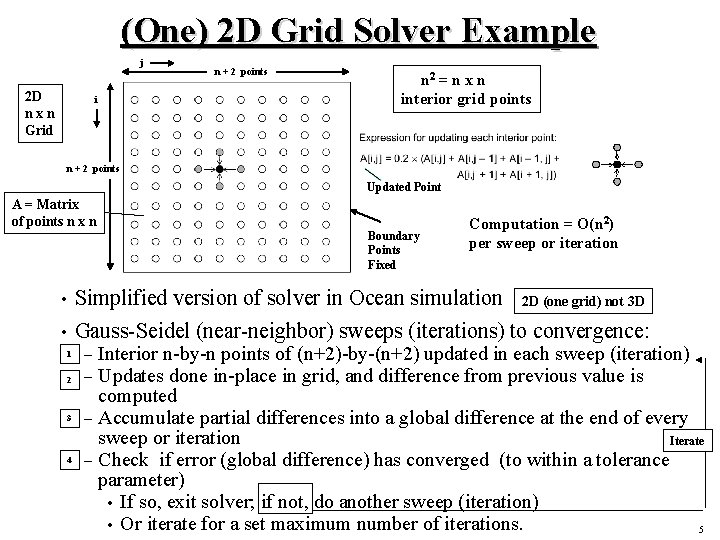
(One) 2 D Grid Solver Example j 2 D n x n Grid i n + 2 points n 2 = n x n interior grid points n + 2 points Updated Point A = Matrix of points n x n Boundary Points Fixed Computation = O(n 2) per sweep or iteration Simplified version of solver in Ocean simulation 2 D (one grid) not 3 D • Gauss-Seidel (near-neighbor) sweeps (iterations) to convergence: • 1 2 3 4 Interior n-by-n points of (n+2)-by-(n+2) updated in each sweep (iteration) Updates done in-place in grid, and difference from previous value is computed – Accumulate partial differences into a global difference at the end of every sweep or iteration Iterate – Check if error (global difference) has converged (to within a tolerance parameter) • If so, exit solver; if not, do another sweep (iteration) • Or iterate for a set maximum number of iterations. 5 – –
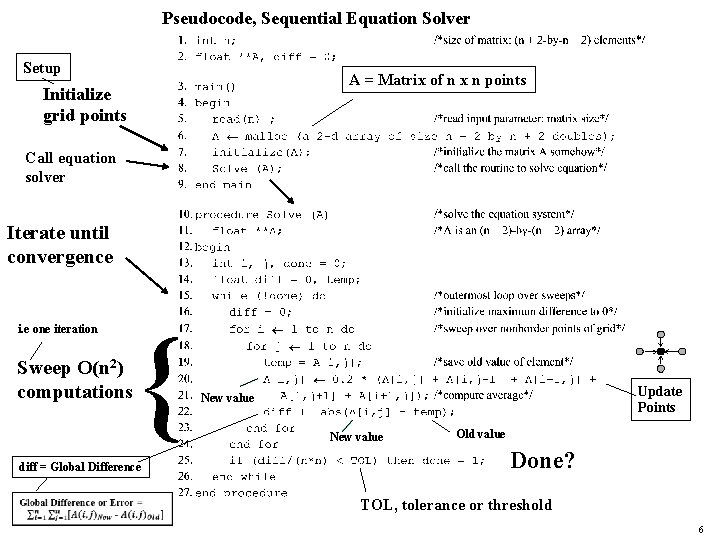
Pseudocode, Sequential Equation Solver Setup A = Matrix of n x n points Initialize grid points Call equation solver Iterate until convergence i. e one iteration Sweep O(n 2) computations { diff = Global Difference Update Points New value Old value Done? TOL, tolerance or threshold 6
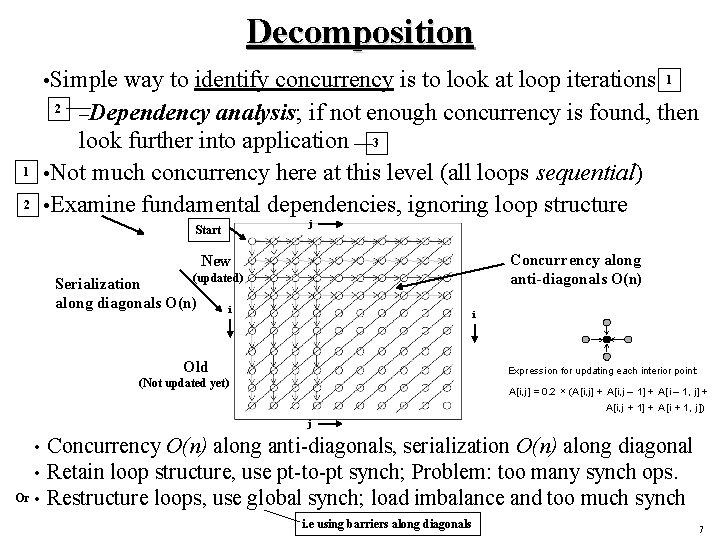
Decomposition • Simple 1 2 way to identify concurrency is to look at loop iterations 1 2 –Dependency analysis; if not enough concurrency is found, then look further into application 3 • Not much concurrency here at this level (all loops sequential) • Examine fundamental dependencies, ignoring loop structure Start j Concurrency along anti-diagonals O(n) New (updated) Serialization along diagonals O(n) i i Old Expression for updating each interior point: (Not updated yet) A[i, j ] = 0. 2 ´ (A[i, j ] + A[i, j – 1] + A[i – 1, j] + A[i, j + 1] + A[i + 1, j ]) j • • Or • Concurrency O(n) along anti-diagonals, serialization O(n) along diagonal Retain loop structure, use pt-to-pt synch; Problem: too many synch ops. Restructure loops, use global synch; load imbalance and too much synch i. e using barriers along diagonals 7
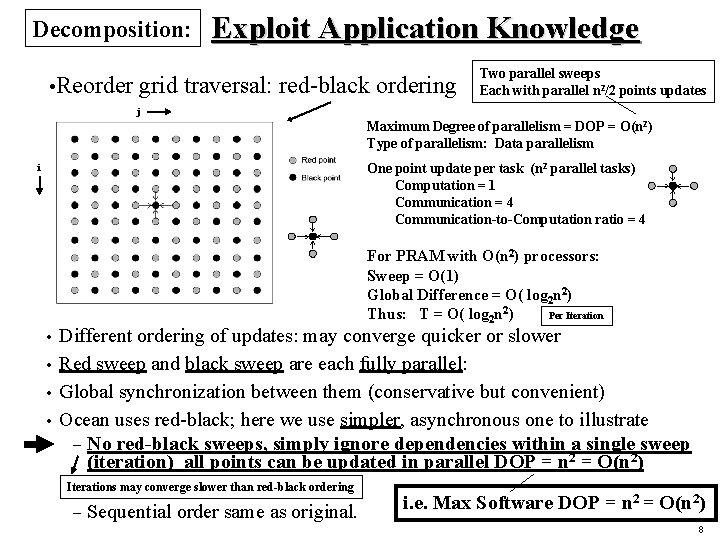
Decomposition: • Reorder Exploit Application Knowledge grid traversal: red-black ordering Two parallel sweeps Each with parallel n 2/2 points updates j Maximum Degree of parallelism = DOP = O(n 2) Type of parallelism: Data parallelism One point update per task (n 2 parallel tasks) Computation = 1 Communication = 4 Communication-to-Computation ratio = 4 i For PRAM with O(n 2) processors: Sweep = O(1) Global Difference = O( log 2 n 2) Thus: T = O( log 2 n 2) Per Iteration Different ordering of updates: may converge quicker or slower • Red sweep and black sweep are each fully parallel: • Global synchronization between them (conservative but convenient) • Ocean uses red-black; here we use simpler, asynchronous one to illustrate – No red-black sweeps, simply ignore dependencies within a single sweep (iteration) all points can be updated in parallel DOP = n 2 = O(n 2) • Iterations may converge slower than red-black ordering – Sequential order same as original. i. e. Max Software DOP = n 2 = O(n 2) 8
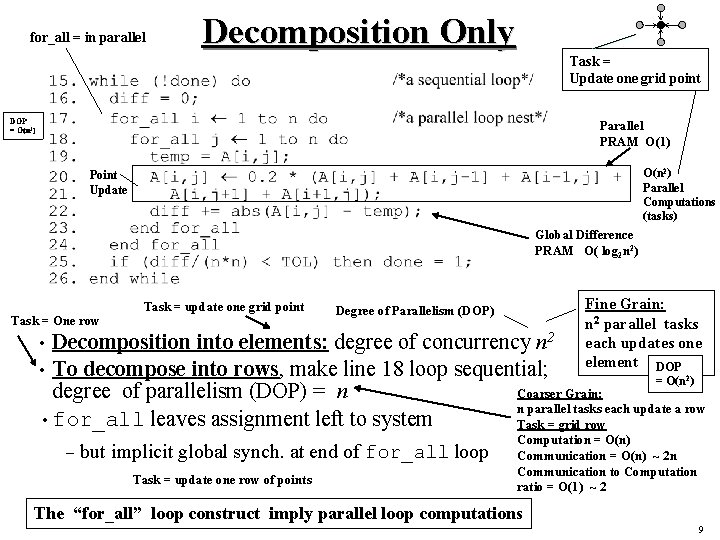
for_all = in parallel Decomposition Only Task = Update one grid point DOP = O(n 2) Parallel PRAM O(1) O(n 2) Parallel Computations (tasks) Point Update Global Difference PRAM O( log 2 n 2) Task = One row Task = update one grid point Fine Grain: n 2 parallel tasks each updates one element DOP Degree of Parallelism (DOP) Decomposition into elements: degree of concurrency n 2 To decompose into rows, make line 18 loop sequential; = O(n ) Coarser Grain: degree of parallelism (DOP) = n n parallel tasks each update a row • for_all leaves assignment left to system Task = grid row • • 2 – but implicit global synch. at end of for_all loop Task = update one row of points Computation = O(n) Communication = O(n) ~ 2 n Communication to Computation ratio = O(1) ~ 2 The “for_all” loop construct imply parallel loop computations 9
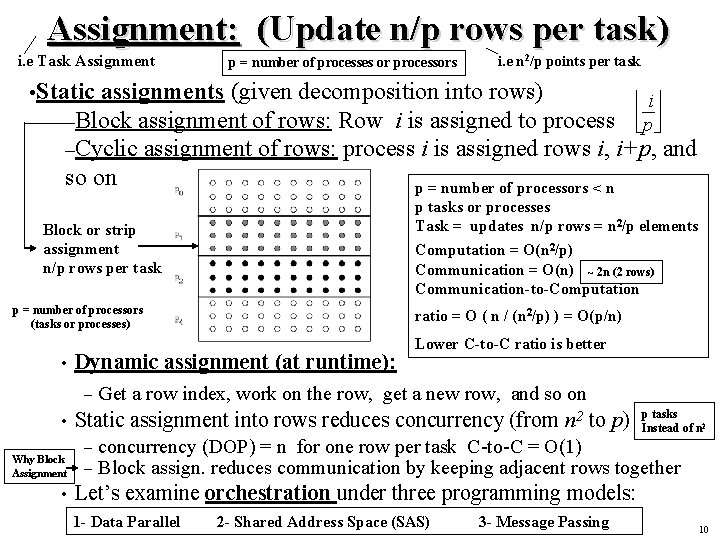
Assignment: (Update n/p rows per task) i. e Task Assignment p = number of processes or processors i. e n 2/p points per task • Static assignments (given decomposition into rows) i –Block assignment of rows: Row i is assigned to process p –Cyclic assignment of rows: process i is assigned rows i, i+p, so on Block or strip assignment n/p rows per task p = number of processors (tasks or processes) • Dynamic assignment (at runtime): – • Why Block Assignment • p = number of processors < n p tasks or processes Task = updates n/p rows = n 2/p elements Computation = O(n 2/p) Communication = O(n) ~ 2 n (2 rows) Communication-to-Computation ratio = O ( n / (n 2/p) ) = O(p/n) Lower C-to-C ratio is better Get a row index, work on the row, get a new row, and so on Static assignment into rows reduces concurrency (from n 2 to p) – – and p tasks Instead of n 2 concurrency (DOP) = n for one row per task C-to-C = O(1) Block assign. reduces communication by keeping adjacent rows together Let’s examine orchestration under three programming models: 1 - Data Parallel 2 - Shared Address Space (SAS) 3 - Message Passing 10
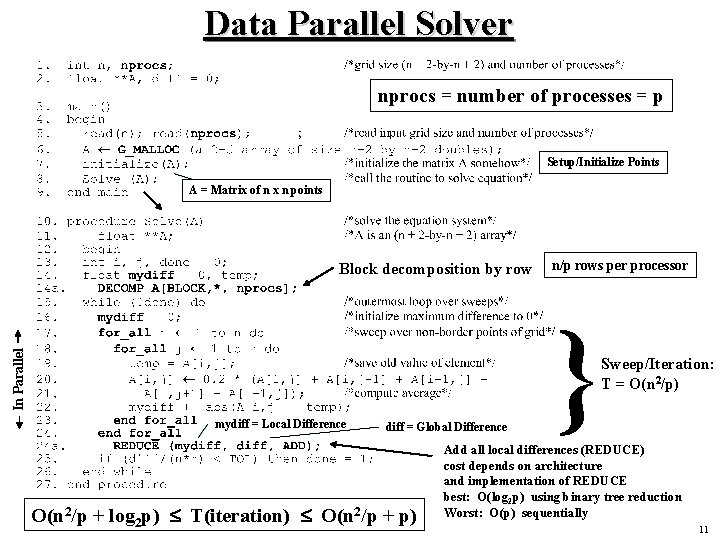
Data Parallel Solver nprocs = number of processes = p Setup/Initialize Points A = Matrix of n x n points In Parallel Block decomposition by row n/p rows per processor } Sweep/Iteration: T = O(n 2/p) mydiff = Local Difference diff = Global Difference O(n 2/p + log 2 p) £ T(iteration) £ O(n 2/p + p) Add all local differences (REDUCE) cost depends on architecture and implementation of REDUCE best: O(log 2 p) using binary tree reduction Worst: O(p) sequentially 11
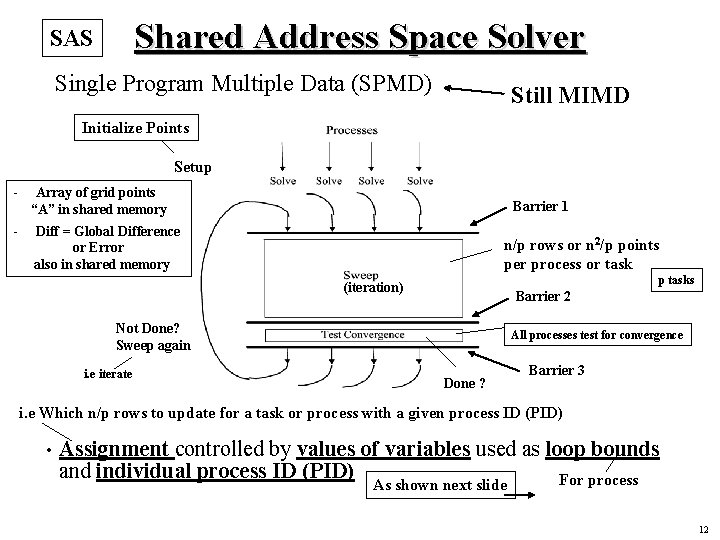
Shared Address Space Solver SAS Single Program Multiple Data (SPMD) Still MIMD Initialize Points Setup - Array of grid points “A” in shared memory - Diff = Global Difference or Error also in shared memory Barrier 1 n/p rows or n 2/p points per process or task p tasks (iteration) Barrier 2 Not Done? Sweep again i. e iterate All processes test for convergence Done ? Barrier 3 i. e Which n/p rows to update for a task or process with a given process ID (PID) • Assignment controlled by values of variables used as loop bounds and individual process ID (PID) For process As shown next slide 12
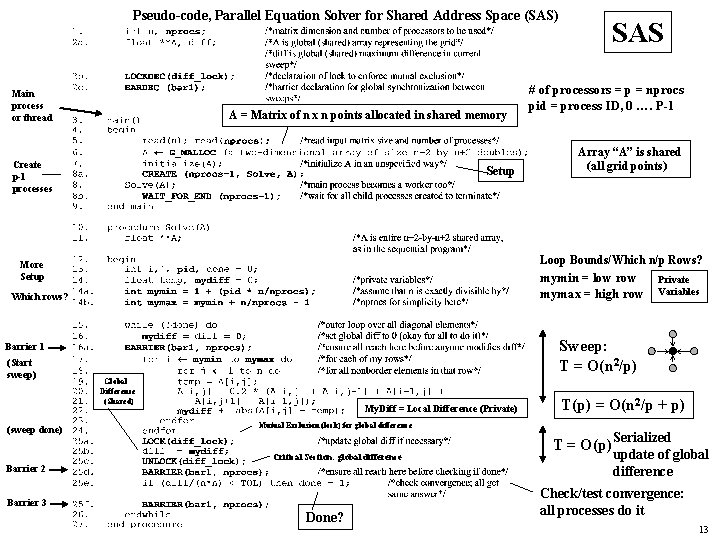
Pseudo-code, Parallel Equation Solver for Shared Address Space (SAS) Main process or thread A = Matrix of n x n points allocated in shared memory Create p-1 processes Setup Array “A” is shared (all grid points) mymin = low row mymax = high row Which rows? Private Variables Sweep: T = O(n 2/p) Barrier 1 (sweep done) # of processors = p = nprocs pid = process ID, 0 …. P-1 Loop Bounds/Which n/p Rows? More Setup (Start sweep) SAS Global Difference (Shared) My. Diff = Local Difference (Private) Mutual Exclusion (lock) for global difference Critical Section: global difference Barrier 2 Barrier 3 Done? T(p) = O(n 2/p + p) T = O(p) Serialized update of global difference Check/test convergence: all processes do it 13
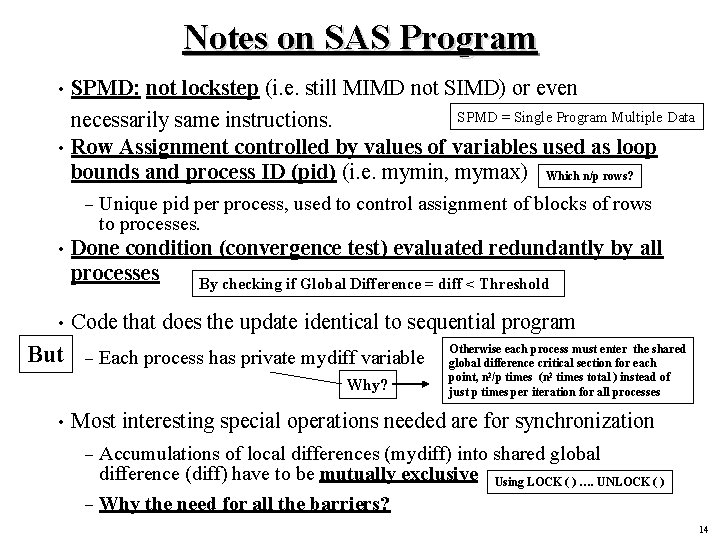
Notes on SAS Program SPMD: not lockstep (i. e. still MIMD not SIMD) or even SPMD = Single Program Multiple Data necessarily same instructions. • Row Assignment controlled by values of variables used as loop bounds and process ID (pid) (i. e. mymin, mymax) Which n/p rows? • – Unique pid per process, used to control assignment of blocks of rows to processes. • Done condition (convergence test) evaluated redundantly by all processes By checking if Global Difference = diff < Threshold • Code that does the update identical to sequential program But – Each process has private mydiff variable Why? • Otherwise each process must enter the shared global difference critical section for each point, n 2/p times (n 2 times total ) instead of just p times per iteration for all processes Most interesting special operations needed are for synchronization Accumulations of local differences (mydiff) into shared global difference (diff) have to be mutually exclusive Using LOCK ( ) …. UNLOCK ( ) – Why the need for all the barriers? – 14
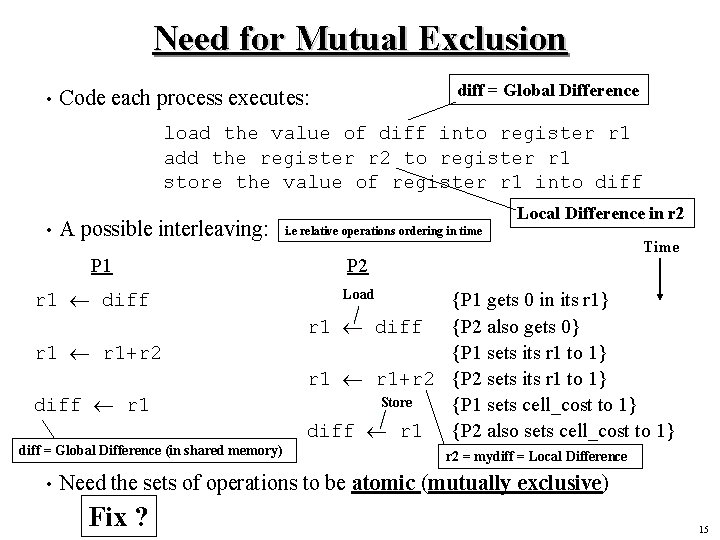
Need for Mutual Exclusion • diff = Global Difference Code each process executes: load the value of diff into register r 1 add the register r 2 to register r 1 store the value of register r 1 into diff • A possible interleaving: Local Difference in r 2 i. e relative operations ordering in time P 1 r 1 diff r 1+r 2 diff r 1 diff = Global Difference (in shared memory) • Time P 2 Load {P 1 gets 0 in its r 1} r 1 diff {P 2 also gets 0} {P 1 sets its r 1 to 1} r 1+r 2 {P 2 sets its r 1 to 1} Store {P 1 sets cell_cost to 1} diff r 1 {P 2 also sets cell_cost to 1} r 2 = mydiff = Local Difference Need the sets of operations to be atomic (mutually exclusive) Fix ? 15
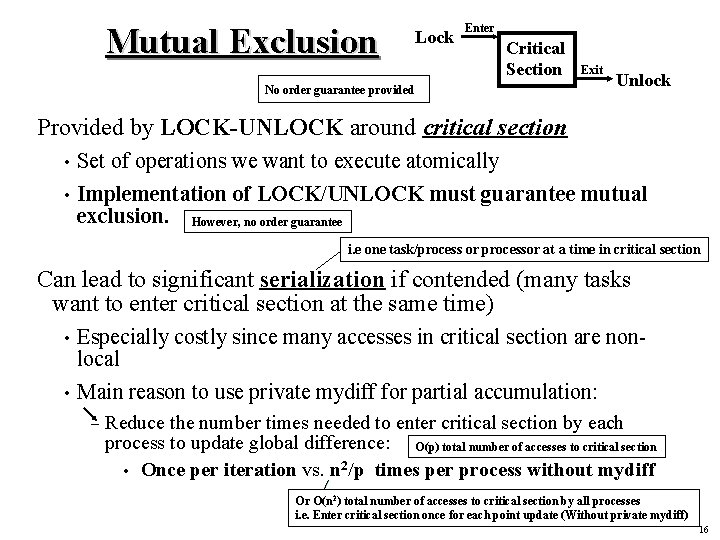
Mutual Exclusion Lock No order guarantee provided Enter Critical Section Exit Unlock Provided by LOCK-UNLOCK around critical section Set of operations we want to execute atomically • Implementation of LOCK/UNLOCK must guarantee mutual exclusion. However, no order guarantee • i. e one task/process or processor at a time in critical section Can lead to significant serialization if contended (many tasks want to enter critical section at the same time) Especially costly since many accesses in critical section are nonlocal • Main reason to use private mydiff for partial accumulation: • – Reduce the number times needed to enter critical section by each process to update global difference: O(p) total number of accesses to critical section • Once per iteration vs. n 2/p times per process without mydiff Or O(n 2) total number of accesses to critical section by all processes i. e. Enter critical section once for each point update (Without private mydiff) 16
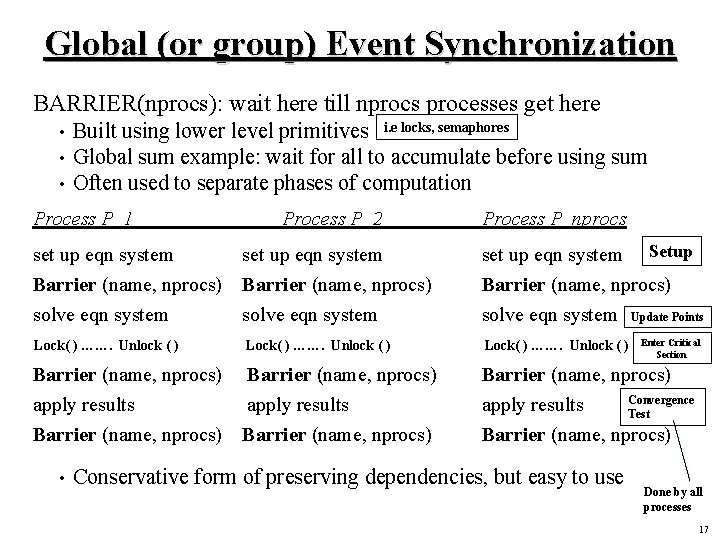
Global (or group) Event Synchronization BARRIER(nprocs): wait here till nprocs processes get here • • • Built using lower level primitives i. e locks, semaphores Global sum example: wait for all to accumulate before using sum Often used to separate phases of computation Process P_1 Process P_2 Process P_nprocs set up eqn system Barrier (name, nprocs) solve eqn system set up eqn system Setup Barrier (name, nprocs) solve eqn system Update Points Lock( ) ……. Unlock ( ) Barrier (name, nprocs) apply results Barrier (name, nprocs) • Enter Critical Section Barrier (name, nprocs) Convergence apply results Test Barrier (name, nprocs) Conservative form of preserving dependencies, but easy to use Done by all processes 17
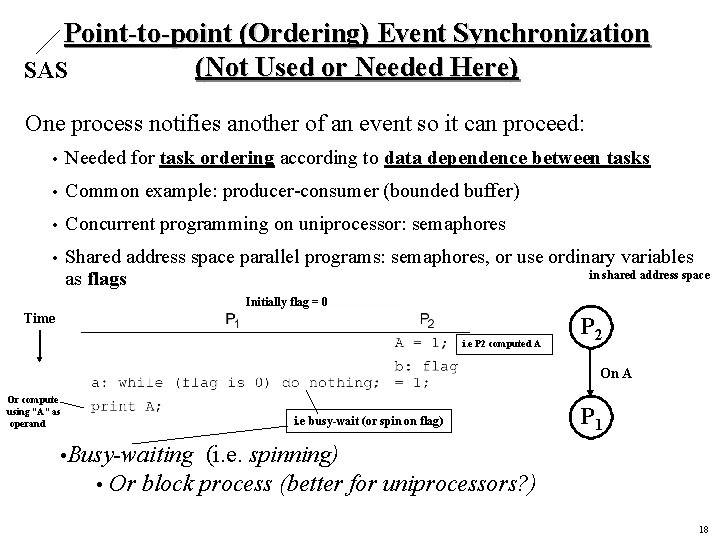
Point-to-point (Ordering) Event Synchronization (Not Used or Needed Here) SAS One process notifies another of an event so it can proceed: • Needed for task ordering according to data dependence between tasks • Common example: producer-consumer (bounded buffer) • Concurrent programming on uniprocessor: semaphores • Shared address space parallel programs: semaphores, or use ordinary variables in shared address space as flags Initially flag = 0 Time i. e P 2 computed A P 2 On A Or compute using “A” as operand • Busy-waiting • Or block i. e busy-wait (or spin on flag) P 1 (i. e. spinning) process (better for uniprocessors? ) 18
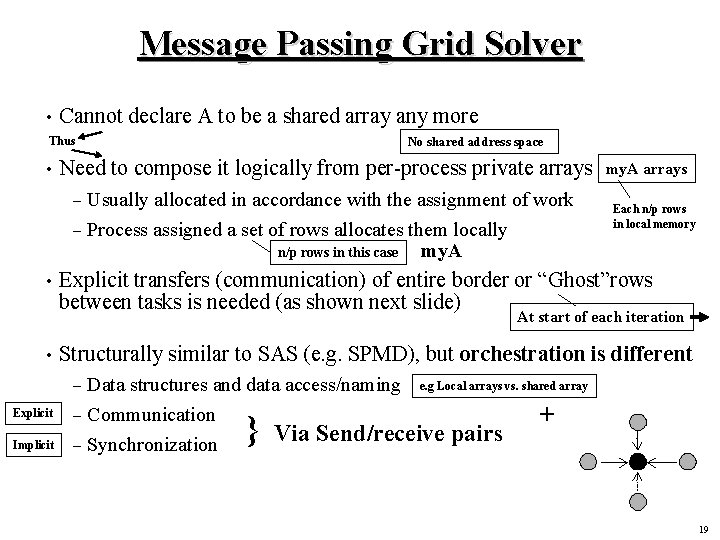
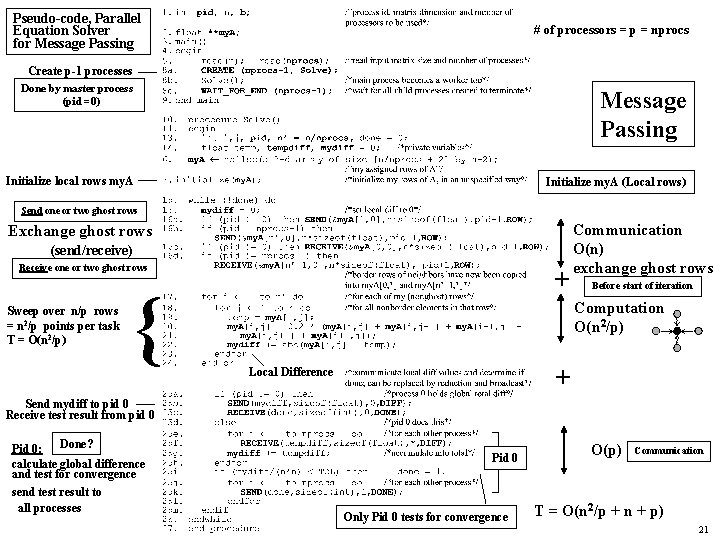
Message Passing Grid Solver • Cannot declare A to be a shared array any more Thus • • No shared address space Need to compose it logically from per-process private arrays – Usually allocated in accordance with the assignment of work – Process assigned a set of rows allocates them locally my. A n/p rows in this case my. A arrays Each n/p rows in local memory Explicit transfers (communication) of entire border or “Ghost”rows between tasks is needed (as shown next slide) At start of each iteration • Structurally similar to SAS (e. g. SPMD), but orchestration is different Data structures and data access/naming e. g Local arrays vs. shared array – Communication + Via Send/receive pairs – Synchronization – Explicit Implicit } 19
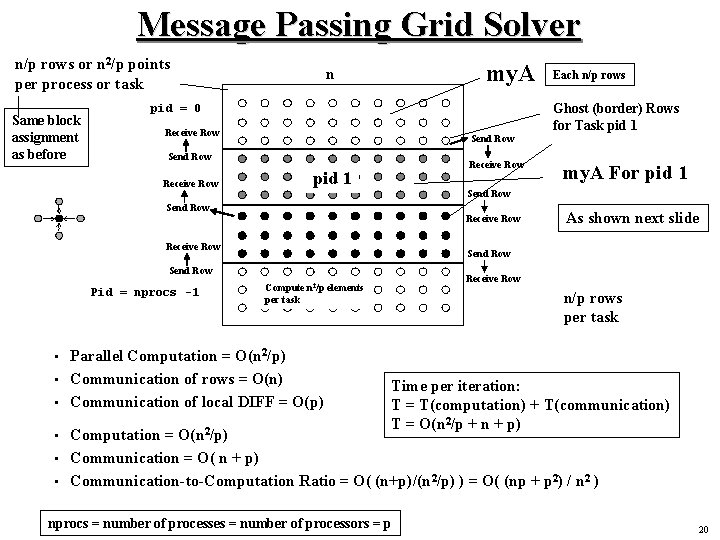
Message Passing Grid Solver n/p rows or n 2/p points per process or task Same block assignment as before my. A n Ghost (border) Rows for Task pid 1 pid = 0 Receive Row Send Row Receive Row pid 1 my. A For pid 1 Send Row Receive Row As shown next slide Send Row Pid = nprocs -1 Each n/p rows Receive Row Compute n 2/p elements per task Parallel Computation = O(n 2/p) • Communication of rows = O(n) • Communication of local DIFF = O(p) n/p rows per task • Time per iteration: T = T(computation) + T(communication) T = O(n 2/p + n + p) Computation = O(n 2/p) • Communication = O( n + p) • Communication-to-Computation Ratio = O( (n+p)/(n 2/p) ) = O( (np + p 2) / n 2 ) • nprocs = number of processes = number of processors = p 20
Pseudo-code, Parallel Equation Solver for Message Passing # of processors = p = nprocs Create p-1 processes Done by master process (pid =0) Message Passing Initialize local rows my. A Initialize my. A (Local rows) Send one or two ghost rows Exchange ghost rows (send/receive) Receive one or two ghost rows Sweep over n/p rows = n 2/p points per task T = O(n 2/p) { + Communication O(n) exchange ghost rows Before start of iteration Computation O(n 2/p) Local Difference + Send mydiff to pid 0 Receive test result from pid 0 Pid 0: Done? calculate global difference and test for convergence send test result to all processes Pid 0 Only Pid 0 tests for convergence O(p) Communication T = O(n 2/p + n + p) 21
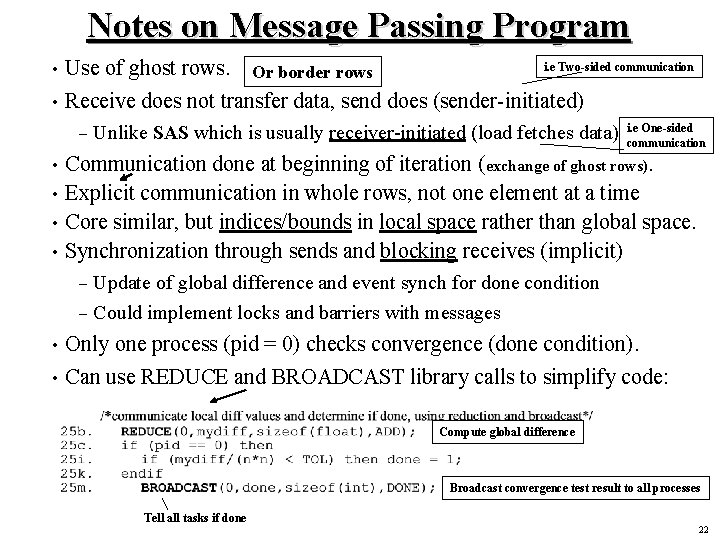
Notes on Message Passing Program i. e Two-sided communication Use of ghost rows. Or border rows • Receive does not transfer data, send does (sender-initiated) • – Unlike SAS which is usually receiver-initiated (load fetches data) i. e One-sided communication Communication done at beginning of iteration (exchange of ghost rows). • Explicit communication in whole rows, not one element at a time • Core similar, but indices/bounds in local space rather than global space. • Synchronization through sends and blocking receives (implicit) • Update of global difference and event synch for done condition – Could implement locks and barriers with messages – Only one process (pid = 0) checks convergence (done condition). • Can use REDUCE and BROADCAST library calls to simplify code: • Compute global difference Broadcast convergence test result to all processes Tell all tasks if done 22
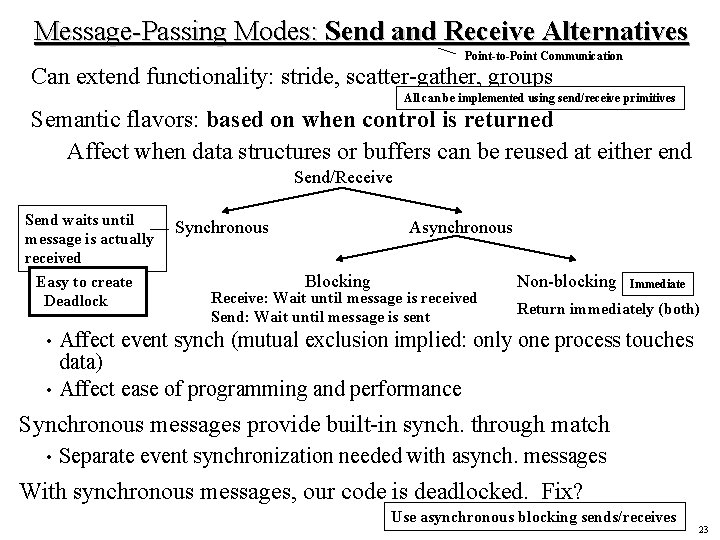
Message-Passing Modes: Send and Receive Alternatives Point-to-Point Communication Can extend functionality: stride, scatter-gather, groups All can be implemented using send/receive primitives Semantic flavors: based on when control is returned Affect when data structures or buffers can be reused at either end Send/Receive Send waits until message is actually received Easy to create Deadlock Synchronous Asynchronous Blocking Receive: Wait until message is received Send: Wait until message is sent Non-blocking Immediate Return immediately (both) Affect event synch (mutual exclusion implied: only one process touches data) • Affect ease of programming and performance • Synchronous messages provide built-in synch. through match • Separate event synchronization needed with asynch. messages With synchronous messages, our code is deadlocked. Fix? Use asynchronous blocking sends/receives 23
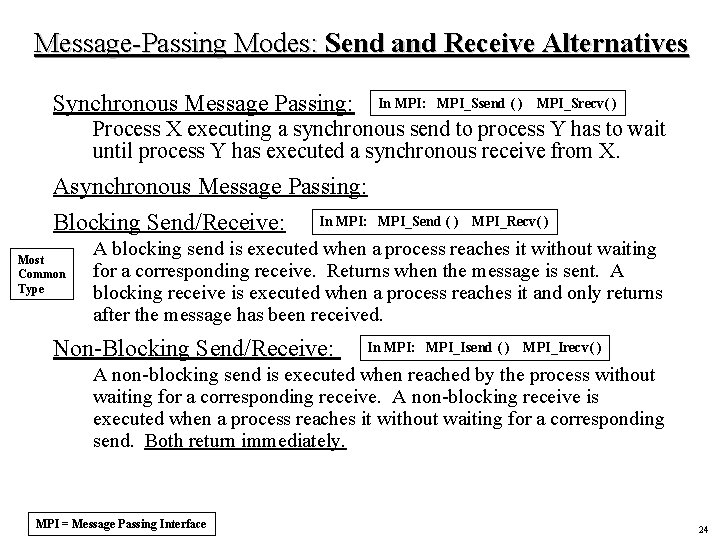
Message-Passing Modes: Send and Receive Alternatives Synchronous Message Passing: In MPI: MPI_Ssend ( ) MPI_Srecv( ) Process X executing a synchronous send to process Y has to wait until process Y has executed a synchronous receive from X. Asynchronous Message Passing: Blocking Send/Receive: Most Common Type In MPI: MPI_Send ( ) MPI_Recv( ) A blocking send is executed when a process reaches it without waiting for a corresponding receive. Returns when the message is sent. A blocking receive is executed when a process reaches it and only returns after the message has been received. Non-Blocking Send/Receive: In MPI: MPI_Isend ( ) MPI_Irecv( ) A non-blocking send is executed when reached by the process without waiting for a corresponding receive. A non-blocking receive is executed when a process reaches it without waiting for a corresponding send. Both return immediately. MPI = Message Passing Interface 24
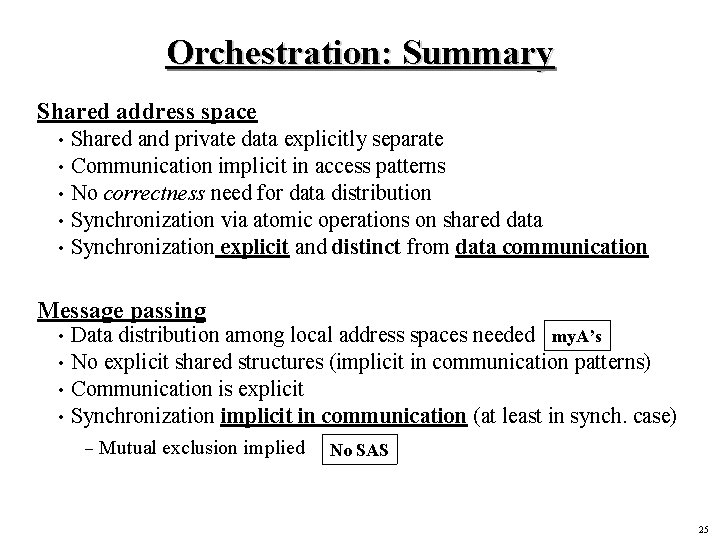
Orchestration: Summary Shared address space • • • Shared and private data explicitly separate Communication implicit in access patterns No correctness need for data distribution Synchronization via atomic operations on shared data Synchronization explicit and distinct from data communication Message passing • • Data distribution among local address spaces needed my. A’s No explicit shared structures (implicit in communication patterns) Communication is explicit Synchronization implicit in communication (at least in synch. case) – Mutual exclusion implied No SAS 25
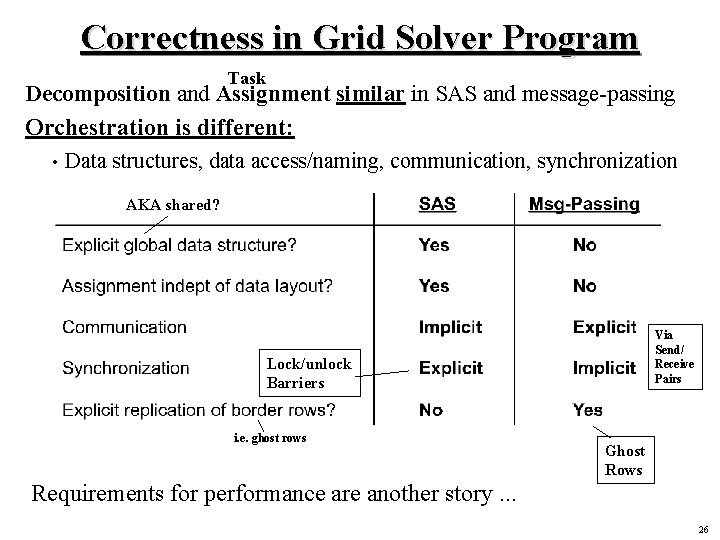
Correctness in Grid Solver Program Task Decomposition and Assignment similar in SAS and message-passing Orchestration is different: • Data structures, data access/naming, communication, synchronization AKA shared? Via Send/ Receive Pairs Lock/unlock Barriers i. e. ghost rows Ghost Rows Requirements for performance are another story. . . 26