
STEP Satellite Test of the Equivalence Principle Alan
- Slides: 17
STEP Satellite Test of the Equivalence Principle © Alan Bean, courtesy Greenwich Workshop Inc .
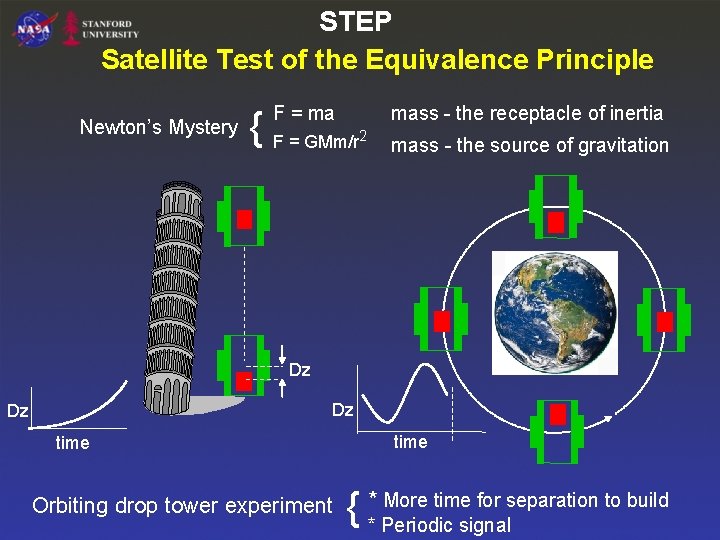
STEP Satellite Test of the Equivalence Principle Newton’s Mystery F = ma { F = GMm/r mass - the receptacle of inertia 2 mass - the source of gravitation Dz Dz Dz time Orbiting drop tower experiment time { * Periodic signal * More time for separation to build
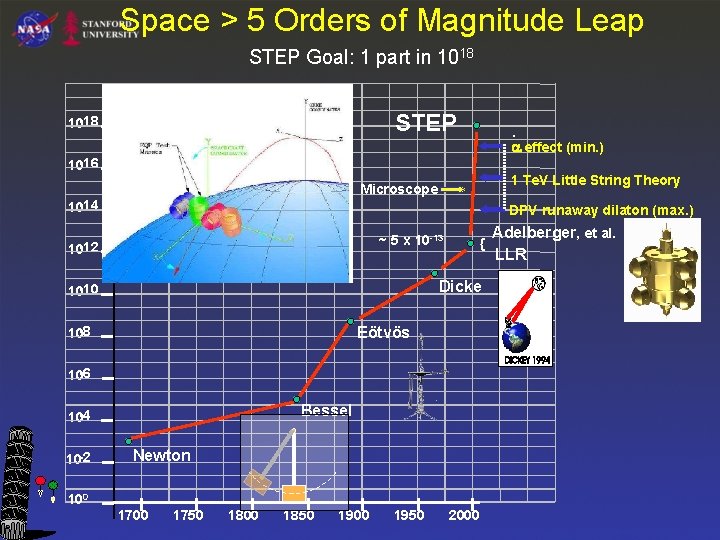
Space > 5 Orders of Magnitude Leap STEP Goal: 1 part in 1018 STEP 10 -18 . a effect (min. ) 10 -16 1 Te. V Little String Theory Microscope 10 -14 DPV runaway dilaton (max. ) Adelberger, et al. LLR ~5 x 10 -13 { 10 -12 Dicke 10 -10 10 -8 Eötvös 10 -6 Bessel 10 -4 10 -2 Newton 100 1750 1800 1850 1900 1950 2000
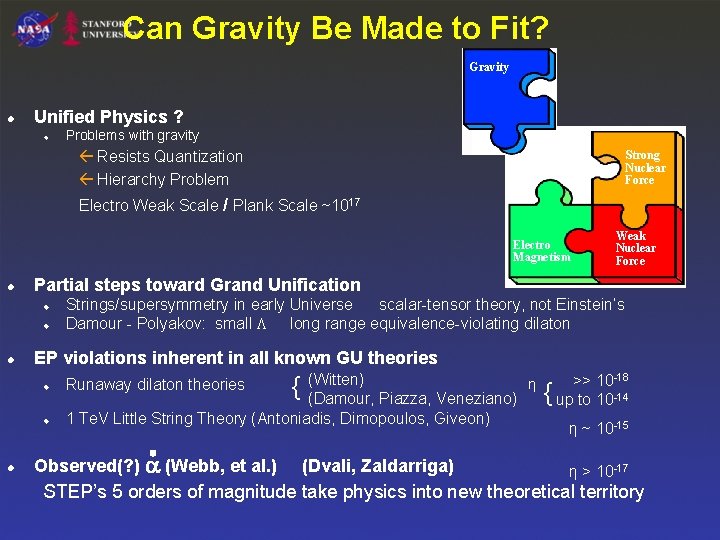
Can Gravity Be Made to Fit? Gravity l Unified Physics ? u Problems with gravity ß Resists Quantization ß Hierarchy Problem Strong Nuclear Force Electro Weak Scale / Plank Scale ~1017 Electro Magnetism l Partial steps toward Grand Unification u u l Strings/supersymmetry in early Universe scalar-tensor theory, not Einstein’s Damour - Polyakov: small L long range equivalence-violating dilaton EP violations inherent in all known GU theories u u l Weak Nuclear Force (Witten) >> 10 -18 η (Damour, Piazza, Veneziano) up to 10 -14 1 Te. V Little String Theory (Antoniadis, Dimopoulos, Giveon) η ~ 10 -15 Runaway dilaton theories Observed(? ) a (Webb, et al. ) { { (Dvali, Zaldarriga) η > 10 -17 STEP’s 5 orders of magnitude take physics into new theoretical territory
STEP Status l Integrated ground test flight accelerometer 2006: Second year ofof 3 prototype year Technology Program under NASA MSFC u Fabricate prototype flight instrument STEP Technical Performance Goals: ß Differential accelerometer ß Cryogenic electronics ß Quartz block mounting structure l Dewar /Probe Design u u u l Systems Study u u u l LMMS design study with Dewar/ Probe Interface definition Probe/Instrument Interface definition Aerogel Implementation Update Error Budget Requirements flowdown Electronics requirements review/ GP-B heritage study Space Vehicle Dynamics u u u Drag Free and Attitude Control design Accelerometer Dynamics simulator On-Orbit Setup algorithm design with ops interface
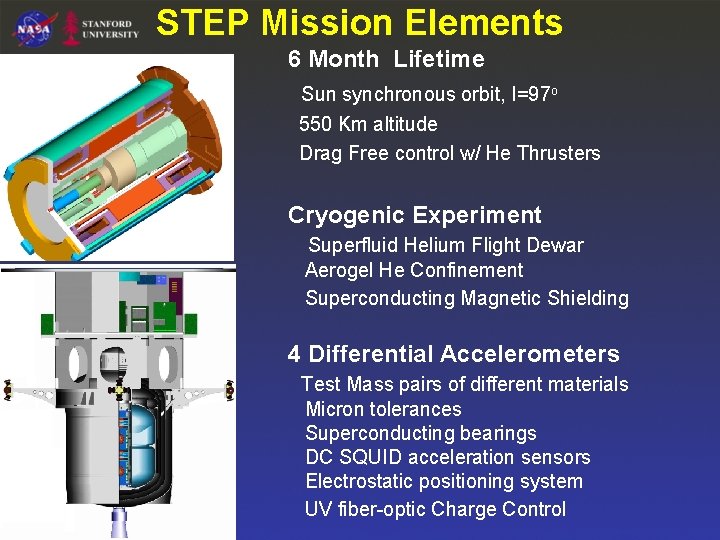
STEP Mission Elements 6 Month Lifetime Sun synchronous orbit, I=97 o 550 Km altitude Drag Free control w/ He Thrusters Cryogenic Experiment Superfluid Helium Flight Dewar Aerogel He Confinement Superconducting Magnetic Shielding 4 Differential Accelerometers Test Mass pairs of different materials Micron tolerances Superconducting bearings DC SQUID acceleration sensors Electrostatic positioning system UV fiber-optic Charge Control
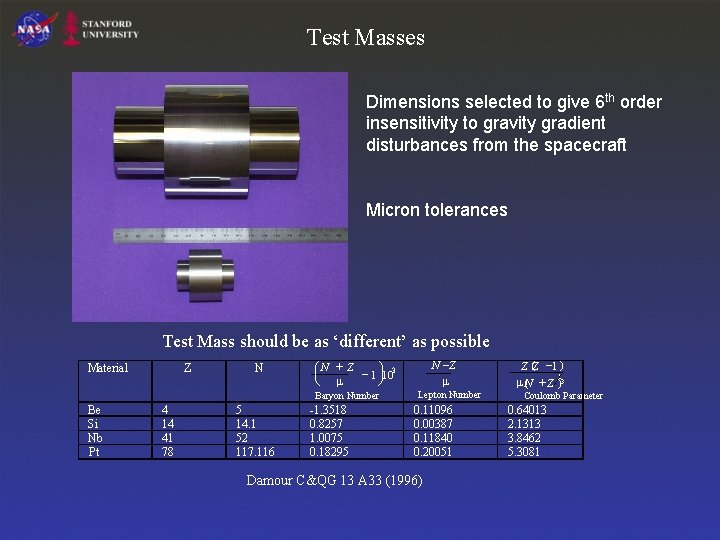
Test Masses Dimensions selected to give 6 th order insensitivity to gravity gradient disturbances from the spacecraft Micron tolerances Test Mass should be as ‘different’ as possible Material Z N æç N + Z ö - 1 ÷ 103 è m ø Baryon Number Be Si Nb Pt 4 14 41 78 5 14. 1 52 117. 116 -1. 3518 0. 8257 1. 0075 0. 18295 N -Z m Lepton Number 0. 11096 0. 00387 0. 11840 0. 20051 Damour C&QG 13 A 33 (1996) Z (Z -1 ) 1 m (N + Z )3 Coulomb Parameter 0. 64013 2. 1313 3. 8462 5. 3081
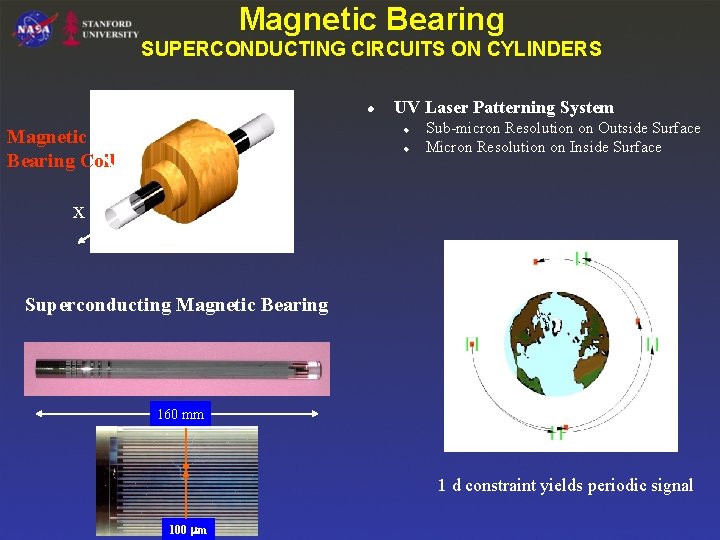
Magnetic Bearing SUPERCONDUCTING CIRCUITS ON CYLINDERS l Magnetic Bearing Coil UV Laser Patterning System u u Sub-micron Resolution on Outside Surface Micron Resolution on Inside Surface x Superconducting Magnetic Bearing 160 mm 1 d constraint yields periodic signal 100 mm
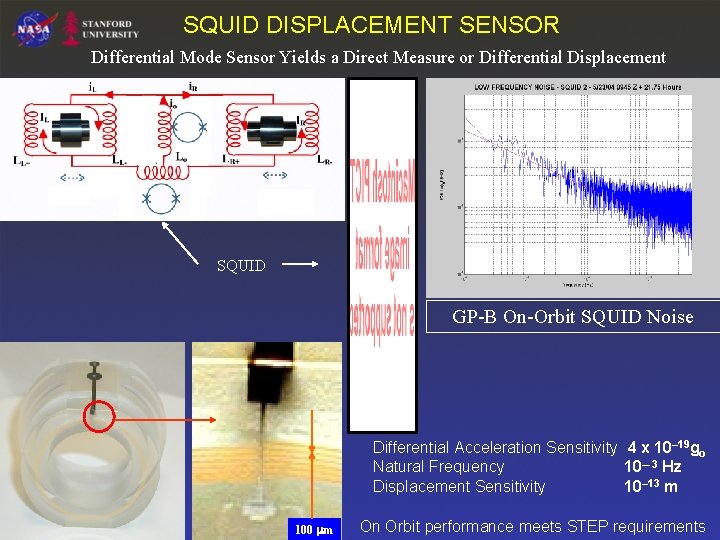
SQUID DISPLACEMENT SENSOR Differential Mode Sensor Yields a Direct Measure or Differential Displacement SQUID GP-B On-Orbit SQUID Noise Differential Acceleration Sensitivity 4 x 10– 19 go Natural Frequency 10–-3 Hz Displacement Sensitivity 10– 13 m 100 mm On Orbit performance meets STEP requirements
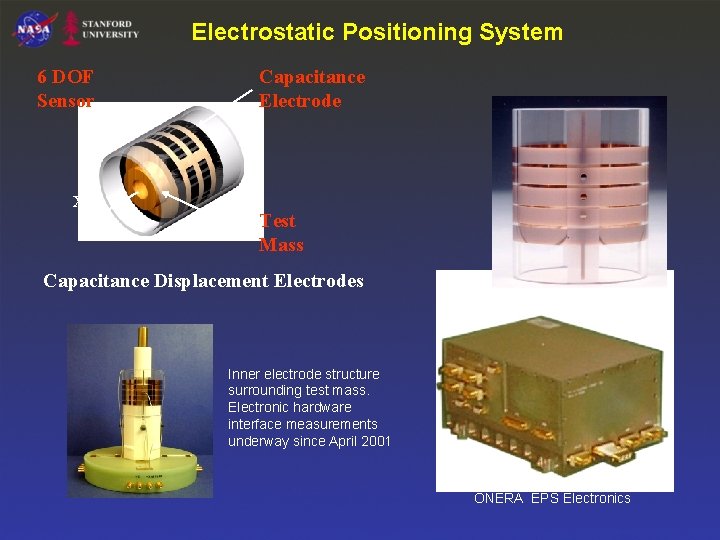
Electrostatic Positioning System 6 DOF Sensor x Capacitance Electrode Test Mass Capacitance Displacement Electrodes Inner electrode structure surrounding test mass. Electronic hardware interface measurements underway since April 2001 ONERA EPS Electronics
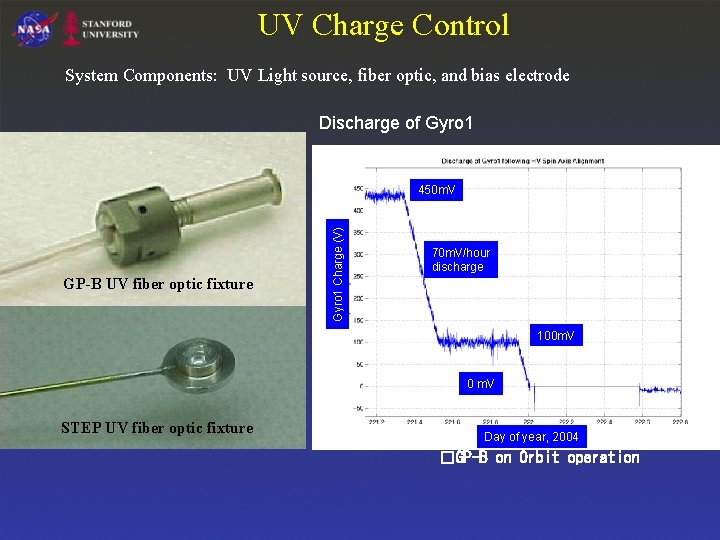
UV Charge Control System Components: UV Light source, fiber optic, and bias electrode Discharge of Gyro 1 GP-B UV fiber optic fixture Gyro 1 Charge (V) 450 m. V 70 m. V/hour discharge 100 m. V 0 m. V STEP UV fiber optic fixture Day of year, 2004 �GP-B on Orbit operation
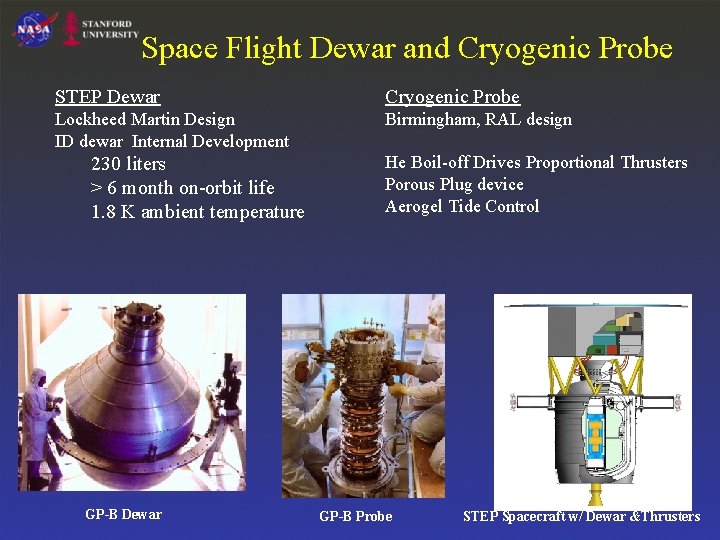
Space Flight Dewar and Cryogenic Probe STEP Dewar Cryogenic Probe Lockheed Martin Design ID dewar Internal Development Birmingham, RAL design 230 liters > 6 month on-orbit life 1. 8 K ambient temperature GP-B Dewar He Boil-off Drives Proportional Thrusters Porous Plug device Aerogel Tide Control GP-B Probe STEP Spacecraft w/ Dewar &Thrusters
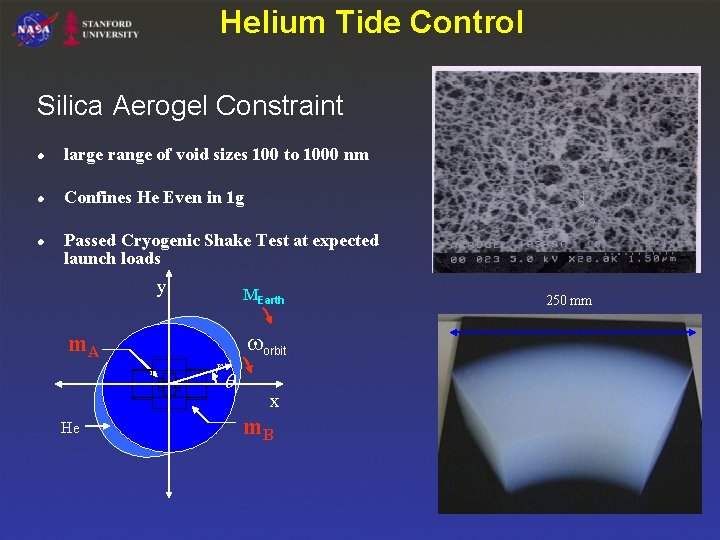
Helium Tide Control Silica Aerogel Constraint l large range of void sizes 100 to 1000 nm l Confines He Even in 1 g l Passed Cryogenic Shake Test at expected launch loads y m. A MEarth Rwe rr ll He q worbit x m. B 250 mm
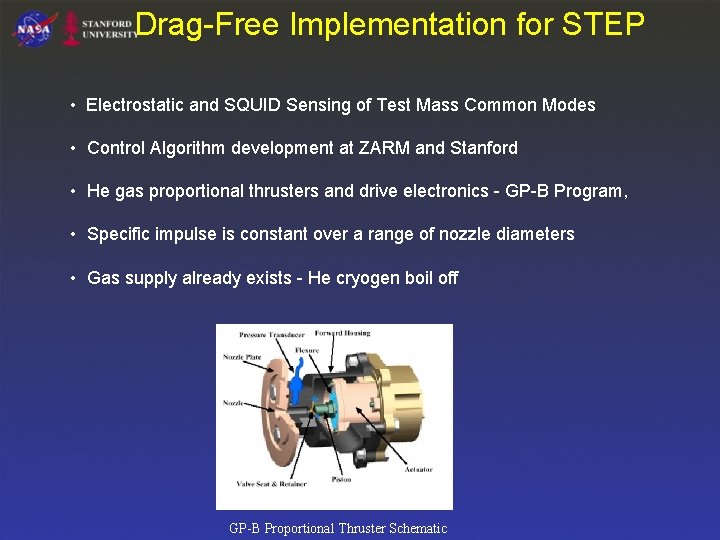
Drag-Free Implementation for STEP • Electrostatic and SQUID Sensing of Test Mass Common Modes • Control Algorithm development at ZARM and Stanford • He gas proportional thrusters and drive electronics - GP-B Program, • Specific impulse is constant over a range of nozzle diameters • Gas supply already exists - He cryogen boil off GP-B Proportional Thruster Schematic
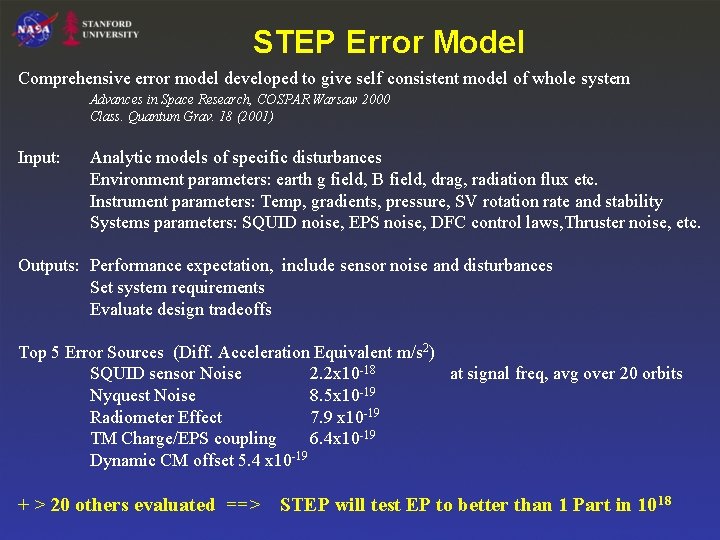
STEP Error Model Comprehensive error model developed to give self consistent model of whole system Advances in Space Research, COSPAR Warsaw 2000 Class. Quantum Grav. 18 (2001) Input: Analytic models of specific disturbances Environment parameters: earth g field, B field, drag, radiation flux etc. Instrument parameters: Temp, gradients, pressure, SV rotation rate and stability Systems parameters: SQUID noise, EPS noise, DFC control laws, Thruster noise, etc. Outputs: Performance expectation, include sensor noise and disturbances Set system requirements Evaluate design tradeoffs Top 5 Error Sources (Diff. Acceleration Equivalent m/s 2) SQUID sensor Noise 2. 2 x 10 -18 at signal freq, avg over 20 orbits Nyquest Noise 8. 5 x 10 -19 Radiometer Effect 7. 9 x 10 -19 TM Charge/EPS coupling 6. 4 x 10 -19 Dynamic CM offset 5. 4 x 10 -19 + > 20 others evaluated ==> STEP will test EP to better than 1 Part in 1018
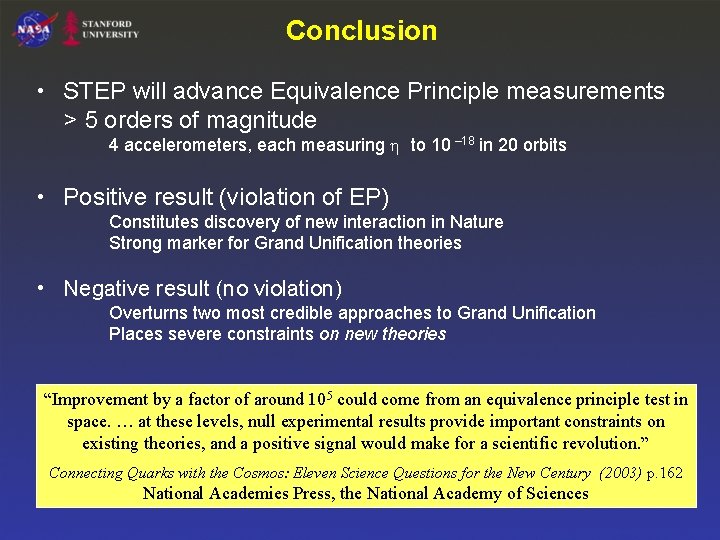
Conclusion • STEP will advance Equivalence Principle measurements > 5 orders of magnitude 4 accelerometers, each measuring h to 10 – 18 in 20 orbits • Positive result (violation of EP) Constitutes discovery of new interaction in Nature Strong marker for Grand Unification theories • Negative result (no violation) Overturns two most credible approaches to Grand Unification Places severe constraints on new theories “Improvement by a factor of around 105 could come from an equivalence principle test in space. … at these levels, null experimental results provide important constraints on existing theories, and a positive signal would make for a scientific revolution. ” Connecting Quarks with the Cosmos: Eleven Science Questions for the New Century (2003) p. 162 National Academies Press, the National Academy of Sciences