
STEP BY STEP ABG INTERPRETATION DR SULEKHA SAXENA

STEP BY STEP ABG INTERPRETATION DR. SULEKHA SAXENA ASSISTANT PROFESSOR DEPT OF CRITICAL CARE MEDICINE KING GEORGE’S MEDICAL UNIVERSITY LUCKNOW INDIA

INDICATION OF ABG ü Assess adequacy of ventilation and oxygenation üAssess changes in acid- base homeostasis üHelps in management of ICU patients.
SITE OF ABG üRadial Artery üBrachial Artery üFemoral Artery üDorsalis Pedis Artery üPosterior Tibial artery

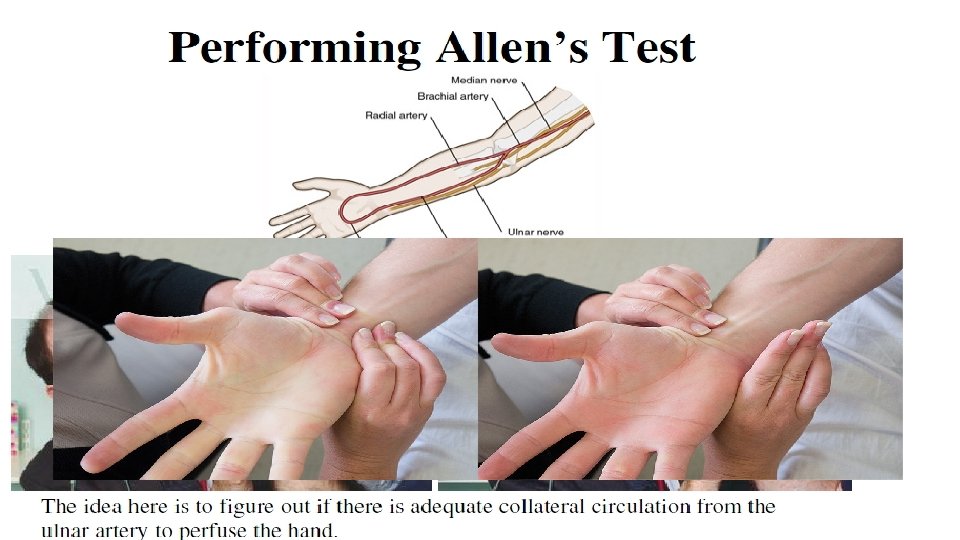
Allens Test
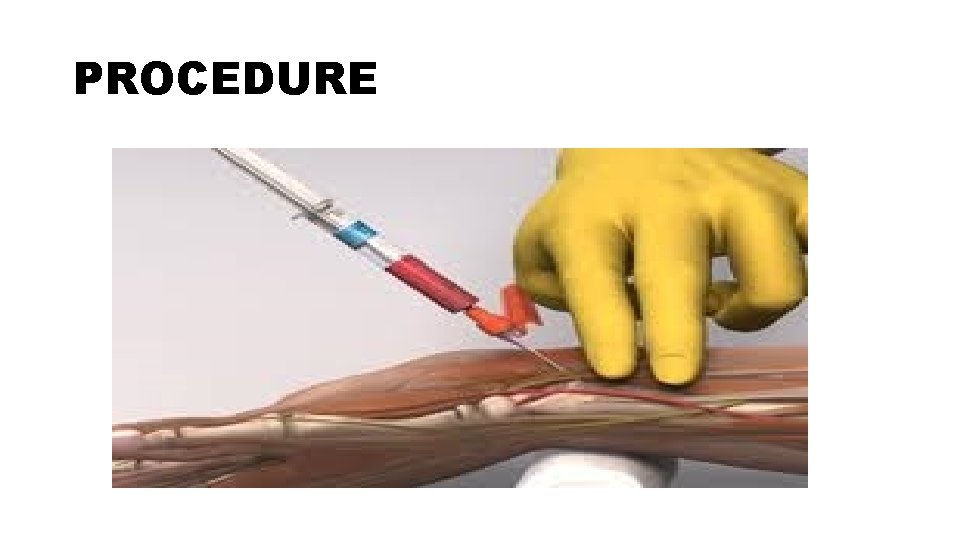
PROCEDURE
CONTRAINDICATION üCellulitis or other infections over puncture site üAbsence of palpable arterial pulse üNegative result of an Allen test/modified Allen test üCoagulopathies / anticoagulant therapy üHistory of arterial spasm following previous puncture üSevere Peripheral Vascular Disease üArterial grafts üDialysis shunt – choose another site
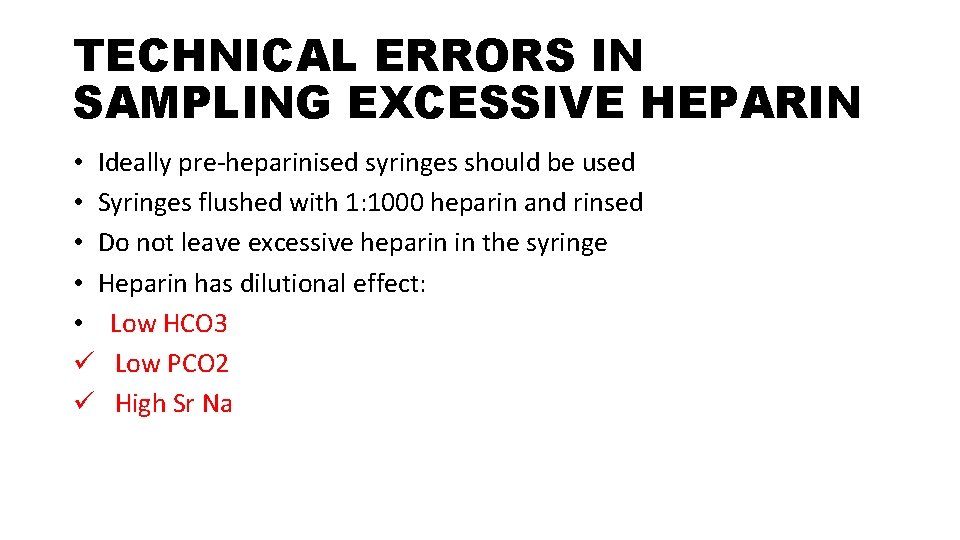
TECHNICAL ERRORS IN SAMPLING EXCESSIVE HEPARIN • Ideally pre-heparinised syringes should be used • Syringes flushed with 1: 1000 heparin and rinsed • Do not leave excessive heparin in the syringe • Heparin has dilutional effect: • Low HCO 3 ü Low PCO 2 ü High Sr Na
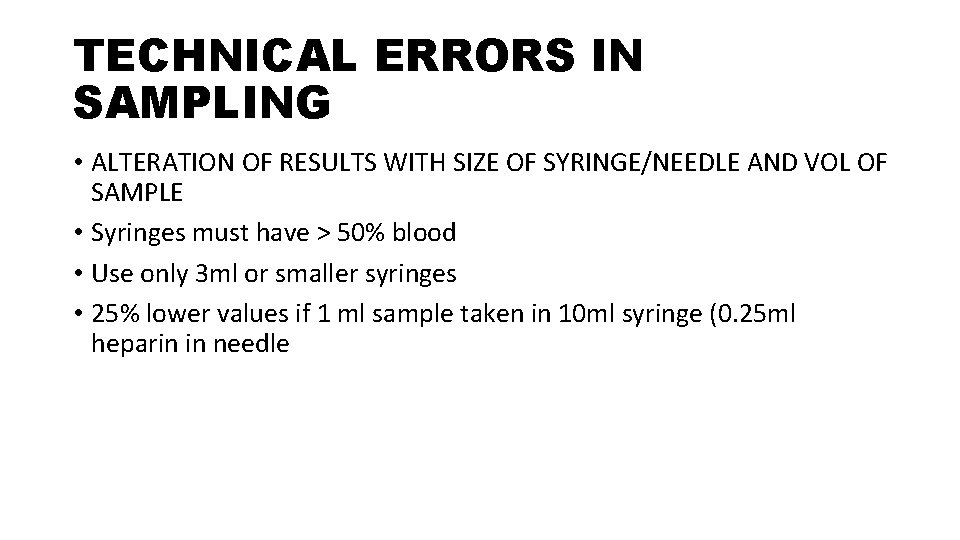
TECHNICAL ERRORS IN SAMPLING • ALTERATION OF RESULTS WITH SIZE OF SYRINGE/NEEDLE AND VOL OF SAMPLE • Syringes must have > 50% blood • Use only 3 ml or smaller syringes • 25% lower values if 1 ml sample taken in 10 ml syringe (0. 25 ml heparin in needle
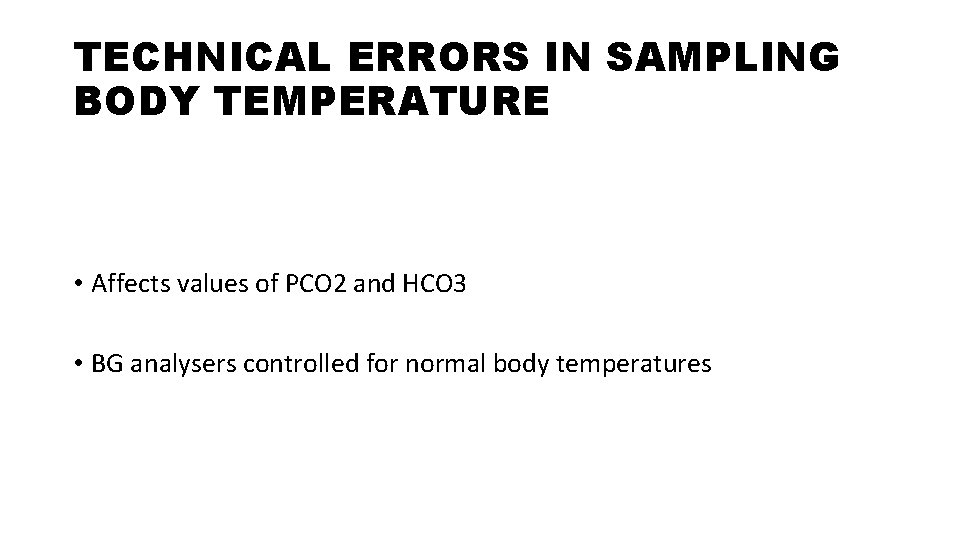
TECHNICAL ERRORS IN SAMPLING BODY TEMPERATURE • Affects values of PCO 2 and HCO 3 • BG analysers controlled for normal body temperatures
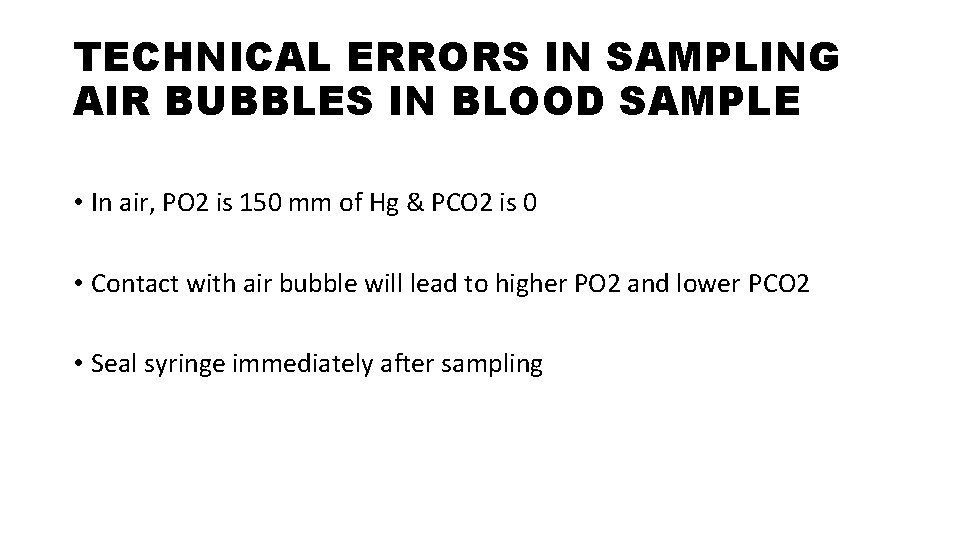
TECHNICAL ERRORS IN SAMPLING AIR BUBBLES IN BLOOD SAMPLE • In air, PO 2 is 150 mm of Hg & PCO 2 is 0 • Contact with air bubble will lead to higher PO 2 and lower PCO 2 • Seal syringe immediately after sampling
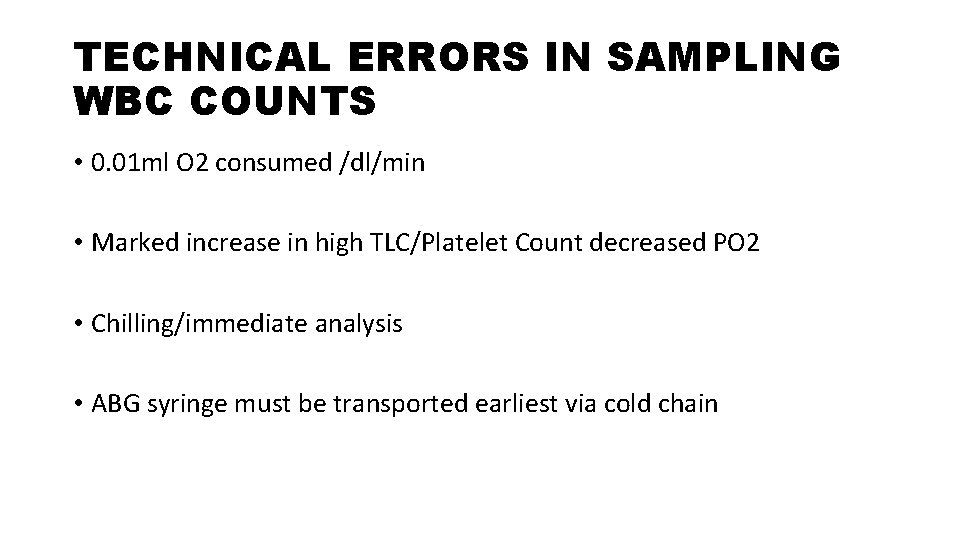
TECHNICAL ERRORS IN SAMPLING WBC COUNTS • 0. 01 ml O 2 consumed /dl/min • Marked increase in high TLC/Platelet Count decreased PO 2 • Chilling/immediate analysis • ABG syringe must be transported earliest via cold chain
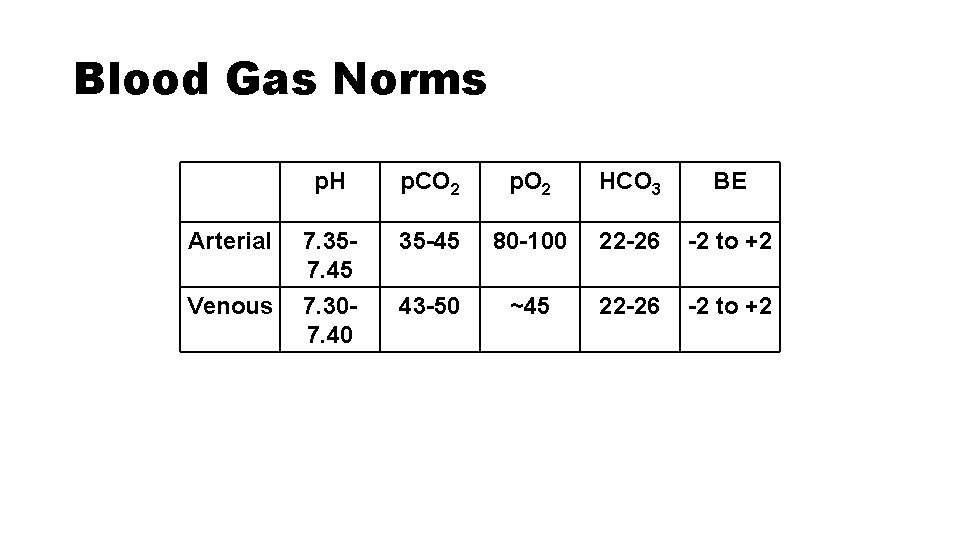
Blood Gas Norms p. H p. CO 2 p. O 2 HCO 3 BE Arterial 7. 357. 45 35 -45 80 -100 22 -26 -2 to +2 Venous 7. 307. 40 43 -50 ~45 22 -26 -2 to +2
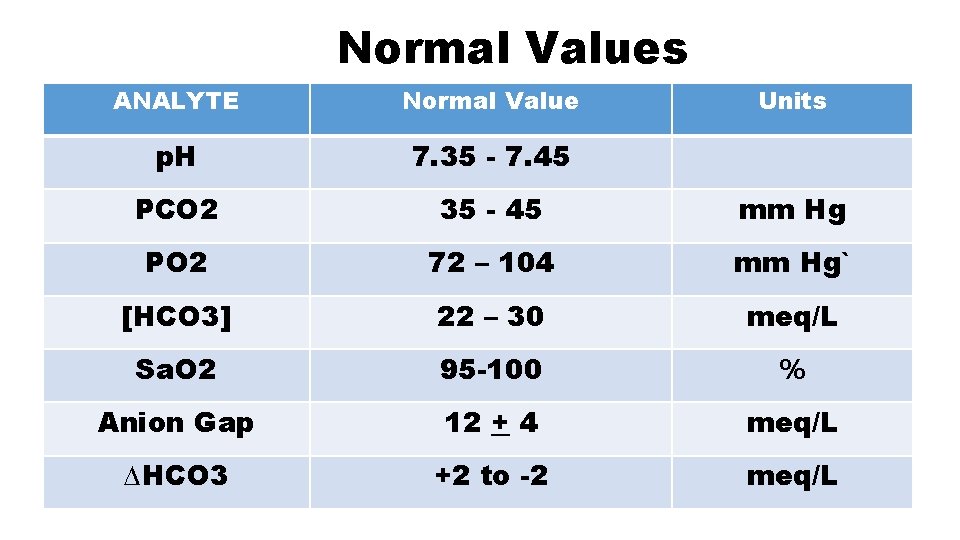
Normal Values ANALYTE Normal Value Units p. H 7. 35 - 7. 45 PCO 2 35 - 45 mm Hg PO 2 72 – 104 mm Hg` [HCO 3] 22 – 30 meq/L Sa. O 2 95 -100 % Anion Gap 12 + 4 meq/L ∆HCO 3 +2 to -2 meq/L
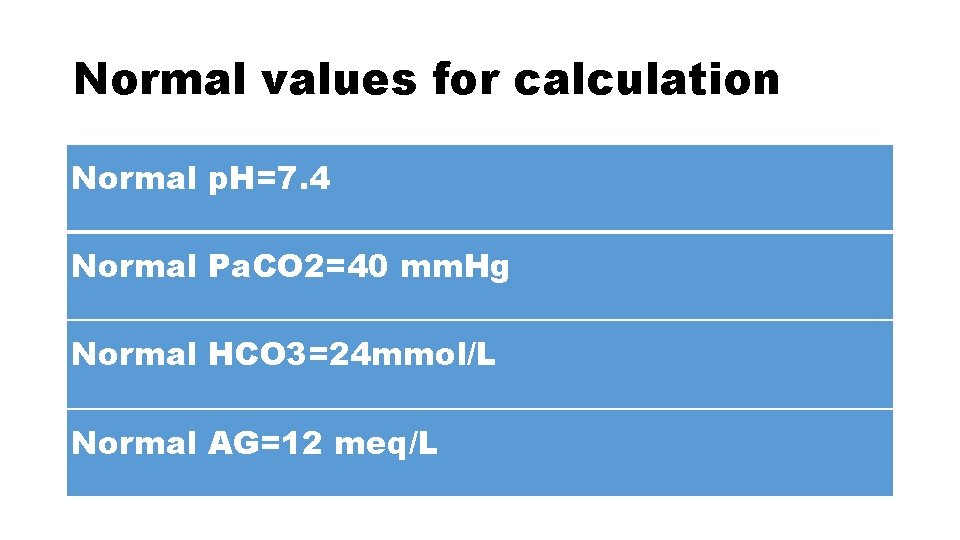
Normal values for calculation Normal p. H=7. 4 Normal Pa. CO 2=40 mm. Hg Normal HCO 3=24 mmol/L Normal AG=12 meq/L
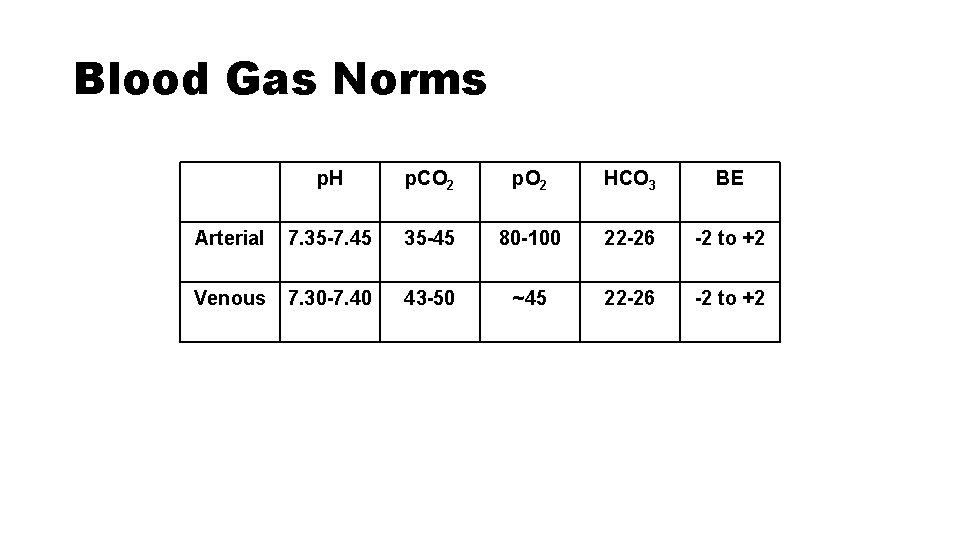
Blood Gas Norms p. H p. CO 2 p. O 2 HCO 3 BE Arterial 7. 35 -7. 45 35 -45 80 -100 22 -26 -2 to +2 Venous 7. 30 -7. 40 43 -50 ~45 22 -26 -2 to +2
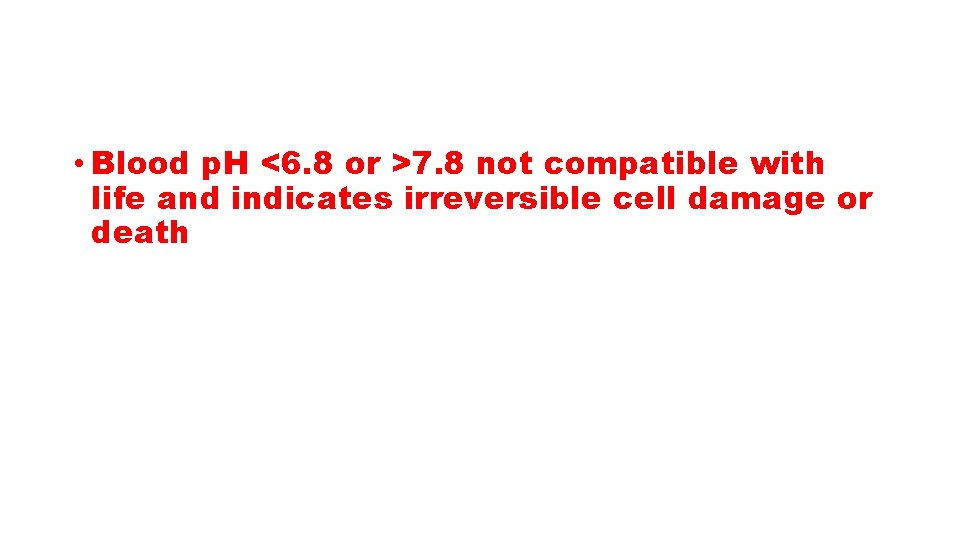
• Blood p. H <6. 8 or >7. 8 not compatible with life and indicates irreversible cell damage or death

Step by step interpretation
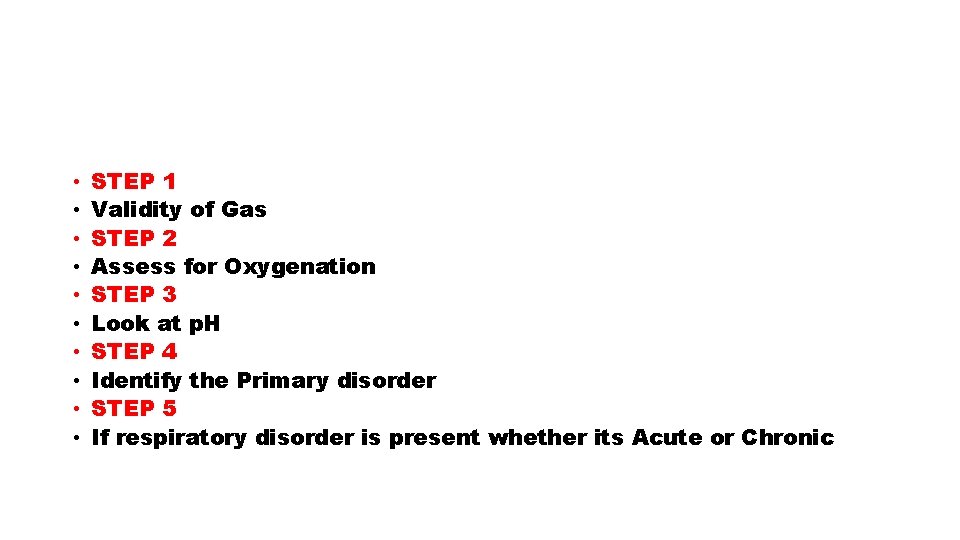
• • • STEP 1 Validity of Gas STEP 2 Assess for Oxygenation STEP 3 Look at p. H STEP 4 Identify the Primary disorder STEP 5 If respiratory disorder is present whether its Acute or Chronic
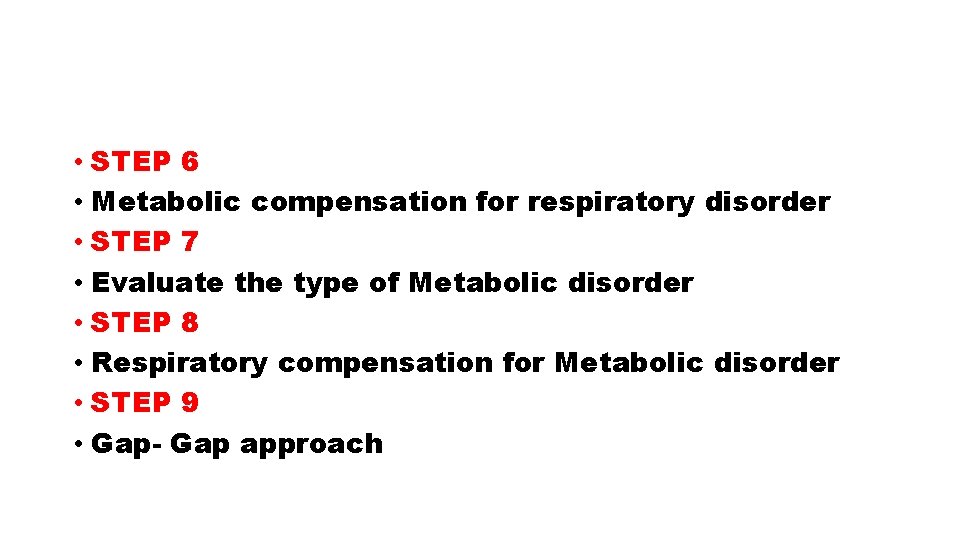
• STEP 6 • Metabolic compensation for respiratory disorder • STEP 7 • Evaluate the type of Metabolic disorder • STEP 8 • Respiratory compensation for Metabolic disorder • STEP 9 • Gap- Gap approach
• Pre requisites prior to any arterial blood gas interpretation, is detailed history of the patient and clinical examination
FIRST STEP-CHECK FOR VALIDITY • At normal p. H of 7. 40 number of H+ ions are 40 • As H+ ions increase acidosis occurs; so if you multiply 40 by a factor of 1. 25 you will get H+ ions equal to 50 which is p. H of 7. 3. As you multiply further H+ ions by 1. 25 you get H+ ions 62. 5 which are equal to p. H of 7. 2. • Similarly as H+ ions fall alkalosis occurs; so if you multiply 40 by a factor of 0. 8 you get H+ ions equal to 32 which is p. H of 7. 5. As you multiply further H + by 0. 8 you get H+ ions 26 which correspond to p. H of 7. 6.
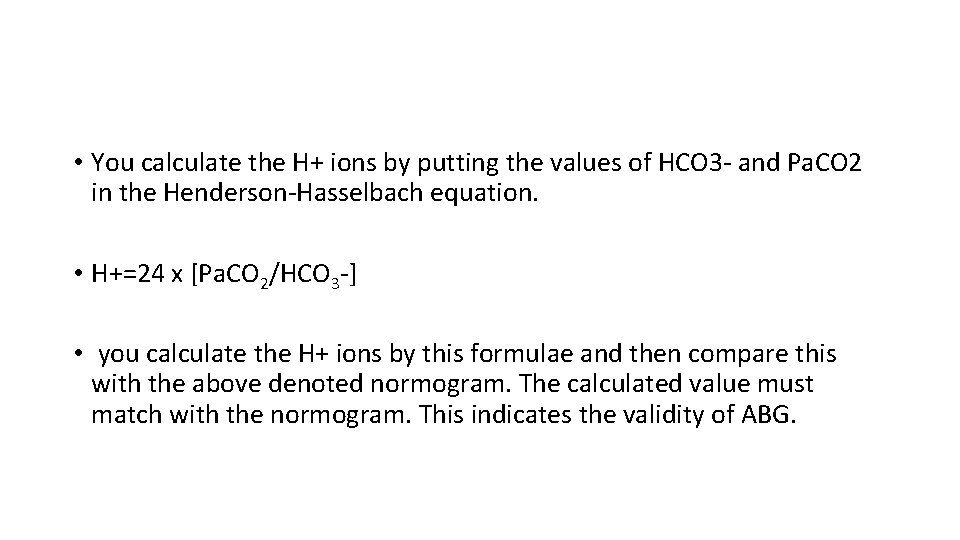
• You calculate the H+ ions by putting the values of HCO 3 - and Pa. CO 2 in the Henderson-Hasselbach equation. • H+=24 x [Pa. CO 2/HCO 3 -] • you calculate the H+ ions by this formulae and then compare this with the above denoted normogram. The calculated value must match with the normogram. This indicates the validity of ABG.
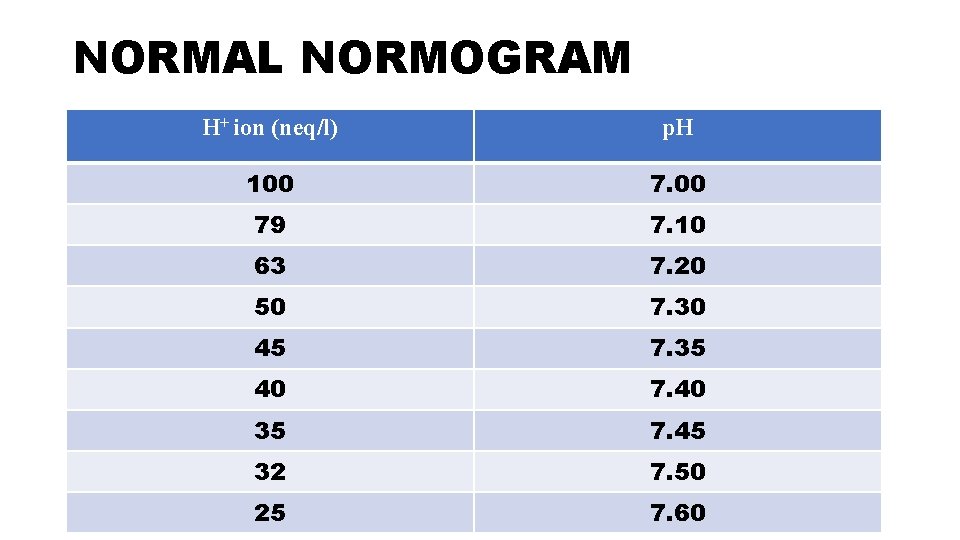
NORMAL NORMOGRAM H+ ion (neq/l) p. H 100 79 7. 10 63 7. 20 50 7. 30 45 7. 35 40 7. 40 35 7. 45 32 7. 50 25 7. 60
SECOND STEP- Assess for Oxygenation • At Room air- The normal alveolar arterial oxygenation gradient (PAO 2 Pa. O 2) is 5 -15 mm Hg. • Normal Pa. O 2 for age = 109 - (0. 45 x Age in years)
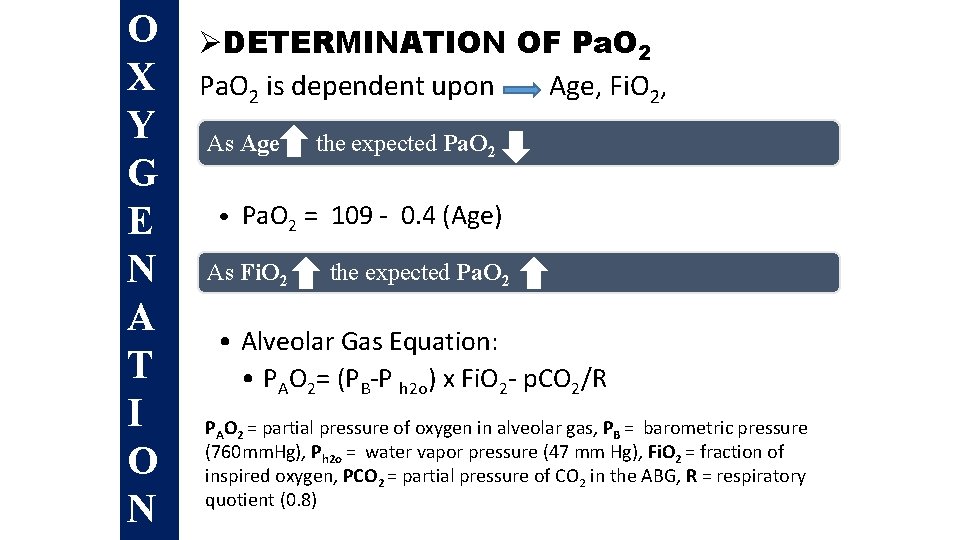
O X Y G E N A T I O N ØDETERMINATION OF Pa. O 2 is dependent upon Age, Fi. O 2, PAs atm. Age the expected Pa. O 2 • Pa. O 2 = 109 - 0. 4 (Age) As Fi. O 2 the expected Pa. O 2 • Alveolar Gas Equation: • PAO 2= (PB-P h 2 o) x Fi. O 2 - p. CO 2/R PAO 2 = partial pressure of oxygen in alveolar gas, PB = barometric pressure (760 mm. Hg), Ph 2 o = water vapor pressure (47 mm Hg), Fi. O 2 = fraction of inspired oxygen, PCO 2 = partial pressure of CO 2 in the ABG, R = respiratory quotient (0. 8)
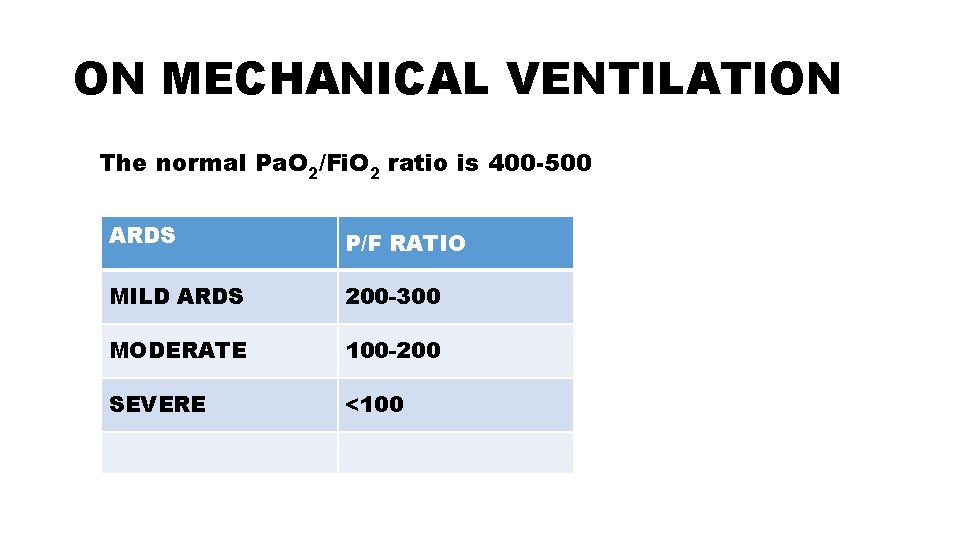
ON MECHANICAL VENTILATION The normal Pa. O 2/Fi. O 2 ratio is 400 -500 ARDS P/F RATIO MILD ARDS 200 -300 MODERATE 100 -200 SEVERE <100
THIRD STEP-ACIDOSIS OR ALKALOSIS • Look at p. H; normal p. H is 7. 35 -7. 45 for calculation purpose it is 7. 4 • Acidemia - p. H <7. 40 is referred as acidemia • The process in the tissue leading to this is referred as acidosis • Alkalemia - p. H >7. 45 is alkalemia • The process in the tissue leading to this is referred as alkalosis.
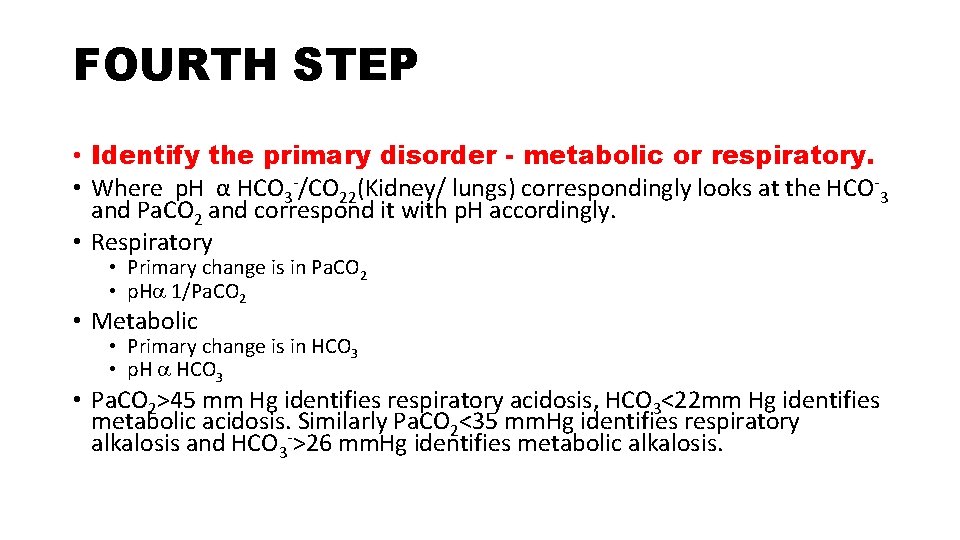
FOURTH STEP • Identify the primary disorder - metabolic or respiratory. • Where p. H α HCO 3 -/CO 22(Kidney/ lungs) correspondingly looks at the HCO-3 and Pa. CO 2 and correspond it with p. H accordingly. • Respiratory • Primary change is in Pa. CO 2 • p. H 1/Pa. CO 2 • Metabolic • Primary change is in HCO 3 • p. H HCO 3 • Pa. CO 2>45 mm Hg identifies respiratory acidosis, HCO 3<22 mm Hg identifies metabolic acidosis. Similarly Pa. CO 2<35 mm. Hg identifies respiratory alkalosis and HCO 3 ->26 mm. Hg identifies metabolic alkalosis.
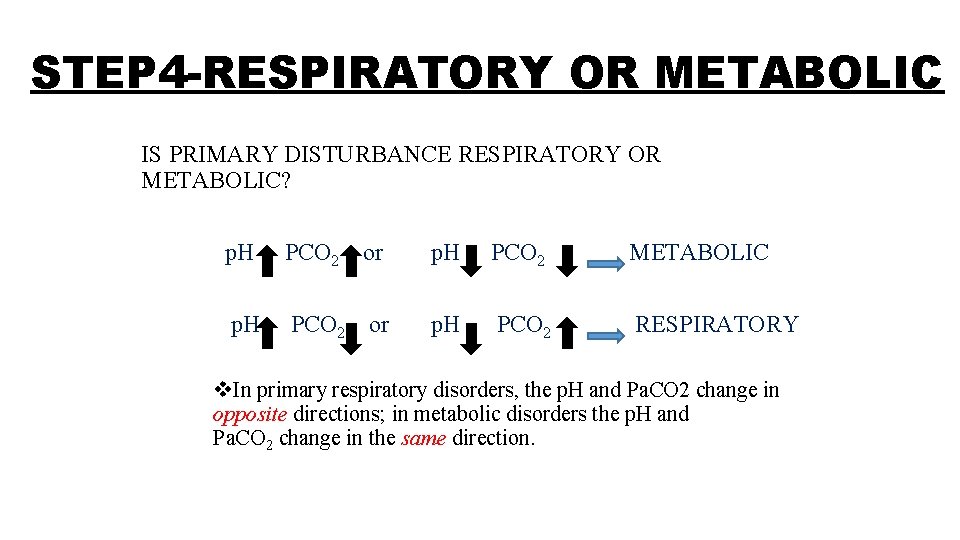
STEP 4 -RESPIRATORY OR METABOLIC IS PRIMARY DISTURBANCE RESPIRATORY OR METABOLIC? p. H PCO 2 or p. H PCO 2 METABOLIC p. H PCO 2 or p. H PCO 2 RESPIRATORY v. In primary respiratory disorders, the p. H and Pa. CO 2 change in opposite directions; in metabolic disorders the p. H and Pa. CO 2 change in the same direction.
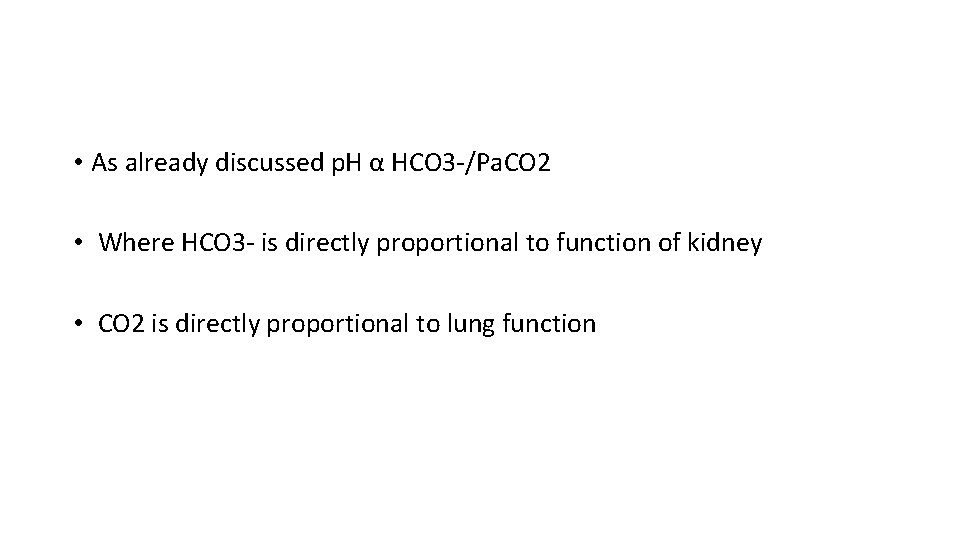
• As already discussed p. H α HCO 3 -/Pa. CO 2 • Where HCO 3 - is directly proportional to function of kidney • CO 2 is directly proportional to lung function
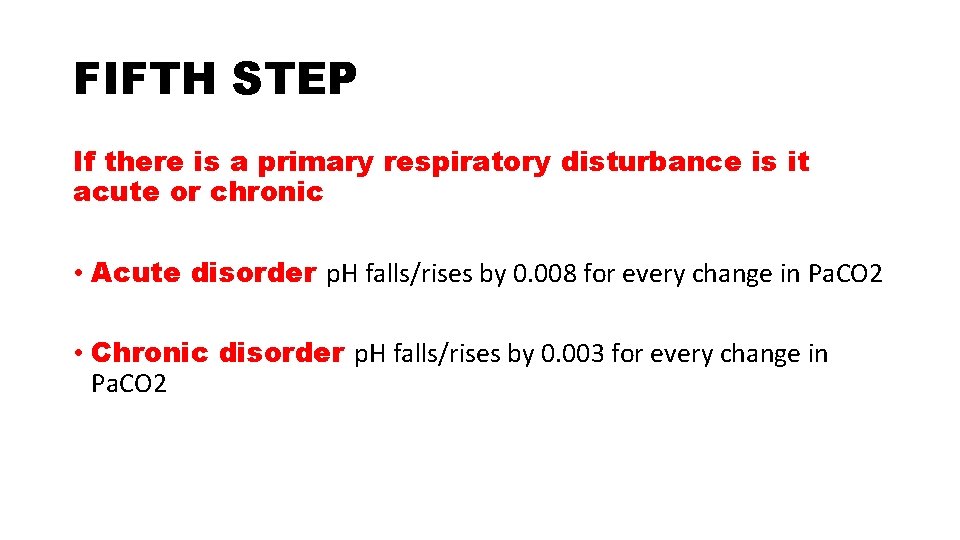
FIFTH STEP If there is a primary respiratory disturbance is it acute or chronic • Acute disorder p. H falls/rises by 0. 008 for every change in Pa. CO 2 • Chronic disorder p. H falls/rises by 0. 003 for every change in Pa. CO 2
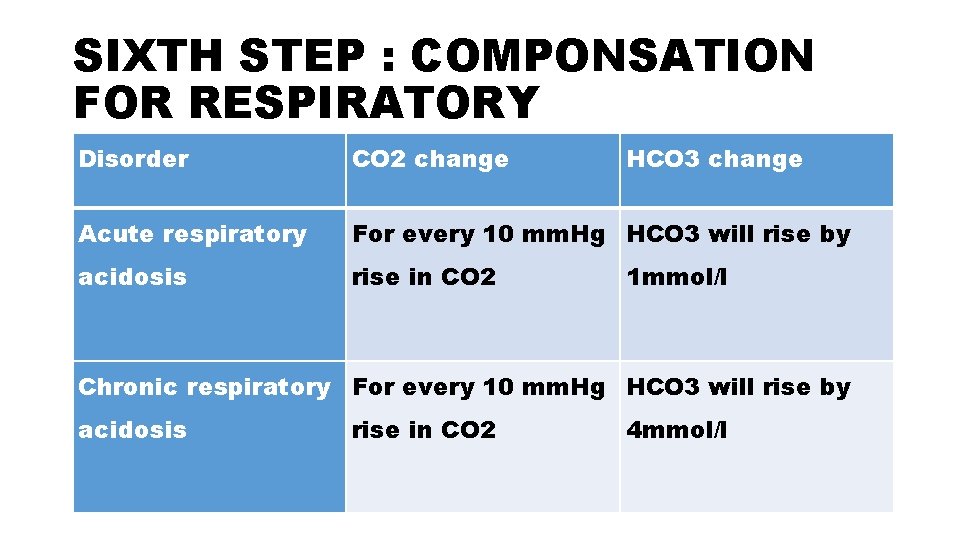
SIXTH STEP : COMPONSATION FOR RESPIRATORY Disorder CO 2 change HCO 3 change Acute respiratory For every 10 mm. Hg HCO 3 will rise by acidosis rise in CO 2 1 mmol/l Chronic respiratory For every 10 mm. Hg HCO 3 will rise by acidosis rise in CO 2 4 mmol/l
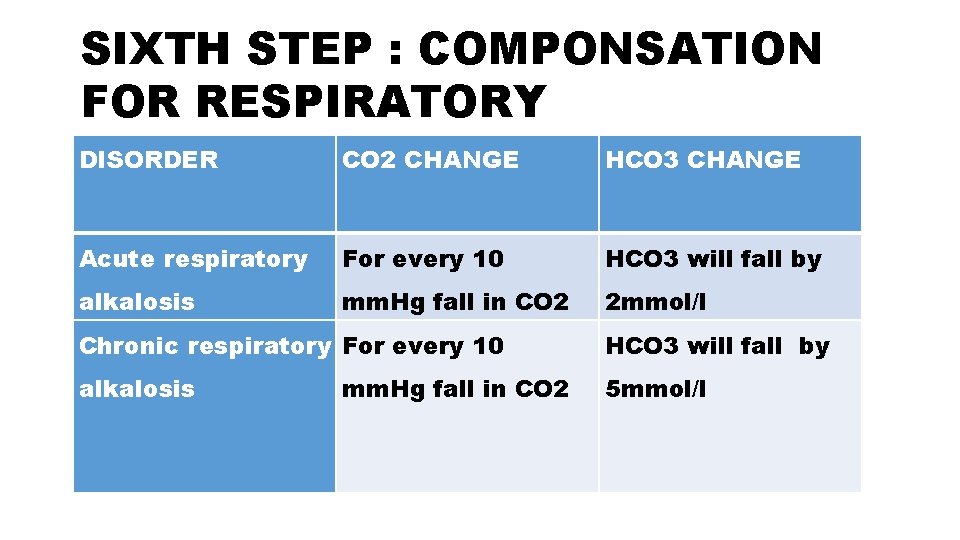
SIXTH STEP : COMPONSATION FOR RESPIRATORY DISORDER CO 2 CHANGE HCO 3 CHANGE Acute respiratory For every 10 HCO 3 will fall by alkalosis mm. Hg fall in CO 2 2 mmol/l Chronic respiratory For every 10 HCO 3 will fall by alkalosis 5 mmol/l mm. Hg fall in CO 2
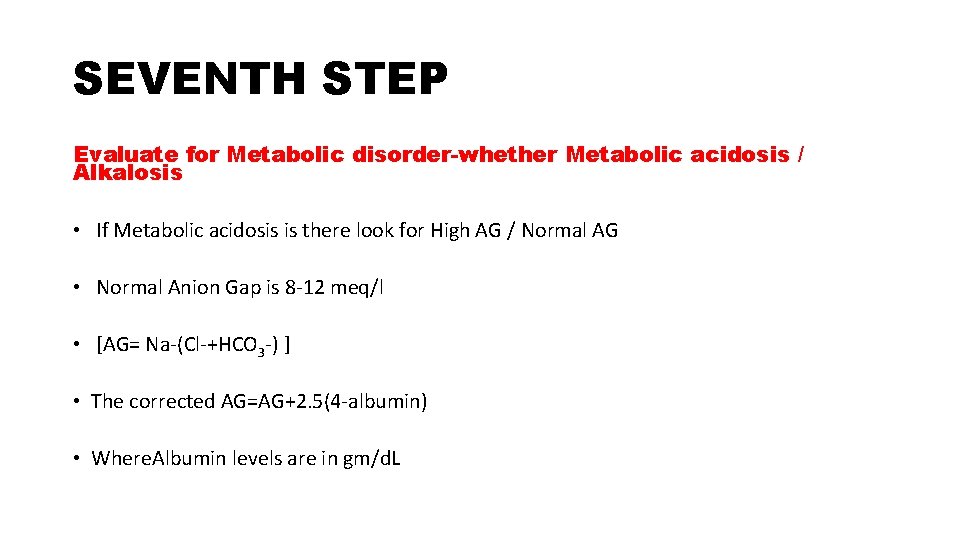
SEVENTH STEP Evaluate for Metabolic disorder-whether Metabolic acidosis / Alkalosis • If Metabolic acidosis is there look for High AG / Normal AG • Normal Anion Gap is 8 -12 meq/l • [AG= Na-(Cl-+HCO 3 -) ] • The corrected AG=AG+2. 5(4 -albumin) • Where. Albumin levels are in gm/d. L
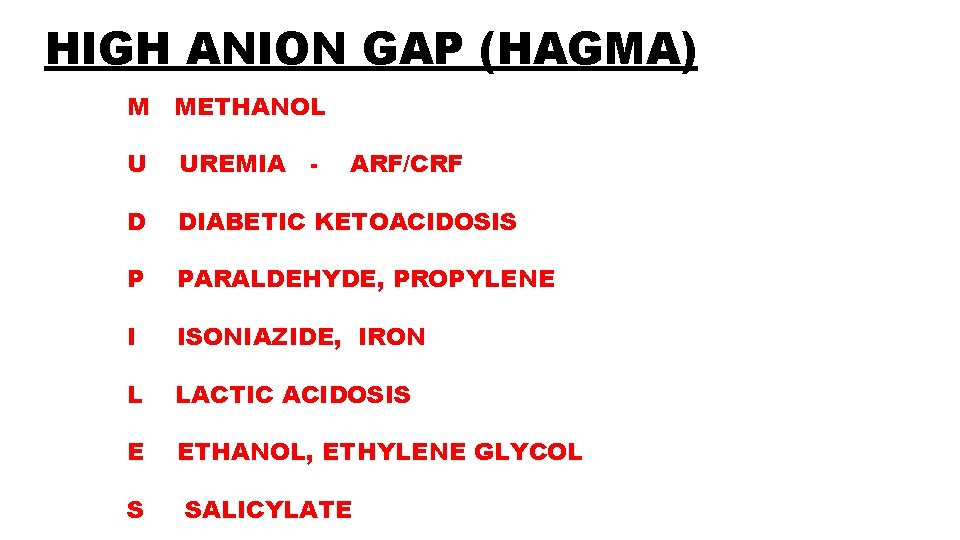
HIGH ANION GAP (HAGMA) M METHANOL U UREMIA - D DIABETIC KETOACIDOSIS P PARALDEHYDE, PROPYLENE I ISONIAZIDE, IRON L LACTIC ACIDOSIS E ETHANOL, ETHYLENE GLYCOL S ARF/CRF SALICYLATE
OSMOLAR GAP If the anion gap is elevated, consider calculating the osmolal gap in compatible clinical situations • Elevation in AG is not explained by an obvious case (DKA, lactic acidosis, renal failure) • Toxic ingestion is suspected • OSM gap = Measured Osm – Cal. Plasma Osm
![Cal. Plasma Osmolarity = 2[Na+] + [Gluc]/18 + [BUN]/2. 8 The OSM gap should](http://slidetodoc.com/presentation_image_h2/1233ca824557345cb023ea3dadd2ab89/image-38.jpg "Cal. Plasma Osmolarity = 2[Na+] + [Gluc]/18 + [BUN]/2. 8 The OSM gap should")
Cal. Plasma Osmolarity = 2[Na+] + [Gluc]/18 + [BUN]/2. 8 The OSM gap should be < 10 m. Osm/kg Osm gap > 10 m. Osm/kg indicates presence of abnormal osmotically active substance ü Ethanol ü Methanol ü Ethylene glycol
NORMAL ANION GAP (NAGMA) Hypokalemic a. GI losses of HCO 3 i. Ureterosigmoidostomy ii. Diarrhea iii. Ileostomy b. Renal losses of HCO 3 i. Proximal RTA ii. Carbonic Anhydrase Inhibitors
ØNormokalemic or hyperkalemic a. Renal tubular disease i. Acute tubular necrosis ii. Chronic tubulointerstitial disease iii. Distal RTA (type I and IV) iv. Hypoaldesteronism b. Pharmacological i. Ammonium chloride, Cacl 2 ingestion ii. Hyperalimentation iii. Dilutional acidosis
• Non AG metabolic acidosis • If urine p. H > 5. 5 : Type 1 RTA • If urine p. H < 5. 5 : Type 2 or Type 4 RTA • Type 2 or Type 4 RTA can be later differentiated using serum K+ level
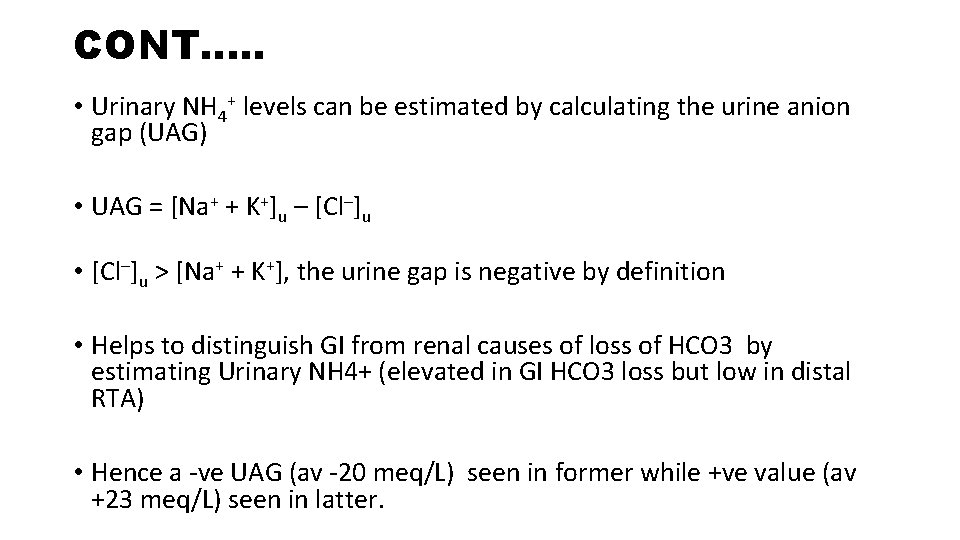
CONT…. . • Urinary NH 4+ levels can be estimated by calculating the urine anion gap (UAG) • UAG = [Na+ + K+]u – [Cl–]u • [Cl–]u > [Na+ + K+], the urine gap is negative by definition • Helps to distinguish GI from renal causes of loss of HCO 3 by estimating Urinary NH 4+ (elevated in GI HCO 3 loss but low in distal RTA) • Hence a -ve UAG (av -20 meq/L) seen in former while +ve value (av +23 meq/L) seen in latter.
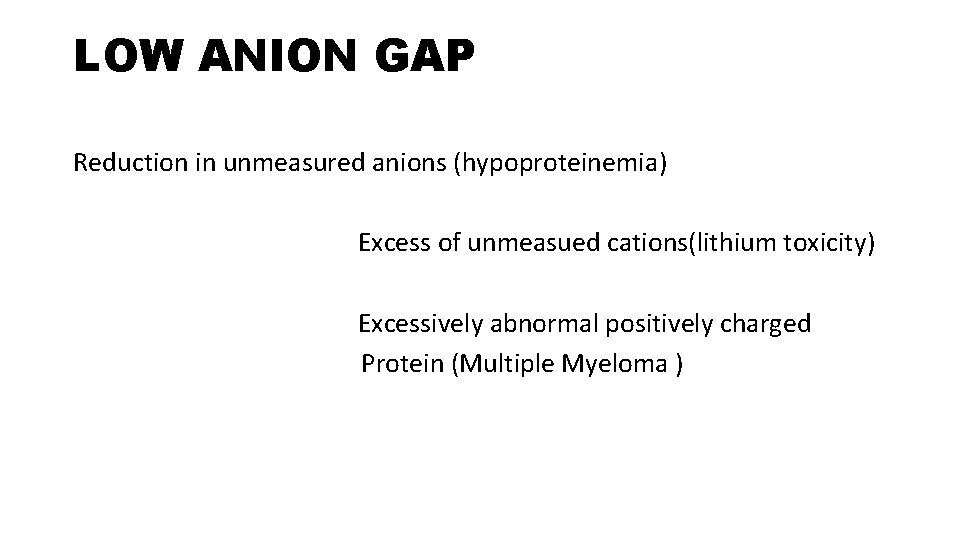
LOW ANION GAP Reduction in unmeasured anions (hypoproteinemia) Excess of unmeasued cations(lithium toxicity) Excessively abnormal positively charged Protein (Multiple Myeloma )
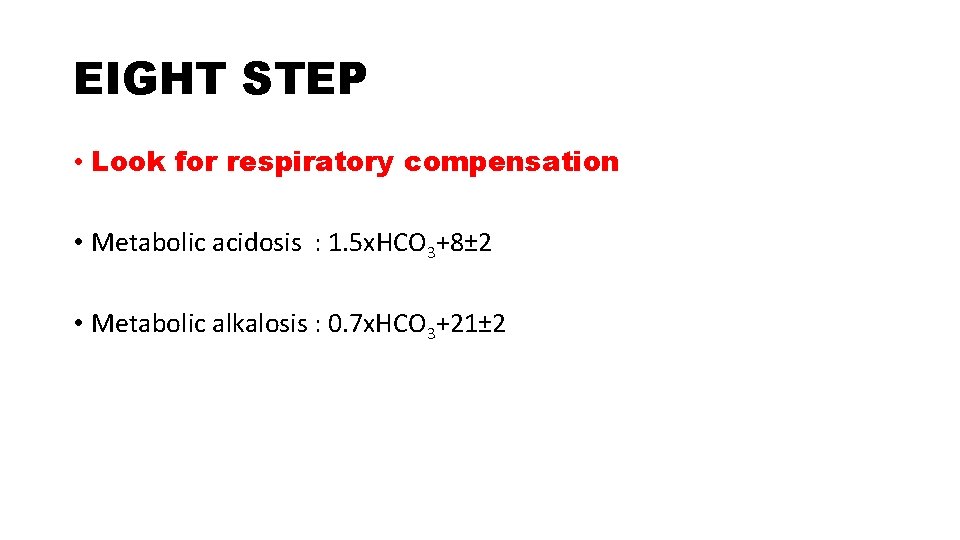
EIGHT STEP • Look for respiratory compensation • Metabolic acidosis : 1. 5 x. HCO 3+8± 2 • Metabolic alkalosis : 0. 7 x. HCO 3+21± 2
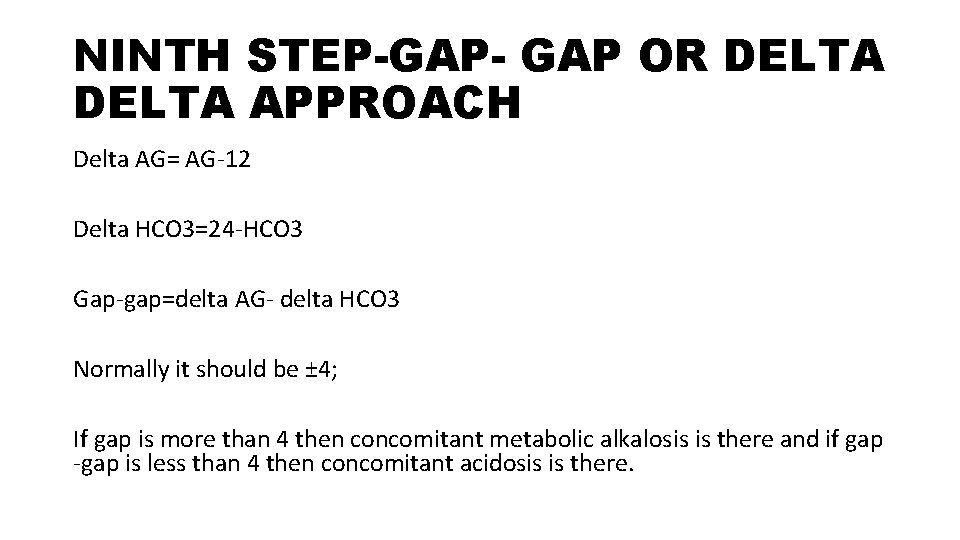
NINTH STEP-GAP- GAP OR DELTA APPROACH Delta AG= AG-12 Delta HCO 3=24 -HCO 3 Gap-gap=delta AG- delta HCO 3 Normally it should be ± 4; If gap is more than 4 then concomitant metabolic alkalosis is there and if gap -gap is less than 4 then concomitant acidosis is there.
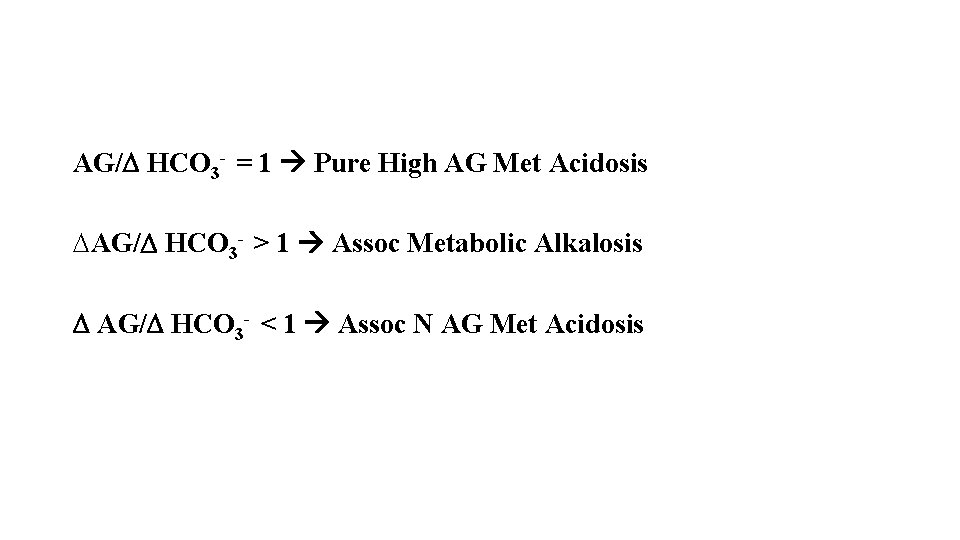
AG/ HCO 3 - = 1 Pure High AG Met Acidosis DAG/ HCO 3 - > 1 Assoc Metabolic Alkalosis AG/ HCO 3 - < 1 Assoc N AG Met Acidosis
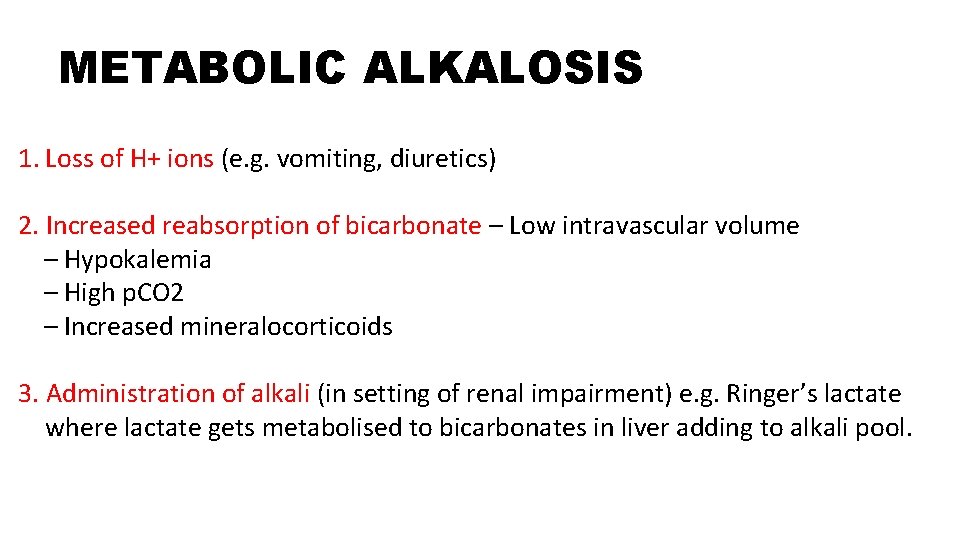
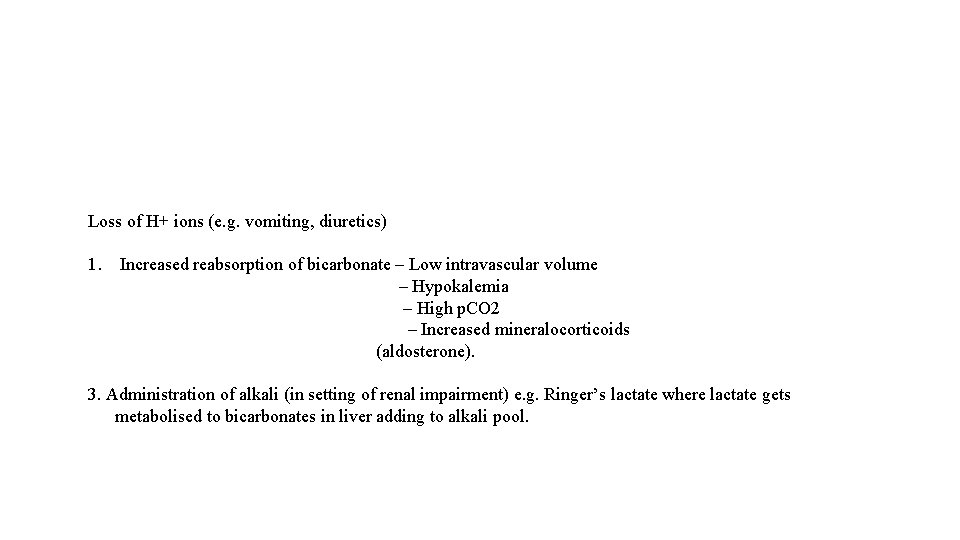
METABOLIC ALKALOSIS 1. Loss of H+ ions (e. g. vomiting, diuretics) 2. Increased reabsorption of bicarbonate – Low intravascular volume – Hypokalemia – High p. CO 2 – Increased mineralocorticoids 3. Administration of alkali (in setting of renal impairment) e. g. Ringer’s lactate where lactate gets metabolised to bicarbonates in liver adding to alkali pool.
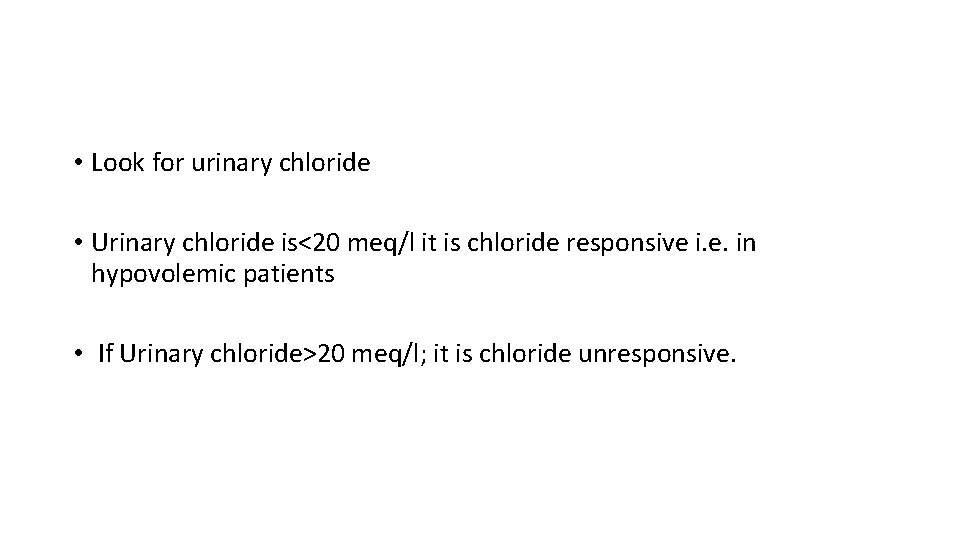
• Look for urinary chloride • Urinary chloride is<20 meq/l it is chloride responsive i. e. in hypovolemic patients • If Urinary chloride>20 meq/l; it is chloride unresponsive.
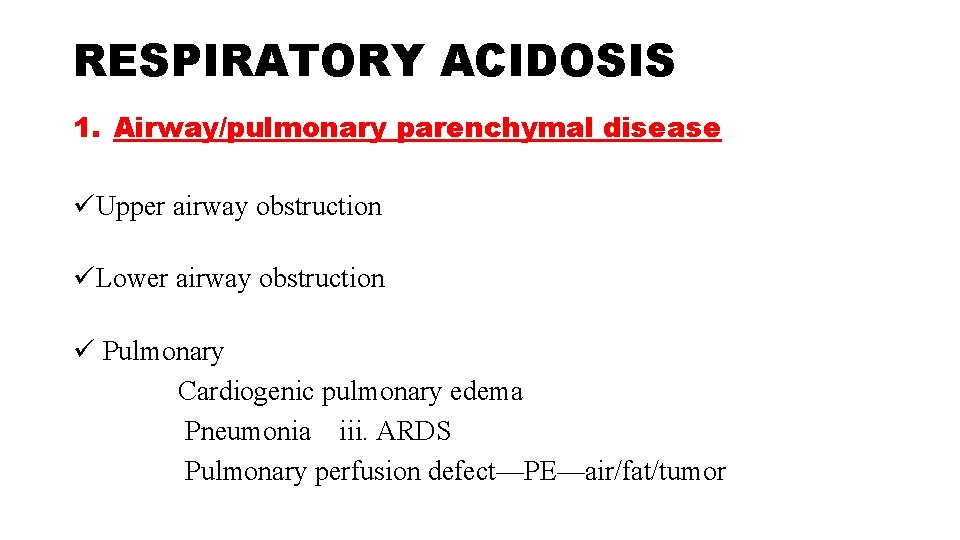
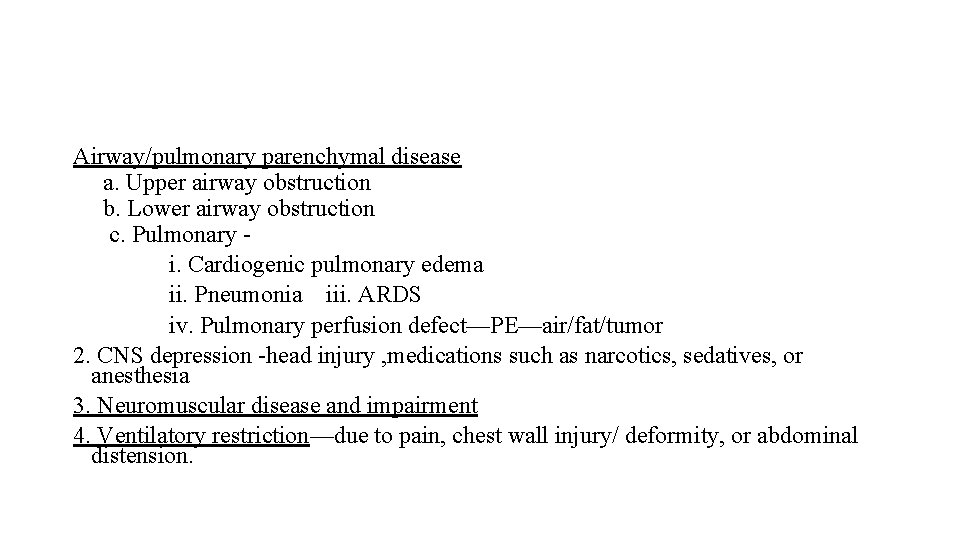
RESPIRATORY ACIDOSIS 1. Airway/pulmonary parenchymal disease üUpper airway obstruction üLower airway obstruction ü Pulmonary Cardiogenic pulmonary edema Pneumonia iii. ARDS Pulmonary perfusion defect—PE—air/fat/tumor
2. Cns Depression -head injury , medications such as narcotics, sedatives or anesthesia 3. Neuromuscular Disease and Impairment 4. Ventilatory Restriction—due to pain, chest wall injury/ deformity, or abdominal distension
INCREASED CO 2 PRODUCTION ü Large caloric loads üMalignant hyperthermia üIntensive shivering üProlonged seizure activity üThyroid storm üExtensive thermal injury (burns
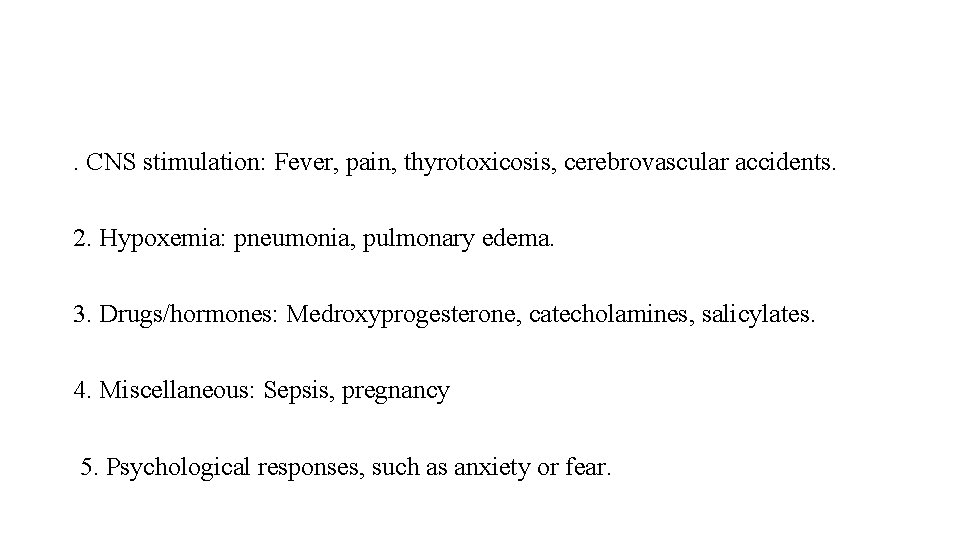
RESPIRATORY ALKALOSIS 1. CNS stimulation accidents. Fever, pain, Thyrotoxicosis, Cerebrovascular 2. Hypoxemia Pneumonia, Pulmonary edema. 3. Drugs/hormones Medroxyprogesterone, Catecholamines, Salicylates. 4. Miscellaneous Sepsis, Pregnancy 5. Psychological responses Anxiety or Fear
Complications üPain üBruising and haematoma üNerve damage üAneurysm üSpasm üAV fistula üInfection üAir or thromboembolism üAnaphylaxis from local anaesthetic

KEEP DISTANCNE BE SAFE THANK YOU
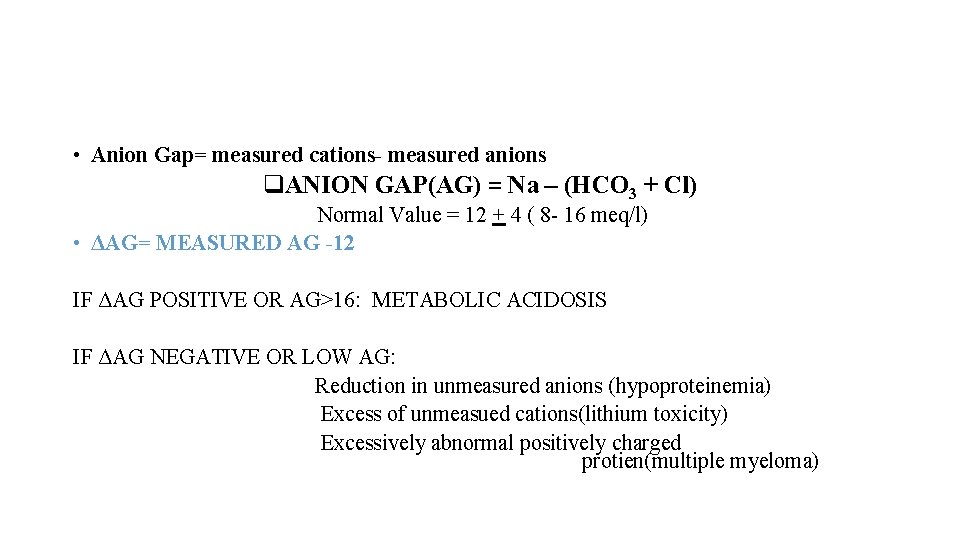
• Anion Gap= measured cations- measured anions q. ANION GAP(AG) = Na – (HCO 3 + Cl) Normal Value = 12 + 4 ( 8 - 16 meq/l) • ΔAG= MEASURED AG -12 IF ΔAG POSITIVE OR AG>16: METABOLIC ACIDOSIS IF ΔAG NEGATIVE OR LOW AG: Reduction in unmeasured anions (hypoproteinemia) Excess of unmeasued cations(lithium toxicity) Excessively abnormal positively charged protien(multiple myeloma)
• Anion Gap= measured cations- measured anions q. ANION GAP(AG) = Na – (HCO 3 + Cl) Normal Value = 12 + 4 ( 8 - 16 meq/l) • ΔAG= MEASURED AG -12 IF ΔAG POSITIVE OR AG>16: METABOLIC ACIDOSIS IF Δ
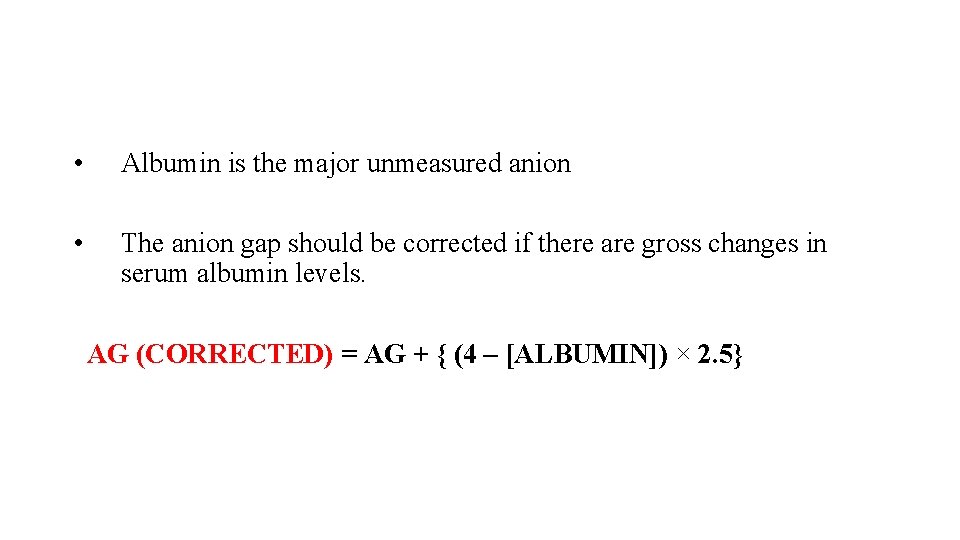
• Albumin is the major unmeasured anion • The anion gap should be corrected if there are gross changes in serum albumin levels. AG (CORRECTED) = AG + { (4 – [ALBUMIN]) × 2. 5}
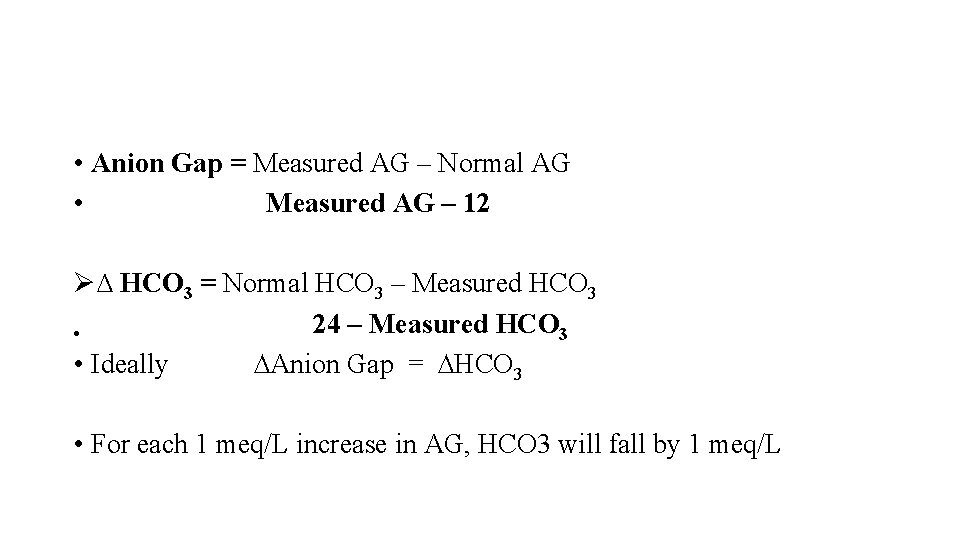
• Anion Gap = Measured AG – Normal AG • Measured AG – 12 Ø∆ HCO 3 = Normal HCO 3 – Measured HCO 3 24 – Measured HCO 3 • • Ideally ∆Anion Gap = ∆HCO 3 • For each 1 meq/L increase in AG, HCO 3 will fall by 1 meq/L
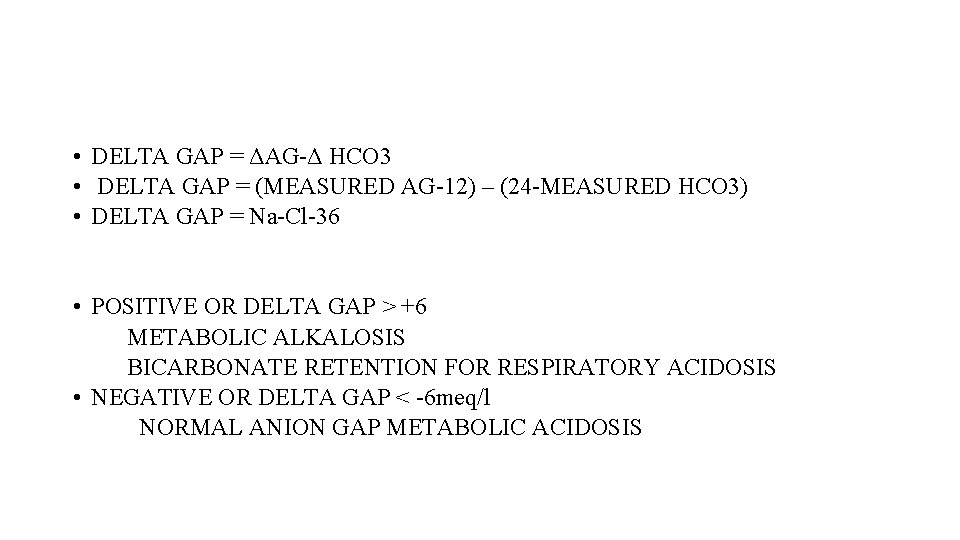
• DELTA GAP = ΔAG-Δ HCO 3 • DELTA GAP = (MEASURED AG-12) – (24 -MEASURED HCO 3) • DELTA GAP = Na-Cl-36 • POSITIVE OR DELTA GAP > +6 METABOLIC ALKALOSIS BICARBONATE RETENTION FOR RESPIRATORY ACIDOSIS • NEGATIVE OR DELTA GAP < -6 meq/l NORMAL ANION GAP METABOLIC ACIDOSIS
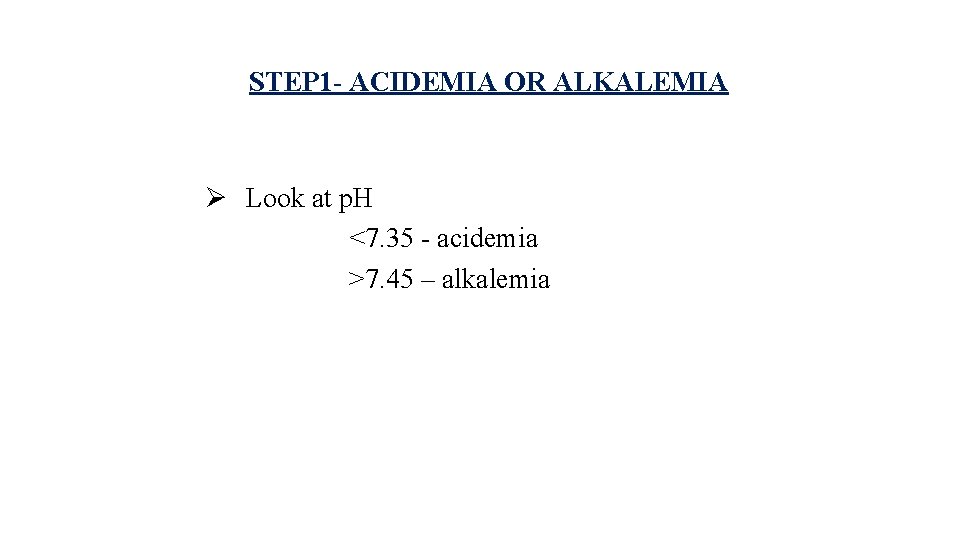
STEP 1 - ACIDEMIA OR ALKALEMIA Ø Look at p. H <7. 35 - acidemia >7. 45 – alkalemia
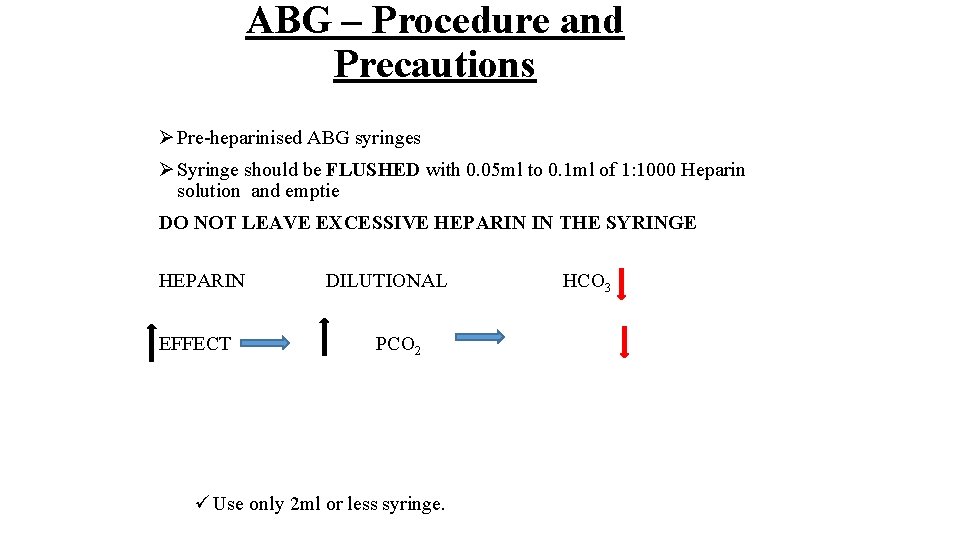
ABG – Procedure and Precautions Ø Pre-heparinised ABG syringes Ø Syringe should be FLUSHED with 0. 05 ml to 0. 1 ml of 1: 1000 Heparin solution and emptie DO NOT LEAVE EXCESSIVE HEPARIN IN THE SYRINGE HEPARIN EFFECT DILUTIONAL PCO 2 ü Use only 2 ml or less syringe. HCO 3
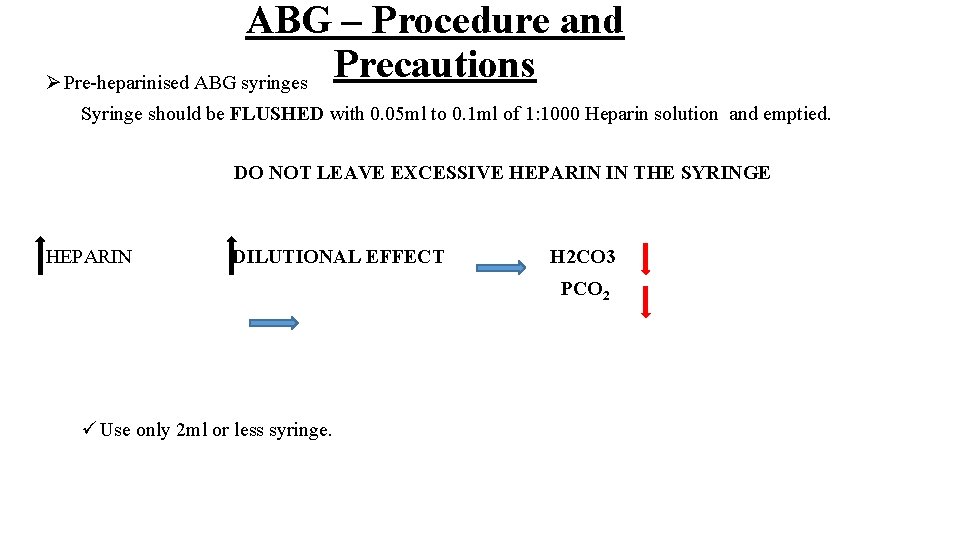
ABG – Procedure and Precautions Ø Pre-heparinised ABG syringes Syringe should be FLUSHED with 0. 05 ml to 0. 1 ml of 1: 1000 Heparin solution and emptied. DO NOT LEAVE EXCESSIVE HEPARIN IN THE SYRINGE HEPARIN DILUTIONAL EFFECT H 2 CO 3 PCO 2 ü Use only 2 ml or less syringe.
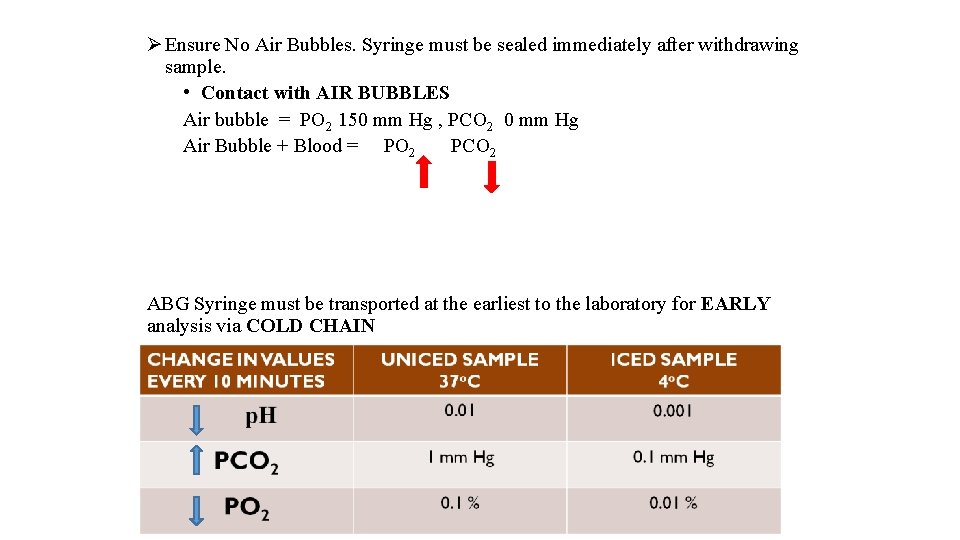
Ø Ensure No Air Bubbles. Syringe must be sealed immediately after withdrawing sample. • Contact with AIR BUBBLES Air bubble = PO 2 150 mm Hg , PCO 2 0 mm Hg Air Bubble + Blood = PO 2 PCO 2 ABG Syringe must be transported at the earliest to the laboratory for EARLY analysis via COLD CHAIN
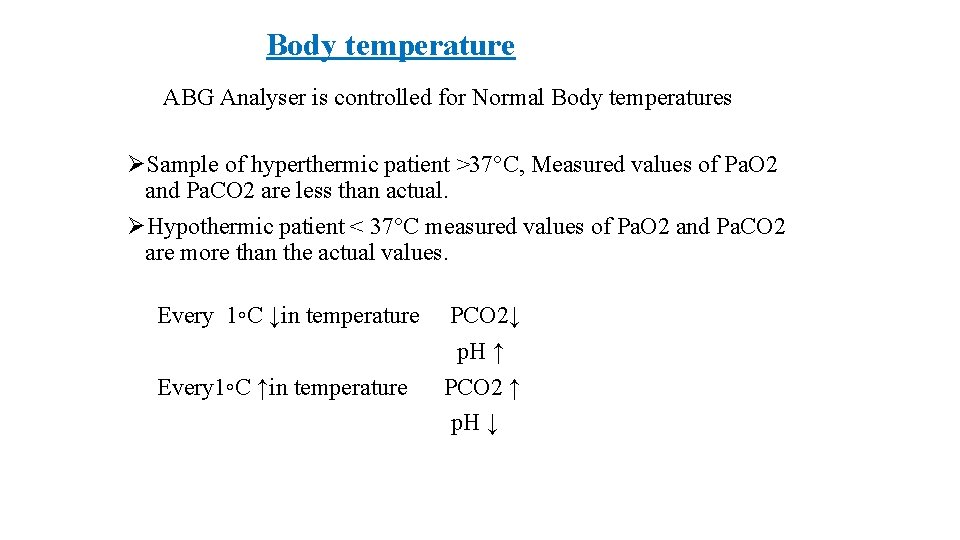
Body temperature ABG Analyser is controlled for Normal Body temperatures ØSample of hyperthermic patient >37°C, Measured values of Pa. O 2 and Pa. CO 2 are less than actual. ØHypothermic patient < 37°C measured values of Pa. O 2 and Pa. CO 2 are more than the actual values. Every 1◦C ↓in temperature Every 1◦C ↑in temperature PCO 2↓ p. H ↑ PCO 2 ↑ p. H ↓
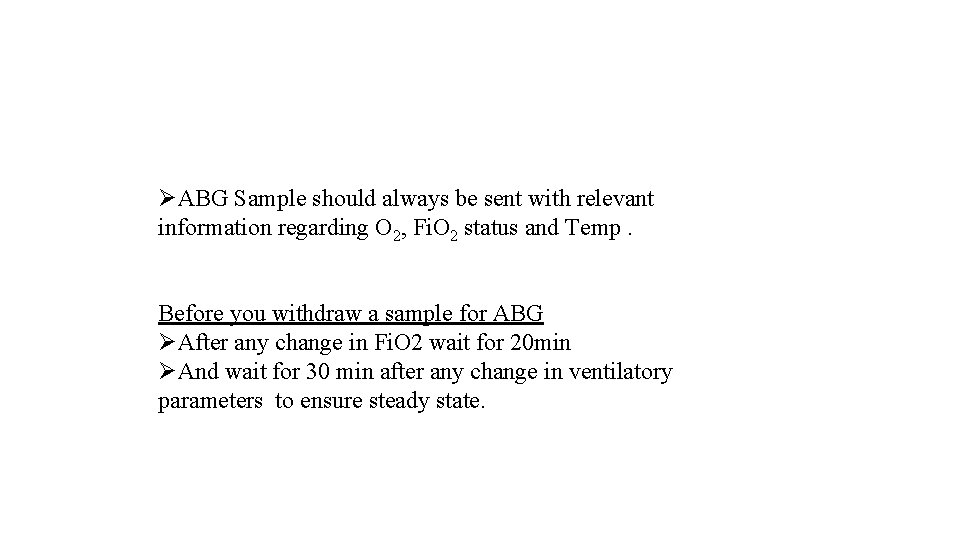
ØABG Sample should always be sent with relevant information regarding O 2, Fi. O 2 status and Temp. Before you withdraw a sample for ABG ØAfter any change in Fi. O 2 wait for 20 min ØAnd wait for 30 min after any change in ventilatory parameters to ensure steady state.
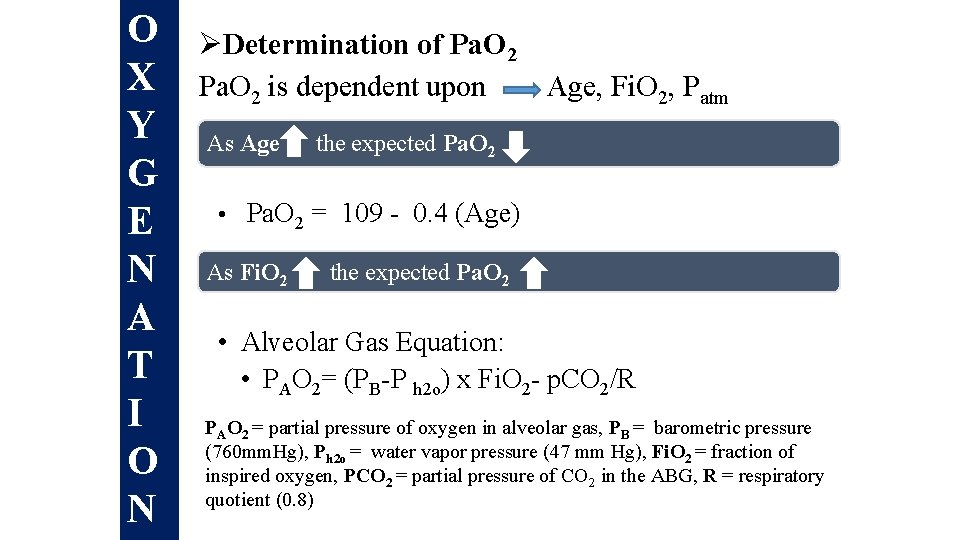
O X Y G E N A T I O N ØDetermination of Pa. O 2 is dependent upon Age, Fi. O 2, Patm As Age the expected Pa. O 2 • Pa. O 2 = 109 - 0. 4 (Age) As Fi. O 2 the expected Pa. O 2 • Alveolar Gas Equation: • PAO 2= (PB-P h 2 o) x Fi. O 2 - p. CO 2/R PAO 2 = partial pressure of oxygen in alveolar gas, PB = barometric pressure (760 mm. Hg), Ph 2 o = water vapor pressure (47 mm Hg), Fi. O 2 = fraction of inspired oxygen, PCO 2 = partial pressure of CO 2 in the ABG, R = respiratory quotient (0. 8)
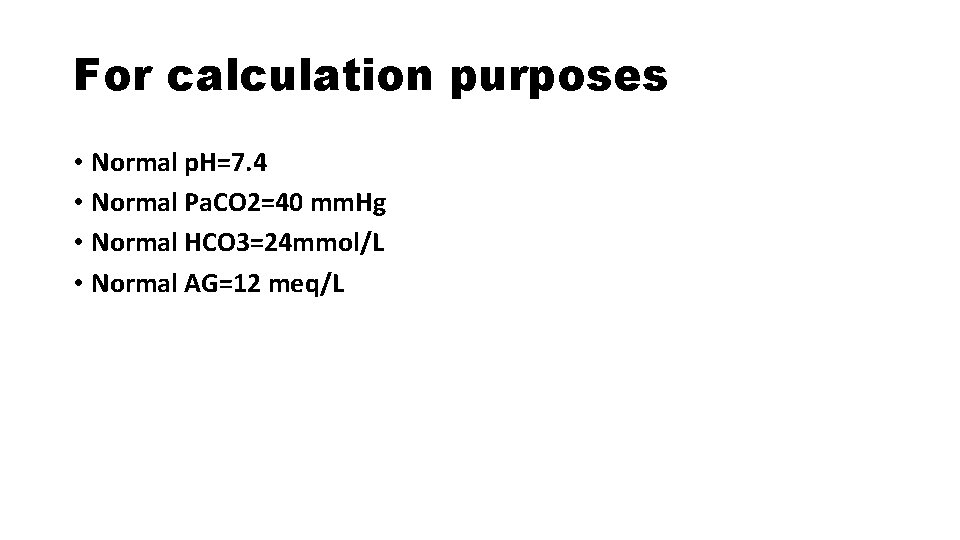
For calculation purposes • Normal p. H=7. 4 • Normal Pa. CO 2=40 mm. Hg • Normal HCO 3=24 mmol/L • Normal AG=12 meq/L
![Is this ABG authentic ? • p. H = - log [H+] Henderson-Hasselbalch equation](http://slidetodoc.com/presentation_image_h2/1233ca824557345cb023ea3dadd2ab89/image-68.jpg "Is this ABG authentic ? • p. H = - log [H+] Henderson-Hasselbalch equation")
Is this ABG authentic ? • p. H = - log [H+] Henderson-Hasselbalch equation p. H = 6. 1 + log HCO 30. 03 x PCO 2 p. Hexpected = p. Hmeasured = ABG is authentic
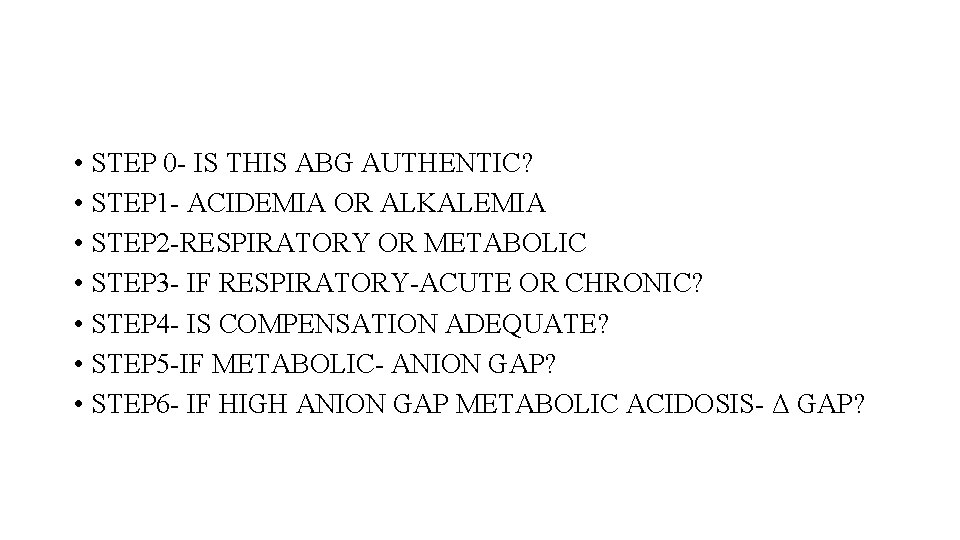
• STEP 0 - IS THIS ABG AUTHENTIC? • STEP 1 - ACIDEMIA OR ALKALEMIA • STEP 2 -RESPIRATORY OR METABOLIC • STEP 3 - IF RESPIRATORY-ACUTE OR CHRONIC? • STEP 4 - IS COMPENSATION ADEQUATE? • STEP 5 -IF METABOLIC- ANION GAP? • STEP 6 - IF HIGH ANION GAP METABOLIC ACIDOSIS- Δ GAP?
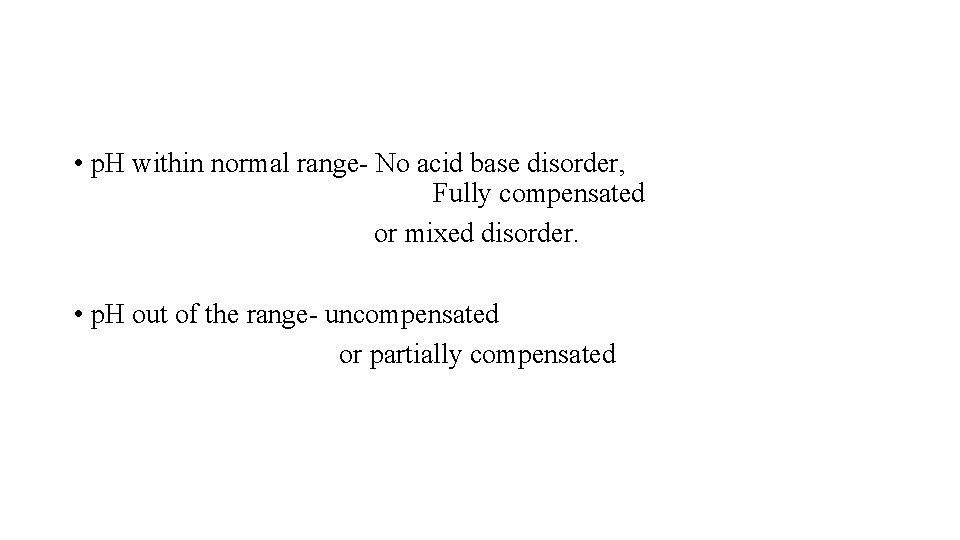
• p. H within normal range- No acid base disorder, Fully compensated or mixed disorder. • p. H out of the range- uncompensated or partially compensated
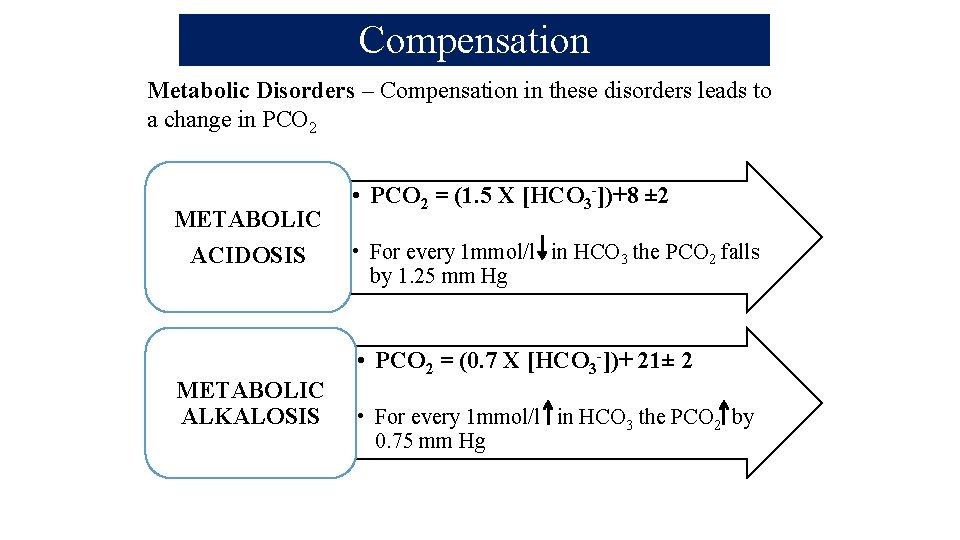
Compensation Metabolic Disorders – Compensation in these disorders leads to a change in PCO 2 METABOLIC ACIDOSIS METABOLIC ALKALOSIS • PCO 2 = (1. 5 X [HCO 3 -])+8 ± 2 • For every 1 mmol/l in HCO 3 the PCO 2 falls by 1. 25 mm Hg • PCO 2 = (0. 7 X [HCO 3 -])+ 21± 2 • For every 1 mmol/l in HCO 3 the PCO 2 by 0. 75 mm Hg
Loss of H+ ions (e. g. vomiting, diuretics) 1. Increased reabsorption of bicarbonate – Low intravascular volume – Hypokalemia – High p. CO 2 – Increased mineralocorticoids (aldosterone). 3. Administration of alkali (in setting of renal impairment) e. g. Ringer’s lactate where lactate gets metabolised to bicarbonates in liver adding to alkali pool.
Airway/pulmonary parenchymal disease a. Upper airway obstruction b. Lower airway obstruction c. Pulmonary i. Cardiogenic pulmonary edema ii. Pneumonia iii. ARDS iv. Pulmonary perfusion defect—PE—air/fat/tumor 2. CNS depression -head injury , medications such as narcotics, sedatives, or anesthesia 3. Neuromuscular disease and impairment 4. Ventilatory restriction—due to pain, chest wall injury/ deformity, or abdominal distension.
• Increased CO 2 production Large caloric loads Malignant hyperthermia Intensive shivering Prolonged seizure activity Thyroid storm Extensive thermal injury (burns)
. CNS stimulation: Fever, pain, thyrotoxicosis, cerebrovascular accidents. 2. Hypoxemia: pneumonia, pulmonary edema. 3. Drugs/hormones: Medroxyprogesterone, catecholamines, salicylates. 4. Miscellaneous: Sepsis, pregnancy 5. Psychological responses, such as anxiety or fear.
COMPLICATIONS • Pain • Bruising and haematoma • Nerve damage • Aneurysm • Spasm • AV fistula • Infection • Air or thromboembolism • Anaphylaxis from local anaesthetic

- Slides: 77