
Step 2 of case management process Session outline








- Slides: 38
Step 2 of case management process
Session outline • Step 2: Intake & assessment - Conduct intake & assessment session - Assess child’s needs § Safety, health, PSS & legal / justice - Suicide assessment
Step 2: Intake & assessment
Key terms • Assessment: The act of gathering information or data at a given moment of time and evaluating it for the purpose of making an appropriate decision about a course of action
Goal & purpose of initial intake & assessment interview • To safely & slowly assess the child’s situation — and his/her experience of sexual abuse — to help determine the child’s and family’s immediate and eventually, longer-term needs
Introduction & engagement Intake & assessment STEP 1 STEP 2 Case followup STEP 2 STEP 5 Case worker will: i. Conduct intake & assessment session with child and/or caregiver ii. Assess child’s needs using forms Case action planning STEP 3 Case closure STEP 6 Implement plan STEP 4 Evaluation STEP 7 Case management tools: • Child Needs Assessment • Case Action Plan Form • Page 118 CCS Guidelines
i. Intake & assessment session Before you begin to talk directly with the child… • If child was referred to the caseworker by another service provider option of gathering information from those already involved in child’s case should be explored • Also gather information from trusted adults (such as the parent)
Discussion questions • What questions do you think you would ask the child during this session? • What are the key bits of information you would need to gather during this session?
Session subjects • Developing a context for the child • Understanding what happened (nature, & timing of sexual abuse) • Understanding who perpetrated the abuse & their access to the child • Identifying if the child has already received care & services • Other relevant information
ii. Assessment of care & treatment needs • Four broad areas of assessment a. Child safety assessment b. Child health needs assessment c. Child psychosocial needs assessment – includes risk assessment for suicide d. Legal / justice needs & action plan • Based on consequences of abuse
a) Child safety assessment • Determining child’s safety is MOST IMPORTANT priority assessment area • Ask about child’s safety concerns privately • Ask: - Child’s sense of personal safety at home - Sense of safety in community - Child’s identified safety / support systems
If during the assessment it is determined that the child is NOT SAFE an action plan must be in place before the child and caregiver leave the interview meeting
Safety & protection - Protective intervention • Collaborate with family & child to assess child’s ongoing situation to establish practice, behaviors or situations needing to change in order for child to be safe and well • Jointly agree what actions are needed to ensure child’s protection • When family poses risk or does not have capacity to ensure wellbeing external intervention may be necessary
b) Child health needs assessment • Possible health concerns include: - pregnancy, - sexually transmitted infections, including HIV, - injury and - infertility
Time critical medical care • Prevention of HIV - post-exposure prophylaxis within 3 days (72 hours) • Prevention of unwanted pregnancy – emergency contraception within 5 day (120 hours) • Medical stabilization / treatment for injury or pain – variable but ASAP • Evidence collection – within 48 hours
Non-urgent or no medical care needed • Even children who were not injured and have no pain – who were not exposed to physical violence, touching or penetration – may need medical help – present them with the options • If no need for referral at all – case worker must note why no referral is necessary
PSS assessment discussion questions • Can anyone remember some of the signs of distress children might exhibit after experiencing sexual abuse?
c) Child PSS needs assessment Possible indicators of distress: • Child’s emotional state • His/ her facial expressions • Body language • Other behavior • Reported behavioral change (ask caregivers)
PSS Assessment process • Explain why you are asking these questions • Ask about any changes in the child’s activities – school attendance, leaving the house, playing with friends, etc. • Ask about child’s feelings • Ask about changes in sleeping, eating or hygiene habits Ø These all indicate if there are symptoms of distress as explained in session on Knowledge Areas – Impact of Sexual Abuse
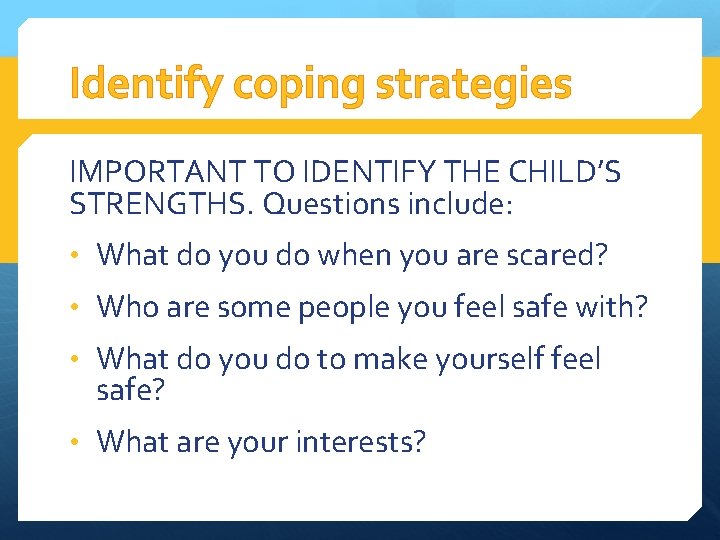
Identify coping strategies IMPORTANT TO IDENTIFY THE CHILD’S STRENGTHS. Questions include: • What do you do when you are scared? • Who are some people you feel safe with? • What do you do to make yourself feel safe? • What are your interests?
If the child has urgent medical and/or safety concerns, it may be necessary to assess psychosocial needs during a subsequent meeting with the child – though establishing if the child is suicidal is crucial as this is potentially life threatening
Suicide assessment
https: //www. youtube. com/watch? v=8 NVB Mfd. P 1 Ww&feature=youtu. be
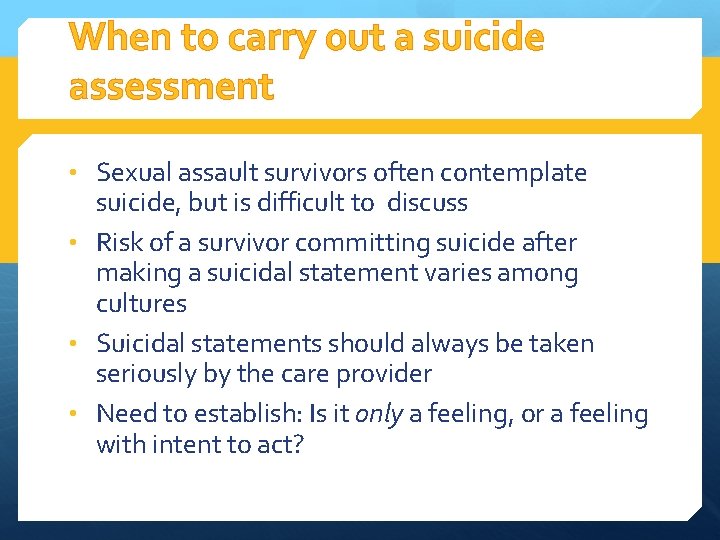
When to carry out a suicide assessment • Sexual assault survivors often contemplate suicide, but is difficult to discuss • Risk of a survivor committing suicide after making a suicidal statement varies among cultures • Suicidal statements should always be taken seriously by the care provider • Need to establish: Is it only a feeling, or a feeling with intent to act?
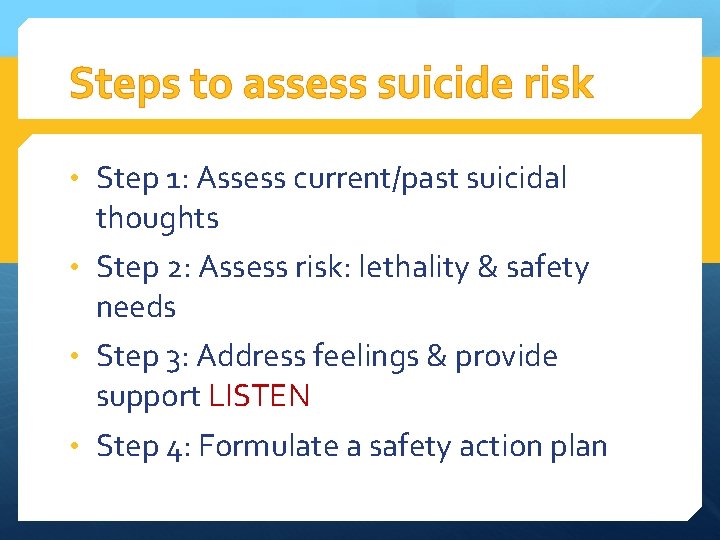
Steps to assess suicide risk • Step 1: Assess current/past suicidal thoughts • Step 2: Assess risk: lethality & safety needs • Step 3: Address feelings & provide support LISTEN • Step 4: Formulate a safety action plan
Plenary discussion • What are common attitudes towards • • suicide in your community? What makes it difficult to talk about suicide? How should suicidal children be handled? Discuss your experiences working with emotionally unstable or suicidal patients. Would you like to discuss this issue further?
Suicide assessment activity
Suicide assessment role play • Break into pairs • One play role of suicidal child survivor – who makes statement given on the card • Other is the case worker – there are some suggested questions you can use, or adjust as you like • Take 5 mins each to practice what you would say to the child survivors
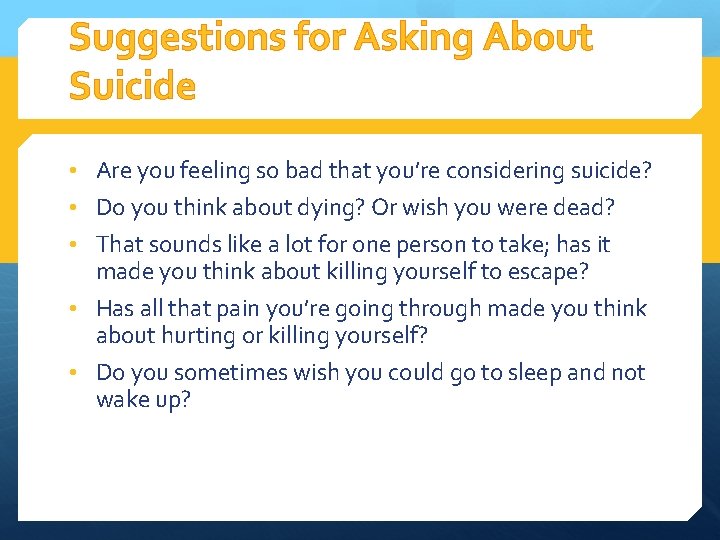
Suggestions for Asking About Suicide • Are you feeling so bad that you’re considering suicide? • Do you think about dying? Or wish you were dead? • That sounds like a lot for one person to take; has it made you think about killing yourself to escape? • Has all that pain you’re going through made you think about hurting or killing yourself? • Do you sometimes wish you could go to sleep and not wake up?
Debrief • What were some good questions or reactions to the child survivor’s statement? • Would the suggested phrases above / in the CCS Guidelines (p. 133 – 135) work in this context? • If not, can we come up with a list of good questions together?
Why talk about suicidal feelings? • Asking a survivor if s/he is suicidal may her /him an opportunity to talk about how s/he is feeling - May help her / him to deal with those feelings - May decrease sense of isolation & distress - And may help reduce risk of attempting suicide • Listen carefully to response. - An initial “I don’t know” or “no” may mean yes • ALWAYS refer to qualified professional health workers for help
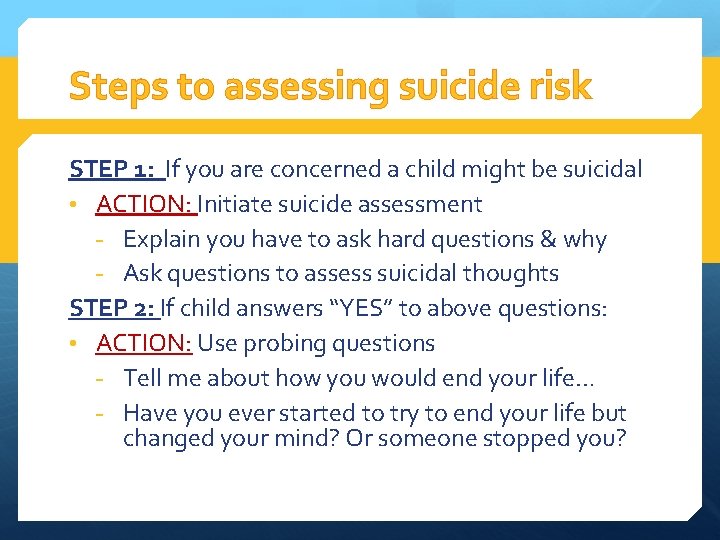
Steps to assessing suicide risk STEP 1: If you are concerned a child might be suicidal • ACTION: Initiate suicide assessment - Explain you have to ask hard questions & why - Ask questions to assess suicidal thoughts STEP 2: If child answers “YES” to above questions: • ACTION: Use probing questions - Tell me about how you would end your life… - Have you ever started to try to end your life but changed your mind? Or someone stopped you?
Step 3: Provide support & Step 4: Formulate a plan STEP 3: If child has no PLAN & no previous attempts – risk is less immediate • ACTION: Address feelings and provide support STEP 4: If the child is able to explain a plan and/or indicate have already attempted suicide - risk is more immediate • ACTION: Formulate a safety action plan
d) Legal / justice needs • Primarily you must determine the child and caregiver’s interest in pursuing legal action through the available justice system • Inform client about options – both formal and informal justice mechanisms and pros/cons of both • Refer to legal aid center if one exists
Remember: Our role • We must ensure safety • We ensure healing - Ensure access to psychosocial support & health services • We assist if seek legal / justice support Ø This feeds into our action plan – what we will do, who we will refer to
Key points
Key points • Need safe, supportive & caring environment during intake & assessment interview • Assessment information – on strengths & needs - is gathered to make an action plan. Assessment of the child’s needs should be ongoing • Safety & medical assessment take priority over PSS and legal/justice assessment. Unless there is indication of suicidal thought – in which case PSS also important