
STEP 2 DESIGN TRAINING Continued STEPS TO EFFECTIVE









- Slides: 25
STEP 2: DESIGN TRAINING (Continued)
STEPS TO EFFECTIVE TRAINING 1. Assess Needs – – 2. Organizational Analysis Person Analysis Task Analysis Ensure Readiness Design Training – – – Create a learning environment Set Objectives Develop manual and lesson plan Select methods/techniques Select trainer and site
Learning Principles: Practice Makes Perfekt Active n Focussed n Massed vs. Distributed n Whole vs. Part n – Sequencing Feedback (knowledge of results) n Learning Curve n
Learning Principles: Retaining What you Learn Practice and Overlearning n Interference and practical limits n Cues for recall n Transfer of Training n
STEP 2: DESIGN TRAINING OBJECTIVES Purpose? n Effective Training Objectives: n – –
SAMPLE OBJECTIVES n n Stoney will attend therapy 3 times a week Stoney will do trunk rotations, swing therapy, ball therapy… Stoney will show an increase in strength and stamina Stoney will have greater balance and control.
SAMPLE OBJECTIVES All supervisors will attend Paul Green’s Behavioral Interviewing Course n All supervisors will improve their interviewing skills n
SAMPLE OBJECTIVES n Receive a job relevance rating of at least 4. 5 out of 5. 0 – n Demonstrate awareness of B. I. principles in a written test with at least 70% accuracy – n (Learning) All interviewing supervisors will review job description and develop at least 5 open-ended questions that focus on past behavior – n (Reaction) (Behavior) Increase validity of interviews by. 30 within 6 months – (Results)
STEP 2: DESIGN— Select Methods/Techniques/Location Based on learning objectives n On-the-Job vs. Off-the-Job n – – – n Methods/Techniques
Training Methods Presentation Methods n n Trainees are passive recipients of information Advantages – n Disadvantages – – – n n Good for teaching? Best use?
Training Methods Hands-On Methods n Require active involvement of trainees – n OTJ; Simulations; games; cases; role plays Advantages – – n Disadvantages? – – n Good for teaching:
Training Methods Team-building n Increase skills needed for effective teamwork – n Advantages? – n Disadvantages? – –
CHOOSING A METHOD KNOW the model n Learning Outcomes n Learning Environment & Transfer n Cost Relative to Benefits n Combine Methods n
HRD Applications Skills and Technical Training
Skills Training Programs n Most common type of training – n Consider “Safety Training” mini-case – n Yet frequently done poorly How could delivery have been improved? Role of behavior modeling
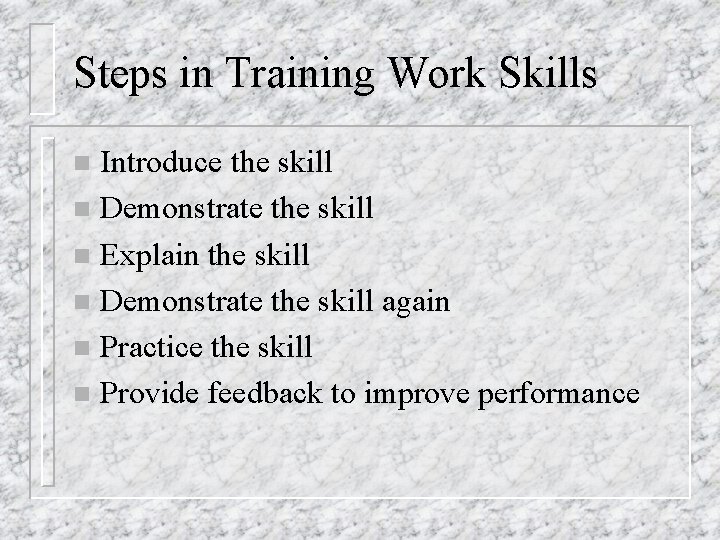
Steps in Training Work Skills Introduce the skill n Demonstrate the skill n Explain the skill n Demonstrate the skill again n Practice the skill n Provide feedback to improve performance n
Step 1: Introduce the Skill Get the learners’ attention n Make sure all learners can see and hear n Clarify why they want to learn the skill n – – n Describe the skill – n How? Safety Training? Your hands?
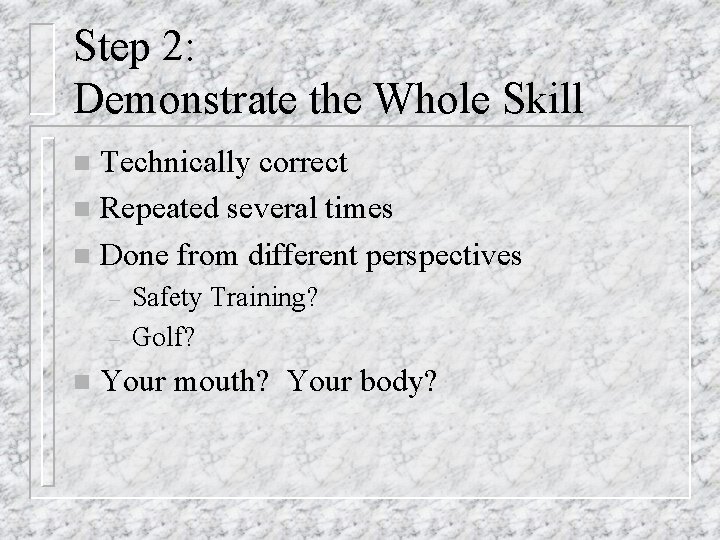
Step 2: Demonstrate the Whole Skill Technically correct n Repeated several times n Done from different perspectives n – – Safety Training? Golf?
Step 2: Demonstrate the Whole Skill Technically correct n Repeated several times n Done from different perspectives n – – n Safety Training? Golf? Your mouth? Your body?
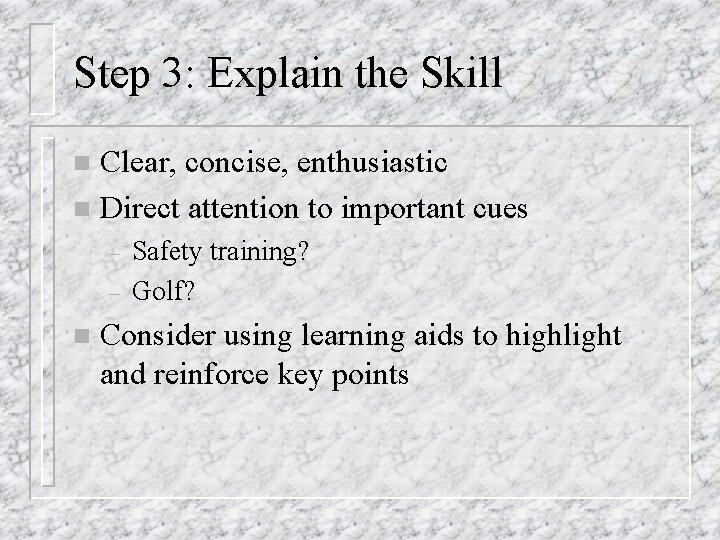
Step 3: Explain the Skill Clear, concise, enthusiastic n Direct attention to important cues n – – n Safety training? Golf? Consider using learning aids to highlight and reinforce key points
Step 3: Explain the Skill Clear, concise, enthusiastic n Direct attention to important cues n Consider using learning aids to highlight and reinforce key points n Your mouth? Your body? n
Step 4: Second Demonstration n Demonstrate parts of skill sequentially – – Safety Training? Golf? Alternate demonstration with explanation n Finish with demonstration of whole skill n
Step 5: Provide Practice Active practice by learner is critical n Create practice environment that is: n – – – Safe (Safety Training? ) non-threatening (Mr. Gleason? ) motivating and successful Repeated, short practice is generally best n Have learner explain and demonstrate skill n
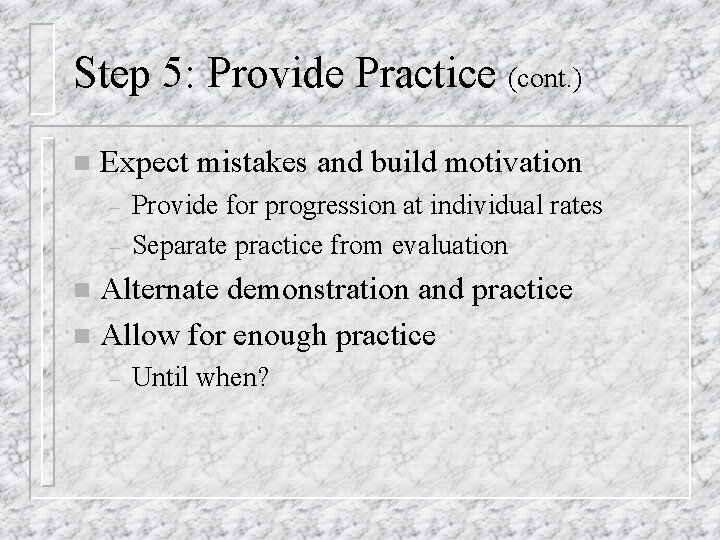
Step 5: Provide Practice (cont. ) n Expect mistakes and build motivation – – Provide for progression at individual rates Separate practice from evaluation Alternate demonstration and practice n Allow for enough practice n – Until when?
Step 6: Provide Feedback Immediate n Accurate and specific n Focus on one correction at a time n Positive n Allow for additional practice after feedback n