
Step 1 Construct wellbuilt and answerable clinical questions

Step 1: Construct wellbuilt and answerable clinical questions

Table of Contents • 2 Types of Questions – Background Questions – Foreground Questions • PICO • Primary vs. Secondary Sources • • Example Exercises: Create PICO Questions PICO Review Questions Another Approach: Asking Well-Formed Clinical Questions Example Exercise: Asking Well-Formed Clinical Questions – Assessing Your Question • Reasoning Behind Each Piece of Your Clinical Question • Reevaluation and Reflection • Helpful Links & Activities

There are 2 categories of clinical questions • Background questions • Foreground questions

Background questions • are broad and ask for general knowledge about a condition.
Background questions usually contain 2 parts • Who, what, where, when, why and how • The disorder, test, or treatment of interest

Background questions are necessary when • one’s experience with the item of interest is limited – may be answered with background resources such as text books and review articles.
Foreground questions • are more specific to the individual patient prompting the question.

Foreground questions usually contain 4 parts (PICO) • Patients or population – Age, sex, race, PMH • Intervention – Exposure, diagnostic test, prognostic factor, therapy • Comparison group or gold standard – Nothing, placebo, another intervention • Outcome of interest – Clinical effect or intervention, patient oriented
Foreground questions • • may be classified into a domain Therapy Diagnosis Prognosis Harm

Foreground questions are answered with • primary sources – original research and journal articles • secondary sources – systematic reviews and synopses of individual studies
Try it yourself. • Scenario 1* • Scenario 2* • Additional Scenarios* All of these example scenarios are created and maintained by the Centre for Evidence-Based Medicine (CEBM), University of Toronto with particular contributions by Sharon E. Straus, W. Scott Richardson, Paul Glasziou and R. Brian Haynes. *
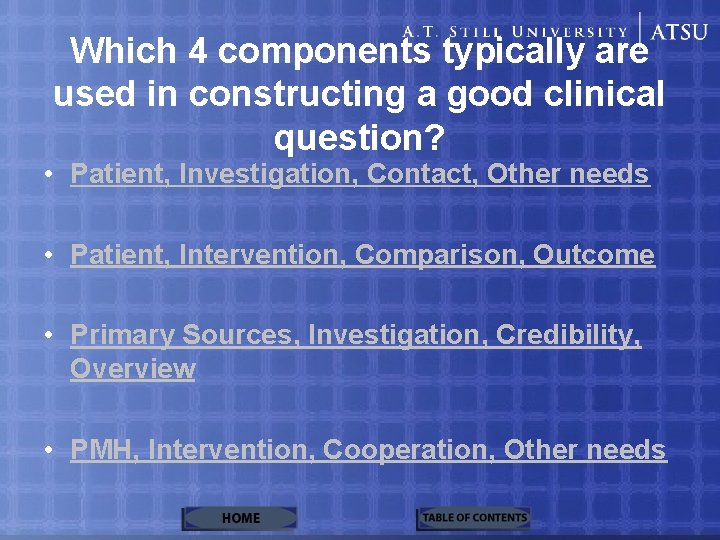
Which 4 components typically are used in constructing a good clinical question? • Patient, Investigation, Contact, Other needs • Patient, Intervention, Comparison, Outcome • Primary Sources, Investigation, Credibility, Overview • PMH, Intervention, Cooperation, Other needs
A Slightly Different Approach & Another Example Scenario • View movie as: – Quick. Time (. mov) – Flash (. swf) • Double-click on video for full-screen mode.
Try it on your own. • Now create your own clinical question based on the information just provided and write it on a piece of paper.
Assessing your Question: Target Population • Did you identify a target population, such as similar patients with similar conditions? • No • Yes
Assessing your Question: • Intervention Did you include an intervention, such as a particular treatment or a comparison of treatments where applicable? • No • Yes
Assessing your Question: Outcome of Interest • Did you mention an outcome of interest that incorporates your patient’s preferences and values, such as a diagnosis or a beneficial result? • No • Yes

Reasoning Behind These Question Components • Structure your question in terms readily suitable for scientific investigation and experimentation. They respectively correspond to: – Control for Extraneous Variables/Reducing Experimental Error (Target Population) – Explanatory/Independent Variable(s) (Intervention) – Dependent Variable(s) (Outcome of Interest)
Target Population • Control for Extraneous Variables, Reducing Experimental Error – keeps clinically relevant differences between patients constant in order to eliminate any effects that these differences may have had on the outcome of interest. The effects that the patients’ differences have on the outcome of interest are often difficult to discern from those of the intervention.
Intervention • Explanatory/Independent Variable(s) – what you are manipulating or comparing. This may consist of various levels of a given treatment (may include no treatment or a placebo) or it may compare different treatments. Similarly, when your outcome of interest is a diagnosis, the intervention may compare the presence or absence of particular symptoms and their severity. It may also include exposure.
Outcome of Interest • Dependent Variable(s) – the result you are observing or measuring. This is the clinically relevant effect of the intervention. This may be a physiological change, elimination of symptoms, a diagnosis, etc.

Reevaluate Your Question. • Do you have a well-formed question now? • Did you include each of the necessary components? • Would you have to change your question much to write it as a PICO question? – Try doing this. – What advantages/disadvantages do you see?
A Moment to Reflect • Why do you think the PICO question format makes a clear, conscious decision to make a distinction between Intervention and Comparison? – What are some advantages and disadvantages to this? – Does it help to have an explicitly stated baseline?
Links to Other Websites & Hands-On Activities • From the Centre for Evidence-Based Medicine – Activity 1 – Activity 2 – Additional Scenarios – (This is a fairly helpful and interactive approach to practicing better clinical question formation. ) • From Penn State College of Medicine

Congratulations! You have successfully completed Step 1. The End
- Slides: 25