
Step 1 Circular Response Circle To democratize group
- Slides: 5
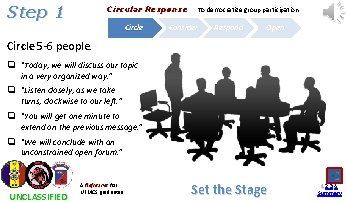
Step 1 Circular Response Circle To democratize group participation. Consider Respond Open Circle 5 -6 people. q “Today, we will discuss our topic in a very organized way. ” q “Listen closely, as we take turns, clockwise to our left. ” q “You will get one minute to extend on the previous message. ” q “We will conclude with an unconstrained open forum. ” UNCLASSIFIED A Refresher for UFMCS graduates. Set the Stage 1234 Summary
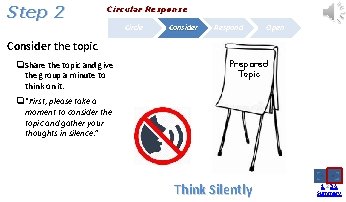
Step 2 Circular Response Circle Consider Respond Open Consider the topic. q Share the topic and give the group a minute to think on it. Prepared Topic q “First, please take a moment to consider the topic and gather your thoughts in silence. ” Think Silently 1234 Summary
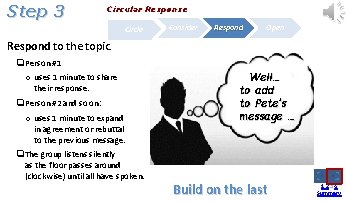
Step 3 Circular Response Circle Consider Respond Open Respond to the topic. q Person #1 o uses 1 minute to share their response. q Person #2 and so on: o uses 1 minute to expand in agreement or rebuttal to the previous message. Well… to add to Pete’s message … q The group listens silently as the floor passes around (clockwise) until all have spoken. Build on the last 1234 Summary
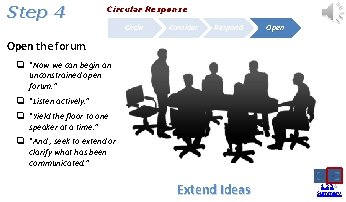
Step 4 Circular Response Circle Consider Respond Open the forum. q “Now we can begin an unconstrained open forum. ” q “Listen actively. ” q “Yield the floor to one speaker at a time. ” q “And , seek to extend or clarify what has been communicated. ” Extend Ideas 1234 Summary
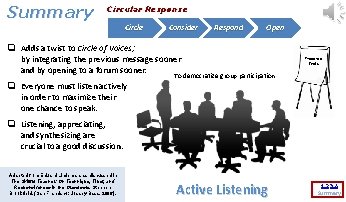
Summary Circular Response Circle Consider Respond Open q Adds a twist to Circle of Voices; by integrating the previous message sooner and by opening to a forum sooner. Prepared Topic To democratize group participation. q Everyone must listen actively in order to maximize their one chance to speak. q Listening, appreciating, and synthesizing are crucial to a good discussion. Adapted from Eduard Lindeman, as discussed in The Skillful Teacher: On Technique, Trust, and Responsiveness in the Classroom, Stephen Brookfield, (San Francisco: Jossey-Bass, 2006). Active Listening 1234 Summary