
STENA OPEN INNOVATION WORKBOOK Purpose This workbook is
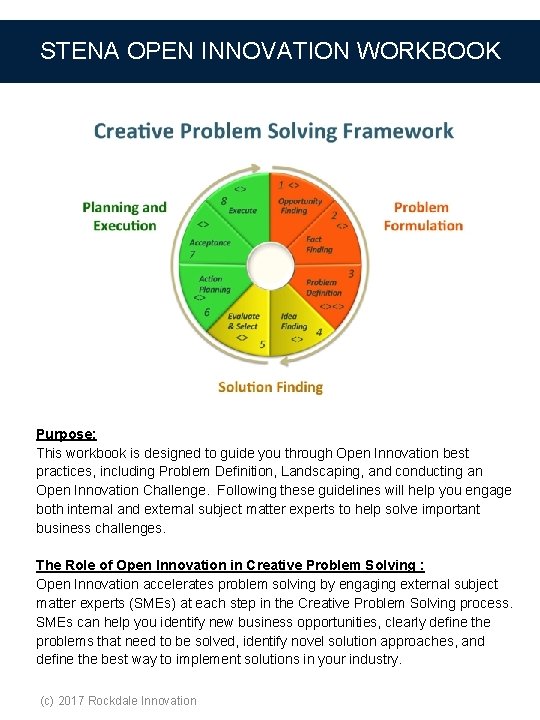
STENA OPEN INNOVATION WORKBOOK Purpose: This workbook is designed to guide you through Open Innovation best practices, including Problem Definition, Landscaping, and conducting an Open Innovation Challenge. Following these guidelines will help you engage both internal and external subject matter experts to help solve important business challenges. The Role of Open Innovation in Creative Problem Solving : Open Innovation accelerates problem solving by engaging external subject matter experts (SMEs) at each step in the Creative Problem Solving process. SMEs can help you identify new business opportunities, clearly define the problems that need to be solved, identify novel solution approaches, and define the best way to implement solutions in your industry. (c) 2017 Rockdale Innovation
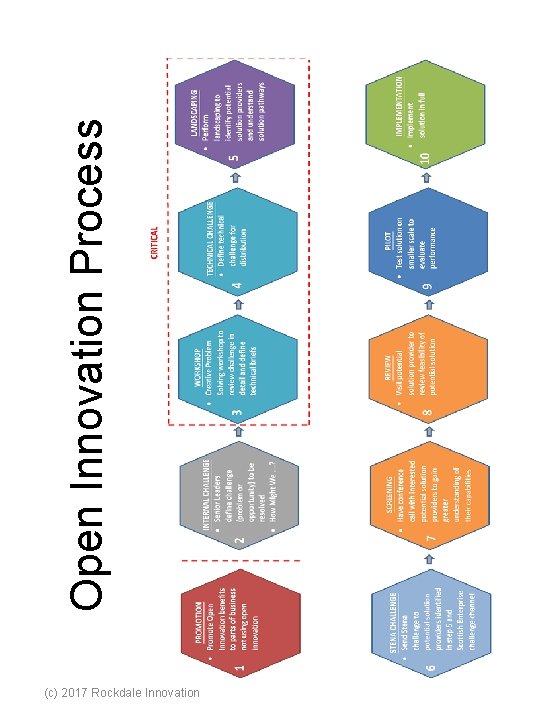
Open Innovation Process (c) 2017 Rockdale Innovation
KEYS TO SUCCESSFUL OPEN INNOVATION Learning from the world’s most innovative companies, we have identified the following keys to conducting successful Open Innovation Challenges: • Senior Leaders role is to clearly define the most important Challenges needed to support the organization’s business goals and objectives. • Effective Problem Definition, resulting in detailed Technical Briefs for distribution to solving communities, is the critical first step in conducting an Open Innovation Challenge. • Conduct a preliminary Landscape assessment using powerful search tools like Google Scholar or Sumo Brain to identify potential solution approaches and partners. • Distribute detailed Technical Briefs – including a concise description of the problem to be solved, ideal outcomes, solution approaches to be considered/avoided, and clear success criteria. • Conduct screening interviews with potential solution providers to complete an objective evaluation of proposed solutions against the stated success criteria. • Have a well thought out Action Plan for piloting the best solutions before fully implementing across the organization. Following these steps will maximize your chances of finding the “missing piece” of knowledge needed for your business! (c) 2017 Rockdale Innovation
Workbook Sections • Effective Problem Definition • Preparing a Technical Brief • Conducting a Preliminary Landscape Assessment • Conducting an Open Innovation Challenge • Conducting a Technical Problem Solving Session • Action Planning (c) 2017 Rockdale Innovation
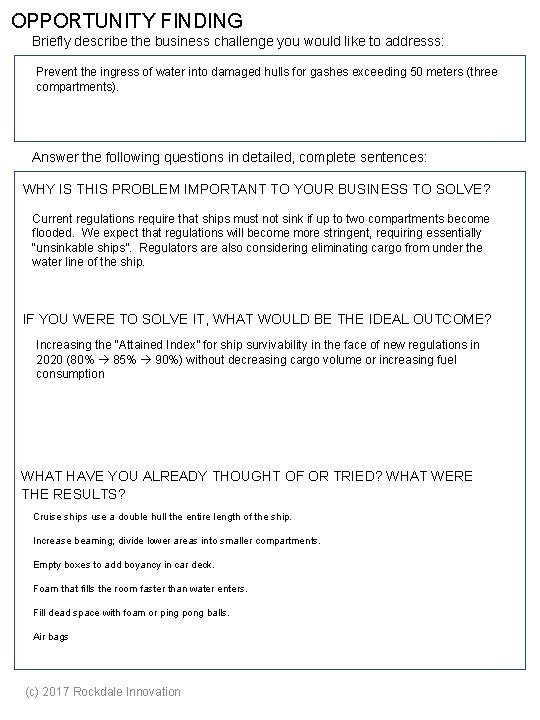
OPPORTUNITY FINDING Briefly describe the business challenge you would like to addresss: Prevent the ingress of water into damaged hulls for gashes exceeding 50 meters (three compartments). Answer the following questions in detailed, complete sentences: WHY IS THIS PROBLEM IMPORTANT TO YOUR BUSINESS TO SOLVE? Current regulations require that ships must not sink if up to two compartments become flooded. We expect that regulations will become more stringent, requiring essentially “unsinkable ships”. Regulators are also considering eliminating cargo from under the water line of the ship. IF YOU WERE TO SOLVE IT, WHAT WOULD BE THE IDEAL OUTCOME? Increasing the “Attained Index” for ship survivability in the face of new regulations in 2020 (80% 85% 90%) without decreasing cargo volume or increasing fuel consumption WHAT HAVE YOU ALREADY THOUGHT OF OR TRIED? WHAT WERE THE RESULTS? Cruise ships use a double hull the entire length of the ship. Increase beaming; divide lower areas into smaller compartments. Empty boxes to add boyancy in car deck. Foam that fills the room faster than water enters. Fill dead space with foam or ping pong balls. Air bags (c) 2017 Rockdale Innovation
(c) 2017 Rockdale Innovation
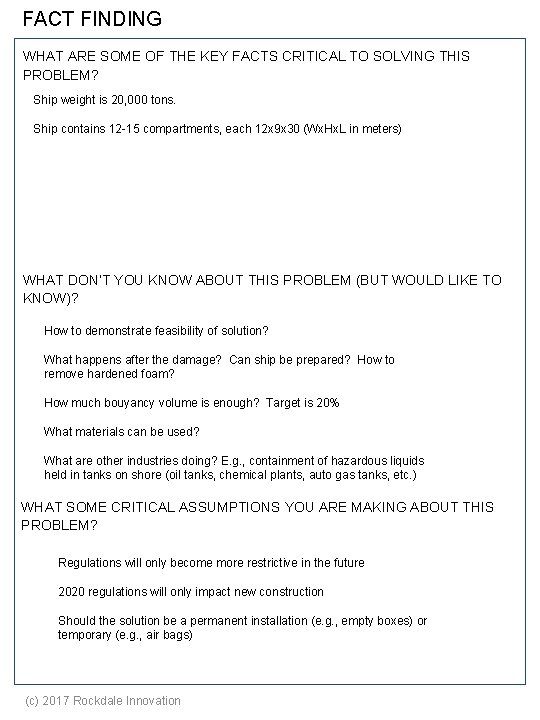
FACT FINDING WHAT ARE SOME OF THE KEY FACTS CRITICAL TO SOLVING THIS PROBLEM? Ship weight is 20, 000 tons. Ship contains 12 -15 compartments, each 12 x 9 x 30 (Wx. Hx. L in meters) WHAT DON’T YOU KNOW ABOUT THIS PROBLEM (BUT WOULD LIKE TO KNOW)? How to demonstrate feasibility of solution? What happens after the damage? Can ship be prepared? How to remove hardened foam? How much bouyancy volume is enough? Target is 20% What materials can be used? What are other industries doing? E. g. , containment of hazardous liquids held in tanks on shore (oil tanks, chemical plants, auto gas tanks, etc. ) WHAT SOME CRITICAL ASSUMPTIONS YOU ARE MAKING ABOUT THIS PROBLEM? Regulations will only become more restrictive in the future 2020 regulations will only impact new construction Should the solution be a permanent installation (e. g. , empty boxes) or temporary (e. g. , air bags) (c) 2017 Rockdale Innovation
PROBLEM DEFINITION Write ten alternative problem statements in the form of complete sentences, based on facts from the previous pages. Identify which of these problems can be solved with resources from your own company, and which are candidates for Open Innovation. PROBLEMS WE CAN SOLVE WITH OUR OWN KNOWLEDGE AND EXPERTISE CANDIDATES FOR INTERNAL CREATIVE PROBLEM SOLVING WORKSHOPS PROBLEMS WE CANNOT SOLVE WITH OUR OWN KNOWLEDGE AND EXPERTISE CANDIDATES FOR LANDSCAPING AND OPEN INNOVATION CHALLENGES (c) 2017 Rockdale Innovation
PROBLEM DEFINITION LANDSCAPING SEARCH TERMS Tips for writing problem statements that will strengthen the Landscaping and/or Creative Problem Solving process: • Detailed problem statements written in complete sentences makes identifying useful search terms for Landscaping much easier • Use “How Might We…? ” to turn negative facts about the challenge into more positively-stated problem statements for Landscaping. • Be divergent! Have every team member state potential problems in their own words from their unique perspective. Remember, every negative fact captured during Fact Finding has the potential to become a new “How Might We…? ” statement. Reviewing your problem statement(s) targeted for Open Innovation, what search terms might you use during your Landscaping? (c) 2017 Rockdale Innovation
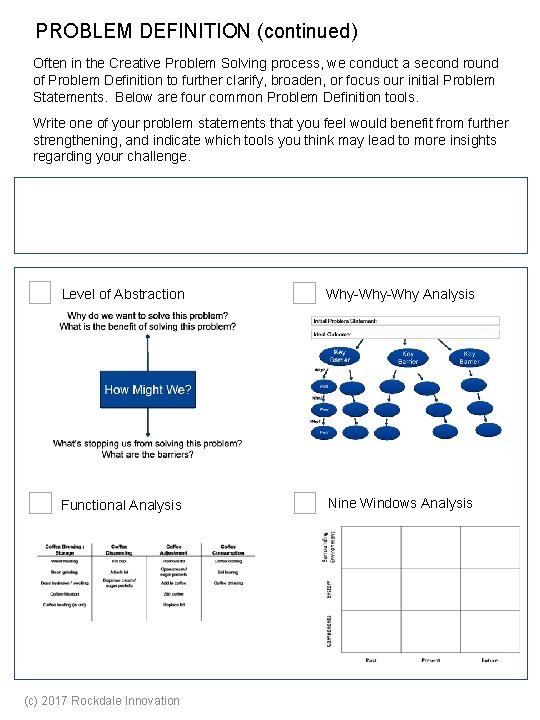
PROBLEM DEFINITION (continued) Often in the Creative Problem Solving process, we conduct a second round of Problem Definition to further clarify, broaden, or focus our initial Problem Statements. Below are four common Problem Definition tools. Write one of your problem statements that you feel would benefit from further strengthening, and indicate which tools you think may lead to more insights regarding your challenge. Level of Abstraction Why-Why Analysis Functional Analysis Nine Windows Analysis (c) 2017 Rockdale Innovation
Workbook Sections • Effective Problem Definition • Preparing a Technical Brief • Conducting a Preliminary Landscape Assessment • Conducting an Open Innovation Challenge • Conducting a Technical Problem Solving Session • Action Planning (c) 2017 Rockdale Innovation
PREPARING A TECHNICAL BRIEF Prepare a Technical Brief for one of the top problem statements above that you would to explore further using the 8 -step Landscaping process. Below are some of the common sections included in a Technical Brief for distribution by a OI Solution Provider like Innocentive (see innocentive. com for examples) • What is the problem you are trying to solve using Landscaping? • What is the ideal outcome if this problem were completedly solved? • What possible solutions approaches should be considered (or avoided)? • What success criteria will be used to evaluate any proposed solutions? • What constraints or “killer issues” would eliminate a solution from consideration? • What other considerations should the Solving Community be aware of while proposing solutions to your Open Innovation Challenge? e. g. , Intellectual Property requirements, key partner capabilities needed, indication of technical readiness, legal or regulatory concerns, etc. (c) 2017 Rockdale Innovation
Workbook Sections • Effective Problem Definition • Preparing a Technical Brief • Conducting a Preliminary Landscape Assessment • Conducting an Open Innovation Challenge • Conducting a Technical Problem Solving Session • Action Planning (c) 2017 Rockdale Innovation
BENEFITS OF LANDSCAPING • Faster resolution of tough technical and business challenges • Quickly Find and Sort Relevant data in your area of interest, providing a concise summary of important facts to guide decision making process • Competitive benchmarking on best practices, both within and outside your industry • Alerts provide updates to stay current on technology & competitive activity thru periodic (e. g. , weekly) email links. • Don’t waste funds recreating solutions already available, as problems you face may have already been solved in another field (c) 2017 Rockdale Innovation
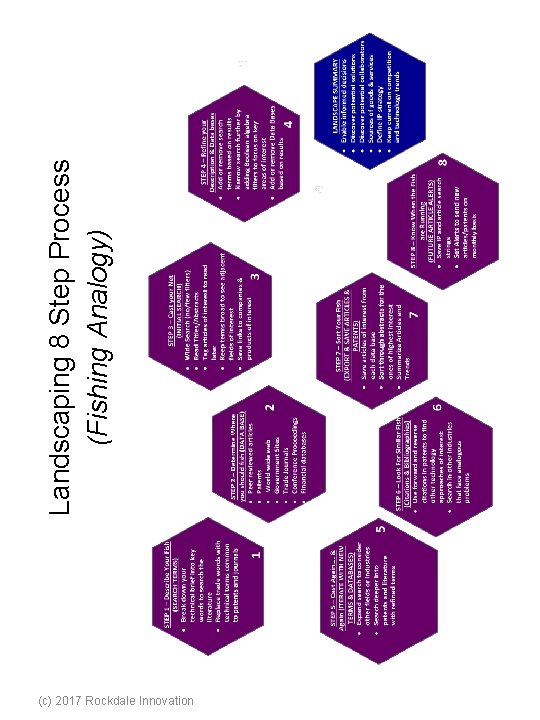
(c) 2017 Rockdale Innovation Landscaping 8 Step Process (Fishing Analogy)
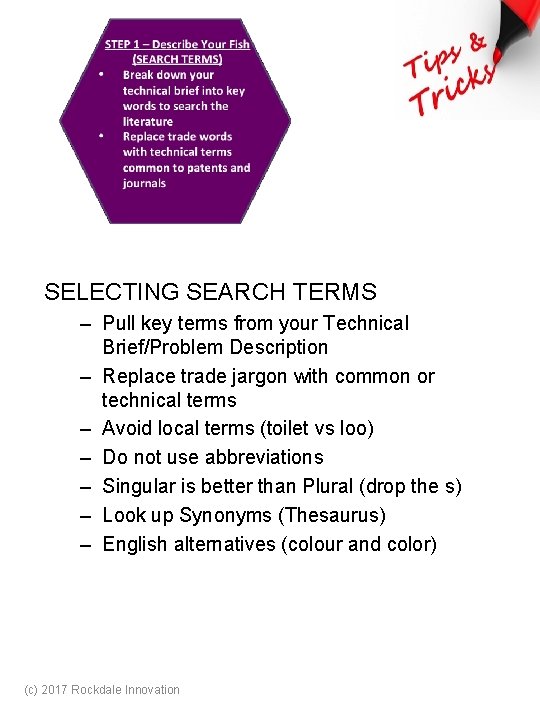
SELECTING SEARCH TERMS – Pull key terms from your Technical Brief/Problem Description – Replace trade jargon with common or technical terms – Avoid local terms (toilet vs loo) – Do not use abbreviations – Singular is better than Plural (drop the s) – Look up Synonyms (Thesaurus) – English alternatives (colour and color) (c) 2017 Rockdale Innovation
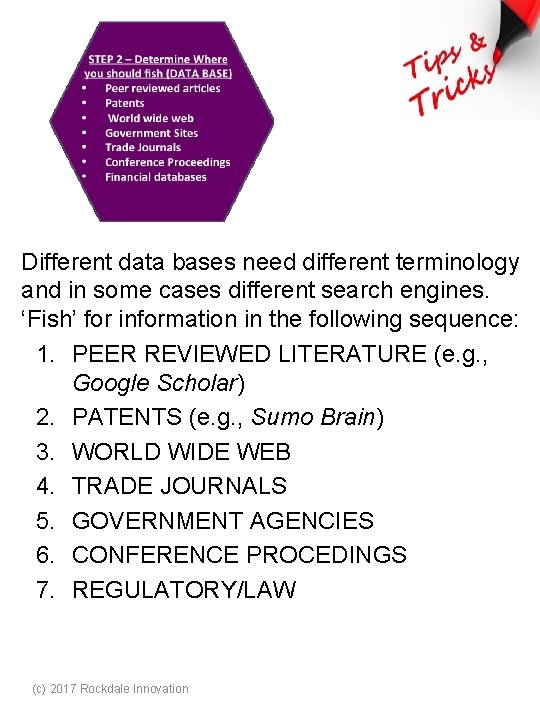
Different data bases need different terminology and in some cases different search engines. ‘Fish’ for information in the following sequence: 1. PEER REVIEWED LITERATURE (e. g. , Google Scholar) 2. PATENTS (e. g. , Sumo Brain) 3. WORLD WIDE WEB 4. TRADE JOURNALS 5. GOVERNMENT AGENCIES 6. CONFERENCE PROCEDINGS 7. REGULATORY/LAW (c) 2017 Rockdale Innovation
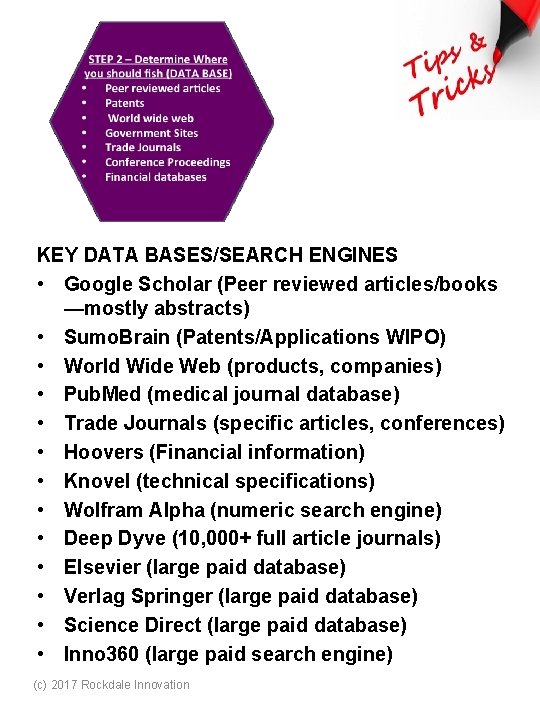
KEY DATA BASES/SEARCH ENGINES • Google Scholar (Peer reviewed articles/books —mostly abstracts) • Sumo. Brain (Patents/Applications WIPO) • World Wide Web (products, companies) • Pub. Med (medical journal database) • Trade Journals (specific articles, conferences) • Hoovers (Financial information) • Knovel (technical specifications) • Wolfram Alpha (numeric search engine) • Deep Dyve (10, 000+ full article journals) • Elsevier (large paid database) • Verlag Springer (large paid database) • Science Direct (large paid database) • Inno 360 (large paid search engine) (c) 2017 Rockdale Innovation
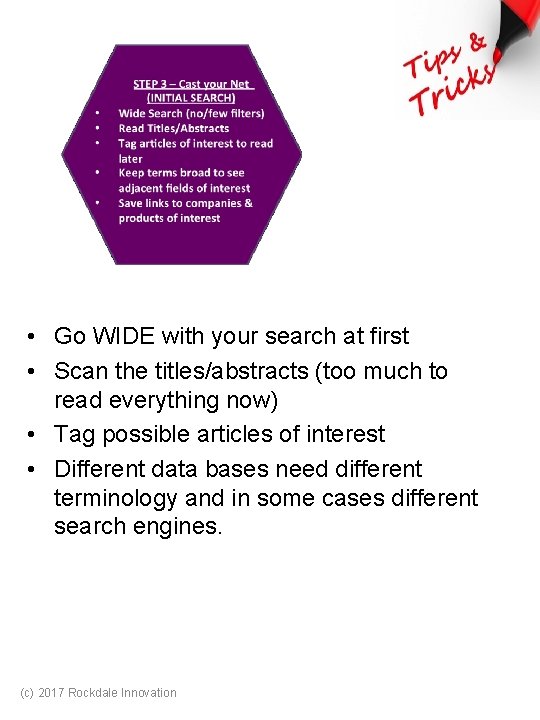
• Go WIDE with your search at first • Scan the titles/abstracts (too much to read everything now) • Tag possible articles of interest • Different data bases need different terminology and in some cases different search engines. (c) 2017 Rockdale Innovation
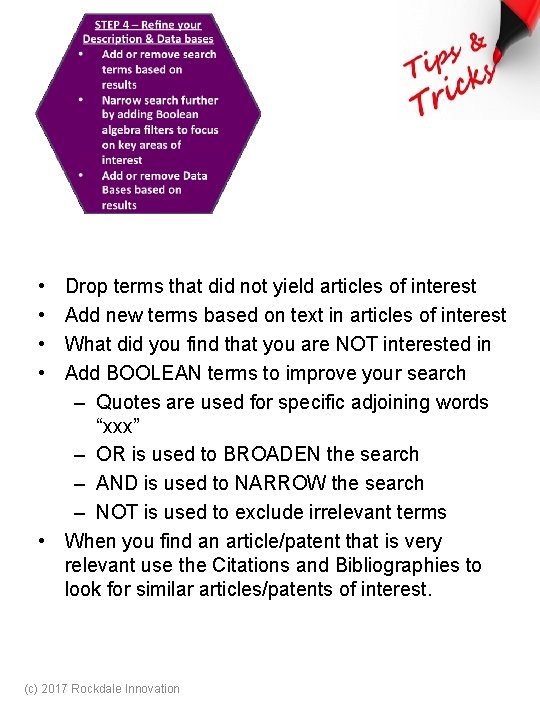
• • Drop terms that did not yield articles of interest Add new terms based on text in articles of interest What did you find that you are NOT interested in Add BOOLEAN terms to improve your search – Quotes are used for specific adjoining words “xxx” – OR is used to BROADEN the search – AND is used to NARROW the search – NOT is used to exclude irrelevant terms • When you find an article/patent that is very relevant use the Citations and Bibliographies to look for similar articles/patents of interest. (c) 2017 Rockdale Innovation
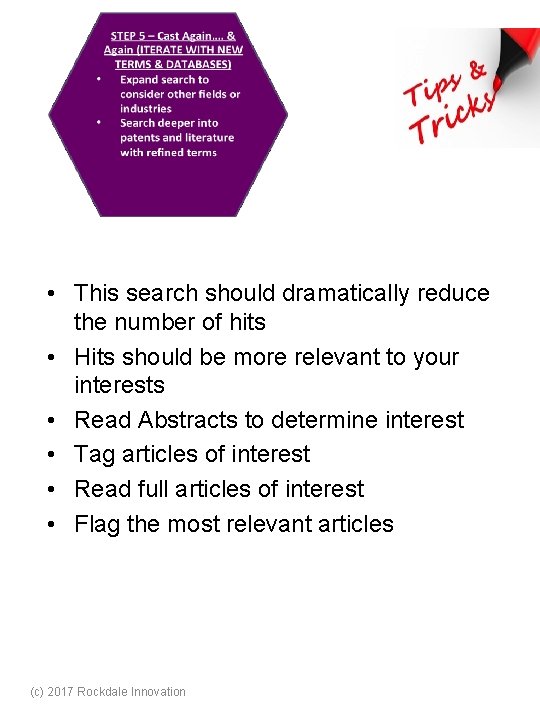
• This search should dramatically reduce the number of hits • Hits should be more relevant to your interests • Read Abstracts to determine interest • Tag articles of interest • Read full articles of interest • Flag the most relevant articles (c) 2017 Rockdale Innovation
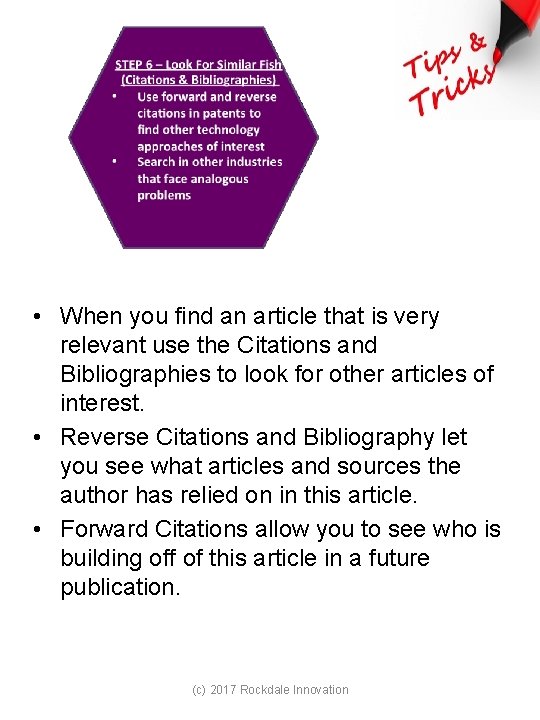
• When you find an article that is very relevant use the Citations and Bibliographies to look for other articles of interest. • Reverse Citations and Bibliography let you see what articles and sources the author has relied on in this article. • Forward Citations allow you to see who is building off of this article in a future publication. (c) 2017 Rockdale Innovation
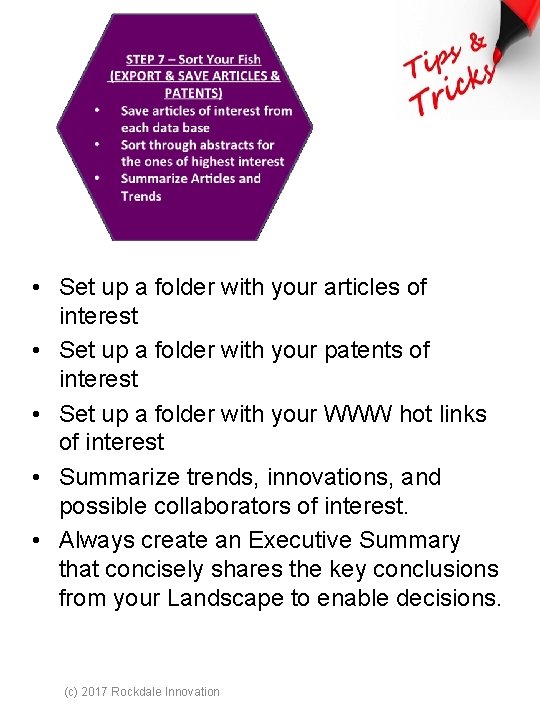
• Set up a folder with your articles of interest • Set up a folder with your patents of interest • Set up a folder with your WWW hot links of interest • Summarize trends, innovations, and possible collaborators of interest. • Always create an Executive Summary that concisely shares the key conclusions from your Landscape to enable decisions. (c) 2017 Rockdale Innovation
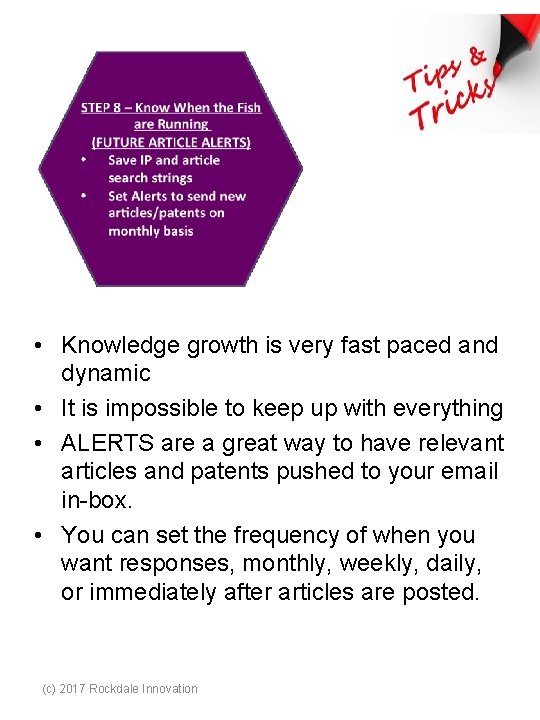
• Knowledge growth is very fast paced and dynamic • It is impossible to keep up with everything • ALERTS are a great way to have relevant articles and patents pushed to your email in-box. • You can set the frequency of when you want responses, monthly, weekly, daily, or immediately after articles are posted. (c) 2017 Rockdale Innovation
Workbook Sections • Effective Problem Definition • Preparing a Technical Brief • Conducting a Preliminary Landscape Assessment • Conducting an Open Innovation Challenge • Conducting a Technical Problem Solving Session • Action Planning (c) 2017 Rockdale Innovation
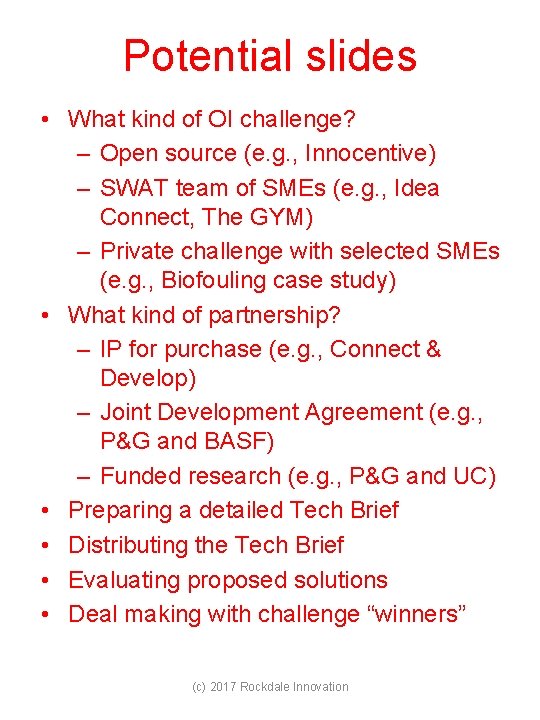
Potential slides • What kind of OI challenge? – Open source (e. g. , Innocentive) – SWAT team of SMEs (e. g. , Idea Connect, The GYM) – Private challenge with selected SMEs (e. g. , Biofouling case study) • What kind of partnership? – IP for purchase (e. g. , Connect & Develop) – Joint Development Agreement (e. g. , P&G and BASF) – Funded research (e. g. , P&G and UC) • Preparing a detailed Tech Brief • Distributing the Tech Brief • Evaluating proposed solutions • Deal making with challenge “winners” (c) 2017 Rockdale Innovation
Workbook Sections • Effective Problem Definition • Preparing a Technical Brief • Conducting a Preliminary Landscape Assessment • Conducting an Open Innovation Challenge • Conducting a Technical Problem Solving Session • Action Planning (c) 2017 Rockdale Innovation
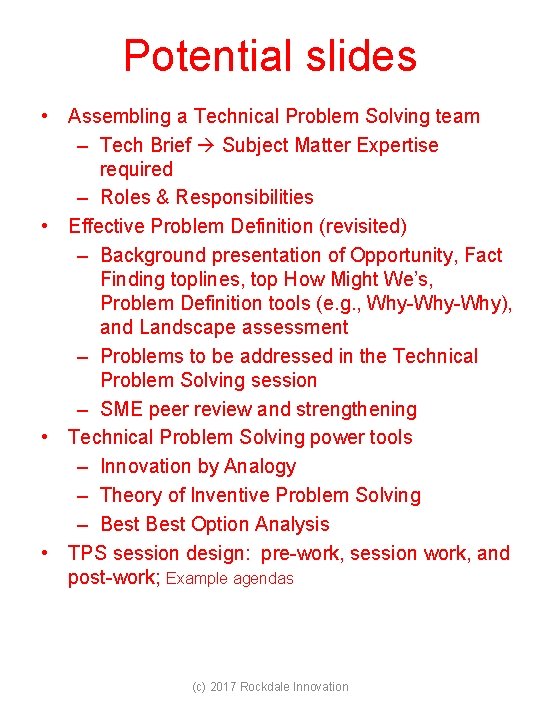
Potential slides • Assembling a Technical Problem Solving team – Tech Brief Subject Matter Expertise required – Roles & Responsibilities • Effective Problem Definition (revisited) – Background presentation of Opportunity, Fact Finding toplines, top How Might We’s, Problem Definition tools (e. g. , Why-Why), and Landscape assessment – Problems to be addressed in the Technical Problem Solving session – SME peer review and strengthening • Technical Problem Solving power tools – Innovation by Analogy – Theory of Inventive Problem Solving – Best Option Analysis • TPS session design: pre-work, session work, and post-work; Example agendas (c) 2017 Rockdale Innovation
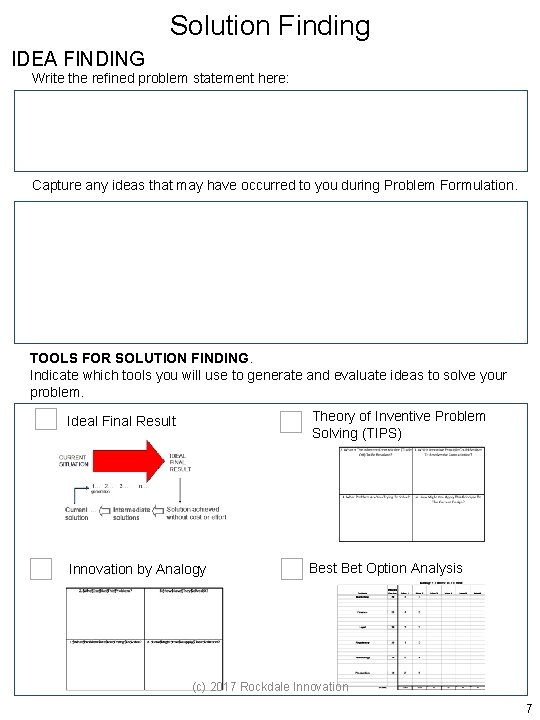
Solution Finding IDEA FINDING Write the refined problem statement here: Capture any ideas that may have occurred to you during Problem Formulation. TOOLS FOR SOLUTION FINDING. Indicate which tools you will use to generate and evaluate ideas to solve your problem. Ideal Final Result Theory of Inventive Problem Solving (TIPS) Innovation by Analogy Best Bet Option Analysis (c) 2017 Rockdale Innovation 7
Workbook Sections • Effective Problem Definition • Preparing a Technical Brief • Conducting a Preliminary Landscape Assessment • Conducting an Open Innovation Challenge • Conducting a Technical Problem Solving Session • Action Planning (c) 2017 Rockdale Innovation
Potential slides • Killer Issue Analysis – “Fail Fast, Fail Cheap” – In FEI, all time/money/resources focused here • Learning Plans – “Phase appropriate” work across all Functions • Stakeholder Analysis – Who’s support is needed – What’s in it for them? • Displayed Thinking – All of the work for success – Most important work in the next 90 Days (c) 2017 Rockdale Innovation
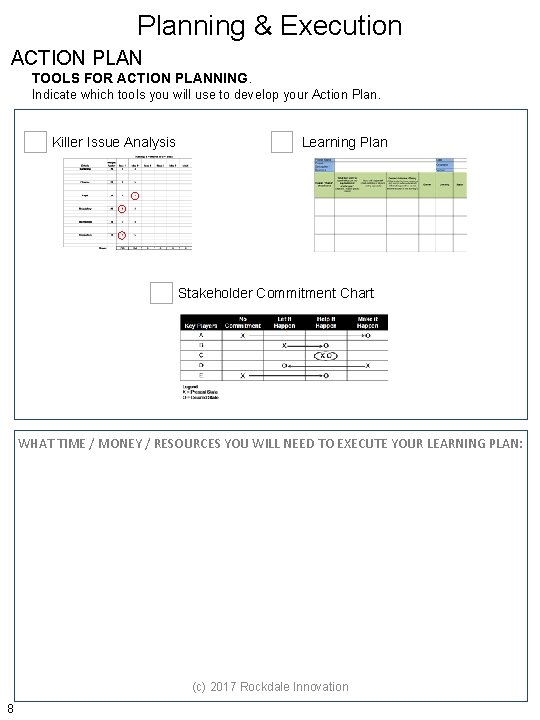
Planning & Execution ACTION PLAN TOOLS FOR ACTION PLANNING. Indicate which tools you will use to develop your Action Plan. Killer Issue Analysis Learning Plan Stakeholder Commitment Chart WHAT TIME / MONEY / RESOURCES YOU WILL NEED TO EXECUTE YOUR LEARNING PLAN: (c) 2017 Rockdale Innovation 8
- Slides: 32