
STEMCHANGING VERBS SCV 1 An L Ford Production

STEM-CHANGING VERBS (SCV) 1. An L. Ford Production © 2018 A stem-changing verb is a special verb that has a change in the “stem. ” The “stem” is the part left after dropping the –ar, -er, or –ir ending. ------pulsa este butón 2. There are 4 types of stem changes in Spanish: para un video e-ie o-ue e-i u-ue . 3. There is NO STEM CHANGE IN THE NOSOTROS FORM! You must conjugate the verb WITHOUT doing the stem -change 4. Only one verb out of thousands stem-changes from u ue in Spanish: Jugar (to play sport/game). 5. All e i stem-changing verbs will be –ir verbs. 6. Sometimes, a verb will have more than one “e”. If this happens, stem- change

STEM-CHANGING VERBS-LIST 1 (1 -26) 12. encontrar- to find 13. soñar- to dream 14. sonar-to sound (alarm clock= el despertador) 15. volar (en un avión)- to fly (on an airplane) 1. almorzar (en tu restaurante favorito)- to 16. resolver (un problema)- to resolve (a problem) eat/have lunch (at your favorite restaurant) 17. apostar- to bet 2. contar (dinero)- to count (money)/tell a 18. demonstrar (para las derechas story civiles)- to demonstrate (for civil rights) 3. mover (a una ciudad nueva)- to move 19. doler- to hurt/ache (*only 2 forms, (to a new city) (a un apartamento nuevo) a new apartment sing. -duele/pl. duelen) 4. dormir (en la recámara/en el dormitorio)20. llover (a cántaros)- to rain to sleep (cats and dogs)(Only 1 form: llueve) (in the bedroom) 21. probar (la carne asada)- to 5. morir- to die test/try/taste (the BBQ) 6. mostrar- to show 22. remover (el graffiti del edificio)- to 7. costar- to cost remove (the graffiti from the building) (*only 2 forms, sing. -cuesta/pl. -cuestan) 23. poder- to be able/can 8. recordar (la fecha/el aniversario)- to remember (the date/the anniversary) 24. envolver un regalo- to wrap (a 9. volver- to return (to a place) present) 25. desenvolver - to unwrap (present) 10. devolver- to return (an item) o-ue
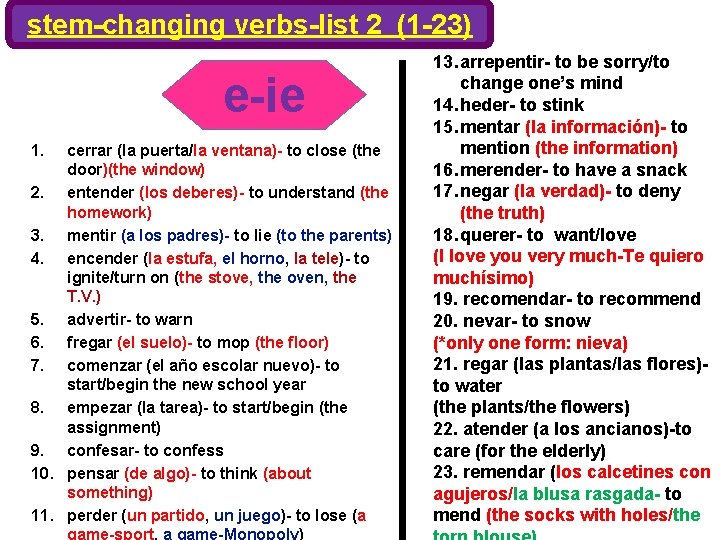
stem-changing verbs-list 2 (1 -23) e-ie 1. cerrar (la puerta/la ventana)- to close (the door)(the window) 2. entender (los deberes)- to understand (the homework) 3. mentir (a los padres)- to lie (to the parents) 4. encender (la estufa, el horno, la tele)- to ignite/turn on (the stove, the oven, the T. V. ) 5. advertir- to warn 6. fregar (el suelo)- to mop (the floor) 7. comenzar (el año escolar nuevo)- to start/begin the new school year 8. empezar (la tarea)- to start/begin (the assignment) 9. confesar- to confess 10. pensar (de algo)- to think (about something) 11. perder (un partido, un juego)- to lose (a 13. arrepentir- to be sorry/to change one’s mind 14. heder- to stink 15. mentar (la información)- to mention (the information) 16. merender- to have a snack 17. negar (la verdad)- to deny (the truth) 18. querer- to want/love (I love you very much-Te quiero muchísimo) 19. recomendar- to recommend 20. nevar- to snow (*only one form: nieva) 21. regar (las plantas/las flores)to water (the plants/the flowers) 22. atender (a los ancianos)-to care (for the elderly) 23. remendar (los calcetines con agujeros/la blusa rasgada- to mend (the socks with holes/the
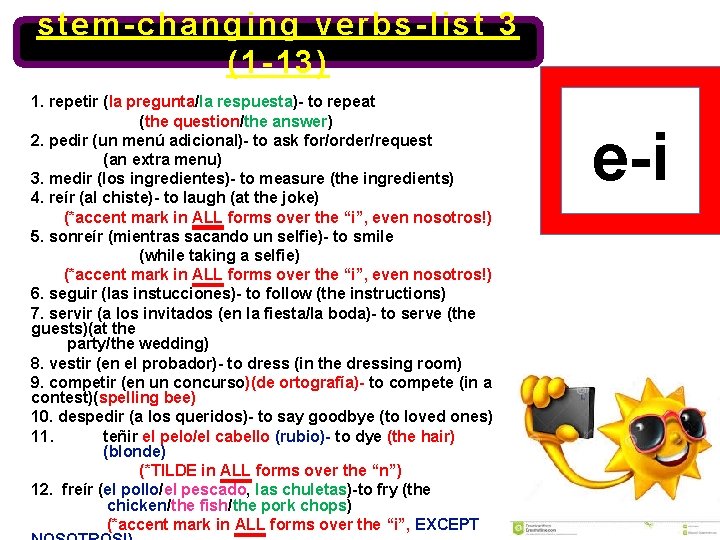
stem-changing verbs-list 3 (1 -13) 1. repetir (la pregunta/la respuesta)- to repeat (the question/the answer) 2. pedir (un menú adicional)- to ask for/order/request (an extra menu) 3. medir (los ingredientes)- to measure (the ingredients) 4. reír (al chiste)- to laugh (at the joke) (*accent mark in ALL forms over the “i”, even nosotros!) 5. sonreír (mientras sacando un selfie)- to smile (while taking a selfie) (*accent mark in ALL forms over the “i”, even nosotros!) 6. seguir (las instucciones)- to follow (the instructions) 7. servir (a los invitados (en la fiesta/la boda)- to serve (the guests)(at the party/the wedding) 8. vestir (en el probador)- to dress (in the dressing room) 9. competir (en un concurso)(de ortografía)- to compete (in a contest)(spelling bee) 10. despedir (a los queridos)- to say goodbye (to loved ones) 11. teñir el pelo/el cabello (rubio)- to dye (the hair) (blonde) (*TILDE in ALL forms over the “n”) 12. freír (el pollo/el pescado, las chuletas)-to fry (the chicken/the fish/the pork chops) (*accent mark in ALL forms over the “i”, EXCEPT e-i
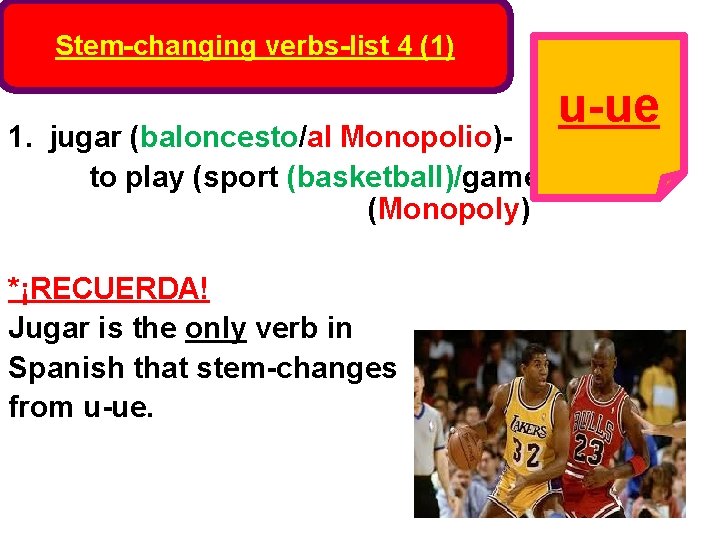
Stem-changing verbs-list 4 (1) 1. jugar (baloncesto/al Monopolio)to play (sport (basketball)/game (Monopoly) *¡RECUERDA! Jugar is the only verb in Spanish that stem-changes from u-ue
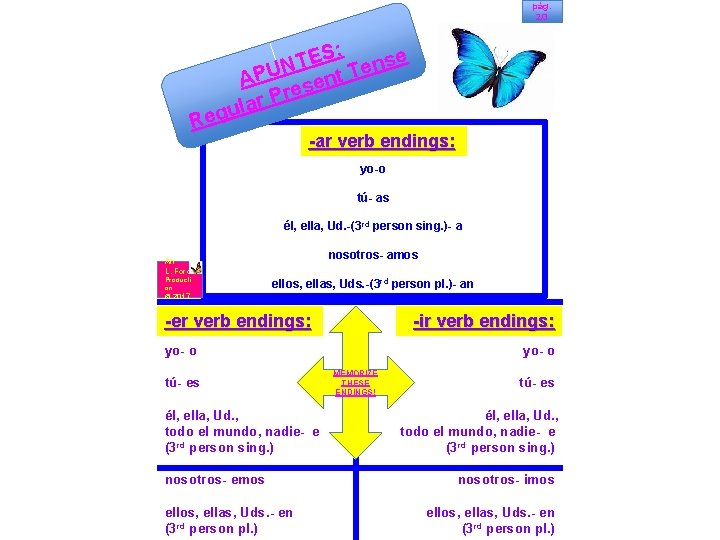
pág. 2/3 S: E T nse N e U T AP esent r P r a l egu R -ar verb endings: yo-o tú- as él, ella, Ud. -(3 rd person sing. )- a nosotros- amos An L. Ford Producti on ellos, ellas, Uds. -(3 rd person pl. )- an © 2017 -er verb endings: -ir verb endings: yo- o tú- es él, ella, Ud. , todo el mundo, nadie- e (3 rd person sing. ) nosotros- emos ellos, ellas, Uds. - en (3 rd person pl. ) yo- o MEMORIZE THESE ENDINGS! tú- es él, ella, Ud. , todo el mundo, nadie- e (3 rd person sing. ) nosotros- imos ellos, ellas, Uds. - en (3 rd person pl. )
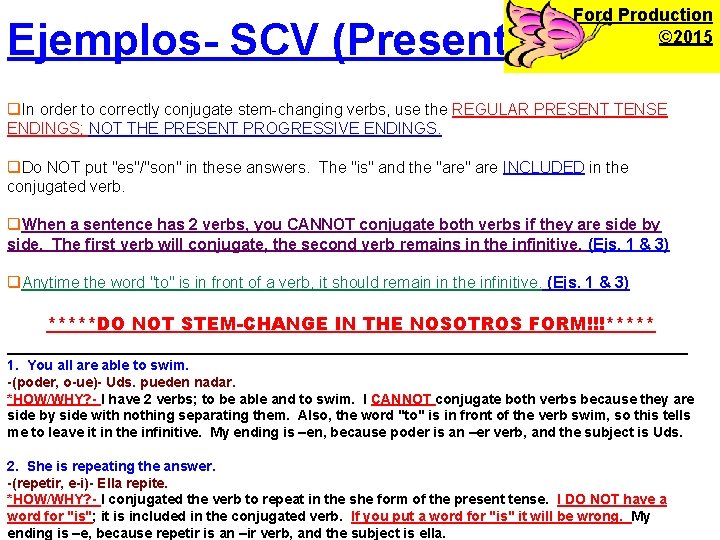
An L. Ford Production © 2015 Ejemplos- SCV (Present Tense) q. In order to correctly conjugate stem-changing verbs, use the REGULAR PRESENT TENSE ENDINGS; NOT THE PRESENT PROGRESSIVE ENDINGS. q. Do NOT put "es"/"son" in these answers. The "is" and the "are" are INCLUDED in the conjugated verb. q. When a sentence has 2 verbs, you CANNOT conjugate both verbs if they are side by side. The first verb will conjugate, the second verb remains in the infinitive. (Ejs. 1 & 3) q. Anytime the word "to" is in front of a verb, it should remain in the infinitive. (Ejs. 1 & 3) *****DO NOT STEM-CHANGE IN THE NOSOTROS FORM!!!***** ______________________________________ 1. You all are able to swim. -(poder, o-ue)- Uds. pueden nadar. *HOW/WHY? - I have 2 verbs; to be able and to swim. I CANNOT conjugate both verbs because they are side by side with nothing separating them. Also, the word "to" is in front of the verb swim, so this tells me to leave it in the infinitive. My ending is –en, because poder is an –er verb, and the subject is Uds. 2. She is repeating the answer. -(repetir, e-i)- Ella repite. *HOW/WHY? - I conjugated the verb to repeat in the she form of the present tense. I DO NOT have a word for "is"; it is included in the conjugated verb. If you put a word for "is" it will be wrong. My ending is –e, because repetir is an –ir verb, and the subject is ella.

An L. Ford Production © 2015 Ejemplos- SCV-(Present Tense) q. In order to correctly conjugate stem-changing verbs, use the REGULAR PRESENT TENSE ENDINGS; NOT THE PRESENT PROGRESSIVE ENDINGS. q. Do NOT put "es"/"son" in these answers. The "is" and the "are" are INCLUDED in the conjugated verb. q. When a sentence has 2 verbs, you CANNOT conjugate both verbs if they are side by side. The first verb will conjugate, the second verb remains in the infinitive. (Ejs. 1 & 3) q. Anytime the word "to" is in front of a verb, it should remain in the infinitive. (Ejs. 1 & 3) *****DO NOT STEM-CHANGE IN THE NOSOTROS FORM!!!***** __________________________________ 3. I don't want to go to the movies tonight. (querer, e-ie)- Yo no quiero ir al cine esta noche. *HOW/WHY? - I conjugated the verb querer (to want/to love) into the "yo" form of the present tense. I have another verb in this sentence (to go). I left "ir" in the infinitive for 2 reasons. (1) I CANNOT conjugate 2 verbs side by side, (2) it says "to go". ANYTIME "to" is in front of a verb, it must remain in the infinitive! My ending is –o, because querer is an –er verb, and the subject is "yo". 4. Father and you are measuring the wall. -(medir, e-i)- Uds. miden la pared. *HOW/WHY? - I conjugated the verb medir (to measure) into the "Uds. " form of the present tense.

An L. Ford Production © 2015 Ejemplos- SCV-(Present Tense) q. In order to correctly conjugate stem-changing verbs, use the REGULAR PRESENT TENSE ENDINGS; NOT THE PRESENT PROGRESSIVE ENDINGS. q. Do NOT put "es"/"son" in these answers. The "is" and the "are" are INCLUDED in the conjugated verb. q. When a sentence has 2 verbs, you CANNOT conjugate both verbs if they are side by side. The first verb will conjugate, the second verb remains in the infinitive. (Ejs. 1 & 3) q. Anytime the word "to" is in front of a verb, it should remain in the infinitive. (Ejs. 1 & 3) *****DO NOT STEM-CHANGE IN THE NOSOTROS FORM!!!***** _____________________________________ 5. We are eating lunch in the cafeteria. -(almorzar, o-ue)- Nosotros almorzamos en la cafetería. *HOW/WHY? - I DID NOT do a stem-change on this verb. Why? NO STEM-CHANGES IN THE NOSOTROS FORM!!!!! My ending is –amos, because almorzar is an –ar verb, and the subject is nosotros. 6. You (fs) are having a snack in the kitchen. -(merender, e-ie)- Ud. meriende en la cocina. *HOW/WHY? - I conjugated the verb merender into the Ud. form of the present tense. You
- Slides: 9