
STEM Project Natural Disaster Research Day How to

- Slides: 19
STEM Project Natural Disaster Research Day How to Evaluate Natural Disaster Emergency Products!
CNN News: Global Awareness • Problem: During CNN, we have witnessed many natural disasters around the world. Today we are tapping into our 21 st century skill of global awareness. We will Brainstorm, Research, and Evaluate the standard category threat level of some of these disasters and design survival kits that will meet the 14 essential needs for various populations. • In your Science notebook, let’s begin a timeline of global natural disasters that we have already witnessed this year, around the world!
Global Natural Disasters Brainstorm Page • http: //www. telegraph. co. uk/education/stemawards/design/deadliest-natural-disasters/
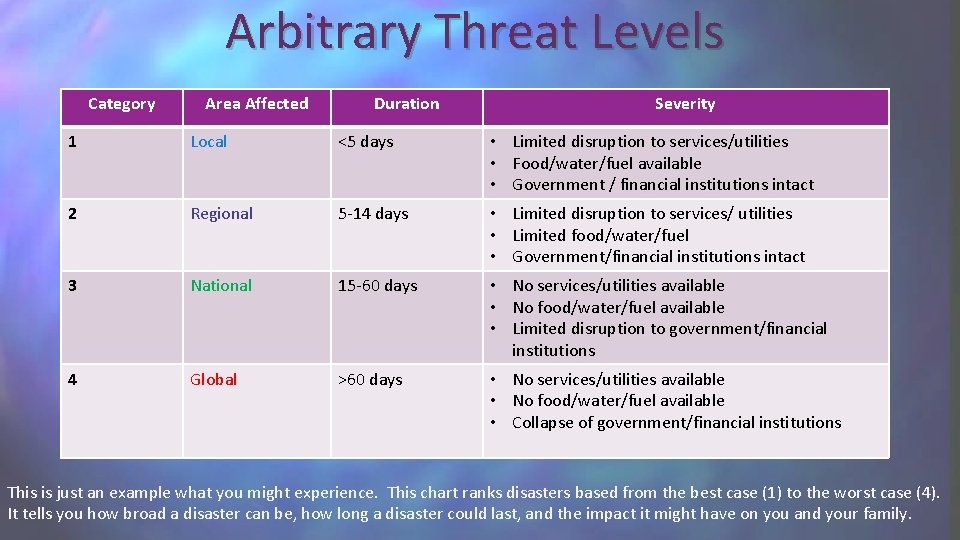
Arbitrary Threat Levels Category Area Affected Duration Severity 1 Local <5 days • Limited disruption to services/utilities • Food/water/fuel available • Government / financial institutions intact 2 Regional 5 -14 days • Limited disruption to services/ utilities • Limited food/water/fuel • Government/financial institutions intact 3 National 15 -60 days • No services/utilities available • No food/water/fuel available • Limited disruption to government/financial institutions 4 Global >60 days • No services/utilities available • No food/water/fuel available • Collapse of government/financial institutions This is just an example what you might experience. This chart ranks disasters based from the best case (1) to the worst case (4). It tells you how broad a disaster can be, how long a disaster could last, and the impact it might have on you and your family.
There are 14 categories to consider when preparing for a disaster 1. 2. 3. 4. 5. 6. 7. 8. 9. 10. 11. 12. 13. 14. Food Water Shelter Light Heating/Cooling Air Sleep Hygiene/Sanitation Medicine/First Aid Communication Electrical Power Financial Security Transportation Protection
Practice A) Pretend now that we have an extended threat. Read through the potential impacts on your sheet. 1. Decide what threat level this natural disaster covers. 2. Think about how broad the disaster is, how long the disaster could last, and the impact it might have on you and your family. Levels: 1 - local 2 -regional 3 -national 4 -global 3. Brainstorm and list what emergency supplies or equipment your family and environment would need and why.
Pretend now that we have an extended threat. Read through the potential impacts. 1. Food – Grocery stores will be closed, electrical stove won’t work, food in your freezer will spoil 2. Water- Service should be unaffected unless very long duration outage. 3. Shelter- Home is structurally sound, fire alarms will work as long as you have batteries, alarm system would in inoperable 4. Light- Main house lighting will be inoperable, no outside security lights 5. Heating/Cooling – Gas heating is inoperable because of electric blowers, heat pump inoperable 6. Air- Air quality should be unaffected 7. Sleep- Sleep may be difficult due to the lack of temperature controls at home.
8. Hygiene/Sanitation – Faucets and toilets should continue to work unless it is a long duration, hot water will be unavailable due to loss of power of electric water heater 9. Medicine/First Aid – Pharmacies will be closed, hospitals will be overwhelmed and running on backup generators 10. Communication – Televisions will be inoperable, cable service unavailable, local stations may go off air. 11. Electrical Power – All electrical power will be lost. 12. Financial Security – Banks and ATMS will be inaccessible and electric transactions such as e -banking will be unavailable. 13. Transportation- Most gas stations will be inoperable, leaving fuel in short supply. Driving at night will be hazardous without street lighting. 14. Protection – Looting, breaking and entering, and violent crimes will likely increase significantly.
Practice B) Let’s take a look at a typical emergency supply kit. Compare it’s content against the scenario below. • Assume that your family of four lives on the East Coast and a hurricane blows through. Thousands of power poles are downed, leaving you without electricity for two weeks. Gasoline is in very short supply, supermarkets are unable to restock, and local resources are contaminated due to flooding. The temperature is 85 degrees during the day and never colder than 50 degrees at night. There are subsequent bouts of heavy rain. Worst of all, a large tree has fallen through your roof of your house. And, though not prevalent, there are scattered incidents of looting.
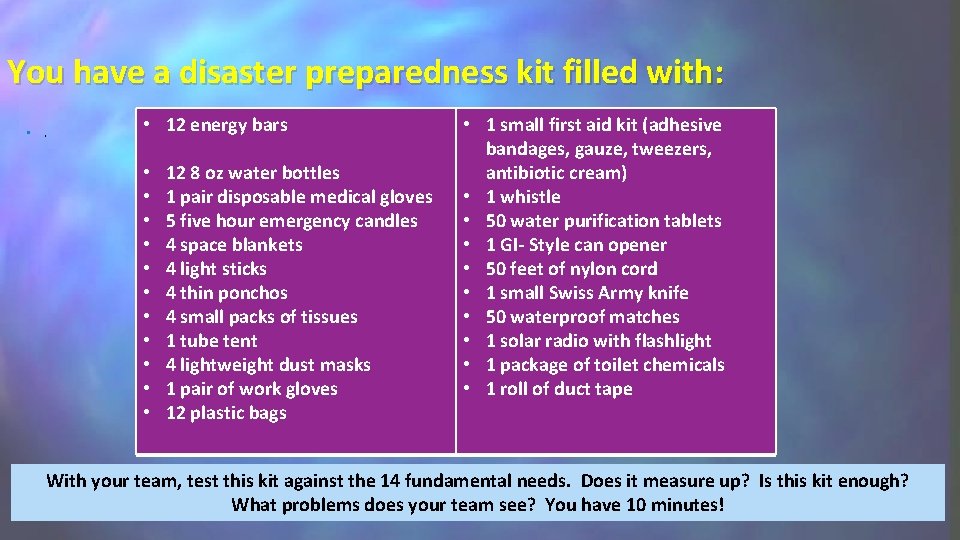
You have a disaster preparedness kit filled with: • 12 energy bars • • • 12 8 oz water bottles 1 pair disposable medical gloves 5 five hour emergency candles 4 space blankets 4 light sticks 4 thin ponchos 4 small packs of tissues 1 tube tent 4 lightweight dust masks 1 pair of work gloves 12 plastic bags • 1 small first aid kit (adhesive bandages, gauze, tweezers, antibiotic cream) • 1 whistle • 50 water purification tablets • 1 GI- Style can opener • 50 feet of nylon cord • 1 small Swiss Army knife • 50 waterproof matches • 1 solar radio with flashlight • 1 package of toilet chemicals • 1 roll of duct tape With your team, test this kit against the 14 fundamental needs. Does it measure up? Is this kit enough? What problems does your team see? You have 10 minutes!
Evaluate your answers compared to the American Red Cross responses: • What materials do you think are most important and why?
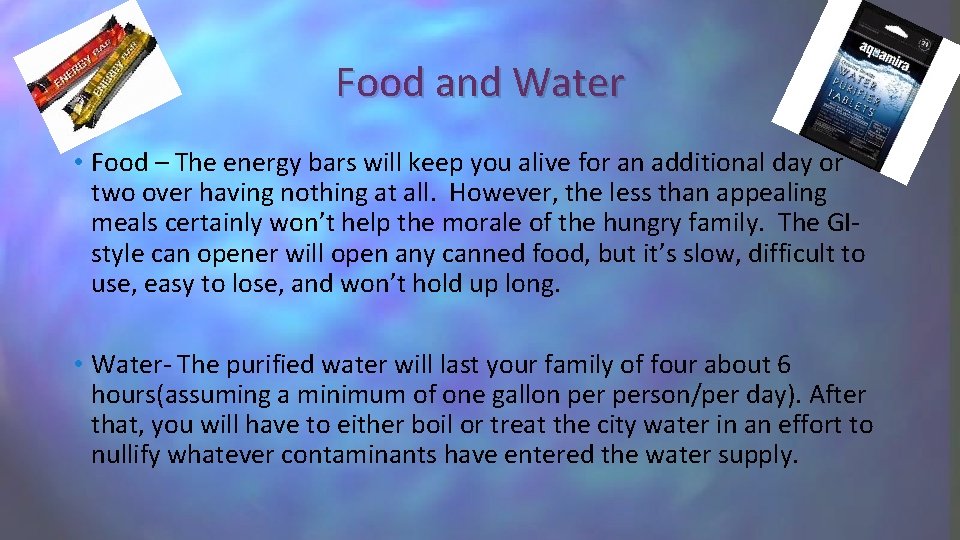
Food and Water • Food – The energy bars will keep you alive for an additional day or two over having nothing at all. However, the less than appealing meals certainly won’t help the morale of the hungry family. The GIstyle can opener will open any canned food, but it’s slow, difficult to use, easy to lose, and won’t hold up long. • Water- The purified water will last your family of four about 6 hours(assuming a minimum of one gallon person/per day). After that, you will have to either boil or treat the city water in an effort to nullify whatever contaminants have entered the water supply.
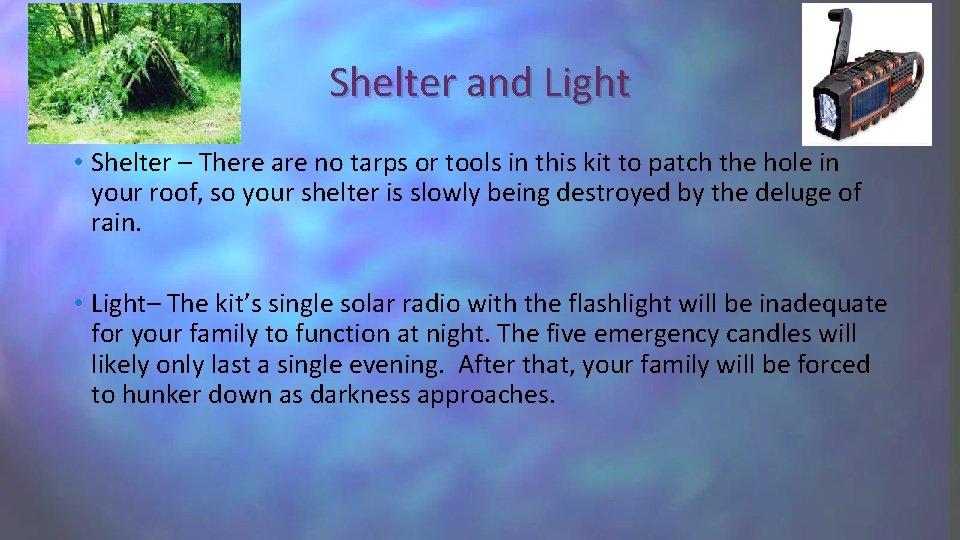
Shelter and Light • Shelter – There are no tarps or tools in this kit to patch the hole in your roof, so your shelter is slowly being destroyed by the deluge of rain. • Light– The kit’s single solar radio with the flashlight will be inadequate for your family to function at night. The five emergency candles will likely only last a single evening. After that, your family will be forced to hunker down as darkness approaches.
Heating/Cooling and Air • Heating and Cooling– temperatures are mild enough that you can survive without heating or cooling. Daytime temperatures will make it uncomfortably warm, as well as increase the need for drinking water. Evening temperatures will be chilly, forcing you to depend on the blankets you already have to keep everyone warm. Space blankets are better for short term survival. They are small, easily torn, hard to wrap yourself properly, and difficult to use without practice. • Air– In this scenario, there are no dangers to your air supply.
Hygiene/Sanitation and Sleep • Hygiene / Sanitation - The few packages of tissues and the potty bucket are inadequate for your family’s personal hygiene. Without ample supply of water, your family faces a risk of disease from poor sanitation. Also, the inability to maintain an accepted level of cleanliness will drastically drive morale down. • Sleep– Sleeping in your home is still possible for awhile, but conditions will quickly become unhealthy because of sanitation issues.
Medicine/First Aid and Communication • Medicine/First Aid – The first aid supplies are completely insufficient for anything beyond a scrapped knee. If anyone in your family becomes injured or ill (both very possible), you will be faced with a very serious situation. • Communication - There is noting in the kit to help contact family or friends, no evacuation plan, no games or activities to keep children entertained, and no information about emergency services.
Financial Security, Transportation, and Protection • Financial Security– The kit does nothing to help your financial security. In particular, it lacks home inventory sheets to help itemize property damage. • Transportation– The small radio might offer information to help decide if evacuation is necessary. However, with this kit alone, you will have no alternate means of transportation, and no maps of the surrounding area. • Protection– The kit offers no personal protection beyond a small pocketknife. Should looters invade your home thinking its empty, your family will be helpless to defend themselves.
Practice C) Your Turn… • Now your team will work together to come up with a relief kit to help in your assigned, specific disaster. When researching your disaster, keep the 14 categories in mind. How will your kit help someone prepare for the disaster or deal with the after effects? Choose one purpose. • Today you will begin your disaster relief research. You will use your plan sheet to come up with your ideas. What supplies will you need? Where will the relief supplies come from? Who is funding the kits? How will they get there?
• 1) details of your geographic location • 2) number of deaths/ injuries • 3) Financial cost of the disaster and its damages • 4) Causes of the natural disaster • 5) Effects DURING the event • 6) Effects AFTER the event • 7) Were the damages worse during or after your specific event? • 8) What were some specific needs of the people during and after? How could you make their lives more comfortable? • 9) Existing solutions being used currently… • 10) Interesting statistics/data • Survival Kit essentials…