
STEM Fair Adapted from the Hillsborough County 5
STEM Fair Adapted from the Hillsborough County 5 th Grade STEM Fair for Classroom Teachers Power. Point Lesson 3: Research adapted from Jefferson County School’s Research Power. Point 2016 -2017 Edition Mr. Shahar
You may not use: • Anything that has materials that came from a person (such as hair, teeth, nails, etc. ) • Any form of bacteria, mold, or fungi (except yeast) • Any weapons (including toy guns, knives, etc. ) or explosive
Requirements • Complete Packet AND Log. • Must be your own work. • All parts of the project must be completed. • Display board is mandatory! • Your parents may help you, but the work must be your own!
Lesson 1 What is a Good Question for STEM Fair ? Due October 27
A good question gives an elaborate answer (several sentences long!) • Good: How does the type of water affect the growth rate of a plant? • Bad: Can plants grow in water?
A good question tells you what you need to measure. • Good: How does the species of the orange affect the amount of juice it has? • Bad: Are oranges juicy?
You can investigate the question yourself. • Good: How do shade trees affect temperature of areas on our playground? • Bad: What are the temperatures on Venus? (though you can look it up, you cannot build a rocket, go to Venus and study this on your own, and get back before the due date)
The answer is a fact, not an opinion. • Good: How does the brand of soap affect the amount of bubbles produced? • Bad: Which kind of soap smells the best?
What is a Good Question? A good science investigation question: • Can not be answered with one word such as yes, no, or purple. • Tells you what you need to measure. • Is something you can investigate yourself. • Is answered with a fact, not an opinion. • Many good questions start with the words “how” or “why. ”
Lesson 2 Purpose Due October 27
Purpose The purpose of the project should tell what you want to find out. The purpose of my project is to find out… You are restating the question as a statement!
Example Question: How does the shape of a container affect the amount of evaporation that occurs? Purpose: The purpose of my project is to find out how the shape of a liquid container will affect how much liquid will evaporate.
Lesson 3 Research Due November 1
Research • Before you can begin your project, you need to learn more about the topic. • You will write the information you learn in your STEM Fair log. • You will use this information to make your hypothesis.
What is Research? Definition - hunting for facts or truth about a subject; also to investigate carefully; to search into.

What else can you use for research? Magazines Newspapers Video/Audio Computers Internet
Internet Search Tips Note: Just like print - Make sure you know what your topic is and how to spell it correctly. When searching remember to try the plural of a word. Ex 1: Search for “snake” and “snakes” Ex 2: Search for “wolf” and “wolves”
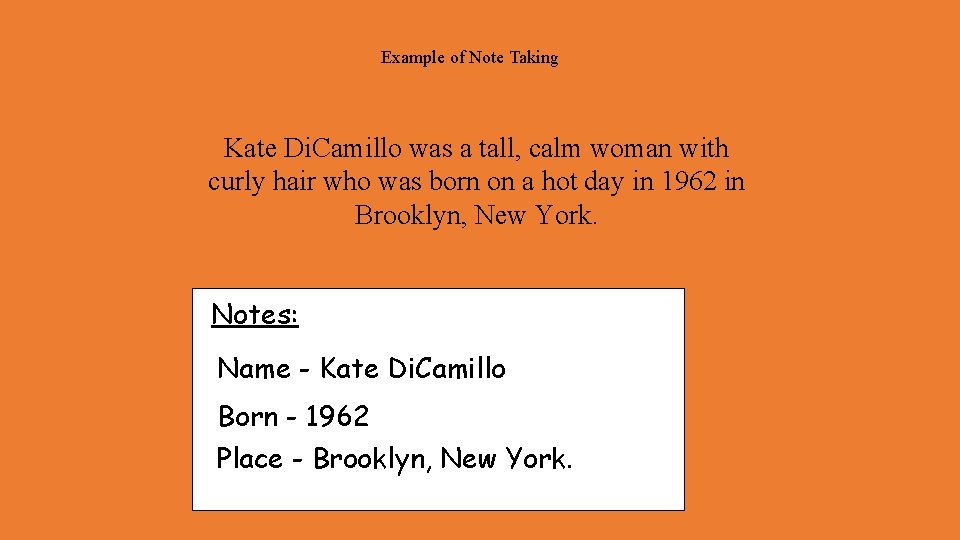
Example of Note Taking Kate Di. Camillo was a tall, calm woman with curly hair who was born on a hot day in 1962 in Brooklyn, New York. Notes: Name - Kate Di. Camillo Born - 1962 Place - Brooklyn, New York.
Do not copy word for word – that is called… Plagiarism Definition: The copying of one’s words without permission and taking credit for them.
Lesson 4 Hypothesis Due November 2
Hypothesis • The hypothesis is what you predict will happen when you perform the experiment based on your research. It is NOT an “educated guess. ” • It does NOT matter whether you are right or wrong; in your conclusion, you will tell if your hypothesis was correct or not. • It is what you think the results of your experiment will be and WHY you think that.
Hypothesis Based on my research, I think __________ will happen because __________. Remember to use the information from your research to explain why you think this will happen!
Lesson 5 Materials Due November 4
Materials This is a list of ALL the materials you need to perform your experiment. You must include how much and which types. Be specific! You cannot be too specific.
Example of Materials List Materials • 2 – 16 oz Office Depot clear plastic cups • 130 ml tap water • 1 Thermometer • 16 oz of ice from cafeteria ice maker
Materials HOW, WHEN, and WHERE will you get your materials?
Lesson 6 Variables Due November 10
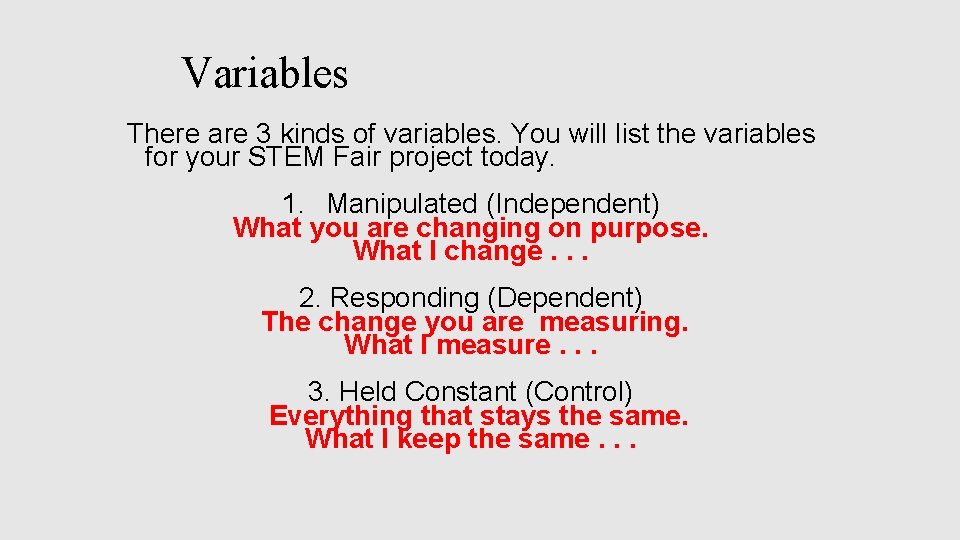
Variables There are 3 kinds of variables. You will list the variables for your STEM Fair project today. 1. Manipulated (Independent) What you are changing on purpose. What I change. . . 2. Responding (Dependent) The change you are measuring. What I measure. . . 3. Held Constant (Control) Everything that stays the same. What I keep the same. . .
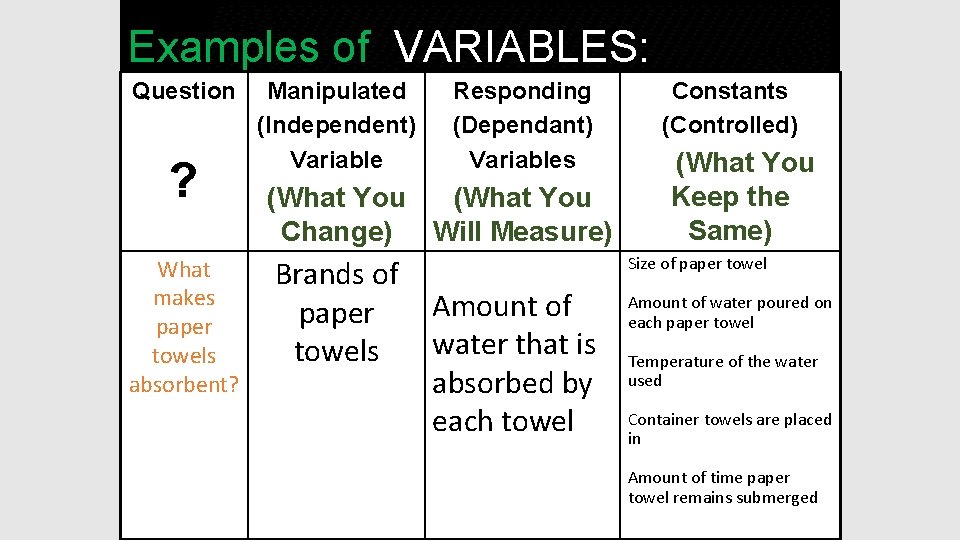
Examples of VARIABLES: Question ? What makes paper towels absorbent? Manipulated (Independent) Variable Responding (Dependant) Variables (What You Change) Will Measure) Brands of paper towels Constants (Controlled) (What You Keep the Same) Size of paper towel Amount of water that is absorbed by each towel Amount of water poured on each paper towel Temperature of the water used Container towels are placed in Amount of time paper towel remains submerged
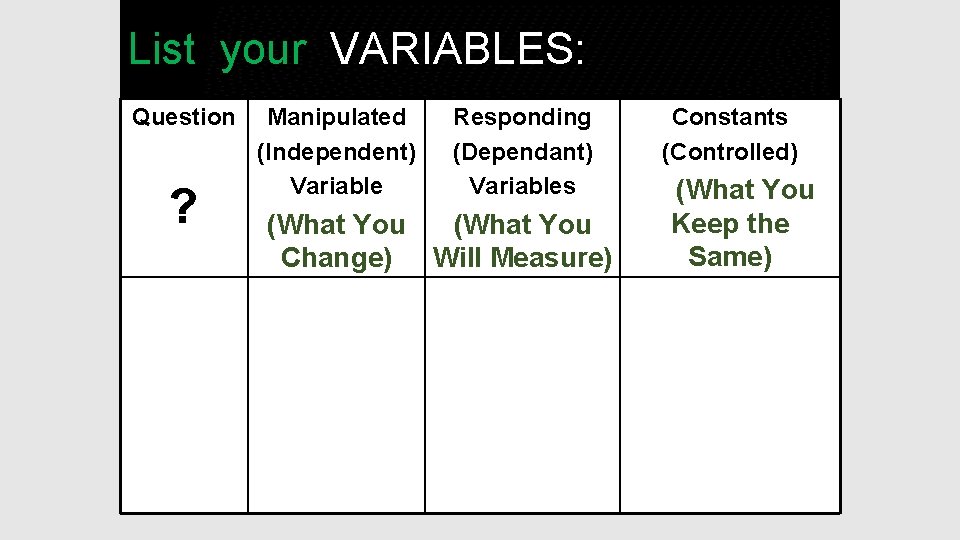
List your VARIABLES: Question ? Manipulated (Independent) Variable Responding (Dependant) Variables (What You Change) Will Measure) Constants (Controlled) (What You Keep the Same)
Lesson 7 Step-by-Step Directions Due November 15
Procedure • These are like a recipe. • Anyone who reads them will be able to duplicate the investigation and get the same results. • Procedures are very detailed.
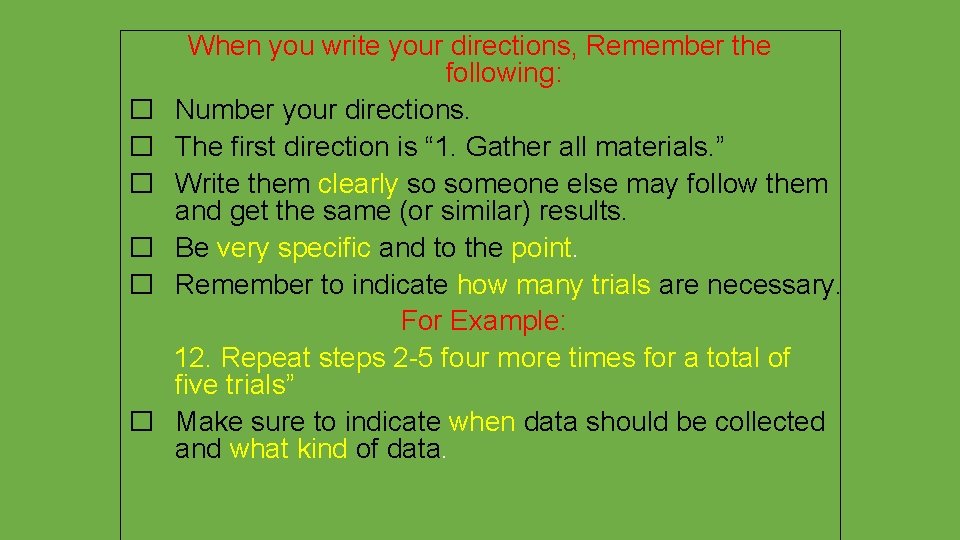
� � � When you write your directions, Remember the following: Number your directions. The first direction is “ 1. Gather all materials. ” Write them clearly so someone else may follow them and get the same (or similar) results. Be very specific and to the point. Remember to indicate how many trials are necessary. For Example: 12. Repeat steps 2 -5 four more times for a total of five trials” Make sure to indicate when data should be collected and what kind of data.
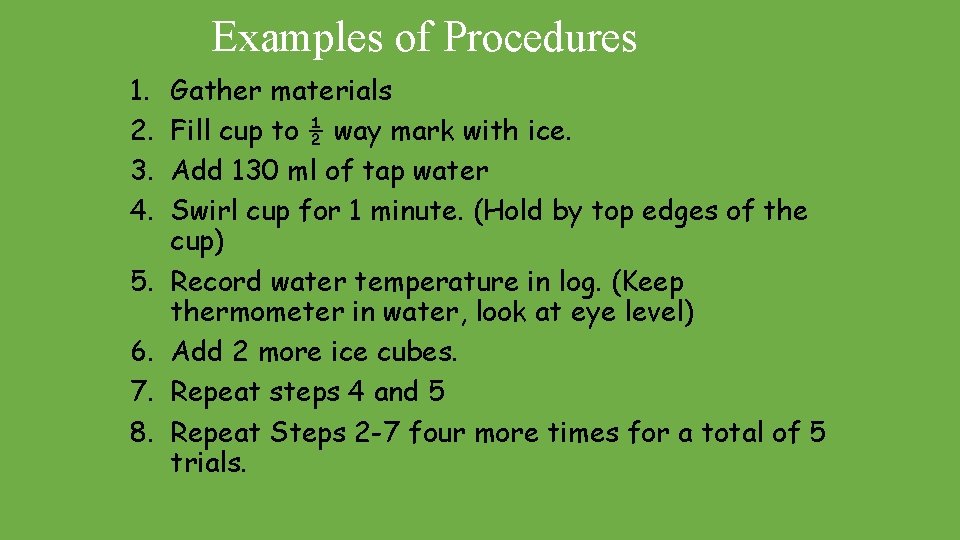
Examples of Procedures 1. 2. 3. 4. 5. 6. 7. 8. Gather materials Fill cup to ½ way mark with ice. Add 130 ml of tap water Swirl cup for 1 minute. (Hold by top edges of the cup) Record water temperature in log. (Keep thermometer in water, look at eye level) Add 2 more ice cubes. Repeat steps 4 and 5 Repeat Steps 2 -7 four more times for a total of 5 trials.
Lesson 8 DATA Collection Due November 18
DATA • Data refers to the information gathered in the investigation • This is in the form of graphs, tables, and charts. • You can supplement your data with photographs, but they do not replace the data.
DATA • To collect your data you will follow your step by step directions exactly as they are written. Imagine how a five-year-old with an advanced vocabulary would follow the procedure. • You will complete a minimum of 5 trials and record the information in your log. • You will use the data to create a data chart.
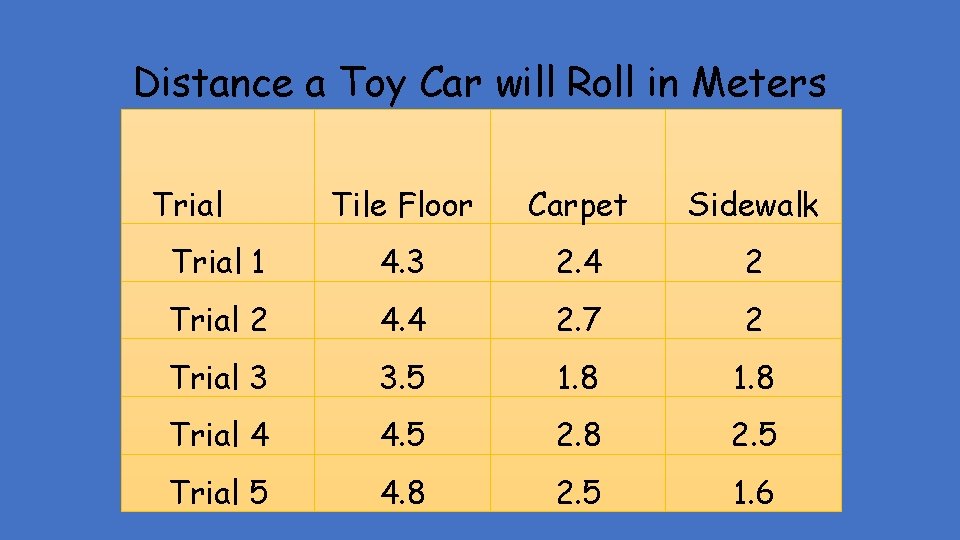
Distance a Toy Car will Roll in Meters Trial Tile Floor Carpet Sidewalk Trial 1 4. 3 2. 4 2 Trial 2 4. 4 2. 7 2 Trial 3 3. 5 1. 8 Trial 4 4. 5 2. 8 2. 5 Trial 5 4. 8 2. 5 1. 6
Quant itative and Quali tative data
Graph Use a bar graph or line graph to display data. This is the same information gathered and already recorded on your data chart. It just looks different!
Graph • A bar graph – shows comparative data. • A line graph – shows data over time (such as growing plants). • Horizontal Axis: The manipulated variable (what you changed on purpose) is displayed on the horizontal axis. • Vertical Axis: The responding variable (what happened as a result of what you changed) is displayed on the vertical axis.
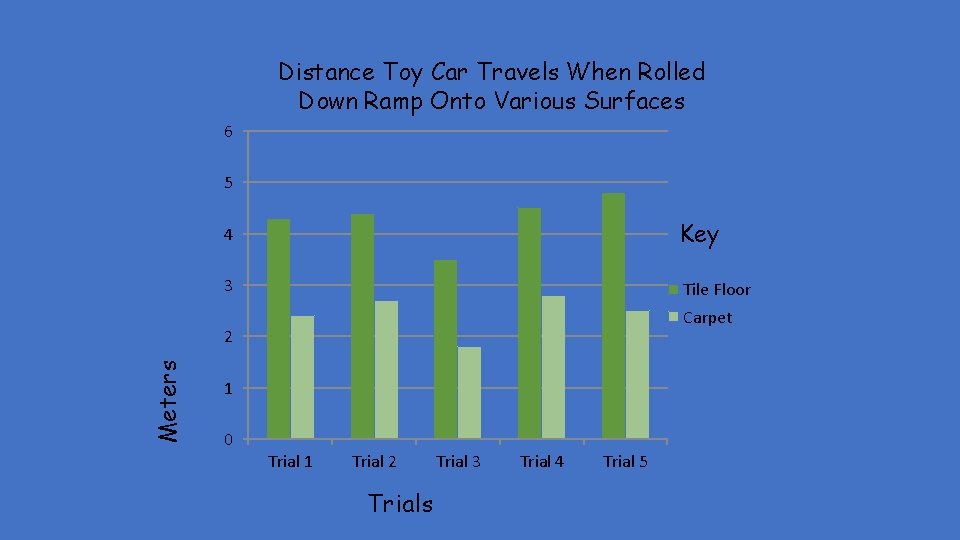
Distance Toy Car Travels When Rolled Down Ramp Onto Various Surfaces 6 5 4 Key 3 Tile Floor Carpet Meters 2 1 0 Trial 1 Trial 2 Trials Trial 3 Trial 4 Trial 5
Lesson 9 CONCLUSION Due November 28
CONCLUSION My hypothesis was (not) supported by the data because… If I were to do this project again, I would change…because…. . The way this is connected to the real world is… A problem I had or unusual event was….
Lesson 10 Displays Due December 1
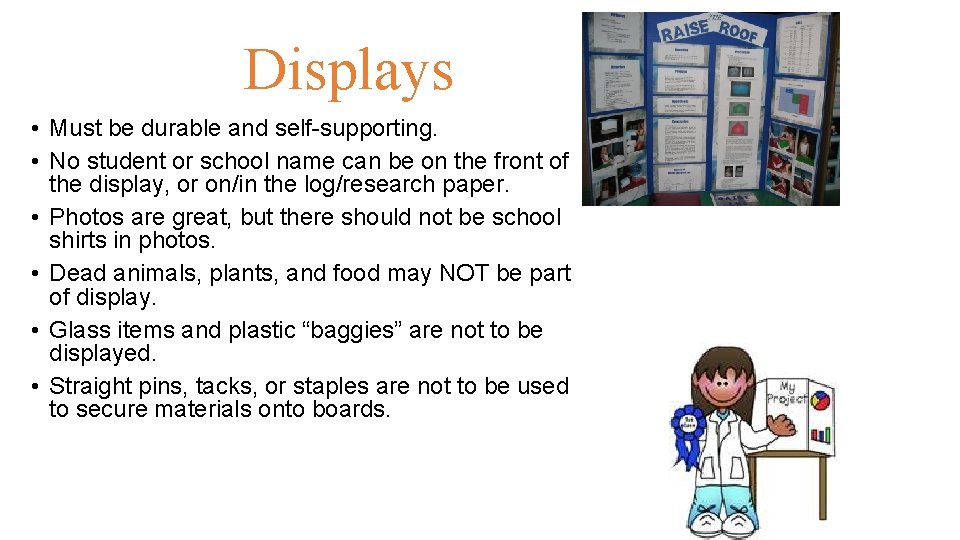
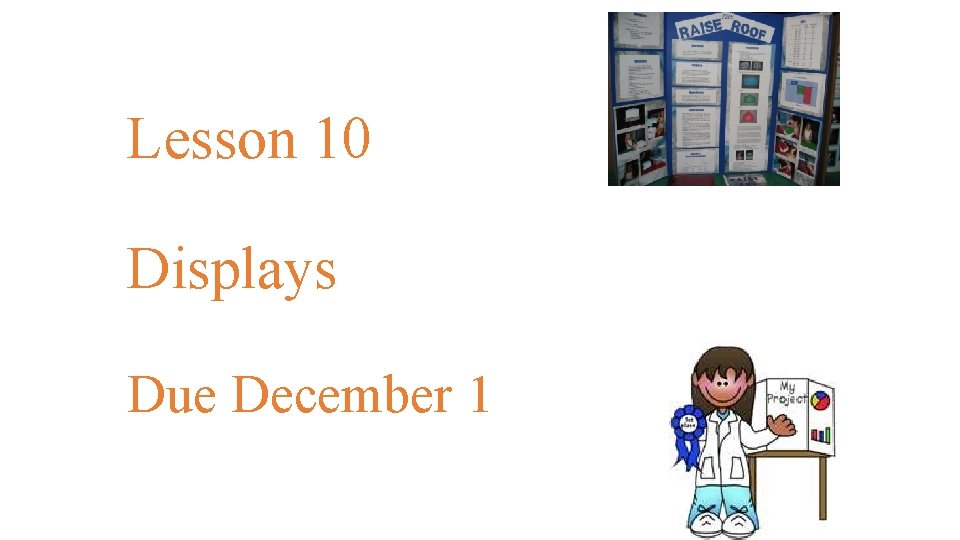
Displays • Must be durable and self-supporting. • No student or school name can be on the front of the display, or on/in the log/research paper. • Photos are great, but there should not be school shirts in photos. • Dead animals, plants, and food may NOT be part of display. • Glass items and plastic “baggies” are not to be displayed. • Straight pins, tacks, or staples are not to be used to secure materials onto boards.
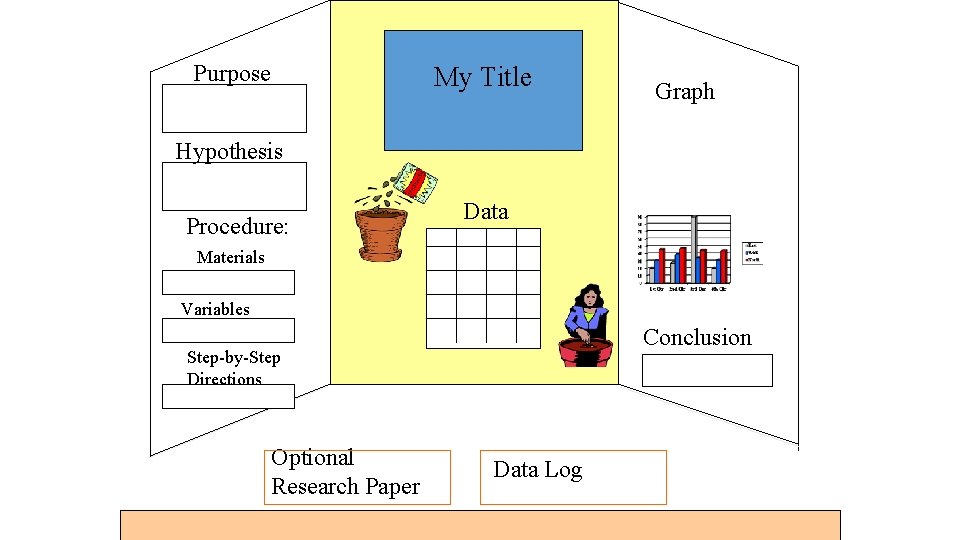
Purpose My Title Graph Hypothesis Procedure: Data Materials Variables Conclusion Step-by-Step Directions Optional Research Paper Data Log
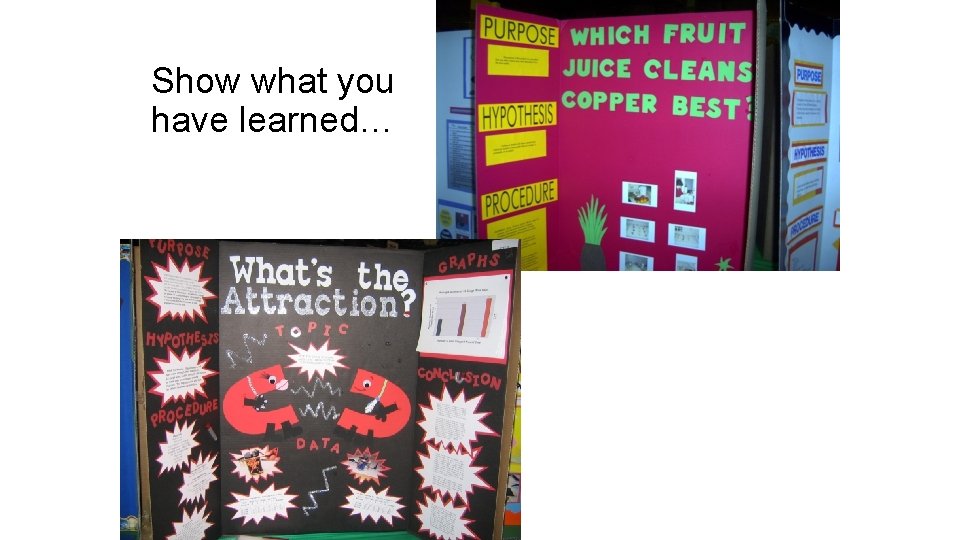
Show what you have learned…
Lesson 14 Oral Presentation Due December 1
Oral Presentation Requirements • Brief (2 -4 minute) synopsis your entire project • You may use notes to speak • You may not have a speech written out • You may use your display to help you • I will be sitting in the back of the room. I need to be able to hear you. You must project your voice when presenting your project.
Include the following information: • Question and Purpose • Important things you discovered while researching that influenced your hypothesis • Hypothesis • Manipulated and Responding Variables • The information you put on your graph • Summary of your conclusion (must include if your hypothesis was correct or incorrect, things you would change if you were to do this experiment again, and real world connections for your project)
- Slides: 51