
Stem cells Learning objectives To understand the embryos
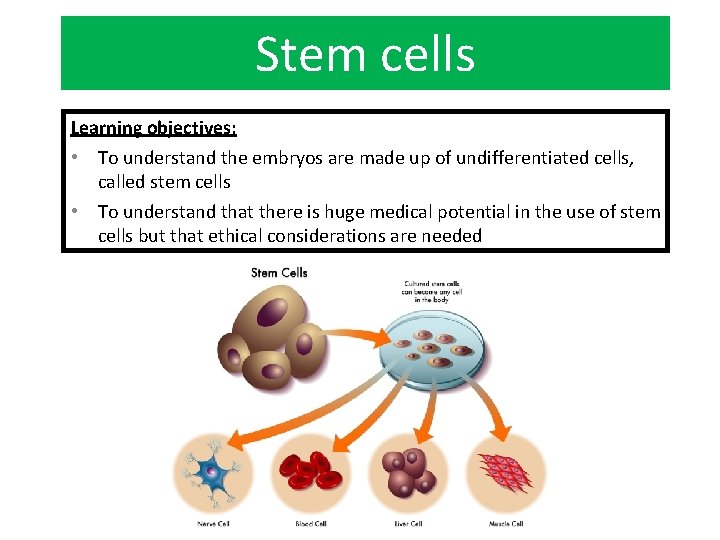
Stem cells Learning objectives: • To understand the embryos are made up of undifferentiated cells, called stem cells • To understand that there is huge medical potential in the use of stem cells but that ethical considerations are needed
Stem cells Paper 2 What are stem cells? Task: Watch video as intro to stem cells and answer video quiz https: //www. youtube. com/watch? v=2 -3 J 6 JGN-_Y
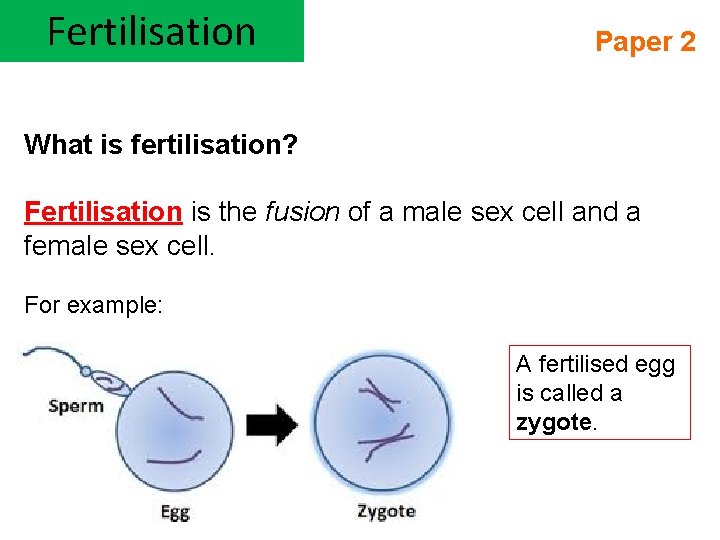
Fertilisation Paper 2 What is fertilisation? Fertilisation is the fusion of a male sex cell and a female sex cell. For example: A fertilised egg is called a zygote.
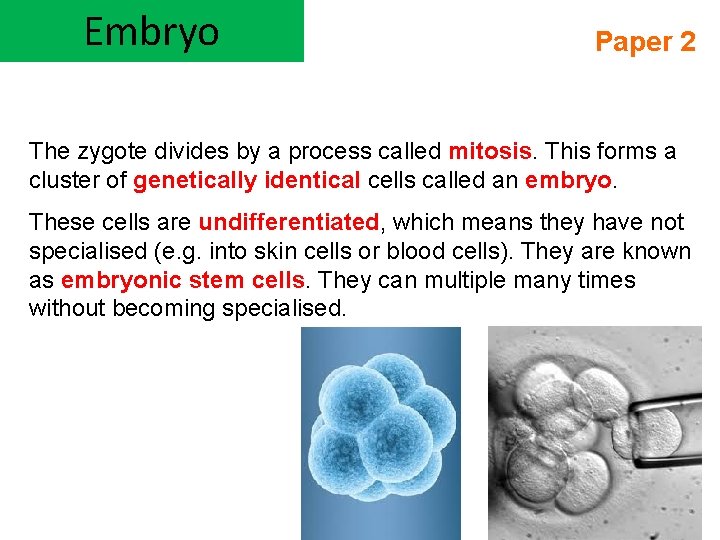
Embryo Paper 2 The zygote divides by a process called mitosis. This forms a cluster of genetically identical cells called an embryo. These cells are undifferentiated, which means they have not specialised (e. g. into skin cells or blood cells). They are known as embryonic stem cells. They can multiple many times without becoming specialised.
Other sources of stem cells Paper 2 Adult stem cells – these can be found in many places in the body. They are also undifferentiated but can only specialise into certain types of cell. For example: Stem cells in the bone marrow – can become red and white blood cells Stem cells in the skin – can become skin cells Stem cells in the liver – can become liver cells
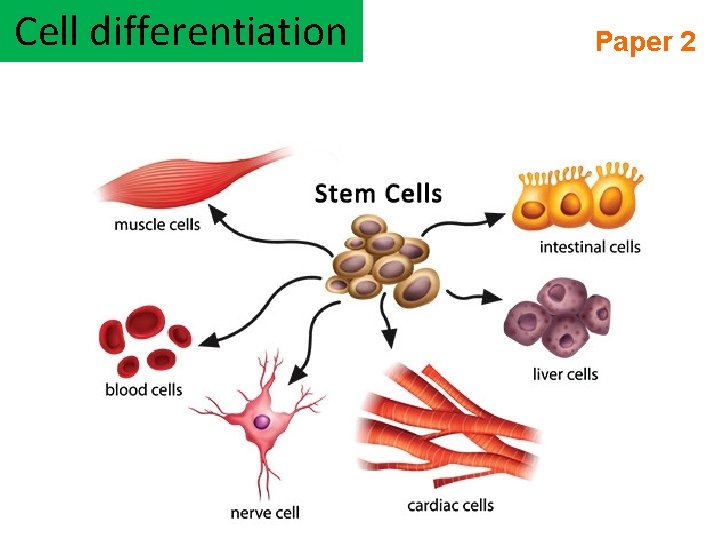
Cell differentiation Paper 2
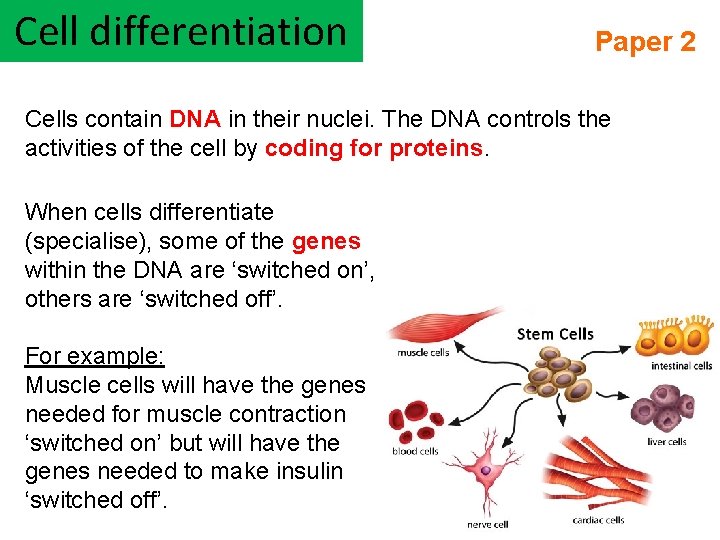
Cell differentiation Paper 2 Cells contain DNA in their nuclei. The DNA controls the activities of the cell by coding for proteins. When cells differentiate (specialise), some of the genes within the DNA are ‘switched on’, others are ‘switched off’. For example: Muscle cells will have the genes needed for muscle contraction ‘switched on’ but will have the genes needed to make insulin ‘switched off’.
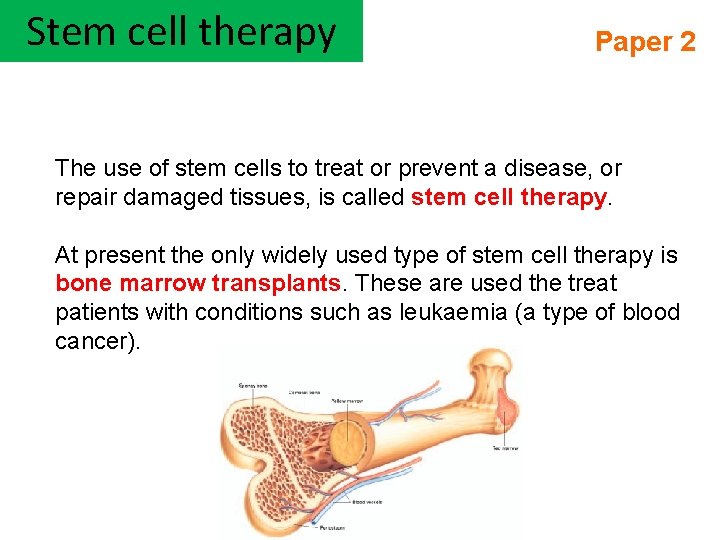
Stem cell therapy Paper 2 The use of stem cells to treat or prevent a disease, or repair damaged tissues, is called stem cell therapy. At present the only widely used type of stem cell therapy is bone marrow transplants. These are used the treat patients with conditions such as leukaemia (a type of blood cancer).
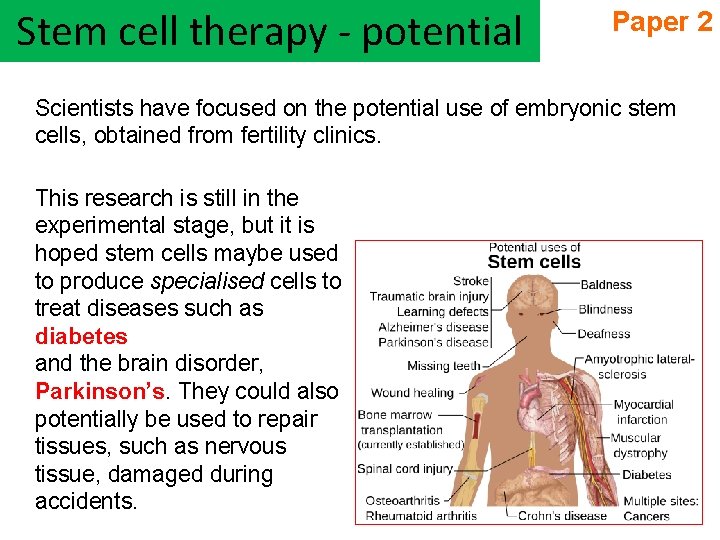
Stem cell therapy - potential Paper 2 Scientists have focused on the potential use of embryonic stem cells, obtained from fertility clinics. This research is still in the experimental stage, but it is hoped stem cells maybe used to produce specialised cells to treat diseases such as diabetes and the brain disorder, Parkinson’s. They could also potentially be used to repair tissues, such as nervous tissue, damaged during accidents.
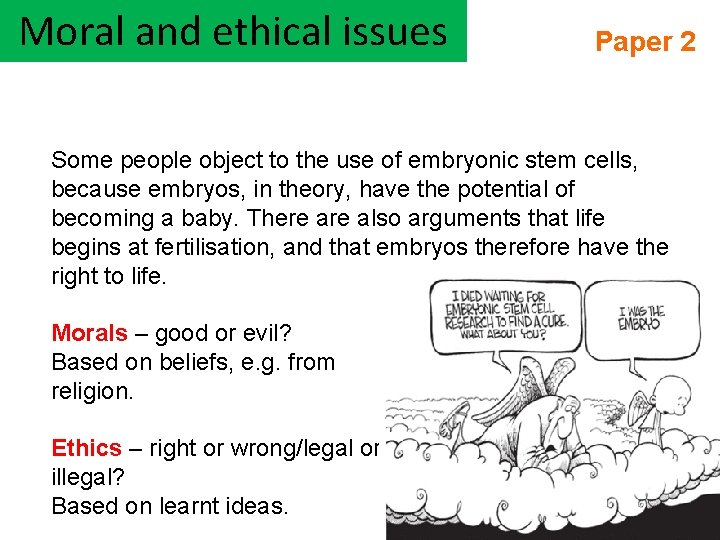
Moral and ethical issues Paper 2 Some people object to the use of embryonic stem cells, because embryos, in theory, have the potential of becoming a baby. There also arguments that life begins at fertilisation, and that embryos therefore have the right to life. Morals – good or evil? Based on beliefs, e. g. from religion. Ethics – right or wrong/legal or illegal? Based on learnt ideas.
Paper 2 Summary – advantages and disadvantages Adult stem cells Embryonic stem cells Disadvantages
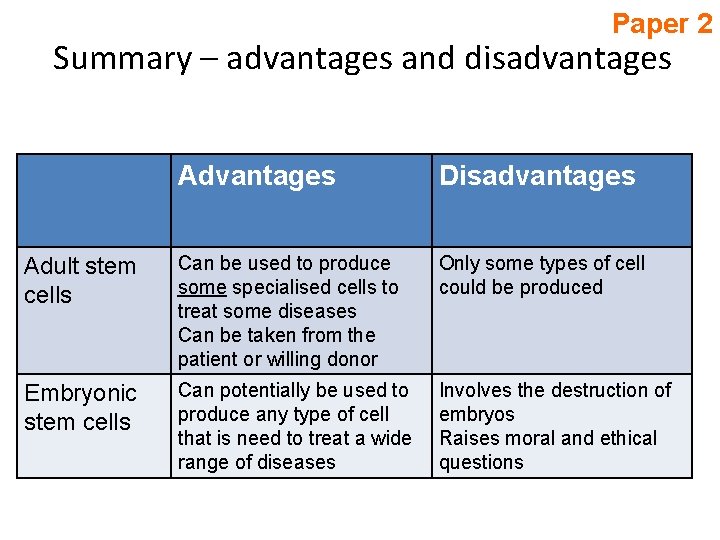
Paper 2 Summary – advantages and disadvantages Advantages Disadvantages Adult stem cells Can be used to produce some specialised cells to treat some diseases Can be taken from the patient or willing donor Only some types of cell could be produced Embryonic stem cells Can potentially be used to produce any type of cell that is need to treat a wide range of diseases Involves the destruction of embryos Raises moral and ethical questions
Thumbs up or down Learning objectives: • To understand the embryos are made up of undifferentiated cells, called stem cells • To understand that there is huge medical potential in the use of stem cells but that ethical considerations are needed
- Slides: 13