
Steller Processes The Jeans Criterion Why do some
- Slides: 18
Steller Processes
The Jeans Criterion Why do some nebulae remain nebulae, but some of them form stars? It’s all about energy. If a nebula is ___________, then the _________ between particles will be _______. The particles will ___________and a star is not likely to form. (KE > PE) If a nebula is ____, then even if it is somewhat dense, the particles will be _______________________ a star is not likely to be formed. (KE > PE)
The Jeans Criterion The ____________ simply states that _____________________, the __________________________________________. So what does this mean? _____________________________
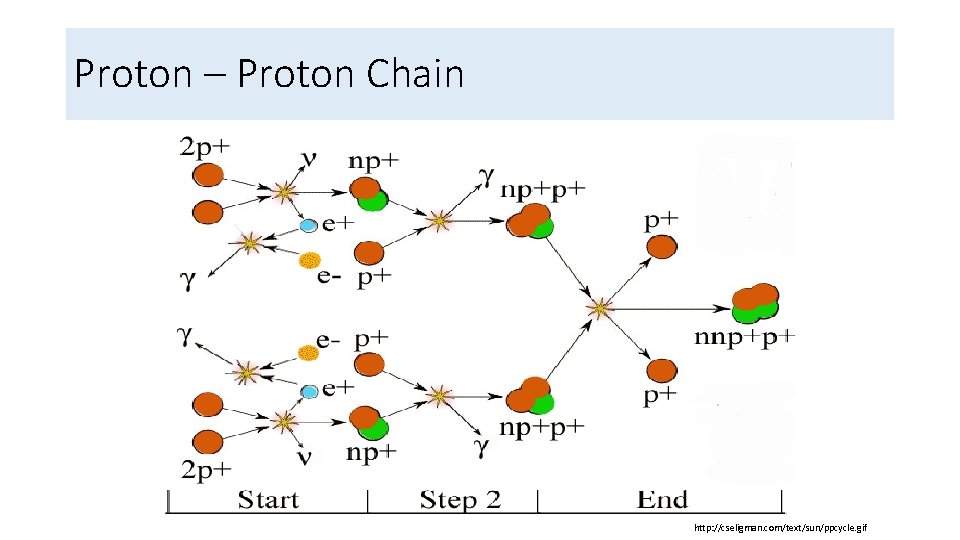
Nuclear Fusion in Stars (Main Sequence) Once force of gravity is strong enough, the _______________________ forming the _______ of the star. This pressure _____________________. When the _____________, the ________ process begins. If the ______ of the star is around the _________, the fusion process will follow the ________________.
Proton – Proton Chain http: //cseligman. com/text/sun/ppcycle. gif
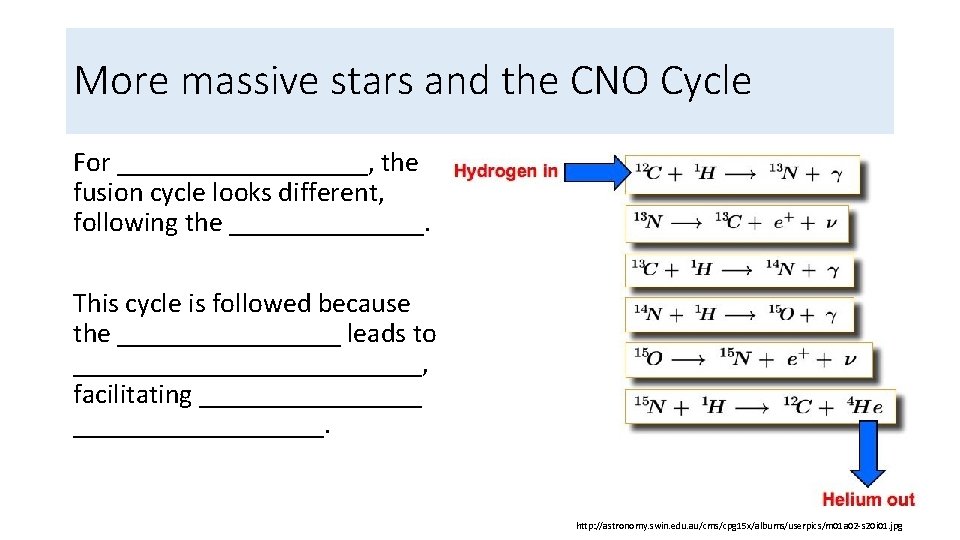
More massive stars and the CNO Cycle For _________, the fusion cycle looks different, following the _______. This cycle is followed because the ________ leads to _____________, facilitating __________________. http: //astronomy. swin. edu. au/cms/cpg 15 x/albums/userpics/m 01 a 02 -s 20 i 01. jpg
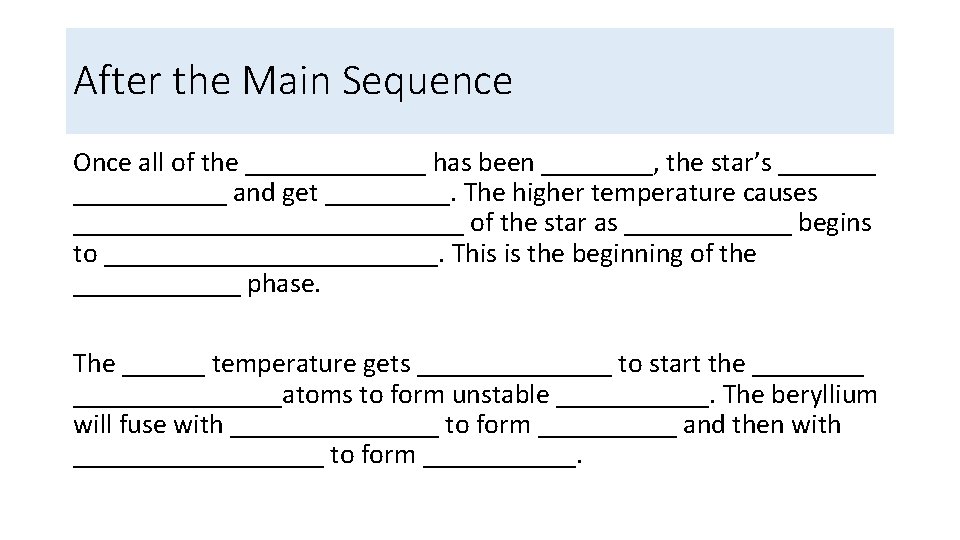
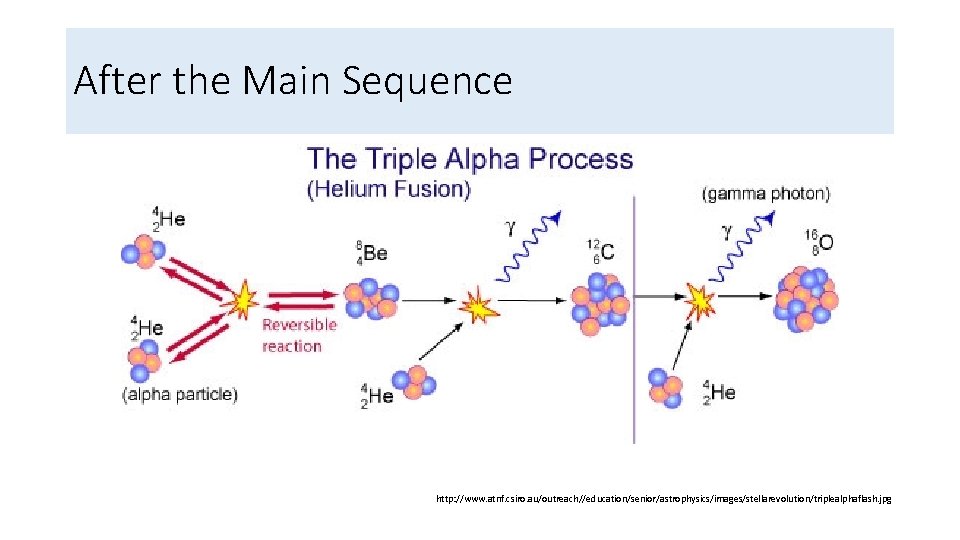
After the Main Sequence Once all of the _______ has been ____, the star’s ___________ and get _____. The higher temperature causes ______________ of the star as ______ begins to ____________. This is the beginning of the ______ phase. The ______ temperature gets _______ to start the _______________atoms to form unstable ______. The beryllium will fuse with ________ to form _____ and then with _________ to form ______.
After the Main Sequence http: //www. atnf. csiro. au/outreach//education/senior/astrophysics/images/stellarevolution/triplealphaflash. jpg
When Will It End? These nucleosynthesis processes will continue with ________ undergoing _____ to form _________________________. As we discussed before, _____ is very _____ and would need to _______ for fusion to occur, instead of releasing energy upon fusion. But there are heavier elements than Iron-56…
Neutron Capture •
S-Process and R-Process In ________, ____________can occur in the very aptly named ______. This is when there is a fairly _______________ and there is ________ to occur ______________________. During a _________, there is a __________. This bombardment of neutrons causes nuclides to undergo ____________________. There is _______________ before more neutrons are added, ______________________. Nuclides heavier than bismuth-209 can be created within minutes!
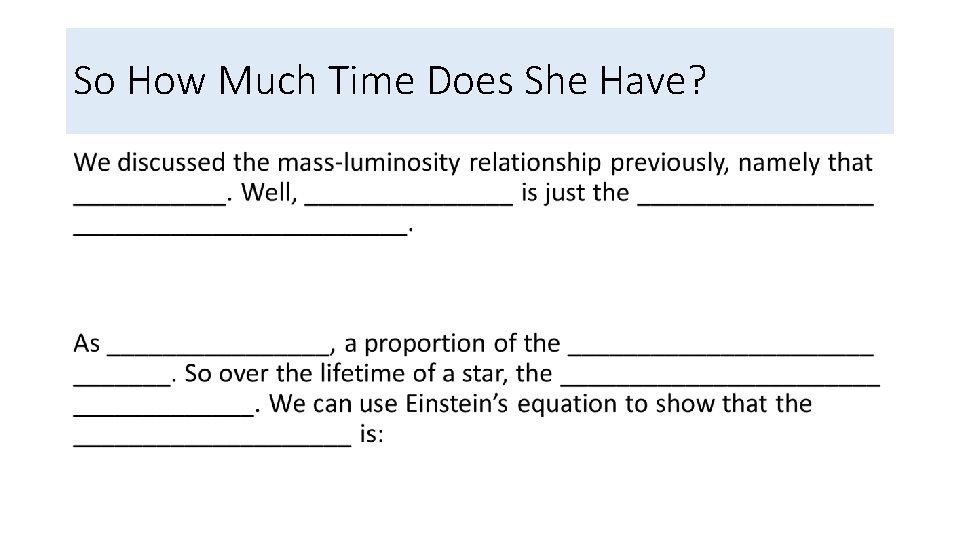
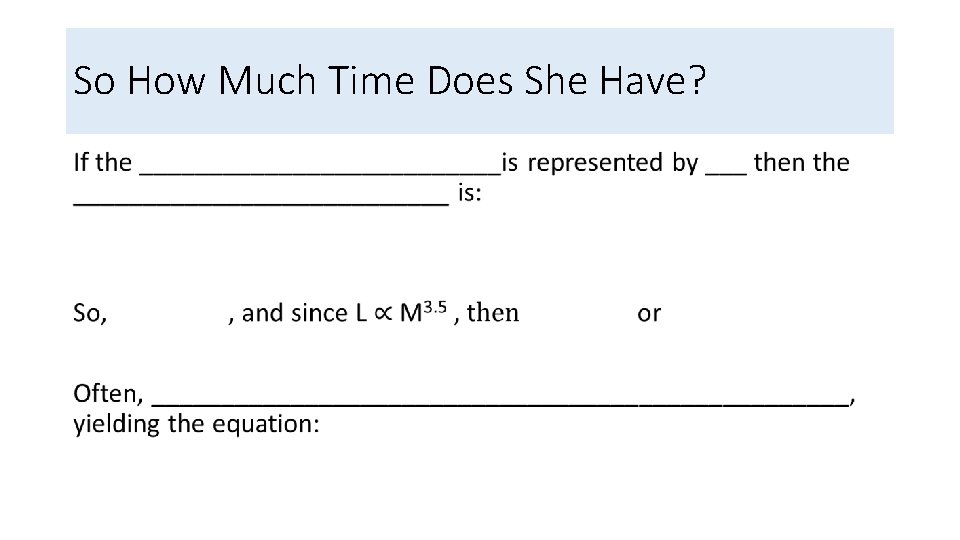
Lifetimes of Main Sequence Stars It would seem to make sense that the larger the star, the longer the star will live (since it has more fuel for fusion). However this is not true. In fact, it is the exact opposite! The ______ requires a ____________ to produce _______ and _________ to ___________________. This ____________ results in the star ___________________ and ______________________.
So How Much Time Does She Have? •
So How Much Time Does She Have? •
Type Ia Supernovae (A Thieving White Dwarf!) •
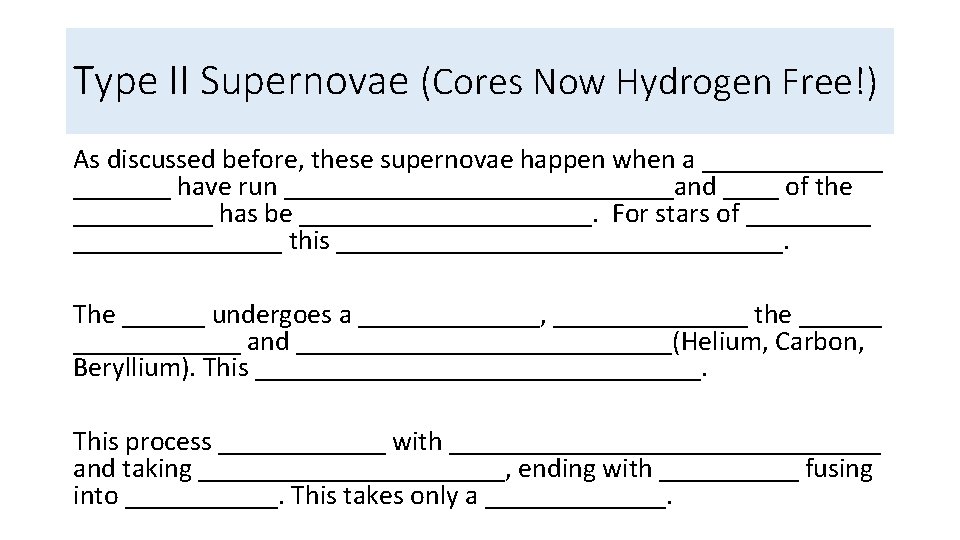
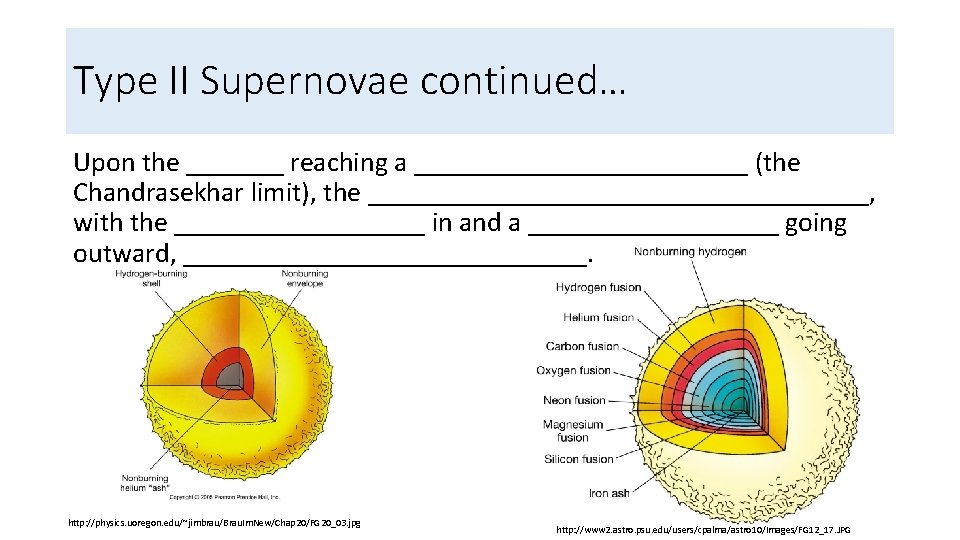
Type II Supernovae (Cores Now Hydrogen Free!) As discussed before, these supernovae happen when a _______ have run ______________and ____ of the _____ has be ___________. For stars of _______________ this ________________. The ______ undergoes a _______, _______ the ____________ and ______________(Helium, Carbon, Beryllium). This ________________. This process ______ with ________________ and taking ___________, ending with _____ fusing into ______. This takes only a _______.
Type II Supernovae continued… Upon the _______ reaching a ____________ (the Chandrasekhar limit), the __________________, with the _________ in and a _________ going outward, _______________. http: //physics. uoregon. edu/~jimbrau/Brau. Im. New/Chap 20/FG 20_03. jpg http: //www 2. astro. psu. edu/users/cpalma/astro 10/Images/FG 12_17. JPG
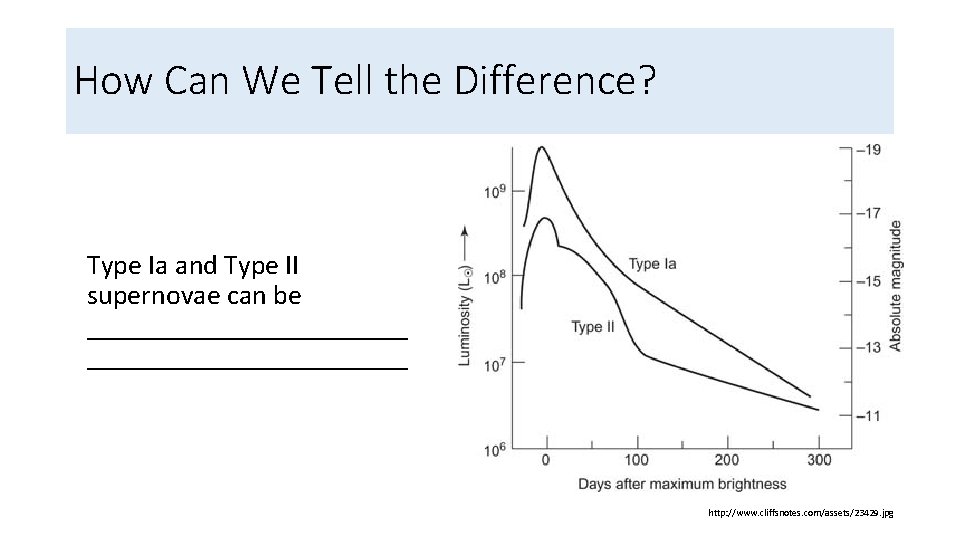
How Can We Tell the Difference? Type Ia and Type II supernovae can be _______________________ http: //www. cliffsnotes. com/assets/23429. jpg