
Stellar Structure Section 6 Introduction to Stellar Evolution

- Slides: 11
Stellar Structure Section 6: Introduction to Stellar Evolution Lecture 16 – Evolution of core after S-C instability Formation of red giant Evolution up giant branch He ignition (low-mass stars: He flash) Asymptotic giant branch Double-shell source stars Thermal pulsing and mixing Evolution beyond He-burning
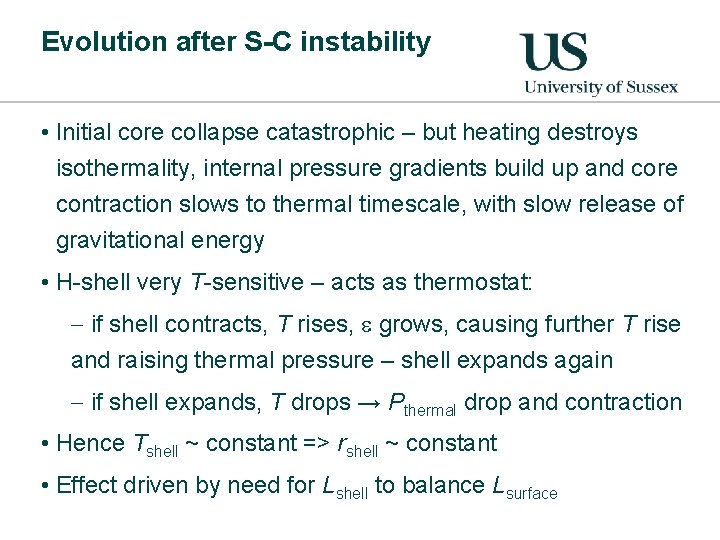
Evolution after S-C instability • Initial core collapse catastrophic – but heating destroys isothermality, internal pressure gradients build up and core contraction slows to thermal timescale, with slow release of gravitational energy • H-shell very T-sensitive – acts as thermostat: - if shell contracts, T rises, grows, causing further T rise and raising thermal pressure – shell expands again - if shell expands, T drops → Pthermal drop and contraction • Hence Tshell ~ constant => rshell ~ constant • Effect driven by need for Lshell to balance Lsurface
Consequence of constant shell radius • Shell radius ‘wants’ to be constant • But core inside it is contracting • This requires the envelope to expand, to compensate – star becomes a giant • L ~ constant (at Lshell), and L R 2 Teff 4, so Teff drops as star expands – becomes red giant Expansion on thermal timescale, implies evolution across HR diagram very fast: accounts for Hertzsprung gap
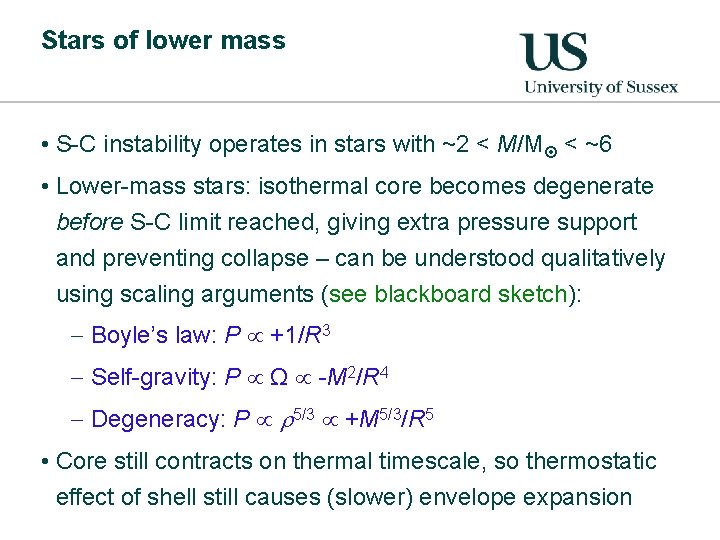
Stars of lower mass • S-C instability operates in stars with ~2 < M/M < ~6 • Lower-mass stars: isothermal core becomes degenerate before S-C limit reached, giving extra pressure support and preventing collapse – can be understood qualitatively using scaling arguments (see blackboard sketch): - Boyle’s law: P +1/R 3 - Self-gravity: P Ω -M 2/R 4 - Degeneracy: P 5/3 +M 5/3/R 5 • Core still contracts on thermal timescale, so thermostatic effect of shell still causes (slower) envelope expansion
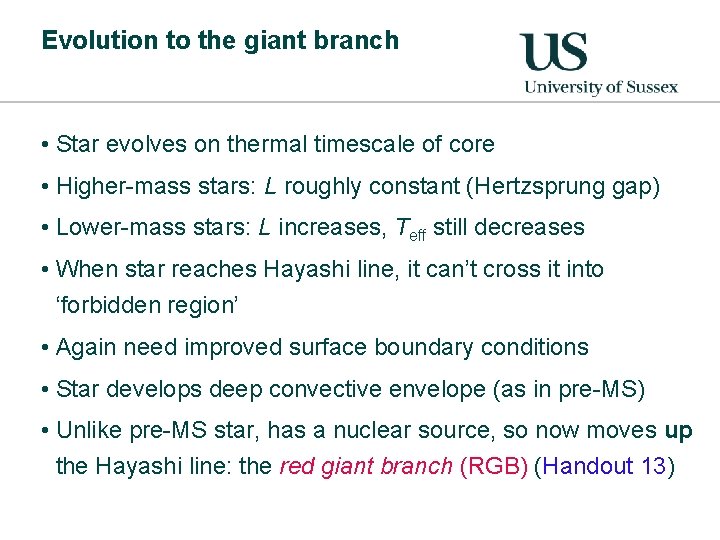
Evolution to the giant branch • Star evolves on thermal timescale of core • Higher-mass stars: L roughly constant (Hertzsprung gap) • Lower-mass stars: L increases, Teff still decreases • When star reaches Hayashi line, it can’t cross it into ‘forbidden region’ • Again need improved surface boundary conditions • Star develops deep convective envelope (as in pre-MS) • Unlike pre-MS star, has a nuclear source, so now moves up the Hayashi line: the red giant branch (RGB) (Handout 13)
Evolution up the giant branch • Core shrinks, T rises until He can burn • He ignition depends strongly on mass: - M > 2. 3 M : core still ideal gas, ignition occurs quietly, at centre; H-burning continues in shell; star stops climbing RGB - M < 2. 3 M : core has become degenerate, and ignition is explosive (see blackboard) – helium flash • Post He-flash: T rises fast until Pion ~ Pel, then Ptot rises, core expands and cools, settles to steady burning • Star survives explosion, but moves rapidly in HR diagram from top of RGB to horizontal branch – see blackboard sketch
He burning and after • Steady core He burning, star in equilibrium, as on MS • Timescale for He-burning much shorter than for H-burning, because burning rate much faster • After He exhausted at centre (Yc = 0), all stars climb giant branch again, approaching it asymptotically from somewhat higher temperatures: Asymptotic Giant Branch (AGB) • Detailed behaviour depends on mass (Handout 14) • Shell burning continues on AGB, both He and H: doubleshell source stars
Thermal pulses and mixing • Shell burning thermally unstable → burning alternating between H and He shells (discovered numerically ~1965) • Instability causes - thermal pulses of luminosity - mixing of processed material to surface (convective envelope outside H shell, plus convection between shells) • Processed material seen in observations - Excess of C: ‘carbon stars’, with C/O ~ 2 -5 (MS: ~0. 5) - Isotope anomalies: 12 C/13 C ~ 10 -20 (solar system ~90; CNO cycle in equilibrium ~4) • Later evolution depends crucially on core mass
Post-He-burning – 1 (no WD remnant) Main Sequence mass > 8 M • Nuclear burning continues beyond C, mainly by addition of He nuclei to form O, Ne, Mg, Si etc, as far as Fe: limit of ‘free’ energy • Core partially supported by degenerate electrons – some electrons in high-energy states may be captured by Ne or Mg nuclei • Pressure drops, core cannot support itself, collapses catastrophically (timescale: 10 s of milliseconds!) to nuclear densities, and bounces, leading to outward-travelling shock wave • Shock also accelerated by pressure of neutrinos, produced in explosive nucleosynthesis generated by energy of collapse • Leads to ejection of outer layers (~90% of mass of star) – Type II supernova (may leave compact core → NS or BH – see later)
Explosive nucleosynthesis (formation of elements heavier than iron) • Very high densities favour neutronisation: e- + p+ → n + (Normally, neutron is unstable, timescale ~900 s) • Neutrino flux helps to accelerate shock • Neutron flux allows rapid neutron addition to Fe and heavier elements, forming n-rich nuclei • Addition very fast compared to -decay timescale – elements produced called r-process elements (r for rapid) – seen in supernova remnants • (AGB evolution: much smaller neutron flux available, n-addition occurs on timescale long compared to -decay timescale – forms n-poor nuclei by s-process (s for slow) – s-process elements seen in atmospheres of red giants and supergiants)
Post-He-burning – 2 (produces WD) Main Sequence mass < 8 M • Neutrino processes cool centre, inhibiting C ignition (needs T ~ 5 108 K) • Degenerate core: - pure helium (low initial mass) - He, C, O mixture (higher initial mass) • On AGB, substantial mass loss by stellar winds (and possibly thermal pulses) – helps to prevent core heating to C ignition • Finally, a “superwind” (observed, not understood) ejects entire outer envelope as coherent shell, revealing hot interior • Hot remnant ionizes shell → planetary nebula • Star then cools and fades → white dwarf star (Handout 15)