
Stellar Structure Section 3 Energy Balance Lecture 5
Stellar Structure Section 3: Energy Balance Lecture 5 – Where do time derivatives matter? (part 1) Time-dependent energy equation Adiabatic changes
Do we need other time derivatives? • Simple treatment of evolution – only time dependence is in nuclear reaction network. • Don’t expect time dependence in mass conservation or radiative energy transfer equations • Time derivative in hydrostatic equation only matters if changes occurring on dynamical timescale – ignore otherwise • Will need to include time derivatives in energy production equation if star changes on thermal or Kelvin-Helmholtz timescales (comparable because from virial theorem U = -Ω/2 => Eth ≈ Egrav) – happens between nuclear burning stages
Generalisation of energy equation • Need to use thermodynamics • Consider change in entropy of a small mass element, relate it to heat supplied to the element, and apply to the energy equation – this gives an expression for the rate of change of entropy at fixed mass (see blackboard) • Use first law of thermodynamics to relate entropy to thermal energy and pressure, and hence derive time-dependent form of energy equation (see blackboard) • Original equation is true either if there is no variation with time or if the changes are adiabatic (see blackboard): d. Q/dt = 0.
Stellar Structure Section 4: Structure of Stars Lecture 5 – Approximation for pressure (part 2) Power laws for opacity, energy generation Resulting set of structure equations Homologous solutions – formal treatment Derivation of M-L(-R) relation
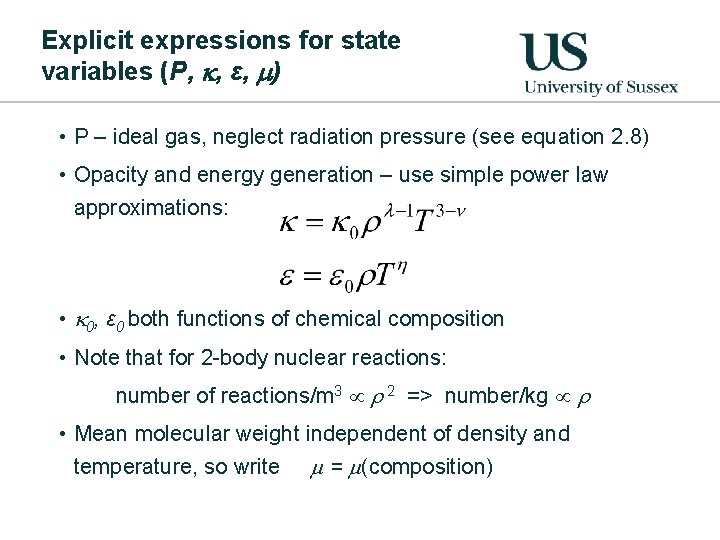
Explicit expressions for state variables (P, , ε, ) • P – ideal gas, neglect radiation pressure (see equation 2. 8) • Opacity and energy generation – use simple power law approximations: • 0, ε 0 both functions of chemical composition • Note that for 2 -body nuclear reactions: number of reactions/m 3 2 => number/kg • Mean molecular weight independent of density and temperature, so write = (composition)
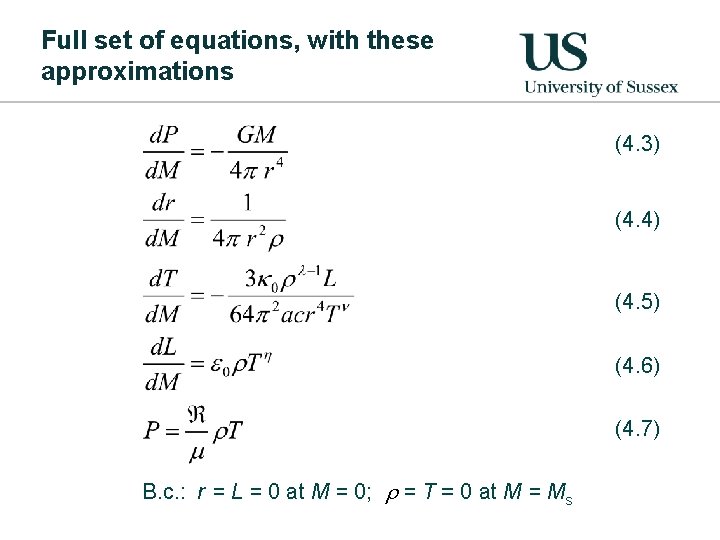
Full set of equations, with these approximations (4. 3) (4. 4) (4. 5) (4. 6) (4. 7) B. c. : r = L = 0 at M = 0; = T = 0 at M = Ms
Homologous solutions • A set of model stars of different mass are said to be homologous if the whole set can be derived from a model for one mass by a simple scaling procedure. • This requires the composition to be the same function of fractional mass for all the stars, i. e. (schematically): composition = c(m), the same for all stars, where m ≡ M/Ms is the fractional mass. • In a homologous set of models, the shapes of the various functions (density, pressure, …), as a function of fractional mass, are independent of the mass of the star (see sketch).
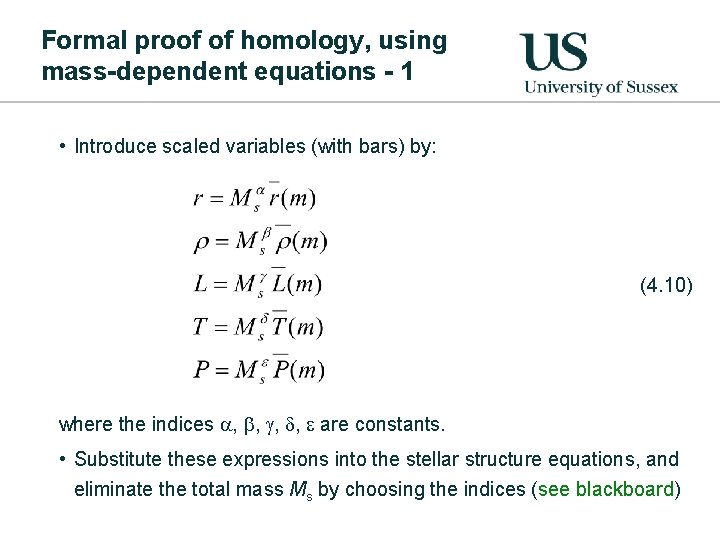
Formal proof of homology, using mass-dependent equations - 1 • Introduce scaled variables (with bars) by: (4. 10) where the indices , , are constants. • Substitute these expressions into the stellar structure equations, and eliminate the total mass Ms by choosing the indices (see blackboard)
Formal proof of homology, using mass-dependent equations - 2 • Eliminating the total mass from the structure equations leads to 5 equations for the 5 indices (see blackboard) • It also leads to 5 structure equations for the barred variables, that are functions of m alone (see blackboard) • The boundary conditions are also independent of the total mass (see blackboard) – but only because of the simple zero boundary conditions at the surface. If density and temperature were non-zero, they would need to scale in the same way with mass, which would introduce an extra, incompatible, constraint. • One solution of the equations for the barred variables, plus the scaling relations, gives a solution for any choice of the total mass – a big saving in effort.
Use of homologous solutions to find mass-luminosity(-radius) relation • Even without knowing the energy generation law (i. e. without having a value for ), can find one important result. • Solve 4 equations without for , , , in terms of . • For luminosity exponent, find: = (3 - ) + - 1 - . (4. 14) • Now use scaling relations (4. 10) at the stellar surface, m = 1, to find expressions for the total radius and luminosity of the star in terms of the total mass (see blackboard). • Use (4. 14) to eliminate and give a relation between the total luminosity, total mass and total radius (see blackboard). • How does this compare with observation? Next lecture!
- Slides: 10