
Stellar Structure Fundamental Astrophysics Stars A star is
- Slides: 39
Stellar Structure Fundamental Astrophysics
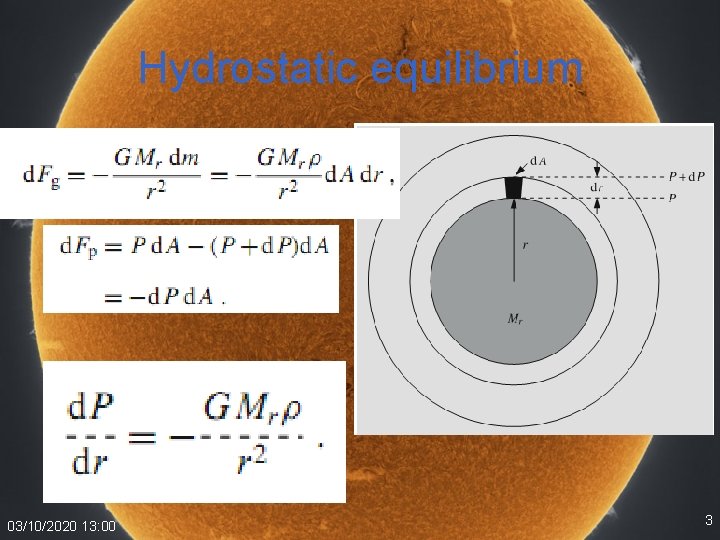
Stars • A star is a giant gas ball at very high temperature. • The stellar energy is generated in its interior. • Th pressure produced by the energy released in the inner regions pushes the gas outwards. • Gravity pulls gas towards the centre. • Let’s calculate the equations goverging this equilibrium of forces: 03/10/2020 13: 00 2
Hydrostatic equilibrium 03/10/2020 13: 00 3
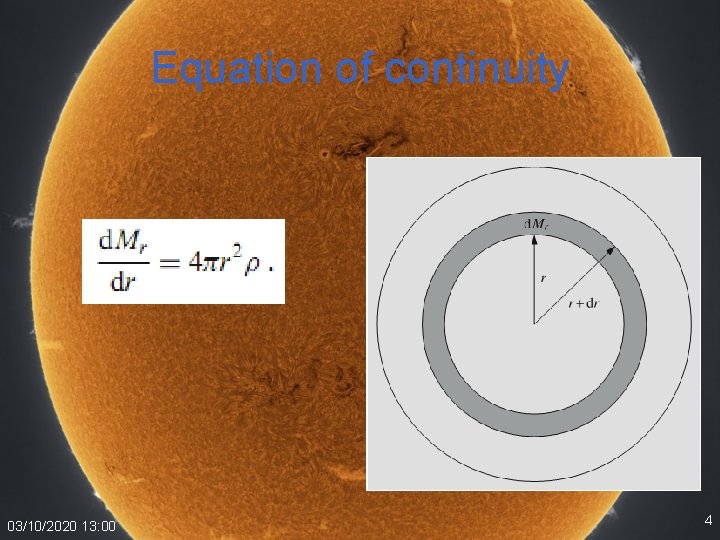
Equation of continuity 03/10/2020 13: 00 4
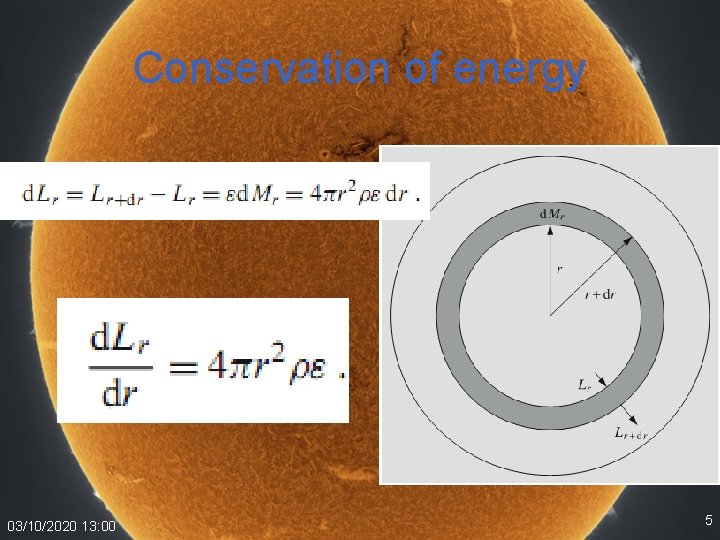
Conservation of energy 03/10/2020 13: 00 5
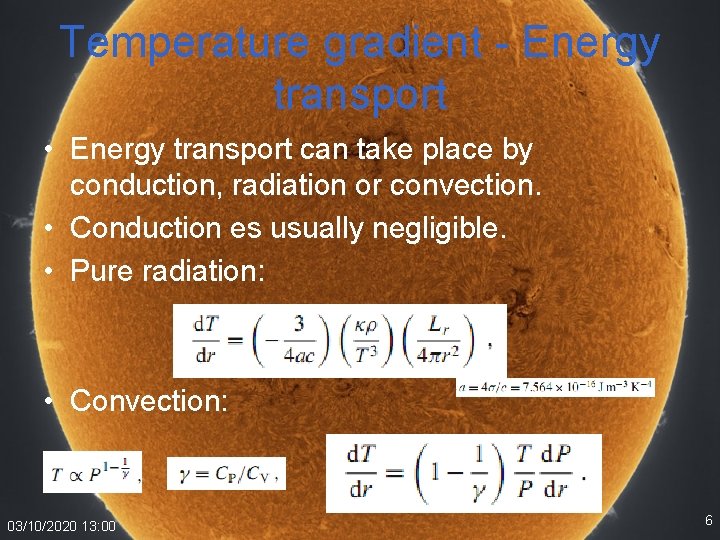
Temperature gradient - Energy transport • Energy transport can take place by conduction, radiation or convection. • Conduction es usually negligible. • Pure radiation: • Convection: 03/10/2020 13: 00 6
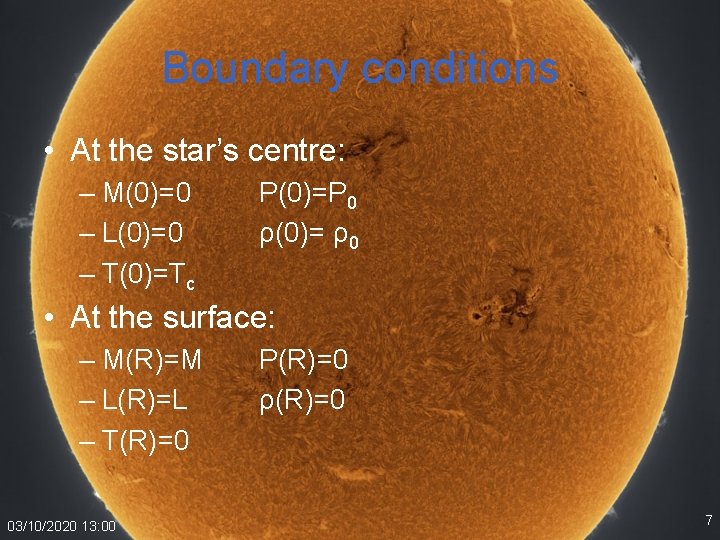
Boundary conditions • At the star’s centre: – M(0)=0 – L(0)=0 – T(0)=Tc P(0)=P 0 ρ(0)= ρ0 • At the surface: – M(R)=M – L(R)=L – T(R)=0 03/10/2020 13: 00 P(R)=0 ρ(R)=0 7
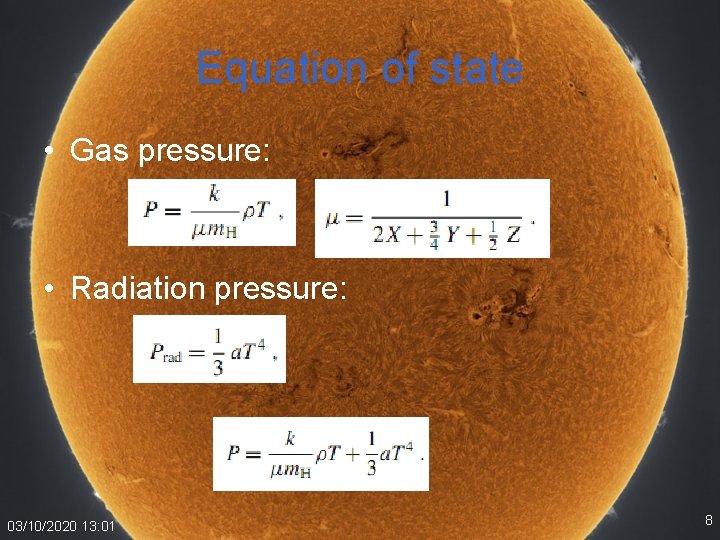
Equation of state • Gas pressure: • Radiation pressure: 03/10/2020 13: 01 8
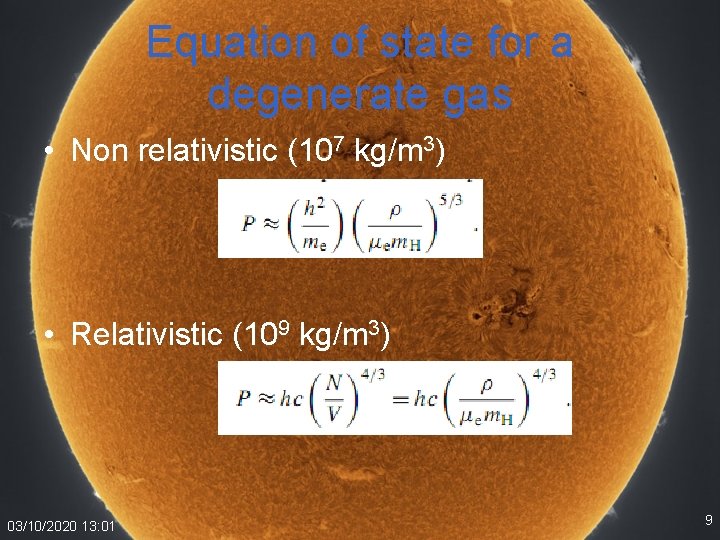
Equation of state for a degenerate gas • Non relativistic (107 kg/m 3) • Relativistic (109 kg/m 3) 03/10/2020 13: 01 9
Energy production in stars • Gravitational contraction was originally proposed as the energy source It would not last enough at the necessary rate. • Earl universe was composed mostly of H, some He, and traces of light elements (Li, Be, …). • Heavier elements originate in stellar interiors Thermonuclear fusion. 03/10/2020 13: 01 10
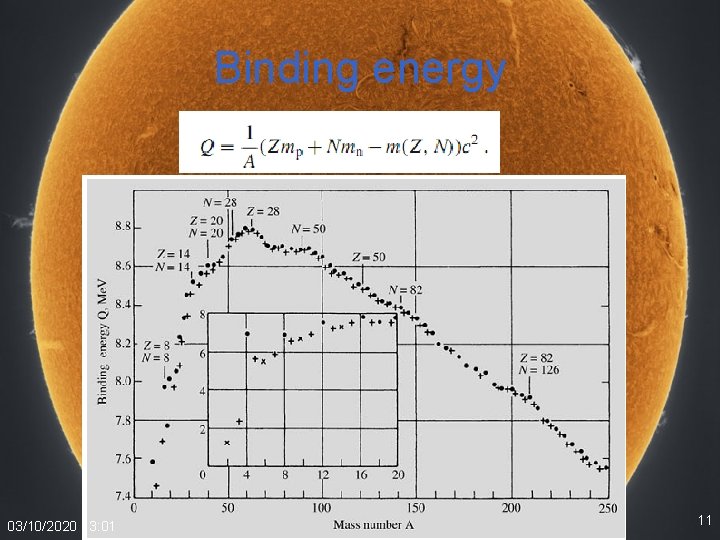
Binding energy 03/10/2020 13: 01 11
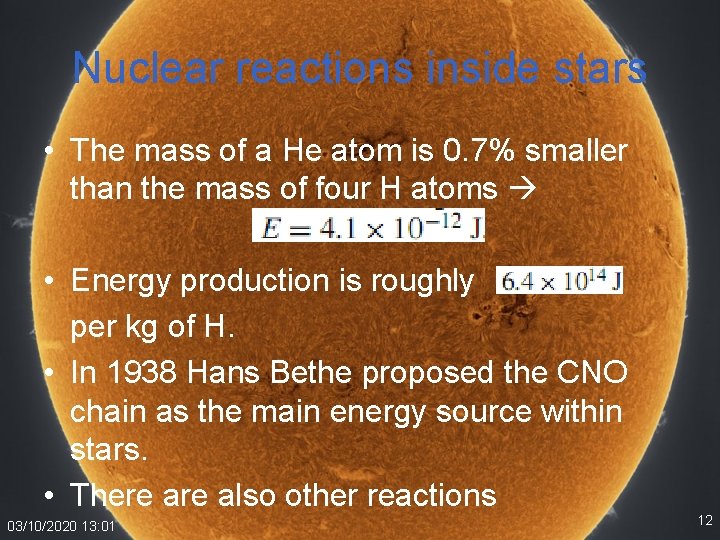
Nuclear reactions inside stars • The mass of a He atom is 0. 7% smaller than the mass of four H atoms • Energy production is roughly per kg of H. • In 1938 Hans Bethe proposed the CNO chain as the main energy source within stars. • There also other reactions 03/10/2020 13: 01 12
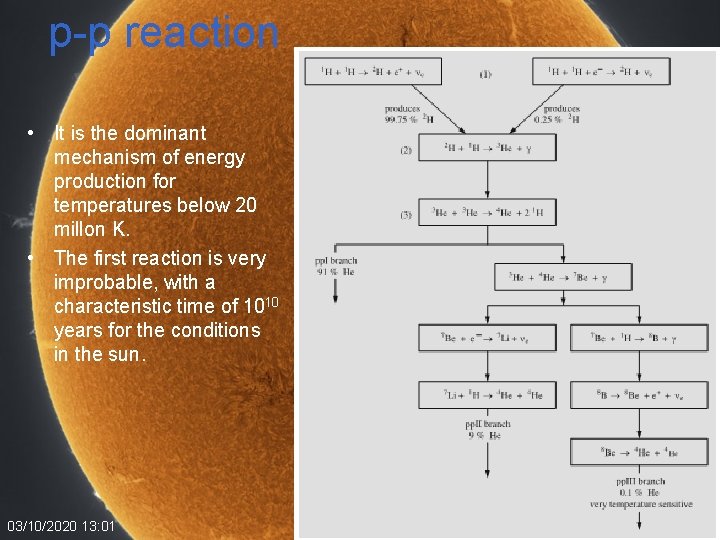
p-p reaction • It is the dominant mechanism of energy production for temperatures below 20 millon K. • The first reaction is very improbable, with a characteristic time of 1010 years for the conditions in the sun. 03/10/2020 13: 01 13
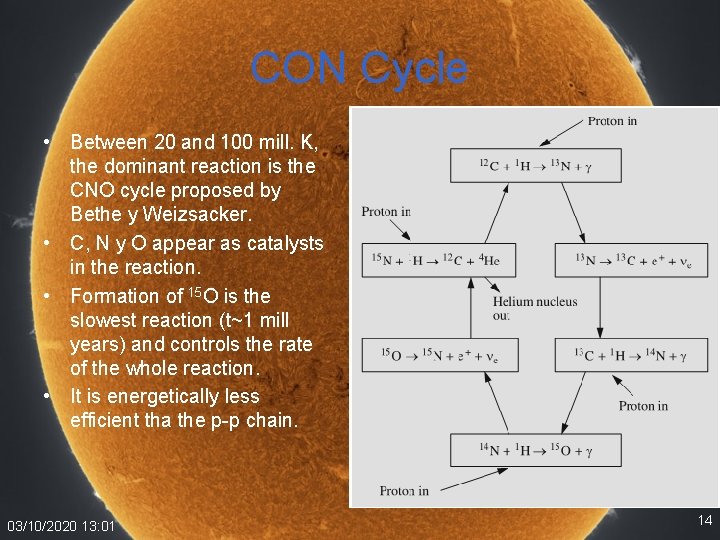
CON Cycle • Between 20 and 100 mill. K, the dominant reaction is the CNO cycle proposed by Bethe y Weizsacker. • C, N y O appear as catalysts in the reaction. • Formation of 15 O is the slowest reaction (t~1 mill years) and controls the rate of the whole reaction. • It is energetically less efficient tha the p-p chain. 03/10/2020 13: 01 14
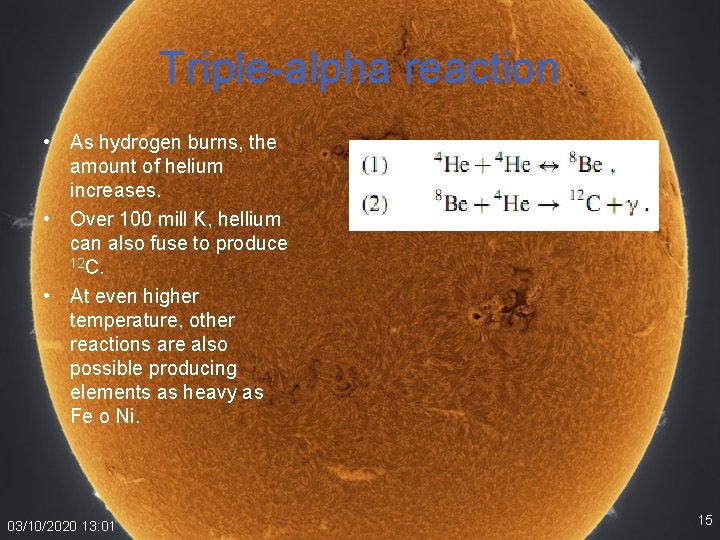
Triple-alpha reaction • As hydrogen burns, the amount of helium increases. • Over 100 mill K, hellium can also fuse to produce 12 C. • At even higher temperature, other reactions are also possible producing elements as heavy as Fe o Ni. 03/10/2020 13: 01 15
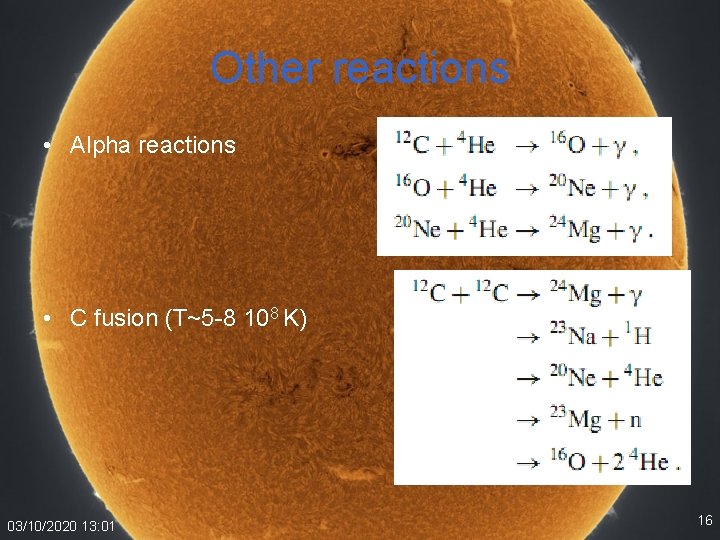
Other reactions • Alpha reactions • C fusion (T~5 -8 108 K) 03/10/2020 13: 01 16
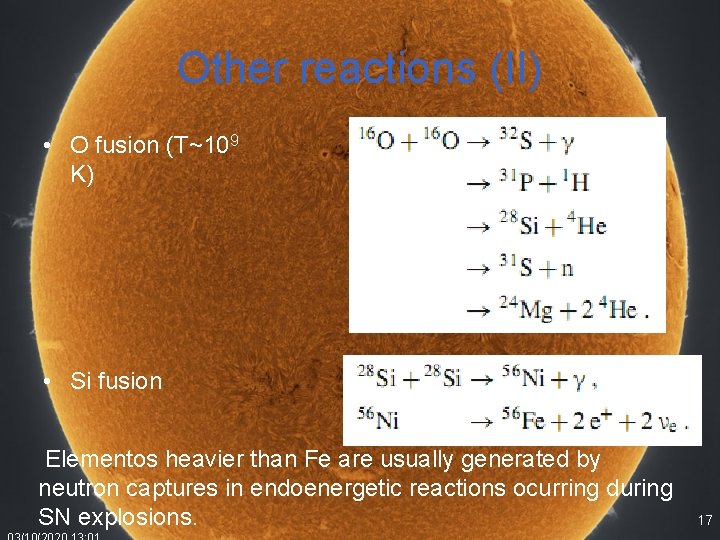
Other reactions (II) • O fusion (T~109 K) • Si fusion Elementos heavier than Fe are usually generated by neutron captures in endoenergetic reactions ocurring during SN explosions. 17
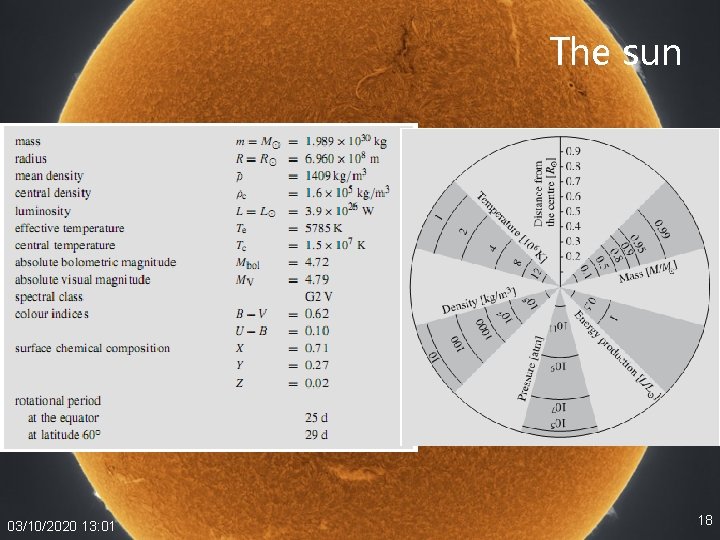
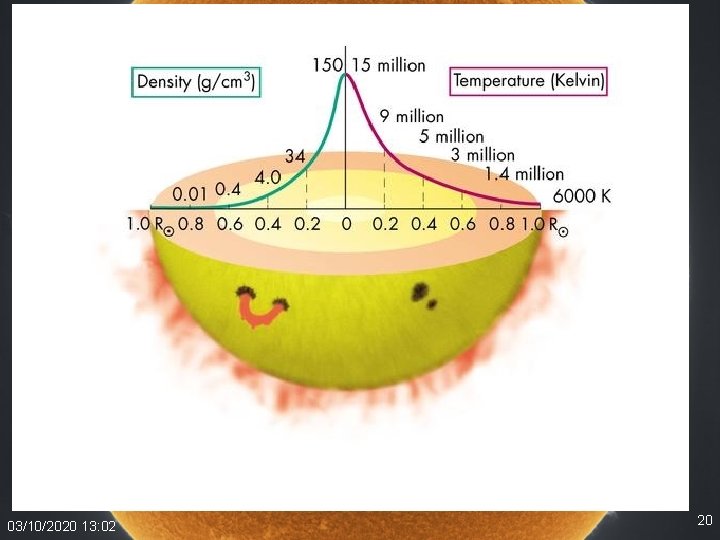
The sun 03/10/2020 13: 01 18
03/10/2020 13: 02 19
03/10/2020 13: 02 20
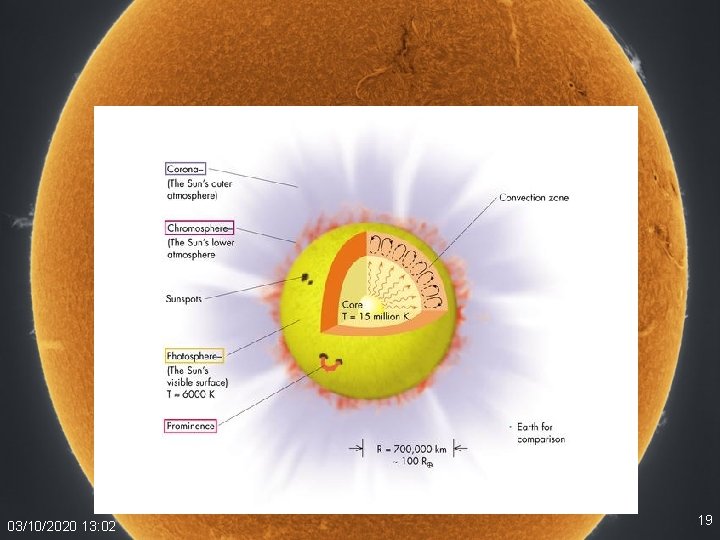
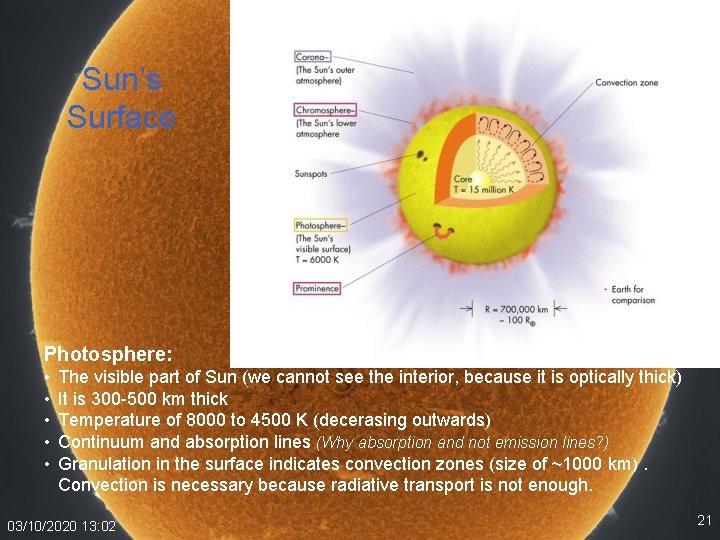
Sun’s Surface Photosphere: • • • The visible part of Sun (we cannot see the interior, because it is optically thick) It is 300 -500 km thick Temperature of 8000 to 4500 K (decerasing outwards) Continuum and absorption lines (Why absorption and not emission lines? ) Granulation in the surface indicates convection zones (size of ~1000 km). Convection is necessary because radiative transport is not enough. 03/10/2020 13: 02 21
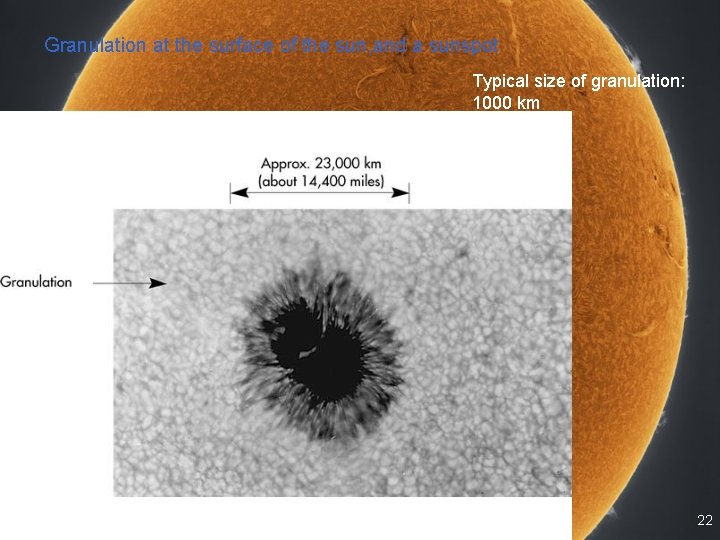
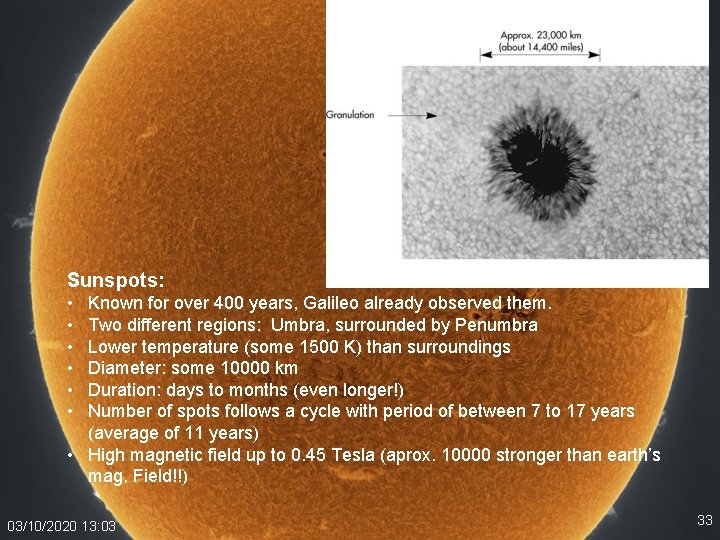
Granulation at the surface of the sun, and a sunspot Typical size of granulation: 1000 km 03/10/2020 13: 02 22
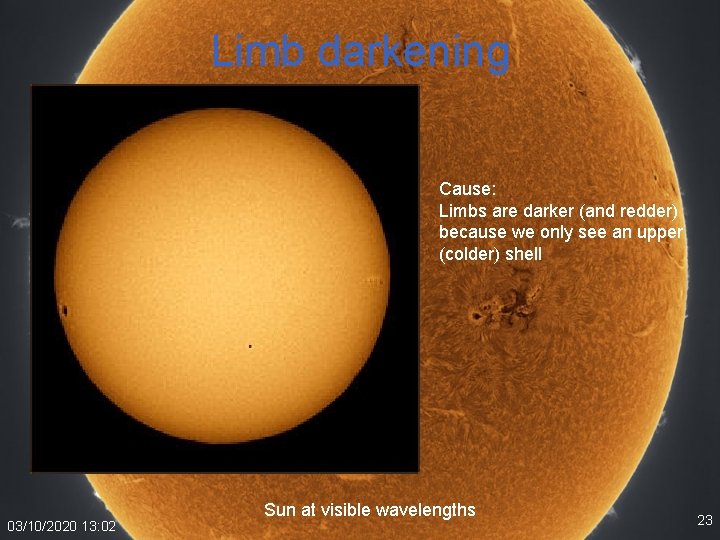
Limb darkening Cause: Limbs are darker (and redder) because we only see an upper (colder) shell 03/10/2020 13: 02 Sun at visible wavelengths 23
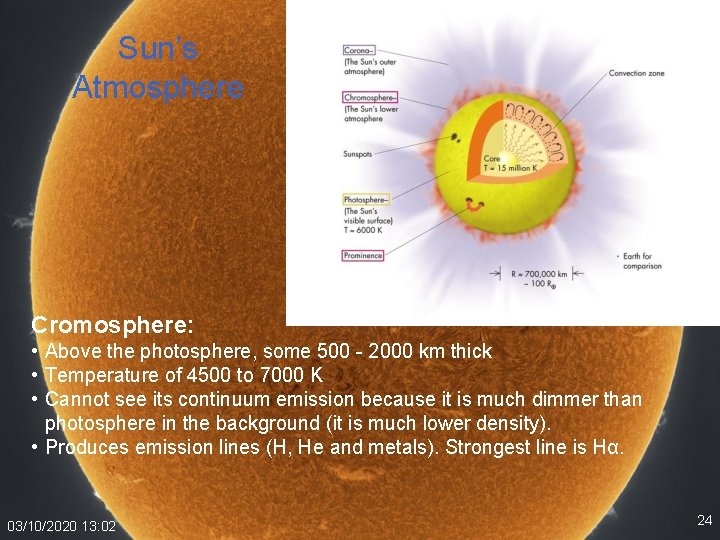
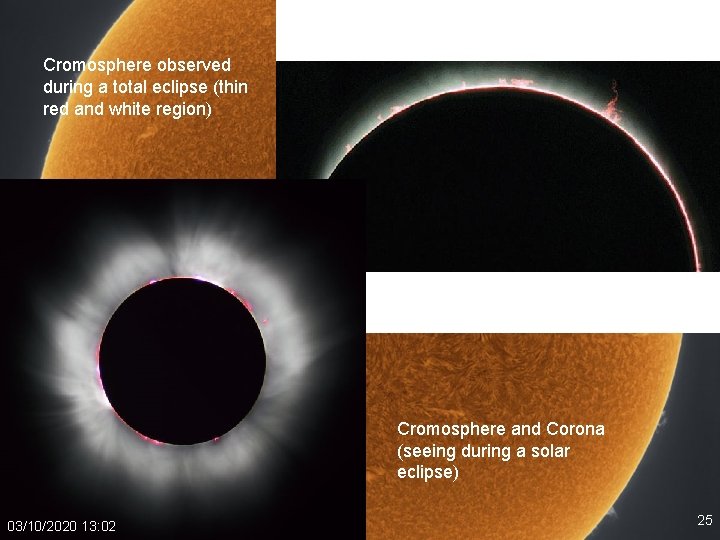
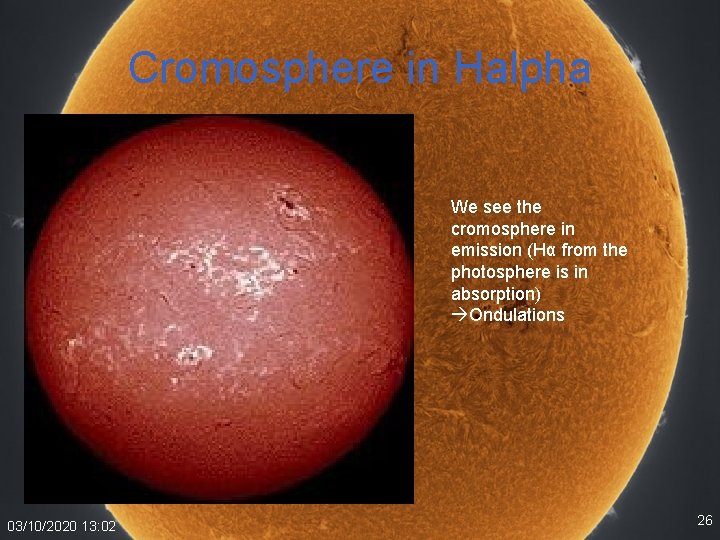
Sun’s Atmosphere Cromosphere: • Above the photosphere, some 500 - 2000 km thick • Temperature of 4500 to 7000 K • Cannot see its continuum emission because it is much dimmer than photosphere in the background (it is much lower density). • Produces emission lines (H, He and metals). Strongest line is Hα. 03/10/2020 13: 02 24
Cromosphere observed during a total eclipse (thin red and white region) Cromosphere and Corona (seeing during a solar eclipse) 03/10/2020 13: 02 25
Cromosphere in Halpha We see the cromosphere in emission (Hα from the photosphere is in absorption) Ondulations 03/10/2020 13: 02 26
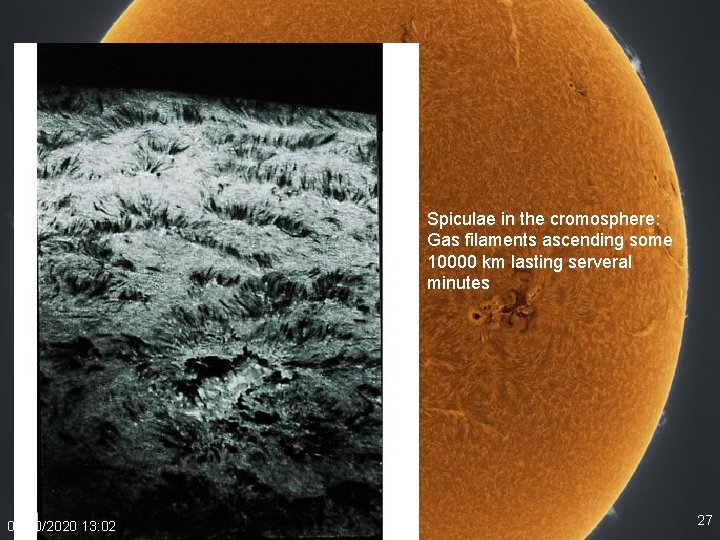
Spiculae in the cromosphere: Gas filaments ascending some 10000 km lasting serveral minutes 03/10/2020 13: 02 27
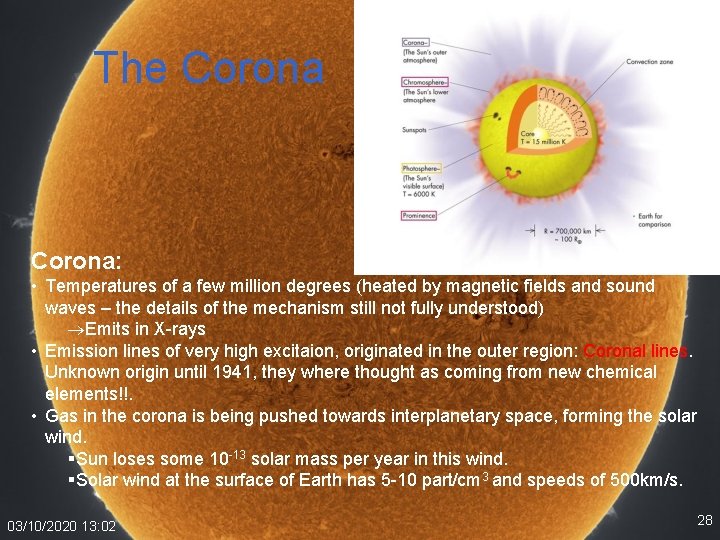
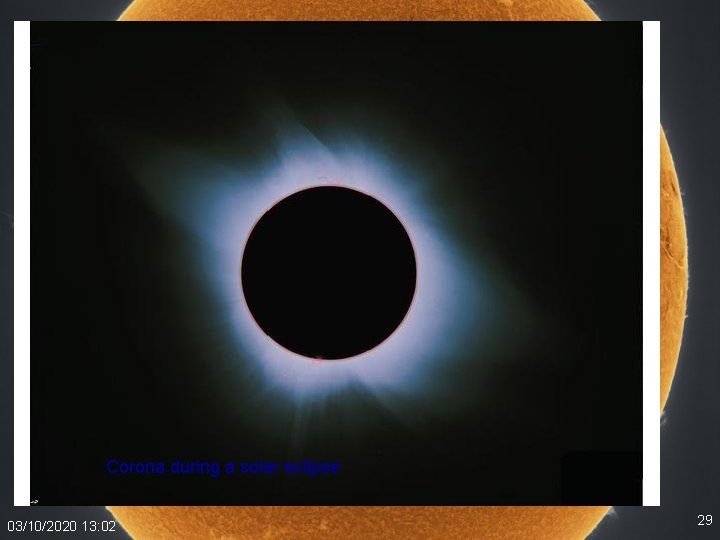
The Corona: • Temperatures of a few million degrees (heated by magnetic fields and sound waves – the details of the mechanism still not fully understood) Emits in X-rays • Emission lines of very high excitaion, originated in the outer region: Coronal lines. Unknown origin until 1941, they where thought as coming from new chemical elements!!. • Gas in the corona is being pushed towards interplanetary space, forming the solar wind. §Sun loses some 10 -13 solar mass per year in this wind. §Solar wind at the surface of Earth has 5 -10 part/cm 3 and speeds of 500 km/s. 03/10/2020 13: 02 28
Corona during a solar eclipse 03/10/2020 13: 02 29
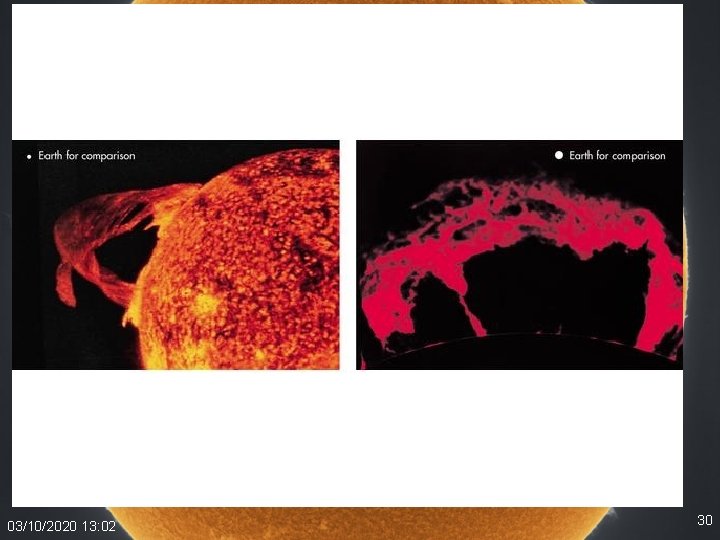
Protuberancias solares 03/10/2020 13: 02 30
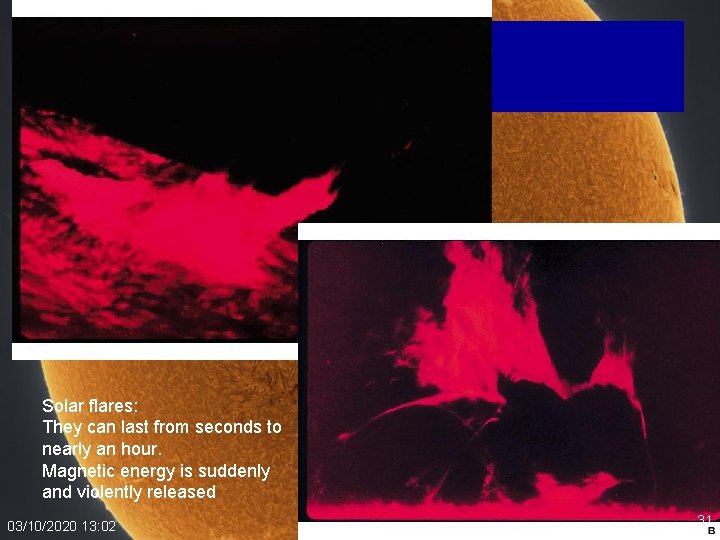
Solar flares: They can last from seconds to nearly an hour. Magnetic energy is suddenly and violently released 03/10/2020 13: 02 31
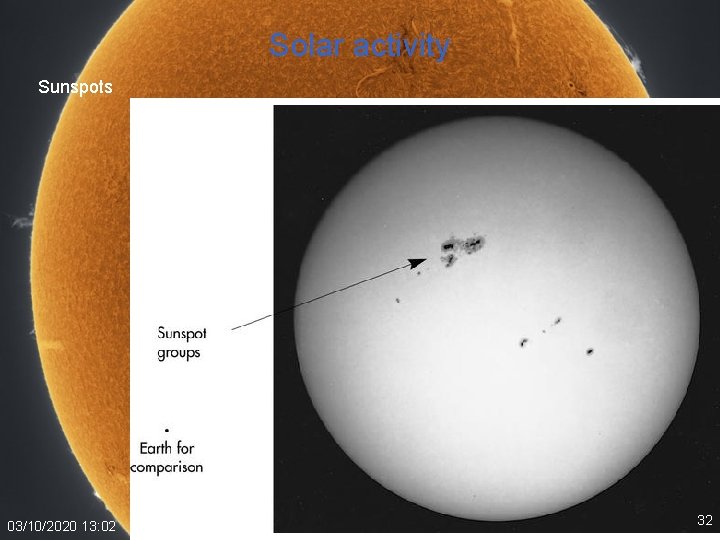
Solar activity Sunspots 03/10/2020 13: 02 32
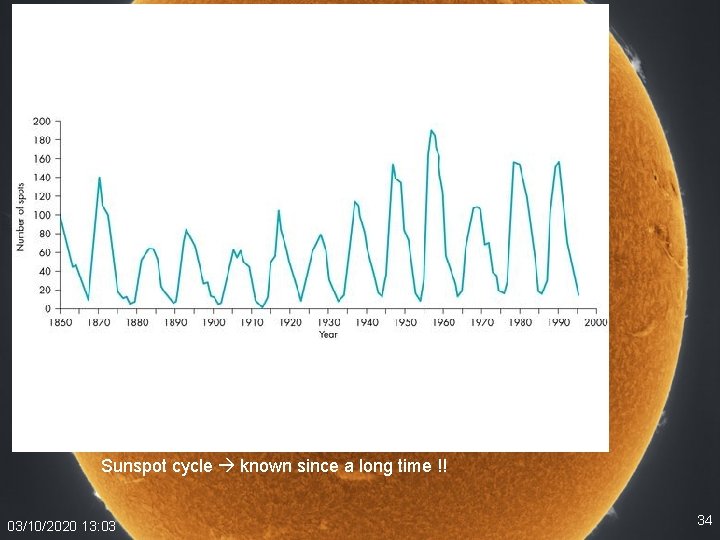
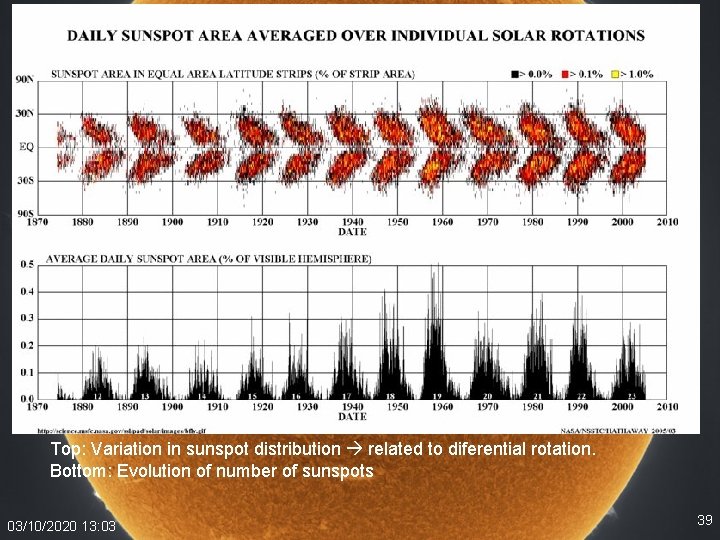
Sunspots: • • • Known for over 400 years, Galileo already observed them. Two different regions: Umbra, surrounded by Penumbra Lower temperature (some 1500 K) than surroundings Diameter: some 10000 km Duration: days to months (even longer!) Number of spots follows a cycle with period of between 7 to 17 years (average of 11 years) • High magnetic field up to 0. 45 Tesla (aprox. 10000 stronger than earth’s mag. Field!!) 03/10/2020 13: 03 33
• Sunspot cycle known since a long time !! 03/10/2020 13: 03 34
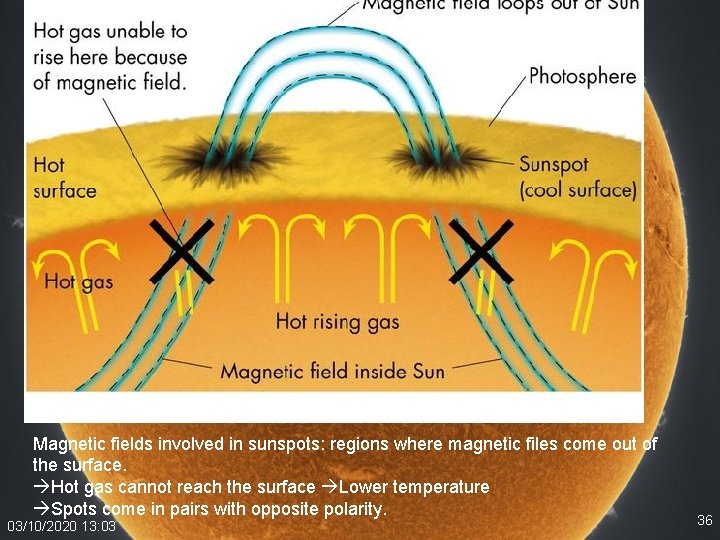
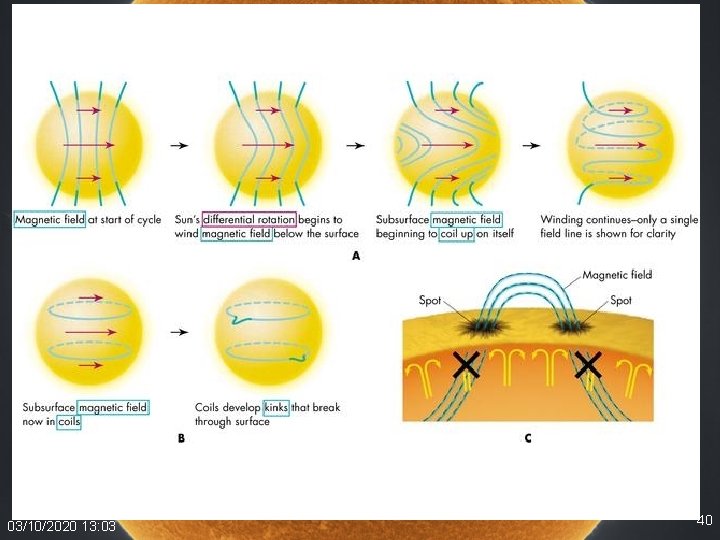
Magnetic fields involved in sunspots: regions where magnetic files come out of the surface. Hot gas cannot reach the surface Lower temperature Spots come in pairs with opposite polarity. 03/10/2020 13: 03 36
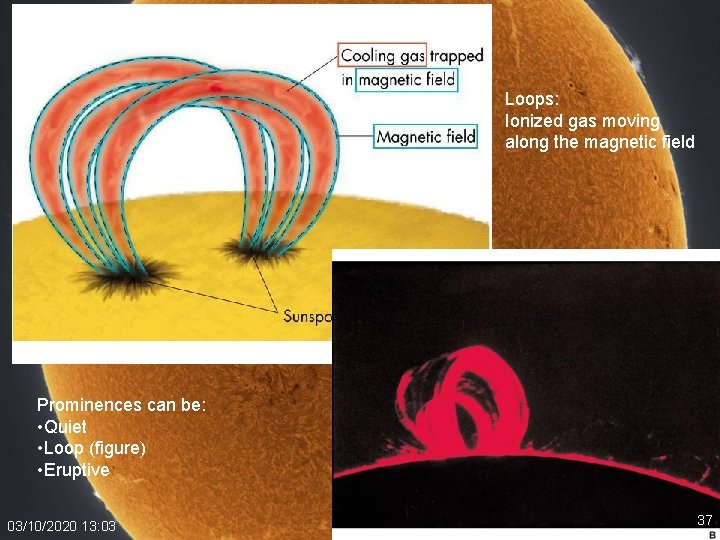
Loops: Ionized gas moving along the magnetic field Prominences can be: • Quiet • Loop (figure) • Eruptive 03/10/2020 13: 03 37
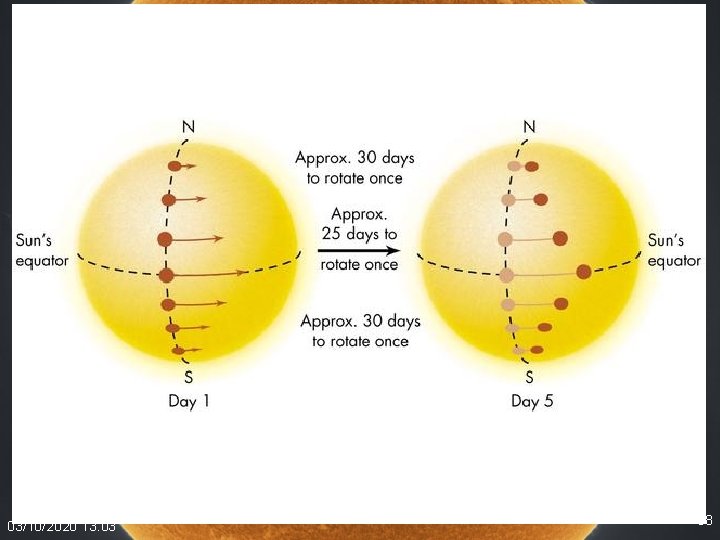
Rotación diferencial del Sol (descubierto en 1630 por Christoph Schneider) 03/10/2020 13: 03 38
Top: Variation in sunspot distribution related to diferential rotation. Bottom: Evolution of number of sunspots 03/10/2020 13: 03 39
Creación del campo magnético a través del efecto dinamo • • • Necesario: Medio conductor, rotación diferencial Actividad solar máximo cuando enredo de las líneas del campo magnético es máximo Detalles del proceso son complejos. 03/10/2020 13: 03 40