
STELLAR ATMOSPHERES A VERY SHORT INTRODUCTION PART I


- Slides: 82
STELLAR ATMOSPHERES A VERY SHORT INTRODUCTION PART I Ewa Niemczura Astronomical Institute, UWr eniem@astro. uni. wroc. pl
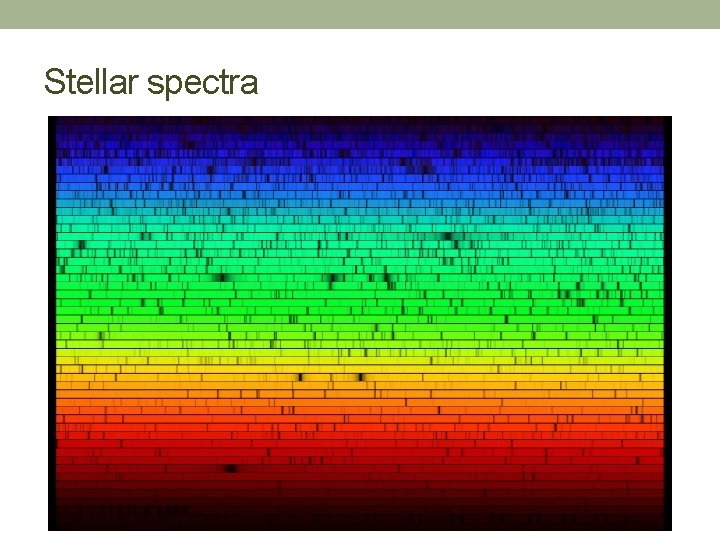
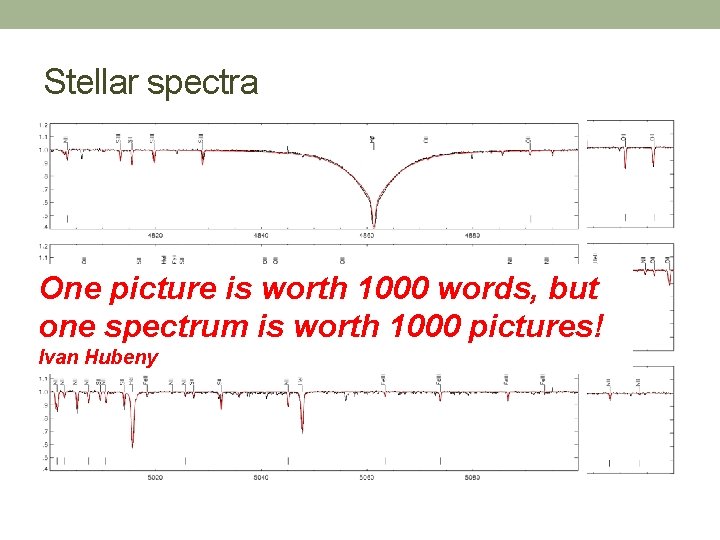
Stellar spectra
Stellar spectra One picture is worth 1000 words, but one spectrum is worth 1000 pictures! Ivan Hubeny
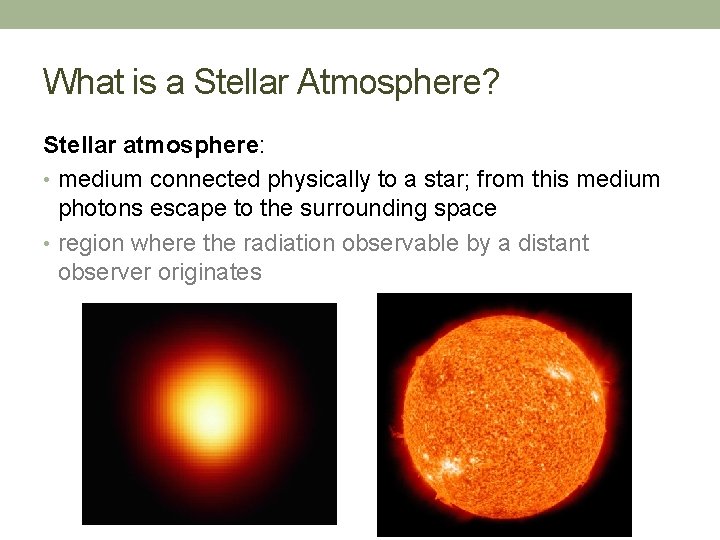
What is a Stellar Atmosphere? Stellar atmosphere: • medium connected physically to a star; from this medium photons escape to the surrounding space • region where the radiation observable by a distant observer originates
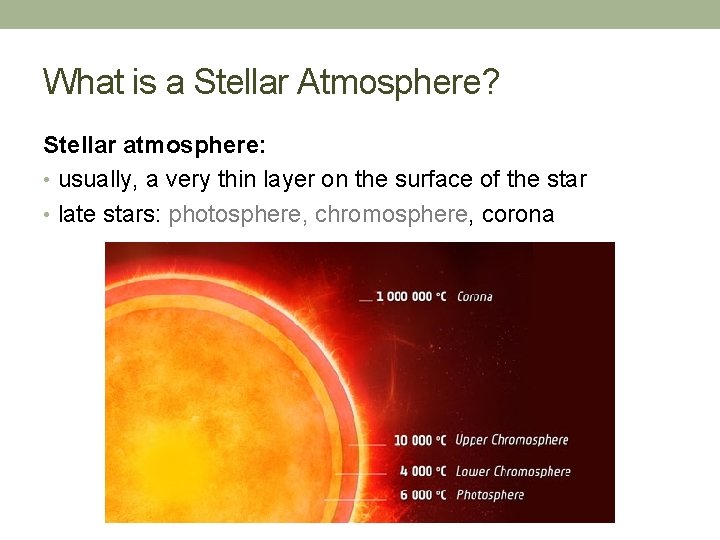
What is a Stellar Atmosphere? Stellar atmosphere: • usually, a very thin layer on the surface of the star • late stars: photosphere, chromosphere, corona
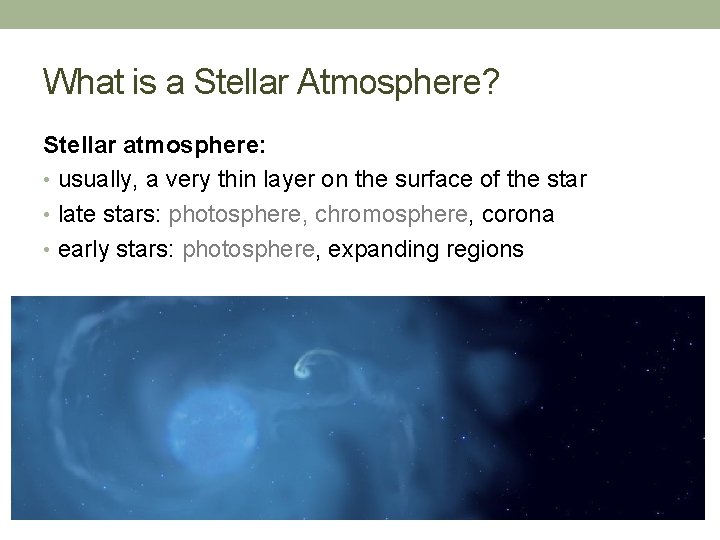
What is a Stellar Atmosphere? Stellar atmosphere: • usually, a very thin layer on the surface of the star • late stars: photosphere, chromosphere, corona • early stars: photosphere, expanding regions
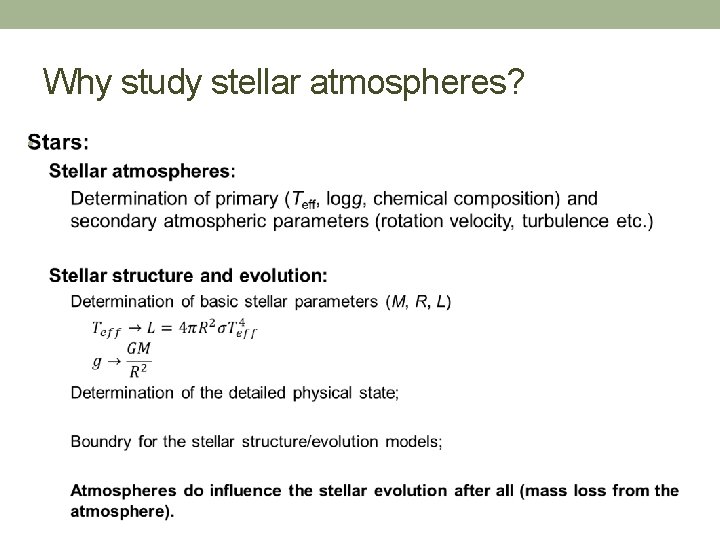
Why study stellar atmospheres? „Why in the world would anyone want to study stellar atmospheres? They contain only 10 -10 of the mass of a typical star! Surely such a negligible fraction of a star mass cannot possibly affect its overall structure and evolution!” Question to D. Mihalas, about 50 years ago From the lecture of Ivan Hubeny
Why study stellar atmospheres? Atmospheres are all we see; we have to use this information in the fullest. Stars: Stellar atmospheres: Determination of atmospheric parameters.
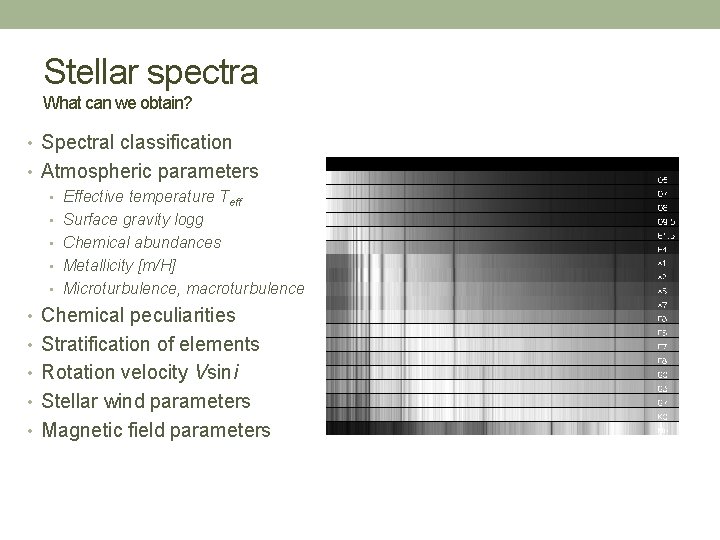
Stellar spectra What can we obtain? • Spectral classification • Atmospheric parameters • Effective temperature Teff • Surface gravity logg • Chemical abundances • Metallicity [m/H] • Microturbulence, macroturbulence • Chemical peculiarities • Stratification of elements • Rotation velocity Vsini • Stellar wind parameters • Magnetic field parameters
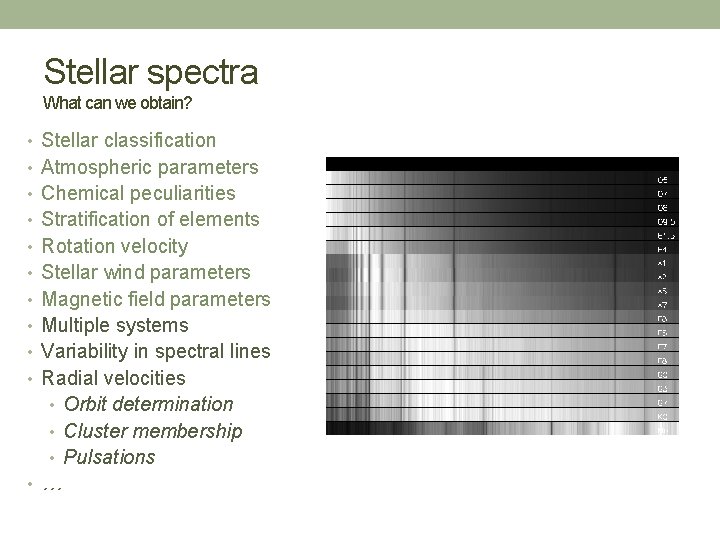
Stellar spectra What can we obtain? • Stellar classification • Atmospheric parameters • Chemical peculiarities • Stratification of elements • Rotation velocity • Stellar wind parameters • Magnetic field parameters • Multiple systems • Variability in spectral lines • Radial velocities • Orbit determination • Cluster membership • Pulsations • …
Why study stellar atmospheres? •
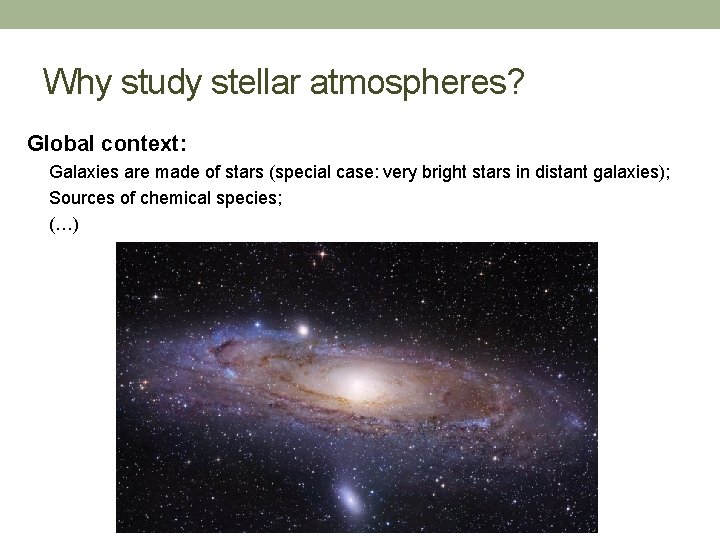
Why study stellar atmospheres? Global context: Galaxies are made of stars (special case: very bright stars in distant galaxies); Sources of chemical species; (…)
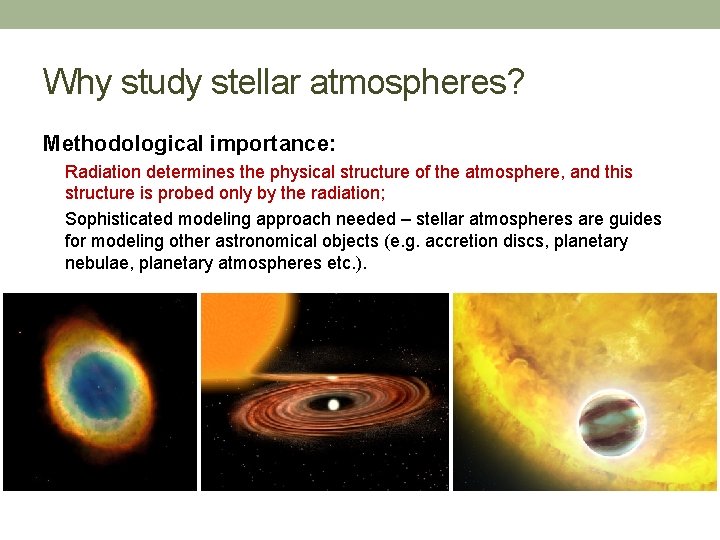
Why study stellar atmospheres? Methodological importance: Radiation determines the physical structure of the atmosphere, and this structure is probed only by the radiation; Sophisticated modeling approach needed – stellar atmospheres are guides for modeling other astronomical objects (e. g. accretion discs, planetary nebulae, planetary atmospheres etc. ).
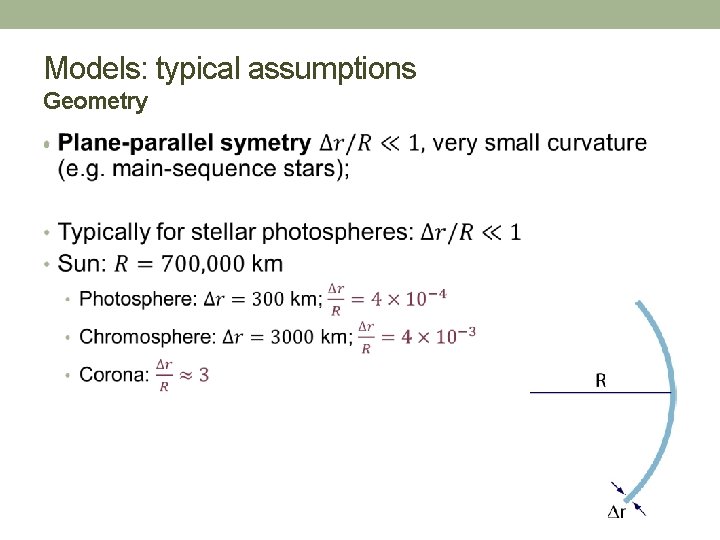
Models: typical assumptions Geometry •
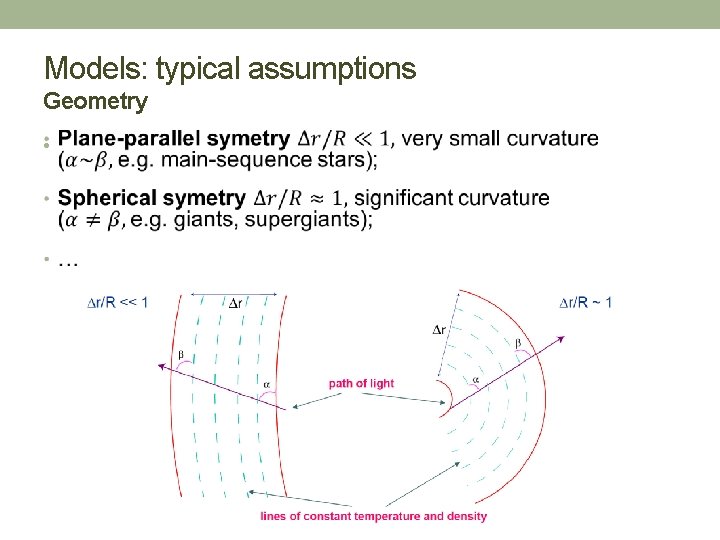
Models: typical assumptions Geometry •
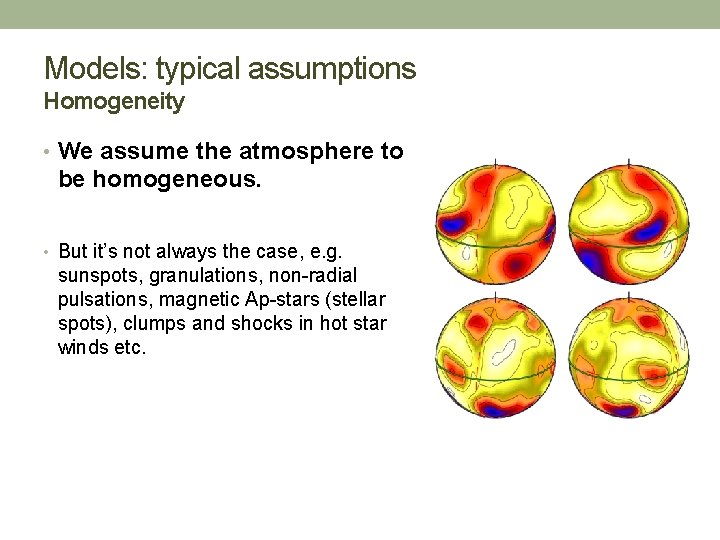
Models: typical assumptions Homogeneity • We assume the atmosphere to be homogeneous. • But it’s not always the case, e. g. sunspots, granulations, non-radial pulsations, magnetic Ap-stars (stellar spots), clumps and shocks in hot star winds etc.
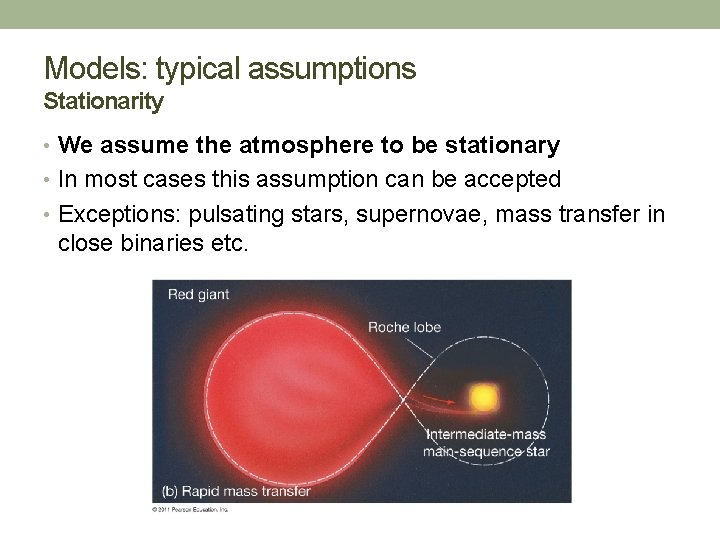
Models: typical assumptions Stationarity • We assume the atmosphere to be stationary • In most cases this assumption can be accepted • Exceptions: pulsating stars, supernovae, mass transfer in close binaries etc.
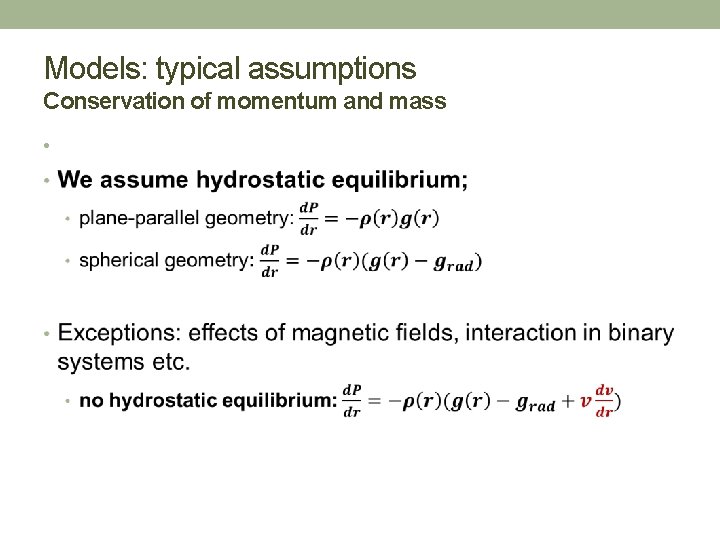
Models: typical assumptions Conservation of momentum and mass •
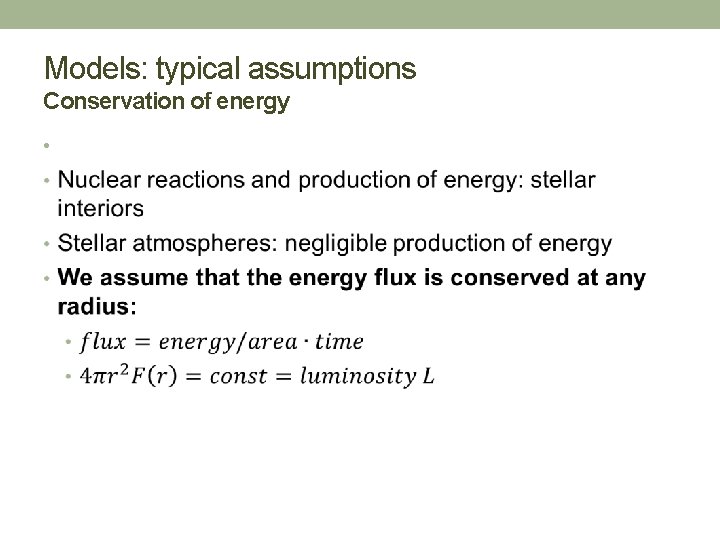
Models: typical assumptions Conservation of energy •
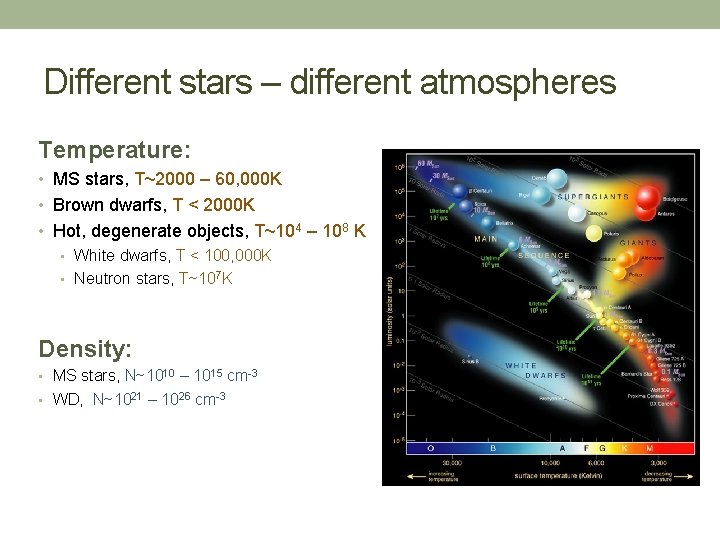
Different stars – different atmospheres Temperature: • MS stars, T~2000 – 60, 000 K • Brown dwarfs, T < 2000 K • Hot, degenerate objects, T~104 – 108 K • White dwarfs, T < 100, 000 K • Neutron stars, T~107 K Density: • MS stars, N~1010 – 1015 cm-3 • WD, N~1021 – 1026 cm-3
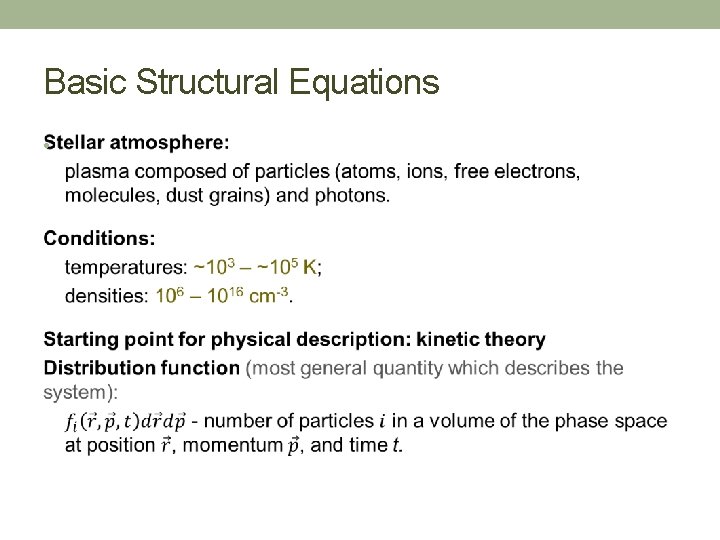
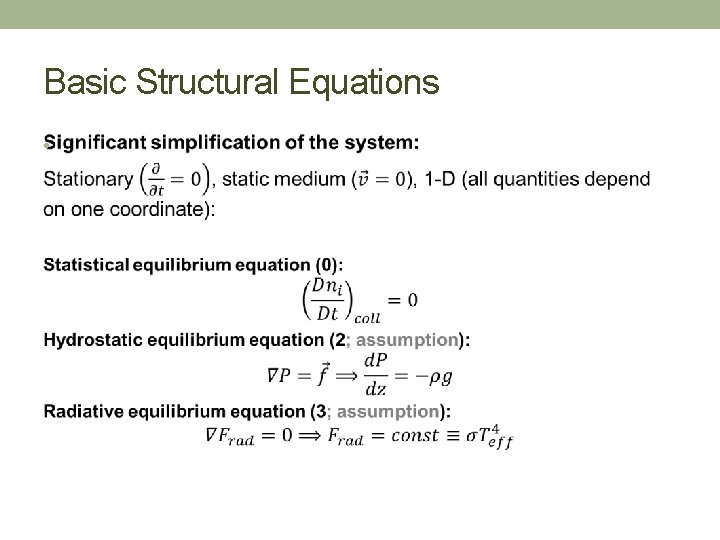
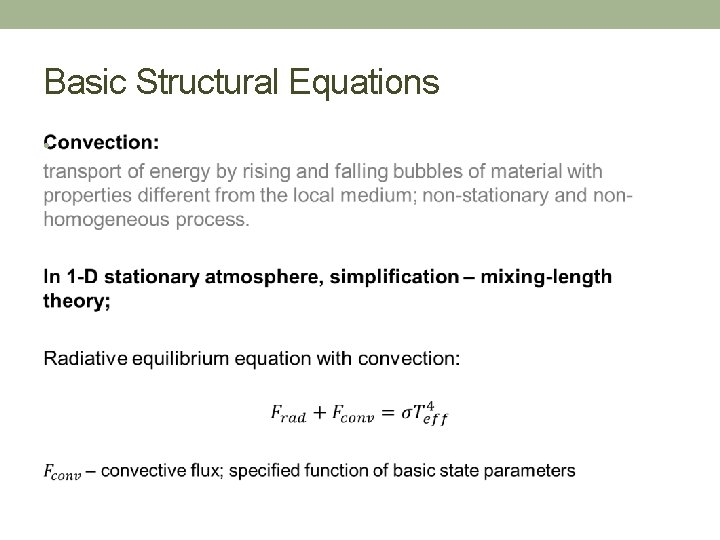
Basic Structural Equations •
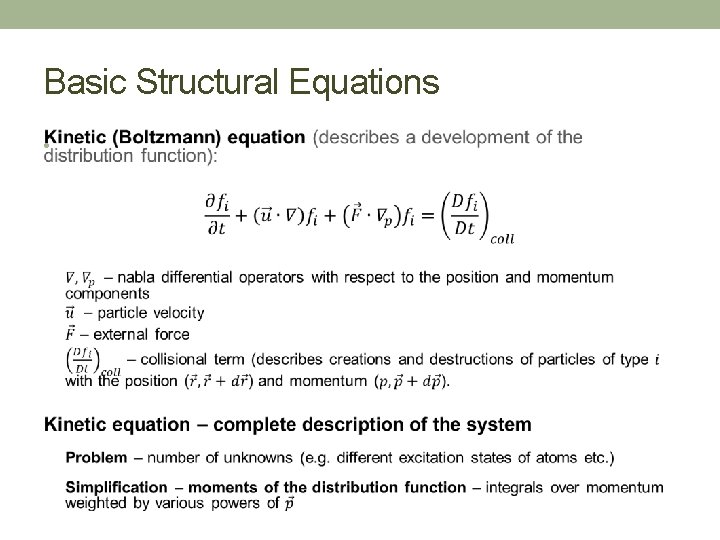
Basic Structural Equations •
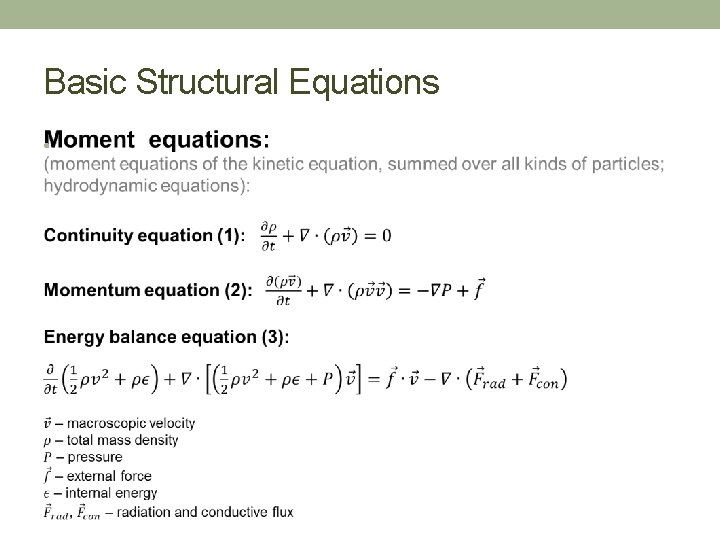
Basic Structural Equations •
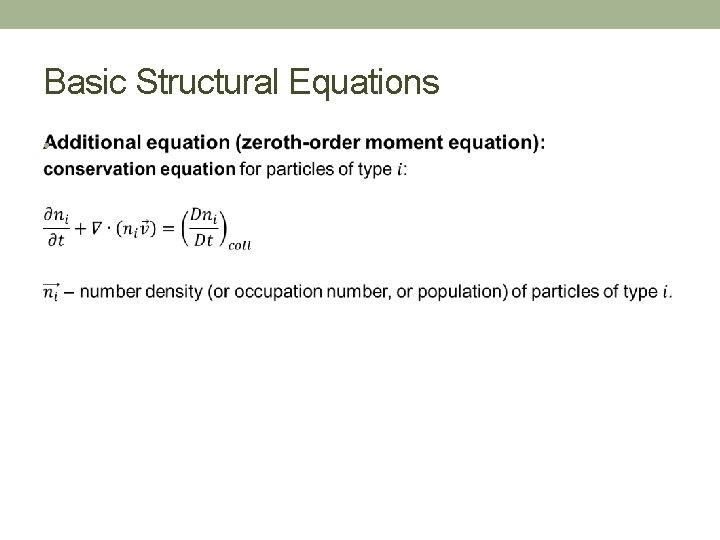
Basic Structural Equations •
Basic Structural Equations •
Basic Structural Equations •
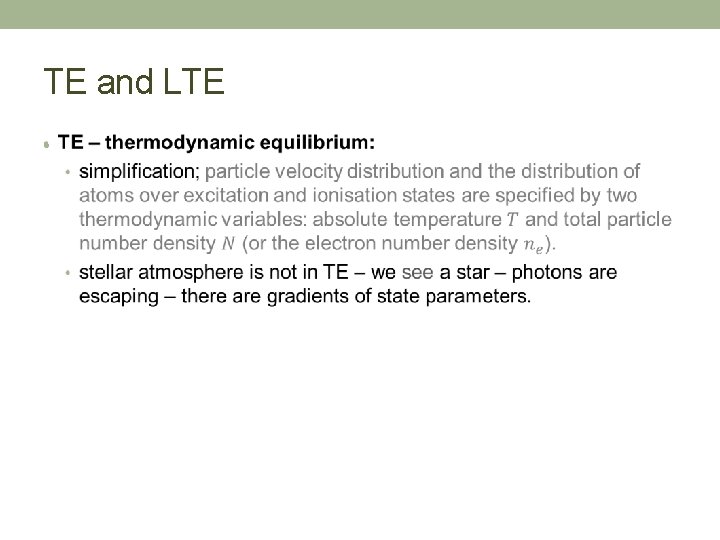
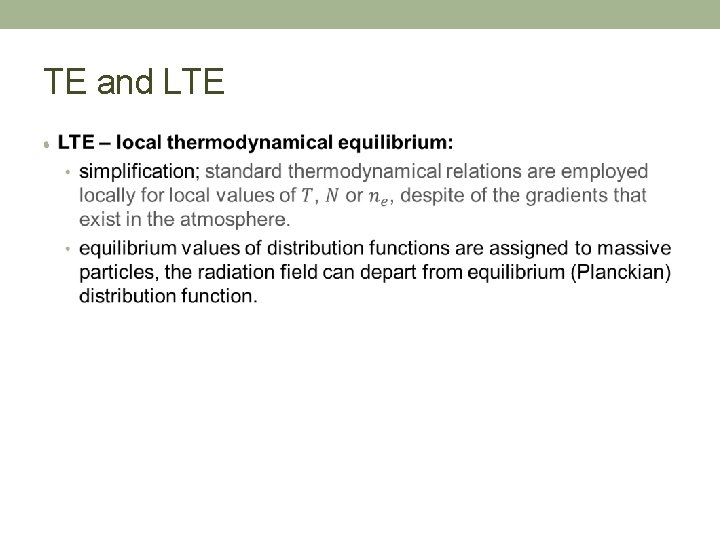
TE and LTE •
TE and LTE •
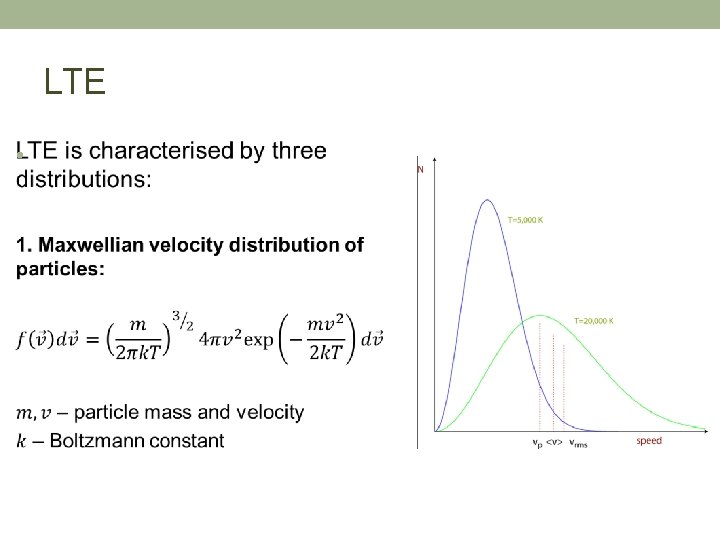
LTE •
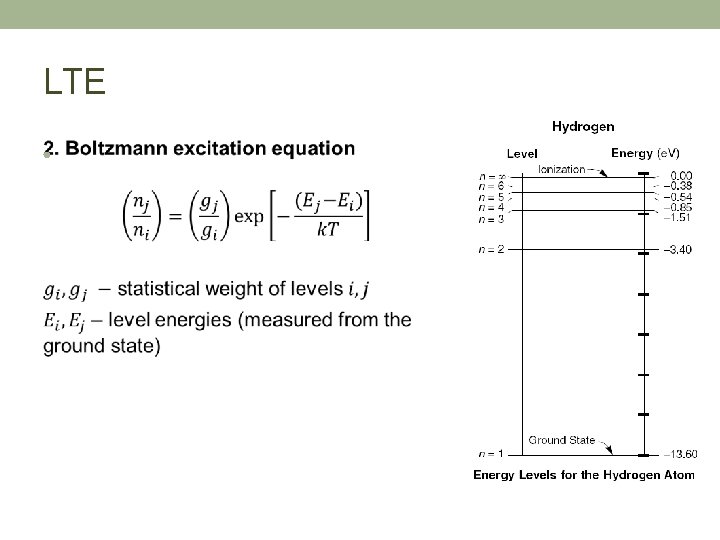
LTE •
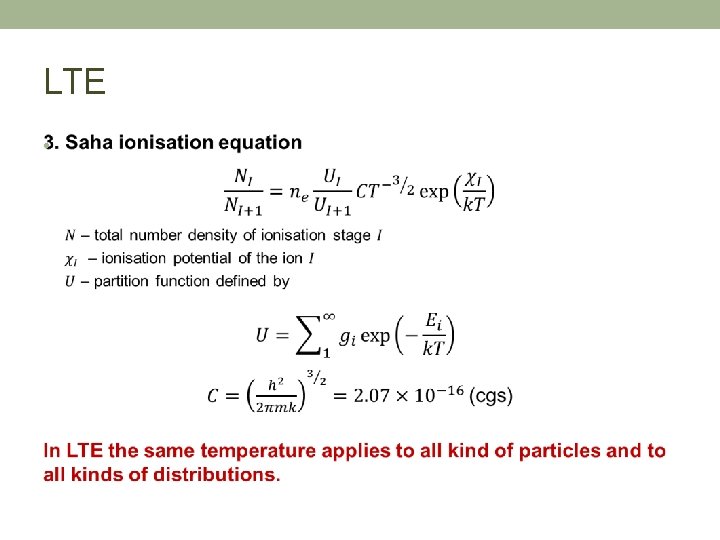
LTE •
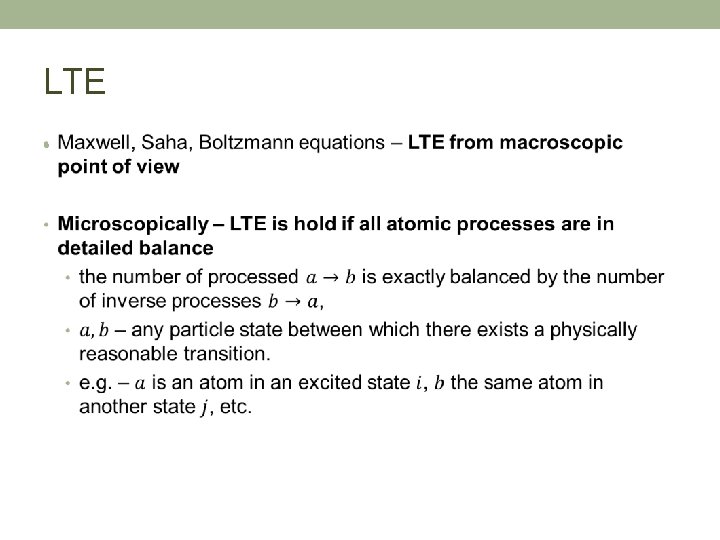
LTE •
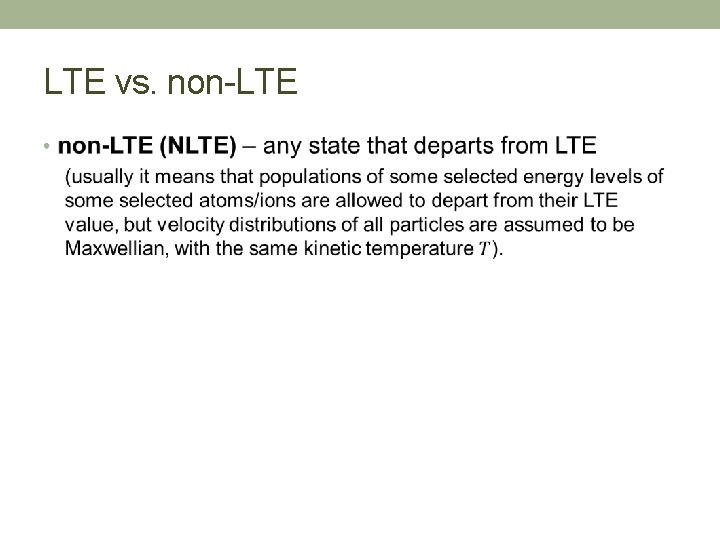
LTE vs. non-LTE •
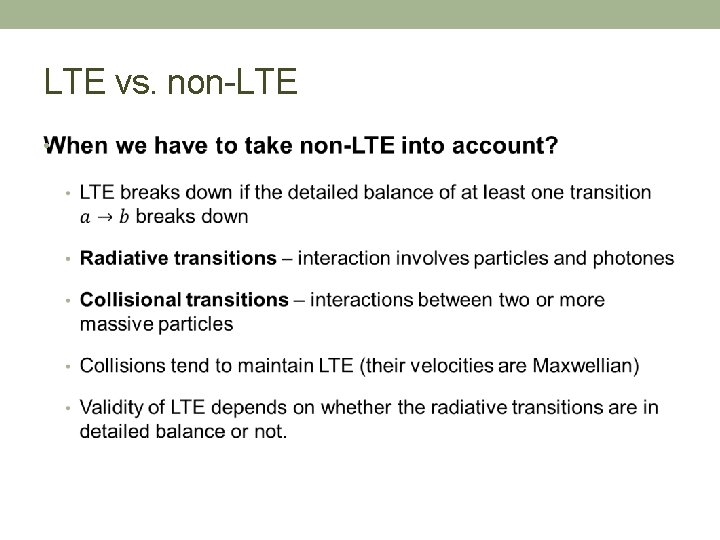
LTE vs. non-LTE •
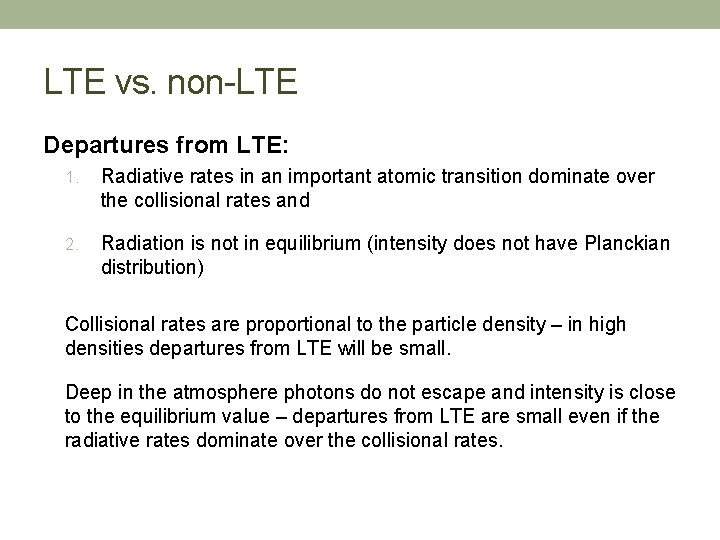
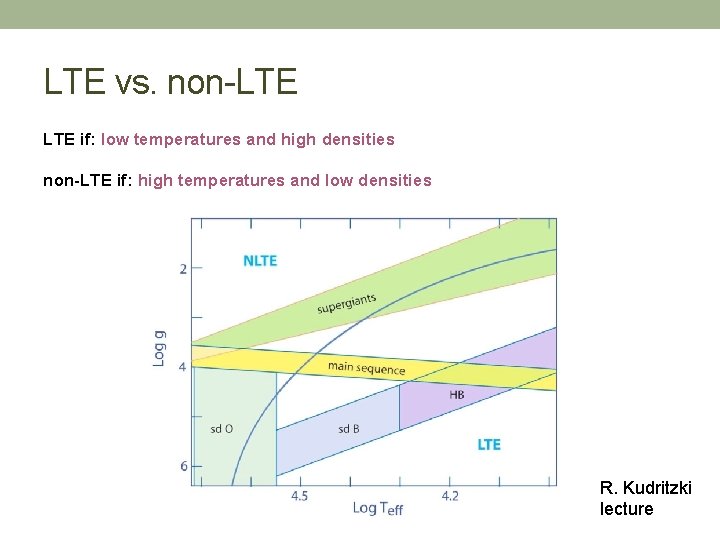
LTE vs. non-LTE Departures from LTE: 1. Radiative rates in an important atomic transition dominate over the collisional rates and 2. Radiation is not in equilibrium (intensity does not have Planckian distribution) Collisional rates are proportional to the particle density – in high densities departures from LTE will be small. Deep in the atmosphere photons do not escape and intensity is close to the equilibrium value – departures from LTE are small even if the radiative rates dominate over the collisional rates.
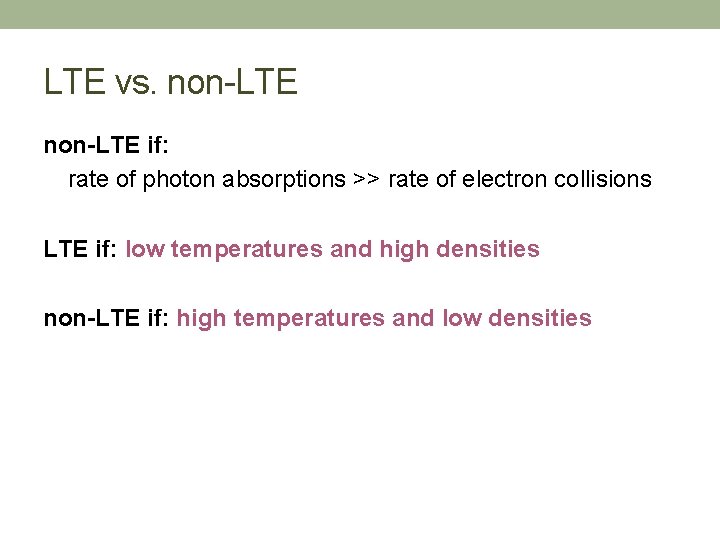
LTE vs. non-LTE if: rate of photon absorptions >> rate of electron collisions LTE if: low temperatures and high densities non-LTE if: high temperatures and low densities
LTE vs. non-LTE if: low temperatures and high densities non-LTE if: high temperatures and low densities R. Kudritzki lecture
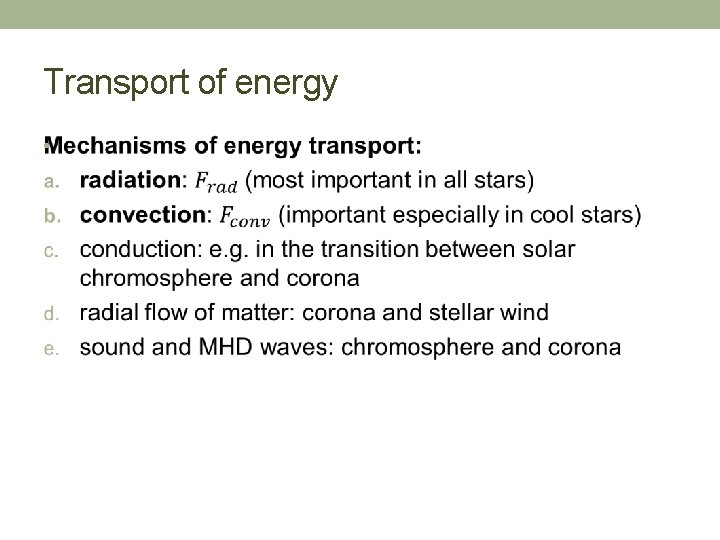
Transport of energy •
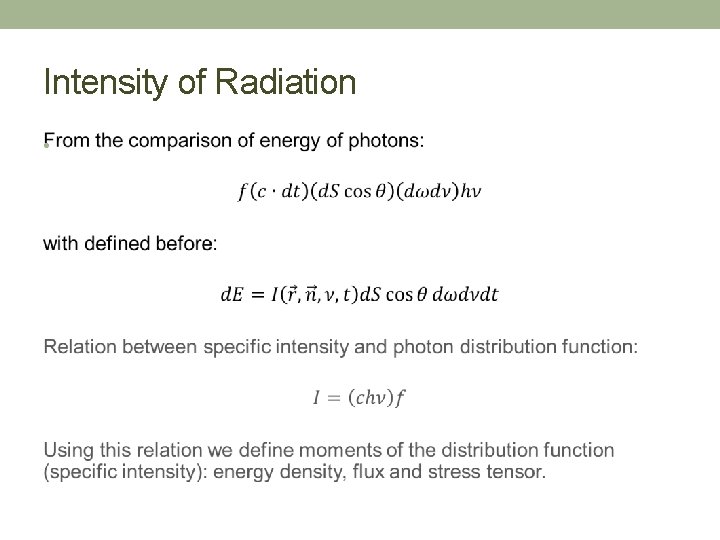
Intensity of Radiation • d. S
Intensity of Radiation •
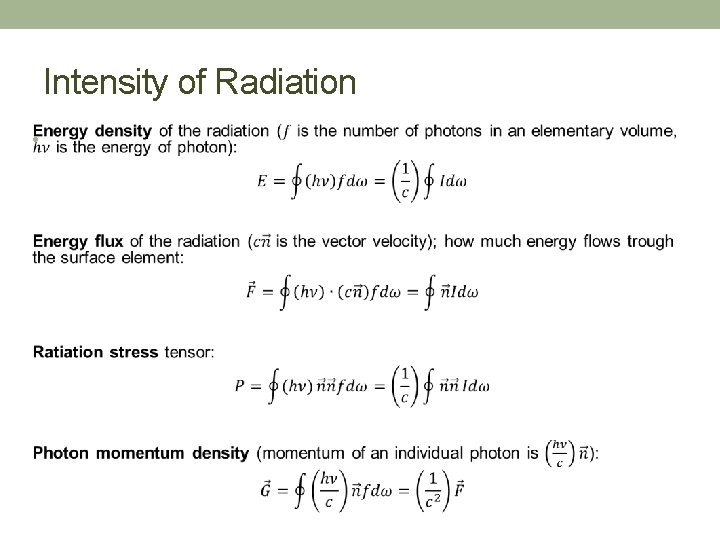
Intensity of Radiation •
Intensity of Radiation •
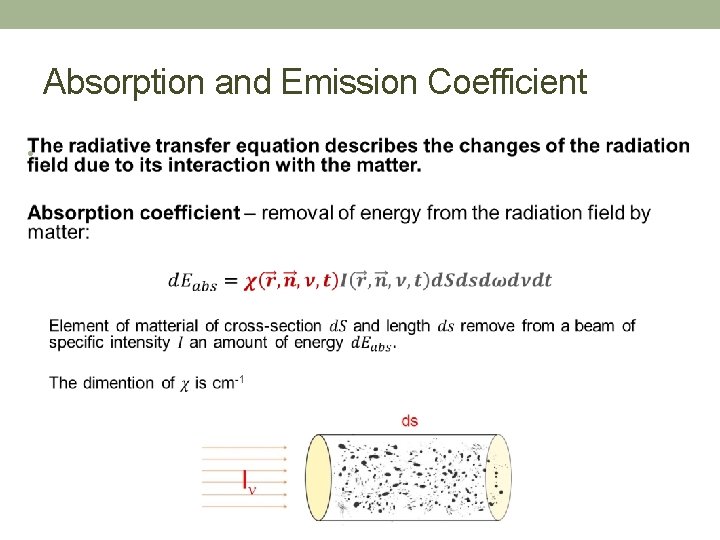
Absorption and Emission Coefficient •
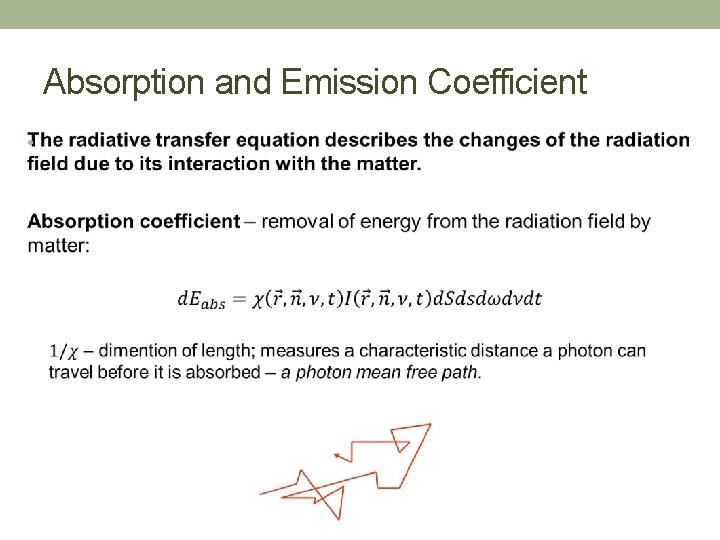
Absorption and Emission Coefficient •
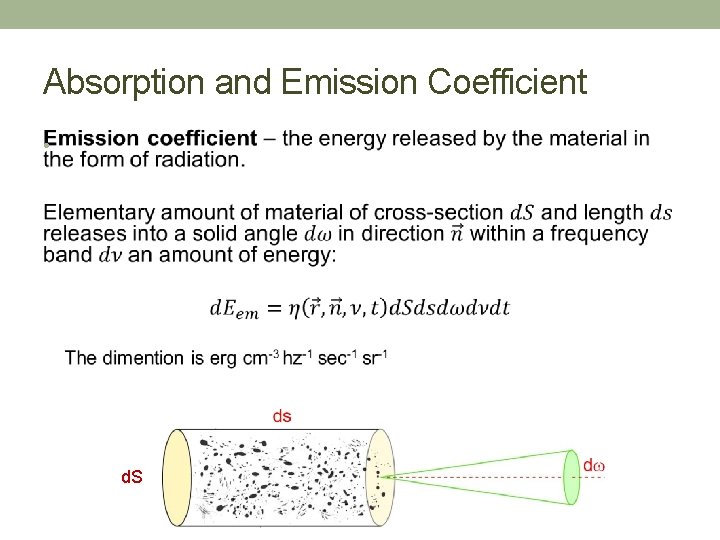
Absorption and Emission Coefficient • d. S
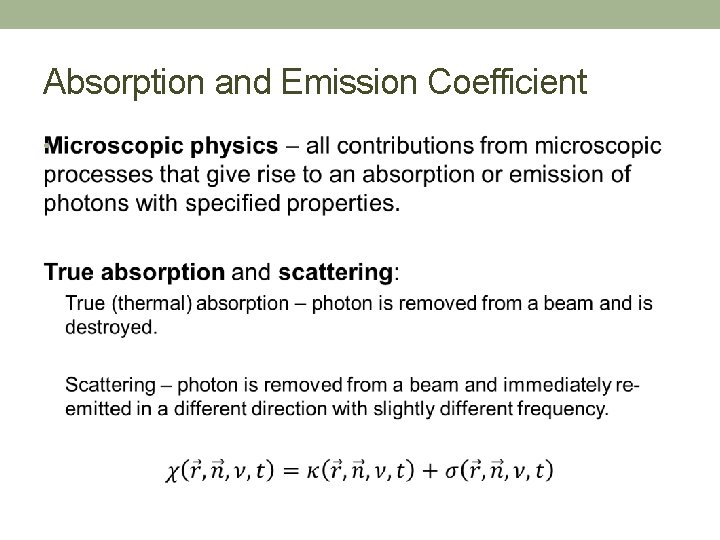
Absorption and Emission Coefficient •
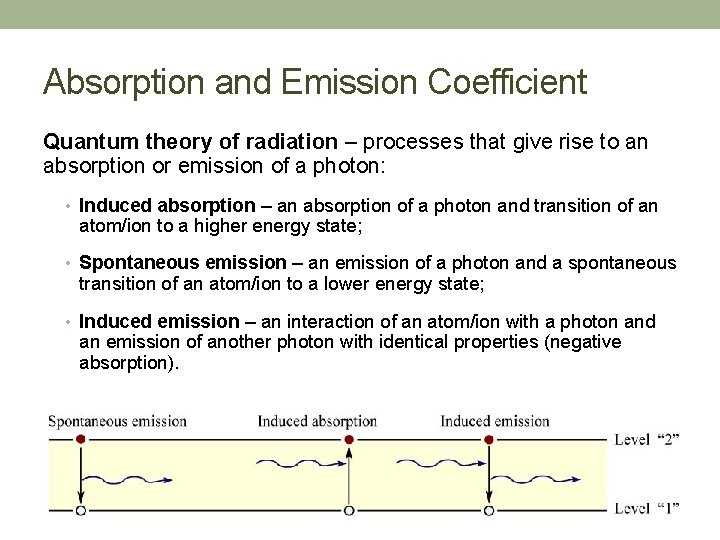
Absorption and Emission Coefficient Quantum theory of radiation – processes that give rise to an absorption or emission of a photon: • Induced absorption – an absorption of a photon and transition of an atom/ion to a higher energy state; • Spontaneous emission – an emission of a photon and a spontaneous transition of an atom/ion to a lower energy state; • Induced emission – an interaction of an atom/ion with a photon and an emission of another photon with identical properties (negative absorption).
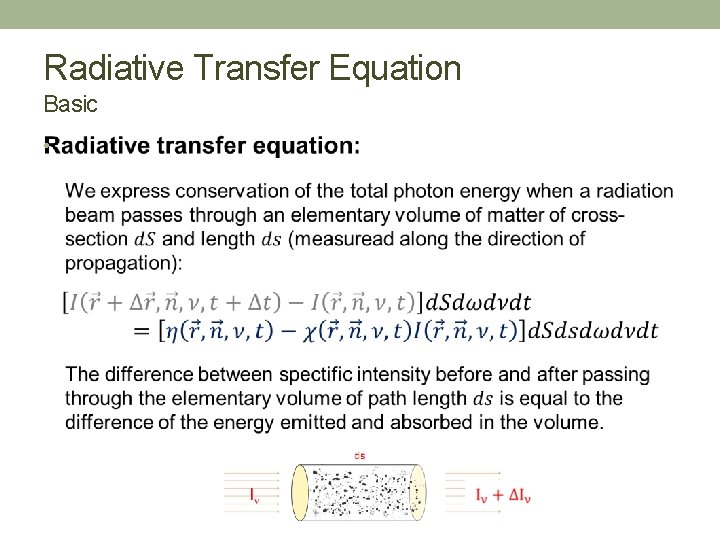
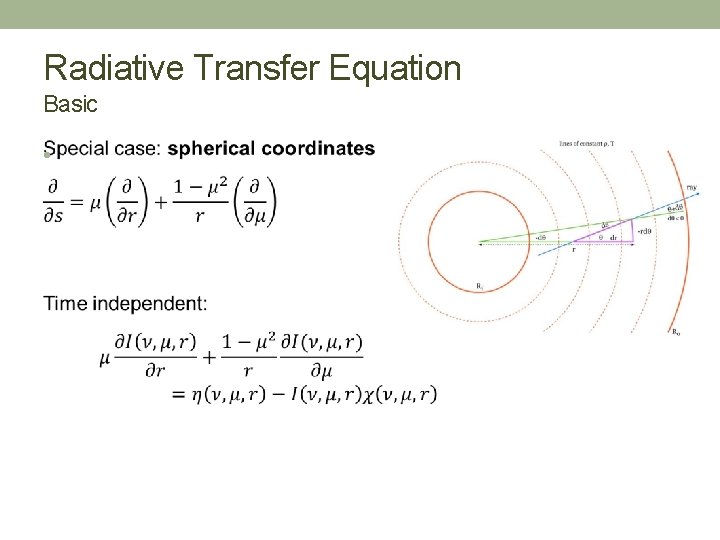
Radiative Transfer Equation Basic •
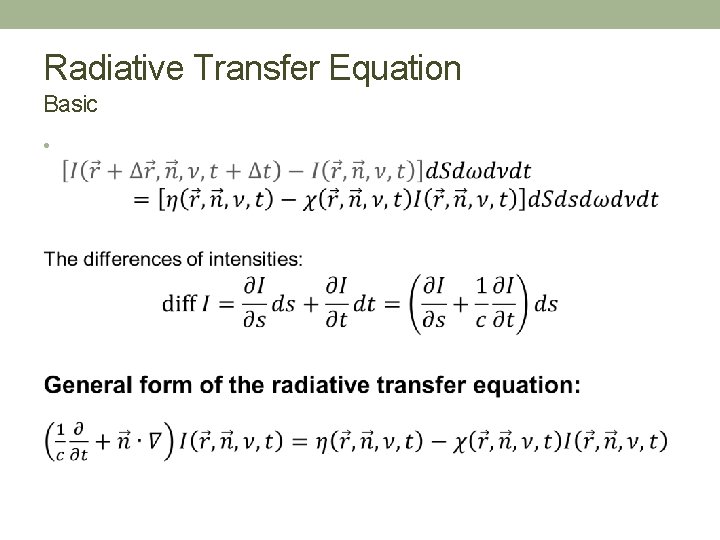
Radiative Transfer Equation Basic •
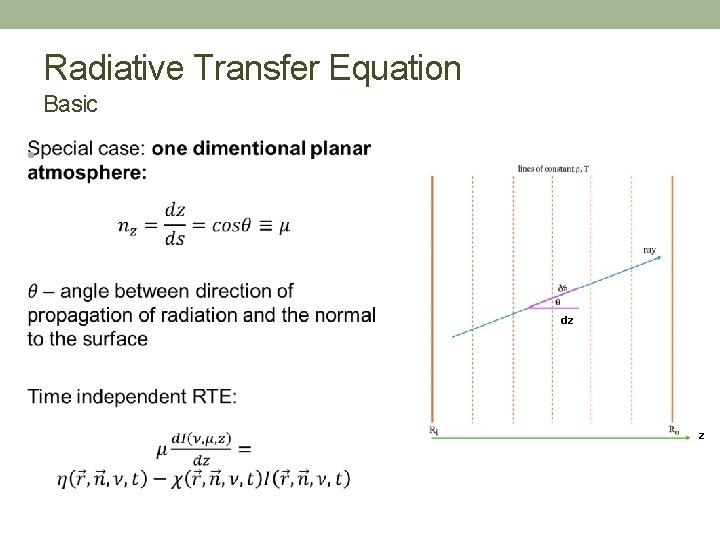
Radiative Transfer Equation Basic • dz z
Radiative Transfer Equation Basic •
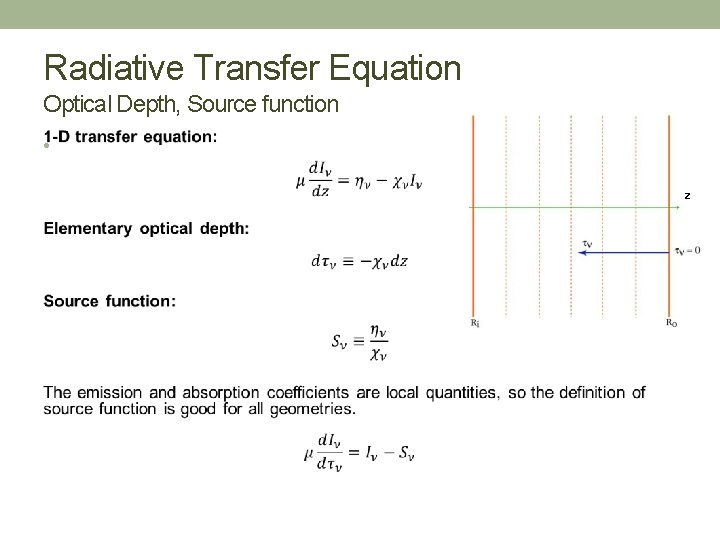
Radiative Transfer Equation Optical Depth, Source function • z
Radiative Transfer Equation Optical Depth, Source function •
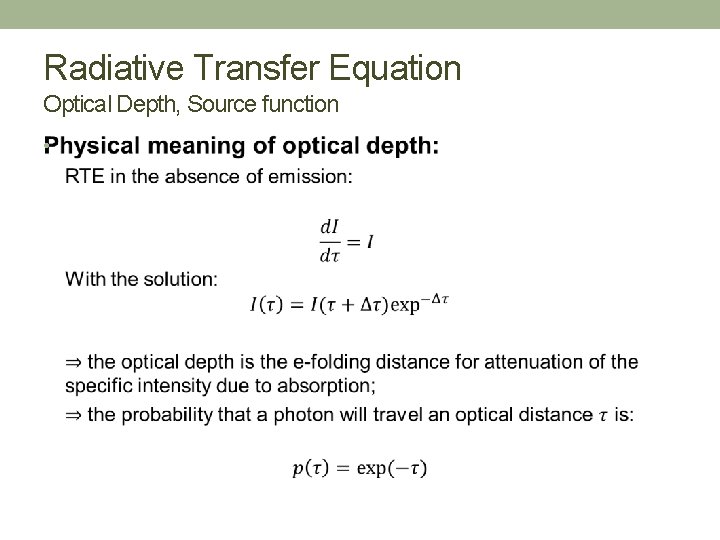
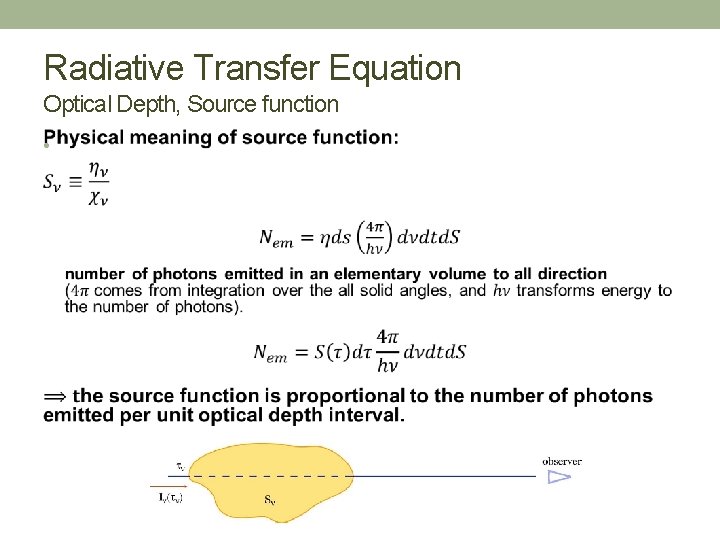
Radiative Transfer Equation Optical Depth, Source function •
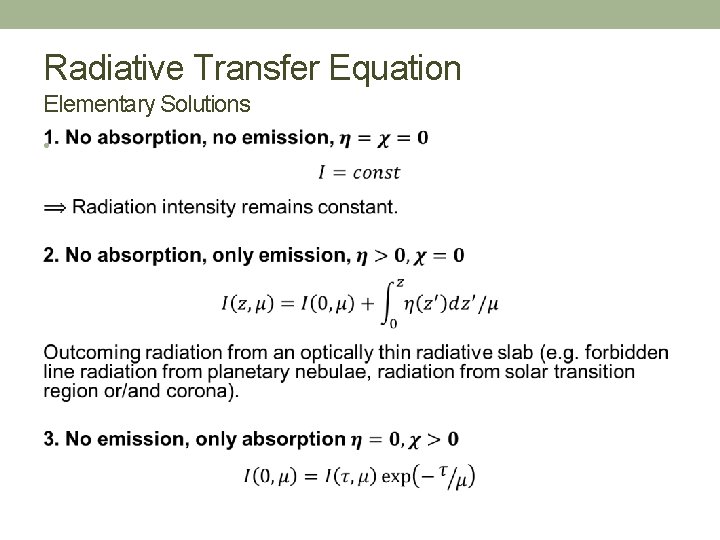
Radiative Transfer Equation Elementary Solutions •
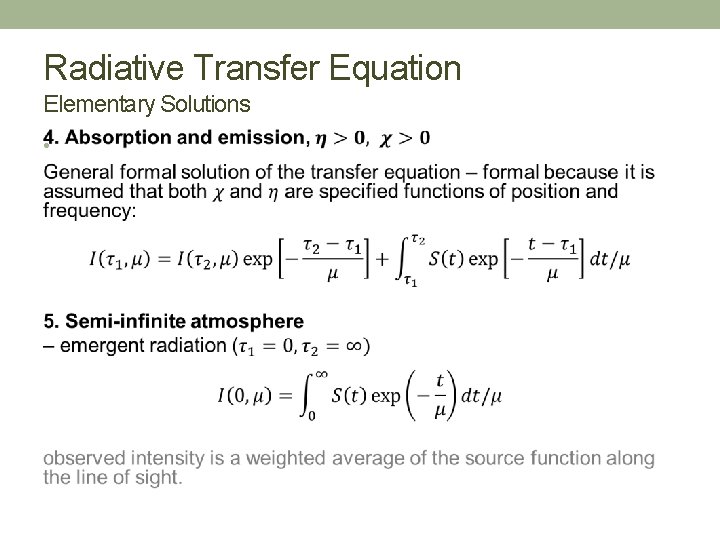
Radiative Transfer Equation Elementary Solutions •
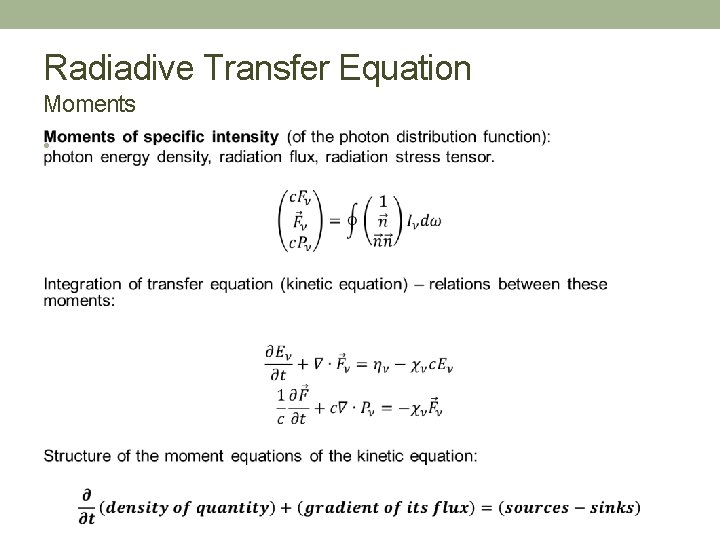
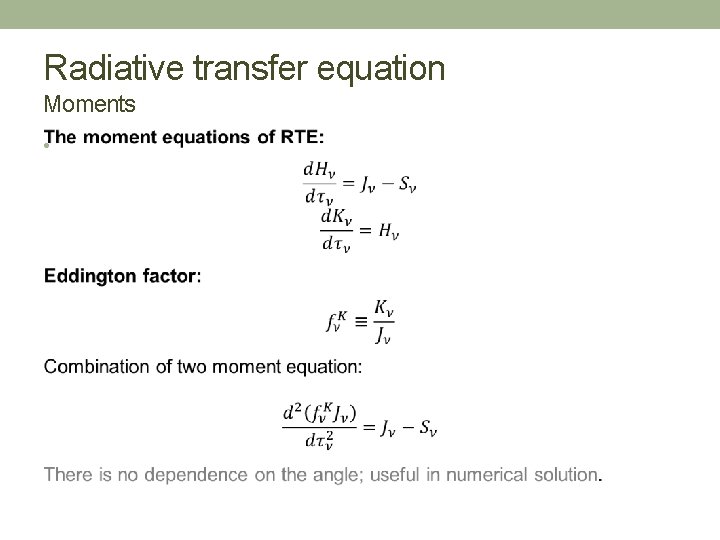
Radiadive Transfer Equation Moments •
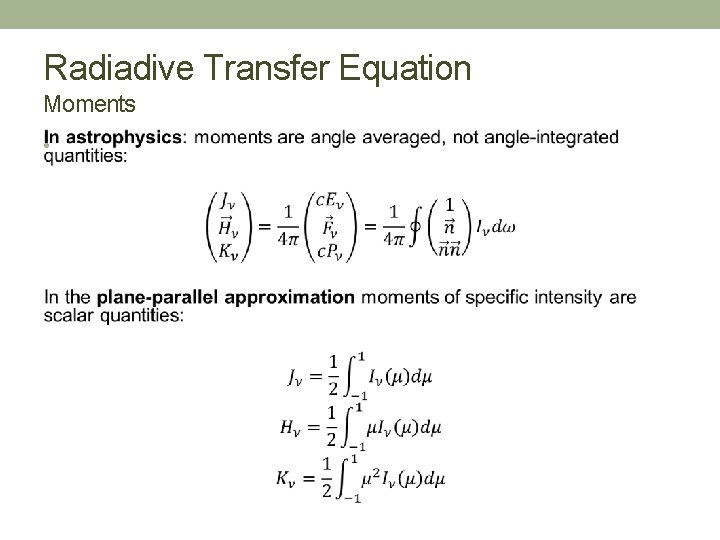
Radiadive Transfer Equation Moments •
Radiative transfer equation Moments •
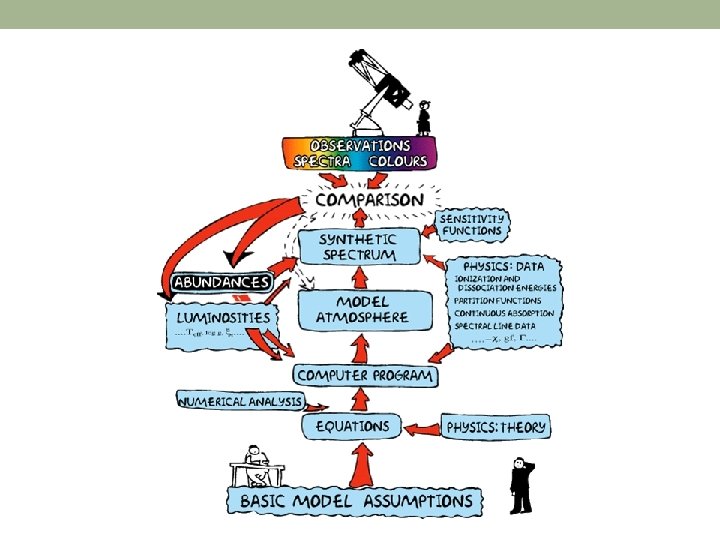
Model atmosphere Definition and terminology Model atmosphere – • Specification of all atmospheric state parameters as function of depth. • Table of values of the state parameters in the discrete depth points. • State parameters: depend on the type of the model (on the basic assumption under which the model is constructed) • Massive particle state parameters – from this we can determine the radiation field by a formal solution of the transfer equation.
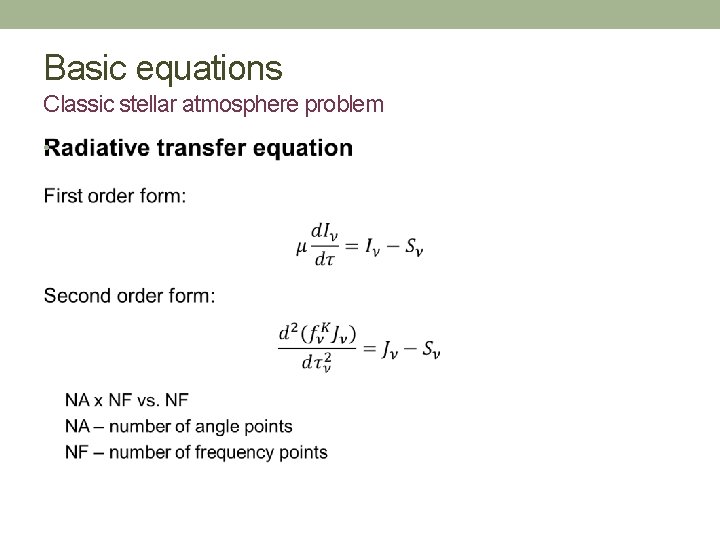
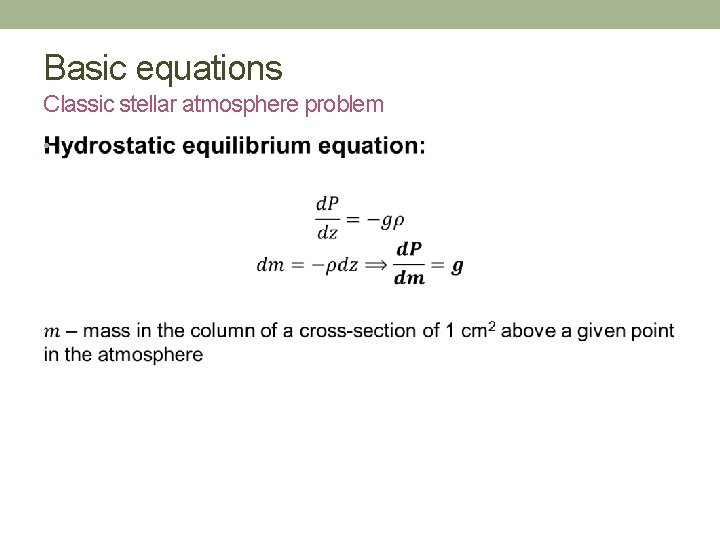
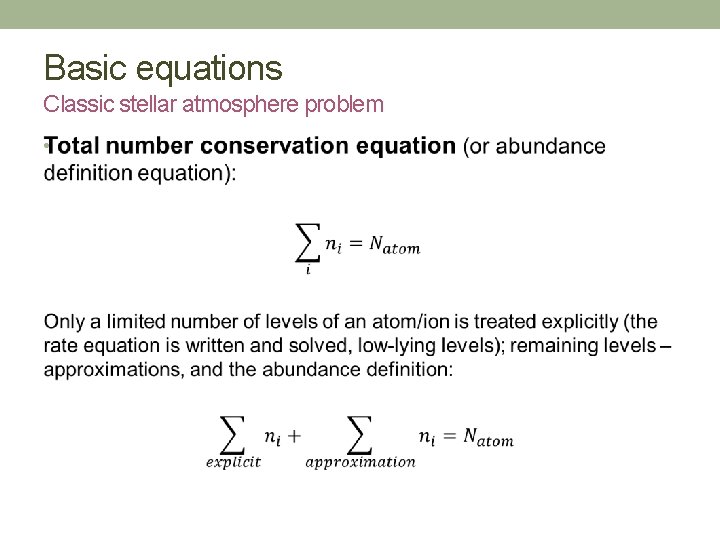
Basic equations Classic stellar atmosphere problem •
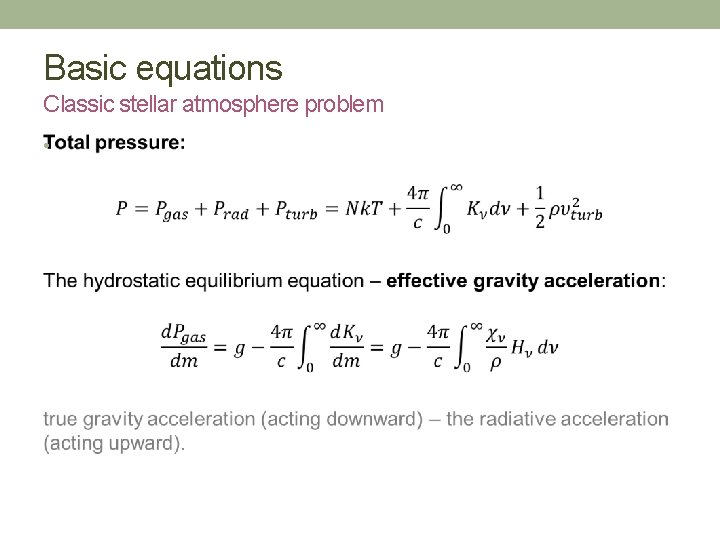
Basic equations Classic stellar atmosphere problem •
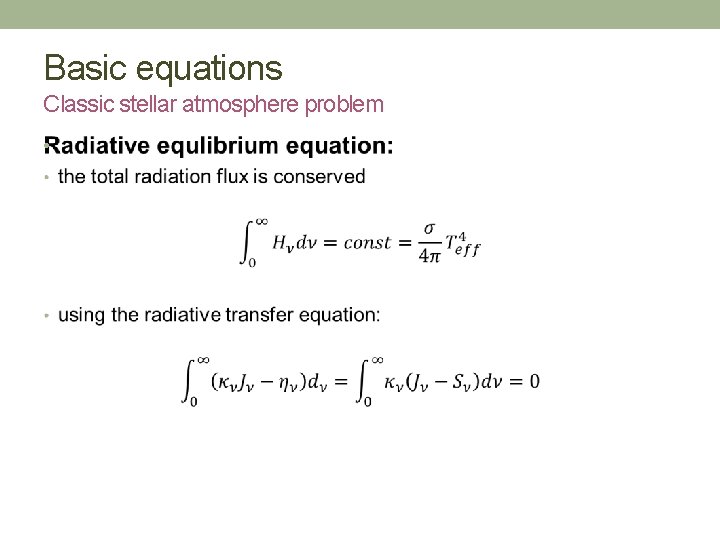
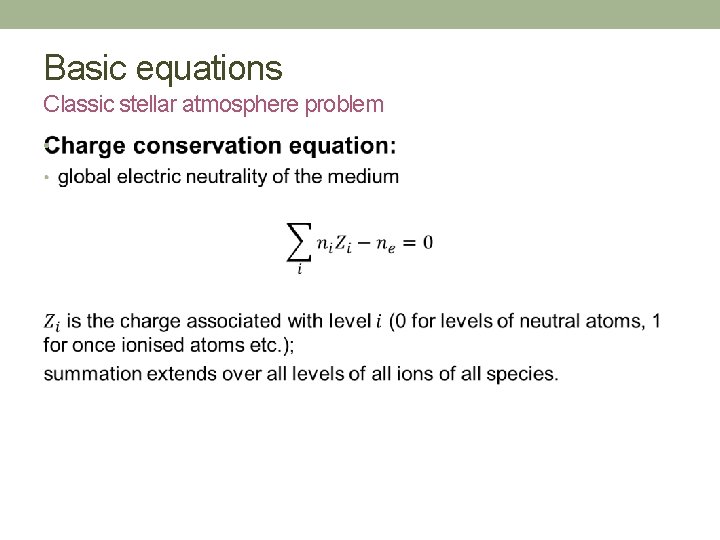
Basic equations Classic stellar atmosphere problem •
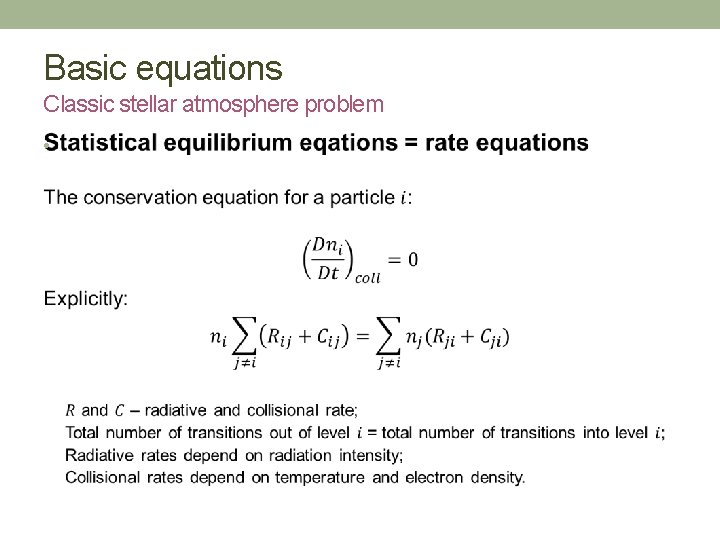
Basic equations Classic stellar atmosphere problem •
Basic equations Classic stellar atmosphere problem •
Basic equations Classic stellar atmosphere problem •
Basic equations Classic stellar atmosphere problem •
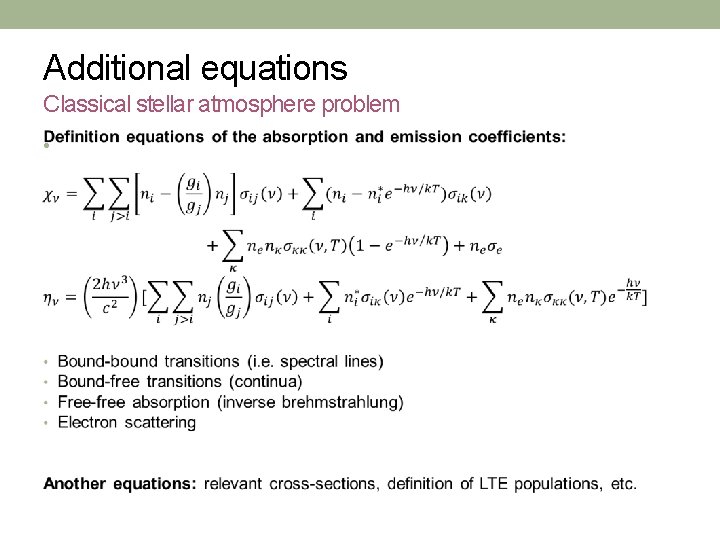
Additional equations Classical stellar atmosphere problem •
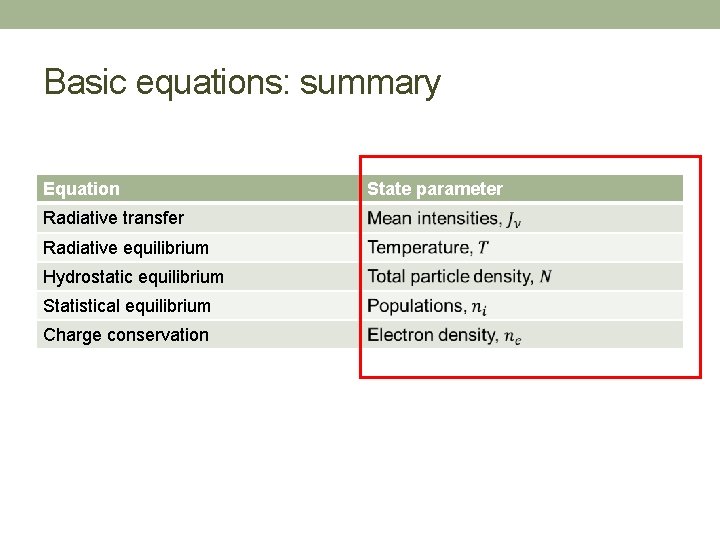
Basic equations: summary Equation Radiative transfer Radiative equilibrium Hydrostatic equilibrium Statistical equilibrium Charge conservation State parameter
Types of model atmosphere Static models: • assumption of hydrodynamical equilibrium • applies only to atmospheric layers that are close to hydrodynamic equilibrium, i. e. the macroscopic velocity is small compared to thermal velocity of atoms – stellar photospheres • basic input parameters: effective temperature, surface gravity and chemical composition, • additional parameters: microturbulence, and in case of convective models: mixing length.
Types of model atmosphere Static LTE models: • LTE assumption, two state parameters, temperature and density (or electron density) describe the physical state of the atmosphere at any given depth. • standard models • Example: Kurucz ATLAS 9 code
Types of model atmosphere Static non-LTE models: model which takes into account some kind of departure from LTE: • models solving for the full structure (TLUSTY) • restricted non-LTE problem: • the atmospheric structure is assumed to be known from previous calculations (LTE or simplified non-LTE), • radiative transfer and statistical equilibrium for a chosen atom/ion is solved simultaneously (DETAIL/SURFACE). • non-LTE line-blanketed models: • non-LTE is considered in most energy levels and transitions between them – lines and continua – that influence the atmospheric structure. • number of such lines may go to millions.
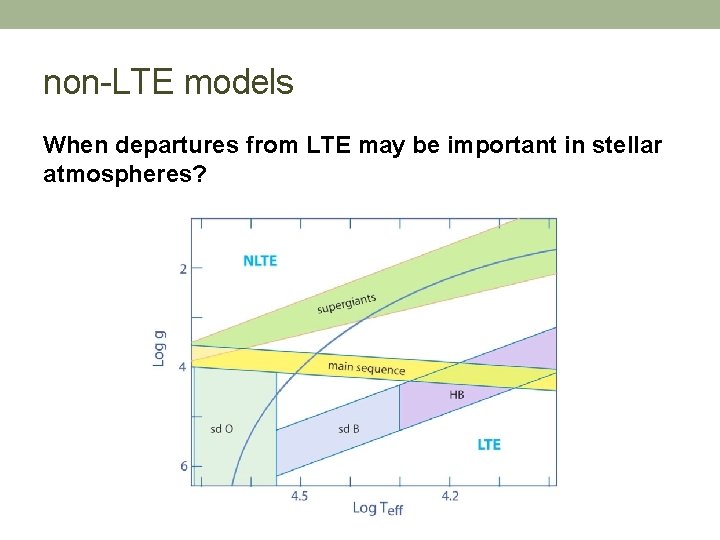
non-LTE models When departures from LTE may be important in stellar atmospheres?
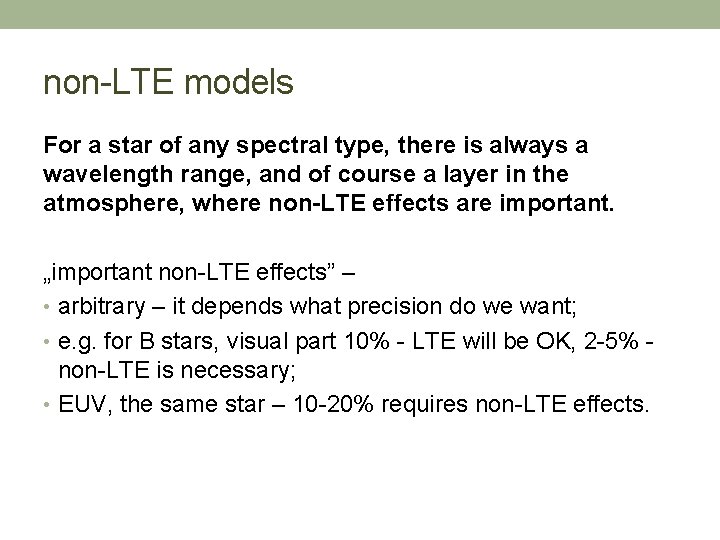
non-LTE models For a star of any spectral type, there is always a wavelength range, and of course a layer in the atmosphere, where non-LTE effects are important. „important non-LTE effects” – • arbitrary – it depends what precision do we want; • e. g. for B stars, visual part 10% - LTE will be OK, 2 -5% - non-LTE is necessary; • EUV, the same star – 10 -20% requires non-LTE effects.
Types of model atmosphere Unified models: • no assumption of hydrostatic equilibrium in the whole atmosphere ranging from a static photosphere to a dynamical outher parts.
Literature • D. Mihalas: „Stellar Atmospheres” • I. Hubeny: „Stellar atmospheres theory: an introduction” in: Stellar atmospheres: Theory and Observations, Lecture note in physics, J. P. De Greeve, R. Blomme, H. Hensberg (Eds. ), Springer • D. Gray: „The observations and analysis of stellar photospheres”