
Stellar Archaeology and Galaxy Genesis DE DM VM

- Slides: 25
Stellar Archaeology and Galaxy Genesis DE + DM + VM Mike Irwin ● LR kinematic and general metallicity measures of Galactic structures ● detailed HR abundances of these to trace chemical development over time ● LR and HR analysis of surviving nearby galaxies ● exploit synergy with GAIA to break degeneracies
Near-field cosmology - some key questions ● where are the missing satellites? ● are dark matter profiles universal? ● ● ● what is the extent nature and spatial distribution of dark matter? how were the Galaxy and M 31 constructed? they typical disk galaxies? what was the role of accretion in the formation of the halo, disk, bulge? dynamics of fine structure Uniqueness of MW and LG: ● are detailed chemistry (tagging) chemical enrichment history age dating of stars what was the detailed of the stellar components?
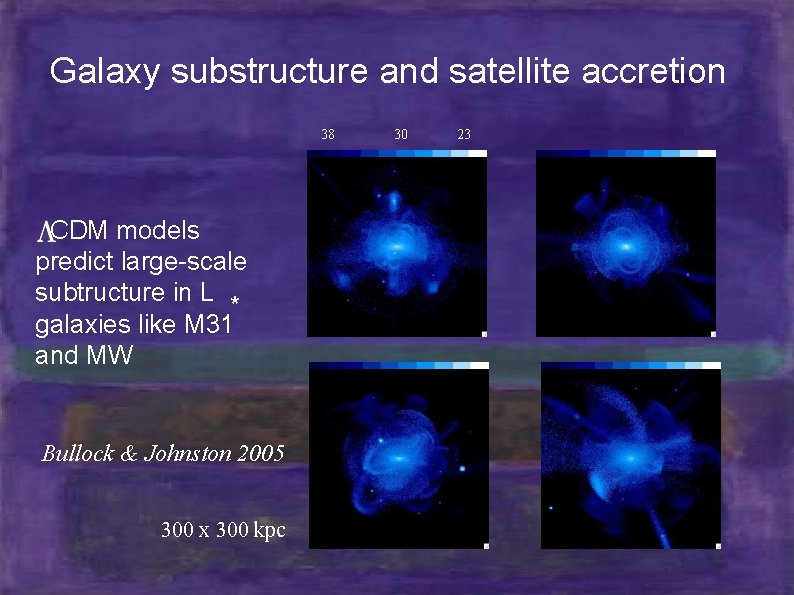
Galaxy substructure and satellite accretion 38 CDM models predict large-scale subtructure in L * galaxies like M 31 and MW Bullock & Johnston 2005 300 x 300 kpc 30 23
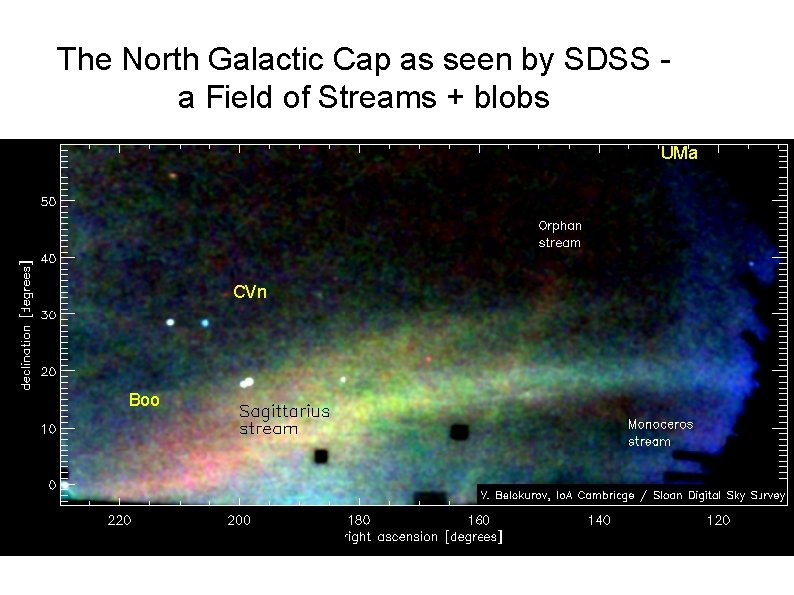
The North Galactic Cap as seen by SDSS a Field of Streams + blobs UMa CVn Boo
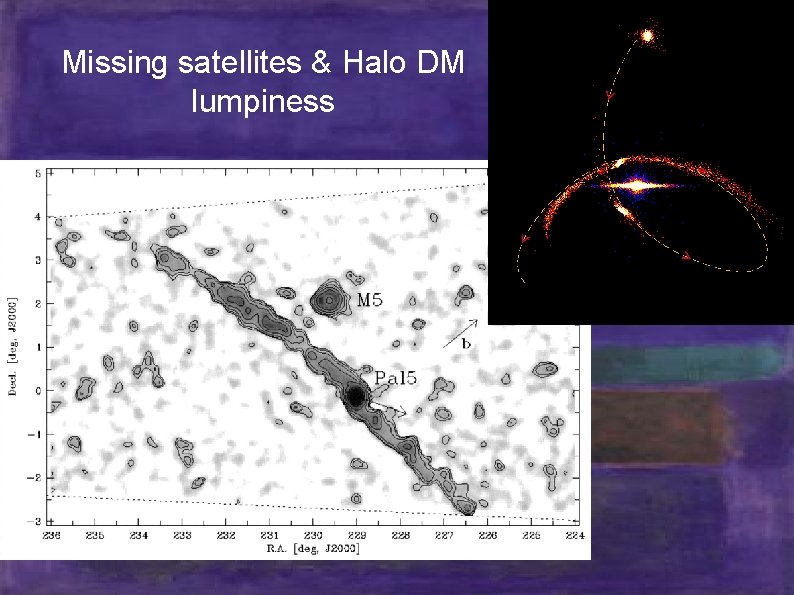
Missing satellites & Halo DM lumpiness Pal 5 : Odenkirchen et al (2003)
Galactic Science ● ● ● chemo-dynamic structure of Galactic components interface between disk, bulge/bar, halo ancient dissolved and surviving substructures fossil record of chemical evolution of stellar pops chemical signature of ancient accretions properties of metal-poor pop. III stars evolutionary history of stellar components IMF, SFH, tagging the chemical development the role of star clusters ● linking the Bulge to the high Z universe ● detailed chemo-dynamics of surviving satellites -
What do you need - I ? ● wide field well calibrated imaging optical -> NIR ● north: SDSS ugriz, WFCAM UKIDSS zy. JHK ● south: Skymapper, VST, CTIO 4 m DE, VISTA ● all-sky: 2 MASS calibration and pathfinder ● GAIA: proper motions and parallaxes ● large area stellar spectroscopy (million stars) ● automate majority of processing and analysis
What do you need - II ? ● 8 m-class telescope with wide fov eg. 1. 5 deg diam ● 1000 -3000 fibres to exploit target surface density ● survey selected regions totalling 1000 -2000 sq deg ● LR vels to 2 -3 km/s; [Fe/H] to 0. 1 -0. 2 dex ● ● HR vels to 0. 5 km/s; EWs to 5 m. A; good wavelength coverage eg. 4800 -6800 A; abundances: light elements, alpha-elements, r- sprocess and heavy elements => chemical tagging synergy with GAIA => LR to V~20 HR to V~17
Summary ● ● large area spectroscopic studies of nearby galaxies are needed to test cosmological predictions on low-mass scales – nature and distribution of dark matter – detailed formation history of galaxies GAIA will revolutionise this field, but will lack detailed chemical information, as well as accurate radial velocities
fin DART
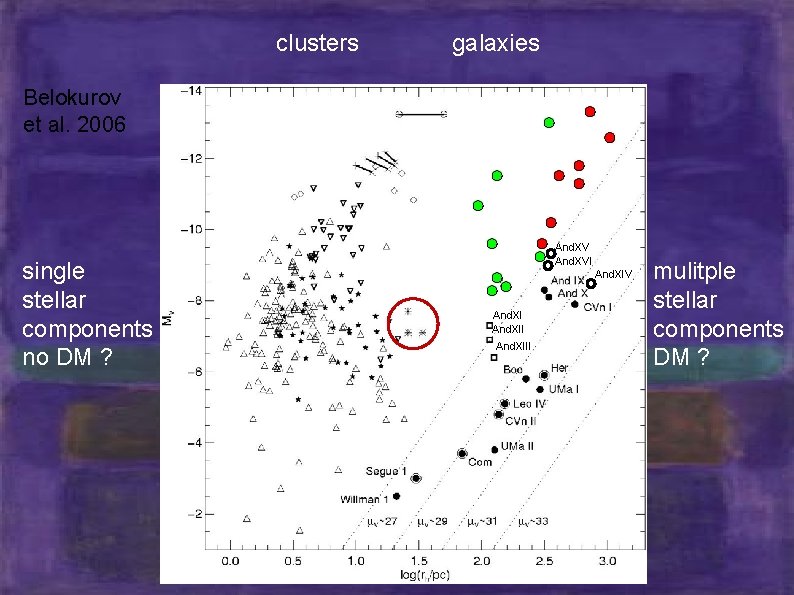
clusters galaxies Belokurov et al. 2006 single stellar components no DM ? And. XVI And. XIV And. XIII mulitple stellar components DM ?
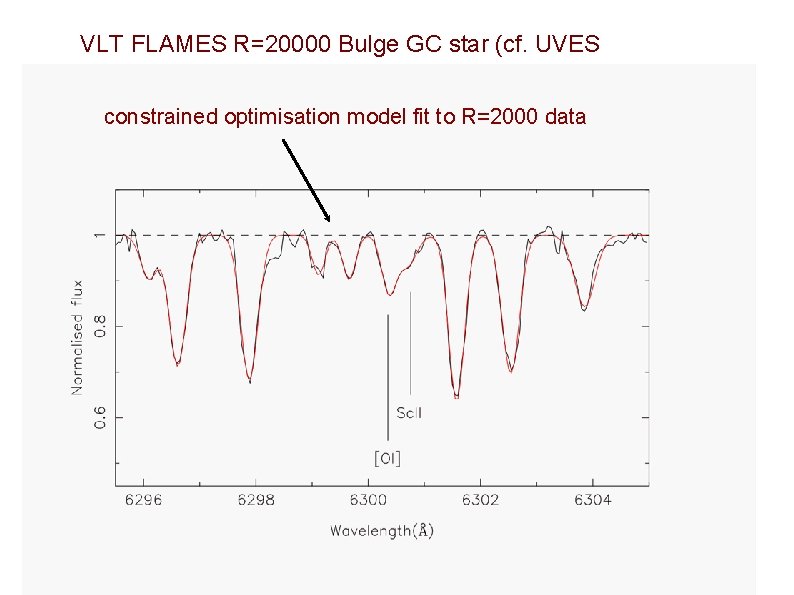
VLT FLAMES R=20000 Bulge GC star (cf. UVES R=47000) constrained optimisation model fit to R=2000 data
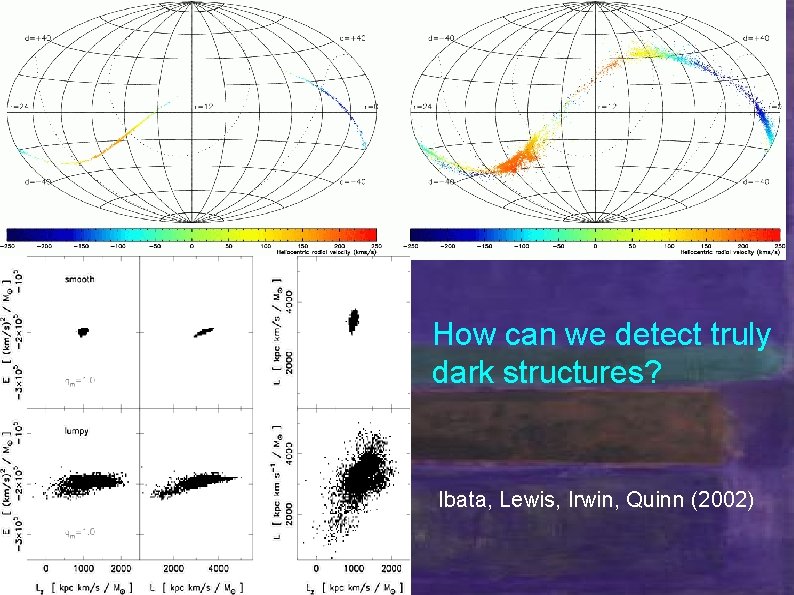
How can we detect truly dark structures? Ibata, Lewis, Irwin, Quinn (2002)
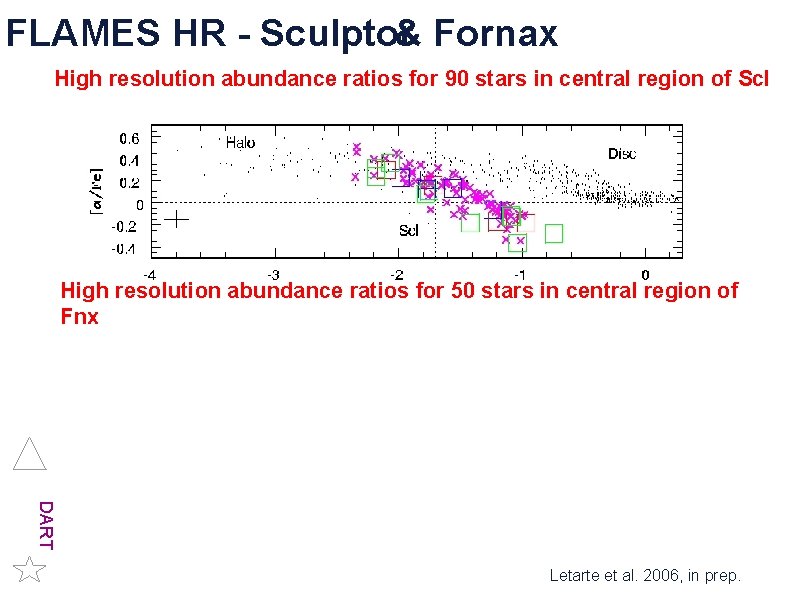
& Fornax FLAMES HR - Sculptor High resolution abundance ratios for 90 stars in central region of Scl High resolution abundance ratios for 50 stars in central region of Fnx DART Hill et al. 2006, in prep. Venn et al. 2006, in prep. Letarte et al. 2006, in prep.
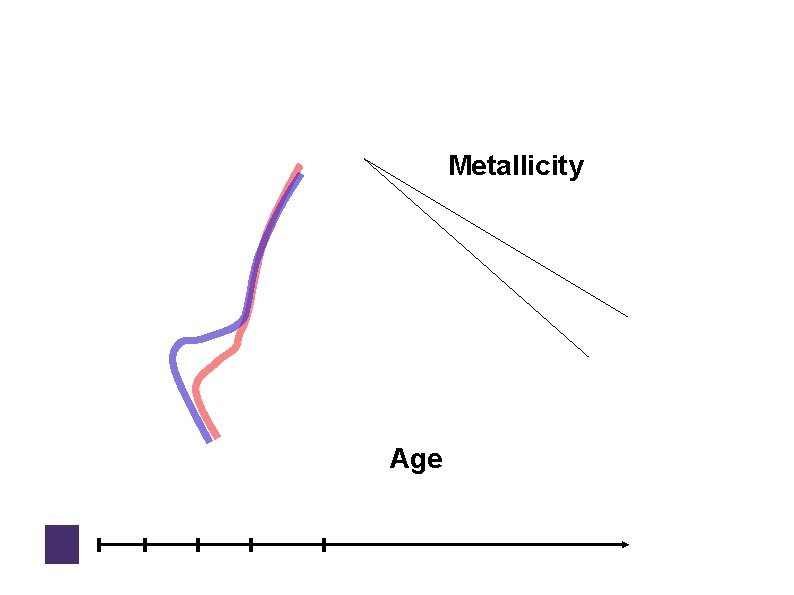
Chemical tagging & Galactic archaeology Metallicity “pristine” atmosphere Age 13. 5 12. 7 11. 5 10. 3 Z= k 20 6 3 2 1 7. 7 Gyr present 0 nuclear burning
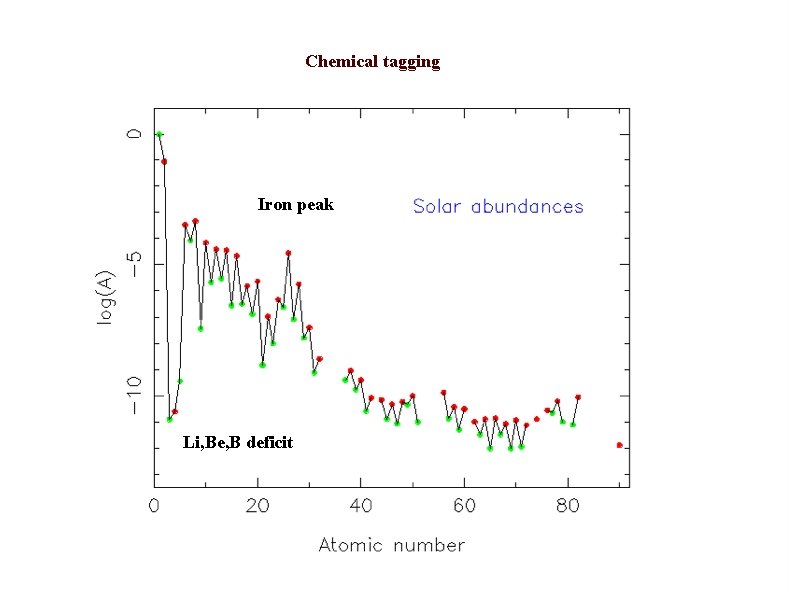
Chemical tagging Iron peak Li, Be, B deficit
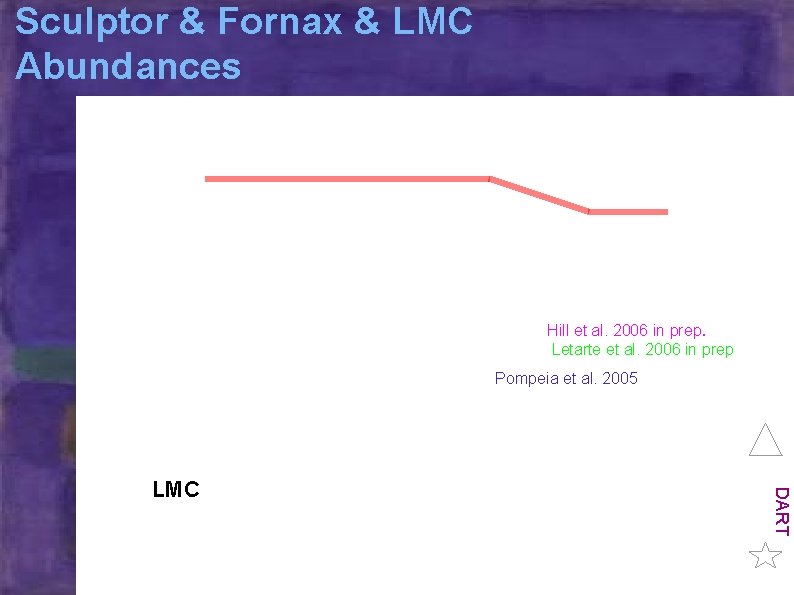
Sculptor & Fornax & LMC Abundances Hill et al. 2006 in prep. Letarte et al. 2006 in prep Pompeia et al. 2005 DART LMC
Near-field cosmology - some key questions ● where are the missing satellites? ● are dark matter profiles universal? ● ● what is the extent nature and spatial distribution of dark matter? how were the Galaxy and M 31 constructed? they typical disk galaxies? are what was the role of accretion in the formation of the halo, disk, bulge? what was the detailed chemical enrichment history of the stellar components?
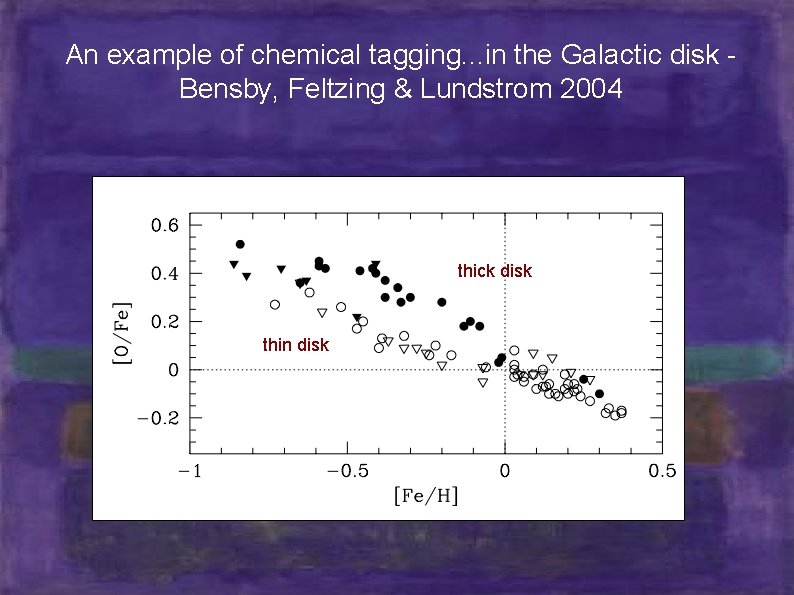
An example of chemical tagging. . . in the Galactic disk Bensby, Feltzing & Lundstrom 2004 thick disk thin disk
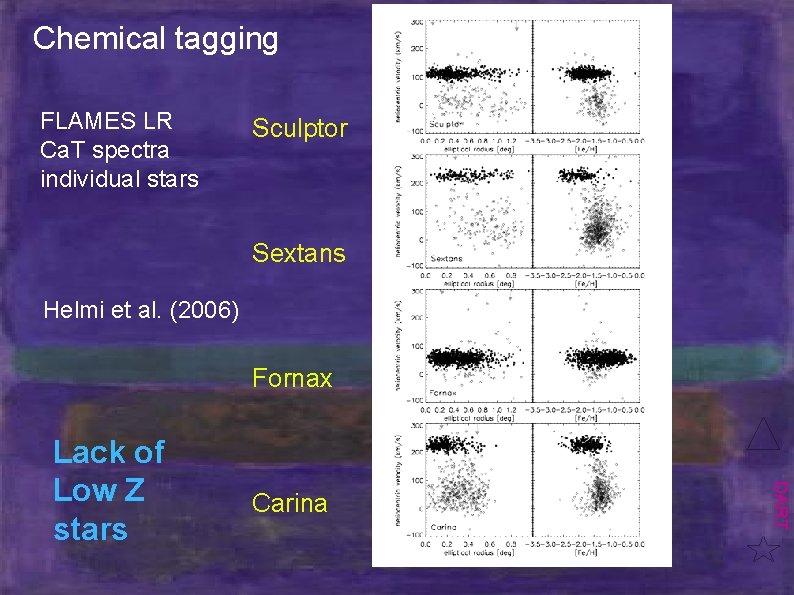
Chemical tagging FLAMES LR Ca. T spectra individual stars Sculptor Sextans Helmi et al. (2006) Fornax Carina DART Lack of Low Z stars
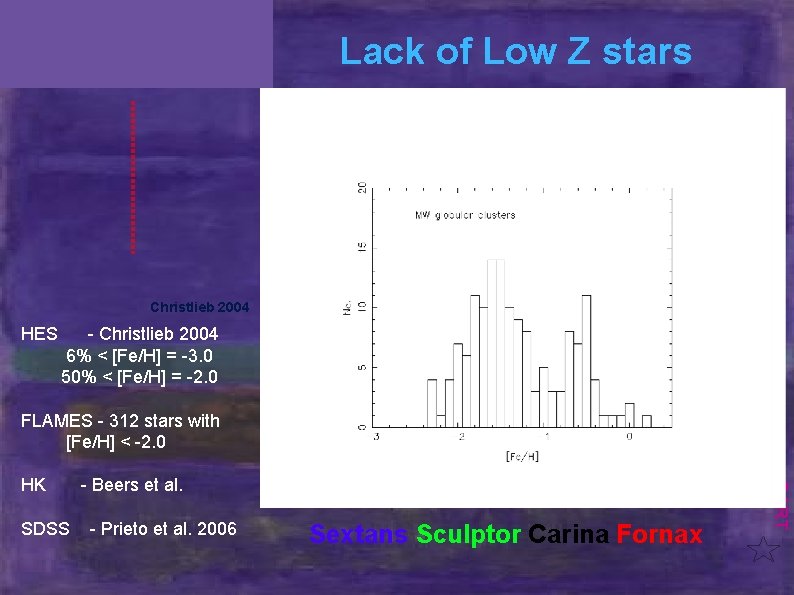
Lack of Low Z stars Christlieb 2004 HES - Christlieb 2004 6% < [Fe/H] = -3. 0 50% < [Fe/H] = -2. 0 FLAMES - 312 stars with [Fe/H] < -2. 0 SDSS - Beers et al. - Prieto et al. 2006 Sextans Sculptor Carina Fornax DART HK
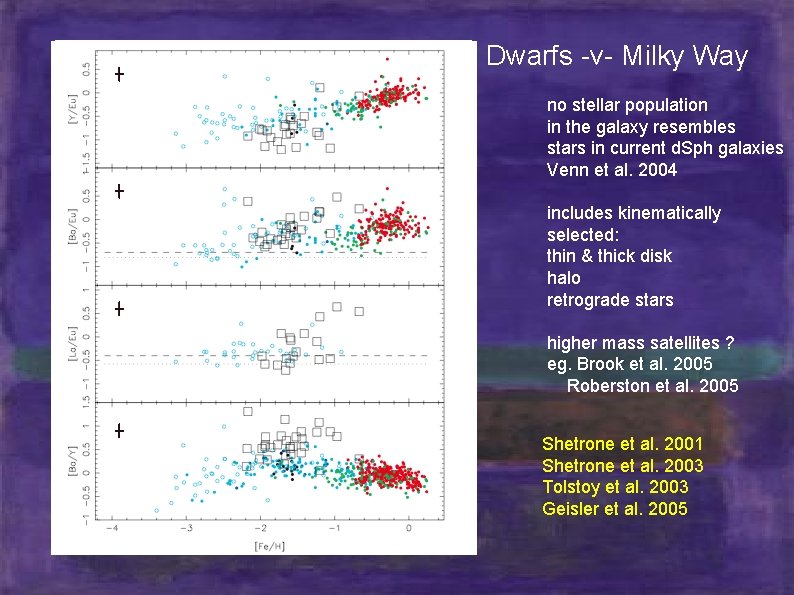
Dwarfs -v- Milky Way no stellar population in the galaxy resembles stars in current d. Sph galaxies Venn et al. 2004 includes kinematically selected: thin & thick disk halo retrograde stars higher mass satellites ? eg. Brook et al. 2005 Roberston et al. 2005 Shetrone et al. 2001 Shetrone et al. 2003 Tolstoy et al. 2003 Geisler et al. 2005
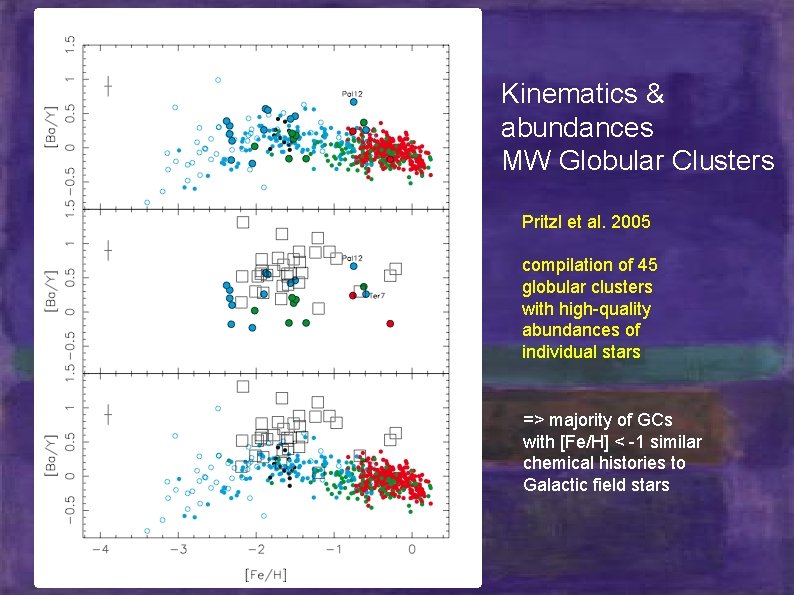
Kinematics & abundances MW Globular Clusters Pritzl et al. 2005 compilation of 45 globular clusters with high-quality abundances of individual stars => majority of GCs with [Fe/H] < -1 similar chemical histories to Galactic field stars
Sculptor & Fornax & LMC Abundances Hill et al. 2006 in prep. Letarte et al. 2006 in prep Pompeia et al. 2005 DART LMC
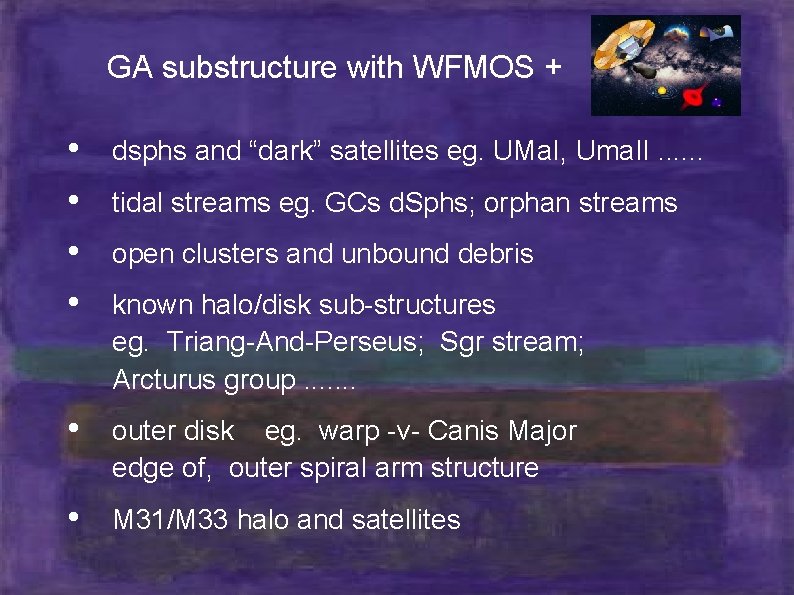
GA substructure with WFMOS + • • dsphs and “dark” satellites eg. UMa. I, Uma. II. . . • outer disk eg. warp -v- Canis Major edge of, outer spiral arm structure • M 31/M 33 halo and satellites tidal streams eg. GCs d. Sphs; orphan streams open clusters and unbound debris known halo/disk sub-structures eg. Triang-And-Perseus; Sgr stream; Arcturus group. . . .